Although the Craftsman movement of the 1890's and the first two decades of the 20th Century was in part an attempt to return to the simpler but more carefully executed workmanship of the era before the dawn of machines. This did not necessarily mean that the products of this era would be devoid of all ornamentation. But the products of the scroll-cutter's saw could not be allowed to overpower the massing of the structure, and extraneous features such as towers with onion domes would not be substituted for the strength that arises from the structural expression of an underlying function. Nevertheless, one would be hard-put to find a dwelling as uncompromisingly reduced to basic elements as the house at 9344 S. Vanderpoel Ave.
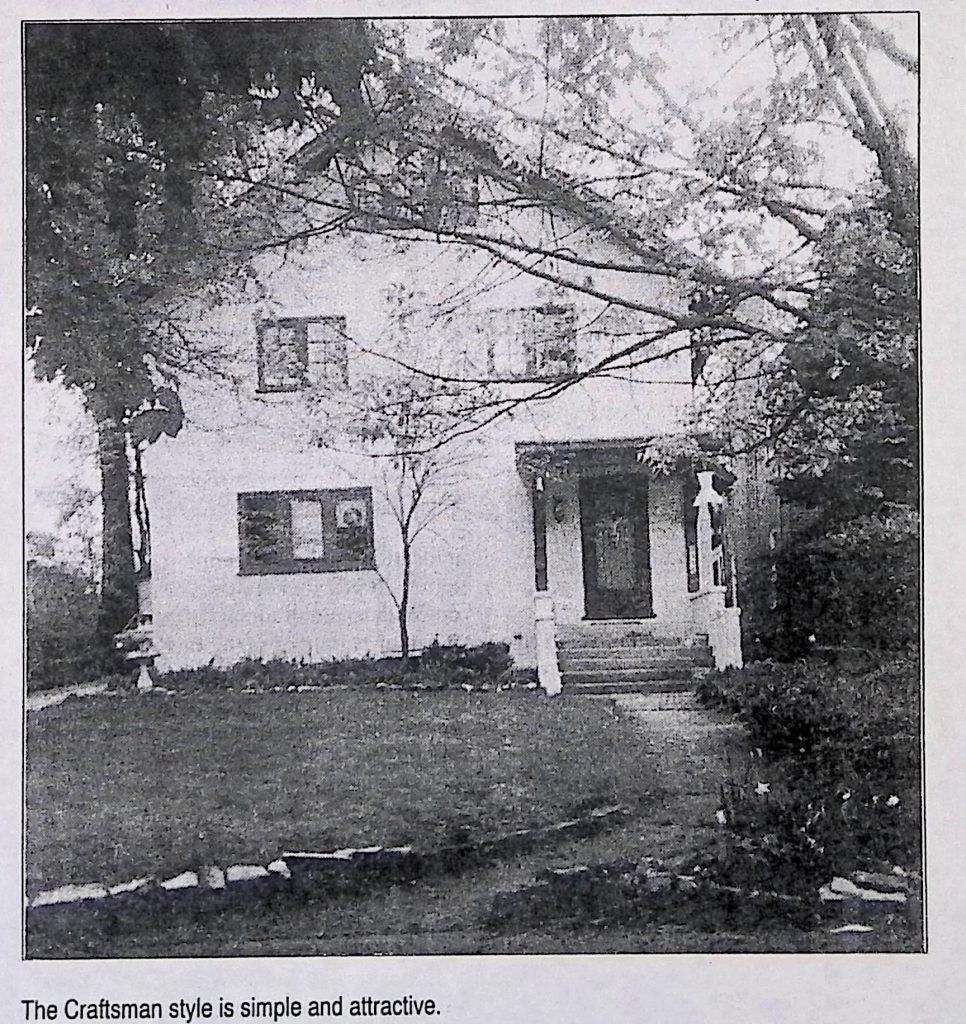
The form of this house is quickly defined. It has two stories with a simple gabled front—basically a box with a pointed roof. In terms of mass, the only variation on this form is a simple boxy bay on the north side of the house around the corner from the front entrance. The walls are relieved on the sides and on the upper floors of the front by simple paned windows with no touch of ornamentation other than the blue paint that sets them off from the cream stucco of the exterior walls.
At the first floor front casement windows consisting of a single sheet of glass are employed instead of panes, but they may be a recent improvement. The porch is covered by a square flat roof supported by diagonal beam braces rising from uprights that flank the main door, surely the most persistent decorative feature in the Craftsman repertory.
Otherwise, nothing is allowed to intrude on the simple box-like quality of the building.
The Craftsman style is simple and attractive.
The ends of the roof rafters are exposed, as is common in Craftsman construction, but no particular elaboration is made of them, particularly since they show along the sides of the house rather than at the front. The house rather derives its solid appearance from the texture of the stucco and from the minimal interruption provided by the no-nonsense windows and porch.
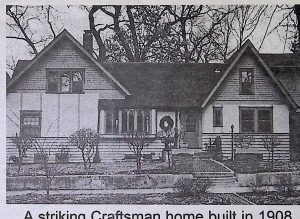
This house was built in 1910 for Ella M. Stewart, a teacher at Barnard School who had previously roomed in the Queen Anne house next door to the south. The architect was Maud M. Kirk, a fellow teacher. Kirk had a house built for herself at 9544 S. Longwood Dr. in 1908 which may have designed.
Maud Kirk was born in 1875 to John Kirk, an Irish immigrant, and to his wife Eliza Christie Kirk, who came to this country from Norway. Her father was employed in a sash and blind factory while her mother kept house.
Maud's parents saw to it that her daughter was educated beyond the minimum required levels, and she graduated from the Chicago Normal School (now Chicago State University) in the class of January 1895. She then became a Chicago public school teacher, working at the Alice L. Barnard School until 1920, after which she taught at Lucy Flower High School for another 18 years.
She was the oldest member of St. Paul's Union Church (now St. Paul's Bible Church) when it celebrated its 50th anniversary in 1943. She retired in the late 1930's and died on June 16, 1950.
It is not quite clear whether Maud Kirk was the only early woman architect on the Ridge. For one thing, Walter Burley Griffin was married to Marion Mahoney, one of the most talented designers and drafters of the day, and her role in his numerous Beverly/Morgan Park houses is unknown.
On the basis of what little information we have, Maud Kirk's architectural career was fairly short, beginning in 1908 and ending in 1912 at about the time when the City of Chicago began requiring a licensed architect's name to appear on building permits.
There are four houses which she is known to have designed, not including her own. The others are fairly elaborate foursquares, displaying an emphasis of their horizontal lines rather than the vertical. Nevertheless, I find that I am most fond of the Stewart house, because it shows the architect as willing to experiment beyond the conventional styles of her day and as having a keen sense of the effects that could be achieved with building materials.