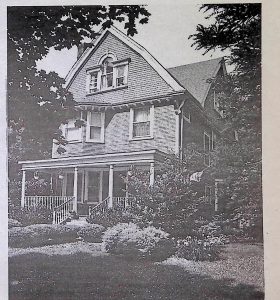
American designers of Queen Anne ar-chitecture experiment extensively with shingles, spindlework, turrets, domed tow-ers and patterned blocks. When today's proud owners display a Queen Anne house for our inspection, we tend to size it up by comparing it to a mental catalogue: Has it got an onion dome or a tower? A patch of shingling? Are there Greek columns or a lot of spindlework? In short, can we compli-ment the owners on how busy the original client kept the carpenters at their jigsaws? It is therefore refreshing to find a Queen Anne house whose allure is something else, such as the Waid-Coleman House, 9332 S. Damen Ave.
The Waid-Coleman House, built in 1894-95 and extensively enlarged in 1906, is the product of two architects. It was built for Daniel Everett Waid (1864-1939), a prominent designer who was born in Gouverneur, New York and educated at Monmouth [Illinois] College, the Art Insti-tute of Chicago, and the School of Archi-tecture at Columbia University in New York City. Waid became a draftsman for the Chi-cago firm of Jenney & Mundie in 1888, and started his own firm in 1894. He built his house in North Beverly, and, although no surviving document says so, it is presumed he was the architect. Waid also designed several houses for members of the Campbell family on Damen Avenue. In 1898 he moved to New York, where he ultimately had a distinguished career designing apart-ment complexes for the Metropolitan Life Insurance Company as well as many hos-pitals and institutional buildings.
Charles Coleman later bought the house and in 1906, he selected Henry Kerchner Holsman (1866-1961) to design the expansion. Holsman interested himself in a wide range of commercial and professional ac-tivities. Besides a long and distinguished architectural career, Holsman was an early designer and manufacturer of automobiles, a town planner and a successful realtor. He was the architect of churches and resi-dences on the Ridge, where he briefly lived, as well as elsewhere in Chicago and in Iowa.
Holsman was born on July 3, 1866, in Dale, Iowa. Orphaned by the age of 11, he took on jobs as a ranch hand and school janitor to help support his siblings and put himself through school. After graduating high school, Holsman taught the 8th grade for three years before entering college in 1887 and stumbling on his future career as an architect. While living with a doctor's family, he came across the plans for the physician's home, which he studied care-fully. When a friend of the doctor was look-ing for an architect to design a house, Holsman volunteered based on this inde-pendent study. The house was enough of a success that he was asked to draw up plans to remodel a four-room house to hold the growing family of a college professor. Instead of adding rooms horizontally, he had the house jacked up and added a new first floor underneath. This novel solution earned him a local reputation as a bright young architect, and he decided to leave Iowa and come to Chicago.
In Chicago he worked as a building su-perintendent for two firms of contractors. In 1896, he married Elizabeth Tuttle, a painter and sculptor, and in 1897, he built himself a Dutch Colonial house at 9026 S. Hoyne Ave. That same year, Holsman had become interested in automobiles and for the next ten years pursued the car busi-ness, building cars and founding the Holsman Automobile Company. The Holsman was a popular high-wheeled car, and highly adaptable to the muddy and snowy country roads of the day, and sev-eral thousand were produced by 1910 when Holsman sold the company.
Throughout his involvement in the au-tomobile industry, Holsman continued his architectural career. In 1902 he received the commission to build the second church of the Longwood (later St. Paul's) Evangeli-cal Congregation in North Beverly. In 1903 he designed the second complex of build-ings for Bethany Union Church in East Beverly, which stood until replaced in 1925 and 1954. In 1908 he designed the Edwin Mack House in North Beverly, surely the most striking Craftsman-style dwelling on the Ridge.
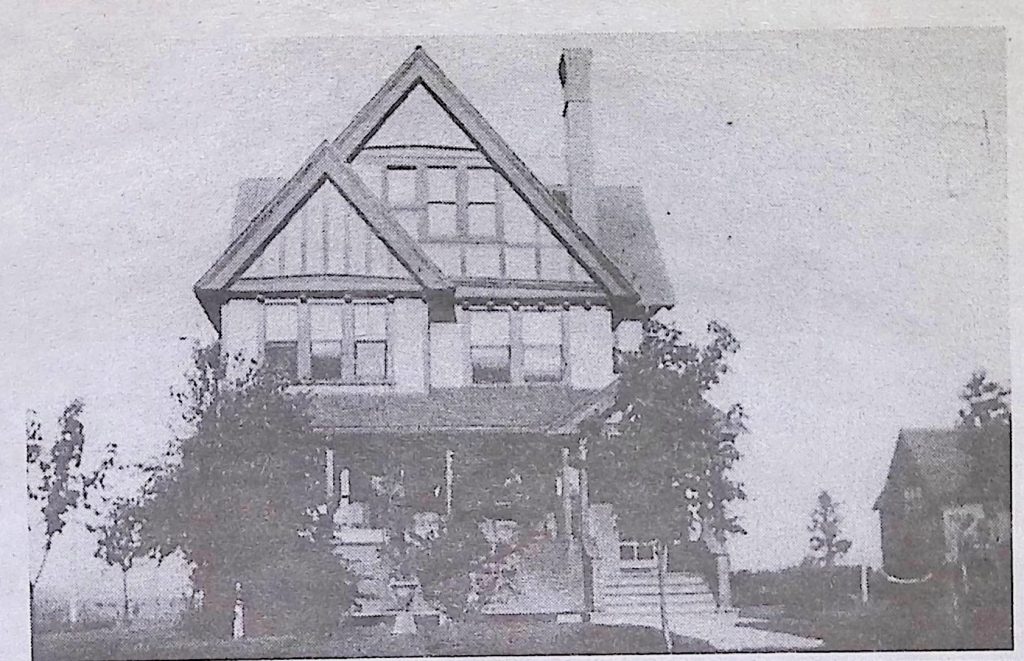
In 1906, Holsman did the major alter-ations to the Waid House for Charles Coleman, and is largely responsible for its present magnificent appearance. He added the south gable and everything under it, including the porte-cochere, and thus in-troduced the balance that dominates the overall composition.
As it stands now, the house is domi-nated by its gables, whose prominence is especially emphasized by the current paint scheme. Each of the gables consists of a heavily-framed triangle, and each rests upon a low triangle formed by denticulated boards. The roof gables and the matching gable over the main entrance all contain half-timbering, consisting of a crosswork of timbers with spaces filled either with plaster or windows. The roof gables rest on large brackets, below which the walls of horizontal boards are interrupted only by windows. The long porch extends across the entire front of the house, its roof resting on brackets that sit on col-umns. The massive front door is on the north end of the porch, and is adjoined by a small high bay of windows. At the south end of the house is the porte-cochere, sup-ported on stone columns with exposed rafters carrying its roof. The new matching garage was completed in 2003.
Unlike the majority of Queen Anne houses, the composition of the Waid-Coleman House is dominated by functional elements rather than by decoration. The gables clearly signal a roof wherever they appear, the middle level of the house is denoted by horizontal clapboards, and the columned porch covers the main story. Though variety of wall surface is surely present, it is subordinated to the functional elements. The house is balanced rather than absolutely symmetrical, though the pair of chimneys is a nice touch. This house emphasizes its honesty by using decora-tion to underline function rather than to distract from it.