Because it coincided with the great Depression, the architecture of American houses of the years between 1930 and 1939 can be misunderstood as a simplification of style necessitated by economic belt-tightening.
In fact, a convergence of trends, including streamlining of decoration on the one hand, and the use of simple geometric solids rather than elaborate surface treatments on the other, combined to produce the styles we have come to associate with that era. Indeed, it is in neighborhoods such as Beverly/Morgan Park, where construction continued through the decade, that we are able to document the development of these architectural trends.
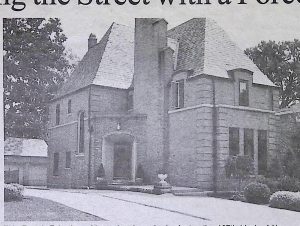
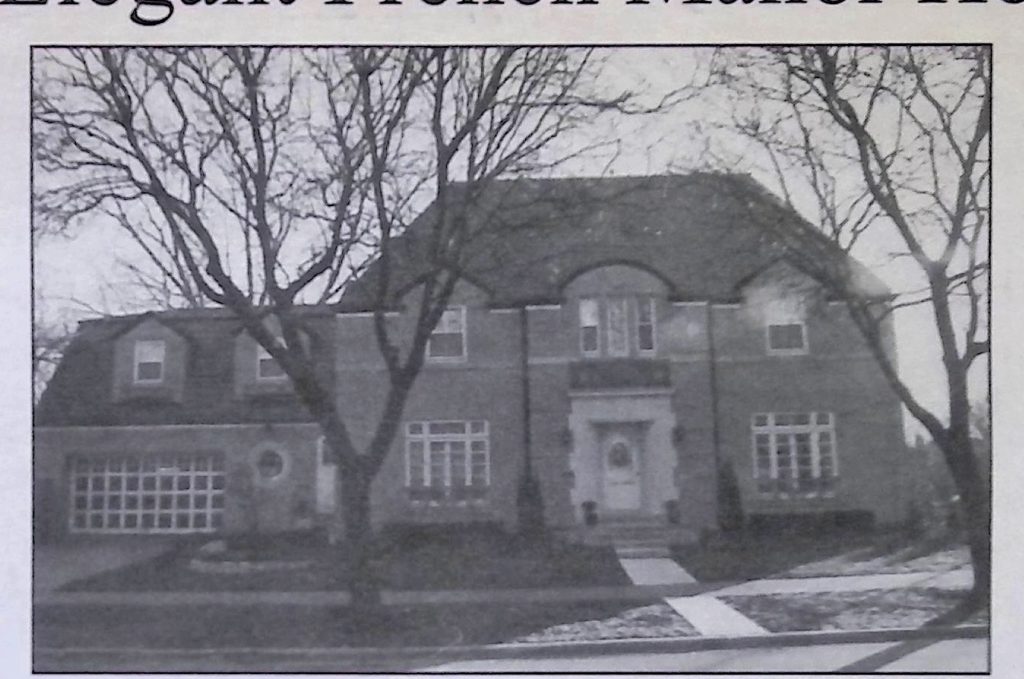
A case in point is the elegant French manor house at 9401 S. Hoyne, built in 1939. This is a house in what the home style guidebooks call French Provincial, a catch-all term for everything from Norman cottages to great manor houses and transplanted chateaux. Americans presumably became more conscious of the French originals upon which these houses were based thanks to doughboys serving in northwestern France during World War. I.
The architect of this house was Jacques J. Kocher (1887-1970), who designed many houses in Beverly/Morgan Park.
Little is known about his early life, but he began his architectural career as a draftsman under the southside architects Edward A. Blondin and Alexander Levy. He began his own practice in 1911, tended to prefer working partners, and spent many years in association with Edward G. McClellan and Ben Larson.
During the 1930s, Kocher joined the architectural staff of the Chicago Board of Education. Eventually he moved to Flossmoor and began to specialize in apartment buildings. After 1955 he was semi-retired.
The house at 9401 S. Hoyne, which faces on 94th St., is set so far from the street that it has virtually no back yard, though there is a considerable side yard to the east. The house succeeds in commanding attention at its corner through a combination of simple massing of the building and a very steep roof of green tile. The impact of the roof is accentuated by replacing the gable which might otherwise cap the projecting central entrance bay of the house with an inclined roof which leans back behind the crescent dormer over the windows above the front door.
The roof is often interrupted at its edges by gabled dormers which rise from the second story through the eaves, but the only features which occupy a place on its steep higher slopes are two dark ventilators with rounded hoods, one on the roof which faces the garage and the other on the back.
The house itself is of brick, with a concrete course at the foundation and a concrete belt course beneath the second-story windows. The windows of both stories have stylized iron balcony rails with a central panel of swags flanked by geometric shapes. All of the corners, including those of the projecting bay which holds the main entrance, have brick quoins.
The entrance itself is a triumph of stylistic convergence, for while it is framed by a squared archway with keystone, constructed of concrete, the portal is transformed into an Art Moderne centerpiece by fluting of the curved sides which reach back to the door, and by the circular platform and steps on which the entrance rests.
On the back of the house, opposite to the main entrance, can be seen a stepped three-tiered window, which climbs nearly to the top of the second story and which illuminates the master staircase.
The treatment of the attached garage is especially interesting. The roof of the house itself is characterized by an almost uninterrupted steep slope, but the garage has a mansard roof pierced by round-topped or gabled dormers. Moreover, all of its ground-floor windows visible from the street are circular portholes framed with concrete. Its door also has a curved top. Thus the architect has deliberately subordinated this part of the house, to emphasize its ancillary role.
The special delight of viewing this house is in appreciating how the architect has drawn attention to it not with elaborate embellishments but by employing simple forms highlighted by occasional decorative touches. It calls to mind those few examples of elaborate country houses that were erected in the 1930s, when the construction of big houses had mostly ceased.