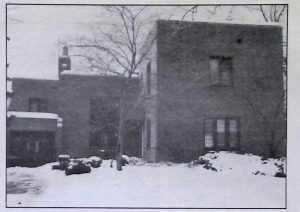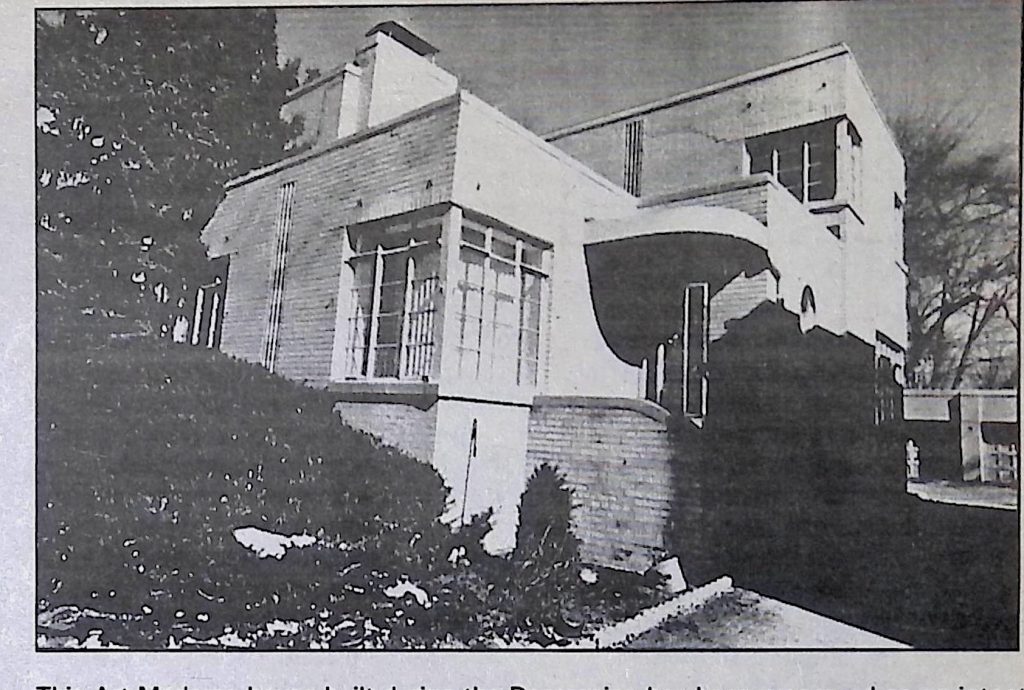
Perhaps the best evidence that Beverly/Morgan Park's prosperity continued (with some hesitancy) through the Depression is the wide sprinkling of Art Moderne houses throughout the neighborhood. Despite their relative simplicity they are both fragile and misunderstood, and it is hard to find intact examples. Their owners are prone to build huts with mansard roofs on their second-floor roof decks, replace the simple rounded canopies over their entrances with Georgian vestibules, and to make other incongruous additions which negate the essential streamlined design. Happily, there are survivors in the original state, among them the house at 10455 S. Bell Ave.
This house was built in 1937 for William J. Mathis. The architect was Albert F. Heino (1905-1955), whose offices were at 10041 S. Western Ave. With an architectural practice half devoted to the design of churches and the other half to airport buildings, Heino was probably the most ethereal architect on the Ridge. Born in Chicago, he attended Morgan Park High School and then took his degree in architecture from Armour Institute of Technology, now the Illinois Institute of Technology. He also earned a masters degree from the University of Illinois. He received his professional training as a draftsman for Schmidt, Garden and Erickson and then with a firm in Rockford. From 1932 to 1942 he had his own practice. From 1942 to 1948 he was the company architect of United Air Lines. He then returned to independent practice until his death. Among his local designs are the Morgan Park Presbyterian Church and the educational building addition to Bethany Union Church.
The massing of the Mathis House, although built up of cubic volumes, is rather complex, because there is a two-story room-size projection from the north front of the house, with a one-story front room in front of that. This makes room for a considerable roof deck on the front of the house at the second floor level, probably large enough to entertain on. The sole chimney rises alongside the two-story projecting mass and alongside the deck, which probably allows for a fireplace near the back of the projecting front room.
The original steel casement windows of the house survive intact, and are placed on the corners, so that for most rooms the light source turns a corner. There is also a round window on the side of the entrance vestibule. This gives a nautical effect, which has been somewhat enhanced by painting some of the copings sea green. All of the balcony walls have an inward-sloping coping that is also seen at the roofline. The doorways to the outside, including the second-floor doorway to the roof deck, are of stainless steel with lots of glass.
There are interesting vertical decorations on the first floor and on the wall behind the roof deck on the second floor. Although they appear to be composed of textured terracotta, they actually employ an idiosyncrasy of the yellow brick from which the house is built. These bricks normally have smooth sides and a rougher-textured bottom. By standing these bricks on end and turning them diagonally with the edge between side and bottom facing out, and then facing the grainy bottom sides all to the left in one row and all to the right in the next, the appearance of a sculptured terracotta moulding is achieved.
The Mathis House is a striking survivor of the early modernist age, owing nothing to preceding historical styles and asserting itself through its simplicity rather than through ostentatious ornamentation. It speaks of a time of shedding old conventions in favor of gracious uncluttered living. It is a landmark of American living.