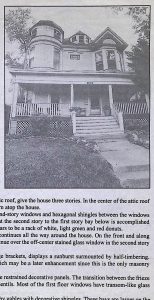
It is fashionable to dismiss Queen Anne architecture as both the product of an expression of the explosive growth of the American economy in the decades after the Civil War, particularly the 1880s and 1890s. These vast houses, characterized by towers, turrets, a variety of exterior wall treatments and a complete lack of restraint in
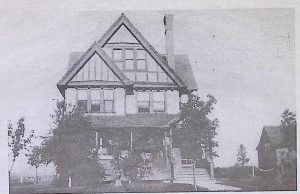
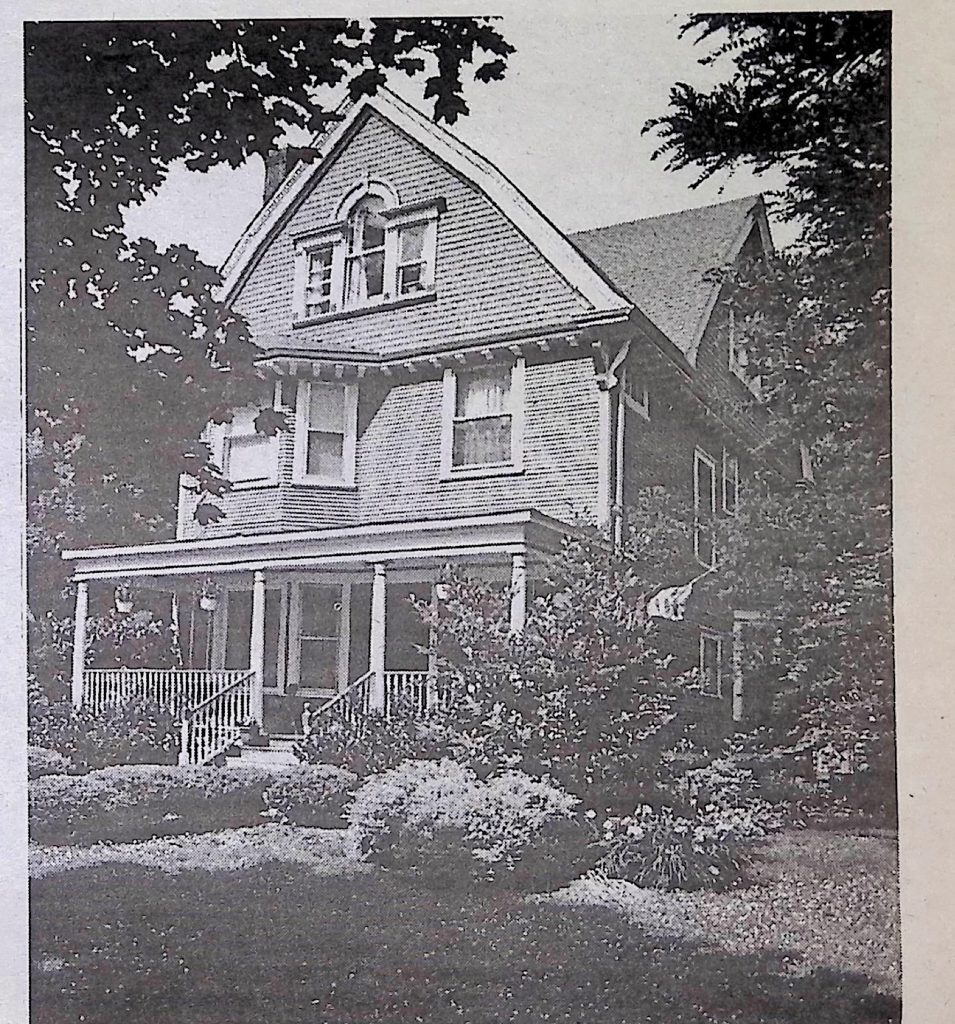
decoration came to be seen both by the leaders of the Prairie School — Wright, Griffin, Maher — and by the revivalists of the historical styles — Colonial, Gothic, Renaissance — as the skeleton in the American architectural closet. And yet, despite its name, this was a style that was certainly an expression of an American yearning to say something about residential architecture and about domestic life in America. A study of the house at 9200 S. Damen Ave. illustrates the architectural passions involved.
This house, now resplendent in balanced shades of red, white and blue, and often flying an American flag, was originally built for David C. Campbell (1834-1919), who was born and raised in Wheeling, Va. (later West Virginia), but who made his fortune in banking and raised his family in Centerville, Iowa. David C. Campbell came to Chicago with his three sons, John, Charles and David, at the time of the World's Columbian Exposition. In Chicago the family business, Campbell Investment Company, invested in real estate. Locally, David Campbell's son, John Campbell, was the organizer behind the Vanderpoel Art Gallery.
The architect of David C. Campbell's house was Daniel Everett Waid (1864 – 1939), a prominent designer who was born in Gouverneur, New York and educated at Monmouth [Illinois] College, the Art Institute of Chicago, and the School of Architecture at Columbia University in New York City.
Waid began his career as a draftsman for the Chicago firm of Jenney & Mundie in 1888. After the onset of the depression of 1894, Waid, who was by then head draftsman, was encouraged to start his own firm. He built his own house at 9332 S. Damen Ave. as well as houses for all of the Campbells on Damen Avenue, the house for John Campbell apparently done jointly with Howard Van Doren Shaw.
In 1898 Waid moved to New York where he had a distinguished career designing apartment complexes for the Metropolitan Life Insurance Company as well as many hospitals and institutional buildings.
In order to understand the architect's intent in the design for the Daniel C. Campbell House, it is important to compare this residence to the temple-house concept discussed by Alan Gowans in his book, The Comfortable House. Gowans argues that, in the late Victorian and post-Victorian era, the cure for all problems was thought to be the home, where children would learn morality, sound social values and respect for tradition. To symbolize this role, the temple-house emerged, so named because it was entered by a front porch carried on Greek or Roman columns and capped by a front gable, like the pediment of the Parthenon.
The front gable — and all of the gables of the Campbell House — are gambrels with two slopes on each side, rather than triangles, probably to lessen the impact of snow sliding from the roof. The gambrel provides a complementary frame for Palladian windows (which have a high rounded center flanked by lower flat-topped double-hung sections), and the front and side gambrels of the Campbell House all have them.
The separate windows in the Palladian groupings are framed by columns and capped by arches. Other features derived from the Italian Renaissance include the simple brackets upon which the roof appears to rest all the way around, and elaborately turned brackets at the corners.
It would seem that Waid was attempting to use the basic form of the temple-house to carry symbols of the Renaissance, in what is known as the free classical variant of Queen Anne. A house thus decorated was intended to convey the taste of selectivity rather than excess. Many Queen Anne embellishments, including shingles, bay windows and decorative railings (now gone from atop the porch and the south bay) can be found in the composition, but they participate in the overall design rather than dominate it. The statement that the house makes about the owners is one of refinement rather than assertiveness, and would have been understood as such by neighbors of the 1890s.