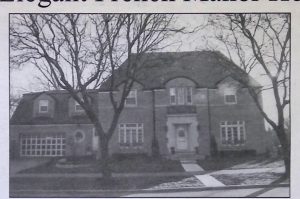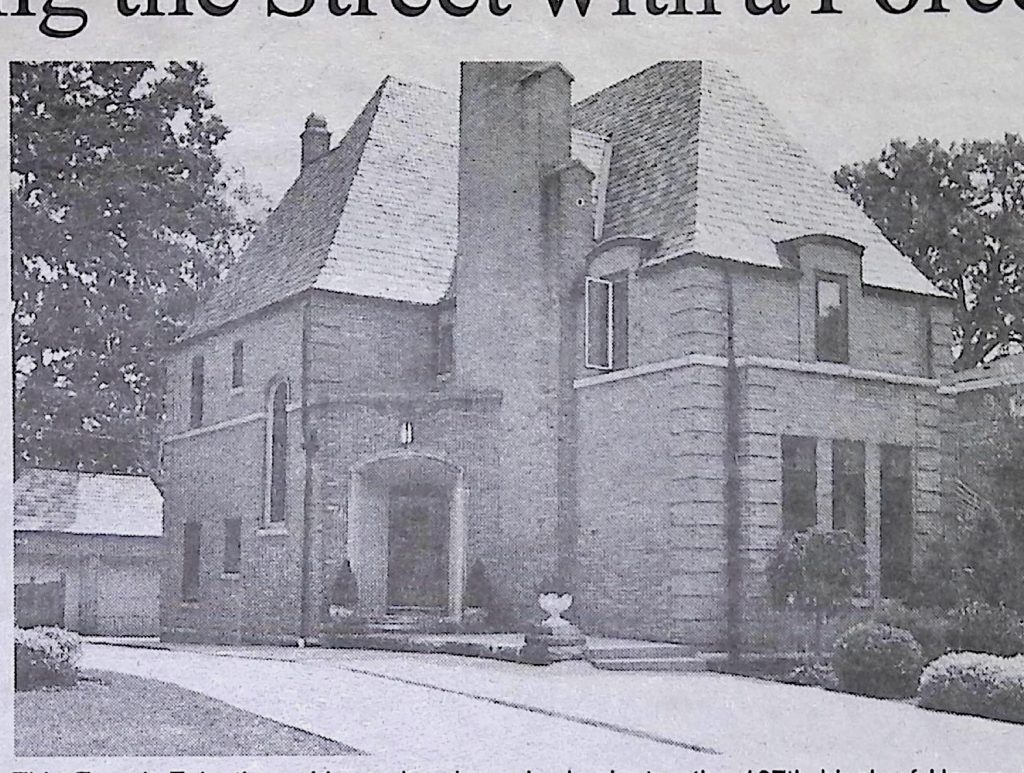
Many Americans first experienced French architecture while serving as doughboys in World War I and were impressed with what they saw. In the 1920s, French chateaus and country houses, suitably modified for 50- or 100-foot lots, began to put in an appearance all over the United States. While the most common French style represented in this country is Norman, characterized by round towers and stout walls, there are also many examples of elegant French-inspired residences that were based on country house originals. Such a house is the French Eclectic residence built in 1927 for Anthony A. Olis, a lawyer, at 10721 S. Hoyne Ave.
The architect of the Olis House was Charles Draper Faulkner (1890-1979), one of the very best Chicago-based architects working in the historical styles. A 1913 graduate of the Armour Institute of Technology (now the Illinois Institute of Technology), Faulkner joined the firm of Solon S. Beman, the architect of Pullman, just before Beman died in 1914, and became the firm’s chief designer. Faulkner inherited from Beman a substantial practice designing Christian Science churches and it may have been Beman who piqued Faulkner’s interest in French originals as well.
The Olis house is carefully organized for impact, which is achieved by massing and emphasis on the vertical. The house is of a uniform orange brick, with very thin mortar joints between courses and the wall surfaces left generally unadorned to emphasize the massing of the building. The sense of height is achieved not only by the use of steep slate roofs which slightly flare at their bases, but also by the tall chimney adjacent to the principal entrance on the north side of the front wing. This chimney, which steps back twice as it rises to its pinnacle above the highest roofline, is the only part of the house to which the limestone string course, which runs all around the house, defers. Otherwise, the string course underlies the principal second floor windows and serves as the coping for the front bay and for the main entrance vestibule, which is placed diagonally across a corner niche behind the chimney.
To relieve the starkness of the massing, most of the house’s corners are chased with quoining (the imitation of buttressing stonework at corners) carried out in the same orange brick as the rest of the house.
Other detailing is apparently intended to tie together the composition. Most windows have a sill of the same limestone as the string course. Occasionally, a round-topped dormer protrudes through the eaves line above the second floor, and the dormer above the front bay is delineated by carrying the lines of its corners down into the brickwork of the second floor.
The principal entrance, on the north side of the main wing, has a deeply recessed medieval doorway with ornamental hinges on the wooden door and a period lantern above for illumination. A patio on the south side of the main wing balances the main entrance on the north side.
A quick look at the garage will repay the effort. Built of brick matching the main house, it displays its own slate mansard flat-topped roof, which contrasts with the pointed roofs of the main house.
The Olis House stakes out a prominent position on its street. It is an excellent example of Faulkner’s ability to achieve a spectacular effect by carefully controlling all of the design details.