By Harold T. Wolff, Historian
Ridge Historical Society
Many people think that the special protections of the City of Chicago's landmark district on Walter Burley Griffin Place, 104th Place between Prospect Avenue and Wood Street, cover only the Griffin-designed Prairie School houses. In fact, the district enshrines every house from one end of the block to the other.
Primarily, of course, this was done to preserve the milieu in which Griffin was building and to give some idea of the contrast between his designs and the sort of houses that were being erected by other architects in the same period. Happily, the district also preserves one of the wonderful houses of one of Ridge's best architects, Harry Hale Waterman.
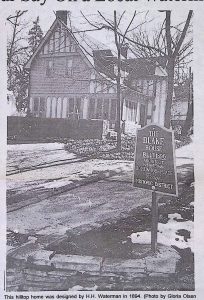
The Alfred H. Rush House, 1669 W. 104th Pl., was constructed in 1894. The original owner was a broker with his own firm, who lived there less than three years before moving to Detroit. Architect Waterman, whose residential work I have had frequent occasion to discuss, resided briefly in Morgan Park. Many examples of Waterman's excellent residential designs are spread across Beverly/Morgan Park, and he seems to have reserved his best designs for our communities.
Harry Hale Waterman was born at Oregon, Wisc. in 1869, but soon moved with his parents to Chicago. He was educated in the public schools, the preparatory department of the old Chicago University, and seems to have attended Northwestern University for a time, though he did not graduate from the last-named institution. He apparently determined upon a career in architecture at the age of 17, and became a draftsman in the office of Joseph Lyman Silsbee in 1886.
When Frank Lloyd Wright first came to Chicago in the following year, his uncle, the Rev. Jenkin Lloyd Jones, arranged for Wright to room with the Watermans for a time, and Wright tells in his autobiography that he and Harry would occasionally put on boxing gloves and do a little sparring. Since Waterman appears to have been stocky, and Wright was both slender and short, these contests must have had the appearance of a bout between a mustacheless Oliver Hardy and a diminutive Stan Laurel.
Wright also worked as a draftsman for Joseph Lyman Silsbee in 1887, and George Maher was employed there before and after Waterman's arrival, until Maher left in 1888. Waterman did not set up his own practice until June 1893, and despite working alongside the two founders of the Prairie School apparently had no desire to establish a style of his own, preferring instead to do excellent work in whatever style seemed appropriate to the particular project.
The Alfred H. Rush House is one of Waterman's earliest designs, and was done at the same time he was carrying out several more costly commissions on top of the Ridge. Nevertheless, Waterman's design contrives to add distinction to what is basically a standard two-story, basement, and attic house of the period by emphasizing its verticality. All the roofs are extremely steep, and have vergeboards which flare inwards for emphasis. The gables under the steep roofs have a triangular base, which in each gable is allowed to disturb the rows of shingles laid above the base, causing the rows themselves to peak at a point above the point of the triangle. There is a gable over the main entrance which echoes the roof gables.
The house is cruciform in plan, with the principal axis running from front to back. This is intersected at right angles by the secondary axis, formed by two bays on opposite sides of the house. But the dominance of the principal axis is reinforced by the continuation of the front-to-back roof behind each bay, by making the gables above the bays taller but narrower, and by cutting off the roof above the bays well above the roofs over the main axis. The east bay has angled sides and is trapezoidal when viewed from above; it is employed to admit light to rooms. The west bay is boxy because it contains a stairway, and it has few windows. Inside the house, much of the beautiful original woodwork is preserved.
Board siding covers most of the external surface of the house, but is occasionally relieved by shingles. All of the walls rest on stone foundations which rise two and a half feet above the ground.
When I first examined this house I was inclined to label it Tudor because of the steep roofs. I now think Waterman's real intent was to take one of the simplest house plans and to use detailing to give it an elegance all its own.