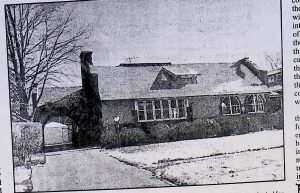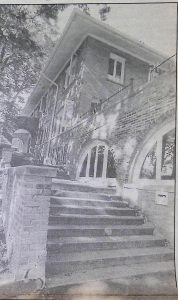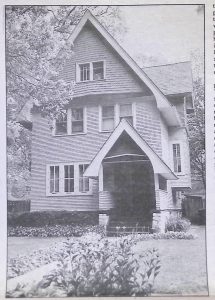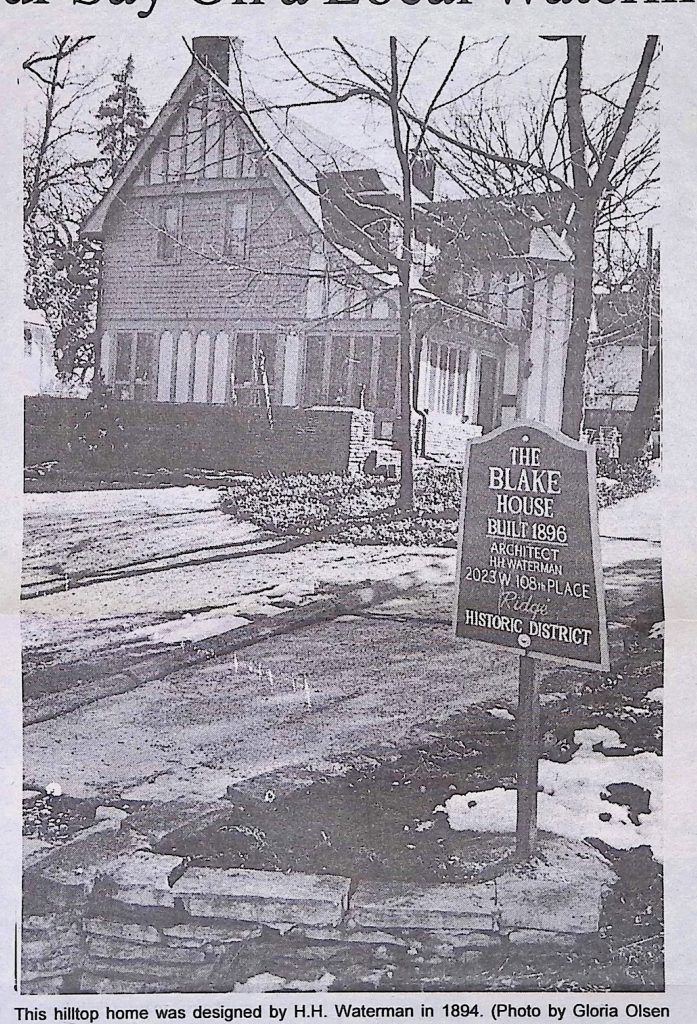
The owners of the Jesse T. Blake House, 2023 W. 108th Pl., have considerable pride in their residence. A small collection of published photographs of the house includes brochures from the Commission on Chicago Landmarks, a passage in the A I A Guide to Chicago, and a plate from a large picture book prepared in connection with a French exhibition on Chicago architecture. But apart from the brief discussion in the A I A Guide, there is little said about this house. This omission needs to be remedied.
The house was built for Blake, a bookkeeper, and the completion of the design was reported in business and real estate journals in April 1894. Blake’s wife was Mary Vierling Blake, the sister of the first wife of architect Harry Hale Waterman (1869-1948), who designed the Blake House, and whose own house was just below it on Longwood Drive in Waterman’s Subdivision.
Harry Hale Waterman was born at Oregon, Wisc., on July 10, 1869, the son of John Adams Waterman, a cattle broker, and his second wife, Emma Hale Waterman. Waterman soon moved to Chicago with his parents, and was educated in the public schools, the preparatory department of the old Chicago University, and at Northwestern University. He began his architectural career as a draftsman in the office of Joseph Lyman Silsbee from 1886 to 1893. This brought him into contact with the polestars of the Prairie School, Frank Lloyd Wright, who also began his architectural career with Silsbee, and George Washington Maher.
Curiously, when Wright first came to Chicago, his uncle, the Unitarian minister Jenkin Lloyd Jones, found him a boarding place with the Watermans. Outside of the office, Waterman and Wright shared an interest in pugilism, and would occasionally put on boxing gloves and do a little sparring.
Waterman went into independent practice in June 1893, and his first houses, especially the large ones, were most often in the provincial French style known as Norman. Among the most impressive of these residences are the Hiram H. Belding house at 9167 S. Pleasant Ave., the house at 9351 S. Pleasant Ave., the first section of Eugene S. Pike’s week-end retreat at 1826 W. 91st St., (now a Forest Preserve caretaker’s residence), and the Blake House. While Waterman’s other Norman houses have simple massing, with their facades parallel to the street, the Blake House has two strongly gabled axes that are joined perpendicularly, forming an L-shaped plan when seen from above. A tower extrudes from the main north-south wing above the veranda on the east side. Blueprints reveal that the main entrance of the house originally was from this veranda, and there is still a canopy there to cover visitors.
With the advent of the car, the only convenient approach to the property was a driveway on the gentler slope west of the house. But in the original configuration this presented a comparatively bland facade to visitors. So a second tower was erected and the massive main entrance door was set in a stone-faced wall alongside it. This alteration was probably designed by Waterman, most likely before the annexation of Morgan Park to Chicago in 1914, since city records hold no permit for it. There is a permit for general repairs in 1927, and this was perhaps when the windows were altered to the present small rectangular panes.
The exterior wall treatments vary, there being panels framed by wood uprights and filled with stucco, and expanses of shingling. In the Blake House, the timber panels are decorative, and at the tops of the panels the framing timbers spread toward each other in an arch-within-an-arch pattern.
Norman towers are often topped with very steep roofs, but Waterman has kept those atop the Blake House towers to a steepness only slightly more pronounced than that of the gabled roofs and of the square dormers that cover most of the second-floor windows, so that their roofs do not overwhelm the principal roof lines.
The overall effect is of an asymmetrically irregular mass carried on the taut rooflines of the steep north-south and east-west gables. The western tower, whose independence is emphasized by panels that rise through two stories straight to the base of the tower roof, has been slipped into the angle between the north-south and the east-west wings but does not challenge them. This house is designed to excite attention through the tension between the “charmingly irregular design,” as the A I A Guide to Chicago calls it, and those structural elements that reveal underlying strength.