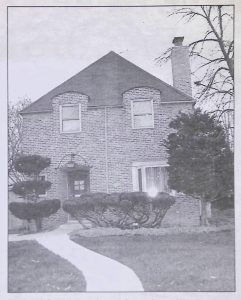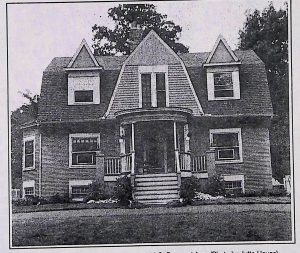

The impressively situated residence at 11322 S. Longwood Drive, rising on its own cliff above all of its neighbors, illustrates how a skilled architect can spell the difference between the success and failure of a house in a high-visibility location. The architect wants to please the owner as well as the eye of the casual viewer passing by on the street. In the case of this house, special effort had to be taken, since most of its audience would never come closer than 150 feet away.
This residence was built in 1906 for Joseph A. Alexander, a manager with the Alexander Supply Company, at a cost of $7,000. It was designed by Albert G. Ferree, an Englewood architect. We know very little about Albert G. Ferree, and because he designed several remarkable houses in Beverly/Morgan Park we would like to know more. Records show Ferree was born in 1848 in Indiana (and thus would have been 58 in 1906) and that he had a wife and three children. Those of us who toured the Bryson B. Hill house at 9800 S. Longwood Dr. on the 1995 BAPA Home Tour have experienced another of Ferree's houses.
This house is in the Colonial Revival style, and draws upon the two dominant English styles of the eighteenth century, Georgian and Adam, for its inspiration. The Georgian style was derived from the architecture of the Italian Renaissance. The Adam style was a later refinement of Georgian.
The Colonial Revival style of architecture began about 1880 and continued well into the 1950's. The rebirth of colonial architecture seems to have been inspired by examples built as exhibition buildings for eastern states at the Centennial Exhibition in Philadelphia in 1876 and at the World's Columbian Exhibition in Chicago in 1893.
In the house under discussion, the placement of the various elements of the Colonial Revival inventory is complicated not only by the great distance between the house and its audience, but also by the height of the house above its viewers. Of course, once the eye has appraised the overall pattern of the house, the feature that then strikes it is the porch. This porch has subtle features which cannot be seen from the street below, but are necessary for the proper appearance of the house. For example, the columns of the porch all lean slightly towards the house in order that from below they will appear to be perfectly vertical. Similarly, the volutes of the ionic columns of the porch are enlarged a little out of scale so that the style of the capitals can be identified from the street.
The proportions of the house itself are also adjusted to the street perspective. The stories are fairly high, and this allows the details of the second floor and the center gable to be seen above the elegant porch. The overhang of the roof above the second story is greater than in colonial models so the decorative dentils can be clearly seen and the junction of roof and wall can be made out clearly from below.
All of the first-floor windows are crowned with keystones, as are the arched Palladian windows in the higher floors; again, this was apparently done to enhance visibility from the street. By separating the major design elements of the facade—quoins (those blocks that seem to reinforce brickwork where it turns a corner), windows, front gable, porch—with just enough space to make them stand out, the house, which is nearly square in floor plan, appears instead to have a broad front and narrow sides.
The architect has thus contrived to give the viewer the impression of seeing a large colonial manor house while staying within the budget for a handsome but not extravagant middle-class house of the turn of the century.