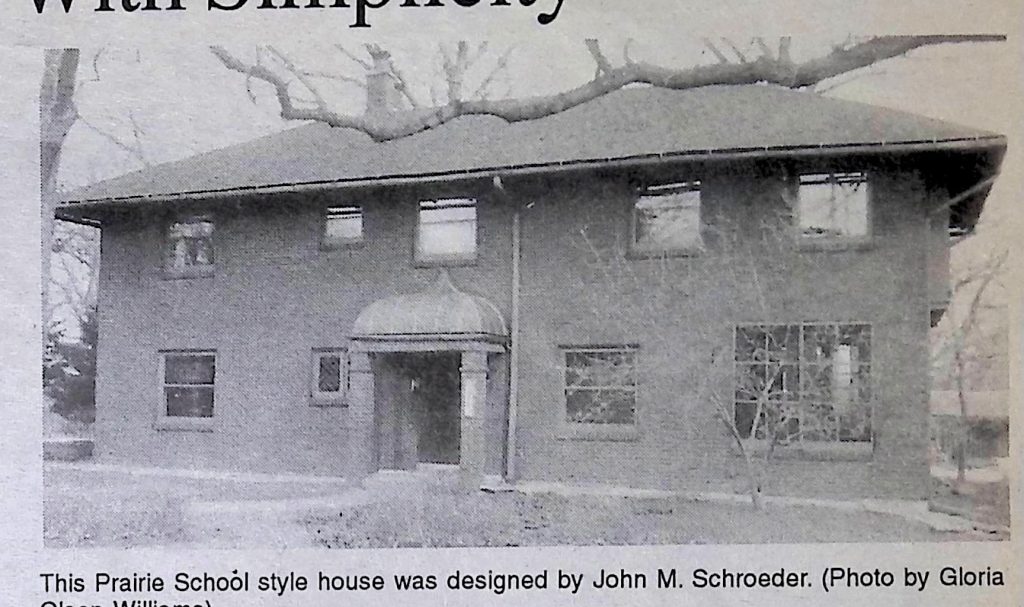
When we visit Oak Park to see the architecture of Frank Lloyd Wright, or Kenilworth to see the houses designed by George Washington Maher, we see how the resident architect influenced other Prairie School designers who worked “on his turf.” The imitation may have been unconscious, but we can’t help noticing the resemblance of the work of the non-residents to that of the town’s trend-setter. By contrast, while many of the architects of the Prairie School worked in Beverly/Morgan Park, none of them lived here, so that our neighborhood gives free rein to the ideas of all of the members of the school who executed buildings here. An excellent example is the house at 10457 S. Seeley Ave., built in 1908 for Richard J. Preston, the manager of the National Acme Manufacturing Company, a maker of screw machinery.
The architect of the Preston house was John M. Schroeder (1863-1921), who was raised on a farm in Worth township, southwest of Blue Island. In 1885 and 1886 he was employed as a draftsman in Joseph Lyman Silsbee’s firm, where all of the earliest Prairie School designers trained in the late 1880’s, and would have worked alongside George W. Maher, but would have been gone by the time Frank Lloyd Wright arrived in 1887. Schroeder had his own practice from 1887 to 1892, partnered with John L. Koster from 1892 to 1896, then returned to individual practice until his death in 1921, when he died of pernicious anemia.
Schroeder’s practice was city-wide, but no one has studied his work systematically, so it is difficult to sum up his achievements. In Beverly Hills/Morgan Park, along with remarkable Prairie-style residences, his work includes a number of boxy houses done for Erastus A. Barnard.
The dominant effect of the Preston house is simplicity, and this is underscored in several ways. First of all, the house, though a full two stories and attic high, deliberately has a lower height than its neighbors. Moreover, the long low hipped roof is uninterrupted by any dormers and the chimneys emerge from the roof on the rear side, so as to make an uncluttered statement of the emphasis on the horizontal.
The windows on the front appear to be randomly disposed, but the architect connived to use them for horizontal emphasis by giving the tops of those of the first floor, except the large south window, a common height above ground, while the sills at the bottoms of all but the small window on the second floor also share a common height. There is a bay window on the second floor on the south side, but it is a simple box bay supported on carved brackets, and does not intrude on the composition.
Except for the boxy houses done for Barnard, most of Schroeder’s residences depend for their effect on one spectacular feature, and in the case of this house it is the copper canopy over the front porch, supported by four simple brick columns, two of them attached to the house. The columns don’t have capitals atop them, but one course of bricks near the top extrudes slightly as a substitute. The canopy tapers to a simple point just beneath the second story window above.
The Preston house is the classic example of how brilliant effects can be achieved by careful design. The roof immediately focuses the attention of the observer on the horizontality. The windows appear to be randomly placed but aren’t. The canopy guides the visitor immediately to the main entrance without interfering with the lines of the house, from which the porch almost stands apart. Truly this house is a marvelous example of the variety of the Prairie