The City of Chicago is devoting resources to the preservation and modernization of bungalows and, in cooperation with the Chicago Architectural Foundation, their glorification as well. They are particularly — though not exclusively — concentrating on the Chicago bungalow, the red-, orange-, brown-, or yellow-brick one-and-a-half story structure with a small dormer or window under the roofline at the front and an underemphasized entrance at the side of the front or on the side. The Chicago bungalow is a frequently-found component of many southwestern and western Chicago neighborhoods, including Bridgeport, Chicago Lawn and Marquette Park. The Chicago bungalow really came into its own just before World War I and enjoyed its heyday in the 1920s.
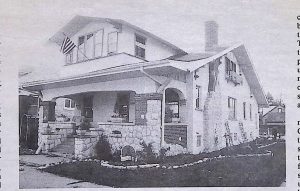
The Chicago bungalow was not the only type of bungalow built in Chicago. The influence of California was widely felt wherever bungalows were built, and California bungalows, with porches spread across the front of the house under wide eaves will be found here and there throughout the city.
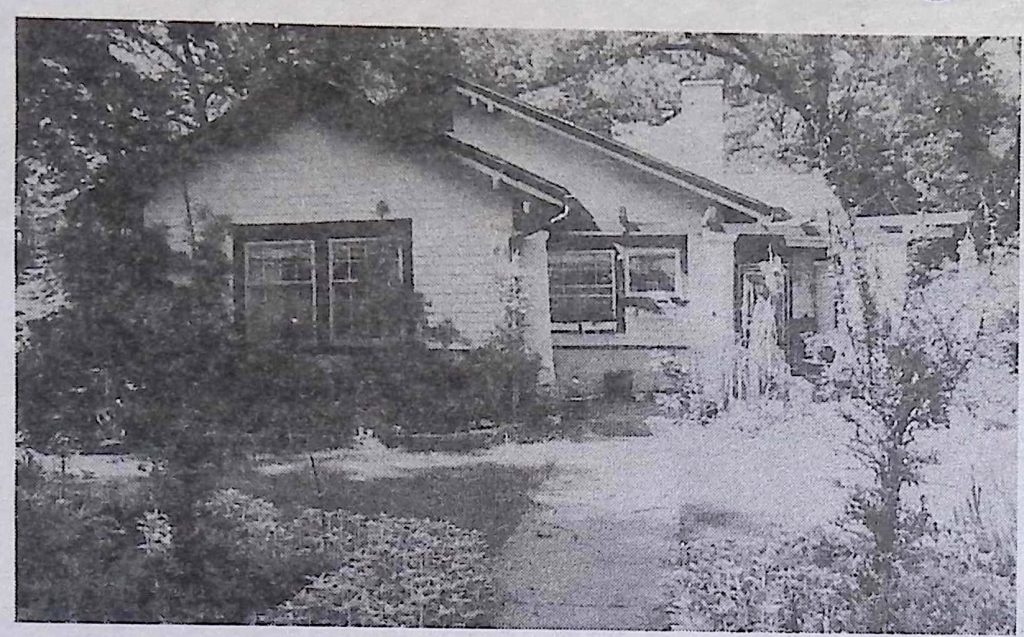
The house at 2140 West 103rd St. represents yet another type of bungalow and was originally built for A. L. Cheney. Unlike the Chicago bungalow and the California bungalow, what this house presents to the street is a pergola, defined by Webster as “a tunnel-shaped structure of latticework, upon which climbing plants are grown.”
The plans for the Cheney Bungalow came from the Radford Architectural Company, which was the brainchild of William A. Radford. Born in Oshgosh, Wisc., in September, 1865, Radford was educated through high school in the public schools of Oshgosh and then joined the family business, which produced milled lumber, window sashes and doors. By 1890 he was secretary and treasurer of the company. In 1902, he launched the Radford Architectural Company, which sold house plans and specifications out of catalogues. Radford also published such works as American Carpenter and Builder (later called The American Builder Magazine) and Beautiful Homes Magazine. In 1908, his offices were at 1827-1833 S. Prairie Avenue.
Given his background in millwork and publishing, it is unlikely that Radford himself made the architectural designs he published. He most likely hired outside architects to make plans, retained a staff of draftsmen, or both. Although several Radford catalogues have been reprinted by Dover Publications, the Cheney Bungalow does not appear in any of them, so we do not know whether it came from a catalogue as yet unprinted, or was one of the custom designs which the firm advertised itself as willing to provide.
The Cheney Bungalow presents to the street an asymmetrical but pleasingly balanced facade, with a front room under one beam-supported gable projecting from another such gable, and the pergola to the east of these. The wings under the gables have white shingled walls, with a dado of yellow stucco rising about three feet from the ground. The dado is separated from the white shingles by a narrow course of brown-painted boards laid on their sides.
and the windows throughout the house are uniformly framed by brown boards.
The pergola is carried on massive yellow columns stuccoed all the way up to the simple, square, layered white capitals. The massive columns define a porch area floored with concrete leading to the main entrance, which is again framed with brown boards.
The principal chimney is in the side wall of the gabled wing next to the entrance, and is yellow and stuccoed all the way up to the roofline, above which it emerges in yellow brick capped with limestone. A smaller chimney arises from the roof near the west side. The underside of the roof shows the exposed rafters to be expected in Craftsman-style houses and flattens out toward the rear.
Although I would not want to suggest that one could not be hospitably entertained behind the forbidding facade of the “Chicago bungalow,” I think it must be admitted that the entrance to the Cheney Bungalow through the pergola is both charming and inviting, and suggests an owner with a vastly different outlook.