
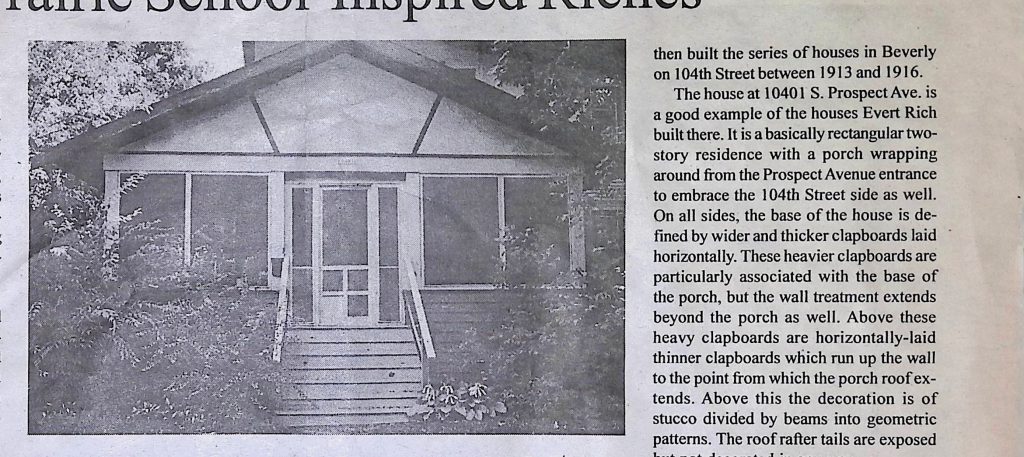
Although they have received almost no attention from architectural researchers, there is a series of Prairie School-inspired houses on 104th Street between Church Street and Prospect Avenue. Not every house on this block belongs to the group, but there are several two-story houses characterized by walls with horizontal clapboards at the base and stucco surfacing divided into geometric panels above. Probably the largest is the corner house at 10401 S. Prospect Ave.
The houses were built for and designed by Evert Rich (1861-1940). In modern parlance Evert Rich could best be described as a developer, but as the designer of record of a number of houses in Beverly/Morgan Park, he deserves a place among the architects of the Ridge as well.
Rich was born in Chicago on May 11, 1861. He was educated in the public schools of Chicago and first appears in the Chicago city directories in 1878 as a builder. Apparently he had been an active builder in Englewood, since he is listed among “the builders of Central Englewood in the early days” in The Story of Englewood, 1835-1923.
In 1885, Rich began to deal in real estate. It appears he picked up some knowledge of design during his early career as a builder, since he won a suit against the Rev. H. S. Williams of the First Presbyterian Church for architectural services in April 1888.
On March 16, 1889, Rich was married to Marie Reinbold, daughter of an Englewood tobacconist, and put aside his real estate practice in 1890 and 1891 to engage in the manufacture of snuff with his brother-in-law. Late in 1891, Rich seems to have decided to test the waters for an architectural career, for the 1892 and 1893 directories find him listed as an architect. With the economic downturn following the World’s Columbian Exposition, however, he is listed as a carpenter in the 1894 and 1895 directories, but again appears as an architect in the listings from 1896 to 1900.
In 1901, Evert and his younger brother Benjamin C. Rich, a civil engineer, established the firm Rich Brothers, builders. They erected an apartment house on the family’s old homestead south of 65th Street between Stewart and Harvard Avenues. In 1905, the brothers went their separate ways, Evert forming the Calumet Construction Company and Benjamin returning to civil engineering.
Evert Rich’s company built a number of residences on West 104th Street, West 104th Place, and Prospect Avenue, including Evert Rich’s own residence at 10420 S. Prospect Ave. The Calumet Construction Company continued in business until 1912.
Thereafter Rich was engaged in building operations at Indiana Harbor, Ind., Los Angeles, Calif., and in marine engineering and construction on Lake Michigan. Rich then built the series of houses in Beverly on 104th Street between 1913 and 1916.
The house at 10401 S. Prospect Ave. is a good example of the houses Evert Rich built there. It is a basically rectangular two-story residence with a porch wrapping around from the Prospect Avenue entrance to embrace the 104th Street side as well. On all sides, the base of the house is defined by wider and thicker clapboards laid horizontally. These heavier clapboards are particularly associated with the base of the porch, but the wall treatment extends beyond the porch as well. Above these heavy clapboards are horizontally-laid thinner clapboards which run up the wall to the point from which the porch roof extends. Above this the decoration is of stucco divided by beams into geometric patterns. The roof rafter tails are exposed but not decorated in any way.
On their exteriors these houses follow the footsteps of Prairie School houses in the neighborhood, particularly the group designed by Walter Burley Griffin on 104th Place, but they lack other Prairie School features such as hipped roofs, casement windows, and long porch roof spans on massive columns. The houses share one design element, a fondness for irregular pentagons. These can be found in the windows under the gables and also in five-sided panels in the stucco, such as the panel in the porch gable over the front entrance at 10401 S. Prospect.
This group of houses can be regarded as evidence of how the Prairie School idiom was seeping into the consciousness of midwesterners up to America’s entry into World War I. Even though the advances in interior circulation developed by the Prairie School architects had yet to register in the public taste, their palette of materials and finishes had won acceptance, signaling a willingness among the public to be weaned from historical styles by the new American-oriented designs. It is greatly to be regretted that at this critical juncture Wright had alienated the American public by his personal adventures and Griffin had gone off to Australia.