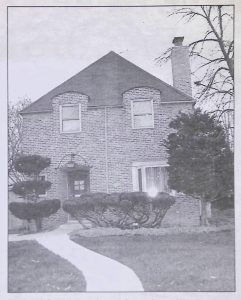
Although not among the things for which he is best known, Frank Lloyd Wright had a reputation for using good design to solve problems in ingenious ways. The classic example was a set of china Wright designed, embellished with a three-quarter circle of solid red just below the rim of the cups so that lipstick-wearers did not have to trouble about leaving a smear. In some of its features, the house at 10403 S. Talman Ave., designed and built in 1940 for Bror Swanson from plans by architect (and Beverly/Morgan Park resident) Rudolph Boehm, can be said to resemble that Wright-designed china.
Rudolph Boehm was born in Brieg, Germany (now part of Poland) on October 27, 1897. He received an excellent technical education in building design, studying the theory of architecture in the classroom during the winter but also learning carpentry and bricklaying through actual experience during the summers.
Boehm came to the United States after serving in the German Army in World War I, and quickly earned his architect's license through study at the University of Illinois and by working as an apprentice. Boehm became an American citizen and opened his office at 76th Street and Cottage Grove Avenue.
By 1936 his office was relocated to 1830 W. 103rd St. in the old Tracy Hall and he had become known for his Beverly Hills and suburban homes. Boehm's first residences had been large rambling country houses, but he quickly responded to the demand for more compact labor-saving designs that arose in the 1930s and continued through the 1950s. In 1941 he met his wife Marie, for whom he built their dream house down the street from the Swanson residence. Rudolph Boehm died on June 3, 1959, shortly after completing the Ridge Lutheran Church, 2501 W. 103rd St., his last commission.
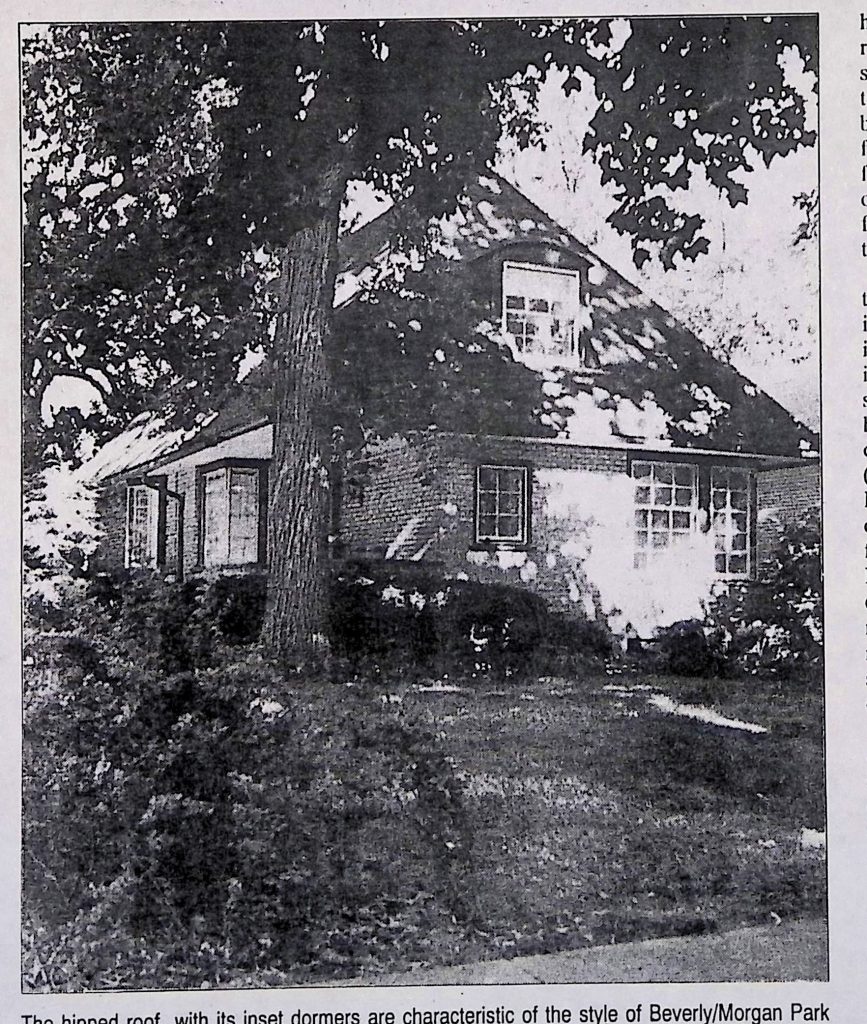
A glance at the Swanson house evokes the memory of certain Frank Lloyd Wright-designed houses because of its hipped roof. This roof illustrates Boehm's penchant for providing little conveniences for his clients. For Boehm, the principal advantage of a hipped roof seems to have been extending the base into a wide overhang at the eaves, providing shelter against rain and snow. But since the effect of this shelter would be largely lost if the roof terminated above the second story, Boehm brought the roof down to the top of the first story. Since the hipped roof extends from the top of the house down to the top of the first floor, it follows that the second floor is entirely under it, requiring dormers to admit light and air.
For Frank Lloyd Wright, dormers through the roof were repulsive, because in the 1890s the attic they ventilated was invariably a hothouse in summer and an icebox in winter, inhabited accordingly by servants. But by 1940 modern forced-air heating and fans had become available for controlling the climate of upper floors (with air conditioning soon to follow). Moreover, a steep hipped roof could be counted on to shed accumulations of snow faster, before it strained the roof supports. Boehm has also minimalized the presence of the dormers by giving them rounded roofs (segmental is the technical term) rather than gabled silhouettes and by in-setting their lower halves in a space carved out of the roof.
The Swanson house displays other characteristic Boehm details, including a rounded bay window at the rear looking out onto the garden and flanked by two doors. On the 104th Street side there is a window like a beak jutting out towards the street, framed with vestigial quoins, while on the front there are wrap-around windows on the south corner, reminiscent of International Style houses of the period. The composition is completed by a free-standing garage with a high pyramidal roof which compliments that of the house.
The Swanson house includes elements which harken back to the first phase of the career of Frank Lloyd Wright while including features that reflect modern living in 1940 and give the house a timelessness even today.