When we think of selecting an architectural style for a particular site, what usually comes to mind is the way in which the horizontal lines of a Prairie-style house reflect the wide-open flat plains of the Middle West, or how the successive piling up of terraces, stairs, porches and stories allows a house to fit into a hillside. But when the site to be accommodated is a grouping of lots whose borders meander in and out, giving the property varying widths and depths, not just any style of building can be erected on it. The one style that can be accommodated on almost any site is Tudor.
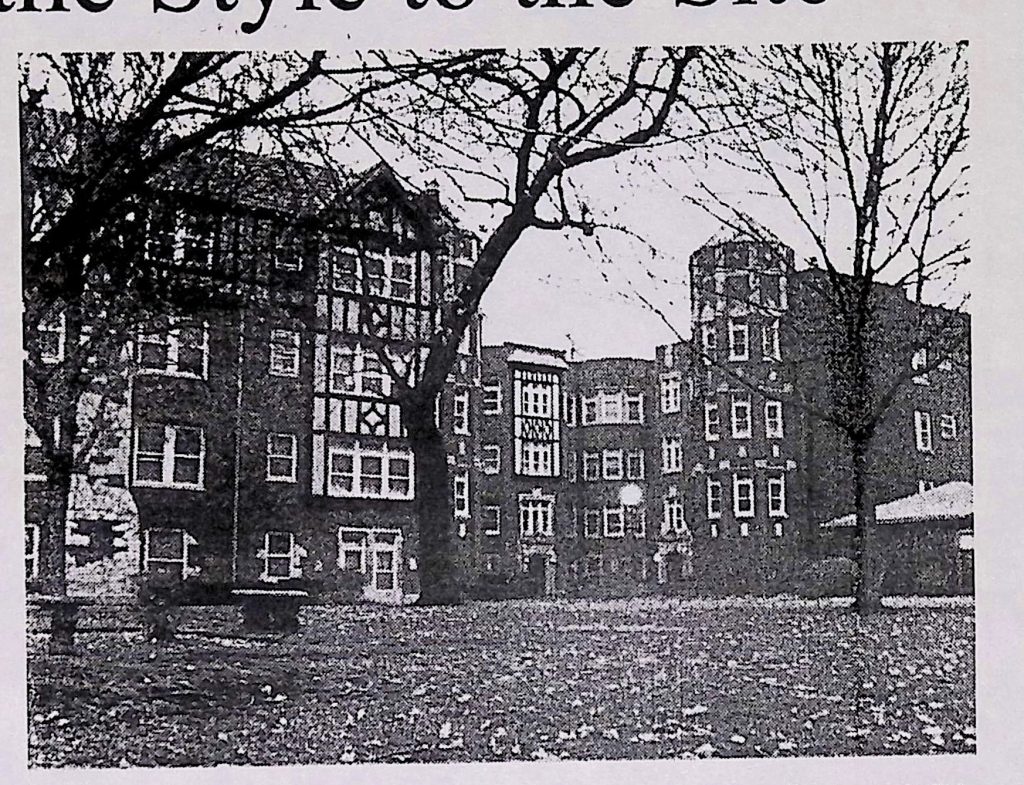
A case in point is the extended apartment building erected for the Englehart Construction Company on the northwest corner of Wood and 104th Streets in 1928 and 1929. Fronted on the Wood Street side by a park-like lawn with flower beds and trees, the building extends 311 feet from north to south and 104 feet from east to west.
The apartment house was designed by the firm of Lindblad & Carlson, a partnership of about a year's duration between Elmer C. Carlson and Alfred G. Lindblad. Carlson was a southsider and it is thought the design was chiefly his. He was born in Sweden on Jan. 20, 1897, and came to the United States with his parents. He studied at the Armour Institute of Technology (now the Illinois Institute of Technology) and the Chicago Academy of Fine Arts, but did not earn a degree from either of these institutions. He received his professional training through employment with several architects or firms including Holabird & Root. From 1929 on he practiced in his own. Before the Depression he specialized in large apartment houses, but thereafter he became known for single-family residences in the Art Moderne style, many of them located in Beverly/Morgan Park.
The site for the Englehart Construction Company's building, besides being corner, is also irregular. At the northwest corner of the property the building ducks behind a house on Wood Street onto a dogleg of the lot which juts back behind the neighboring house on 104th Street. For this reason the north end of the building looms like a diagonal ravine over the walks that approach the northern entrances. The entrance to the ravine-like passage is guarded by facing octagonal towers with pointed roofs, and at the far end projecting stories and a curved wall break up the flat planes of the ravine's bluffs.
Further south, the main walls of the building are parallel to Wood Street, but these are broken up by courtyards which hold the entrance pavilions, which are highly decorated on the ground-floor level. The windows are mostly grouped in threes, often projecting on the upper stories in box bays supported both by brackets and corbelling, in which supporting layers of bricks each extend a little outward than the layer below. The box bays display decorative half-timbering, and sometimes are capped by gables with decorative bargeboards. The decorative scheme continues around to the 104th Street side. The ground-floor windows are often solitary rather than grouped, and this has allowed the architect to employ round or oval windows with keystones on top, bottom, and sides here and there. Others of these single windows are square with stones interrupting their brick framing. At the roof, two of the corners display little turrets called bartizans, and at some points there are crenellations. In the middle of the composition is a four-story-high chimney with chimney-pots.
It might be supposed that, with all of these disparate elements, the effect would be chaotic, but because the window groupings are kept rigidly one above the other, the overall sense is of an orderly framework within which playful elements are allowed to, well, play. The building simultaneously displays immense dignity and delightful decorations. This is the essence of Tudor's charm, as well as the aspect which allows it to harmonize with a variety of surroundings so effectively.