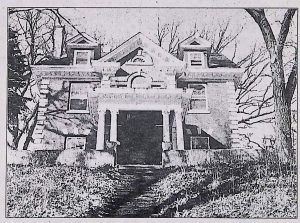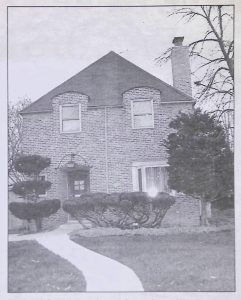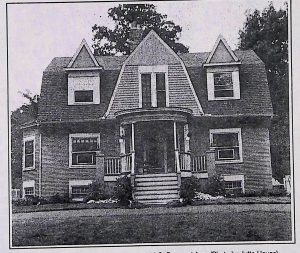
Even for those who have spent their entire lives on the Ridge, experiencing the BAPA Home Tour by bus can be an eye-opening experience. As the vehicle winds its way up and down Beverly/Morgan Park streets, a resident may watch with interest the reaction of visitors from other neighborhoods or outside the city.
These visitors view great mansions of stone or brick, low lying Prairie School houses that appear to arise from their sites, cozy bungalows ranged in neat rows on modest but well-manicured lots, and occasional apartment complexes, some festooned with the towers and battlements of late Medieval times.
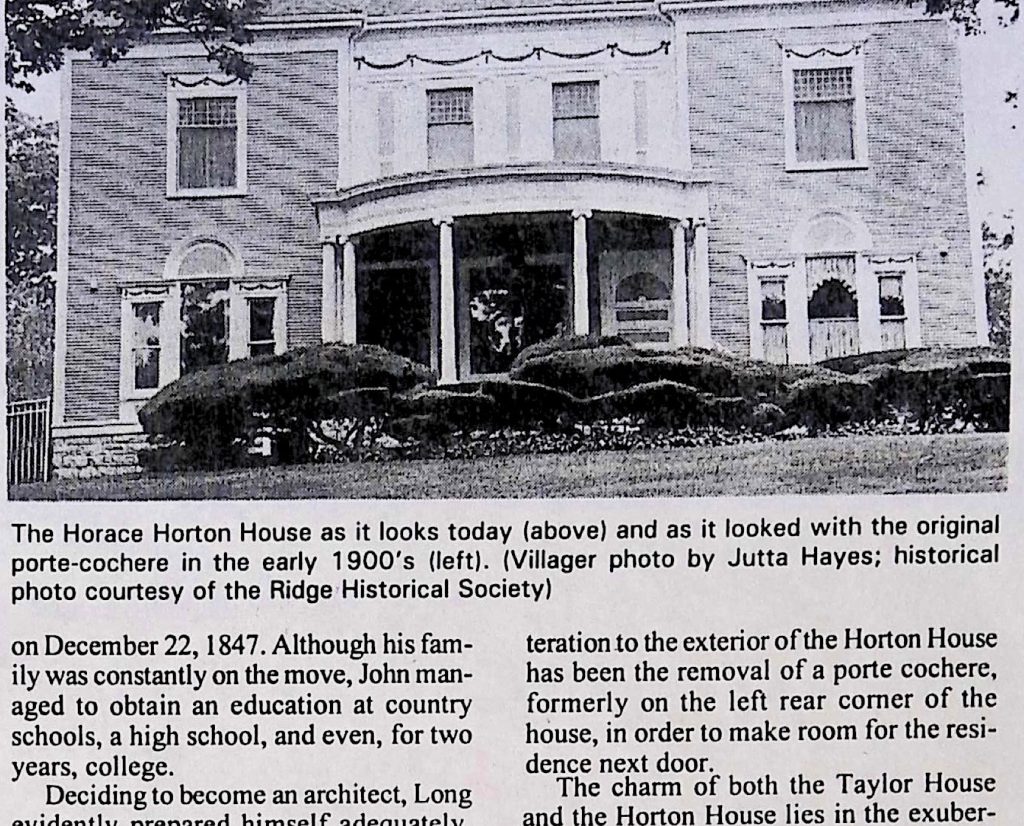
There is one point in the tour when “ohs” and “ahs” can be guaranteed, and that is when the bus passes the mansion built in 1890 for Horace E. Horton at 10200 S. Longwood Dr.
Here, it seems, a manufacturer of bridges and water towers had the good sense to place in the hands of a gifted architect a magnificent hilltop site with a great sloping front lawn. Handed back was a magnificent symmetrical mansion conceived in the style of Colonial American houses, but not one of the repetitive Georgian five-bay, center-entrance-ranked designs that characterize so much of Colonial Revival architecture.
Horace E. Horton was born near Herkimer, New York, but moved with his parents to Rochester, Minnesota while still a child. He studied civil engineering, and designed and built bridges across the upper midwest. In 1889, he decided to bring the family business to Chicago.
The site chosen for what was to become the Chicago Bridge & Iron Company plant was between 105th and 107th Streets right between the Rock Island and Panhandle Railroads, affording easy transport connections east and west without the necessity of shipping into Chicago.
At the time the plant site was acquired, Horton purchased from Robert Givins, owner of the Castle at 103rd Street and Longwood Drive, the adjoining lot to the north, measuring 350 by 150 feet. The purchase price was $4,500, a sum which would have constructed a substantial brick house at the time. In time the Hortons would build two other houses on the Longwood Drive lot.
Whether Robert Givins, a realtor who wrote novels on the side, regarded Horton as the perfect neighbor or not, he knew that Horton’s new manufacturing plant would attract many home buyers to the vicinity.
To design his house, Horton selected John T. Long, an experienced architect who was then at the peak of his career. Long was born in Henry County, Indiana, on December 22, 1847. Although his family was constantly on the move, he managed to obtain an education in country schools, a high school, and even, for two years, college.
Deciding to become an architect, Long evidently prepared himself adequately, though we don’t know how. He came to Chicago in 1874. Long apparently served for some years as a draftsman, including a brief stint for the city clerk about 1878-1880. Gradually he developed a reputation, and was particularly noted for churches, schools, and railroad stations.
In 1889 he designed the First Presbyterian Church (now the Metropolitan Community Church) at 41st Street and King Drive, and a gymnasium for Mount Union College in Alliance, Ohio, demolished in 1972, the same year it was placed on the National Register of Historic Places.
These buildings were designed in a robust Richardsonian Romanesque style. Long’s own house was Colonial Revival.
In 1891, Long drew plans for the Rock Island railroad station at 111th Street. He laid out the design in brick and stone, but it was executed in wood. Long also designed two Morgan Park commercial buildings, no longer standing.
With the onset of the national depression of 1893-1898, Long’s career faded rapidly, and about 1908 he retired to San Diego, California, where he died June 18, 1922. In the later years of his life he devoted himself to genealogy, with particular reference to his membership in the Sons of the American Revolution. Perhaps this may explain why his known residences are in Colonial Revival style.
It was Ken Jellema, the perceptive architectural historian of Blue Island, who first pointed out, in a letter to the current owners, that the Horton House was clearly based on—though not a copy of—the Henry Augustus Coit Taylor House in Newport, Rhode Island, designed by Charles Follen McKim (of McKim, Mead & White) and erected in 1885-1886.
Since the Taylor House had an additional servants’ wing which undermined the symmetry of the basic composition, the Horton House preserves McKim’s basic concept better than the original, which has been demolished. The principal alteration to the exterior of the Horton House has been the removal of a porte cochere, formerly on the left rear corner of the house, in order to make room for the residence next door.
The charm of both the Taylor House and the Horton House lies in the exuberantly textured central sections of the front and side walls, framed by the relatively plain corner pavilions and producing the elegance which any controlled display of exuberance is bound to achieve. In the Horton House, the effect is enhanced by details painted red, in contrast to the general white-framed gray background.
Palladian windows, a combination of one round-topped window above the central of three square or rectangular windows in a row, are used to good advantage on the ground floor of the corner pavilions.
The curved porch with its balustrade also heightens the elegance of the central portion of the house, and the red swags perform the same function for the many windows they grace.
The architecture of McKim, Mead & White and of those who followed them speaks to a sense of architecture as an endeavor of man to make his own environment rather than to let his surroundings grow organically from nature—very different from the tradition of the Prairie School. The real impact of the Taylor House can be understood best when it is realized that in the Kenwood neighborhood stands another Colonial Revival house generally considered to have been inspired by the Taylor House. This is the George Blossom House, one of the so-called “bootlegged houses” designed by Frank Lloyd Wright when he was supposed to be funneling such commissions to his employers, Adler & Sullivan.
Of the surviving examples of houses in the Taylor House style, the Horton House is probably the best midwestern example, perhaps the best in the country. And in view of the stature of the architects who worked in this style for whatever reason, no one can doubt its attractions.
As a final word, I think I can speak for the community in expressing its gratitude to the present owners, who have done so much to bring this magnificent house back to what the original architect envisioned.