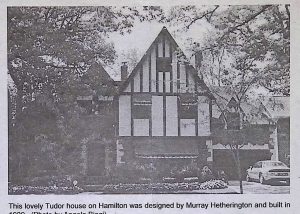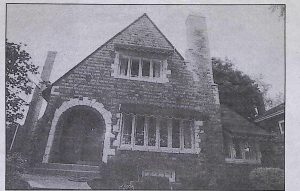
The hilltop residence at 10162 S. Longwood Dr., built for publisher William H. McDonnell in 1929, is probably the most prominently located Homer G. Sailor-designed house on the Ridge.
William Henry McDonnell was a man who had worked his way up. Educated no further than the public schools of Chicago, McDonnell became a journeyman printer in 1908 at the age of 18. In 1913, he purchased a half interest in an Englewood printing firm, his partner being Jonathon E. Foster. Foster & McDonnell printed several small Englewood papers, among them the Englewood Economist.
Jonathon Foster and William McDonnell eventually bought two other local newspapers, then gathered all of their publications into the Southtown Economist in 1923.
By concentrating on a single newspaper, they were able to add staff and increase news content, making their paper a force in Englewood.
Homer G. Sailor was primarily known as an Englewood architect, so it is not surprising his work came to the attention of William McDonnell. While Sailor’s fame on the Ridge deservedly is due to the houses he designed here, apartment buildings and commercial structures made up much of his work in other parts of the city. Nevertheless, by 1929, Homer Sailor had a respectable portfolio of residences to his credit, many of them on the Ridge.
The style of architecture selected by Homer G. Sailor and his client was Tudor Revival. The term “Tudor” is here historically imprecise, since few American examples copy the architectural characteristics of early 16th-century England. Instead, the style is based on a variety of late Medieval English prototypes ranging from thatch-roofed cottages to grand manor houses.
In viewing Tudor Revival houses, the fun is in following the architect’s flight of fancy, which must provide details to delight the eye without overwhelming the building. The formal entrance to the house on this side is by two short flights of steps, either of which take the visitor onto a small terrace, the front of which is a fountain: The terrace in turn serves as a stage before a semi-hexagonal bay of two stories containing the ornately-hinged main door.
On the first floor of the house, the windows are elaborately treated with stone framing and have small panes, rectangular below, diamond-shaped in the stone transoms above. The second-floor windows, except those in the bay, are less elaborately framed in brick arches with stone keystones, and have only diamond-shaped panes. The hexagonal bay has a crenelated parapet at the roof line, and the east window rises past the roof line into a heavily-ornamented flat-topped dormer which continues the parapet of the bay.
By contrast, the less showy Longwood Drive side presents a chimney with stones embedded here and there and a big chimney pot on top. Windows flank it on each floor and to the north is a simple porch with arched openings protected by iron-work railings. Clearly this house was intended to offer magnificence at its front door, without lording it over the street below.