By Harold T. Wolff
Ridge Historical Society
Lying in the lee of the Blue Island Ridge, the area from Wood to Charles south of 95th Street is, to some extent, sheltered from the elements to which the houses on higher ground are fully exposed.
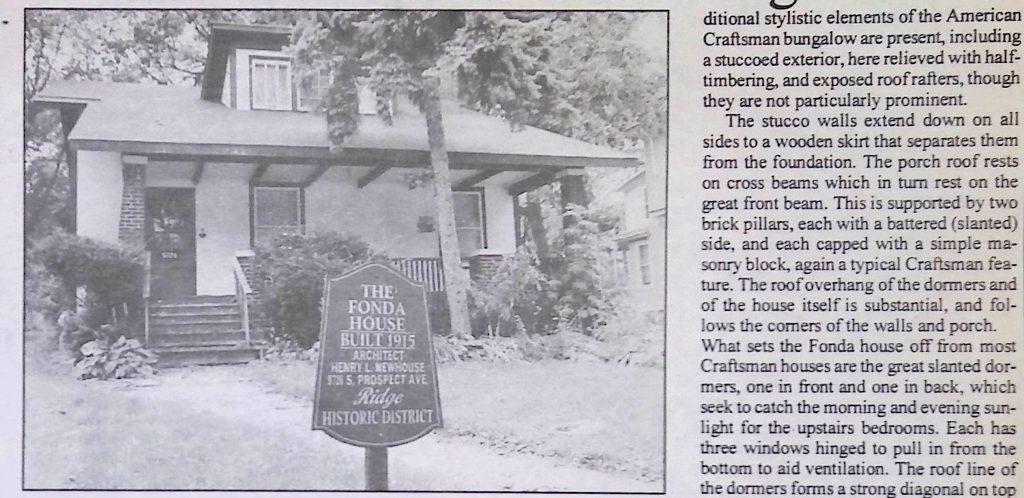
Sometimes architecture must be planned to compensate for missing climactic forces, particularly in a house which has been erected in a setting outside the one for which it was originally intended. Such a house is the Craftsman bungalow built for Frank M. Fonda in 1915 at 9726 S. Prospect Ave.
The architect of the Fonda house was Henry L. Newhouse (1874-1929), who was born in Chicago and attended public schools. He obtained his architectural training at the Massachusetts Institute of Technology, and opened his practice in 1896.
In 1913 with Felix M. Bernham, Newhouse formed the firm of Newhouse and Bernham, which is best known for large commercial buildings and apartment houses. Among the firm's better known structures are the Del Prado Hotel in Hyde Park, the Sutherland Hotel in Kenwood, the McVickers Theater in the Loop (now destroyed), the Auburn Park Trust and Savings Bank, and the Kehilath Anshe Ma'ariv Temple, now the home of Operation PUSH. The firm was responsible for the construction of over 4,000 buildings.
The house which Newhouse designed for Fonda in many ways typifies the Craftsman bungalow from the first quarter of the century. The word bungalow is derived from Bengala, and simply refers to the origin of this house type in Bengal, India. In its native locale, a bungalow is supposed to be open to the elements, both to catch the breezes and to allow the monsoon winds and rain to pass harmlessly through the house. It is not, however, supposed to be open to the sun.
In the case of the Fonda house, the traditional stylistic elements of the American Craftsman bungalow are present, including a stuccoed exterior, here relieved with half-timbering, and exposed roof rafters, though they are not particularly prominent.
The stucco walls extend down on all sides to a wooden skirt that separates them from the foundation. The porch roof rests on cross beams which in turn rest on the great front beam. This is supported by two brick pillars, each with a battered (slanted) side, and each capped with a simple masonry block, again a typical Craftsman feature. The roof overhang of the dormers and of the house itself is substantial, and follows the corners of the walls and porch.
What sets the Fonda house off from most Craftsman houses are the great slanted dormers, one in front and one in back, which seek to catch the morning and evening sunlight for the upstairs bedrooms. Each has three windows hinged to pull in from the bottom to aid ventilation. The roof line of the dormers forms a strong diagonal on top of the house, which is picked up by wall timbers in each side wall, which in turn slant down to meet each other and to form a diamond with the timbers under the roof. The architect turned a functional adjustment to the usual bungalow configuration into a major design element.
The Fonda house may seem as something of an experiment in the development of the typical Craftsman style bungalow, in which the architect successfully incorporated a change in the lighting scheme for the interior rooms into the stylistic treatment of the building as a whole, and produced an early illustration of the maxim, “form follows function.”