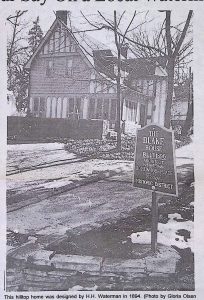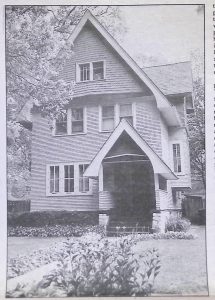
Harry Hale Waterman, whose best work is identified with Beverly Hills/Morgan Park, always seems under-appreciated to the people who know it best. Apparently uninterested in forging a new style and then having to sink or swim with it, Waterman built within all of the historical styles popular during his career and did a few buildings in the new modes that came along while he was working, including the Prairie School and Art Moderne. But his interpretations always have more to them than mere copying of landmarks of past or present.
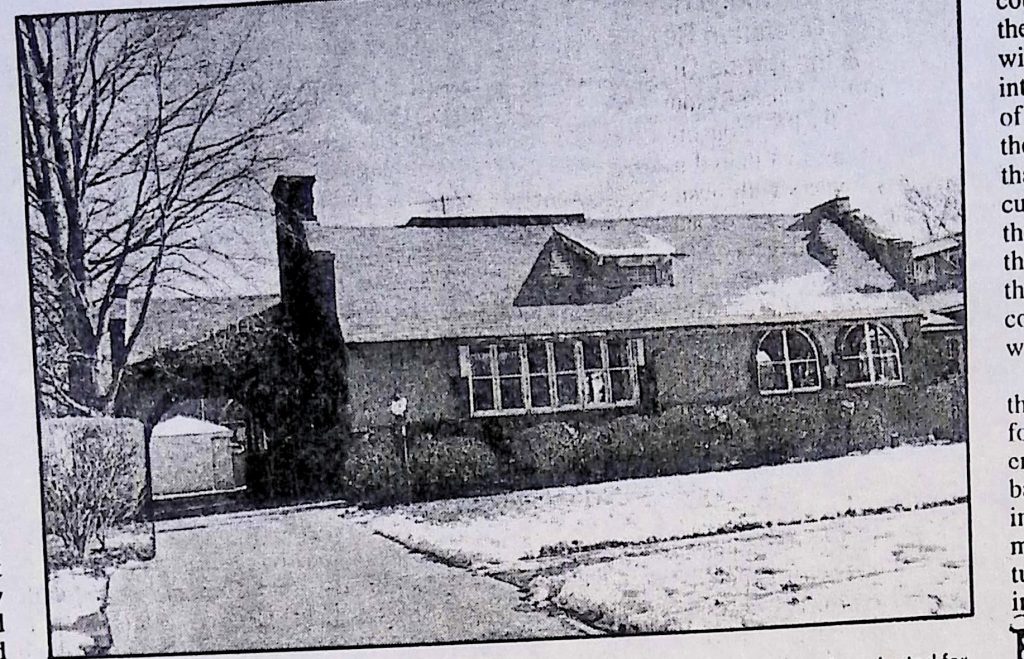
An illustration of his approach is the unusual house at 11123 S. Bell Ave., the first of three houses in Morgan Park built over two decades for Edna Schell, widow of Frank Schell. (Her son Herman claimed that Edna's name was really Edmaire, and that it was for her that the street of that name in Morgan Park was named, but it is unclear whether this is true or merely a family story.) This house was begun in September or October, 1907, and probably not finished until 1908.
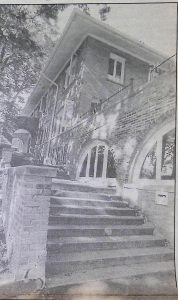
Technically this house can be assigned to the Mission style. In place of pointed gables at its sides are walls topped by elaborately curved copings derived from early California mission churches. It originally had a red tile roof, and the south side windows and the port cochere have arches that recall the arcaded porches that give entrance to the otherwise unconnected rooms of Spanish colonial buildings.
Most Mission style houses had stucco outer walls, but the walls of this house are predominantly brick on the north and south sides, while they have stucco walls above a brick dado. The house departs from California examples in having the windows grouped in rows on the front and in bays on the back. On both the front and back, the roofs have a sort of visor that extends out to shade the windows.
Although basically a one-story house, there is an attic story illuminated by shed dormers.
Perhaps Waterman's most creative adaptation of the Mission originals is in the floor plan. Many California missions have outbuildings consisting of otherwise unconnected single rooms joined by a porch and surrounding a courtyard used for open aircooking and communal activities.
Here, Waterman has kept the effect of a courtyard, walled off from the outside by the two wings of the house, but dispensed with the porch, since the rooms have an interior circulation. Nevertheless, the bays of windows looking out to the back direct the interest of the occupants to the yard on that side and give the house an outside focus, at least in the summer months. Since the visor roofs tend to keep sunlight off the windows during the middle of the day, the interior during the summer is dark and cool, with windows grouped on opposite walls to promote cross-ventilation.
It can be seen that Waterman has taken the usable elements of this basically Californian style and adapted them for a northern climate. This house has only a few basic features in common with the slavish imitations of the Mission style more commonly seen, but it is functionally more attuned to what the Franciscans were seeking to achieve in California.