
Explore the RHS Facebook Archives, a rich repository of local history written by Carol Flynn. For two decades, Carol brought a deeply dedicated voice to public education at RHS. Her role as Facebook administrator through mid-2025 naturally extended her prolific research into meticulously detailed articles, most notably her multi-part historical series posts. Today, Carol continues her local history writing for The Beverly Review and other outlets.
Past Events: 2021
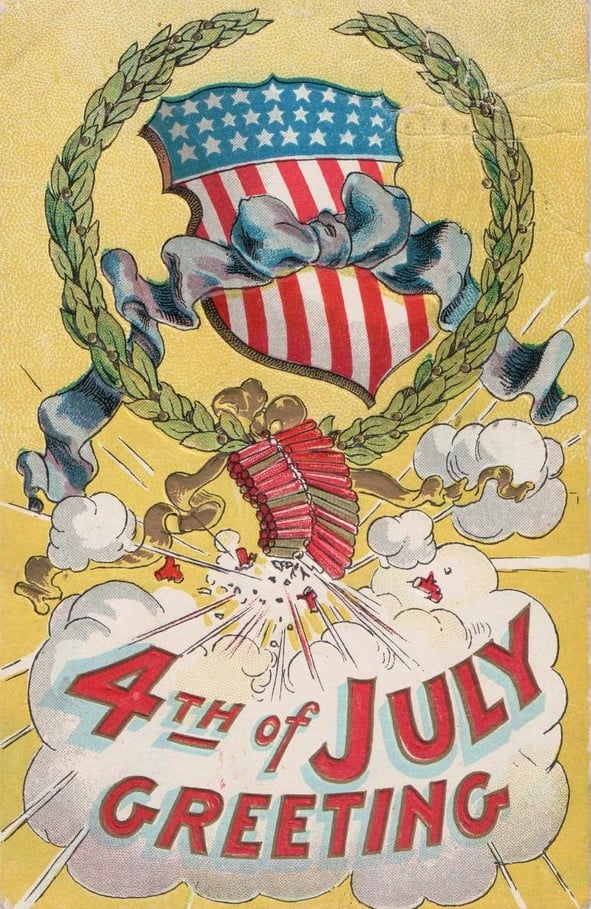
Happy Fourth of July from the Ridge Historical Society!
How did the residents of the Ridge celebrate one hundred years ago? According to the July 8, 1921 Englewood Times newspaper and our intrepid reporter Mrs. Pauline F. Palmer:
“The Ridge enjoyed a corking good Fourth and the field park and swimming pool at 97th Street and Longwood Drive was crowded all day. The baseball games and water sports attracted much attention. Many guests from adjoining suburbs were present and were pleased at the comfortable pleasures enjoyed by all.”
Mrs. Palmer is referring to the original Ridge Park, which was established in 1911 – 12. The architect John Todd Hetherington, who designed many fine homes in Beverly and Morgan Park, was a member of the Ridge Park commissioners. The board persuaded Hetherington to design the park. His creation included a small field house, outdoor swimming pool, running track and sports fields, surrounded by trees, shrubbery, flowers and walks.
In 1929, Hetherington, now in partnership with his son Murray D. Hetherington, designed the current field house, which enclosed the pool, and used the original fieldhouse as the auditorium.
And in case anyone thinks that porch and lawn concerts are anything new, because of the pandemic, that is not so.
Mrs. Palmer also reported that for the holiday one hundred years ago:
“About one hundred guests enjoyed the out-door street dance and sing at 94th Street and Pleasant Avenue, given by Miss Edna Wiggins of 9372 Longwood Drive on Tuesday evening. A four-piece orchestra furnished the music and the young people all enjoyed the novel way in which the party had been planned. Mr. and Mrs. A. B. Christian, 9300 Longwood Drive, and Mrs. Mitchell of Memphis, Tennessee, chaperoned the dance. Refreshments were served.”
Ridge Historical Society
The First Chicago Christmas Tree – Part 4
By Carol Flynn
Chicago displayed its first municipal Christmas tree in 1913. This was the first time a giant tree lit with electric bulbs was displayed in a public space for everyone in the Chicagoland area to enjoy. A lavish lighting ceremony was held on Christmas Eve.
New York City displayed the first municipal tree in 1912, and Chicago, Boston, and other cities followed the next year. In Chicago, the Municipal Christmas Festival Association was formed to plan and manage the activities. The honorary president was Mayor Carter H. Harrison. There were over fifty honorary vice-presidents representing business and industry, civic associations, churches, newspapers, welfare and social agencies, and education. Amalie Hofer Jerome, from the Hofer family on the Ridge, represented the Civic Music Association. Artists including the famous sculptor Lorado Taft donated their design talent to create the display.
The tree was set up off of Michigan Avenue, just north of the Art Institute on land considered part of Grant Park then.
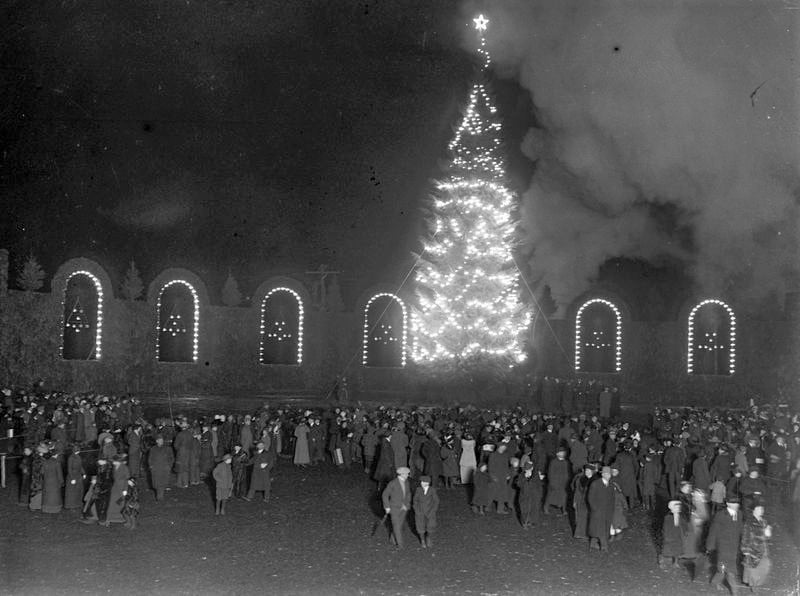
The tree was created from a 35-foot Douglas spruce mounted on a 40- foot base, covered by smaller trees, topped with a star of Bethlehem. The trees were donated by Frederick A. Jordan, of Roselawn, Michigan. He was the partner of the late Captain Herman Schuenemann, whose “Christmas Tree Ship” had gone down in Lake Michigan the year before while bringing trees to Chicago.
The tree was set in a 25-foot-tall arcade composed of arches and smaller Christmas trees, all lit with colored lights. Commonwealth Edison supplied the lights for the tree and arcade. Steam train engines from the Illinois Central Railroad were behind the arcades, blowing steam to create a special effect of fog. The tree was doused with water and frozen first, then slowly lit for a dramatic, icy effect.
A hospital station with volunteer doctors and nurses was set up to deal with injuries and lost children.
The lighting event on December 24th was almost curtailed by a blizzard earlier in the day. The streets were impassable and local transportation was impeded. Thousands of men poured out from lodging houses to help clear the snow – there was not enough work for all of those who showed up to help. The snow was soon cleared, and the event was able to go on as planned.
Thousands of free train tickets were made available for children so that families could come to the event, and over 100,000 people showed up.
The lighting ceremony started with a parade down Michigan Avenue, which included the police force and mounted Illinois National Guard cavalry. Speeches, and musical performances from a variety of sources, including the Chicago Grand Opera Company, followed, broadcast through huge megaphones. Motion pictures for children, mostly public safety features, were shown on a huge screen near the Art Institute.
Mayor Harrison pushed the button to illuminate the tree around 6:15 p.m., and the crowd gave out “lusty cheers.” The mayor’s speech was included in the record for the City Council. He stated that he hoped this would inaugurate a long series of celebrations for the city, and that the lights may serve as an inspiration to charity, the greatest of all virtues.
The festivities went on for several hours. There were a few minor glitches – the train engines, promised to be silent, were not, and drowned out some of the performances. The star of the opera who was promoted for the event was a no-show. Children were confused about the identity of Mayor Harrison – he was not fat enough to be Santa Claus.
The program was completed with the singing of the Star-Spangled Banner.
The police had assigned 250 men to detail the event. The officer in charge declared the crowd to be the “biggest, happiest, most cheerful, best and easiest handled” crowd he had seen.
The tree was illuminated nightly until the New Year.
The great success of this first tree led to the tradition that has now been going on for 108 years.
Image: The first Chicago Christmas Tree, 1913.
Next post: Some background information on early electrical technology in the City of Chicago.