
Explore the RHS Facebook Archives, a rich repository of local history written by Carol Flynn. For two decades, Carol brought a deeply dedicated voice to public education at RHS. Her role as Facebook administrator through mid-2025 naturally extended her prolific research into meticulously detailed articles, most notably her multi-part historical series posts. Today, Carol continues her local history writing for The Beverly Review and other outlets.
The History of the Morgan Park Police Station
Ridge Historical Society
National Police Week: The History of the Morgan Park Police Station – Part 1
By Carol Flynn
May is a busy time for “recognition weeks.” There was nurses’ week and teachers’ week, and May 9 to May 15 is National Police Week.
This seems like a good time to share the interesting story of the Morgan Park police station, now the 22nd District Police Station at 1900 West Monterey Avenue. The community didn’t always have its own police station – in fact, it was a struggle through the years to keep one here.
When the Village of Morgan Park annexed to the City of Chicago in 1914, all of the local services – fire department, police department, water, streets, utilities, schools, library – you name it – came under the control of city departments and regulations.
On Wednesday, April 22, 1914, at 5:40 p.m., Chicago took over Morgan Park and the four police officers employed by the village at that time became members of the Chicago Police Department. Morgan Park soon became part of the 32nd Ward.
On May 2 of that year, Chicago Police Superintendent James Gleason established a new police station at Morgan Park, and transferred in a lieutenant, a detective sergeant, three sergeants, and seven patrolmen. Lt. John F. Sullivan of the Hyde Park police station was given command. The first criminal complaint the new Morgan Park police station dealt with was an employee theft on May 26, 1914.
In 1916, the Police Superintendent was now Charles Healey, and he created a new police district, the 27th or Gresham, that included Morgan Park. Joseph C. Mullin was promoted from lieutenant to captain to be commander of this new district.
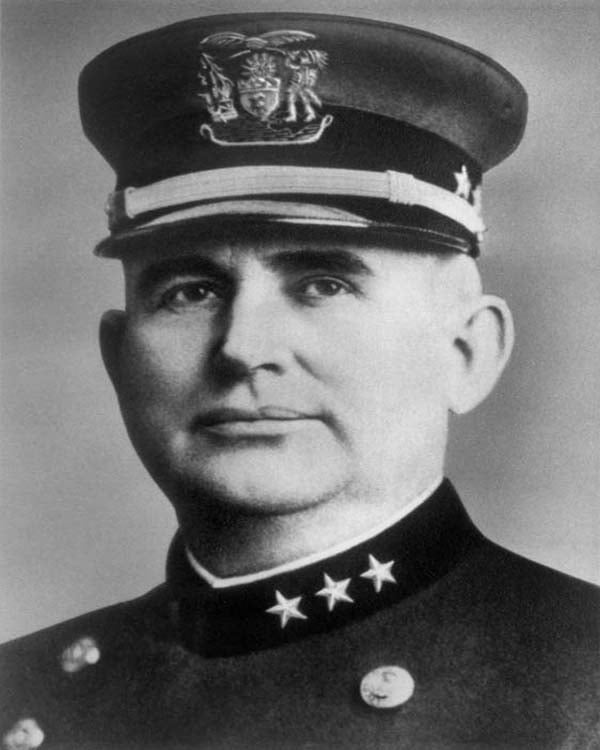
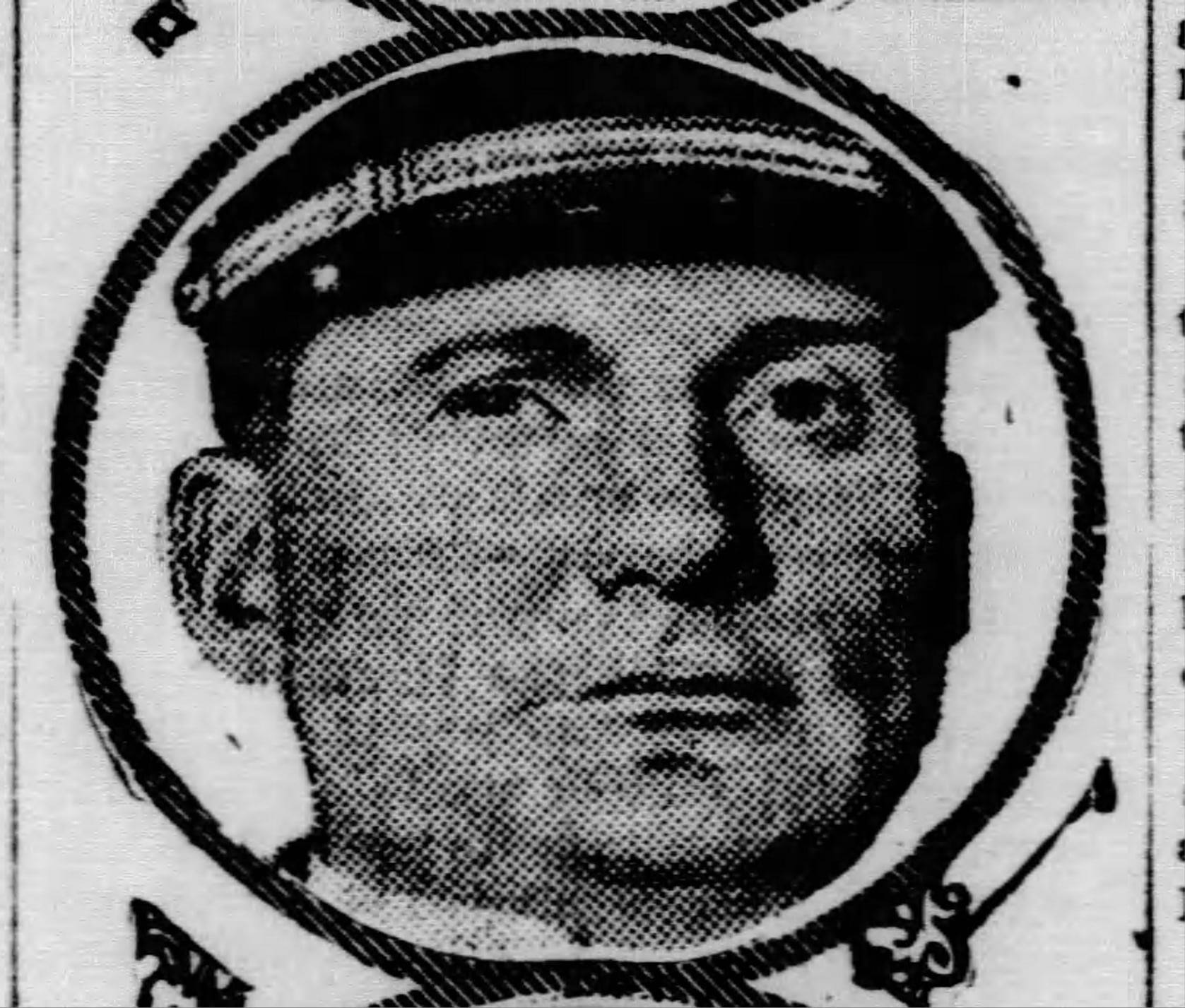
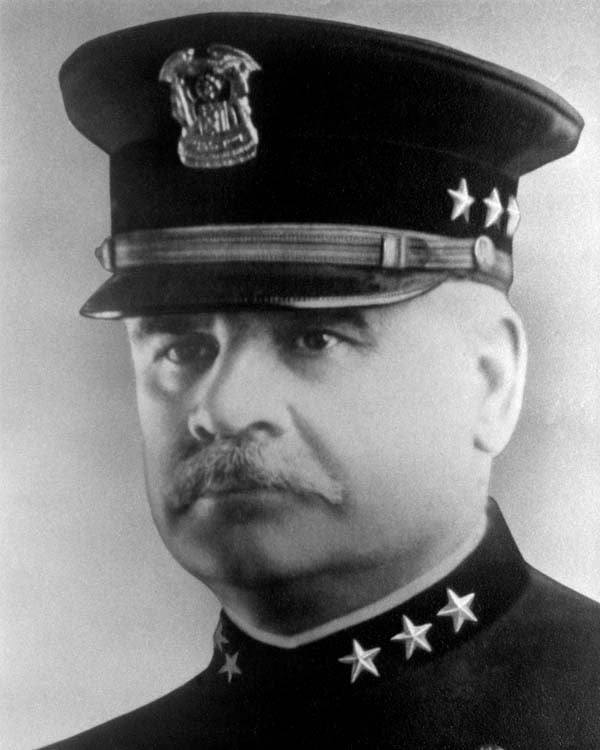
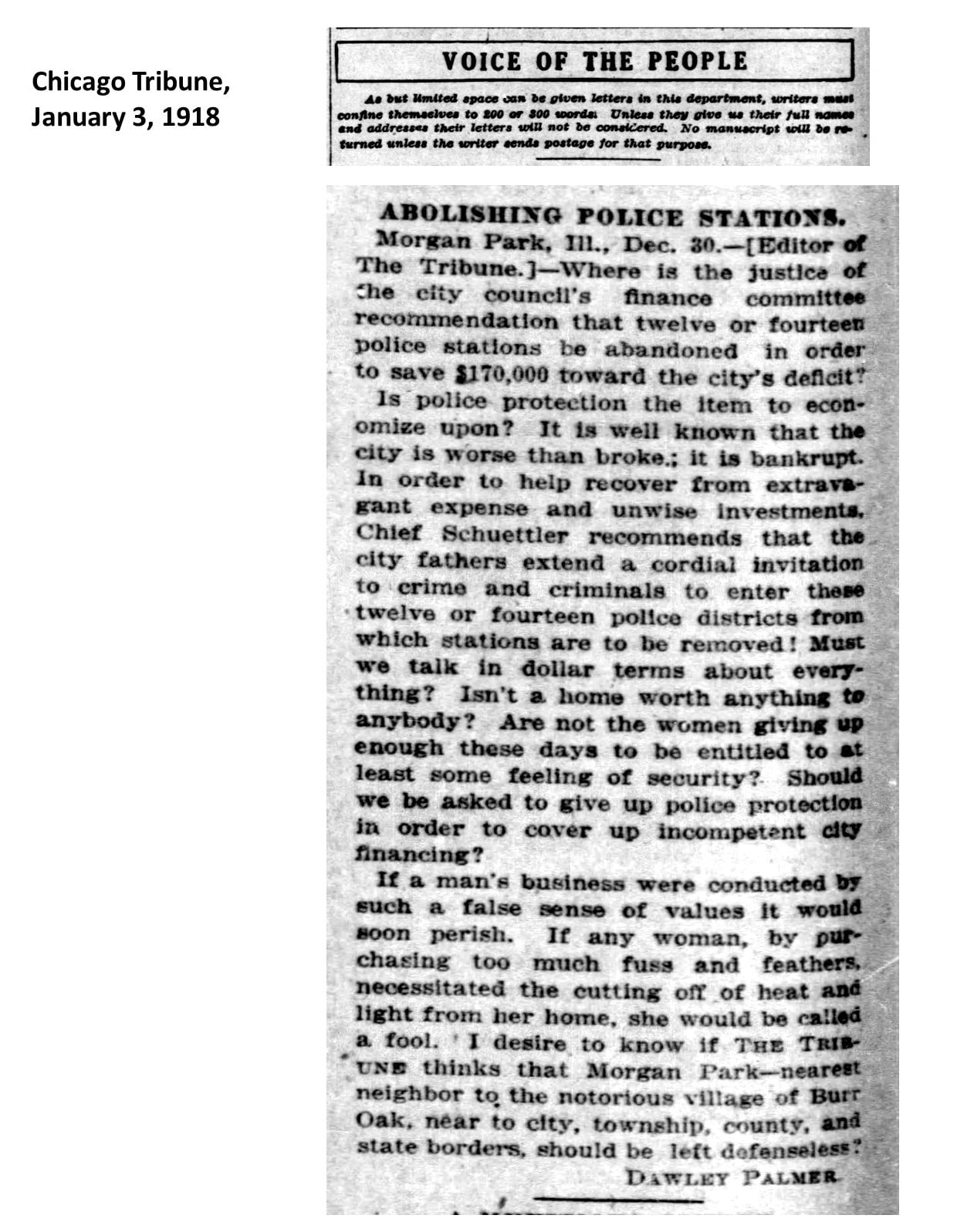
In 1917, there was again a new Police Superintendent, Herman F. Schuettler, an “efficiency expert” who had been acting chief four times. He proposed a reorganization of the police department, reducing the number of police stations from 45 to 22. He claimed that the money saved in administrative costs would be used to put more police officers out on the streets. The city council approved the plan. The Morgan Park station was on the list to close.
The residents of the Morgan Park area were very much against the closing of the station, and held a mass meeting attended by over 500 people to discuss what to do. The leaders of the effort to save the Morgan Park station included Aldermen Albert Fisher and James Rea; the head of the Morgan Park Business Men’s Association (MPBMA), Burten A. Knapp; and other civic organizations like the Morgan Park Improvement Association.
The concern was that the closest stations would be three miles away. A “committee” of 100 people was formed to visit city hall.
A “vigilance committee” was also formed at the time for “protection against criminal invasion.” Three hundred men signed up immediately, and money was raised to buy revolvers for all of them. A shooting range was planned so the men could learn to handle their weapons. It was announced a medal would be given to the first man who captured a criminal.
Schuettler met with fifty representatives of Morgan Park and assured them he would ask the city council finance committee to reconsider the issue. In the meantime, the vigilance committee continued its plans. It was also referred to as the “Home Guard Company” in local papers.
In January, Schuettler announced twelve stations, including Morgan Park, would close. However, he went on furlough after becoming ill, and the position of Superintendent was temporarily filled by John Alcock. Ten stations were closed in January 1918, but Alcock allowed Morgan Park and one other, Deering, to remain open. Deering was determined to be important because the manufacturing of war supplies went on in the district – the U.S. was involved in World War I at the time. But Morgan Park was allowed to remain open due to the pressure put on the mayor, city council, and police chief by the residents of the area and Alderman Fisher.
Then it was announced in February that the Morgan Park station would definitely close. Schuettler returned from his leave but continued to have health issues and was in and out of office during the spring.
The Morgan Park police station was finally closed on April 28, 1918. Adequate police protection in the form of mounted and motorcycle police was pledged, as well as a patrol wagon to be kept at the old station for emergencies.
The residents of the community planned to circulate a petition to reopen the station.
Schuettler died that summer and Alcock became acting superintendent again. Alcock gave a presentation to the people of Morgan Park from the pulpit of the Morgan Park Congregational Church in September of 1918. He told the audience that Jesus Christ couldn’t be chief of police in Chicago without being criticized. He said it was time to begin a larger and more loyal support of good policemen.
However, there were no plans to reopen the Morgan Park police station.
Next post: Morgan Park continues its fight for a police station.
Ridge Historical Society
National Police Week: The History of the Morgan Park Police Station – Part 2
By Carol Flynn
The Morgan Park police station was closed in 1918, four years after it was established when the village annexed to the City of Chicago. Morgan Park was now serviced by District 8 – Precinct 10, referred to as the Kensington station, located at 200 East 115th Street. The District 9 – Precinct 12 station at 8501 South Green Street, referred to as the Gresham station, was the other station that could service the area.
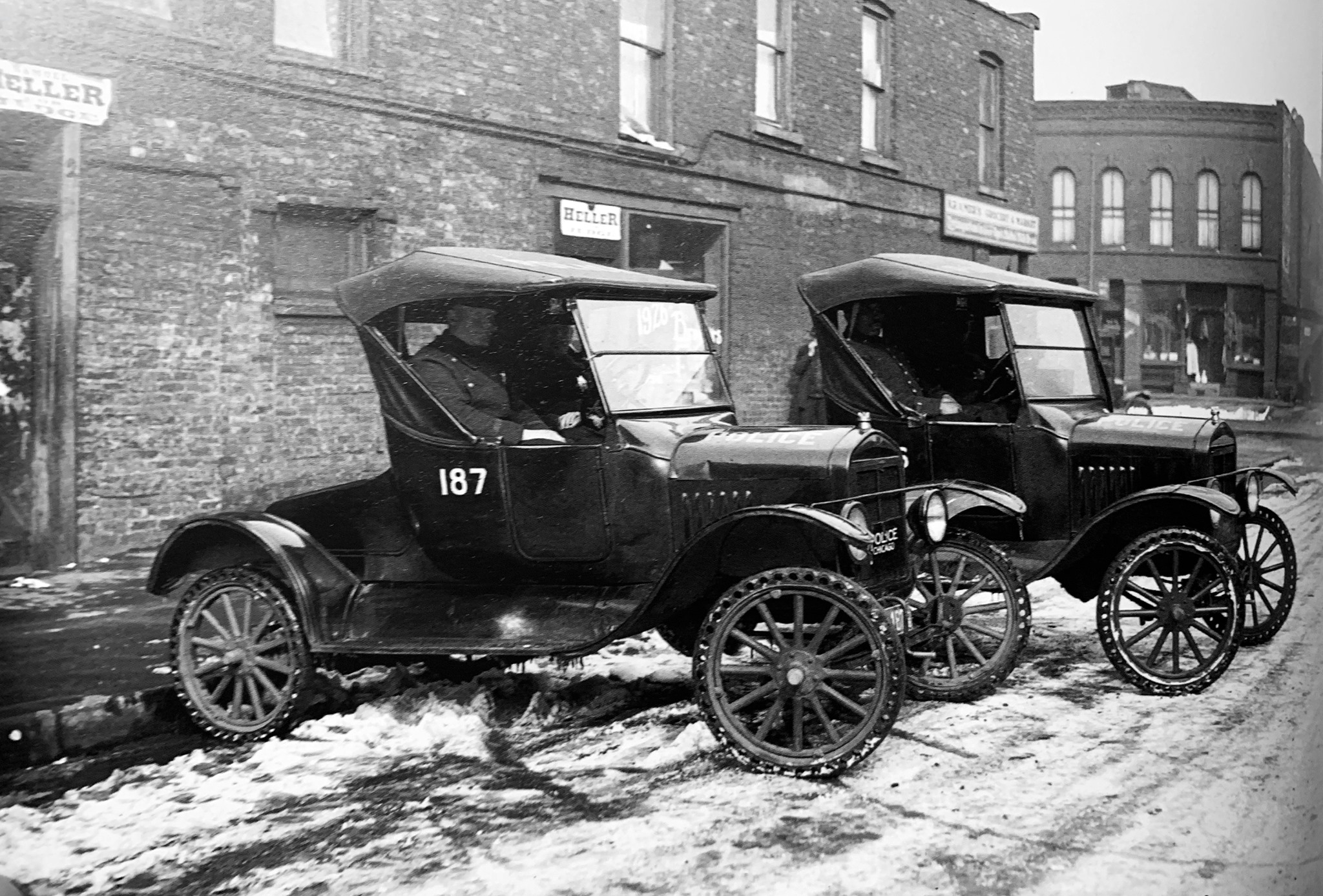
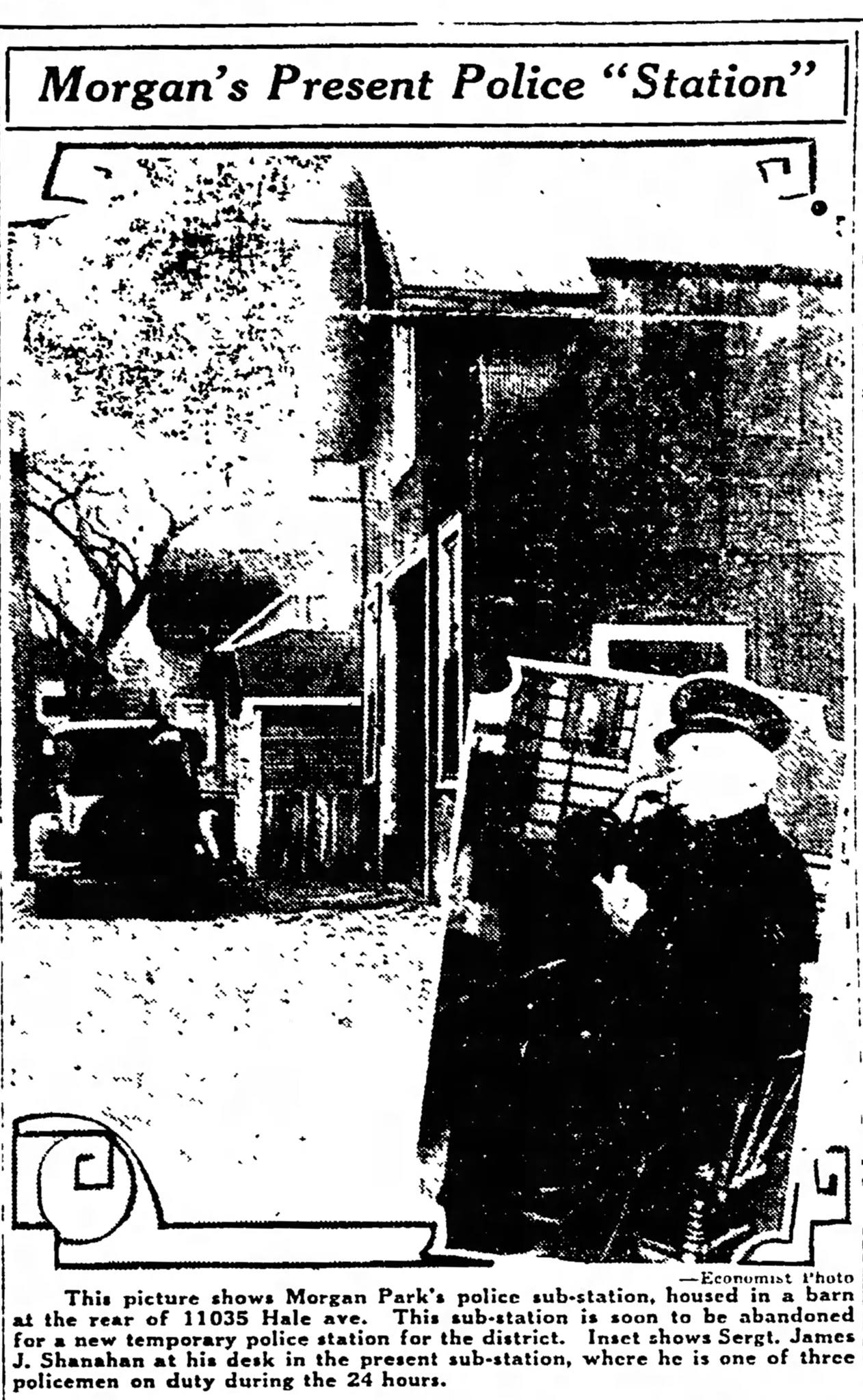
A frame building at 11033 South Hale Avenue was used as a small sub-station after 1918, with a few officers assigned there. The building was behind the storefront originally used as the town hall and was described in the papers as the “old barn in the alley.” One “flivver” squad operated out of the building and other police autos were stored there.
In 1925, the Morgan Park community requested that their area be transferred to the Gresham station as it would be easier and closer. It was also requested that the substation in the barn be moved to the storefront on the property, the old town hall. Concern was expressed it was inconvenient and inappropriate for women to have to walk down a dark alley to get help, especially at night. The transfer to Gresham happened in July 1926, but the relocation of the sub-station did not happen.
By 1927 the Morgan Park community was seriously petitioning the city to establish a new police station there. A series of home robberies and “peeping Toms” at the “scantily protected homes of Beverly Hills” and purse snatches along Vincennes Avenue had led to fear and concern. It was felt it took too long for a response from Kensington or Gresham.
Commissioner of Police Michael Hughes gave assurances that the department would try for a new station and personnel, but this would depend on securing the funding from the city. Hughes reportedly had already asked the city for 8,000 additional men.
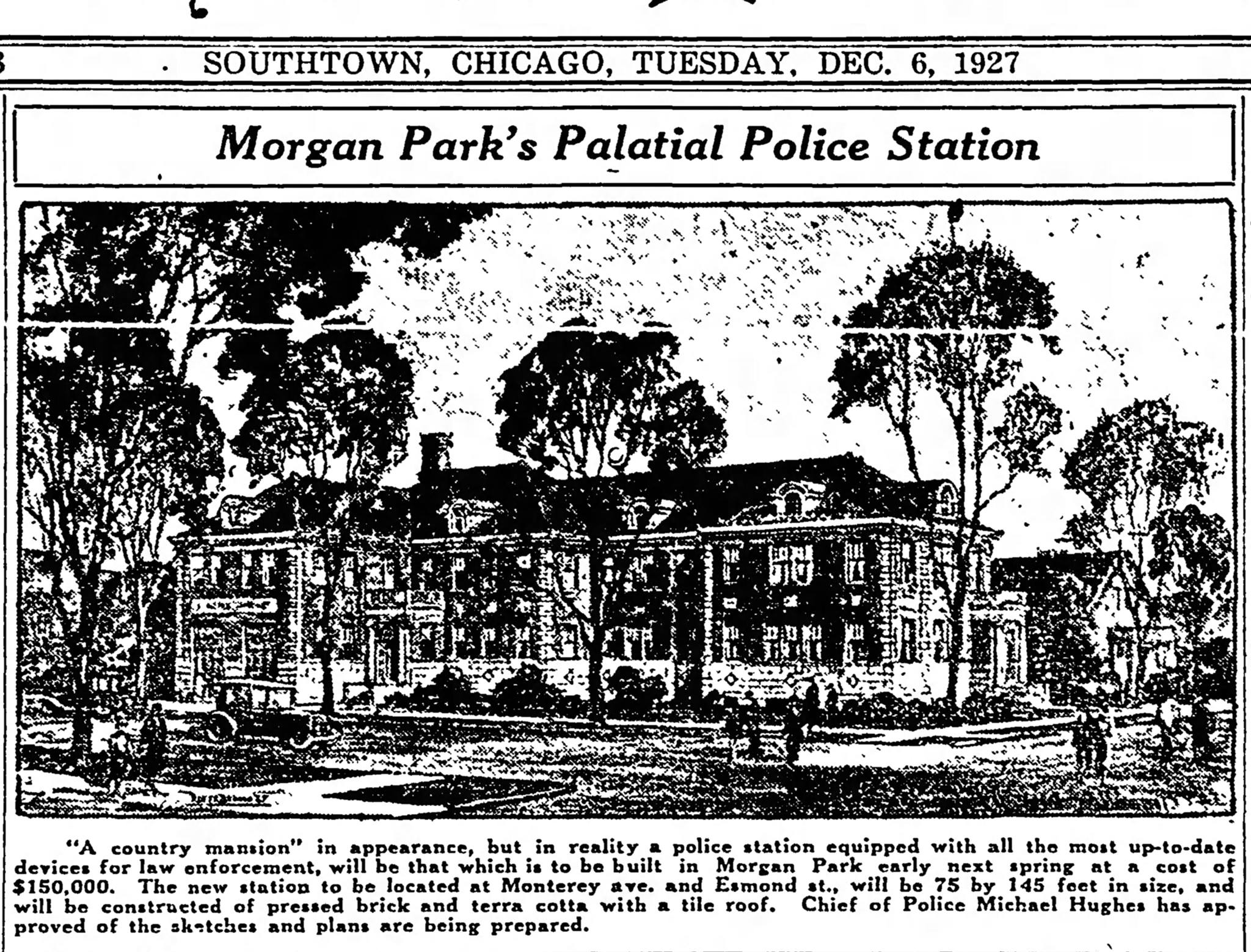
Later that year, it was announced that a state-of-the-art police station would be built at Monterey Avenue and Esmond Street in Morgan Park. The plans showed a brick building with professional landscaping that would include a courtroom, holding cells with showers, a dormitory, a gymnasium, and a garage. Designed by city architect Argyle E. Robinson to fit in with the architecture in the area, Hughes described it as “a beautiful building that would look more like a country mansion than a police station.”
Land was purchased at the northeast corner of Monterey Avenue and Esmond Street for the new station. In early 1928, it was reported that the plans for the new station had been approved by all necessary parties; the money had been set aside from a recent bond issue; bids were received and ready to be reviewed; and the contract would be awarded in time for the new station to be open by October.
This new building was never built. Instead, the funds were diverted to completing the central police station at 11th and State Streets.
Disappointed, in 1929, the citizens of Morgan Park again went back to the Commissioner of Police, now William Russell.
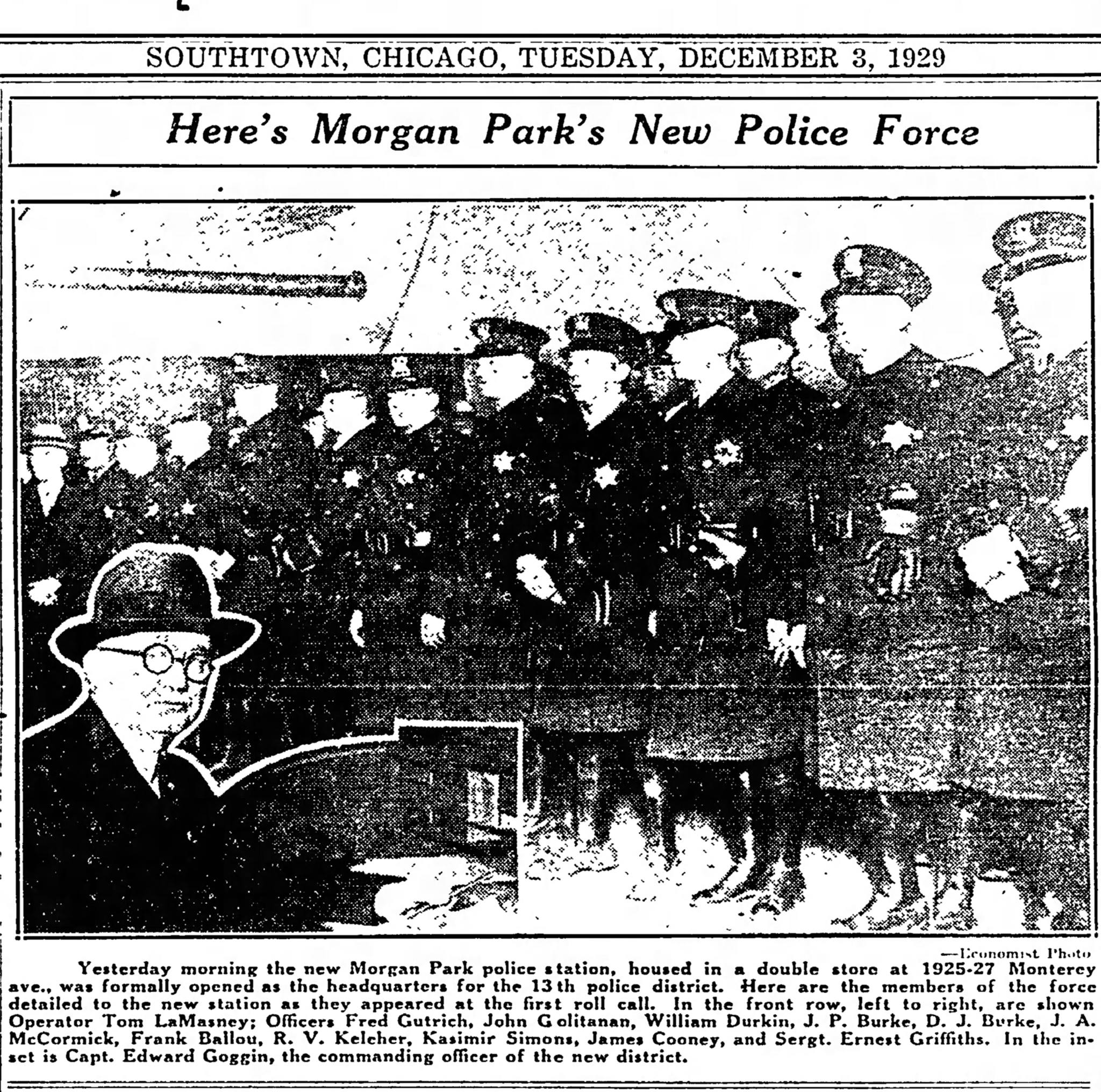
The city agreed to rent a double storefront at 1925-27 Monterey Avenue to use as a new station. The location was considered temporary until the funds could be found to build a new station. The facility was remodeled, telephone lines were installed, and the new 13th District opened on December 2, 1929. The day sergeant from the alley substation became the day sergeant in the new facility.
The boundaries of the new district were Halsted Avenue, 99th Street, and the city limits to the south and west. Mount Greenwood had annexed to the city in 1927 and was included in the new district. There were no holding cells or garage at the facility, so prisoners and wagon calls still had to be handled out of Gresham or Kensington.
The Ridge community welcomed the new police staff with a parade, entertainment, speeches, and a luncheon at Morgan Park High School. Every civic group in the community was represented at the event. The entertainment was provided by a vocalist, a trio of police singers, and the high school band.
In January 1936, it was announced that the city had received over $11 million in grants and loans from the Public Works Administration (PWA). This was a federal program during the Great Depression to supply jobs to unemployed men for construction projects. PWA funds could be used for 45% of the cost of a public building. City architect Paul Gerhardt designed a “standard” police station to be built in several locations, including Morgan Park.
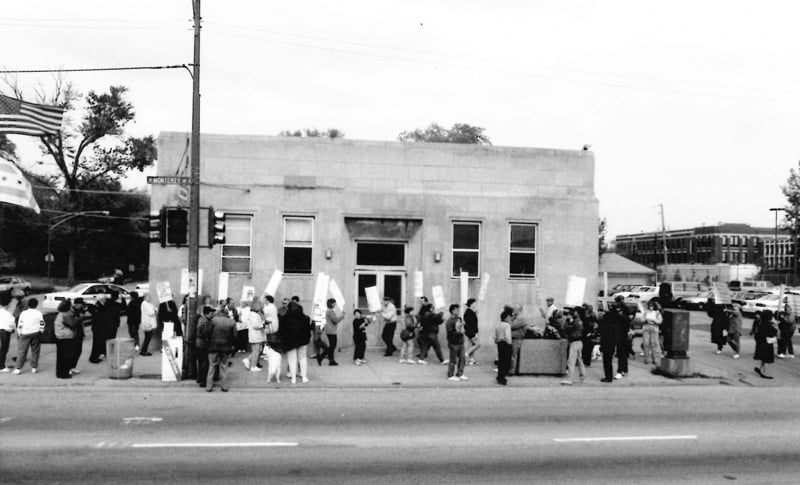
A new cement art deco-style station was finally built in 1936 at 1830 West Monterey Avenue. This one included holding cells and a garage. Morgan Park finally once again had a completely functional police station.
And then in 1961, the unthinkable again happened – the City of Chicago closed the Morgan Park police station.
Next post: Once again Morgan Park seeks to reestablish its police station.
Ridge Historical Society
National Police Week: The History of the Morgan Park Police Station – Part 3
By Carol Flynn
This is the timeline for the Morgan Park police station:
1914 – The Village of Morgan Park annexes to Chicago; a Morgan Park police station is established as part of the Chicago Police Department, incorporating the four officers previously employed by the Village.
1918 – Morgan Park station is discontinued; a small substation continues in a barn.
1928 – A new station is planned but never built.
1929 – A new Morgan Park station opens in a storefront at 1925-27 Monterey Avenue.
1936 – A new station is built at 1830 W. Monterrey Ave.
1961 – The Morgan Park police station is closed once again.
1975 – The Morgan Park police station is reopened at 1830 Monterey Ave.
1983 – The City of Chicago announces plans to close the Morgan Park police station again but the community prevails in keeping the station open.
2004 – The current 22nd District Police Station at 1930 W. Monterey opens.
Throughout its history, the City of Chicago has gone back and forth on the philosophy of a centralized versus a decentralized police station. “Centralized” calls for command and decision-making coming from fewer people at the top levels of the hierarchy, resulting in fewer facilities to maintain with fewer administrative staff. The belief is that less budget spent on administrative costs frees up more for actual officers out on the street. When the pendulum swung toward centralized command, Morgan Park lost its police station and had to rely on services from either Kensington or Gresham.
When the pendulum swung toward “decentralized” policing, that is, command and decision-making are focused in the communities where the services occur, Morgan Park got its police station back. And of course, this being Chicago, the role politics played in deciding where police stations were established – or removed from – can never be discounted.
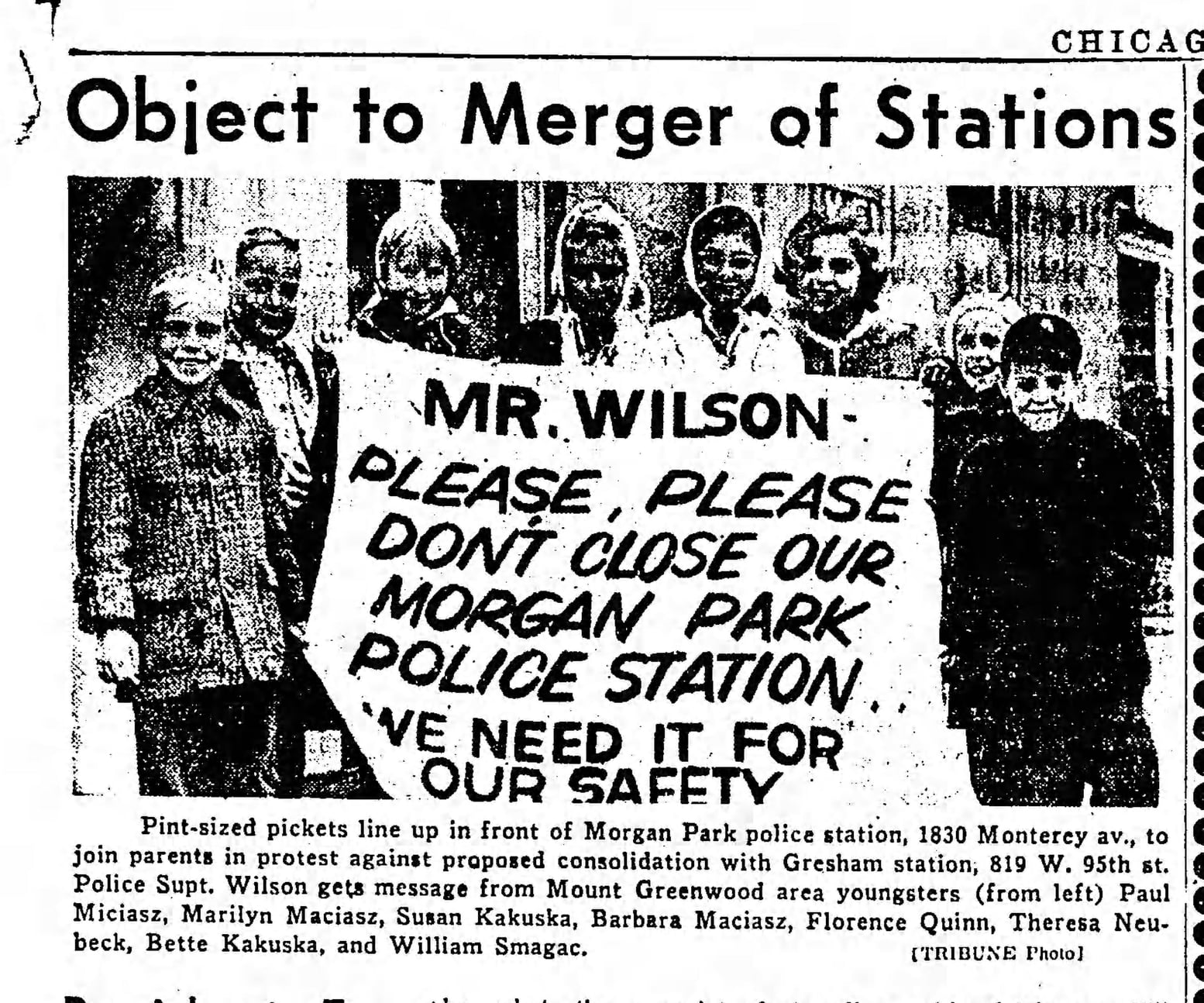
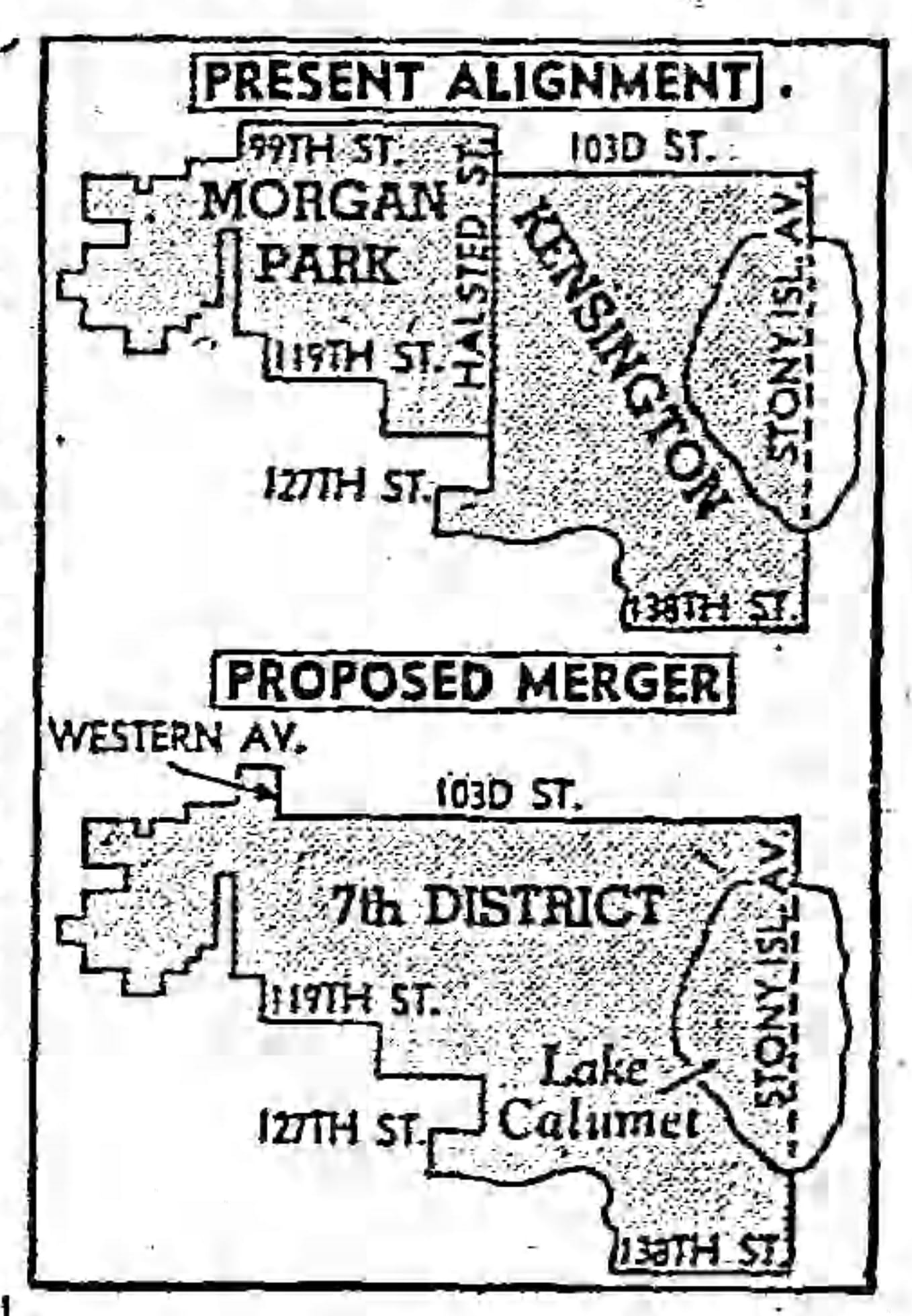
In 1960, it was announced that the City of Chicago was reorganizing the police department again, consolidating districts and closing some stations. Just as in 1918, the rationale was that less money spent on administration would allow for more police on the street.
The proposal included combining the 12th and 13th districts and eliminating the Morgan Park station at 1830 West Monterey Avenue. The community, led by the Beverly Area Planning Association (BAPA), strongly opposed this. But appeals to the mayor, city council, and police department went unheard, and the station closed at midnight, December 18, 1961. The Chicago Board of Education took over the old police station.
In the spring of 1975, it was announced that the Morgan Park police station would reopen in the building on Monterey. The current Police Superintendent, James M. Rochford, supported decentralized policing efforts. In the past, the main reason the districts were aligned the way they were was actually due to the technology at the time – the coordination of the telephone exchanges system and the police radio zones. The telephone system was due to be computerized, which would end this system and allow the police department to set boundaries based on community needs rather than telephone lines.
The 22nd Police District opened its doors in March 1975 in the existing building at 1830 Monterey, necessitating the Board of Education to vacate the premises.
The boundaries of the district were the Dan Ryan Woods on the north; the Chicago, Western, and Indiana railroad tracks on the east; and the city limits on the south and west.
In 1983, it was once again proposed that Morgan Park be one of three stations to close to reduce administrative costs for the city. The community fiercely fought the closing and it did not happen.
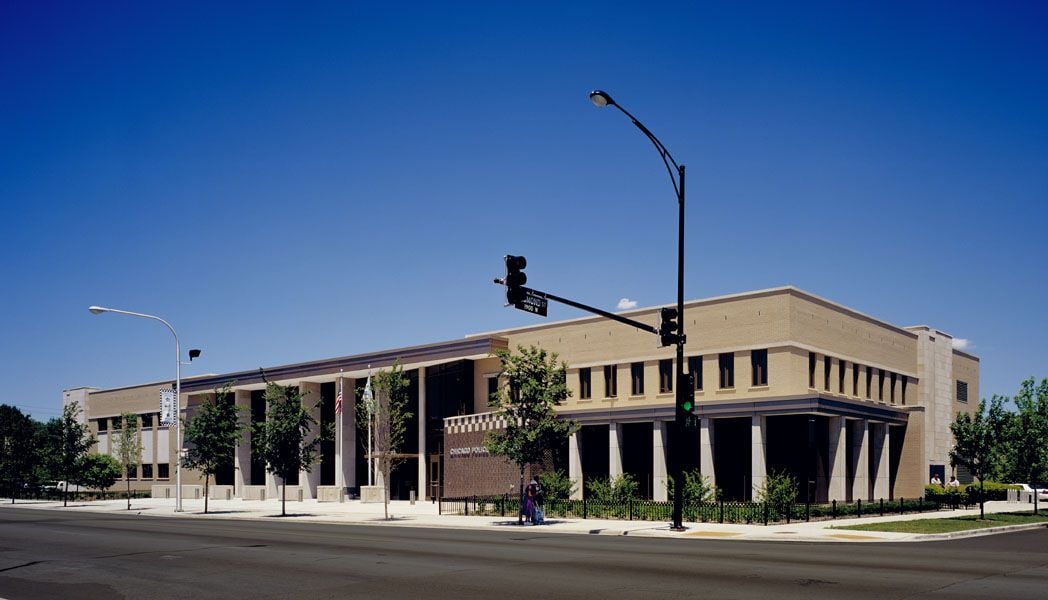
In 2000, it was announced that as part of a continuing program to replace aging and outmoded police stations citywide, a new station would be built at 111th and Esmond Streets. The city used its power of eminent domain to acquire some of the property, forcing the removal of some occupied homes. The Edna White Community Garden had to relocate to the land vacated across the street when the old building was torn down.
The new facility opened at 1900 West Monterey Avenue in the summer of 2004. Where the old station had no lockers, no private rooms for discussions, no holding cells, no parking lot, and limited technology, the new station not only had lockers, it included a fitness room. It had a community room and private meeting rooms, a lockup, two parking lots, and, most important, high-tech equipment. It was also built to be “green,” using recycled materials and energy-efficient design elements.
The 22nd District has been operating out of this building for seventeen years.