
Explore the RHS Facebook Archives, a rich repository of local history written by Carol Flynn. For two decades, Carol brought a deeply dedicated voice to public education at RHS. Her role as Facebook administrator through mid-2025 naturally extended her prolific research into meticulously detailed articles, most notably her multi-part historical series posts. Today, Carol continues her local history writing for The Beverly Review and other outlets.
Irish American Heritage Month
The Ridge Historical Society
March – Irish American Heritage Month and Women’s History Month – Post 2
By Carol Flynn
For March, we’ll be alternating stories between Irish American heritage and women’s history on the Ridge.
Beverly is known today as one of the most Irish Catholic neighborhoods in Chicago. According to the U.S. Census Bureau, in West Beverly (west of Western Avenue), almost 55% of residents report Irish ancestry, the highest concentration in the city. Mount Greenwood and West Morgan Park are each about 45% Irish, and Beverly about 25%. Chicago, as a whole, is about 7.5% Irish.
Many people, including new home buyers in Beverly, think this has always been the case. It’s not surprising they would think this, given the media’s penchant for using terms like “Beverly’s deep Irish roots” to describe the community, implying this goes way back in history.
In reality, the large Irish presence in Beverly is a much more recent phenomenon, not solidifying until about 1980, well more than a century after the area was first settled.
Beverly was originally settled mainly by English and other European Protestants as a “bedroom community” for wealthy businessmen attracted to the Ridge by its scenic beauty. They built country estates here and invested in property for development, while most of their business and social lives were centered in downtown Chicago.
Morgan Park was planned as an education, temperance, and religious community, with the Baptist Theological Seminary founded here. Mount Greenwood was primarily farmland, with ministers who preached hard work and temperance.
There was always an Irish presence on the Blue Island Ridge, however small, even in the earliest days, although it would be impossible to say who was the first person of Irish descent to ever step foot here.
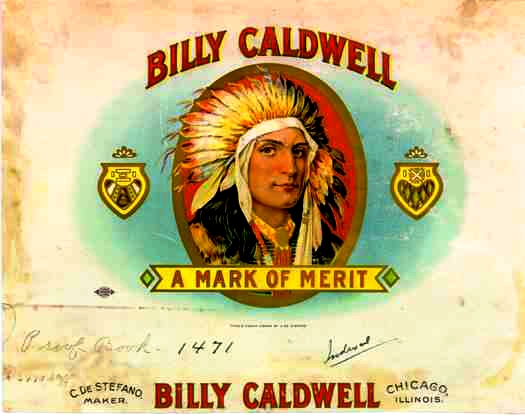
One early person was Billy Caldwell, also known as Chief Sauganash and the “Irish Indian.” Caldwell (1782-1841), the son of a Scots Irish officer in the British Army and a Mohawk mother, was raised Catholic from the age of seven on by his white stepmother. He came to Chicago in 1820 from Canada as a fur trader.
Billy Caldwell became an important figure in Chicago history, and there are historical references to his visits to the Blue Island area.
Fluent in French, English, and Native American languages like the Algonquin language used by the Potawatomi people most prevalent in the Chicago area, Caldwell became a leader among both the Potawatomi people and the white settlers.
Caldwell was known to guide survey and expedition teams through the area. During one visit, he was part of a team that lost everything when their wagon capsized in Stony Creek at the southern edge of the Ridge, so they stopped at a dwelling along the Vincennes Road where they were given food and spent a cold night outside by a fire.
Caldwell was credited with the idea of building the Cal-Sag Channel to be a feeder into the Illinois and Michigan Canal.
Before he led the Potawatomi out of Chicago in 1836, after the Treaty of Chicago, it was reported the “old Irish Chief” rode his pony through the prairies near the Ridge.
The Sauganash area on Chicago’s north side, the Billy Caldwell golf course, and Caldwell Woods in the Cook County Forest Preserves all get their names from this man.
More on Beverly becoming “Irish” will be in upcoming posts.
This idealized image of Billy Caldwell was used for a cigar brand many decades after his death.
The Ridge Historical Society
March – Irish American Heritage Month – Post 2
By Carol Flynn
Happy St. Patrick’s Day!
Today we present part 2 of how Beverly became an Irish Catholic community.
Although founded by Protestants from England and other northern European countries, from the earliest days on, there was always an Irish Catholic presence on the Ridge.
One person was John Lynch (1825-1890), who came in 1844 to work for Thomas Morgan, the wealthy English Protestant who bought thousands of acres on and around the Ridge, and for whom Morgan Park is named.
Lynch, born in Ireland, worked for Morgan for seven years before buying his own farmland around 105th and Loomis Streets.
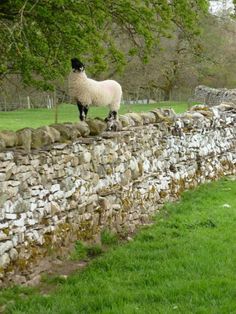
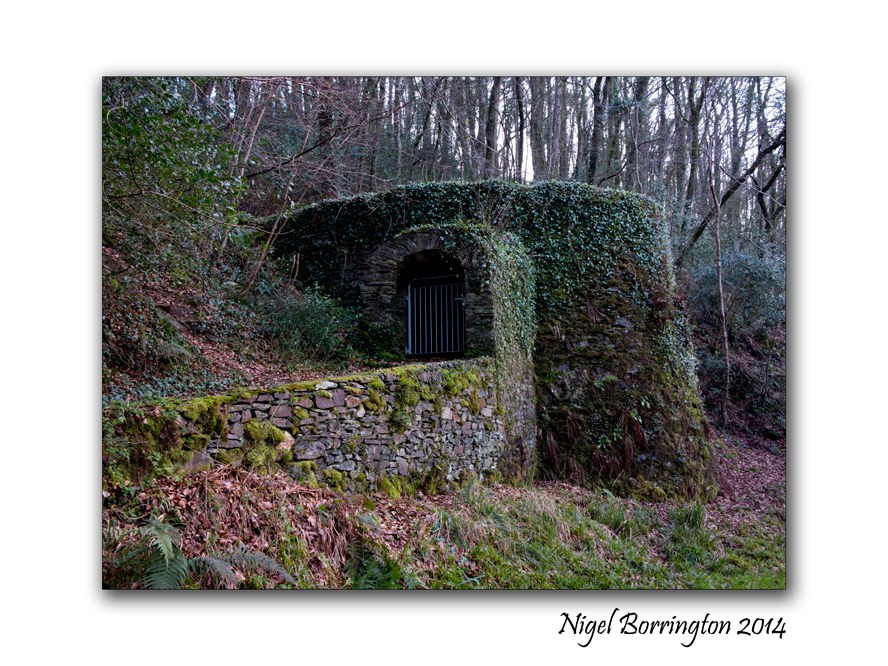
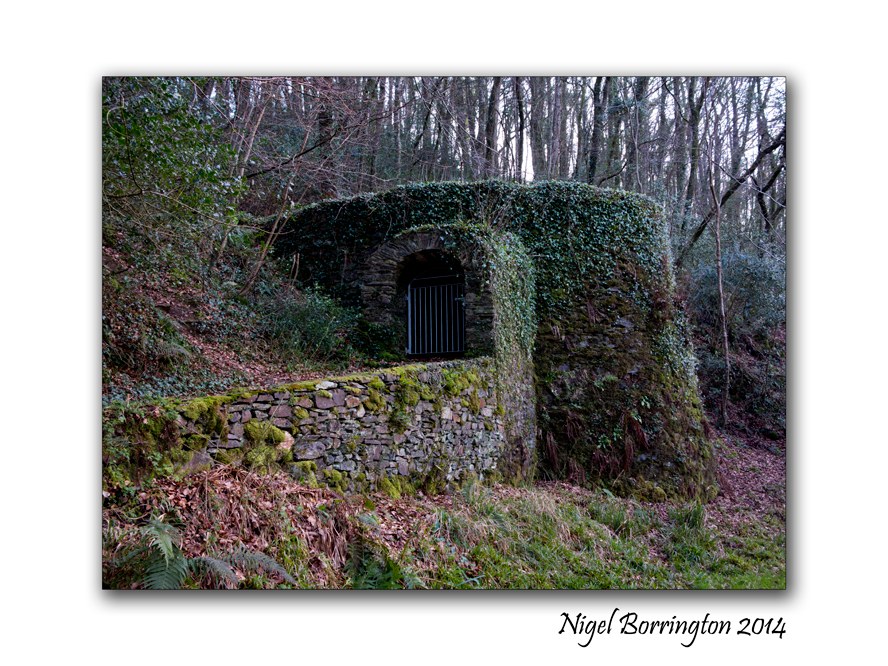
The young Lynch helped Morgan build and manage his estate. In true Irish style, Lynch built a substantial sheep cote and subterranean icehouse from limestone he quarried and dragged from Blue Island. Nestled into the Ridge, the structure opened onto what is now Longwood Drive between 91st and 92nd Streets.
Lynch married Margaret Martin (?-1874) from Ireland, and they had three children. Their descendants have lived on the Ridge for many generations.
More than a million Irish people emigrated from their homeland during and after the Irish Famine years of the 1840s. The Irish Catholic population grew in the Chicago area.
There were also German and French Catholics in the area. The first Catholic parish serving the northern part of the Ridge, Saint Margaret of Scotland, began as a mission church operated by St. Benedict Church of Blue Island sometime around 1861. St. Benedict Church was founded for the German Catholic population working on the canal. Sacred Heart Mission Church moved from Alsip to its present location at 117th and Church Streets to serve the French Catholics working in the local brickyards.
As part of Washington Heights, Beverly was annexed to the City of Chicago in 1890. West Beverly and Morgan Park followed in 1914 and Mount Greenwood joined the city in 1927.
The next post will cover the founding of St. Barnabas Parish.
The Ridge Historical Society
March – Irish American Heritage Month – Post 3: More on the Sheepfold/Icehouse
By Carol Flynn
The post on St. Patrick’s Day about the sheepfold and icehouse built on Thomas Morgan’s estate in North Beverly by John Lynch was well received – almost 4,000 people have been reached so far. However, that post only covered part of the story. Since the topic proved to be a hit, here are more details about that structure.
John Lynch was seventeen years old when he arrived in New York from Ireland in 1842. Although his individual story is not known, it’s likely that he joined the many thousands of his fellow Catholic countrymen driven by hardship to leave their native country and seek out new opportunities.
Lynch encountered wealthy English Protestant Thomas Morgan who had purchased thousands of acres of land on and surrounding the Ridge. In 1844, according to Andreas’ History of Cook County (1884), Lynch arrived on the Ridge, and worked for Morgan for seven years, until Morgan’s death in 1851. Lynch then bought his own land around 105th and Throop Streets, which he farmed.
It appears that young Lynch helped Morgan build and manage his estate. Morgan brought some livestock with him from England on his private ship, and probably purchased more once in the U.S. Enclosures to protect the livestock from wolves and the harsh Chicago winters were necessities. Also, ice cut in winter could be stored in subterranean rooms for a supply in summer. This helped with food preservation.
The Andreas book includes the following information on the sheepfold and icehouse that Lynch built, in true Irish fashion, on the Morgan estate. The information was shared by Isaiah T. Greenacre, an attorney who grew up in Washington Heights.
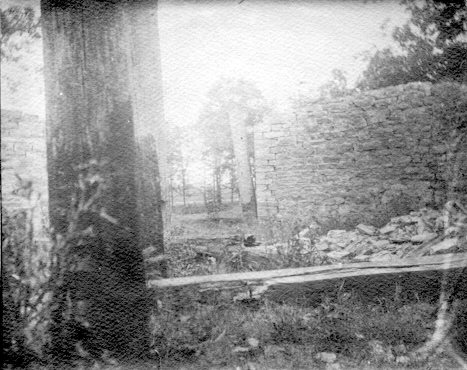
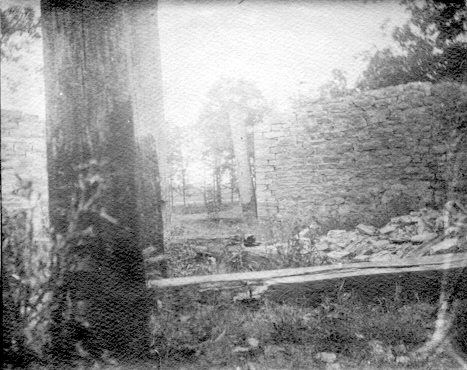
“Directly in front of the dwelling [the remains of Morgan’s house, Upwood] and on the slope of the hill is a stone structure, or rather a large pit, lined with a stone wall, which wall extends, or once did, far above the top of the hill, but of late years, time has reduced it nearly to a parallel with the hillside. At the east side of the wall and at the base of the hill, is an immense opening, once composed of two tremendous oak doors (now broken and probably used for kindling wood) fastened to the wall by enormous iron hinges that reached across each door. The walls are built of very rough stone. Mr. J. Lynch, Sr., the contractor of this wall, quarried the stone of Blue Island, and did the hauling of the stone and all; he alone having to play the part of stone quarrier, teamster and stone mason. It must have been a very tedious job. On entering this pit, which seems to have answered the purpose of a sheepfold, you find its floors to be composed of bits of stones, in all probability fragments of the wall, and other rubbish, likely the accumulation of years. On the west side and leading in toward the hill is an opening in the wall. On crossing the threshold of what was once a doorway, you imagine yourself about to descend into the depths of darkness by a subterranean passage. But ‘ere you have walked within the distance of about thirty-six inches, you presently find yourself in a round turret shaped cell, with an oval ceiling. In the ceiling is an opening which leads to the surface of the ground. This opening is covered by an immense stone placed over the hole where it makes its appearance on the hill. This cell is built of brick, and unlike the sheep-fold it has a good stone floor. It seems that at one time there was a door dividing the cell from the fold. It seems the cell answered the purpose of an icehouse, and the opening a mere ventilator. The place seems to have stamped on its surface everywhere antiquity.”
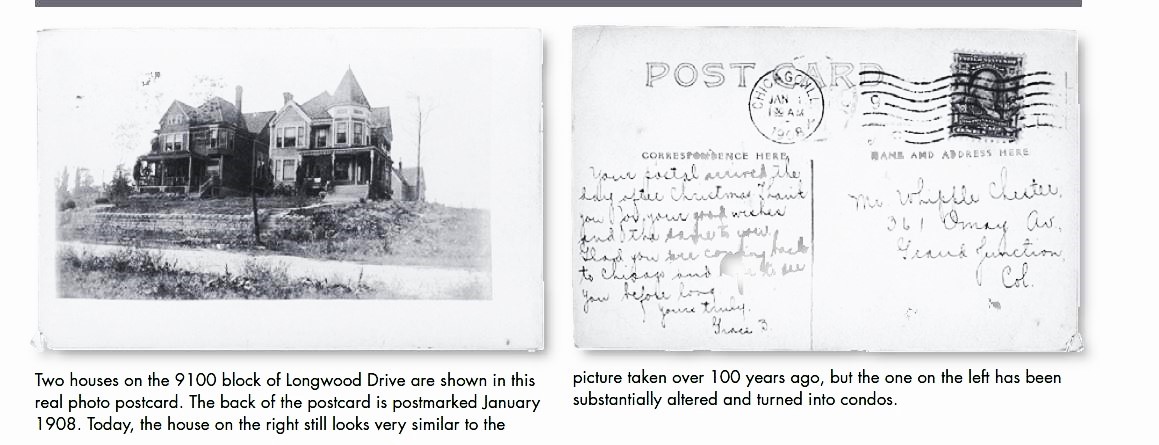
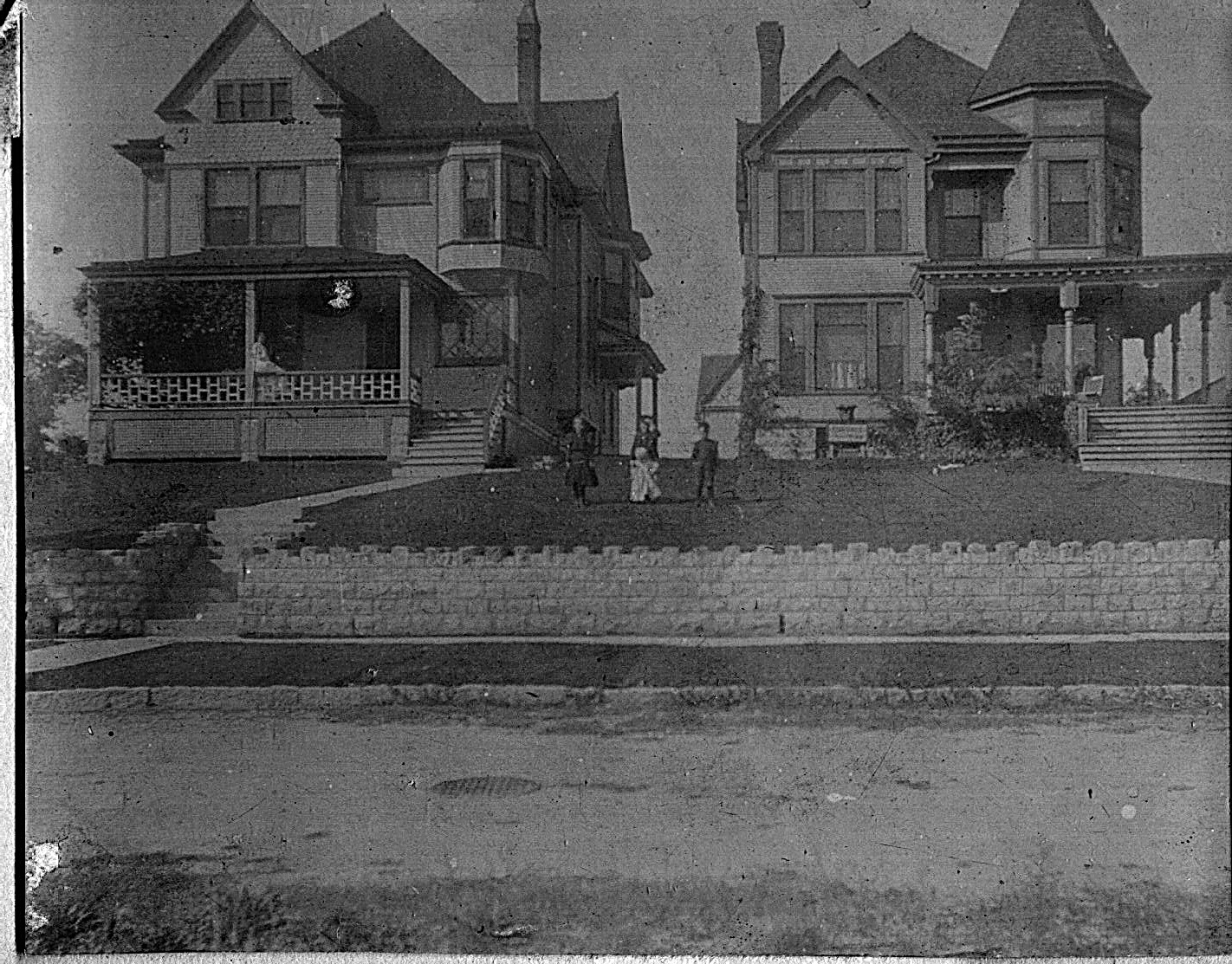
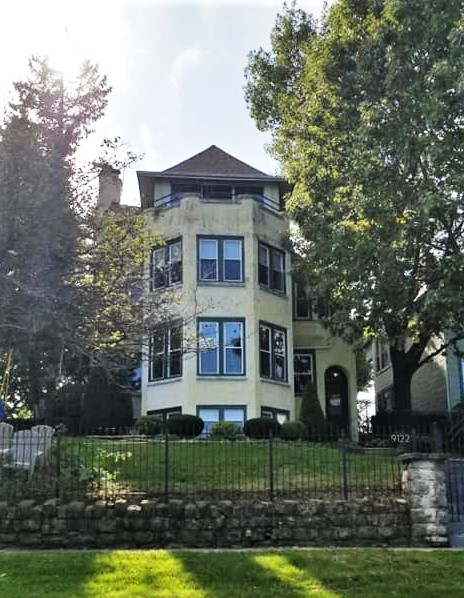
The sheepfold/icehouse opened onto what is now Longwood Drive between 91st and 92nd Streets. There is nothing left of the building today, but pieces of limestone from the structure appear to have been used for other purposes in the area.
The current houses on this site have a limestone wall in front of them that possibly is made from the remains of the sheepfold/icehouse. The house at 9122 S. Longwood Drive was owned and turned into an apartment building by architect John Todd Hetherington in the 1920s.