
Explore the RHS Facebook Archives, a rich repository of local history written by Carol Flynn. For two decades, Carol brought a deeply dedicated voice to public education at RHS. Her role as Facebook administrator through mid-2025 naturally extended her prolific research into meticulously detailed articles, most notably her multi-part historical series posts. Today, Carol continues her local history writing for The Beverly Review and other outlets.
Chicago Weather History and the Current U.S. Conditions
The Ridge Historical Society
Chicago Weather History and the Current U.S. Conditions – Part 1: Fire
By Carol Flynn
Our concern lies with the sections of the country that are experiencing extreme weather conditions that are creating disastrous situations.
All eyes are turned towards the fires spreading through Los Angeles County in California. At the time of this post, at least four separate wildfires, burning on over 5,500 acres, have been identified, named the Palisades, Eaton, Hurst, and Woodley Fires. All are at 0% containment. Two fatalities have been reported, as well as a high number of significant injuries, and over 1,100 structures have been destroyed. Eighty thousand people are under mandatory evacuation orders. Hundreds of thousands of people are without power.
Neighboring Riverside County also has the Tyler Fire burning, reported at 50% containment.
The spread of the fires is a result of very strong Santa Ana winds, with isolated gusts up to 100 miles per hour; ongoing drought conditions; and very low humidity levels. The actual causes of the fires are under investigation.
Not to be tone deaf or insensitive, because the critical story here is the situation in California, but people interested in Chicago history can’t help but see the parallels between the Los Angeles situation and the Great Chicago Fire of 1871.
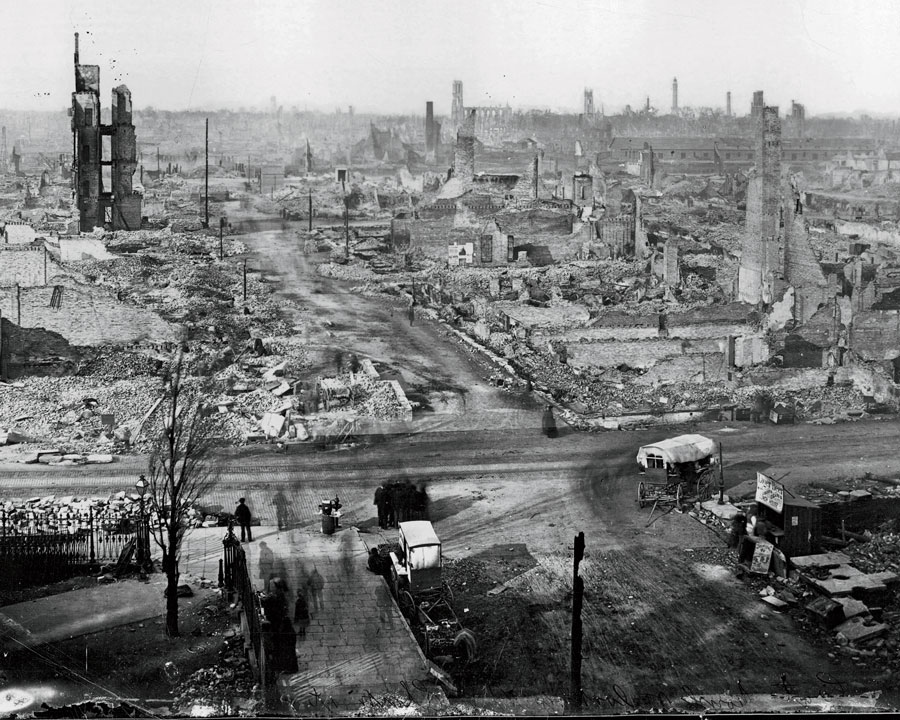
From October 8 to 10, 1871, fire raged through the City of Chicago, ultimately killing an estimated 300 people and leaving more than 100,000 people homeless. Over 17,000 structures in about a 3.3 square-mile area were destroyed.
The fire started around the barn and shed at the O’Leary residence on DeKoven Street. Although the fire was blamed in the media on a cow kicking over a lantern, in reality, the cause of the fire has never been determined.
Like Los Angeles, a long period of hot, dry, windy conditions led to the Chicago fire spreading rapidly.
In Chicago at the time, congested neighborhoods of wooden structures and wooden sidewalks provided plenty of fuel for the fire. The fire twice leapt the Chicago River, destroying the near southwest side, most of downtown, and the near north side. The building housing the city’s waterworks was consumed by flames, destroying the water mains, leaving fire fighters helpless.
The Chicago fire finally started to burn itself out after reaching more sparsely built areas, and then it began to rain late in the evening of October 9th.
People on the Blue Island Ridge, about twelve miles south of the downtown area, watched the Chicago fire light up the night sky. They were no strangers to fire.
One of the issues in Los Angeles is the dry vegetation due to the drought conditions. This is very much like the prairie fires that burned here in autumn-time in years past.
William W. Barnard shared this account in his document, “Tracy Fifty Years Ago,” written in 1894. The Barnards lived at 103rd Street and Longwood Drive, where today stands the CVS drug store.
“Prairie fires were very frequent and much dreaded. I feel that no account of the early days of Tracy would be complete without a prairie fire. In the afternoon of an autumn day of 1845 our family had their first experience with a prairie fire. Grandfather had died within the first few months of their residence here. The eldest son was sick in bed with the ague. Grandmother with her four younger sons and fourteen year old daughter went out to fight the flames. Aunt Mary, who was too small to help, remained at home carrying water to her brother and watching the fire. As she looked to the west and the south she heard the loud roaring and saw the flames running ten to twelve feet high where it reached the tall weeds and extending as far as she could see. Eagerly she watched the family who were fighting the flames. They had nothing with which to plow and they could only set back fires and whip it with wet bags and brush. They worked heroically but were continually obliged to retreat. Nearer and nearer the house it came, but at last when it came to the low grass only a few rods from the door the fighters conquered. It was the custom to plow around the houses and stacks for protection against these fires. Sometimes two circles were plowed and the grass in the space between them burned off, thus an effectual barrier was made. Dr. Eagan, one of the early doctors of Chicago, asked one of the farmers the best way to protect his hay stacks from fire and was told to plow around them and burn between. He followed out the instructions by plowing several times around the stack and then burning between the furroughs and the stack which resulted in his burning up his own hay.”
Unfortunately, natural disasters such as fires, and recovery from them, make up a substantial part of history, and we are bearing witness to this right now. As we continue to monitor the situation occurring in California, Chicagoans will prepare to join any and all efforts to help the people devastated by these wildfires.
Image: The aftermath of the Great Chicago Fire of 1871