
Explore the RHS Facebook Archives, a rich repository of local history written by Carol Flynn. For two decades, Carol brought a deeply dedicated voice to public education at RHS. Her role as Facebook administrator through mid-2025 naturally extended her prolific research into meticulously detailed articles, most notably her multi-part historical series posts. Today, Carol continues her local history writing for The Beverly Review and other outlets.
Halloween
The Ridge Historical Society
Happy Halloween
By Carol Flynn
Halloween originated in Ireland and came to the U.S. with the Irish immigrants in the 1800s.
They believed that at this time of year, the veil between the spirit world and the physical world was the thinnest and human and non-human spirits could more easily cross over. They were fine with visits from their deceased loved ones; in fact, they even set places at the dinner table for them.
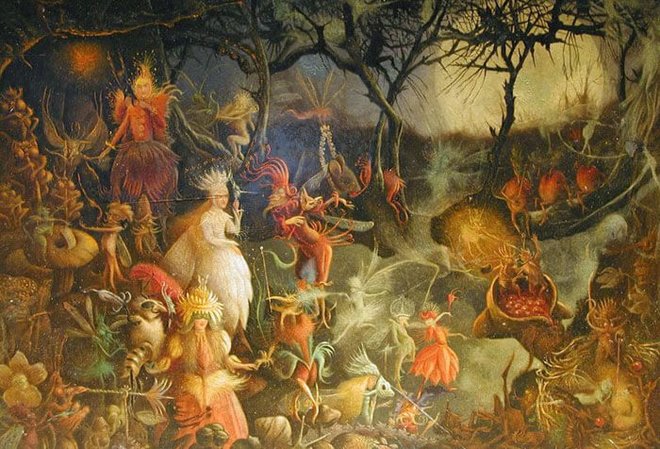
But the non-human spirits, the demons and the fairies, were another matter.
The traditions of wearing costumes and placing lit-from-within turnips in windows to drive away the evil spirits, and leaving out treats to keep the fairies from playing tricks, were customs that the Irish brought with them to the U.S.
Since that time, U.S. residents of all backgrounds have embraced the day with its traditions and turned it into a day of celebration. In Chicago, “autumn” is synonymous with “Halloween time.”
Creating “haunted houses” started to become popular in the U.S. in the 1930s. In more recent years, decorating houses for Halloween has become a huge part of the holiday. According to the National Retail Federation, it’s estimated that in 2023, people in the U.S. spent $3.9 billion on home decorations.
The Ridge area has many finely decorated houses for today, and one in Blue Island is proving to be popular, both because of the decorations and because of the house itself.
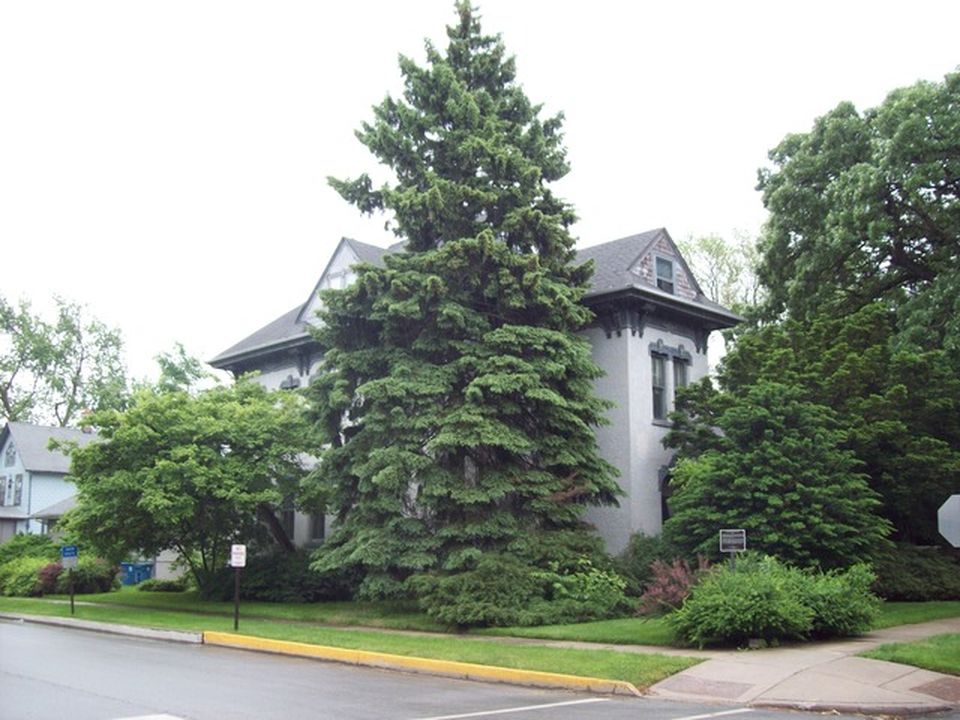
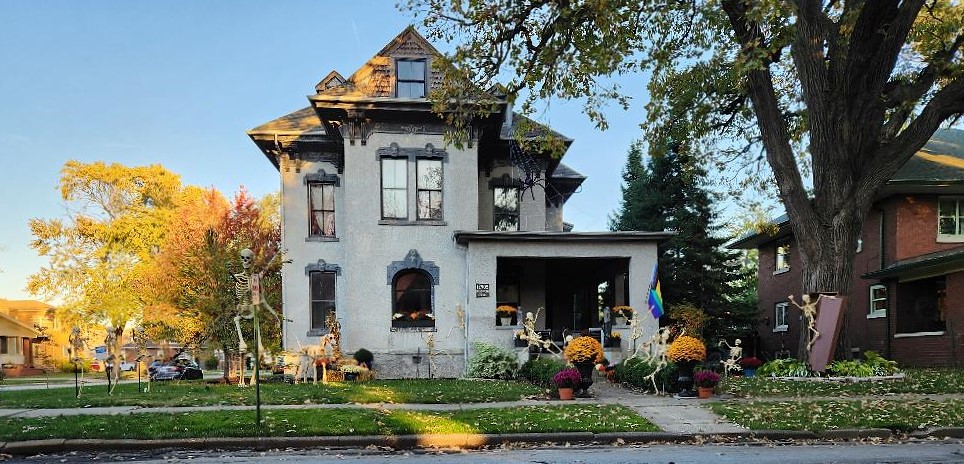
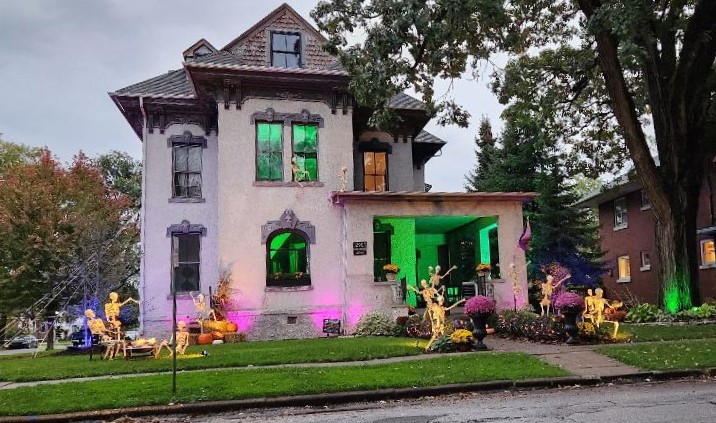
The Charles S. Young House at 12905 Greenwood Avenue, has a collection of skeletons at the front entrance and on the front lawn that has been added to each year, displayed in various poses – climbing out of a coffin, etc. Lit at night, it has the desired dramatic and spooky, yet fun, effect.
The house itself, of Italian Gothic Revival style with large, dramatic proportions, was built in 1886 for Young, part of a prominent family of real estate investors. The architect is not known.
Charles Young was the first president of the Blue Island Library Association, and his wife Jennie Alexander Young was a charter member of the Blue Island Woman’s Club.
The next tenant rented the house and ran a residential hotel for railroad employees there. The house was then purchased and lived in for many years by a member of the well-known Blue Island business family. The third owner was a Holocaust survivor who was known for helping people in need, including housing recovering substance abuse patients in the house.
Upon that owner’s death, the house became vacant and was on and off the market for years. It became derelict, overgrown with evergreen trees and other vegetation. Of course, it developed the reputation for being haunted.
When the current owners purchased the house in 2019, the realtor asked them if they realized they were buying a haunted house. They responded, enthusiastically, “Oh, yeah!”
They have spent the last five years lovingly restoring the house to its former glory, and they do admit that they have had a few unusual experiences in the house.
They took those as welcoming signs, and believe that any presence there is positive, not menacing.
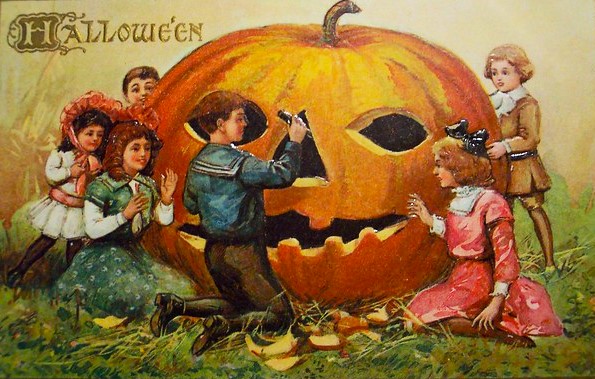
Happy Halloween from the Ridge Historical Society.
Halloween has become a truly American holiday but its origins are in Ireland. The traditions that the Irish brought over to the U.S. in the 1800s turned into today's Halloween customs.
About 2,000 years ago, the Celtic New Year of Samhain was born. The new year started with the end of the harvest. The people believed that at this time of year, the barrier between the physical and spiritual worlds was thinnest, and spirits could cross over into the physical world.
This included the spirits of deceased loved ones, who were welcomed. Places at the table were even set for these spirits.
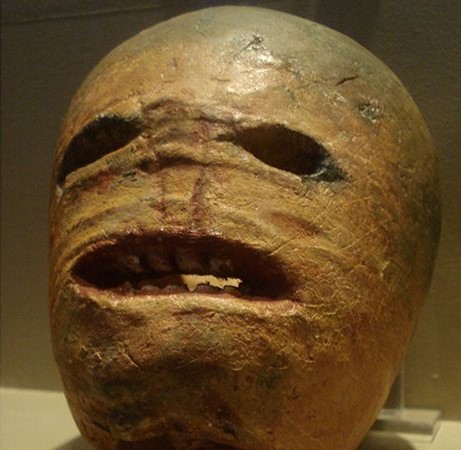
It also included non-human spirits, like demons and fairies. To scare away these beings, people carved gruesome faces into turnips (rutabagas) and lit them from inside with candles, and placed them on their stoops or in their windows.
When they came to the States, rutabagas were less plentiful , and they discovered pumpkins were much easier to carve.
Thus, jack-o-lanterns began.
They also dressed in fearsome outfits to confuse the demons, leading to costumes. They left out treats for the fairies so the fairies wouldn't play tricks on them, leading to trick-or-treating.
The Ridge Historical Society
Halloween on the Ridge – Part 2: Halloween Customs One Hundred Years Ago
By Carol Flynn
The first post covered the origin of Halloween as a Celtic custom brought over to the U.S. by the Irish immigrants in the 1800s.
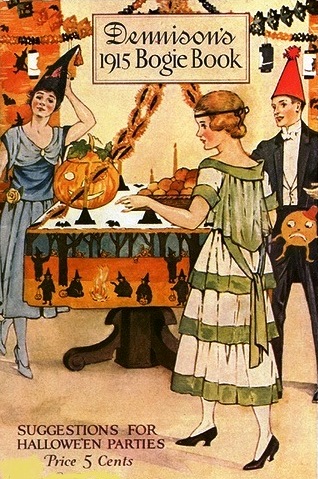
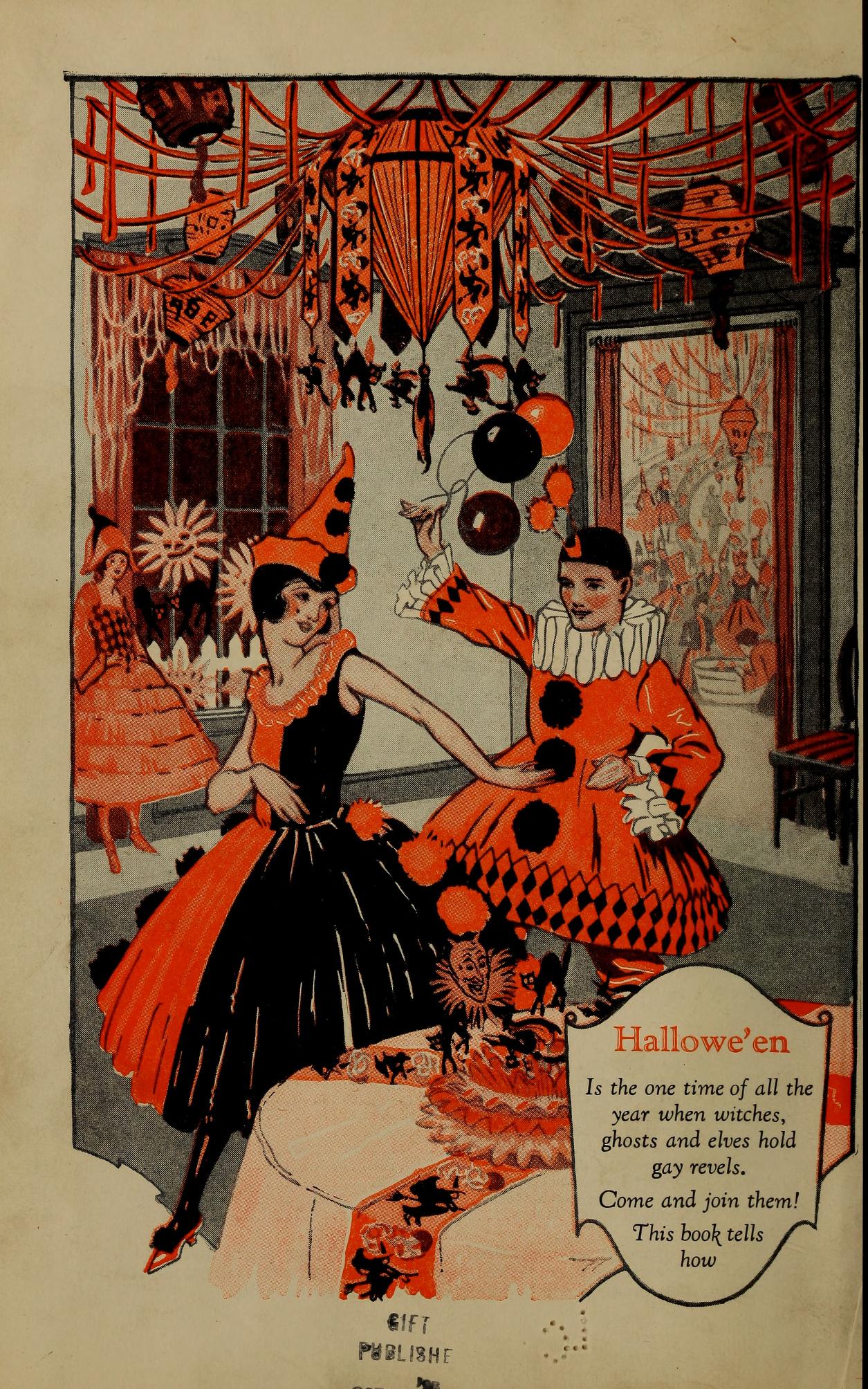
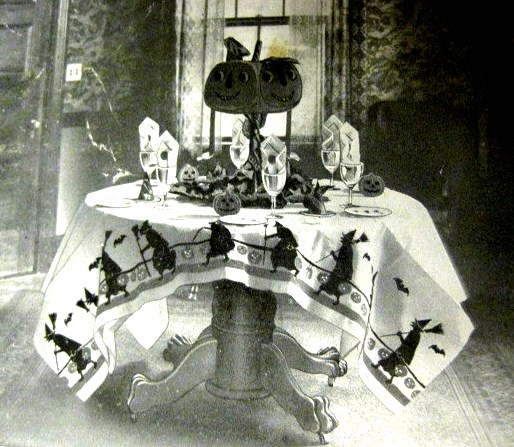
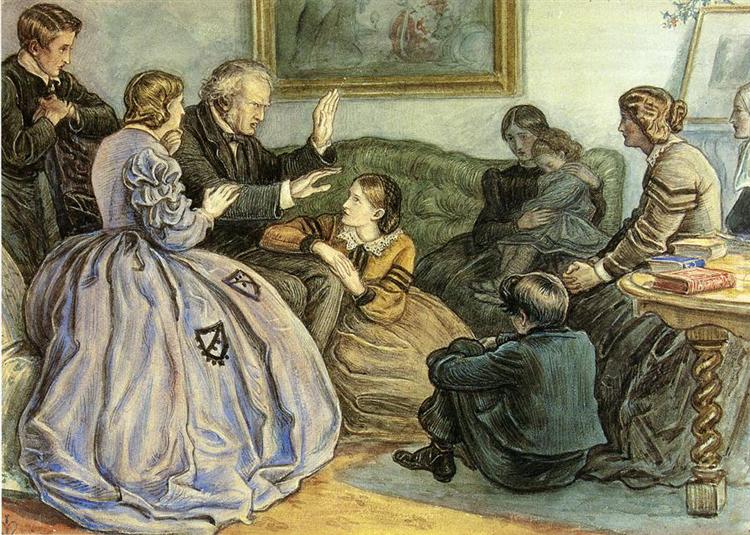
By 1900, Halloween had lost most of its superstitious and religious overtones, and parties were the most common way to celebrate the day. My great-grandparents hosted a Halloween party at their house on 110th and Homewood Avenue in 1915. This is what a party might have looked like back then.
Prior to 1900, decorations relied on natural items. The Irish Americans adapted their customs to use the native plants they found in the U.S., like corn stalks, to symbolize the harvest. Jack-o-lanterns were still customary, but now they were made from native pumpkins. One Irishman who moved to the States about twenty years ago commented that it was much easier to carve pumpkins than to carve turnips.
In the early 1900s, several companies, notably Dennison Manufacturing Company, began making paper products such as heavy cardboard die cuts; paper plates, cups, and napkins; crepe paper streamers, and the like.
Decorations became much more sophisticated and commercial. Dennison published “Halloween Bogie” books from 1909 through 1934 that were catalogs that also included ideas, illustrations and instructions for decorations and parties.
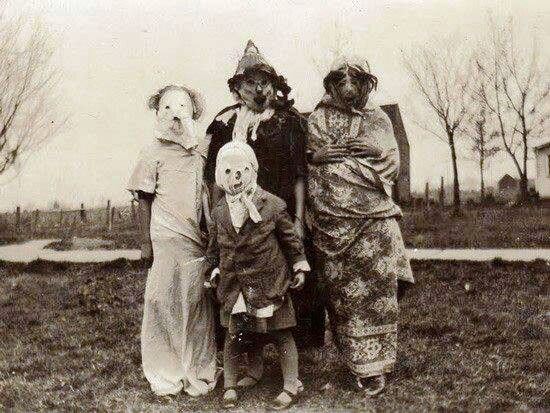
Costumes were mostly still homemade affairs, although there were some costume companies, but their goods were expensive. The costumes presented in the Bogie books were sophisticated but many photos from the early 1900s show homemade costumes that were, quite frankly, creepy, by today’s standards.
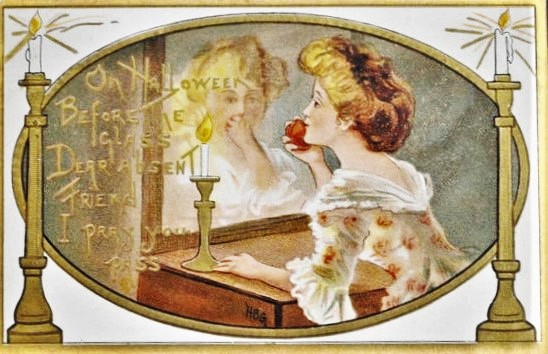
In addition to some of the traditional games like bobbing for apples, fortune telling and other divination games were popular. Variations of a “mirror test” were mentioned often in articles of the day. One version called for a girl to sit before a mirror at midnight on Halloween, combing her hair and eating an apple, in order to see the face of her true love reflected in the glass.
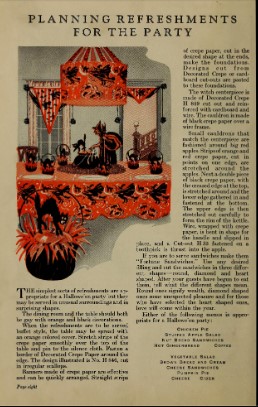
Food suggestions included a sit-down supper with items like cream of celery soup, brown bread sandwiches and Waldorf salad, to a buffet including a variety of finger sandwiches (cucumber, salmon, jelly), stuffed celery, and orange sherbet. Gingerbread was popular in any form – cookies, cake with marshmallow frosting.
The Ridge Historical Society
Halloween on the Ridge – Part 1
By Carol Flynn
A 19th Ward friend recently posted pictures of people in hand-made, grotesque Halloween costumes, the kind they wore in the early 1900s. This led to questions about how Halloween was celebrated back then, and I promised to share some history on the topic.
I rarely write in the first-person narrative style, but this story started with a personal discovery. Seven years ago, I was researching for a historical topic to write about for Halloween. As I looked through the Morgan Park Post newspapers from the early 1900s, I found the usual entries about school groups having parties and the like, but nothing was catching my fancy.
Then I found this announcement in the November 6, 1915, Post: “Mr. and Mrs. Thos. Cummings entertained at a Hallowe’en party last Saturday evening at their home on Homewood Ave.“
My “A-ha!” moment had arrived. Thomas and Johanna Cummings were my great grandparents. They lived on Homewood Avenue just north of the 111th Street train station, but their house was demolished in the 1960s for one of the “modern” apartments now there.
So great-grandpa and great-grandma had a Halloween party more than one hundred years ago. That got me to wondering – what would Halloween have been like back then? Who was invited? (Surely my grandparents were there, they had lived in a cottage on 108th Street and Longwood Drive, although my mother wouldn’t be born for a few more years.) What did they serve for refreshments? What was the entertainment?
I started looking into this, and wrote an article for the Beverly Area Planning Association’s Villager newspaper, so some of this appeared in print before.
Halloween was an Irish invention, going back thousands of years, to pagan harvest festivals in Ireland and other Celtic lands. Believing that supernatural beings and ghosts could more easily cross over into the physical world at this time of year, people dressed like demons to escape notice by real demons, and left gifts of food for the fairies in the hope the fairies would not play tricks on them. They placed gourds and turnips carved with grotesque faces, and lit from inside with candles, on windowsills to scare away harmful spirits.
These pagan practices became intertwined with the concepts of Christianity when the Feast of All Souls and the Feast of All Saints were established. The millions of Irish immigrating to the U.S. in the 1800s, including my ancestors, brought a mixture of the old and the new ideas with them.
The British Protestants who were the predominate population of the U.S., and the Ridge up to the 1950s or so, did not celebrate Halloween. In fact, in Victorian England, the time of year for ghost stories was Christmastime, hence the most famous fictional ghost story of all time, A Christmas Carol by Charles Dickens, first published in 1843.
The U.S. citizenry adopted the customs brought over by their new Irish American neighbors, and as usual, adapted them in unique “American” ways.
Halloween lost most of its superstitious and religious overtones in the U.S. by the beginning of the 20th century. By 1915, parties were the most common way to celebrate, and usually included decorations, costumes, games, and refreshments.
Next post: U.S. Halloween customs by 1915.
Ridge Historical Society
Halloween – October 31, 3021: The “Tombstone House”
By Carol Flynn
It’s Halloween, so it is a good day to look at the macabre in the neighborhood. This isn’t a ghost story – in fact, it’s pretty much the opposite, a “debunking” story. But it also illustrates that true history can be as interesting – and strange – as legends.
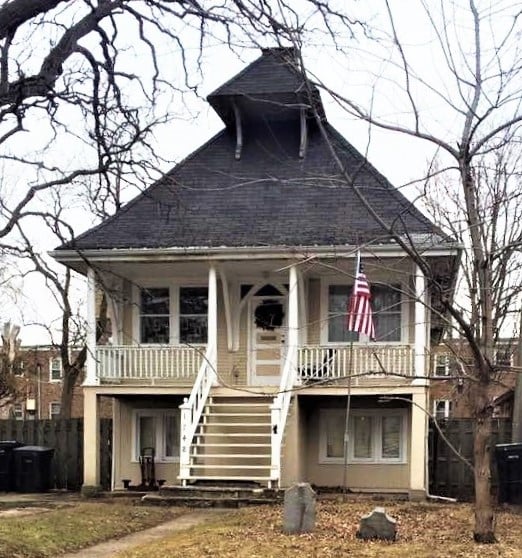
The Ridge Historical Society (RHS) is regularly asked about the tombstones that are on the front lawn of a house in the 1700 block of West 96th Street. Are they real? Yes. Are people buried there? Not very likely. Was that a cemetery? No. How did the tombstones get there? That’s a good question and the answer remains elusive.
Here is the information RHS has gathered to date. Let’s start with the house. The house was actually originally a church.
St. Paul’s Bible Church at 94th and Winchester started as a Sunday school in the Longwood train station at 95th Street, then the congregation used a tent. One of the founders of the church was William Merchant Richardson French, the first executive director of the Art Institute of Chicago, whose historic house still stands in north Beverly.
In 1893, the congregation built a small wooden church. This wooden church was replaced by a stone church in 1902-3. The wooden church was moved and became a private home on 96th Street.
Moving houses was not uncommon in the past. They were placed on rollers and dragged to the new location by horses. It could take days to move a house but it was easier than building a new one.
Now, the tombstones. The names on them are Johan Sandtner, d. 1914; and Barbara Sandtner, b. 1859 d. 1915. RHS researchers located death and burial records for these people. These markers belonged to a couple that is buried in St. Mary’s Cemetery at 87th Street and Pulaski Road. Their names are recorded as John and Barbara Santner. John died at 4313 Lake Park on March 9, 1914, and Barbara died at 5836 Princeton on May 11, 1915.
It was not unusual to have multiple spellings of names in the past. Sometimes people changed their names to be more Anglicized. One conjecture is that the tombstones were replaced to correct or change the names from Sandtner to Santner, and from Johan to John. Then the old gravestones were discarded.
What is still the question is exactly how the tombstones wound up in front of the relocated church-turned-house on 96th Street. They’ve been there for decades. In the 1980s, the owner or resident of the house told the RHS Historian that he placed the markers there, but he would not say where he got them originally.
A few years ago, another person reported to RHS that he was told by the man there that the tombstones were found in the basement of the house when he moved in, and he put them out in front. The man at the house said that perhaps there had been a graveyard there with the church.
That seems very unlikely because there is no documentation that that building was ever a church at that address, only a private residence. If St. Paul’s had a graveyard, it would have been at the church site a few blocks to the north.
So are people buried on 96th Street? Well, the Santners are not, and there is no record of any kind of cemetery ever being there. THAT much can be confirmed.
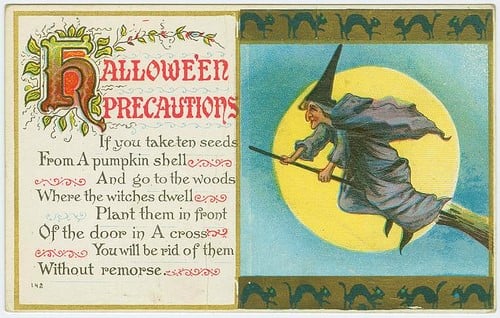
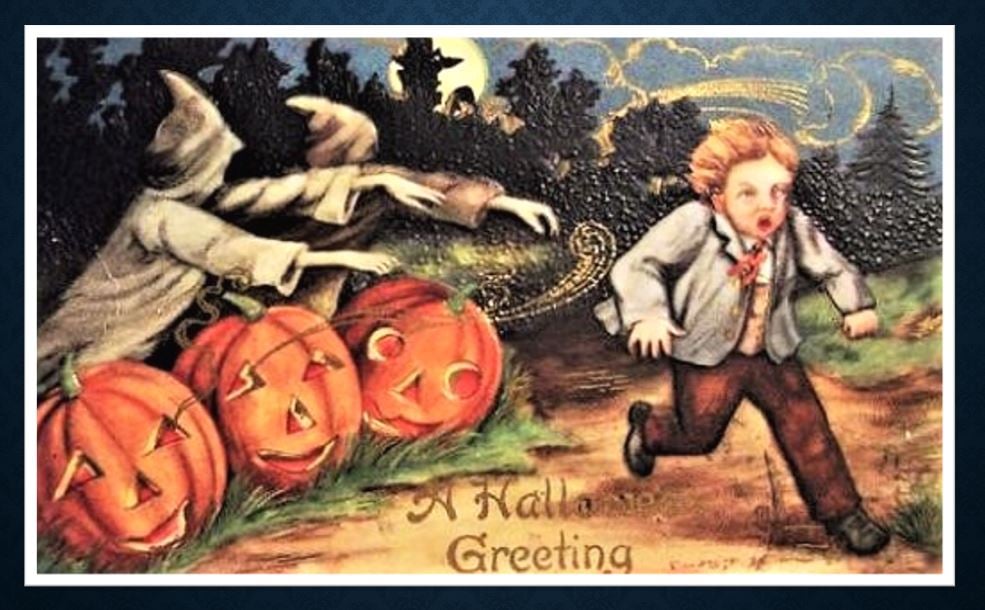
Happy Halloween from the Ridge Historical Society. Here is a vintage postcard with some sage old folklore advice. Of course, it depends if it is a good witch or a bad witch ….
The Ridge Historical Society
The Paranormal Ridge: Part 14 – Save the Castle Ghosts
By Carol Flynn
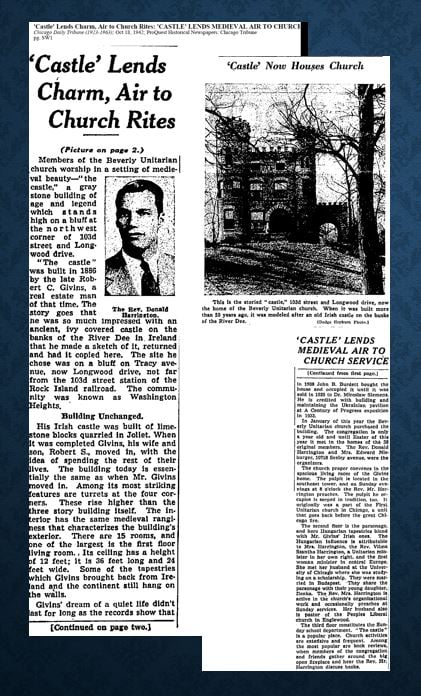
Thank you to the members of the Beverly Unitarian Church (BUC) for being such good sports for the last few years while the Castle ghost folklore was researched and shared with the public. As much as folklore is an important part of history, it is recognized that the BUC has more important things to deal with than female phantoms with Irish brogues who don’t leave footprints in the snow.
Before we get to a final word about the Castle, there is one more category of ghost stories to look at – experiences that couldn’t and shouldn’t have happened.
There are several websites on which people post paranormal experiences and occasionally stories about the Castle show up. Here are two that fall into the “couldn’t and shouldn’t” category that were edited slightly to make them more readable:
“My friends and I would sometimes ditch school to go smoke some bud and we would often go to the abandoned castle. I’ve heard the voice of a woman talking, almost like shouting, as if in an argument with someone. She didn’t sound like an American; she sounded English or Celtic of some sort, with very proper speaking. I did not see anything but had a feeling of being watched.”
‘It is definitely haunted. I found a way inside and I did indeed hear a woman speaking aggressively in an English accent, or she sounded Irish.”
In response to these stories, first, the Castle has never been abandoned in its entire 130+ years of existence. BUC bought the Castle in 1942 and has used and maintained the building consistently for almost 80 years. Second, the building is kept secure and it is very doubtful anyone casually “found a way inside.” This is the “couldn’t” part of these stories – they just do not ring true.
More importantly, the Castle is private property. “Ghost exploration” does not justify trespassing, violating any laws, or invading someone's privacy. This is the “shouldn’t” part and applies to any location, not just the Castle.
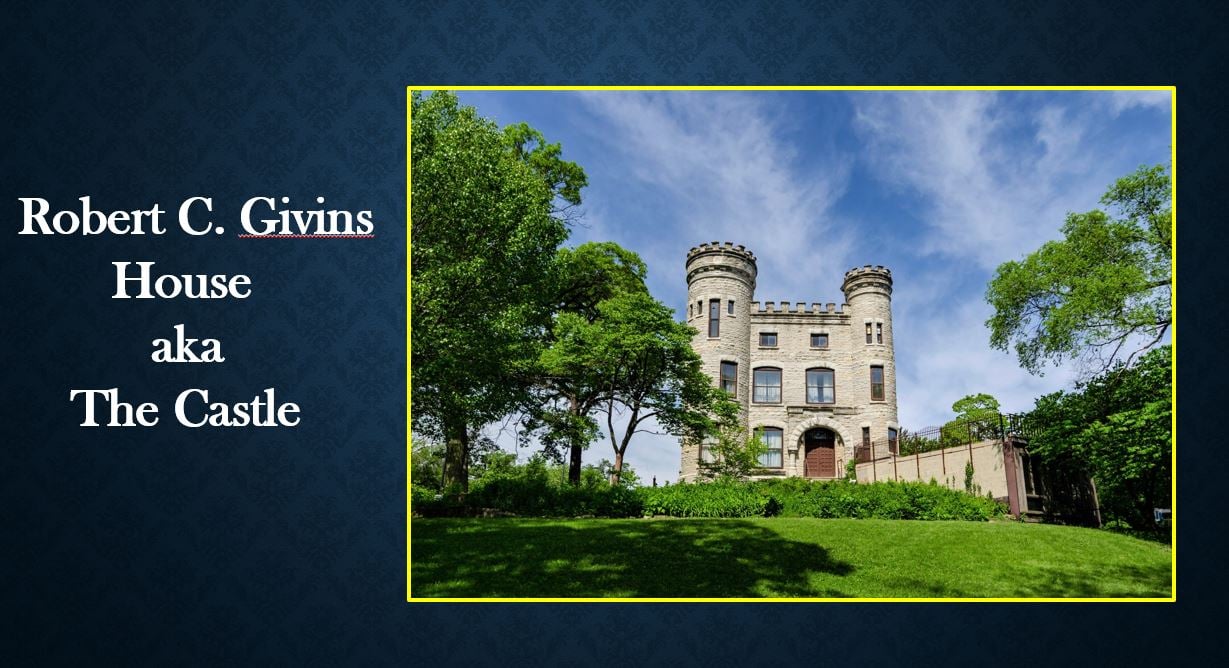
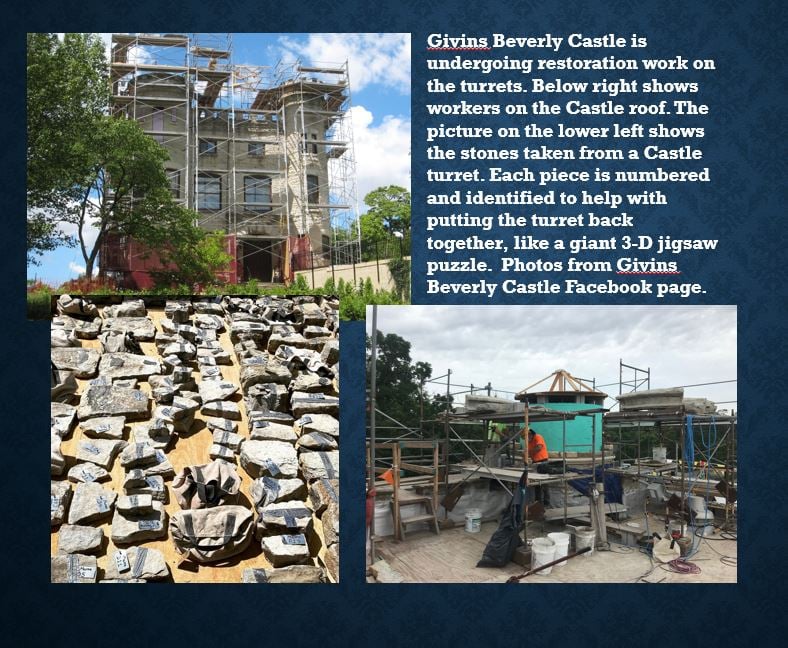
The final word about the Castle is that the BUC is currently undertaking a major restoration project. After more than 130 years, the turrets, or tops of the round towers at the Castle's corners, were found to be deteriorating. Work to repair them began this past summer.
The BUC continues to reach out to the community for financial support for the preservation work. Donations to the Castle Restoration Fund are used solely for that purpose and not for church operations. For more information on the restoration project, including information on funding and donating, visit the website at givinsbeverlycastle.org or see the Facebook page Givins Beverly Castle.
Castles stir the imagination, especially a medieval castle perched on a hill in a modern American city. The towers and turrets conjure up images of another time and place, of knights and fair maidens, thrones and dungeons. Ghost stories are part of the mystique of a castle, and the Givins Beverly Castle is no exception.
The Castle is the best known and loved landmark in Beverly. Even though the building is owned by BUC, the entire community gets to enjoy its presence. Saving the Castle means saving history and folklore – and the ghosts themselves. If the Castle deteriorates, where will the Irish lasses go?
Happy Halloween.
The Ridge Historical Society
The Paranormal Ridge: Part 13 – Odds and Ends on Castle Ghost Stories
By Carol Flynn
Here are two more pieces of interesting trivia about the Givins Beverly Castle that relate to the paranormal. The first is the Transylvania connection, and the second is Bob Givins’ own experience with a ghost.
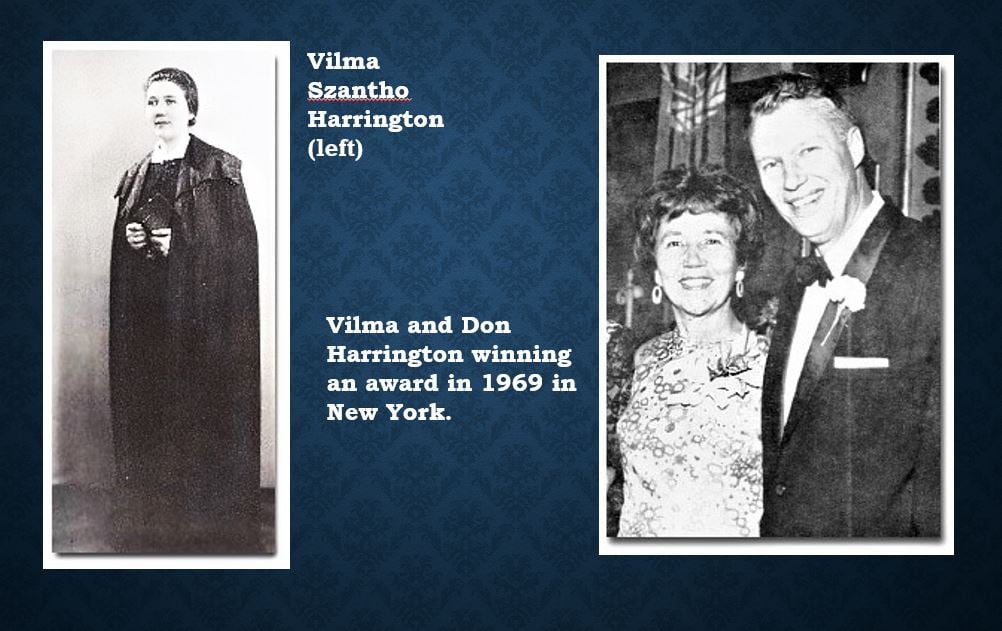
If the rumor that there was once a woman from Transylvania, Romania, the home of Dracula, in the neighborhood and she was connected to the Castle is ever heard, well, that is true. Her name was Vilma Szantho Harrington, and she was instrumental in starting the Beverly Unitarian Church. She was the first woman to be ordained a Unitarian minister.
Vilma was born and raised in Transylvania, which, along with Poland, was a starting place for the Unitarian Church. She came to Chicago to attend the University of Chicago. There she met Donald Harrington, a fellow seminary student, and they married in 1939. The Harringtons started the Unitarian Church in the Castle. They moved on to New York, where Donald became a leader in the Church there.
The history of the Unitarian Church is very interesting. By all of the many accounts about the Harringtons, they were wonderful people, devoted to social justice causes. Vilma died in 1982. Her husband wrote a tribute to her that can be found online at https://www.harvardsquarelibrary.org/biographies/vilma-szantho-harrington/. Donald died in 2005 in Transylvania.
The Unitarian Church connected with Harvard University has mentioned Dracula humorously in some of its web posts, but there is, of course, no connection at all between the Church and Dracula.
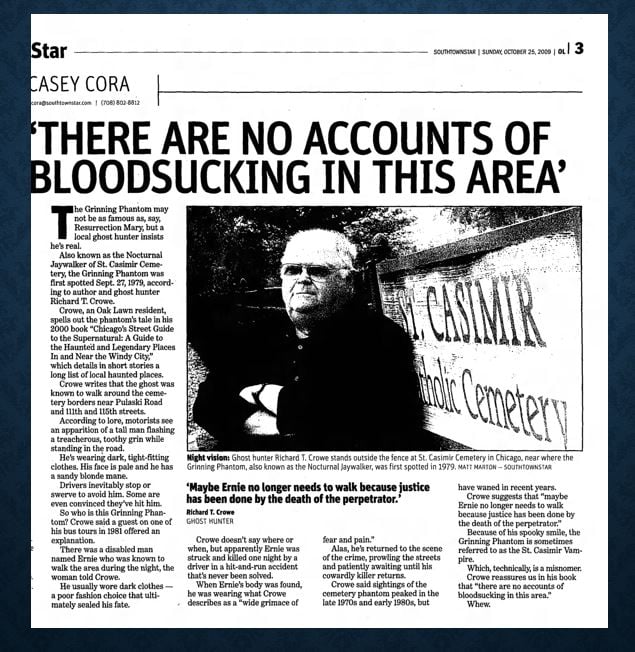
There has been an occasional vampire story on the South Side but these never came to anything. There were occasional sightings of a phantom by 111th and Pulaski Road at St. Casimir Cemetery, on the western edge of Mt. Greenwood. Richard Crowe, Chicago’s legendary ghost lore expert and tour director, assured the public this was not a vampire.
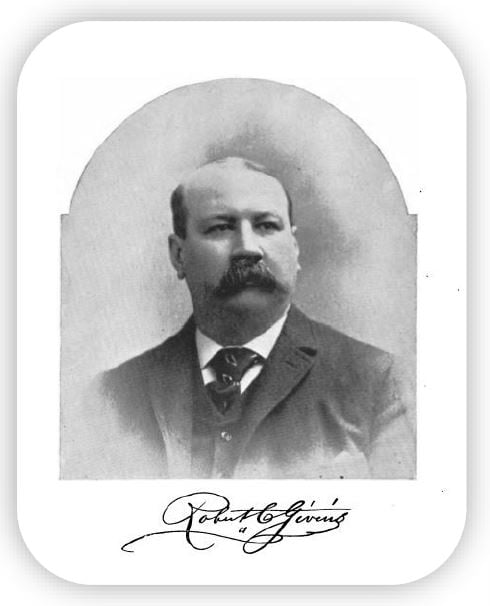
These posts have covered ghost stories at the Castle that Robert C. Givins built. As it turns out, Givins himself was no stranger to ghost experiences. One experience is covered in a book titled Robertson’s Landmarks of Toronto, published in 1894.
Givins’ ancestors came from Northern Ireland to Canada. Around 1800, Colonel James Givins, Robert’s grandfather, built a home in Toronto. At the time, Toronto was called York, and this was one of the first homes established, a landmark for many years until it was demolished in the late 1800s.
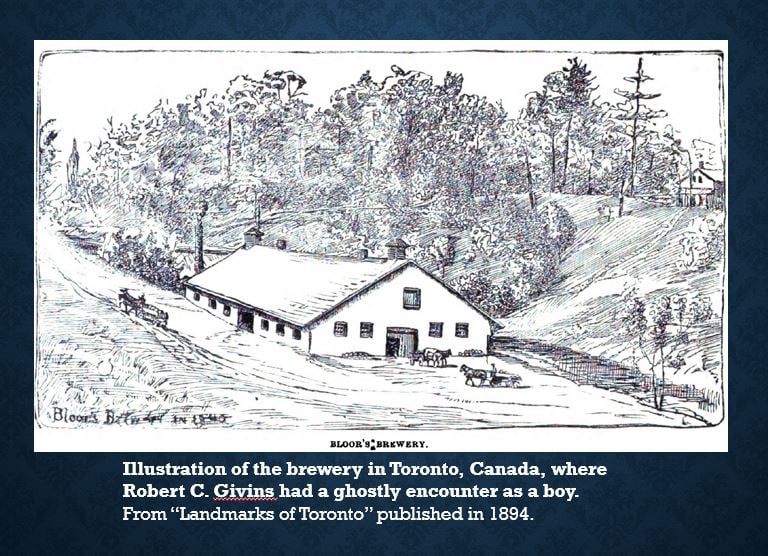
Robert C. Givins was born in Canada in 1846. In an adjacent village, Yorkville, which became part of Toronto in 1883, was an old brewery built at the bottom of a ravine. The building was described as “a low, red brick building one hundred feet long and fifty or sixty feet wide.” It was in a very picturesque setting, surrounded by thick woods with a pond from a stream that had been damned up to create water power for grinding. A water wheel was at one end of the building. A road ran down to the brewery from the street above.
By 1860, the brewery was no longer in operation. The building was used by local boys for a meeting place and shelter. In the wintertime, the road leading down into the ravine was used for sledding.
Givins shared the following story with a Canadian newspaper reporter:
“I remember one dark night one of the boys [dared] a party of us to go through the old [brewery]. A superstition existed among many in the village that this old building was haunted, and notwithstanding our frequent visits there in the day time, there was not a boy in the neighborhood who could be hired at any price to go through it at night, and I have no doubt many believed that it was actually haunted, because I remember a story in circulation at the time that one night an old watchman had occasion to go down there after an escaped burglar, claiming that as he entered the old building, he saw four ghosts playing whist on the top of one of the vats. He did not wait to catch the burglar, who either escaped or was annihilated by the ghostly occupants of the old building.
“We followed the nervy youth who originated this hazardous proposition. It was the blackest night he could have selected; thunder clouds hung over the pond, and an occasional flash indicated an approaching storm, and added no little terror to the occasion. To many of us this day seemed our last. Whew! – going through the old brewery at night. We groped our way down the hill, and after stumbling about over the rough ground and through shrubbery we finally got to the entrance to the old sluice. [This opening was where the water once ran to power the wheel for grinding.] It was 200 feet through into the big water wheel, which was located at one end of the brewery. The passage way was large enough for us to go two abreast, but was very low; we had to creep on our hands and knees. [No one] experienced a more breathless journey than we did.
“We got along, however, all right until we came to the big wheel, and after we all climbed through we stood inside the wheel to get a rest before we explored other portions of the brewery. In the corner of the room we thought we saw what first appeared to be a ray of light peeping through a crack in the wall. We all looked intently upon the corner where we saw two big bright eyes glaring at us like two coals of fire. We were paralyzed for a minute, not one of us mustering up courage enough to speak. At last the leader whispered, “Let’s get,” which we did and the way we scrambled out through that sluice to the entrance and got up the hill can never be properly expressed. Upon reaching the street, we walked hand in hand home.”
Tomorrow: Halloween and a final post on Castle ghosts
The Ridge Historical Society
The Paranormal Ridge: Part 12 – More Recent Experiences at the Castle
By Carol Flynn
The early owners of the Givins Beverly Castle at 103rd Street and Longwood Drive were three private families in succession, and for a year and a half in the 1890s, the Castle was rented by a female college. Since the early 1940s, the Castle has been owned by the Beverly Unitarian Church (BUC). The building has been used for church services and functions and rented or loaned out for many other functions, from Jewish religious services to Christian weddings to Neo-Pagan drummings.
Beginning in the 1970s, the first-person stories relating strange experiences at the Givins Beverly Castle started to be recorded in newspaper interviews. Three people publicly shared their paranormal experiences – a caretaker from the 1960s, a psychic who visited in the 1970s, and a minister from the 1990s. There were, of course, many other hearsay stories repeated through the years.
More recently, other people have shared personal experiences. Another caretaker from the past confirmed that her daughter-in-law, the “sensitive” one in the family, was visited by an entity at the Castle in a room on the second floor that she used for sewing.
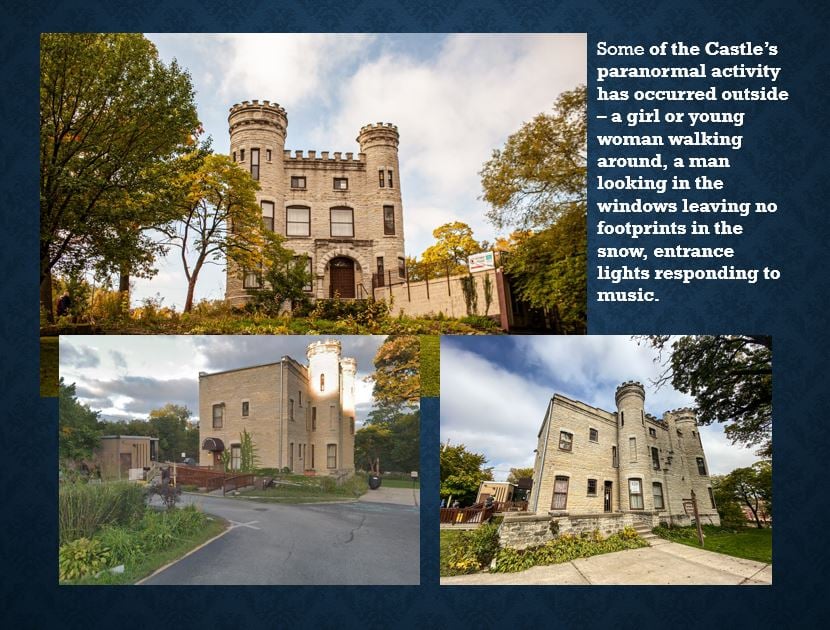
People from Blue Island involved in a ghost investigation a few years ago observed the phantom of a young woman dressed in an old-fashioned plaid dress gliding around the outside of the Castle.
A police officer said he was called to the Castle in the 1990s when a church member saw a man’s face looking in the windows from the outside, moving from window to window. The police officer said there were no footprints in the snow outside the windows.
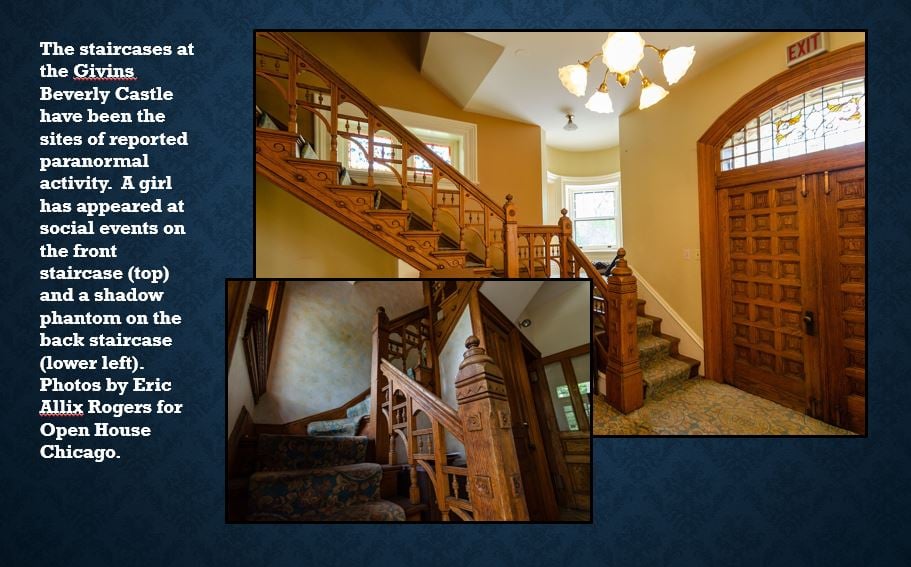
A person who came to the Castle for Neo-Pagan events in the mid-1990s reported on an on-line site that she and a friend experienced intense feelings of being watched and driven away as they were climbing the stairs to the third floor. She attributed this to a haunted nursery that had been on the third floor. The third floor does not have a history of being used as a nursery, but BUC did conduct Sunday school classes up there.
About eight years ago, someone from the Castle who wished to remain anonymous was shown a photo a local woman took of the Castle that seemed to show the phantom of a young girl out in front on the Longwood Drive-side, walking toward the school annex to the north. The anonymous person said that teachers at the school reported feeling someone tug on their clothes at a child’s height but when they turned around there was no one there, or they heard a child’s voice in the school hallway but there were no students out there when they looked.
Musicians visiting the outside of the Castle at night heard disembodied footsteps and experienced lights flickering on and off in response to their guitar-playing. This brings up a point – the entity does seem to respond to social events and music. Several BUC members, as well as the caretaker whose story was reported in post 9, have said they have heard the piano playing when it is covered and no one is in the room, and the sounds of the voices and tinkling silverware and glasses. The minister reported the slender arms that went around her husband’s waist during an event (post 10). And there are stories of a girl being spotted at social events, often on the stairs, when no children were invited or reported as being there, but these stories are not verified.
One piece of information that is shared in the books is a reference to an actual woman who reportedly lived in the Castle during the Great Depression and tended the gardens. Some people have thought this woman could be the ghost. Who started this theory, and why, isn’t known. No historical information has been found on this woman, and it would not be appropriate to name her in this post.
In summary, the major stories that come up again and again for the Castle involve a young woman and/or a girl, from the past, usually with an Irish brogue. Who this person (or persons) could be is a guess – a student, a servant, a patient, a teacher or church member, a family member, are all possibilities. She most likely is not Givins’ Irish fiancé who died before she lived in the Castle because, first, there is no record to be found of Givins visiting Ireland in the immediate years before the Castle was built, and second, at the time the Castle was built his wife Emma, a school teacher of Norwegian descent, was very much alive, and she did live in the Castle for years. His first wife had died some years before.
The other stories that are reported by several people include sounds of the piano playing, and voices and clinking cutlery and glasses, like an event is going on.
There have been a few reports of male presences but these are much less common.
In the next post on the topic, some odds and ends related to the Castle ghost stories will be explored.
The Ridge Historical Society
The Paranormal Ridge: Part 11 – A Psychic’s Visit to the Castle
By Carol Flynn
The Givins Beverly Castle has been owned and operated since the early 1940s by the Beverly Unitarian Church (BUC). In the early 1970s, the BUC brought attention to the stories of ghosts at the Castle through a series of events and newspaper articles.
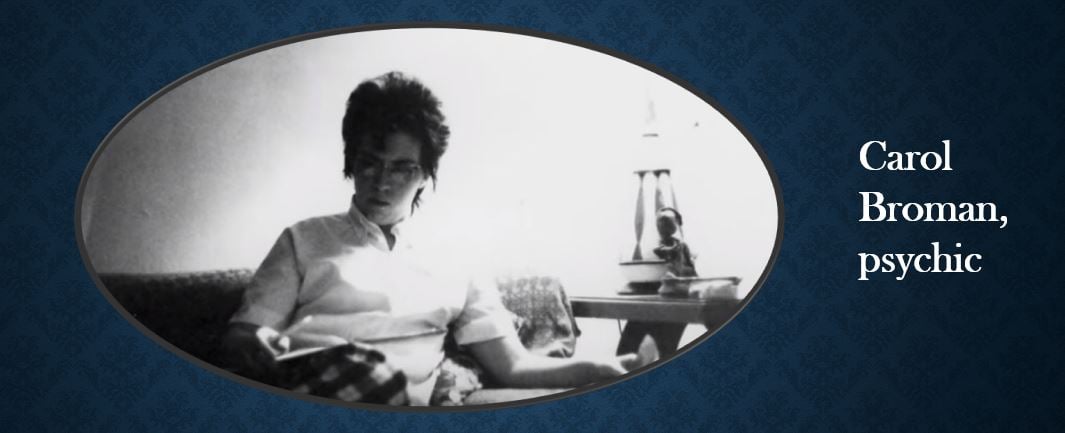
In 1995, the Chicago Tribune ran an article by Jerry Thomas calling attention to one of these events from the 1970s. The article stated that in 1973, a psychic named Carol Broman visited the Castle and reported that she experienced two spirits there – one a young girl – and there was bantering between them.
In preparation for last year’s “Folklore and Phantoms” program, this visit was researched – and proved to be most interesting.
This psychic, Carol Broman, was called in by the police in 1978 to help in the investigation of serial killer John Wayne Gacy. At that point, they were still treating the situation as a missing person case for one young man who had disappeared from his job at a drug store. He had told his mother he was going to talk to someone about a construction job. The police knew that Gacy and many others had been in the pharmacy that day, but no connections had been made yet. They still hoped to find the young man alive.
Broman told the police the boy was dead, he had been murdered, they would find multiple victims at the killer’s house, that it had to do with the construction business, and that the killer used trickery and torture on his victims. She also said the young man did not realize he was dead yet and his spirit was wandering.
Broman turned out to be correct in what she told the police they would find. The police never went public at the time that they used a psychic. The police inspector, Joseph Kozenczak, and his wife later wrote two books, and he was interviewed for an episode of Psychic Investigators, which can be found on YouTube. Kozenczak said he was chilled to the bone by Broman’s revelations. Although the use of psychics in policework is very controversial, Broman did a lot of work with the police as a psychic investigator. Broman and Kozenczak are deceased now. Gacy was executed in 1994 for 33 murders.
[As an aside, Gacy did construction work in the Beverly/Morgan Park area, and people here knew him. One RHS officer who worked for the city met Gacy through city contract work. She said everyone considered him a nice guy. It was an unimaginable horror when the bodies were found in the crawlspace under his house.]
Five years before she was involved in the Gacy investigation, Carol Broman, the psychic, accompanied by a Chicago Sun-Times reporter, was invited to visit the Castle to investigate paranormal activity. Their visit was covered in a Sun-Times article, and later covered in two books about ghosts, based on the Sun-Times article. The information in this post is based on the material in those books, so it is now third- or fourth-hand reporting. Of course, as this gets farther away from the original sources, the possibility of misinterpretation increases – this is often how folklore begins. Readers are cautioned that this incident at the Castle has not been verified – the original Sun-Times article has not been reviewed because the Sun-Times archives are not easily accessible to the public. In fact, there does not seem to be an archive for this time period – the 1970s.
According to the books, Broman started her tour in the basement, where she sensed fire in the Castle. She stated that there had been fires, and there would be another. The Castle does not have a history of any serious fires.
Broman said that In the living room/sanctuary of the Castle, she encountered two entities having a discussion. One was a young girl with the usual Irish brogue. The other was a tall man who was very angry, talking about infidelity, and wanting to burn the Castle down. He had been accused of murder but had never been tried for the crime, and he said although he had committed the murder, he was the one who had been treated very unfairly.
He was trying to plead his case to Broman, but she said she didn’t believe him. He had been a cruel and controlling husband. She felt the girl was the niece of the wife. The room was filled with white camellias which had been the wife’s favorite flower.
Unfortunately, there were no details given about who this man was or who he had killed, or where, when or how the murder had taken place, or what, if any, connection there was to the Castle. No known incidents like this have been associated with the Castle. Robert C. Givins, who built the Castle, had one son, Robert S. Givins, and there was a scandal when the son’s wife ran off with another man. But there was no known murder associated with this incident. The young girl continues the usual theme of the ghosts at the Castle. This story remains a complete mystery.
The next post will cover some experiences people have reported more recently.