Explore the RHS Facebook Archives, a rich repository of local history written by Carol Flynn. For two decades, Carol brought a deeply dedicated voice to public education at RHS. Her role as Facebook administrator through mid-2025 naturally extended her prolific research into meticulously detailed articles, most notably her multi-part historical series posts. Today, Carol continues her local history writing for The Beverly Review and other outlets.
New Year
The Ridge Historical Society
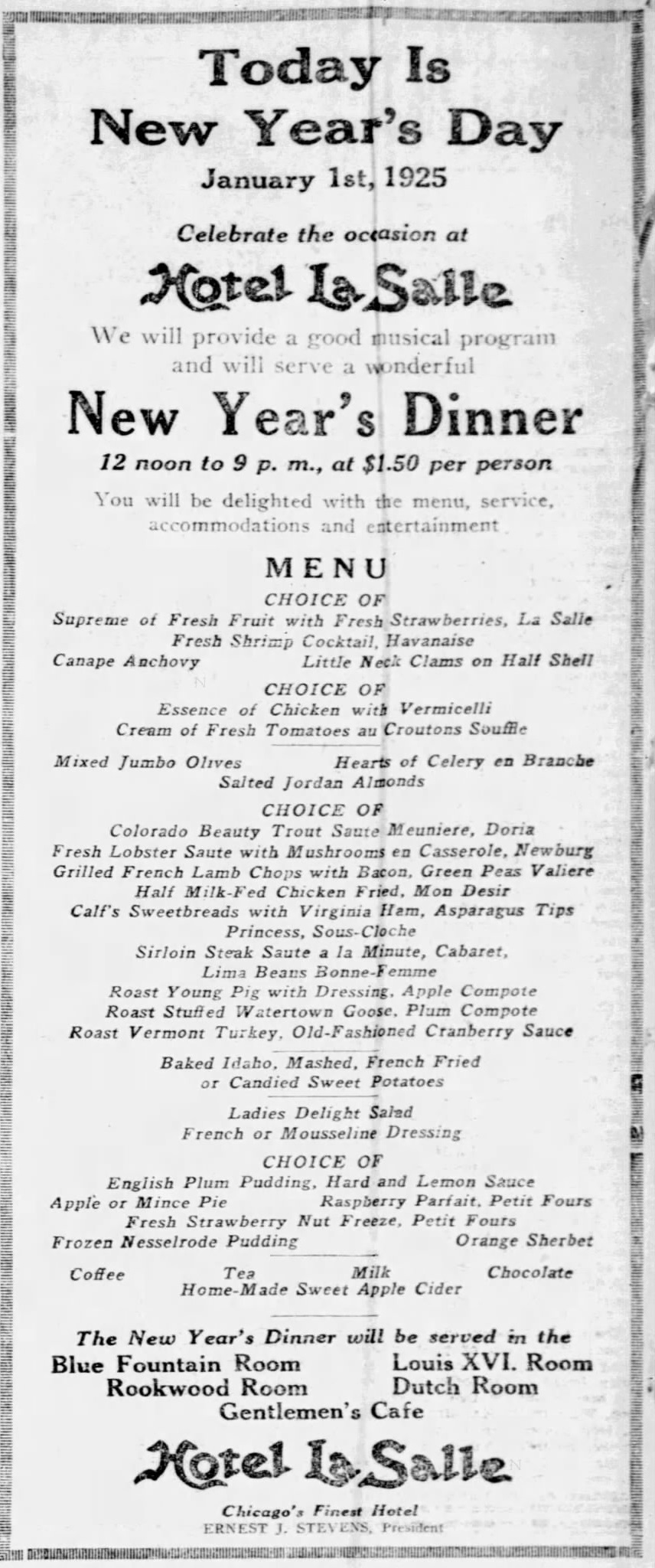
New Year 1925
By Carol Flynn
Chicago, Chicago, that toddlin’ town.
Chicago, Chicago, I’ll show you around.
Bet your bottom dollar you’ll lose the blues in Chicago, Chicago, the town that Billy Sunday could not shut down.
On State Street, that great street, I just want to say
They do things they don’t do on Broadway. Say!
They have the time, the time of their life.
I saw a man who danced with his wife
In Chicago, Chicago, my home town.
This favorite, “Chicago (That Toddlin’ Town),” was written in 1922 by Fred Fisher. It appears to have been first recorded by the elusive Joseph Samuels and his jazz band in August of 1922.
The song became best known when recorded by Frank Sinatra in 1957, although many people have sung it through the years, from Judy Garland to James Brown to the band Green Day.
The “toddle” was a jazz dance step in the Roaring Twenties. It was popular with college students and “flappers,” those modern young women who disdained the old social conventions, and wore short (that is, knee length) skirts, bobbed their hair, drove automobiles, smoked cigarettes and drank alcohol in public, listened to jazz, and loved to dance.
Music and dancing were favorite social activities, from time immemorial, and this was certainly true for New Year’s events one hundred years ago.
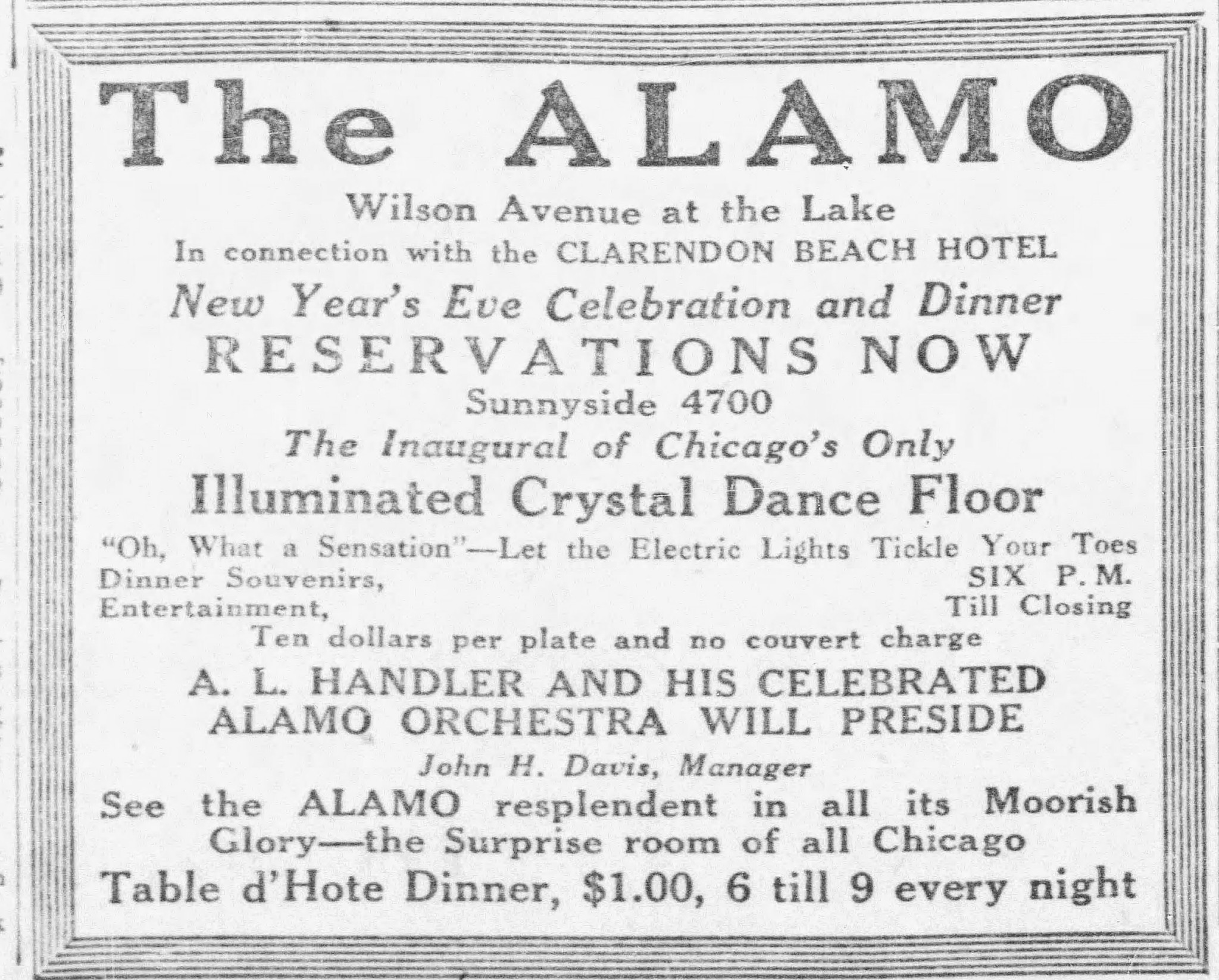
The Chicago hotels and restaurants were completely booked for both New Year’s Eve and New Year’s Day, and many private parties were held, also, at membership clubs and private houses. The parties were called “watch parties,” as in watching the old year exit out the door and the new one enter – at midnight, the doors were thrown open for this to happen.
The general format for a party was an extravagant dinner followed by a live orchestra and dancing. Some games in the evening were also often played – charades and guessing games were popular.
According to a Chicago Tribune newspaper article on December 31, 1924:
“Chicago tonight is going to don its dress suits, silver flasks, and tin horns and step out in search of A.D. 1925 in a spirit of peace and prosperity for the year to come.
“That is the official forecast, based on a canvass last night of hotels, cabarets, and roadhouses, police and federal officials – and bootleggers.”
Yes, bootleggers – Prohibition was in effect in 1924, which meant making, transporting, selling and serving (but not consuming) alcohol were all illegal. People regularly brought in their own alcohol to an event, hence the reference to the silver flasks.
The bootleggers reported that business was better than ever. Scotch was going for $7 per bottle; bourbon for $10; gin for $4. These prices were enough “to make one with a pre-Volstead memory shiver, but cheap enough in modern years.” Champagne, however, was very expensive – “about $1 per bubble.”
At the less well-heeled establishments, moonshine could be had for $1 per quart.
Chief of Police Collins said his men would enforce all liquor laws, but it was a “tough job.” He said they would “see there are no flagrant violations.” The Tribune noted that “handling a flask has never been considered flagrant.”
For New Year’s Eve, 1924, the big event for the social elite was a concert by the Yale Glee, Banjo, and Mandolin Club, in town from the east coast. This was preceded and followed by numerous private parties.
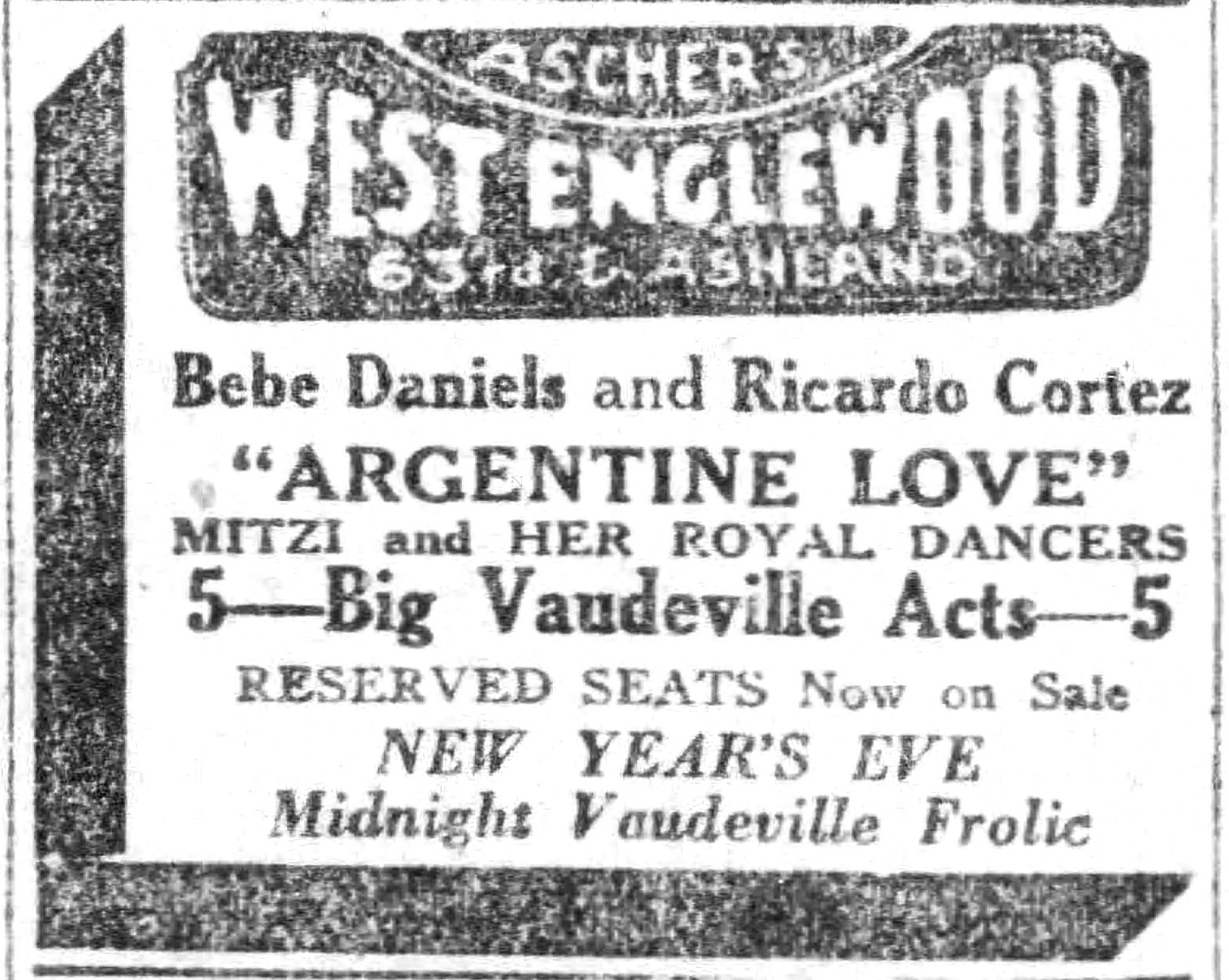
For the less high-brow, there were plenty of burlesque, vaudeville, musical comedy, and cabaret shows scheduled. Taxicabs, which usually made their last runs at midnight, were staying on the streets until 2 a.m.
The people who stayed home for the evening could still have music and dancing, via records played on the family’s gramophone or phonograph, if the family could afford such a machine.
For everyone, though, there was listening to the radio.
The radio stations covered live events, from political and other speeches to football games, and broadcast live orchestras and other entertainment, from the hotels or from the radio station’s studios. The radio stations usually signed off by 10 or 11 p.m.
On December 31, 1924, Chicago Tribune-owned WGN offered dinner music, and a few hours later dance music, from the bands at the Drake and Blackstone Hotels, but ended at 11 p.m.
Three other local stations planned New Year’s programs past midnight, one running until 6 a.m.
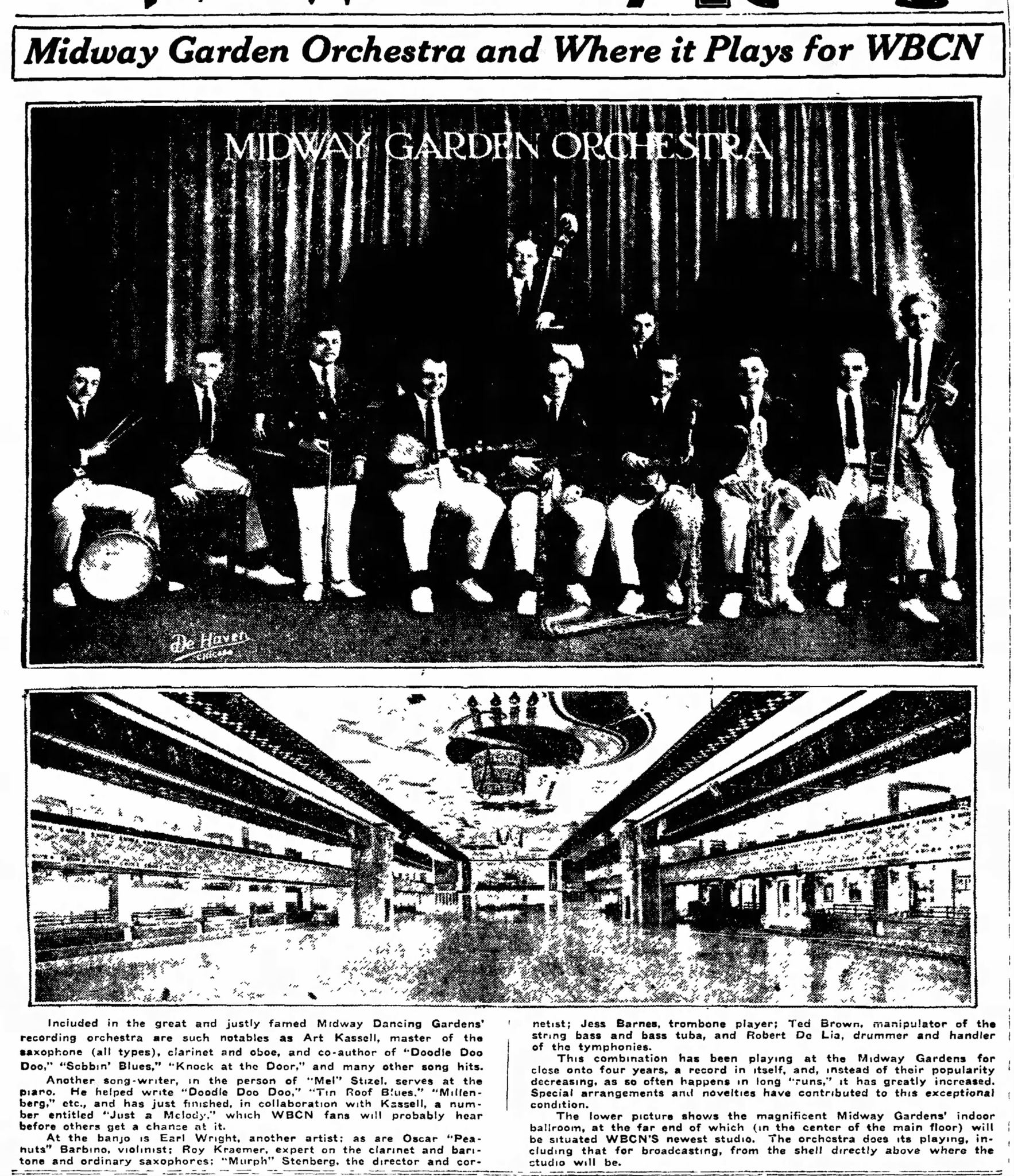
The biggest radio event, however, was taking place on WBCN, the station owned by the Southtown Economist newspaper. The station and the Midway Dancing Gardens had recently signed a deal that the Midway Gardens orchestra would be broadcast live on the radio station six days per week (closed on Mondays), and the inaugural event was scheduled to take place on New Year's Eve.
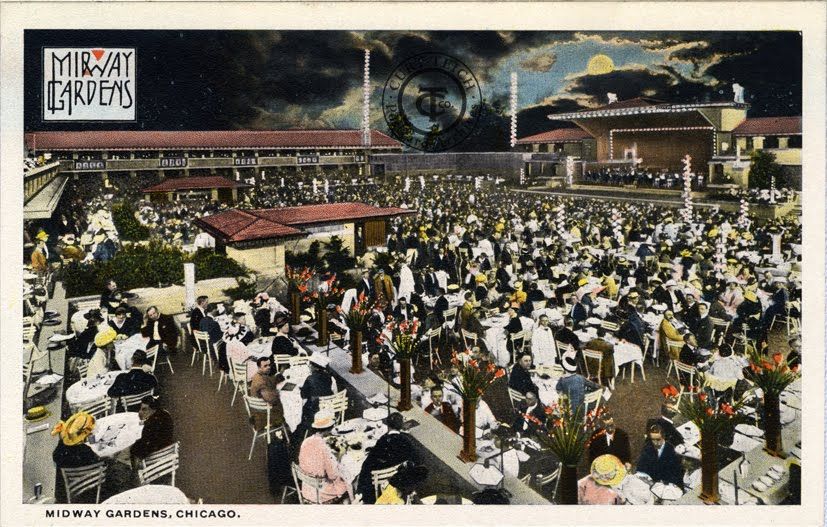
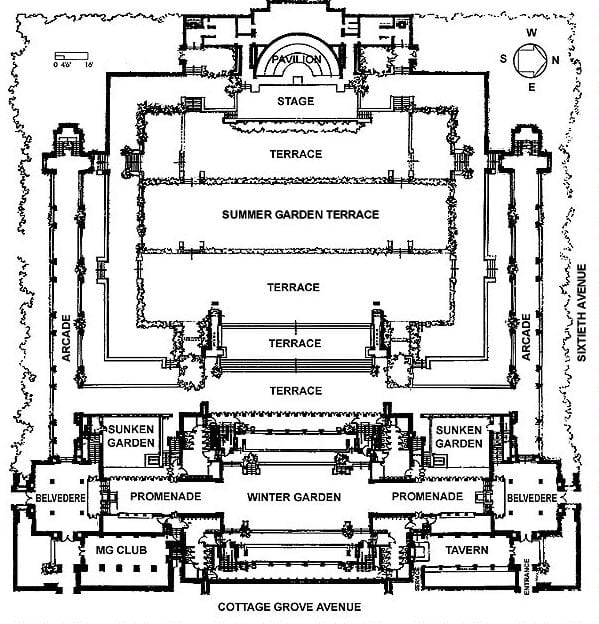
Midway Gardens was an entertainment complex at 60th Street and Cottage Grove Avenue, designed by architect Frank Lloyd Wright, that opened in 1914. It went through several owners before closing permanently and being demolished in 1929.
The facility offered outdoor dining and dancing in the summer and had a smaller indoor “winter garden.” It was considered to have “the largest toddle floor in the world.”
Other names it went by through the years were the Edelweiss Gardens and the Midway Dancing Gardens.
Although very popular with the public, Midway Gardens was never successful from a financial perspective.
In 1924, however, the Midway Dancing Gardens had a superb recording orchestra, and according to rival Tribune, “as a result WBCN listeners are to have dance music equal to any now being broadcast.”
The deal between WBCN and the Midway Dancing Gardens was considered “pioneering” and “highly distinctive” because it was the first time a public ballroom and a radio station had made an agreement on this scale.
On New Year’s Eve, from 10 p.m. to 2 a.m., dance numbers interspersed with specialty numbers were planned to be played continuously by the orchestra, which was in a shell above the dance floor. A microphone was installed suspended from the ceiling, wired into the transmitting equipment of the radio’s operations room at 730 West 65th Street.
This allowed the orchestra to “play for those actually present, and for radio-listeners at the same time.”
The event was very successful. On January 1, 1925, the Tribune reported that the Midway Dancing Gardens was so crowded in person there was scarcely room to dance.
The people listening from home might have had more space to push furniture out of the way to toddle.
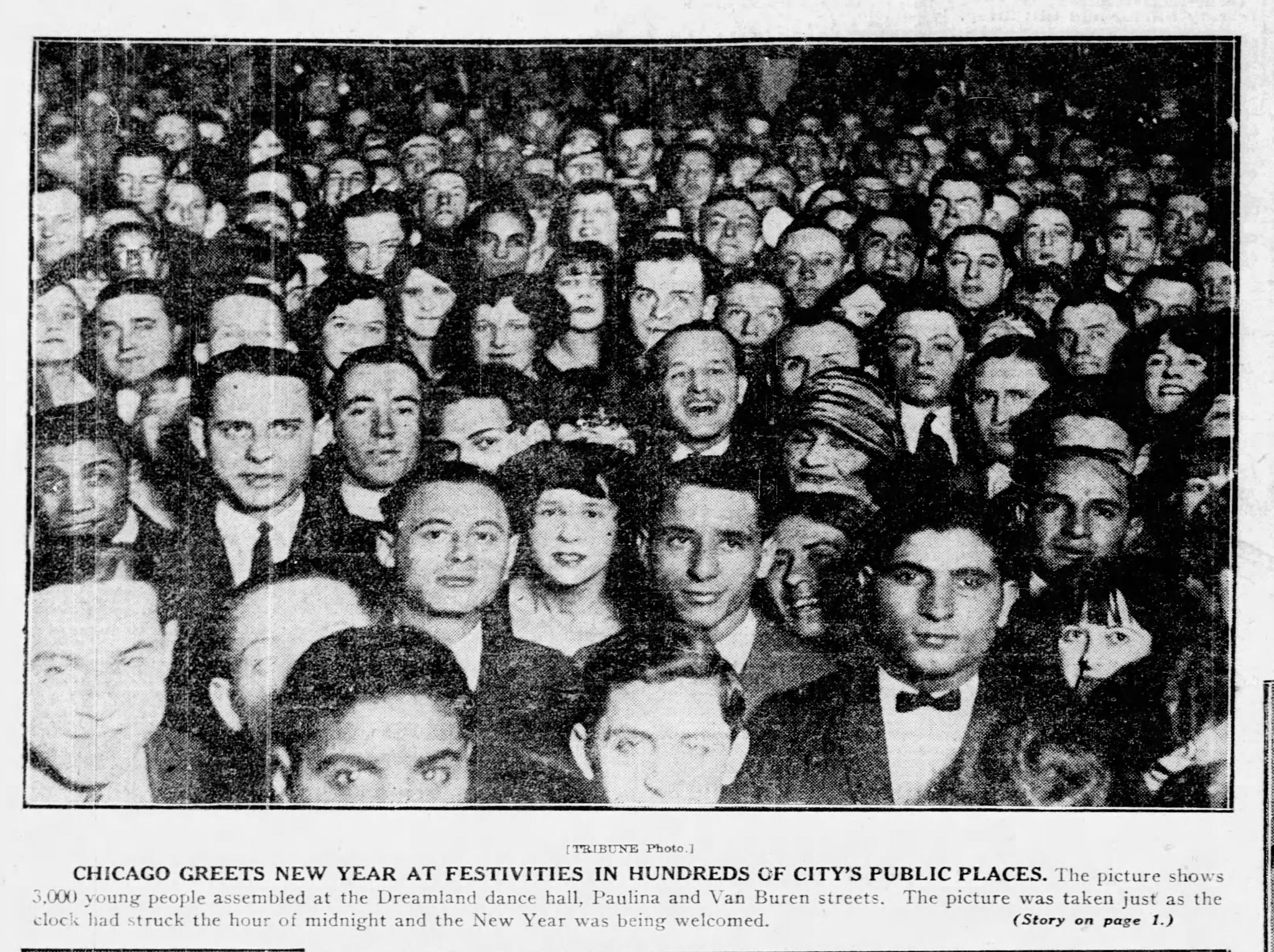
All of the events held around the city did excellently – the hotels and restaurants reported the highest attendance ever. The going rate was $10 per person at the better places, and the Drake Hotel had 3,000 guests.
No attempt was made to conceal the liquor people brought with them – bottles were left in open display on tables and counters. The venues supplied drink set-ups for $1.00 apiece.
The police said the crowds exceeded anything they expected, yet the people were good-natured and there were few disorderly incidents.
The Tribune noted that at the Pershing Palace at 64th Street and Cottage Grove, one of the tables included Archie Benson, the Prohibition enforcement officer. Benson had announced that he would “keep an eye on enforcement measures in the loop,” but here he was among the revelers and their silver flasks.
No arrests were made there, or in the Loop, or at the Midway Dancing Gardens, for liquor.
That was Chicago in 1924-25.
The Ridge Historical Society
The New Year in Chicago and on the Ridge 100 Years Ago – Part 1
By Carol Flynn
One hundred years ago, the annual welcoming in of the New Year promised to be one of the tamest ever. The United States was under the mandate of Prohibition. No alcohol could be produced, imported, transported, or sold.
In early December of 1922, Colonel Levi G. Nutt of the Federal Internal Revenue Department, charged with enforcing Prohibition in northern Illinois, was reported by the Chicago Daily Tribune to be organizing an undercover force of agents who would dress in evening clothes and “bear a general resemblance to ordinary human beings” to infiltrate New Year’s events to “harass, mangle, and destroy the merry making.”
The Tribune reported that “Col Nutt, who may be a nice man in a family circle, is a terror in the performance of duty, and he seems to enjoy saying that he expects to fill the jails and the hoosegows, the coolers and the police stations.”
However, the Chicago police didn’t intend to cooperate. According to the Tribune, Chief of Police Charles C. Fitzmorris said, “Let ‘em celebrate. The police will not interfere in any lawful celebrations. I expect to celebrate myself….[H]alf the men are to be off duty on Christmas and the other half on New Year’s.”
The Illinois Anti-Saloon League reportedly decided to ignore the New Year celebrations as a “temporary matter” that would not “take precedence over the fight” against illegal saloons.
The Tribune then reported that the raids were off, that Roscoe C. Andrews, Federal Prohibition Director for the State of Illinois, said that as long as people didn’t publicly flourish their hip flasks they would not be subject to search and seizure. This meant, wrote the Tribune, that “persons capable of pouring discreetly from under a tablecloth or a napkin, or from a flask in the pocket, will be immune from arrest.”
“Chicago’s holiday lid … [is] blasted clear off,” wrote the Tribune, leading Chicagoans to rush to make reservations for events.
Andrews, however, reacted to this Tribune article with an angry rebuttal, declaring, “Any statement that the lid is off in Chicago and that violations of the national prohibition act will be countenanced in any way, is absolutely without foundation….The mere fact that flasks are concealed under tablecloths or napkins is no defense.”
The battlelines were drawn.
Numerous parties took place that holiday week-end, in hotels, cabarets, and private clubs and residences. The demand for space in the hotels was so great that some events had to take place on January 1 instead of December 31.
Many of the events were dinner dances, starting in the early evening. A formal dinner was followed by music and dancing. As many as three orchestras performed at some events. Additional entertainments, like vaudeville acts, were on some of the agendas. Events at country clubs included outside sports like ice skating and hockey. At midnight, noisemakers, horns, and pistol caps created a din that could go on for half an hour. Then a less formal supper was served at midnight, followed by dancing until the wee hours of the morning.
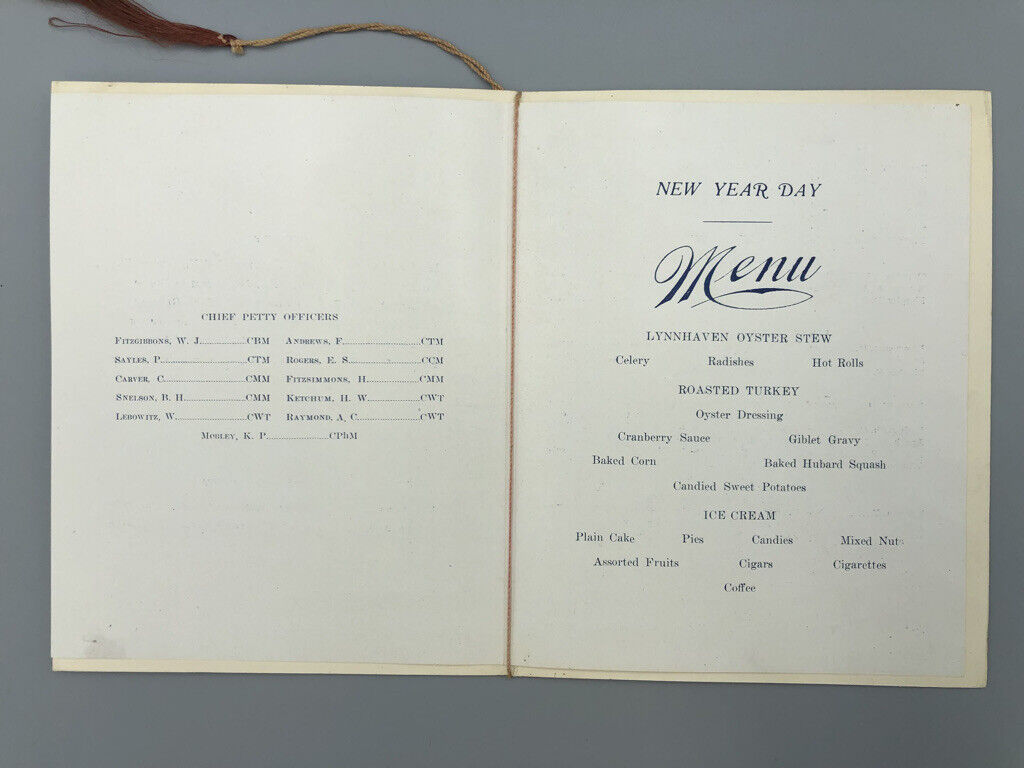
The menus for the formal dinners were always interesting and opulent. A typical New Year’s menu at a hotel included beginning courses of fruit cocktail, consommé, cream of tomato soup, and celery and almonds, followed by chicken and oysters dishes. The meat entrées included broiled pork tenderloin with pineapple fritters and fruit sauce, roasted turkey with cranberry jelly, and braised filet of beef with Bordelaise sauce. The side dishes were mashed potatoes, fried sweet potatoes, fresh spinach, and corn with green peppers. The entrees were followed by a lettuce and tomato salad. Desserts included pumpkin pie, peach pie, maplenut ice cream, steamed fruit pudding, assorted cakes, cheese, apples and raisins. Coffee, tea, and milk were availalble, and of course, people brought along their own flasks.
The cost for this meal was around $2.00 per person. A fifth of bootlegged Scotch was going for around $12.
The next day, St. Louis and San Francisco reported that riots ensued when federal agents raided events at hotels and resorts. The party-goers threw water glasses, flower vases, chairs, and even their plates bearing their entrees at the agents. People were injured – one agent was knocked unconscious by a flying bottle – and arrests were made.
Not so in Chicago. The promised raids of the “famous full dress army” never materialized, except for a few “minor cafes and saloons.”
The Tribune reported that Chicago “danced, sang, ate, went to theaters, churches and receptions.” Events at three to four hundred cafes, hotels, cabarets, and gardens, and too many private parties in residences and clubs to count, were celebrated with “little disorder” – for the most part, people were “good-natured and jolly.”
The weather was mild that year, very similar to what is forecasted for Chicago this year – the temperatures were in the mid-forties and cloudy, with a little light rain. Some 75,000 people descended upon the loop and the lakefront.
1922 turned out to be one of the biggest New Year’s Eve celebrations in Chicago’s history. Even Colosimo’s Café at 21st Street and Wabash Avenue, run by the “Chicago Outfit,” had to close its doors and cut off admittance, so great were the crowds trying to gain entry.
Many people held “watch parties” at home. Tomorrow, we’ll explore what was going on in Beverly and Morgan Park as 1922 became 1923.
The Ridge Historical Society
New Year’s Eve, 1921
By Carol Flynn
What was happening on the Ridge one hundred years ago? To answer that question, RHS turned to its old friend, the news correspondent from the Ridge for the Englewood Times back then, Pauline Palmer.
And according to Mrs. Palmer, Mrs. George Gale of 2325 W. 108th Place held a “watch night party on New Year’s Eve.”
A little research revealed that Mrs. Gale was the former Alma Demers, born in Canada in 1878. George Gale was born in Illinois in 1872 and was an inspector at the stockyards.
A little more research revealed that “watching the old year out” was the general theme of New Year events back then, as opposed to welcoming in the New Year as is done today.
The custom was to open the front door at the stroke of midnight so the old year could exit and join all the years of the past, and the “baby new year” could enter and begin its life. The guests would form a circle and sing “Auld Lang Syne.”
Although we don’t know the exact details of the Gales’ New Year’s Eve party in 1921, some clues as to what they might have done can be found in “Novel Entertainment for Every Day in the Year” written by Ellye Howell Glover, published in 1921.
A suggested menu was a “Jack Frost” dinner, composed of raw oysters on ice, cream of corn soup with whipped cream on top, turkey cutlets, mashed potatoes, cauliflower in ramekins, fruit salad in white chrysanthemums, vanilla pudding and cakes rolled in coconut. Obviously, the theme was white food!
A recommended table decoration also included party favors. The top of an evergreen tree (suggested was the top of that year’s Christmas tree) could be turned into a “New Year’s wish tree.” For each guest, a tiny envelope attached to a gilded wishbone could contain a personal good wish from the hostess to the guest, or a suitable quotation. A variation could be little boxes filled with good luck talismans.
After supper, the evening was filled with games and dancing.
There was also “Dennison’s Christmas Book” of 1921 that included ideas for New Year celebrations.
Dennison books were a great source for party planning for several holidays – the company had “Bogie” books for Halloween, also. Every year, the books contained new ideas for party themes (such as “Sailing into the New Year”), decorations, games, and party favors. Of course, the books also served as catalogs for Dennison’s line of products, which included a variety of crepe paper decorations.
Prohibition had started the year before with the passage of the Eighteenth Amendment to the U. S. Constitution which banned the manufacture, transportation, and sale of alcoholic beverages. The consumption of alcohol was never illegal under federal law; the issue would have been procuring it legally.
Happy New Year from the Ridge Historical Society.
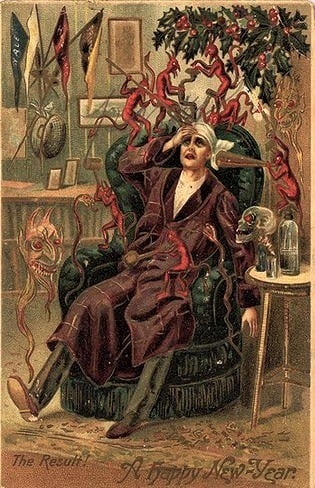
New Year 1921
By Carol Flynn
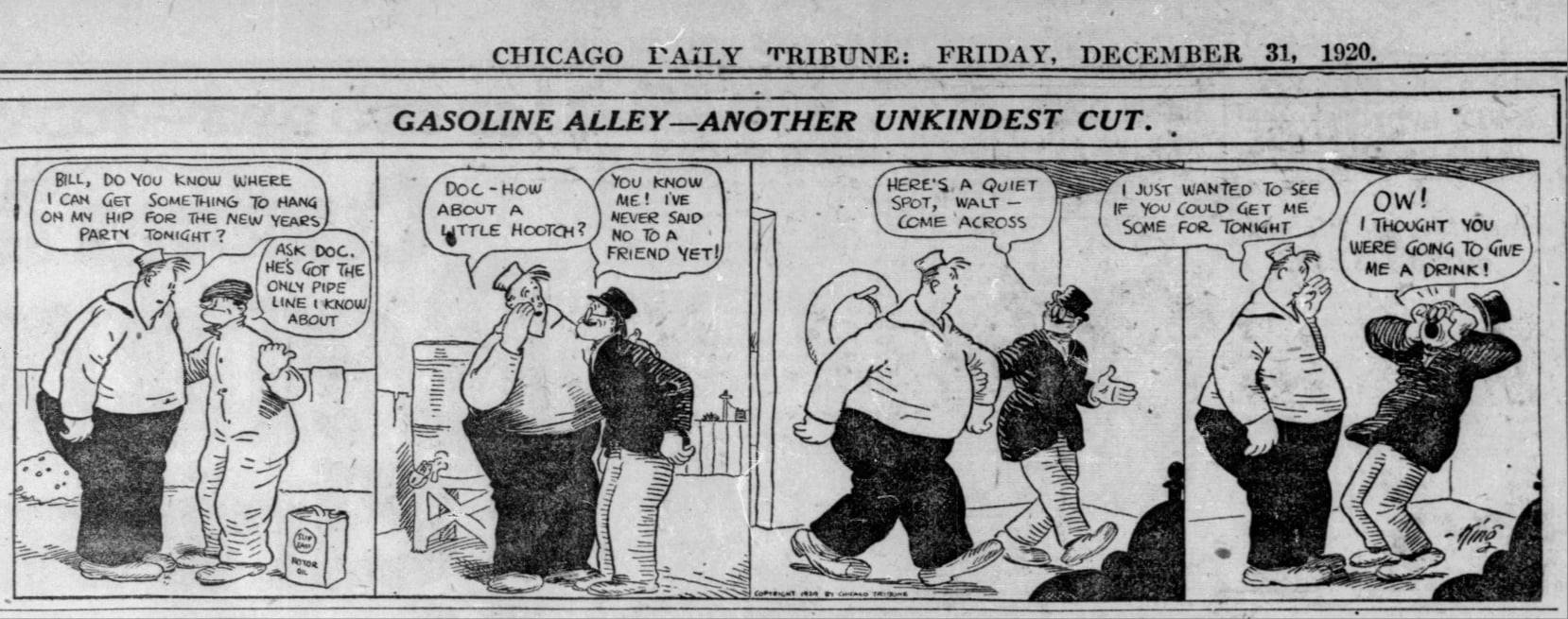
New Year’s Eve in 1920 was a momentous occasion. It was the first New Year’s Eve following the implementation of Prohibition.
The Eighteenth Amendment to the United States Constitution was ratified in January 1919 and became effective in January of 1920. It stated that “the manufacture, sale, or transportation of intoxicating liquors … is hereby prohibited.”
The Volstead Act, or National Prohibition Act, accompanied the 18th amendment and covered its implementation. It was named for Andrew Volstead, Chairman of the House Judiciary Committee.
In the federal law, consumption of alcohol and private ownership of alcohol were not banned, and the use of wine in religious ceremonies and alcohol for medicinal and research purposes was allowed. States could set their own laws, but Illinois used the federal version.
As New Year’s Eve approached, the Federal Prohibition Commissioner, John F. Kramer, stated there would be no “tilting” of the Volstead Act. He warned that federal agents throughout the country “were prepared to halt any attempt to turn the celebration of the New Year into an orgy of imbibition” like what occurred before Prohibition.
Chicago hotel, restaurant, and cabaret owners hoped that an exception would be made for that one night, that the “dry” agents would not “chaperone” their establishments. But that did not happen.
According to the Chicago Tribune in December 1920, Frank D. Richardson, Chicago’s “dry chief,” made it clear to the hotels that would host most of the parties that “Chicago hotels must obey the law.”
Richardson said, “Every hotel, from the largest to the most exclusive to the smaller family hotels will have its quota of dry agents assigned to check the
tendency toward law violation.”
As it turned out, Chicagoans for the most part behaved themselves. On January 1, 1921, the Tribune reported that the crowds in the loop were smaller that year, and although noisy, “there was an absence of the bibbling boisterousness of other days” – and little for the police to do.
Some of the restaurants and cabarets, of course, circumvented the rules. There were a few raids on places where alcohol was being sold, and arrests were made. The paper noted the evening was not entirely dry, “though more arid than any of its predecessors in memory.”
“Hip liquor,” or flasks that patrons carried secretly, were “winked at” in most of the restaurants but incidents of intoxication were infrequent. One manager noted that people were having as good a time without liquor as with it. For one thing, they spent more time on the dance floor.
But most of the party-goers made it an early night, and the crowds thinned out by 1:00 a.m.
One Tribune reporter lamented that in “restaurants where in former years the celebration found light, music, wine and hilarity only the ghosts of the former days walked, danced, and dined.”
He found it a “dreary tour” through the neighborhoods of “darkened doors of the cafes of yesteryear.” He called it the “indications of a new age.”
Prohibition was repealed in 1933. It proved to be impossible to enforce, and there were economic drawbacks mostly in the loss of tax revenue from the sale of alcohol. The health and social outcomes of Prohibition are mixed. Drinking did decrease and some medical conditions like liver cirrhosis declined. However, crime and violence due to illegal operations increased.
When Prohibition was repealed at the federal level, it was left up to states and local governments to restrict or ban alcohol. One of Chicago’s best examples of a “dry” community that chose to stay that way is our own Beverly/Morgan Park area. Morgan Park was founded as a temperance community. Efforts have been made through the years to reverse this “dryness” but to date, the residents have voted to ban the sale of alcohol east of Western Avenue. There are a few exceptions where addresses hold a liquor license.