Explore the RHS Facebook Archives, a rich repository of local history written by Carol Flynn. For two decades, Carol brought a deeply dedicated voice to public education at RHS. Her role as Facebook administrator through mid-2025 naturally extended her prolific research into meticulously detailed articles, most notably her multi-part historical series posts. Today, Carol continues her local history writing for The Beverly Review and other outlets.
April 2025
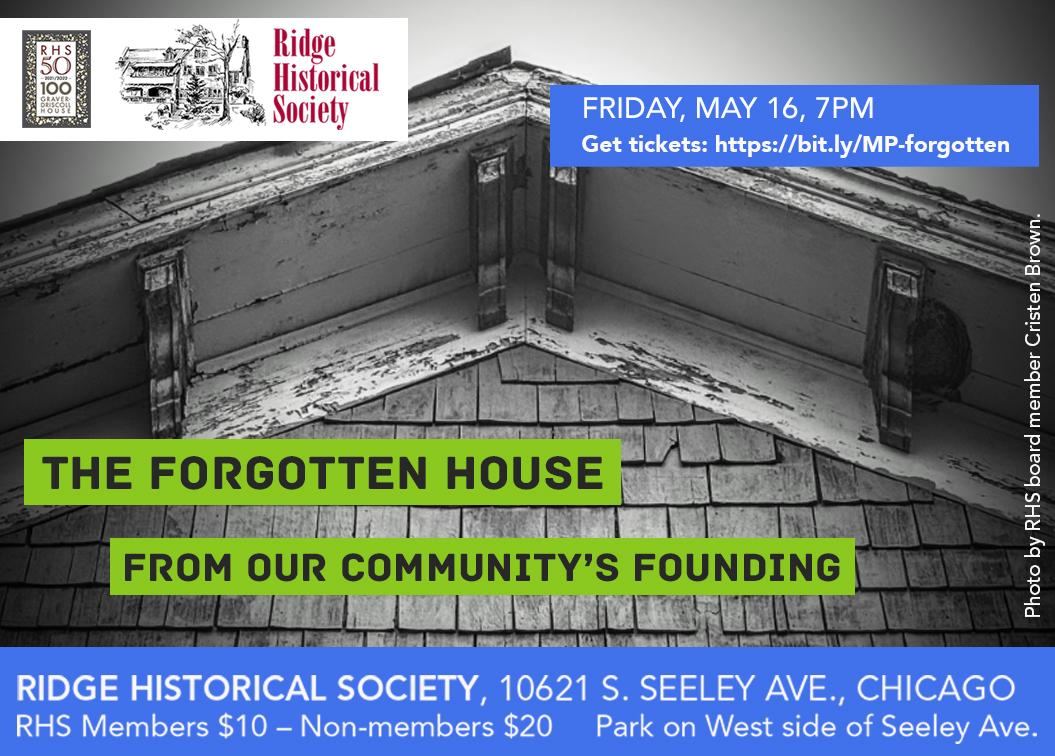
The Forgotten House
from Our Community’s Founding
Friday, May 16, at 7:00p.m.
The Forgotten House
from Our Community’s Founding
While on a run in August 2024, RHS board member Tim Blackburn jogged past a house in Morgan Park that he instantly knew was one of the earliest remaining homes in the Beverly Hills and Morgan Park area. His initial research determined the house had been moved to its current location, but discovering where it was moved from and its history turned out to be a 'needle in a haystack' investigation.
In this program, Tim will guide you through his journey to uncover the important origins of the house, built by one of the community’s earliest settler families just a few years after they aided Black freedom seekers nearby. Given the current condition of the house, this is a history you'll want to learn before it is possibly lost to time. Ridge Historical Society hopes that by educating about the history of this house, its legacy may be preserved.
Ridge Historical Society
10621 S. Seeley Ave., Chicago, IL 60643
Members: $10 | Non-members: $20 | Students under 18: $5
Get tickets online: https://bit.ly/MP-forgotten
RSVP: ridgehistory@hotmail.com 773.881.1675
Ridge Historical Society
The First Country Club on the Ridge: The Ellerslie Cross Country Club – Part 5 – Hare Coursing with Greyhounds – Continued
By Carol Flynn
The Ellerslie Cross Country Club, the first country club to open on the Blue Island Ridge at the southwest corner of 91st Street and Western Avenue, held hare coursing events on the golf course during the non-golf months.
Hare coursing was a sport especially popular in England and Ireland in which greyhounds competed to chase and attempt to capture a hare, which was usually a jackrabbit in the U.S.
The dogs were judged on speed and agility, and the winner was not necessarily the dog that caught the hare. While a point was awarded for catching the hare, if the hare escaped, that was fine, too, although that rarely happened.
Note that humane groups were against this and other “bloodsports” like dog fighting, but they were legal in the late 1800s. Hare coursing eventually turned into greyhound racing, but hare coursing is still legal – and controversial – in some western states where jackrabbits are plentiful.
The Ellerslie Club introduced the sport, the forerunner of greyhound racing, in a big way to Chicago. Past Mayor John Hopkins, the uncle of one of the Ellerslie Club’s founders, was a fan of the events at the Ellerslie Club.
Some of the coursing events were written up in great detail in the newspapers. The first coursing event held at the Ellerslie Club, in October of 1899, was discussed in the preceding post.
In a memorable match in April of 1900, the hare escaped the golf course, crossed the railroad tracks to the west, and disappeared into the woods of Evergreen Park.
The two competing dogs followed it and disappeared from the spectators’ sight. After a three-mile run, a dog by the name of Password emerged victorious.
Password was owned by Michael Allen, whose champion dog St. Clair won the first coursing event at Ellerslie. Password was the daughter of St. Clair.
Michael Allen, who was introduced in the previous post, was born in Ireland in 1855 and came to the U.S. in 1874, and by 1899 he was a naturalized citizen. He and his wife Catherine “Kate” (Walsh) Allen, and their three children lived at 4459 Halsted Street and owned a store and saloon.
Although storekeeper and “liquor dealer” were listed as his official employment, Allen had an obvious passion for hare coursing with his greyhounds. He won thousands of dollars from coursing.
Greyhounds usually competed for just a few years and were retired well before the age of five years old, so there were always new, young, fresh dogs coming into competition.
In addition to the champions already mentioned, some of Allen’s other famous dogs were named Pathfinder, Cork Screw, and Apple Blossom. He was considered to have one of the finest kennels (referred to as stables back then) in the country, and participated in matches all over the U.S.
But the sport was becoming increasingly controversial. In 1899, Allen was charged with cruelty to animals by the Humane Society for conducting an informal hare coursing event in an open field in Chicago. In court, he showed that he followed the “sporting principles” for the sport so he was acquitted.
The success of the coursing events at the Ellerslie Club led the founders of the club, including Joseph M. Crennan and Thomas J. Keeley, profiled in Post 2 of this series, to join with Allen and other backers to open a new coursing club in Chicago, and this led to the Chicago Coursing Club in 1904.
There had been an informal “Chicago coursing club” that held events in a field at 47th Street and Western Avenue that was often in trouble with the law and the Humane Society, but this new club was founded outside of city limits where there were no local laws governing this type of operation.
Forty acres of land were leased in Mount Greenwood, running from 105th to 111th Street, Sacramento west to Kedzie Avenue. The course was just to the west of the railroad tracks next to Mount Greenwood Cemetery, so there was already well-established public transportation to the area.
The founders enlisted James “Big Jim” O’Leary to join their efforts, which, according to the Chicago Tribune, was an “indication that the backers of the enterprise mean to give it a thorough trial” “to establish coursing as a regular sport” in Chicago.
Big Jim was the son of Catherine and Patrick O’Leary, whose barn was the site for the start of the Great Chicago Fire of 1871. Big Jim was a famous gambler, the scourge of fellow Irishman Police Chief Francis O’Neill for the illegal operations Big Jim ran.
At the same time, Big Jim was a folk hero to the public because he ran an honest operation and was known to never default on a bet. Betting on the greyhound coursing events was an important part of the enterprise and Big Jim’s involvement meant the betting would be honest and fair.
The first officers of the Chicago Coursing Club included Michael Allen as President, O’Leary as Treasurer, and Crennan and Keeley as Directors.
The Chicago Coursing Club opened with its first event in May of 1904, attended by over “1,000 spectators crowded into the grandstand.” The newspapers described the park as “one of the best in the country.” To comply with the laws of the Humane Society, escapes for the jackrabbits were built into the burlap fences and most of the rabbits managed to elude the dogs.
Twenty-four dogs were entered. Big Jim O’Leary’s dogs were named Troublesome and Yankee Dime. Crennan also had dogs entered, including Colonial Girl, Modern Girl, and Judge Brown.
Allen and his partner Wilson entered Rosie Macree, Bill Dugan, Advertiser, Barefoot Boy, Our Minnie, and Kitty of the Hill.
The second day of the inaugural event, when the finals were held, attracted twice as many people, with over 2,000 in attendance. As no surprise, there was no final round because by then the top three dogs were all owned by Allen – Bill Dugan, Barefoot Boy, and Our Minnie – and the purse of $540, worth about $18,000 today, was his.
The Humane Society was against the new operation from the beginning. In 1905, someone, never identified, managed to steal the fifty rabbits that the Club was going to use for an event, so the event had to be canceled.
After a few years, differences in the philosophy of running the Club caused Big Jim O’Leary to leave the operation. He believed it should be run strictly as a sporting and betting operation, but others felt it should be run as a commercial revenue maker.
And then Mount Greenwood finally incorporated as a village in 1907, and with that came rules and laws and licenses.
The Chicago Coursing Club finally ended operations around 1908.
The next post will look at the other sporting events that went on at the Ellerslie Cross Country Club, the equestrian events that gave the club its name.
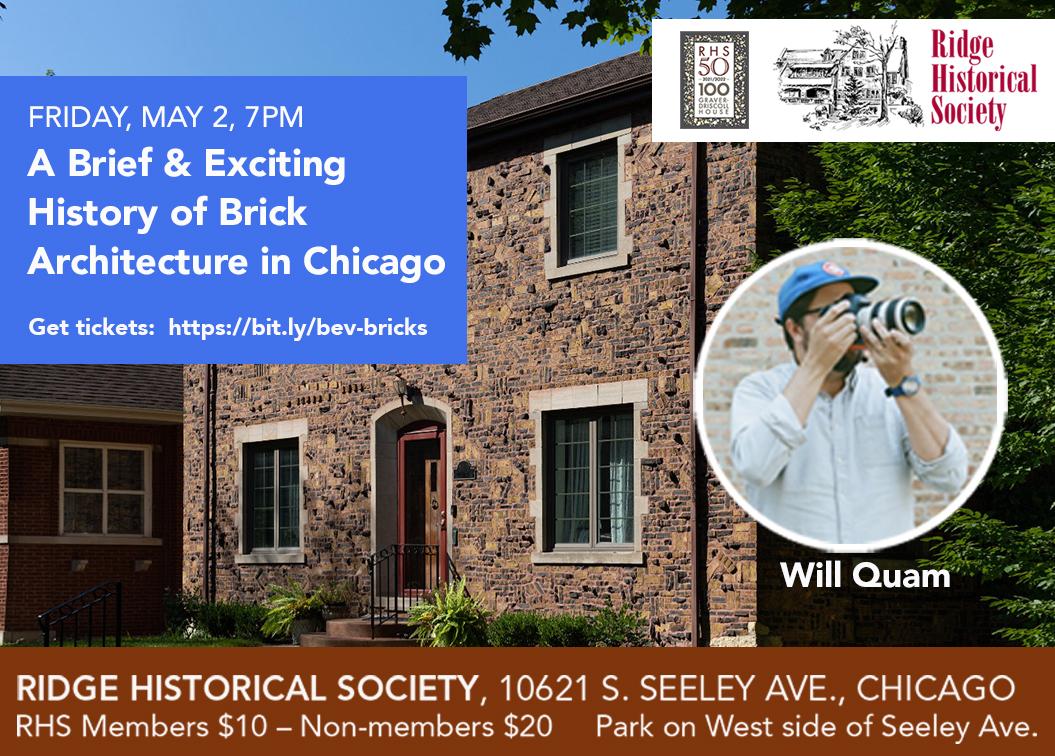
Friday, May 2, at 7:00p.m.
A Brief & Exciting History of Brick Architecture in Chicago
Brick is an ever-changing material that has defined Chicago and its architecture. Learn the trends and fashions through Chicago's brick history: Homegrown common bricks, imported red bricks, wild colors, textures, and terra cottas of the 1910s-30s, Miesian modern bricks and more. You'll discover the technology and architectural innovations that can be found across Beverly, Morgan Park, and Chicago, written into its brick. This presentation will be accompanied by dozens of Will Quam's photos of buildings and their details.
About the presenter: Will Quam is an architecture historian and photographer. He has been called "Chicago's premiere brick expert" by Geoffrey Baer, and his photography and passion for Chicago's brick history have been featured on Block Club Chicago, WTTW, The Chicago Tribune, WGN and more. His architecture tours were named some of Chicago's best by Curbed and the Chicago Reader. His book on this history of brick architecture in Chicago, Fire and Clay, will be published by the University of Chicago Press in 2026. Learn more at www.brickofchicago.com
Members: $10 | Non-members: $20 | Students under 18: $5
Ridge Historical Society
10621 S. Seeley Ave., Chicago, IL 60643
Get tickets online: https://bit.ly/bev-bricks
RSVP: ridgehistory@hotmail.com 773.881.1675
Ridge Historical Society
The First Country Club on the Ridge: The Ellerslie Cross Country Club – Part 4 – Hare Coursing with Greyhounds
By Carol Flynn
The first country club to open on the Blue Island Ridge was the Ellerslie Cross Country Club at 91st Street and Western Avenue, founded by a group of Irish American businessmen in 1899. Although it was technically located in Evergreen Park, the address was often given as Beverly.
The Ellerslie Club introduced golf to the Ridge, covered in Part 3 of this series. Two other sports were also of great interest to the founders of the club – hare coursing and equestrian events.
This post and the next will discuss coursing, then a look at equestrian events will show why “cross country” was part of the name of the club.
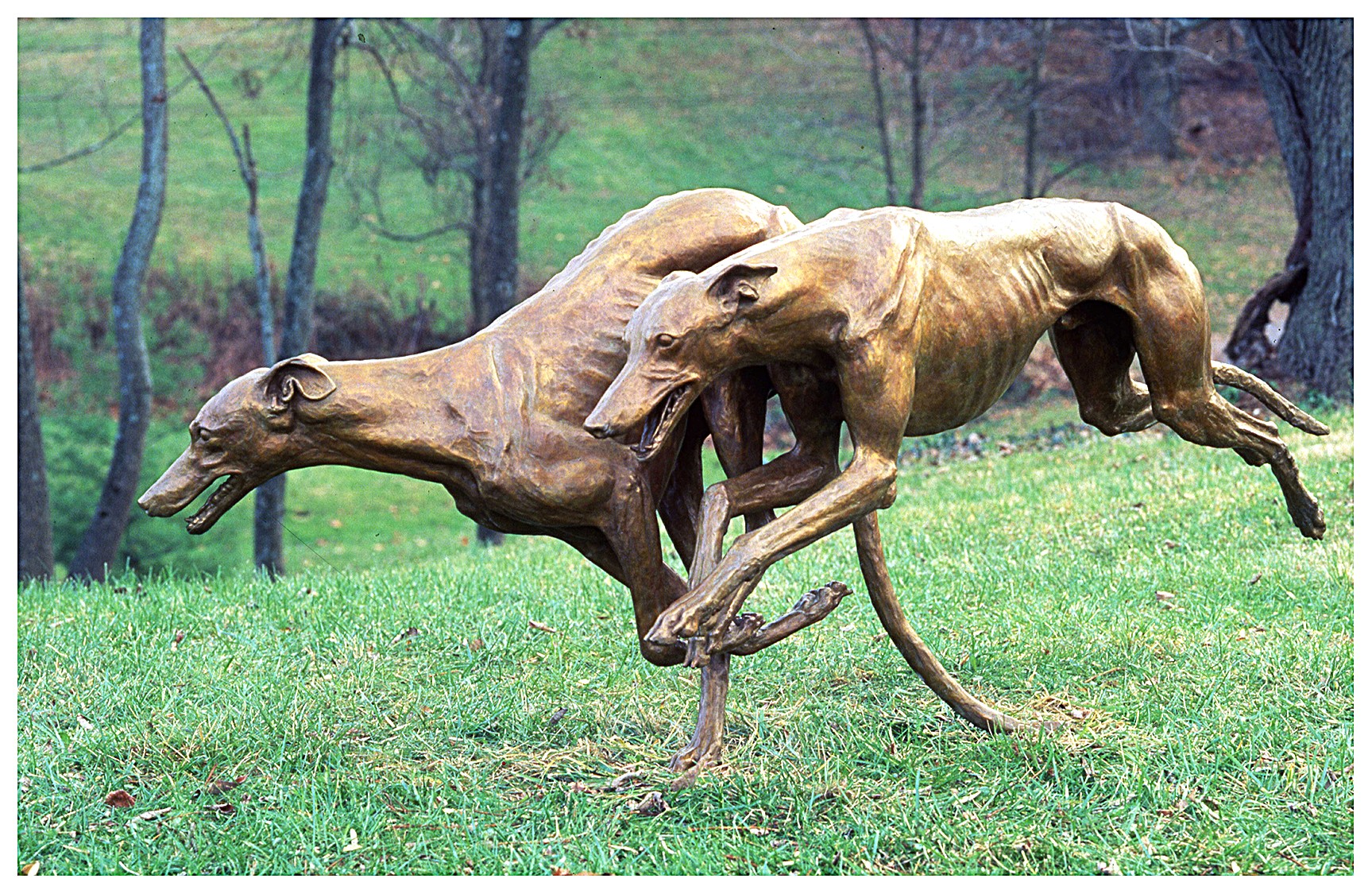
Hare coursing is an ancient practice that uses dogs known as “sighthounds,” that hunt by sight, speed, and agility, instead of scent and endurance, to pursue hares for hunting, sport, and pest control. The best-known sighthounds are greyhounds.
The practice was first written about in Greece more that 2,000 years ago, but it was the English nobility under Queen Elizabeth I in the 1500s who turned coursing into a competitive sport.
For centuries in Great Britain, “commoners” were not allowed to own sighthounds and engage in coursing, but by the 1800s, that social order had broken down, and the sport had become more a favorite of the working classes in England and Ireland and less of one for the aristocracy. It really came down to being able to acquire and breed greyhounds.
Greyhounds came to America with the European settlers. Thomas Morgan brought greyhounds with him from England that he used for hunting deer and wolves on the Ridge. The dogs were also used by farmers to control jack rabbit populations.
By the late 1800s, hare coursing was a popular sport in the U.S., with governing organizations, clubs, and numerous competitions, formal and informal.
When the Ellerslie Club started holding events, the formal competitions in Chicago were usually “closed coursing,” that is, held in confined spaces with escape routes built into the “walls” for the hares. There was also “open coursing” where there was sufficient outdoor space, with the rabbits released with the chance to outdistance and outmaneuver the dogs.
Two dogs at a time competed against each other, chasing a released hare, and judges awarded the dogs points for speed and skill in manipulating the hare’s movements (“turning”) and for catching the hare. The dog with the most points advanced to the next round, until there were only two undefeated dogs left for the final round and the grand prize. In large competitions, as many as 400 dogs might be entered and the competition took days to complete.
The hare was given a head start and was more agile than the dogs, but the hounds were larger and could cover the ground faster. Each competition lasted only seconds, and it did not matter if the hare managed to escape because the point of the competition was not killing the hare, it was judging the dog’s performance in trying to catch the hare. A true “sportsman,” in theory, celebrated the hare’s escape, but the hare rarely won.
Coursing was a brutal “bloodsport” for the hares, raising obvious objections from humane groups. Other bloodsports were also tolerated back then, including dog fighting and rat baiting. In fact, John B. Sherman, who started the Union Stockyards, had an experimental stock farm on the land that is now Dan Ryan Woods, and held parties there that featured dog fights for entertainment.
Hare coursing was eventually mostly replaced by greyhound racing, where the dogs chase mechanical rabbits, but some countries still allow live hare coursing. It is banned in England, but in Ireland, it is still allowed, and even though the dogs wear muzzles it still results in severe injuries and fatalities for the hares. In some western states in the U.S. where there are large populations of jack rabbits, it is legal – and highly controversial. Even where banned, hare coursing, like dog fighting and other bloodsports, goes on illegally.
Back in 1899, the sport using live rabbits was legal, and people with prized dogs traveled around the country to compete in events.
Some of the founders of the Ellerslie Club owned greyhounds and actively participated in competitions. Fred Higbie was one of those men, and he was introduced in Post 2.
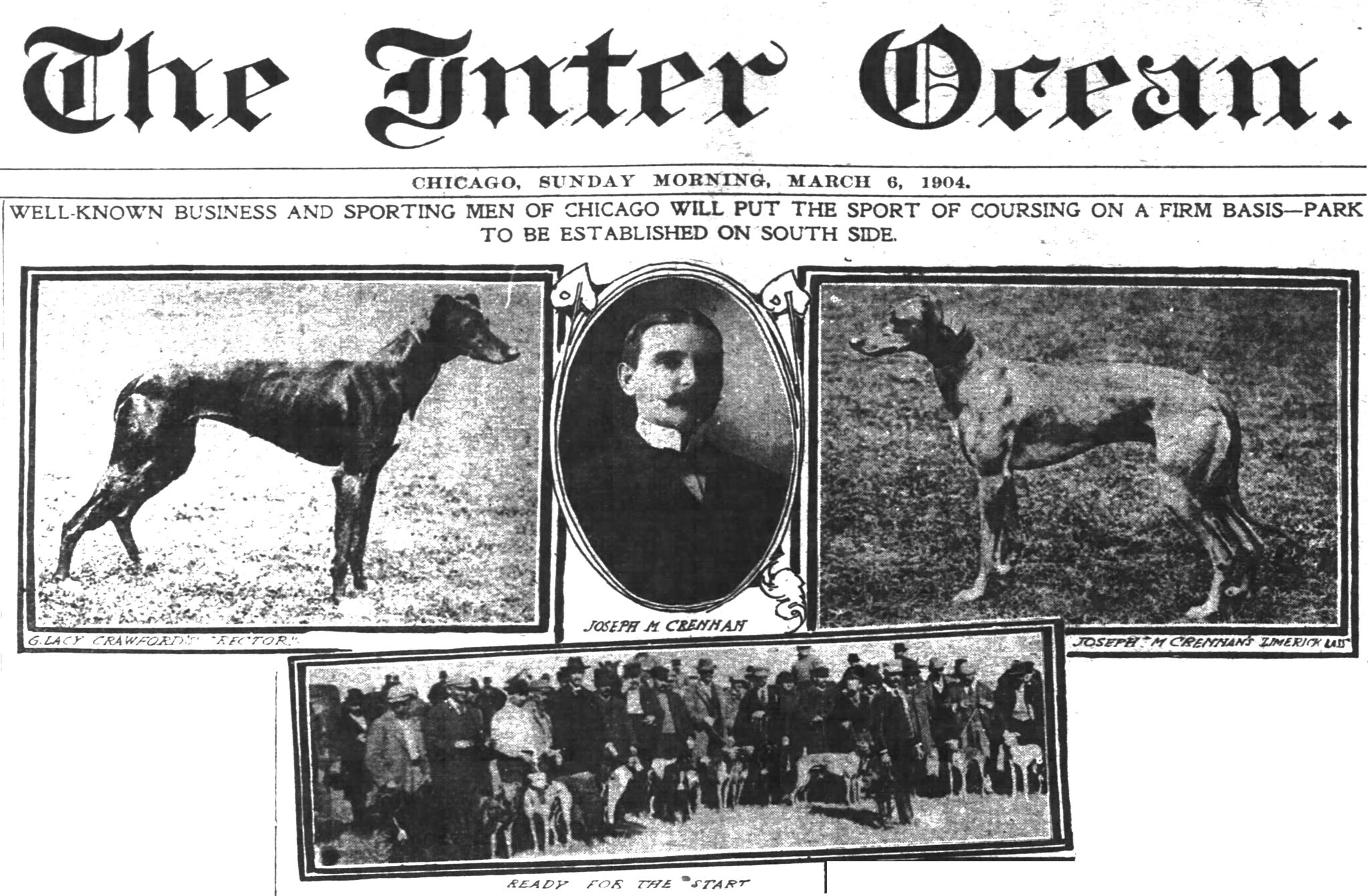
The first coursing event at Ellerslie was held in October of 1899 and described in the Inter Ocean newspaper as “the first genuine exhibition of the well-known old country sport on a large scale ever seen around Chicago, and the details were carried out to perfection.”
Jackrabbits were brought in from Wichita, Kansas to be used as the lures, and competitors came from as far away as Pittsburg, Pennsylvania.
The final round came down to a competition between Higbee’s prize dog named “Bright Eyes” and a dog named “St. Clair” bred from a champion in England, owned by a man named Michael Allen. St. Clair was the winner.
Michael Allen, born in Ireland, was a famous and successful hare coursing sportsman who lived in Chicago.
He had a kennel of greyhounds that the newspapers called the best in the city and one of the best in the country. He competed all over the country and his dogs won many prizes.
The next post will cover how the success of Ellerslie’s coursing events led the Ellerslie founders to also form the Chicago Coursing Club and build a coursing park in Mount Greenwood on land west of Mount Greenwood Cemetery. Not only were Michael Allen and his dogs major players in this story, so was the famous gambler Big Jim O’Leary, son of Catherine O’Leary, famous for her now known to be innocent role in the Great Chicago Fire.
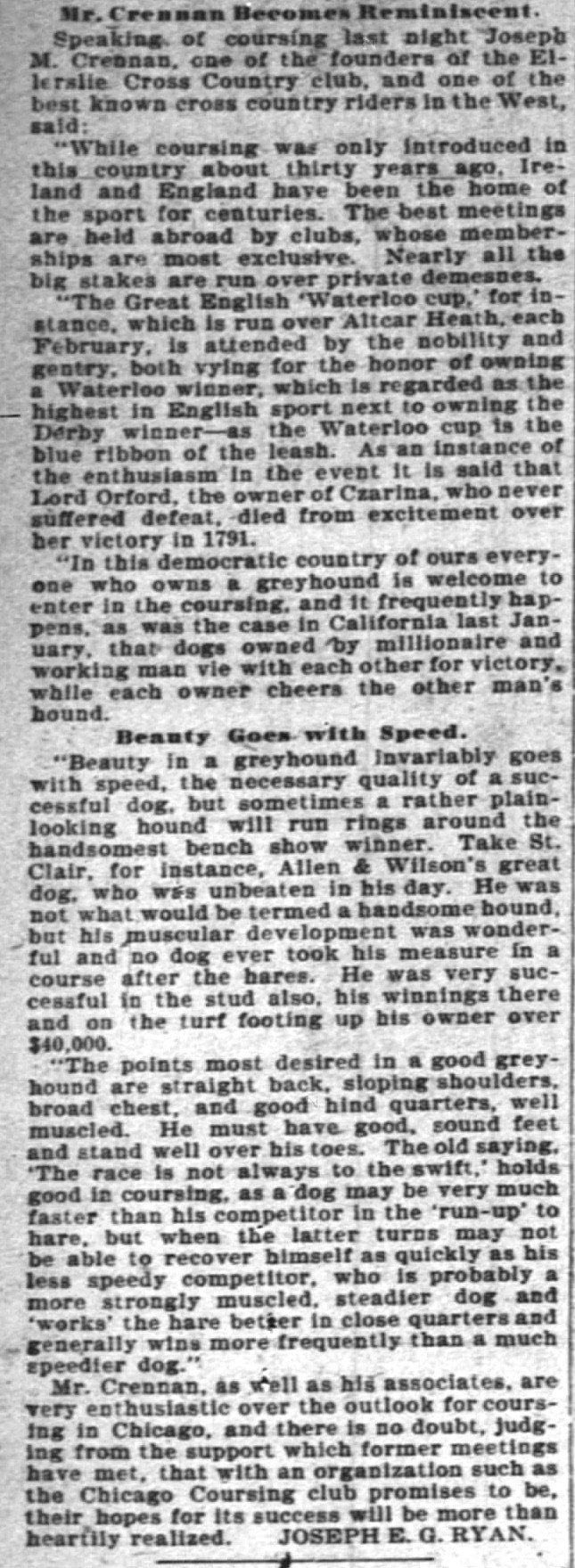
Image from Inter Ocean newspaper, March 6, 1904. Joseph Crennan, from Ireland, was the first president of the Ellerslie Cross Country Club, and he was a founder of the Chicago Coursing Club that built a park in Mount Greenwood.
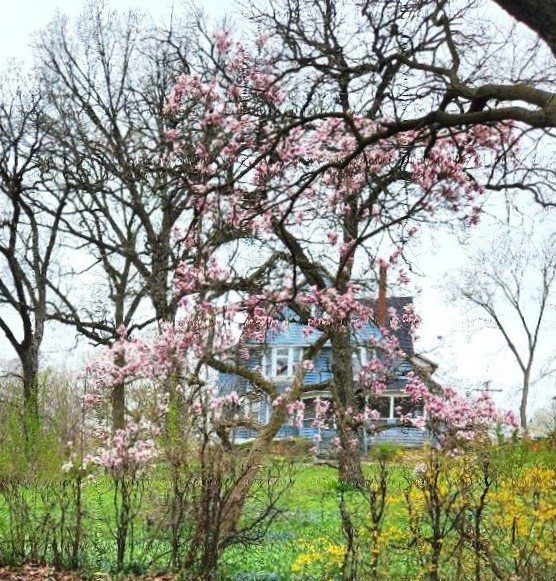
Happy Easter from the Ridge Historical Society.
RHS will be closed tomorrow, Easter Sunday, April 20, 2025.
Some lovely springtime views can be found around Beverly and Morgan Park. This is the Reuben P. Layton House at 10324 Longwood Drive, glimpsed through magnolia, forsythia, and Siberian squill.
Siberian squill and forsythia were introduced into the U.S. by English settlers, and both became popular for gardens in the late 1800s.
Magnolias traveled in the opposite direction – the magnolias native to the southern U.S. were introduced into England and Europe by returning explorers and traders.
Edited: There are daffodils here, too – also introduced into the U.S. In fact, most of the gardens we build are full of plants not native to the U.S. They come from tropical areas so they only last through the summer, or they have been hybridized to withstand our northern climate. Too many people still think of our native prairie plants as "weeds."
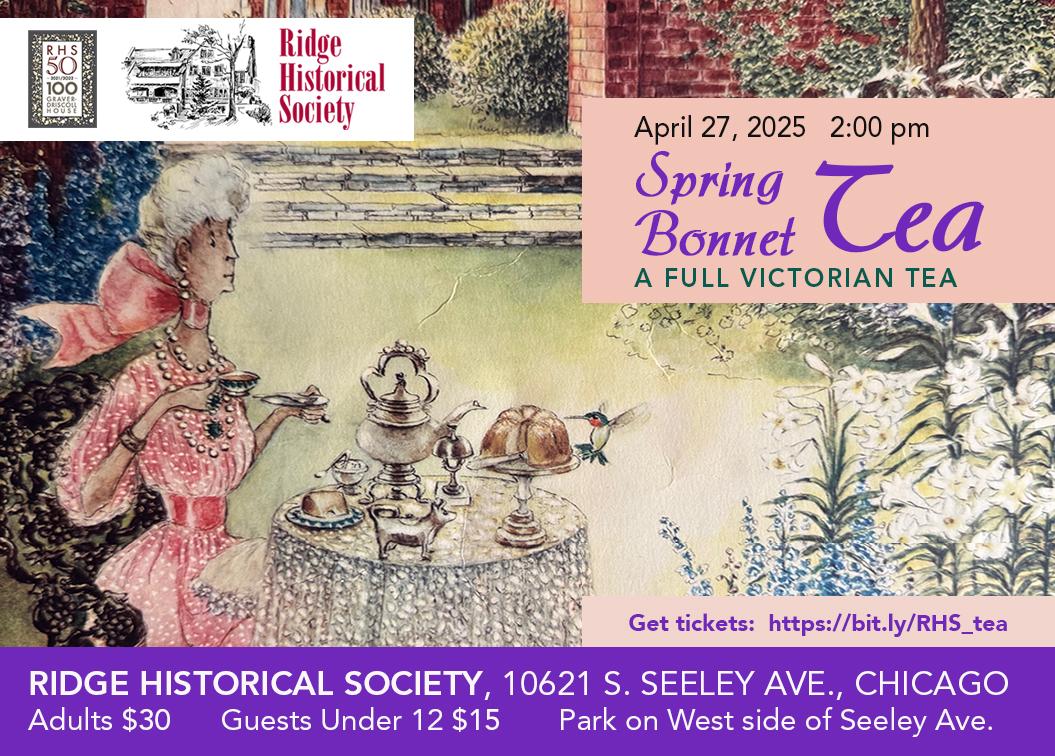
Spring Bonnet Tea 2025
Sunday, April 27, 2025 at 2pm
RHS is happy to continue to hold this popular spring annual fundraiser event. Join us for a Full Victorian Tea featuring a fine selection of savories, scones and pastries. Ladies, please wear a spring hat or bonnet!
A wonderful multi-generational event — come with friends, bring your daughters or granddaughters for a lovely afternoon! A fun addition is a drawing for door prizes.
This Full Victorian Tea is set in the Historic Graver-Driscoll House, on the Ridge in the Beverly Hills neighborhood of Chicago.
Space is limited, advance ticket purchase or RSVP required.
Adult Guests $30 Guests Under 12 $15
Ridge Historical Society
10621 S. Seeley Ave., Chicago, IL 60643
Limited Capacity. Get tickets here: https://bit.ly/RHS_tea
RSVP: ridgehistory@hotmail.com 773.881.1675
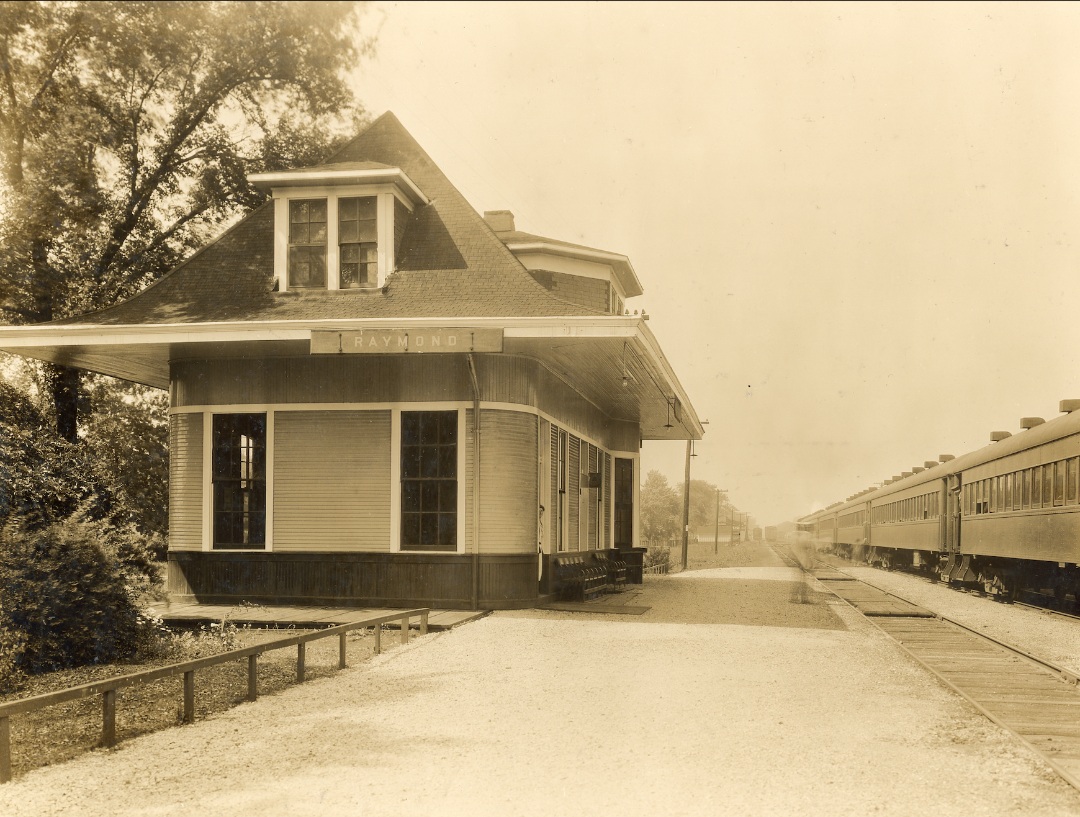
Ridge Historical Society
Letter to Metra about 115th Street Station
By Carol Flynn
Metra, the state agency that runs the Rock Island commuter line through Beverly and Morgan Park, recently announced projects for the Rock Island stations along the Beverly line.
The major project that has prompted concern in the community relates to the 115th Street station.
Metra announced it has earmarked $8.69 million for a multi-year plan that includes a new plaza and sidewalks, parking lot resurfacing, accessibility improvements, new lighting, bicycle parking, and landscaping improvements. The funding includes any environmental analyses required by law and will address stormwater management needs.
Most significant, the plan includes building a new warming shelter to replace the historic station built in 1892 that was destroyed by fire in 2017.
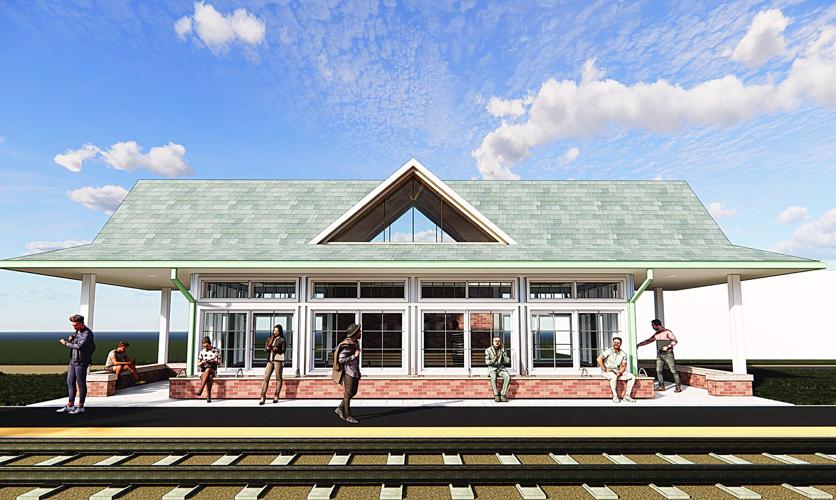
An illustration of the proposed shelter from Legat Architects was shared publicly at the time of the announcement.
The design of the structure raised concern among members of the Ridge Historical Society (RHS) Historic Buildings Committee (HBC). This prompted them to write a response to Metra, detailing the committee’s concerns and recommendations.
The letter was supported by 19th ward alderman Matt O’Shea, and was signed onto by the Beverly Area Planning Association.
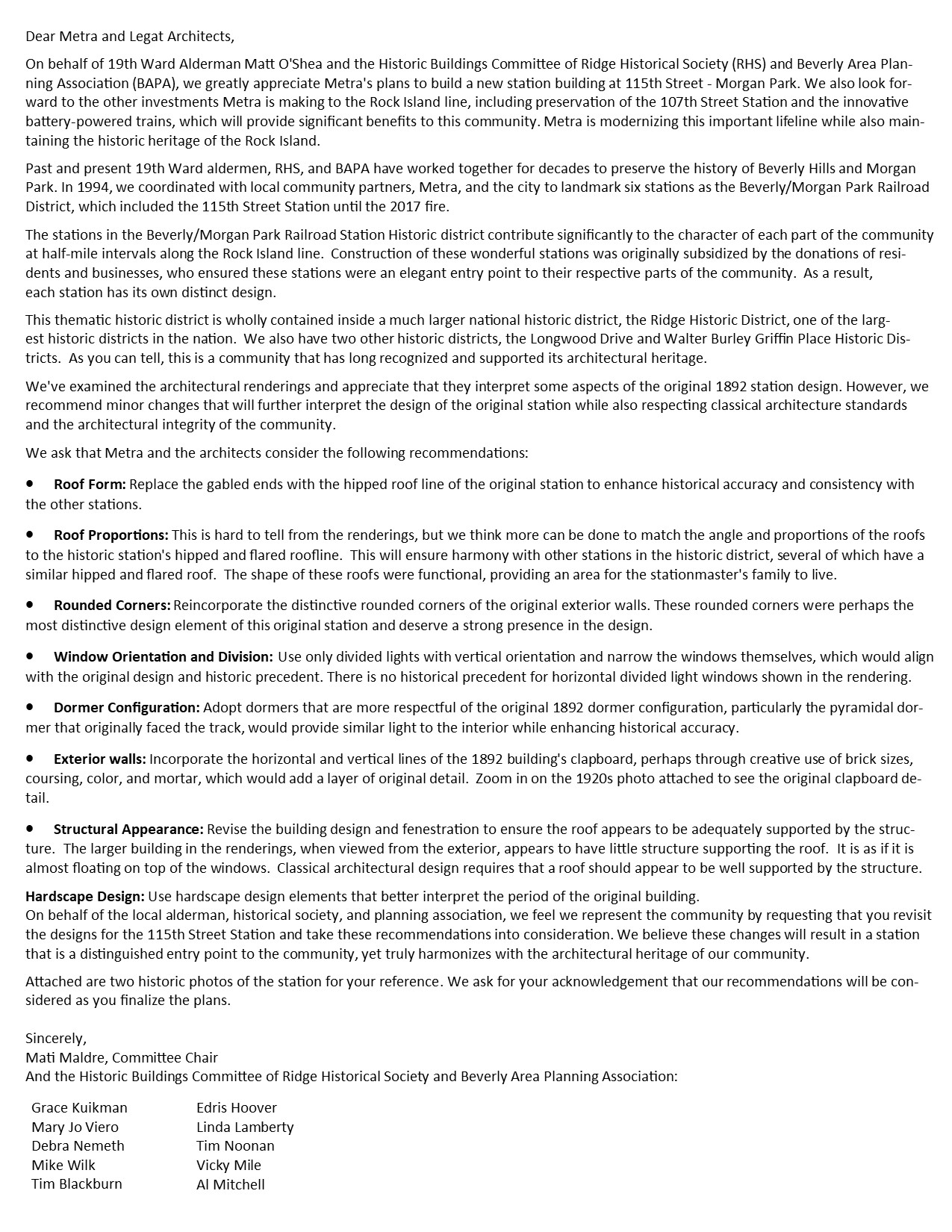
The letter to Metra is attached to this post.
To better understand the situation and the letter, here is background Information.
The reason the design is of concern to RHS is that the train stations are historic buildings, and their look is very important for preserving the visual cohesiveness of the neighborhoods around them and reinforcing the unique historic identity of the Beverly/Morgan Park community. The Historic Buildings Committee feels the proposed structure could be better designed from a historic perspective.
The Metra Rock Island railroad commuter line has always been more than just a convenient means of transportation to downtown Chicago, it is a vital part of the history, tradition, and culture of Beverly, Morgan Park, and Mount Greenwood.
The Chicago and Rock Island Railroad, the original branch to the east of the Beverly branch, running between Chicago and Joliet, began in 1852, and by 1866 had expanded into the Chicago, Rock Island, and Pacific Railroad (CRI&P) connecting Chicago to Denver and Houston.
In 1869-70, the men who owned and operated the CRI&P formed the Blue Island Land and Building Company and bought most of Thomas Morgan’s original estate north of the city of Blue Island.
They built a new branch of their railroad west along 99th Street from the original line to this new land, then south to merge with the original line in Blue Island, creating the route used today.
The land was developed into Beverly and Morgan Park, creating “railroad suburbs” along the commuter line that allowed people to live in the idyllic countryside and easily travel to downtown for jobs, business, shopping, and social and cultural events.
In 1889, the commuter line was extended north to 91st Street.
The train stations along the route, designed to fit in architecturally with the community, became hubs for local business and society and influenced the placement of parks, public buildings, and residences.
In the early 1980s, the state of Illinois took over the line from the declining railroad company through the newly formed Regional Transportation Authority (RTA). Metra is a division of the RTA.
The train stations that mark the stops along the Rock Island commuter line from 91st Street to 115th Street were designated the Beverly/Morgan Park Railroad Stations District by the Commission on Chicago Landmarks in 1995. They are also included in the national Ridge Historic District.
The six stations in the original Chicago landmarks district at 91st, 95th, 99th, 107th, 111th, and 115th Streets created a “thematic-style” landmarks district, with the buildings connected to each other by common purpose, not by geographic closeness.
The stations were built between 1889 and 1945, and, according to Commission staff, “are rare survivors of a once common nineteenth century building type.” They share the scale, materials, and architecture style of nearby buildings, making them “strong visual features” in the community.
The station at 103rd Street was not included in the original landmarks district because it was built in 1967, replacing an 1890 building.
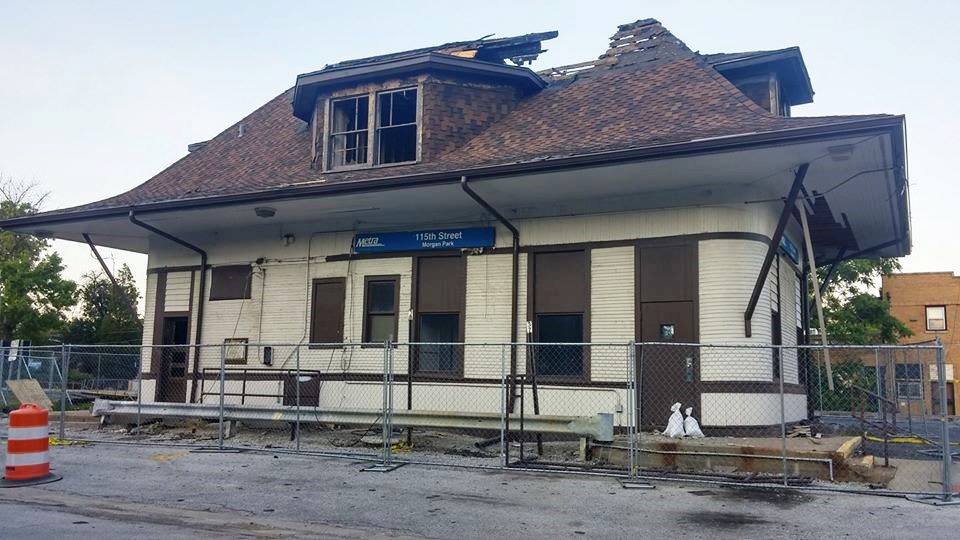
In 2017, the station at 115th Street, built in 1892, was demolished following irreparable fire damage, so that station became another loss to the landmarks district.
At the time the115th Street station was badly damaged by fire in 2017, it was no longer in use for ticket sales and was only occasionally open in winter as a warming house.
The replacement structure is not required by law to meet any historic standards, so Metra’s intent to honor the community’s history is voluntary.
The letter to Metra details several areas that need change.
The concerns and recommendations stated in the letter relate to the roof form and proportions, the loss of rounded corners that were distinctive to the original building, the window orientation and division, the dormer configuration, the lines of the exterior walls, and the lack of a strong structural appearance.
The committee recommended that hardscape design elements be used that better interpret the historic time period of the original building.
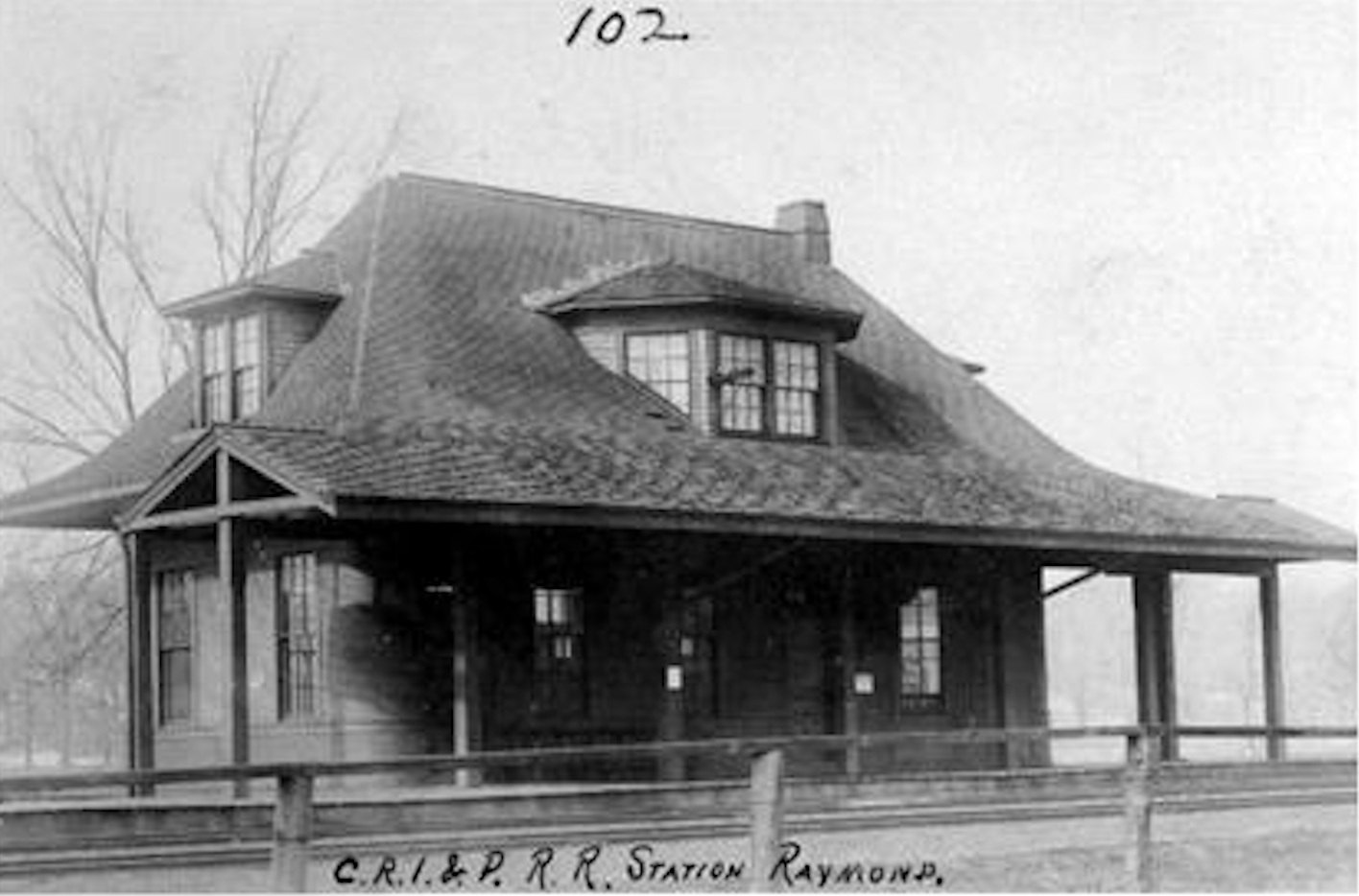
Several early pictures of the 1892 building were included with the letter to Metra.
Call to Action
RHS preservationists have raised a call to action, and encourage commuters, residents, and other interested parties to submit public comments on the proposed design to Metra. Please send email comments to the Metra Board at metraboard@metrarr.com.
Another option is to use the Metra "contact us" form at:
https://metra.com/contact-us
Metra also announced other projects along that line as follows:
– 95th Street – Beautification landscape work
– 99th Street – Accessibility and state of good repair improvements
– 101st Street – Crossing replacement
– 103rd Street – Beautification landscape work
– 111th Street – Accessibility and state of good repair improvements
These improvements may include ramps, handrails, curbs and gutters, parking lots, pavement markings, signage, retaining walls, canopy alterations, and other alterations required to meet accessibility criteria.
In 2024, Metra announced that the historic station at 107th Street would undergo rehab, but did not set a date for that project or provide other details. That structure was built in 1908, and any changes to it would have to meet landmarks criteria.
Metra announced the work on the 115th Street station would begin in 2025.
According to Tim Blackburn, RHS Board member and member of the Historic Buildings Committee, the new 115th Street Station was unveiled and approved with no public debate or feedback at the Metra board meeting on February 19, 2025. Given that Metra plans to start construction in 2025, the committee members knew they needed to act fast to influence changes to the design.
Although the project page for the 115th Street Station reports that Metra will use "distinctive architectural elements and materials that are appropriate for the historic neighborhood," the committee members feel the current plans do not achieve that goal.
Any questions about this should be sent directly to the RHS Historic Buildings Committee at ridgehistory@hotmail.com or 773/881-1675.
And please feel free to share this with any groups that may be interested. Thank you!
Ridge Historical Society
The First Country Club on the Ridge: The Ellerslie Cross Country Club – Part 3
By Carol Flynn
The Ellerslie Cross Country Club was the first country club to open on the Blue Island Ridge. Posts 1 and 2 of this series covered the history of country clubs and the men who started the Ellerslie Club.
Country clubs formed around the sport of golf, which, although it had been around in Scotland since the 1400s, became very popular in England in the mid to late 1800s, and spread to the U.S. by the 1880s.
Large plots of land were needed to play golf, so groups set up “courses” outside the city limits, “out in the country,” hence “country clubs.” The first country club to open in the Chicago area was the very-exclusive Chicago Golf Club in 1893 in Belmont (Downers Grove).
In the summer of 1899, a group of young Irish American businessmen rented about 85 acres of land at the southwest corner of 91st Street and Western Avenue. The land extended south and west from that point. This was, and still is, in Evergreen Park, but the location was often referred to as Beverly Hills.
The land was described as about 25 acres of woodland and the rest as meadowland, but there were also considerable wetlands there and the land had to be drained to build the clubhouse and course.
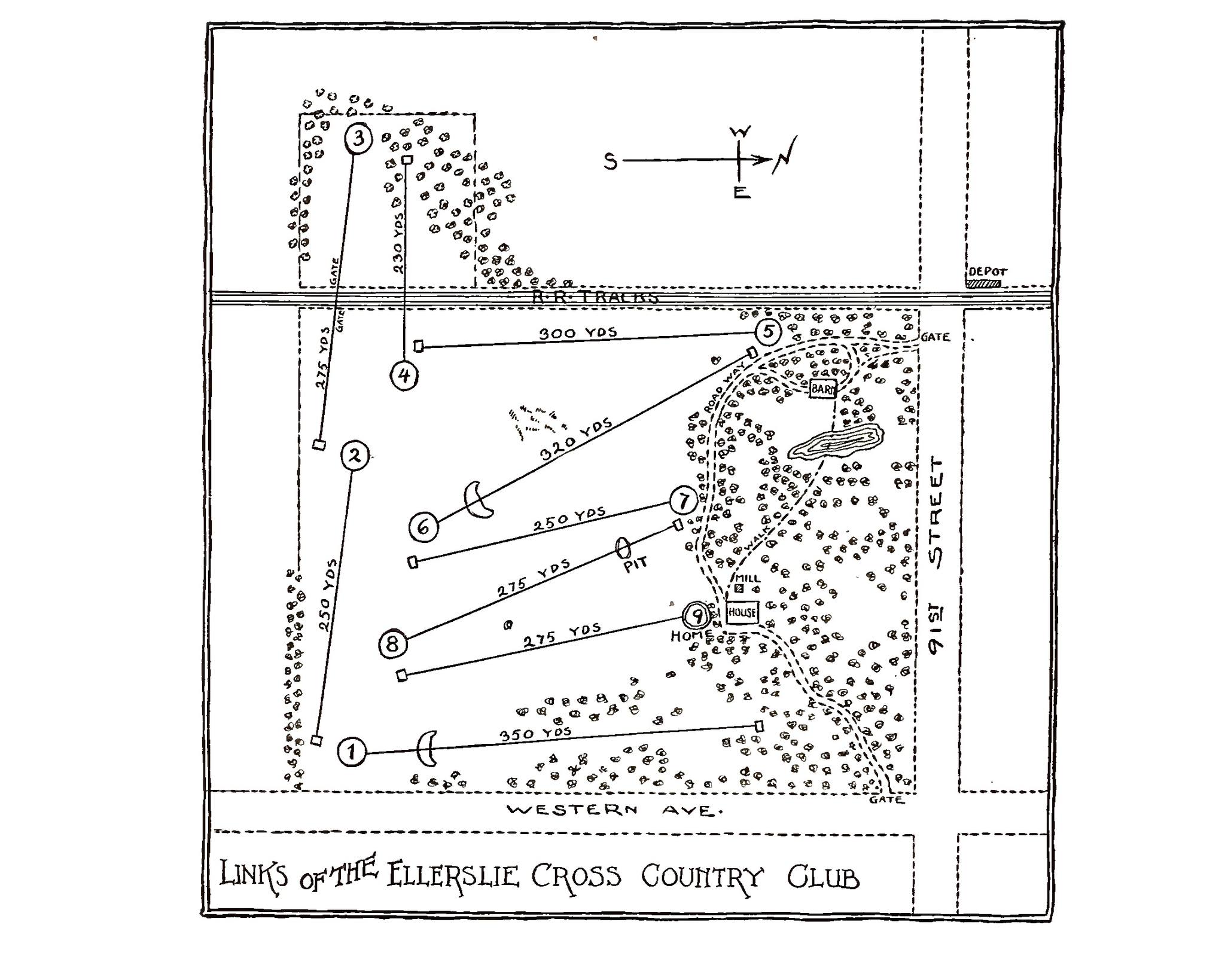
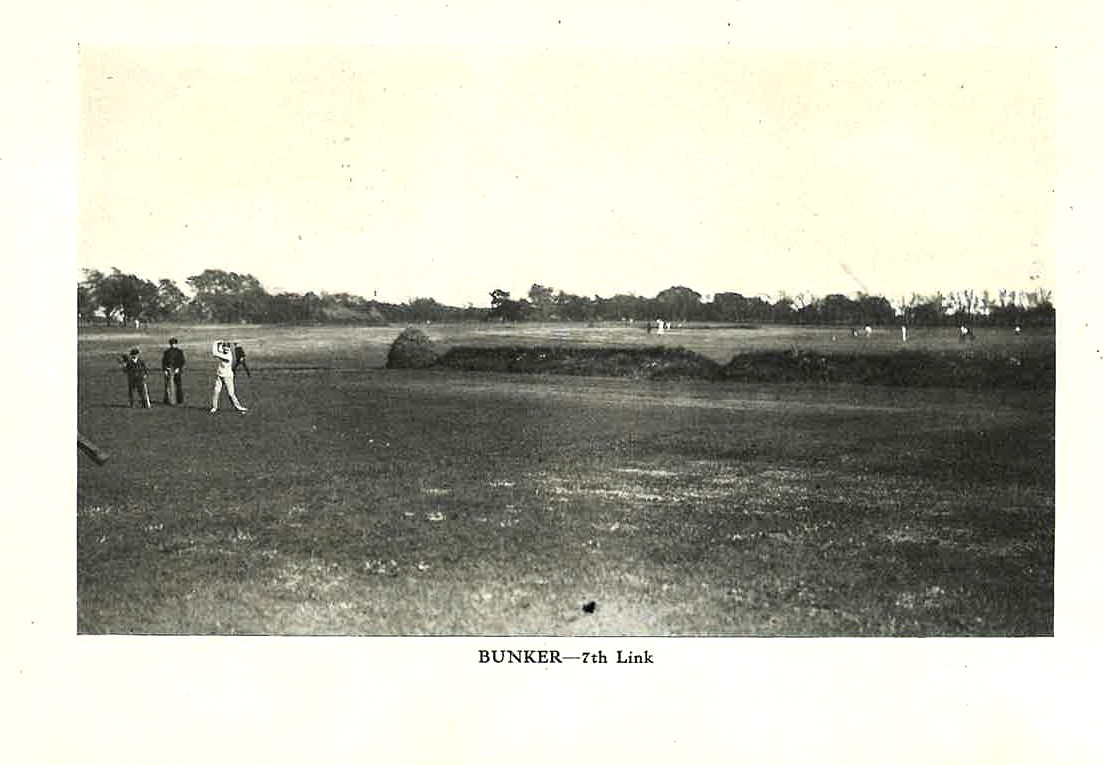
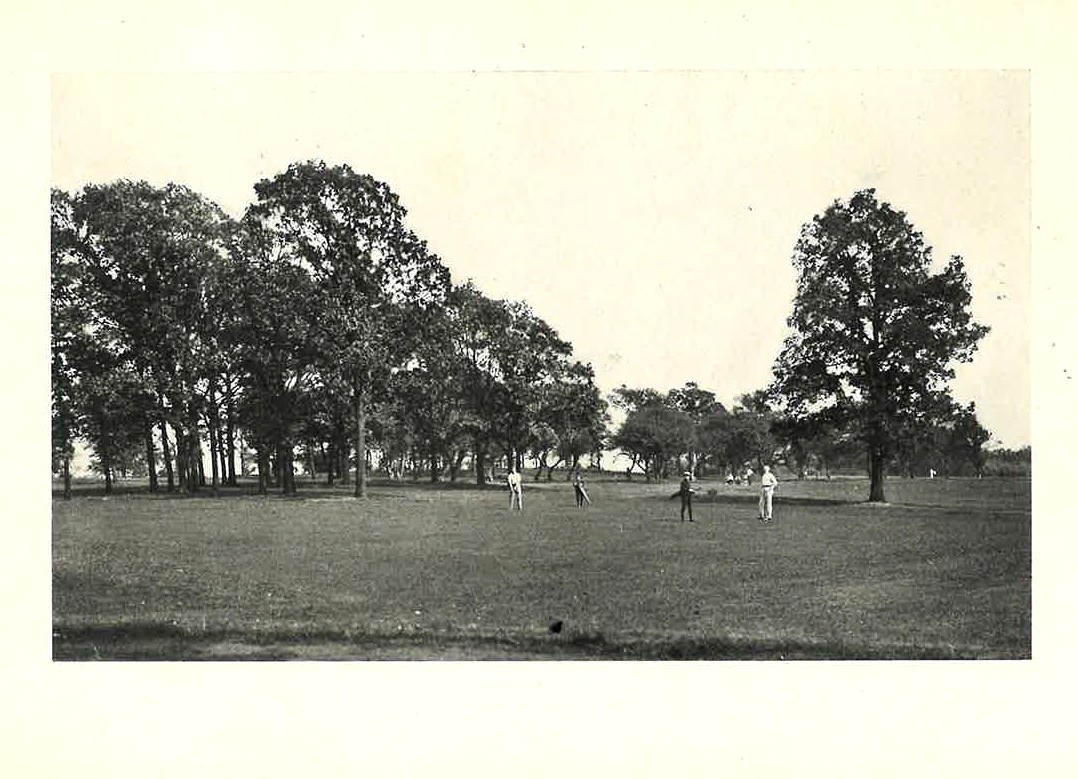
A nine-hole golf course was laid out, described as full of natural hazards including trees and water. Two of the holes were played over railroad tracks. Golf champion James Foulis supervised the layout of the course.
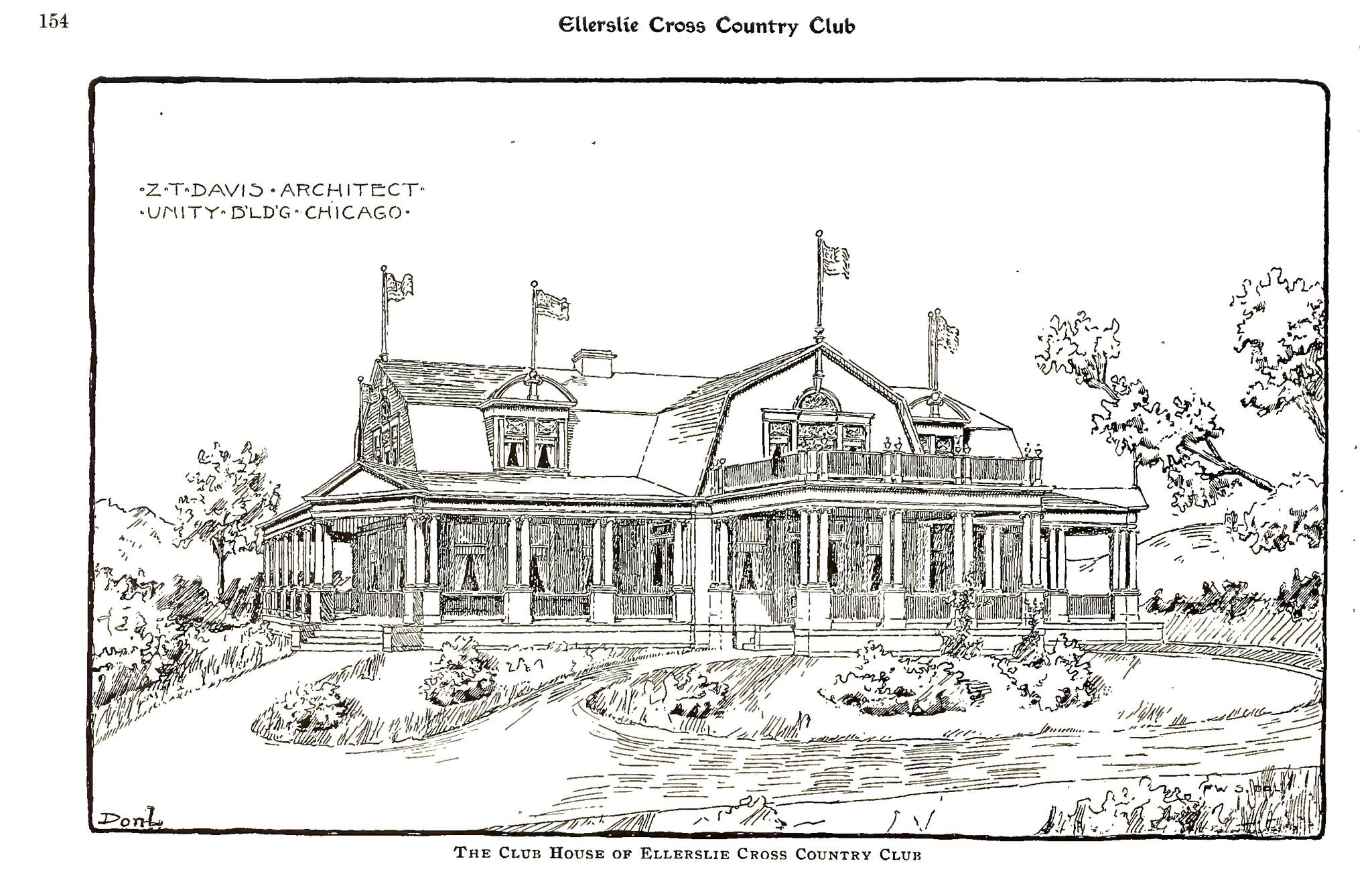
Ellerslie member architect Zachary Taylor Davis designed the clubhouse and the grounds. He was the supervising architect for Armour and Co., and his later projects included Comiskey Park, Wrigley Field, and Mount Carmel High School. He became famous for creating innovative ballparks.
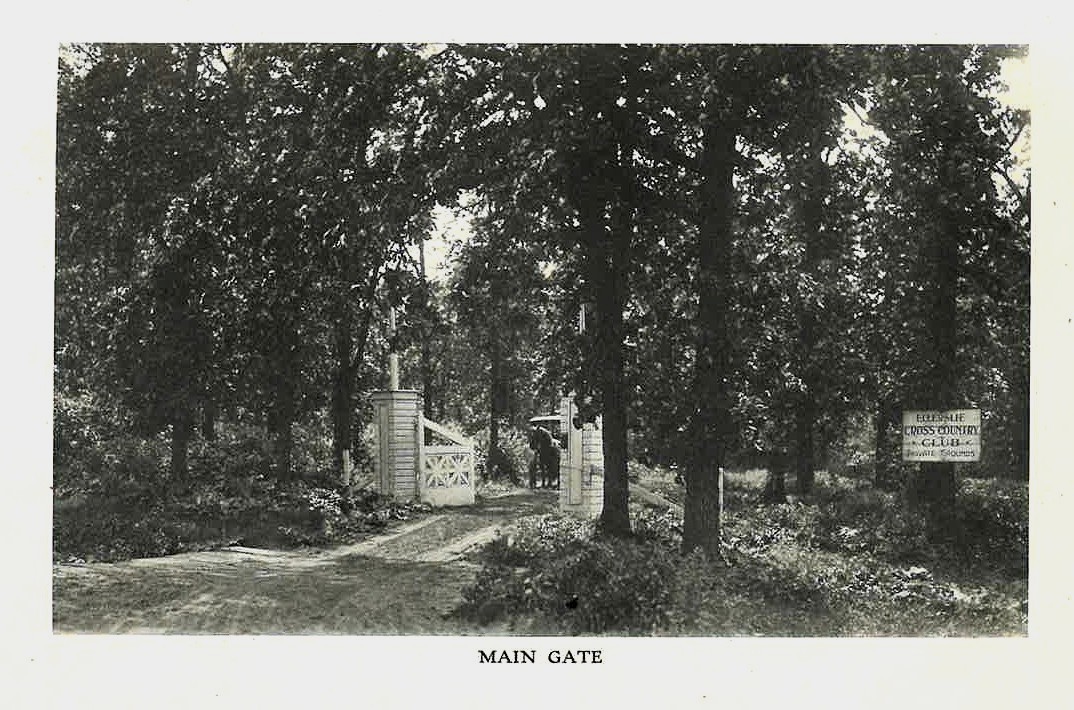
The clubhouse Davis designed for the Ellerslie Club stood “in the center of a shady grove” with “spacious verandas” that provided good views of the course. It was designed and decorated in a “rustic” style with “thorough comfort.” The clubhouse included reception rooms and a billiard room on the first floor, and sleeping rooms on the second floor. A stable was also built on the site.
The name “Ellerslie” was selected because it was the name of an ancient Scottish chieftain, acknowledging the origin of modern golf.
The full name of the club was the Ellerslie Cross Country Club.
Although golf was the impetus to start the club, the real passion and expertise of the founding members of the club were equestrian sports and “coursing” with greyhounds. “Cross country” referred to riding horses across the fields in fox hunts like they did in Ireland and England. More on the coursing and equestrian aspects of the club will be covered in the next posts.
The links officially opened on July 22, 1899. The club was accessible by the Rock Island train line, and the club had a coach that met the trains that came in each day.
The club founders were all avid competitive sportsmen and sportswomen, and although golf was new to them, they caught on to it quickly. The country clubs were built as people were just learning how to play the game. On the day the Ellerslie Club opened, introducing golf to the Ridge, it was packed with people holding a putter for the first time.
Golf was considered an allowable sport for women, as were croquet, tennis, and badminton. The sisters and wives of the young men who founded the club were active participants in the sports, cross country riding as well as golf, and social events there; in fact, they were the "influencers" behind the concept of the club. As was mentioned in the last post, there were several instances of young men and young women from the club marrying each other.
The first “professional” at the club was Bert Coffey, “a graduate from the caddy ranks of Washington Park,” and he was considered “very capable” according to the city newspapers. His role included greenskeeper and instructor.
There are several publications still available from that time period that offer details about the club.
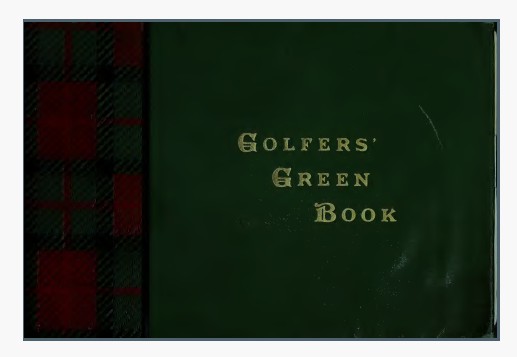
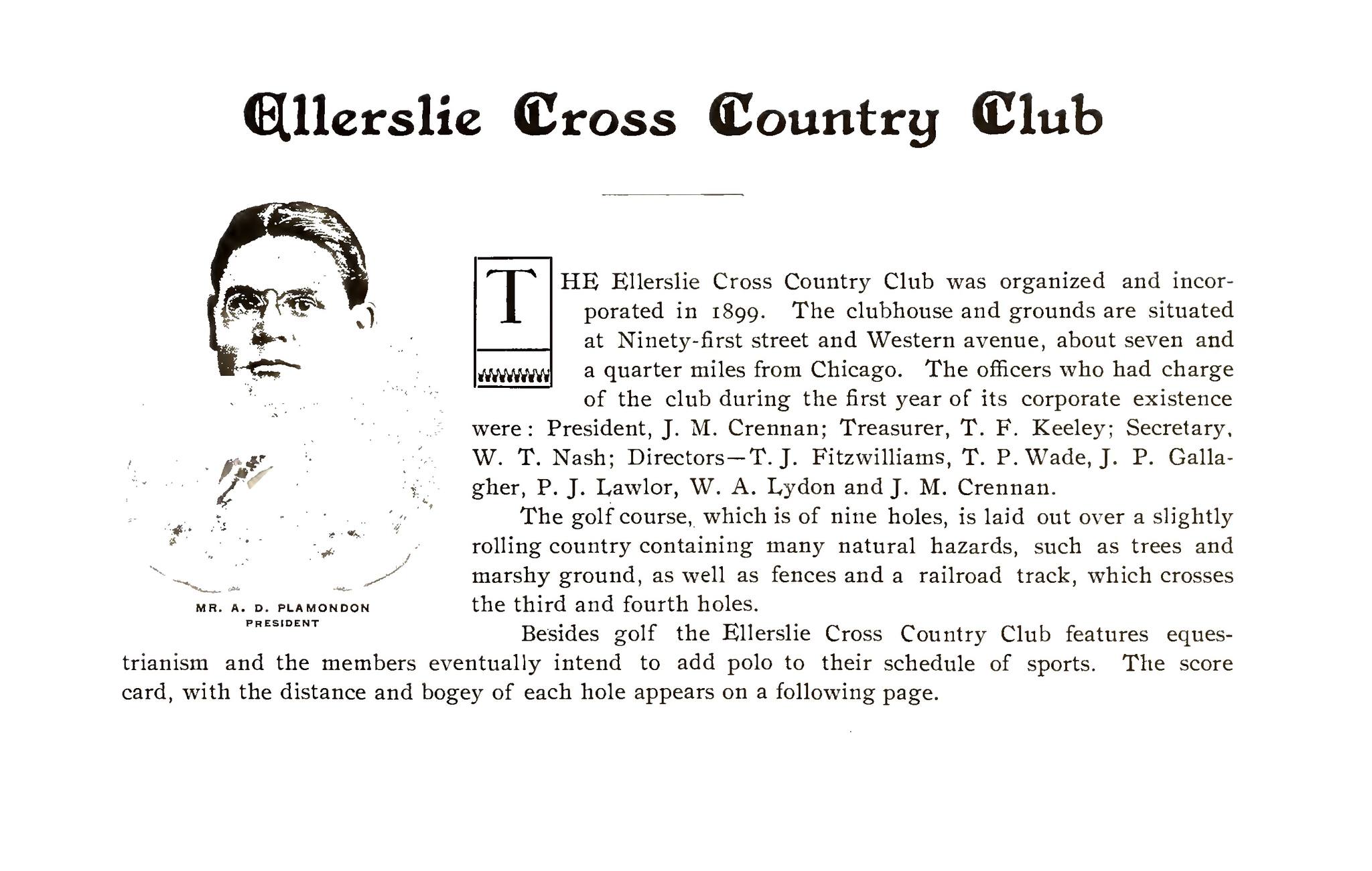
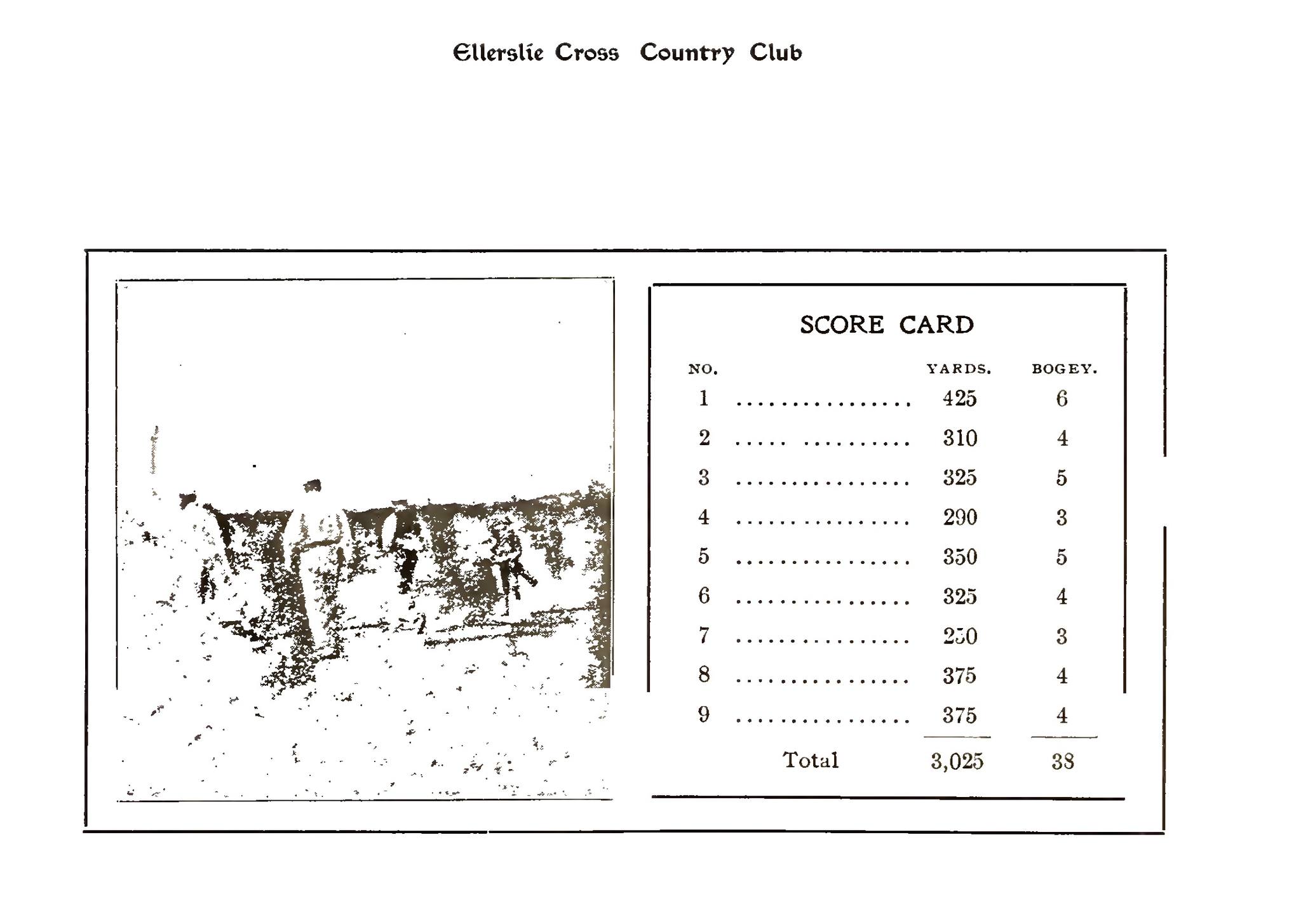
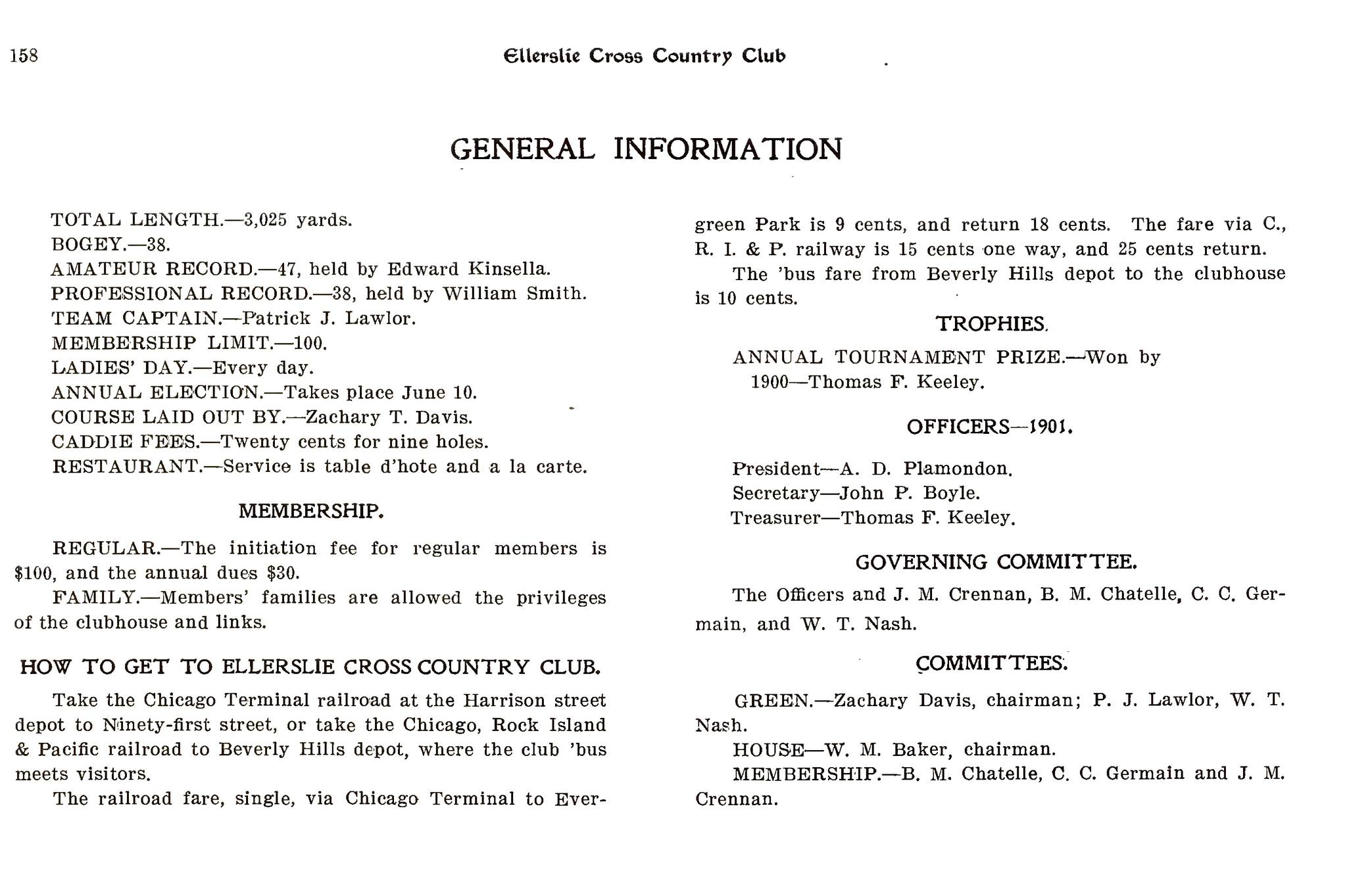
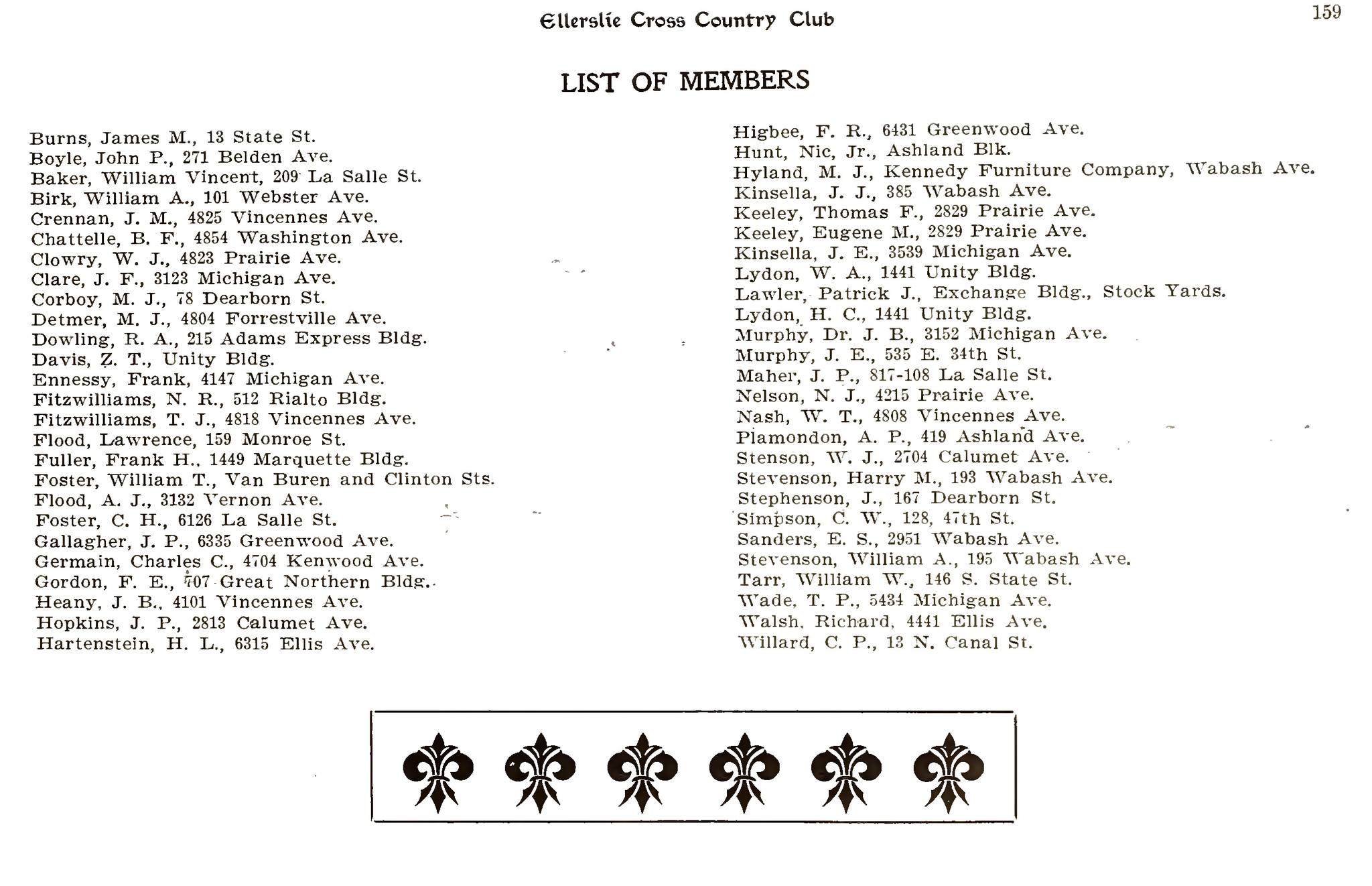
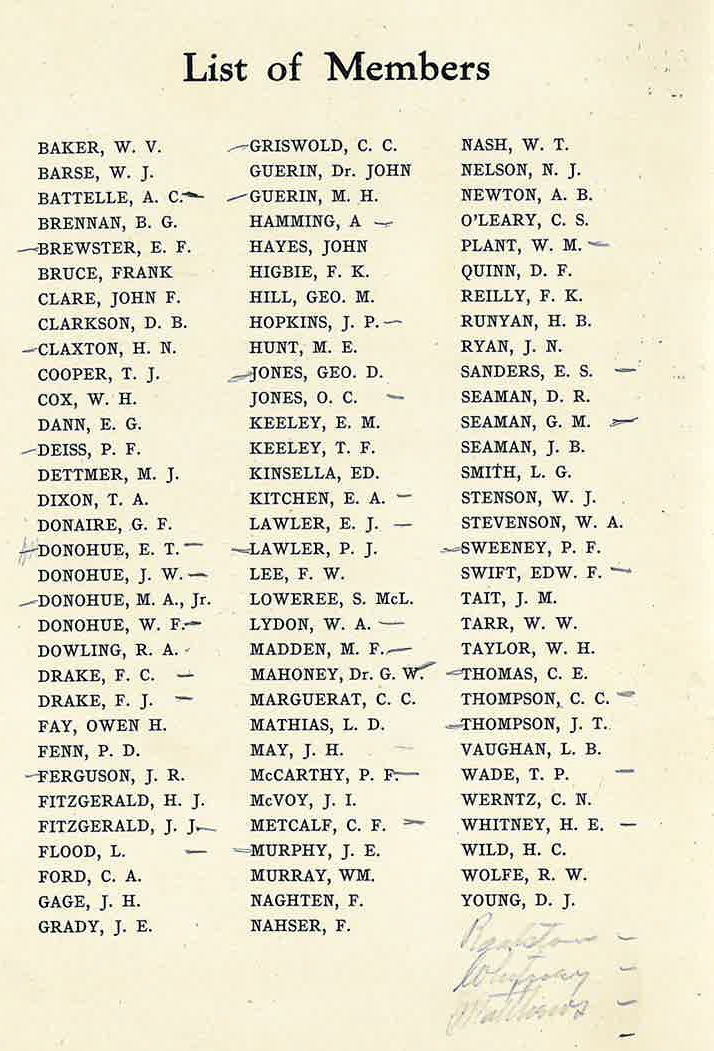
First, the “Golfers’ Green Book” of 1901, published by the National Golf Bureau, lists the Ellerslie Club along with thirty other Chicago-area clubs. The six-page spread on the Ellerslie Club is attached here, including an image of the club house and diagram of the course.
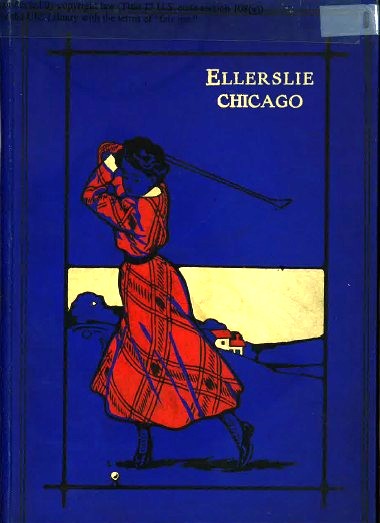
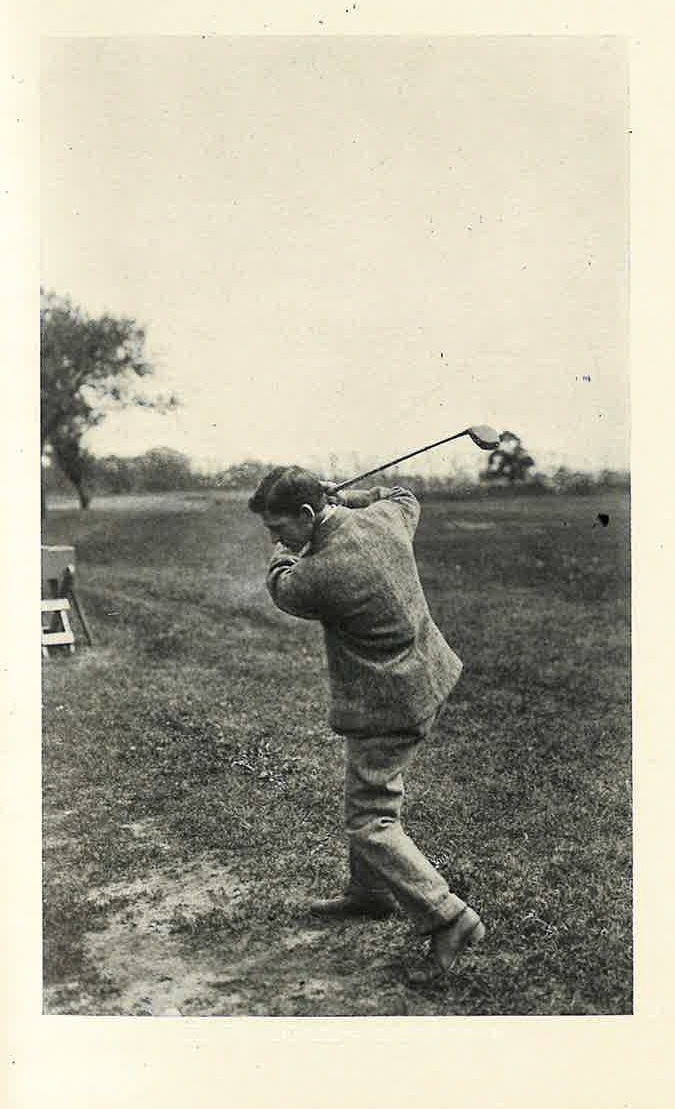
In 1905, the Ellerslie Club printed a little book that described “some special features” of the club. Some photos from that book are included with this post.
The book reported that William “Willie” Hoare was the golf professional on staff; he was there to assist and give instructions. He was a known, successful competitor in contests throughout the U.S.
Food service, from snacks to full meals, was available at any hour. A piano, near the ballroom door, always had the sheet music of the latest popular songs.
Besides golf, there were tennis, hammocks, and swings, and activities for children on the lawn. Members could bring guests at any time.
While golf was a summertime sport, the Ellerslie Club planned to offer year-round activities.
In their first autumn, following the close of the golf links for the year, they held a country fair with displays of livestock and farm equipment, competitions like sack races and catching a greased pig, entertainment from “a one-legged fiddler,” and dinner and dancing into the evening. They offered five dollars in gold to any couple willing to be married in front of the crowd, but it was not reported if anyone took up that offer.
This event was followed by their first coursing event, featuring greyhounds owned by some of the members. The coursing part of the Ellerslie Club will be explored in the next post.