Explore the RHS Facebook Archives, a rich repository of local history written by Carol Flynn. For two decades, Carol brought a deeply dedicated voice to public education at RHS. Her role as Facebook administrator through mid-2025 naturally extended her prolific research into meticulously detailed articles, most notably her multi-part historical series posts. Today, Carol continues her local history writing for The Beverly Review and other outlets.
August 2023
The August Villager, the community newspaper put out by the Beverly Area Planning Association, includes an article by Linda Lamberty, Ridge Historical Society Historian, introducing the upcoming RHS exhibit, "Louise Barwick's Lost Ridge."
The exhibit will officially open to the public the day of the @[672585269479476:69:Beverly Art Walk], Saturday, September 23, 2023.
Along with the exhibit, RHS will run a series on Miss Barwick and her remembrances of her times on Facebook. So look for this in September!
The Old Water Tower by Louise Barwick, 1893. Located, in the artist’s own words, “200 feet north of 103rd Street between Hoyne and Seeley,” the water tower was constructed circa 1888 as part of a much-needed water system that included a windmill. The then modern achievement became redundant when the area was annexed to Chicago in 1890, when water and other utilities began being supplied by the City.
The Ridge Historical Society
The Early Days of Morgan Park – Part 1
By Carol Flynn
Selecting a date to recognize the “beginning” of Morgan Park is arbitrary.
Indigenous people lived in the area for thousands of years before the European settlers came, so habitation is not really the measure.
What is really being decided is a date to mark the transition from Natives to non-natives as the predominant inhabitants of the Ridge.
The identity of the first non-native to step foot on the Ridge, and when that person came, will never be known with certainty. The first written records of explorers in the Chicago area date to the 1600s. Jean Baptiste Point du Sable of African descent is recognized as the first non-native to take up residence in the downtown area around 1790.
Fort Dearborn was established in 1804 and survey teams operated from there. They could see the Blue Island rising from the prairie twelve miles to the southwest.
In 1972, a group of Beverly/Morgan Park residents proposed that the community recognize the year as the sesquicentennial of the founding of Beverly/Morgan Park. This was based on the arrival of French-Canadian fur trader Joseph Bailly in 1822 at Porter, Indiana, on the Calumet River, where he established a homestead. Bailly was from a well-known family that ran trading posts from Michigan to Chicago. He interacted with the local Native Americans, predominantly the Potawatomi, and travelled their paths and waterways.
It was surmised that Bailly knew well the local Natives, and the Vincennes Trail that ran through the Ridge, and that he “opened up” the Blue Island Ridge to the fur trade. Therefore, they believed this was the start of current history, at the time 150 years in the past. There was a year’s worth of celebrations in 1972 to mark this anniversary.
A decade after Bailly, in 1832, DeWitt Lane built a cabin at what today is about 102nd Street and Seeley Avenue. He didn’t own the land; the U.S. government had not yet put it up for public sale.
The Native Americans gave up ownership of the land with the Treaty of Chicago in 1833, and began to leave the area.
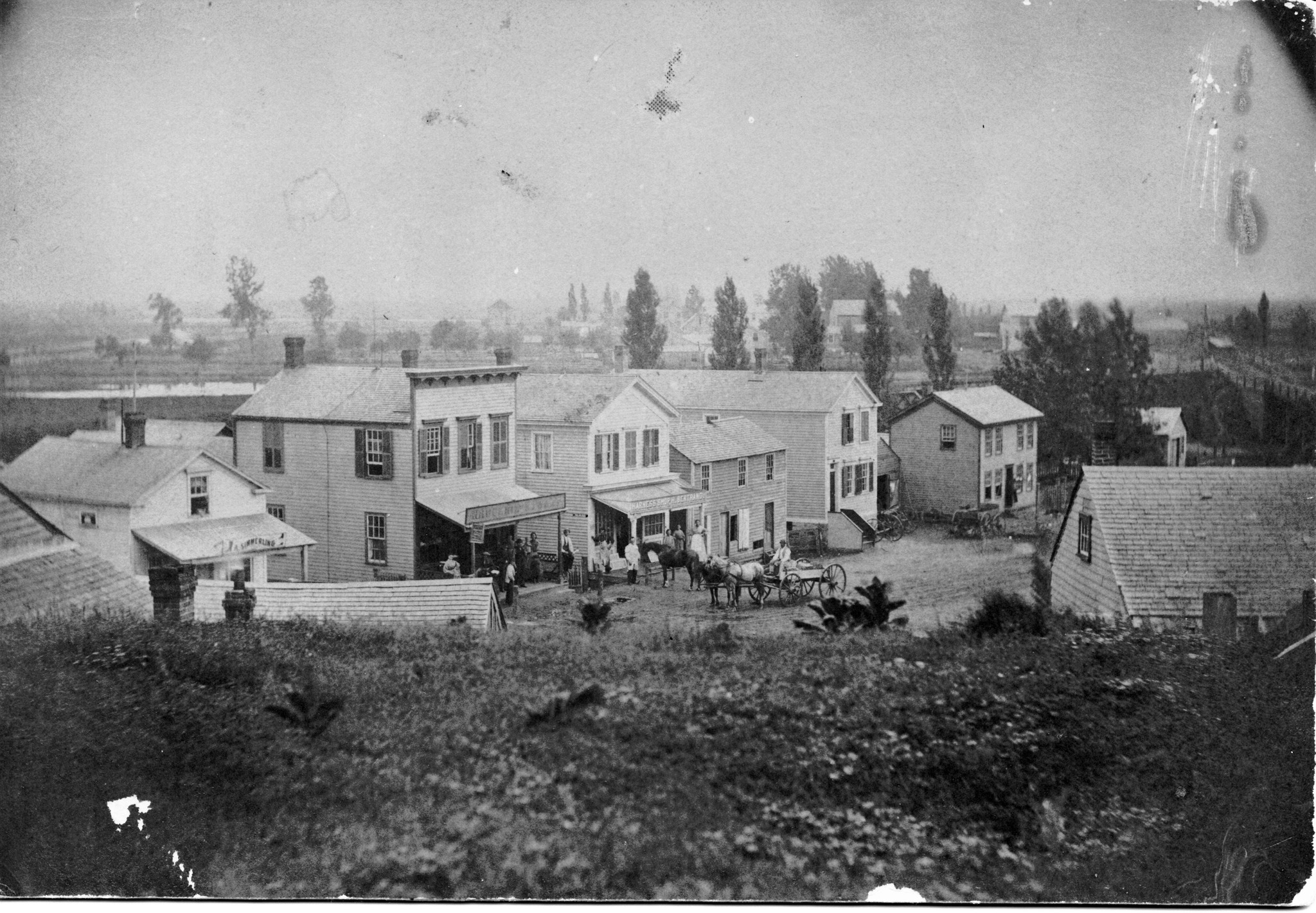
The government began public domain land sales in 1834. John Blackstone bought up substantial property on the Ridge in 1835 and 1839, and reportedly built a house in today’s North Beverly. In 1844, he sold the land to Thomas Morgan from England who moved here with his family, livestock, and hounds, and established an estate he called Upwood around 91st Street and Longwood Drive.
At the same time, settlement was going on at the southern tip of the Ridge, where the city of Blue Island was being established. Other homesteads were being established along the Vincennes Trail; Norman Rexford and Jefferson Gardner were there in 1834. Because Morgan did not like the Vincennes Trail running through his property, he rerouted it to the east below the Ridge.
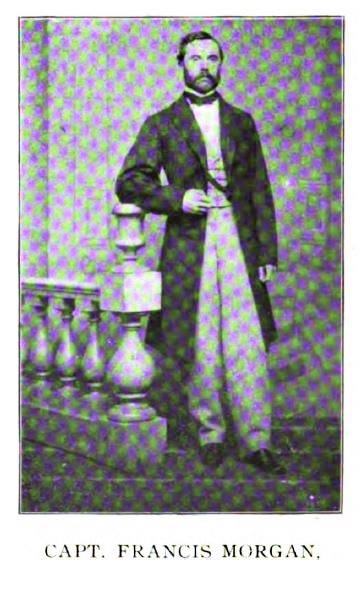
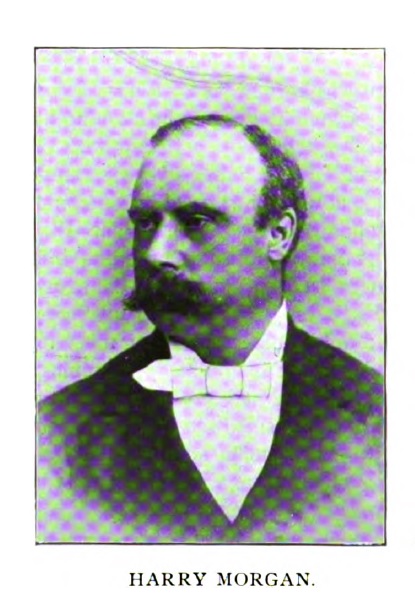
Thomas Morgan died in 1851 and the estate passed to his widow, Anna, and their nine children. In 1868, a substantial portion of the estate was sold to a group of investors headed by Frederick H. Winston, and Winston took legal title from the Morgan heirs. In 1869, the group of investors incorporated as the Blue Island Land and Building Company (BILBC), and Winston transferred the title to the company.
Some of this land they sold off immediately, and it became the Village of Washington Heights that included today’s Beverly. Washington Heights was incorporated as a village in 1874, and was annexed to the city of Chicago in 1890.
The BILBC developed some of the land into a section they called Morgan Park, which was incorporated as a village in 1882, and was annexed to Chicago in 1914.
The next post will look more at the BILBC and the establishment of the Village of Morgan Park.
The Ridge Historical Society
The End of “Joliet Limestone”
By Carol Flynn
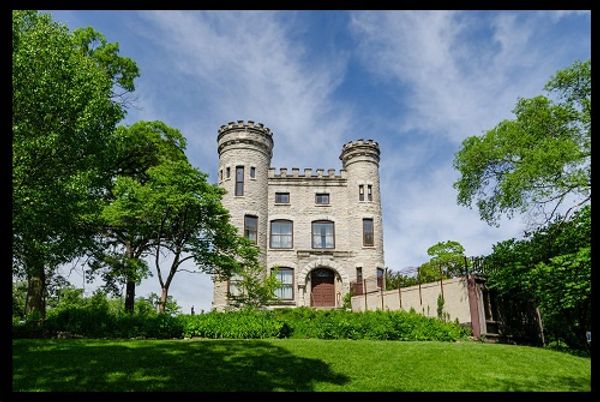
The Givins Beverly Castle, the Robert C. Givins House, located at the corner of 103rd Street and Longwood Drive, is Beverly’s best-known landmark. The Castle was built in 1887-88, which makes it over 130 years old.
But really, the Castle is millions of years old – it was constructed of “Joliet limestone.” The proper name for the stone is Joliet – Lemont dolomite, and its chemical composition gives it a yellowish or buff color not found in limestone which is usually more gray in color.
This material was quarried in the Joliet area and used for many buildings throughout the area, from the Water Tower and Holy Name Cathedral in downtown Chicago to the Joliet prison – and the Beverly Castle. The last documented building made of this stone was constructed in the 1940s – the All Saints Greek Orthodox Church of Joliet.
Last month, the last quarry in Joliet announced it was closing. This means it is more important than ever to preserve these buildings. The Beverly Unitarian Church, which owns and uses the Castle, completed restoration of its turrets in recent years.
The Ridge Historical Society
The Early Days of Morgan Park – Part 2
By Carol Flynn
August of 1868 was one of the most critical times in the history of the Blue Island.
That month, a group of investors, headed by Frederick H. Winston, purchased the land that had been held by the Morgan family since Thomas Morgan first purchased it in 1844. This began the development that led directly to the communities known today as Beverly Hills and Morgan Park.
This group, which incorporated the next year as the Blue Island Land and Building Company (BILBCo), included business and real estate men who had the vision to recognize the potential value of the land on the northern portion of the Blue Island. They invested their money in purchasing a large tract of this real estate for development and resale. Some of them chose to live here themselves.
A more detailed look at the BILBCo offers a glimpse into the business dealings of 155 years ago, and the men who made those deals.
Thomas Morgan died in 1851, and the land went to his widow, Anna Maria, and their nine children. Morgan’s will reportedly included a “dower clause,” that is, a provision that Anna could continue to use the land for her support, giving her a “life interest” in the property. “Dowers” are very common, usually conferred at the time of marriage, or sometimes by law. [Note that contemporary Illinois law does not include automatic dower rights.]
Anna was living in New Orleans in August of 1868 when Winston and his group purchased the land from the family. Some of the adult Morgan children were still living on the Ridge at the time, and in other parts of Chicago, notably Hyde Park. Winston personally took over the legal title from the Morgan heirs.
Anna died in December of 1868, in New Orleans, and her remains were returned to Chicago for burial in the family plot in Graceland Cemetery. The original family cemetery was on the Morgan estate in northern Blue Island, but prior to the selling of this land, the Morgan graves were moved to Graceland Cemetery.
The group of investors incorporated the next year. The Twenty-sixth General Assembly of the State of Illinois, convened in Springfield on January 4, 1869, passed an act to incorporate the BILBCo effective April 15, 1869.
The incorporators were listed as Charles V. Dyer, L. P. Hilliard, Thomas S. Dobbins, Charles W. Weston, John F. Tracy, John B. Lyon, Charles H. Walker, James Milliken, and Frederick H. Winston.
The purpose of the BILBCo was “laying out a town in the townships of Lake, Calumet, and Worth, or either of them, in the county of Cook, and buying, improving and selling land and town lots in said town, and in the townships of Lake, Worth and Calumet, and in the county of Cook.”
The act was granted for twenty years, during which time the BILBC could engage in legal business including entering into contracts; procuring, improving, and selling real estate and personal property; and suing and being sued.
The capital stock was set at $250,000, divided into $100 shares. The incorporators had six months to raise $150,000 of that stock, elect a board of directors, and develop governing documents to manage the interests of the stockholders.
They successfully accomplished that – likely they had it set up before the incorporation was even official and they were ready to begin business as soon as the state legislators gave the approval.
Frederic Winston served as the first president of BILBCo; the secretary/treasurer was George C. Walker; and the business agent/superintendent of operations was Col. George R. Clarke.
Winston turned over the title of the Morgan estate lands to the BILBCo. They immediately started selling off the land to the north of 107th Street, which they called “Washington Heights,” to numerous developers and individuals.
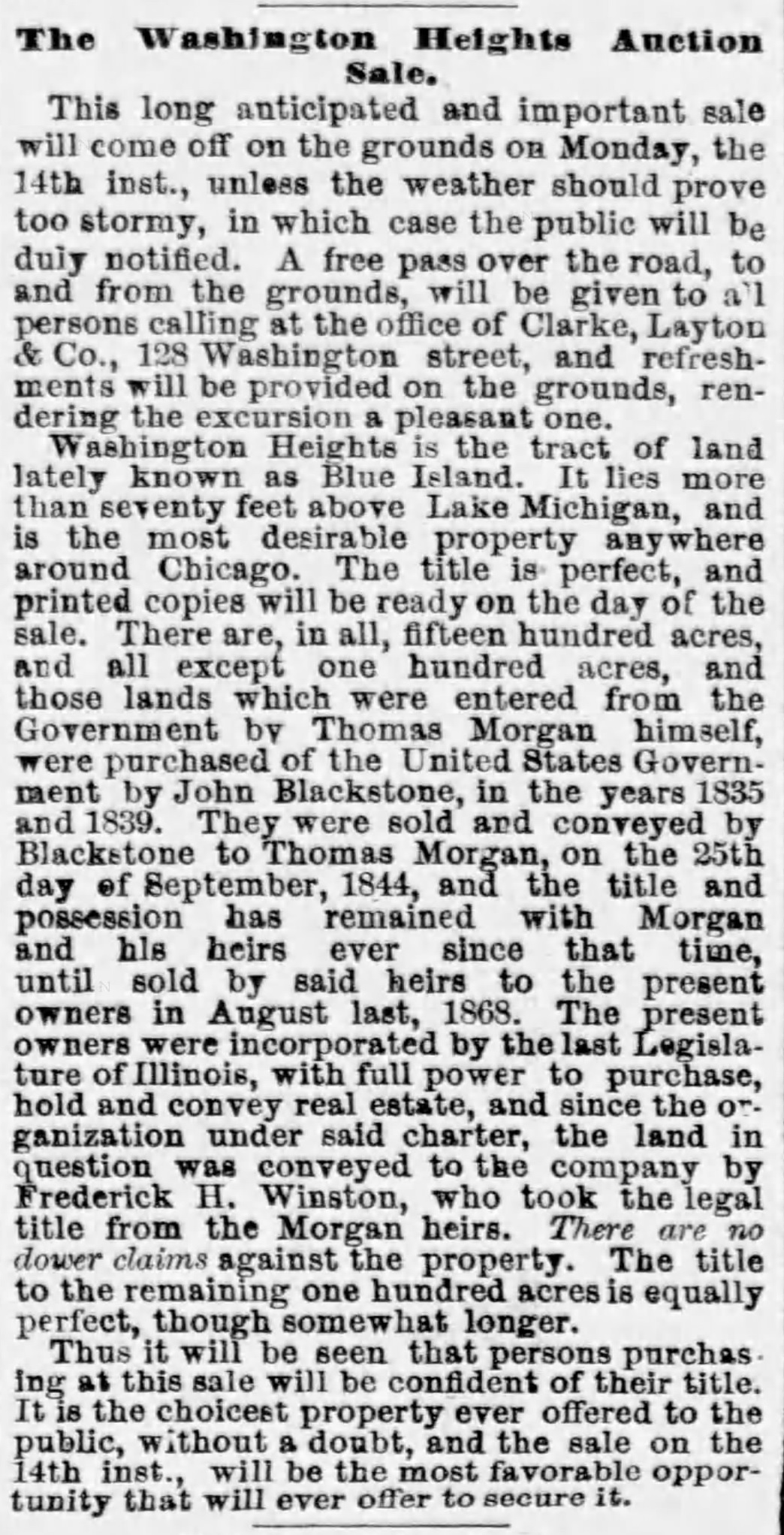
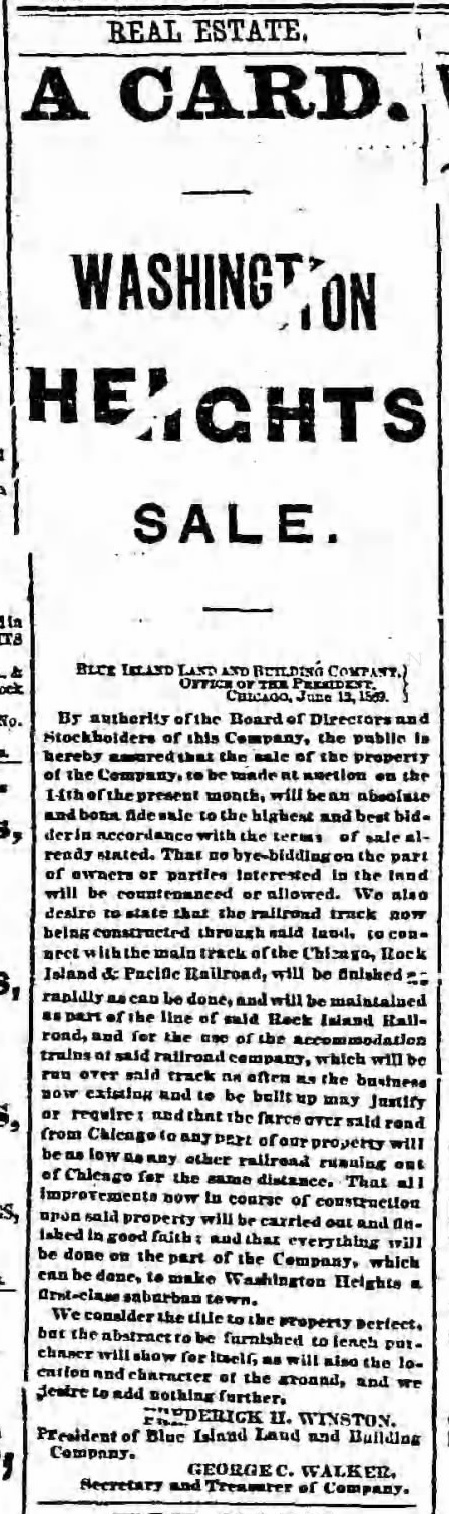
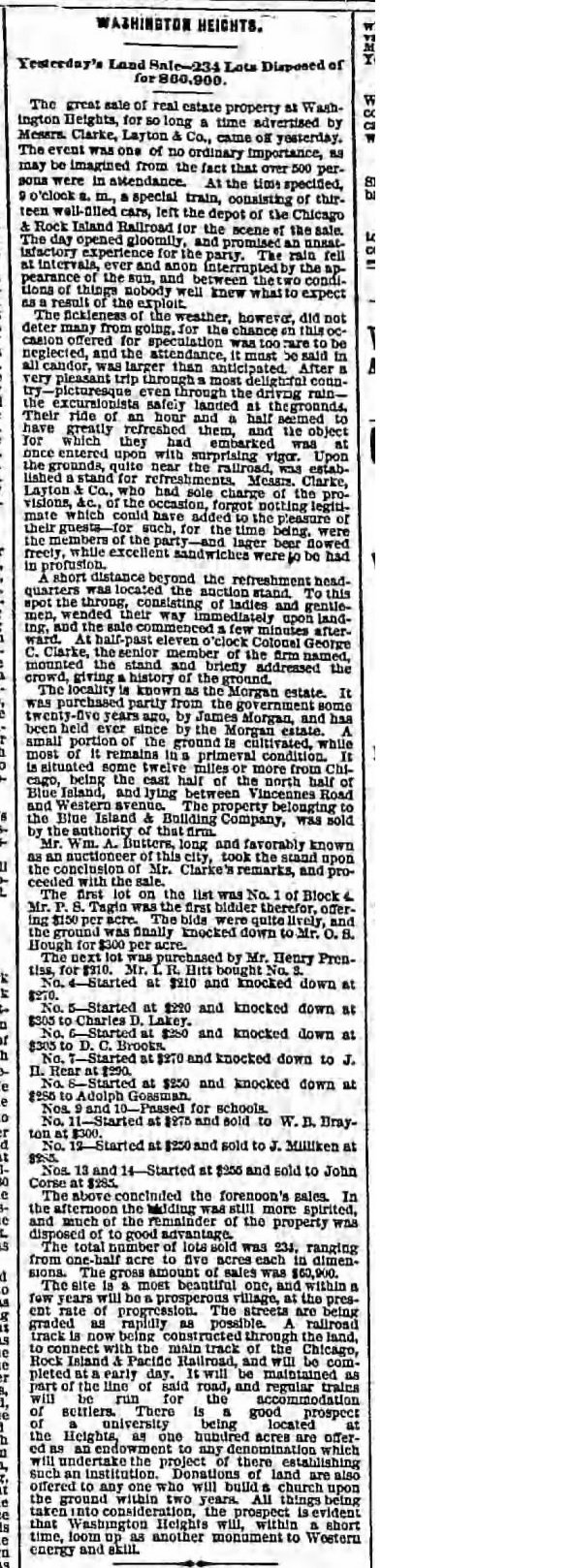
A huge public auction was held on Monday, June 14, 1869. The BILBCo took in over $60,000 that day in real estate sales.
Three newspaper clippings about that auction are attached. The development of Washington Heights and Beverly will be a topic of a future series.
The BILBCo kept the land south of 107th Street to create their own development, an idyllic village they named “Morgan Park.” The rest of this series will deal with the history of that development.
Some historically significant names appeared on that list of men involved with the BILBCo – Dyer, Tracy, Walker, Milliken, Winston, Clarke. The next post will share biographical sketches of some of these people.