Explore the RHS Facebook Archives, a rich repository of local history written by Carol Flynn. For two decades, Carol brought a deeply dedicated voice to public education at RHS. Her role as Facebook administrator through mid-2025 naturally extended her prolific research into meticulously detailed articles, most notably her multi-part historical series posts. Today, Carol continues her local history writing for The Beverly Review and other outlets.
December 2021
The Ridge Historical Society
History of the Chicago Wards – Post 6: Beginning a Chicago Wards Timeline for the Ridge; Early Aldermen for the Ridge
By Carol Flynn
A timeline has been started for the history of the Chicago wards on the Ridge.
1889, June – Lake Township was annexed to the City of Chicago, which included the land north of 87th Street, east of Western Avenue, which today includes the northern part of Dan Ryan Woods. This land includes the northern tip of the Blue Island Ridge so the land is connected geographically to the Ridge even though it is not considered part of North Beverly and is not part of today’s 19th ward. At the time of annexation, the land was part of the Sherman Farm estate. This land formed part of the new 31st ward.
The first two aldermen for any part of the Ridge were Edwin J. Noble and Captain George F. McKnight, Republicans from the thirty-first ward.
1890, April – The land from 87th Street south to 95th Street, Western Avenue east to State Street, included in the Calumet Township, was annexed. It had been unincorporated land before that. The land included what today is known as North Beverly. It was assigned to the 31st ward.
1890, November – The land from 95th Street south to 107th Street, Western Avenue east to a zigzag alignment of streets, was annexed. The municipality had been incorporated as Washington Heights, and included today’s Beverly Hills.
1891, February – The annexed land of Washington Heights was added to the 31st ward.
1895, April – Isaiah T. Greenacre was elected the first alderman from the Ridge.
North Beverly and Washington Heights remained in the 31st ward until 1901, when population growth and shifts led to redistricting of the wards. The part of the 31st ward that included North Beverly and Washington Heights was split off into its own ward, and the renumbering of the city wards made this the 32nd ward. This will be covered in an upcoming post.
The aldermen of the 31st ward during the time it included North Beverly and Washington Heights, all Republican, were:
1889-1891: George McKnight
1889-1896: Edwin Noble
1891-1893: Edwin A. Plowman
1893-1895: James L. Francis
1895-1897: Isaiah T. Greenacre
1896-1898: Clark T. Northrop
1897-1899: Elliot W. Sproul
1898-1901: Joseph Badenoch
1899-1901: Henry F. Eidmann
McKnight, Noble and Plowman were covered in previous posts.
Francis was a prominent member of the city council’s special committee for the 1893 World’s Fair. He planned on seeking reelection in 1895 but he was ousted by the Republican “machine.” Later that year, Francis was charged with “boodling,” the term for various types of graft and corruption. He was accused of accepting cash and stock from the Mutual Electric Light and Power Company, located in Brainerd, in exchange for backing ordinances favorable to the company, charges he strongly denied.
Isaiah T. Greenacre was the first alderman elected from the Ridge. He played a considerable role in local, city, and state politics and he will be profiled in the next post.
Northrup was a prominent businessman who held the position of foreign representative with Smith and Co. before becoming a member of the Board of Trade. He had been a trustee for Lake Township.
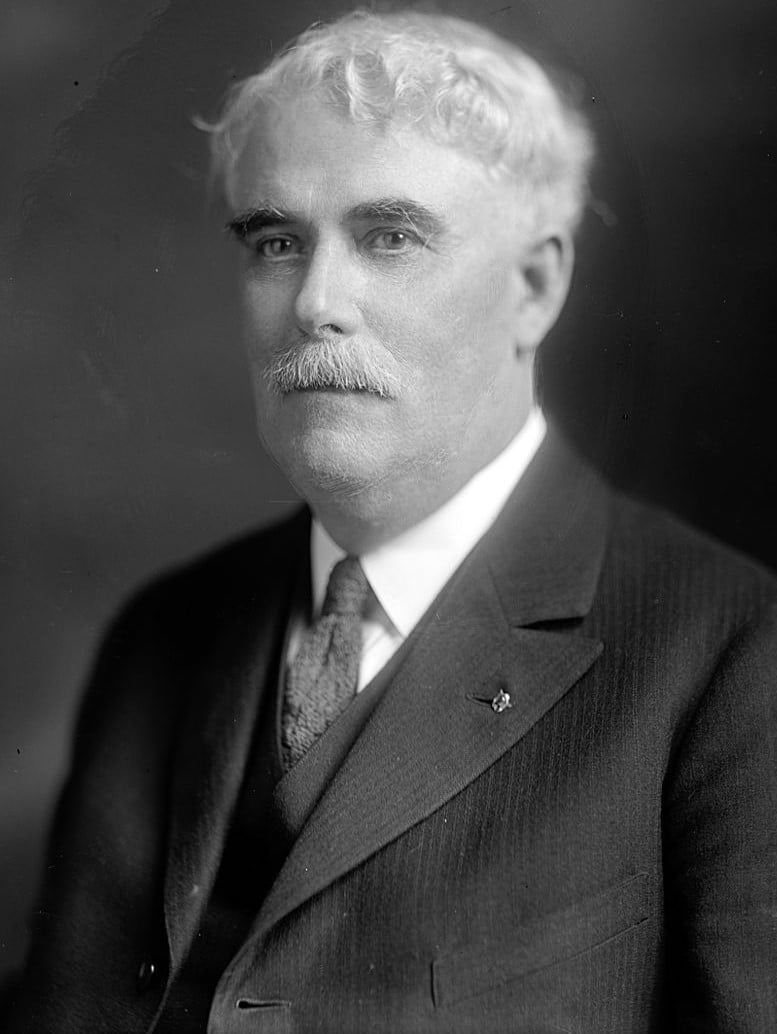
Sproul was a contractor and builder. He later served in the U.S. House of Representatives as the Congressman from the 3rd District of Illinois from 1921 to 1931. This photo is of Elliot W. Sproul.
Next post: Isaiah T. Greenacre, first alderman elected from the Ridge.
The Ridge Historical Society
The First Chicago Christmas Tree and the Ridge – Part I – Revised
By Carol Flynn
Chicago’s first municipal Christmas tree was displayed in 1913. For the first time, on Christmas Eve, viewers witnessed a giant tree ablaze with strands of electric light bulbs set up on Michigan Avenue. Ridge resident Amalie Hofer Jerome was named an honorary vice president for the lighting event.
RHS profiled the Hofer family in the Winter 2013 RHS newsletter, which focused on the beginnings of the kindergarten movement in the U.S. The Hofer sisters led the way in Chicago in the establishment of kindergartens and training programs for kindergarten teachers. And that was only one of their accomplishments.
These 2021 posts will cover more on the Hofers, and then feature the 1913 Christmas event.
The Hofer family came of age during the Progressive Era of the late 1800s – early 1900s, a time of widespread reform in just about every area of American life, from education to business to government. This will be explored when Amalie Hofer’s career is reviewed in an upcoming post.
Amalie’s father was Andreas Franz Xaver Hofer, born in 1821 in Baden, a historical territory in south Germany and north Switzerland. He took part in the unsuccessful Baden Revolution of 1848 – 49, an attempt to overthrow the ruling princes. Forced to flee the country, he came to New York City in 1849.
His future wife, Mari Ruef, was born in 1836 in Baden, and came to New York in 1852. There she met Hofer and they married in 1853. Hofer died in 1904 and was buried in Mount Hope Cemetery on the Ridge. Mari moved to California where she died in 1918. Hofer’s remains were then brought from Chicago to California to be buried with her.
The Hofers moved to Iowa from New York. Hofer fought with the Iowa Infantry of the Union Army in the Civil War. They became naturalized citizens of the U.S.
The Hofers were farmers and dry goods merchants in McGregor, Iowa. Hofer became known as a local expert on cultivating grapes and was active in the Iowa State Horticulture Society. They purchased a local newspaper, the McGregor News, which they ran for many years. The family was well known in the community.
Hofer‘s philosophy for the newspaper was “closely identified with the interests of the people and with successful government,” according to an article written in 1904 by his sons. He was involved in local politics and a leader of the temperance movement. Many of the beer breweries in the U.S were owned by German immigrants, and the newspapers made note of the divide in the German community over the alcohol issue. Hofer wrote temperance tracts in the German language which were published by the German National Temperance Association.
He used the newspaper to advance his platforms and this did not always go over well with the subjects of his commentaries. In one court case that was followed closely by the public, the newspaper and its publishers, A. F. Hofer and Sons, were sued for $5,000 by a saloon keeper claiming the paper had damaged his character. The paper had accused the saloon keeper of keeping a gambling house. The saloon keeper was backed by the local liquor league. The case went to court, and the Hofers won the case – the charges against the saloon keeper were “fully sustained.”
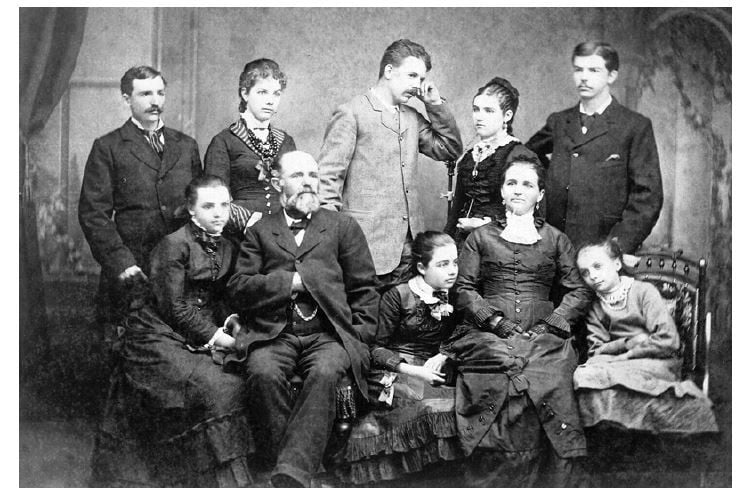
The Hofers had eight children, five daughters and three sons. They were mostly self-educated, and as youths were all involved with the newspaper, leading to careers that included writing, editing, and publishing.
The family sold the McGregor News in 1890. By then, the sons, Ernest (1855-1934), Frank Xaver (1856-1905), and Andreas F., Jr., (1861-1913), who made the newspaper and publishing industries their lifetime careers, had moved to Salem, Oregon. “E.” and “A. F.” took over the Capital Journal, an evening paper. Ernest later ran the Industrial News Review, which advocated for “policies essential to the well-being of our country.” Frank owned half of one newspaper and was the founder of another.
In the 1890s, Mr. and Mrs. Hofer moved to Chicago from Iowa. They settled on the Ridge at 1833 W. 96th Street. In Chicago, they were surrounded by their daughters, who were educators and social activists.
Next post: The Kindergarten Movement and the Hofer sisters
Photograph: Andreas Franz and Mari Hofer and their eight children. User-submitted on Ancestry.com.
The Ridge Historical Society
The First Chicago Christmas Tree and the Ridge –
Part 2 – The Kindergarten Movement and the Hofer Sisters
By Carol Flynn
Amalie Hofer Jerome, from the Hofer family who lived on the Ridge, was an honorary vice president for the lighting ceremony for the first Chicago municipal Christmas tree displayed in 1913.
The Hofer family had three sons and five daughters.
The sons were mentioned in the previous post. The family had owned a newspaper in Iowa, and the sons all moved to Oregon and stayed in the newspaper and publishing business.
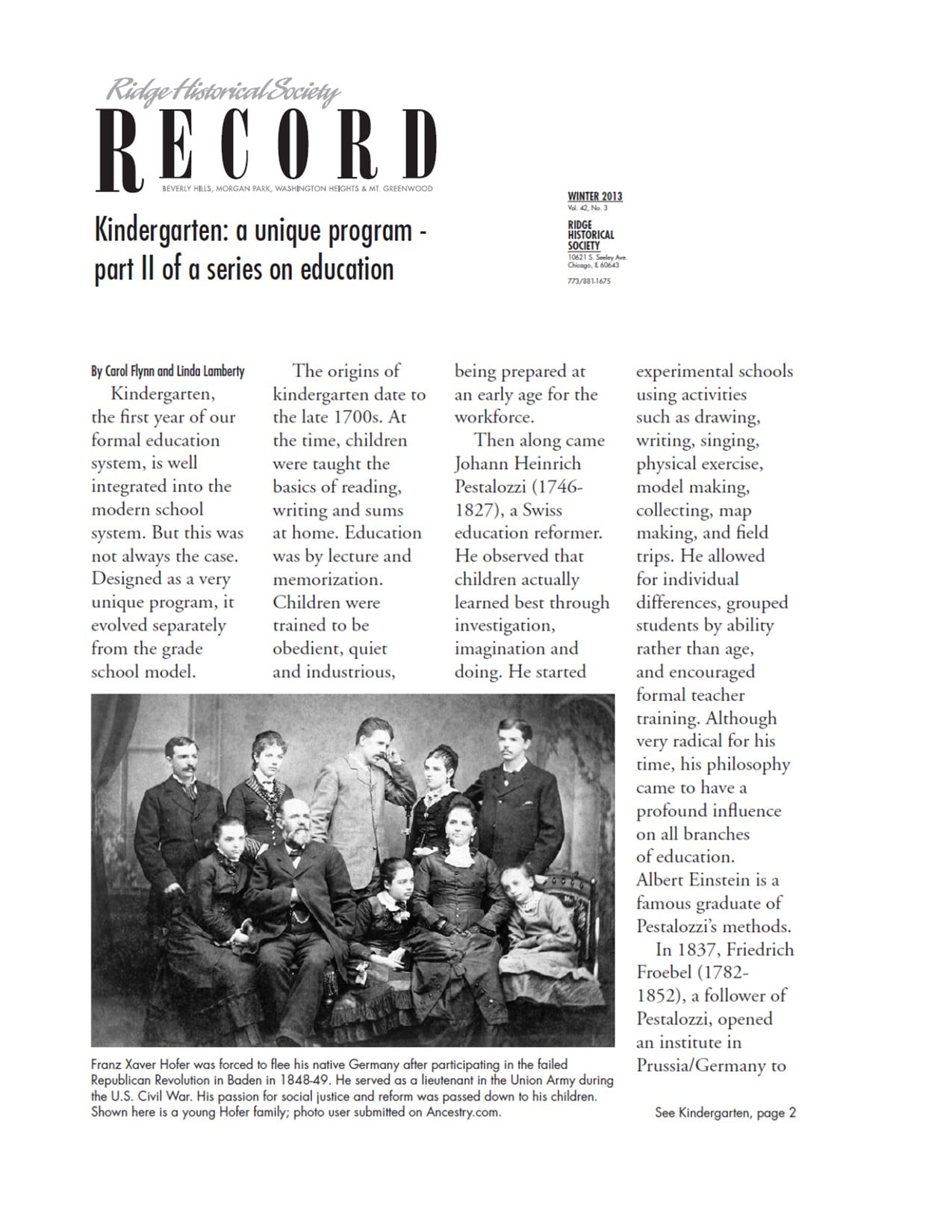
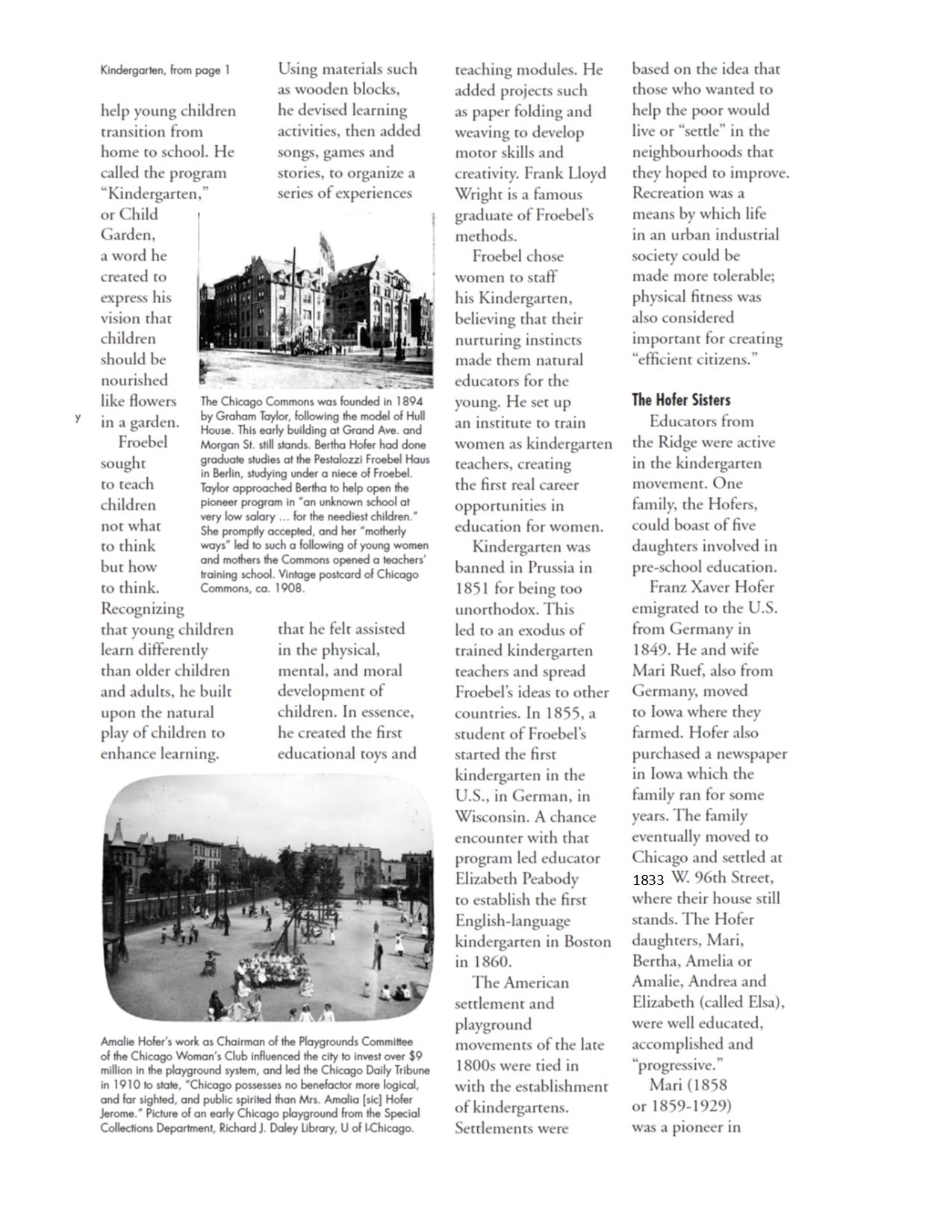
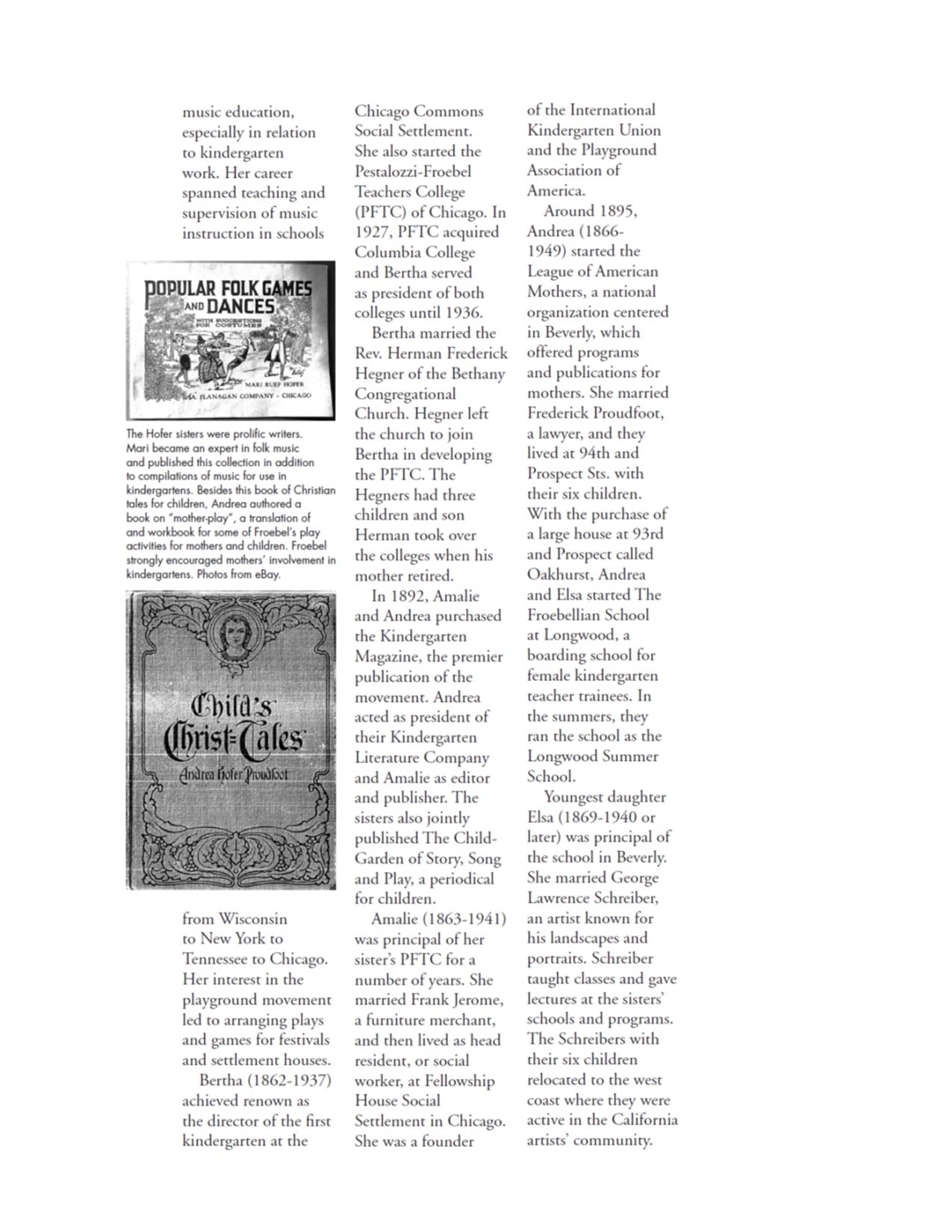
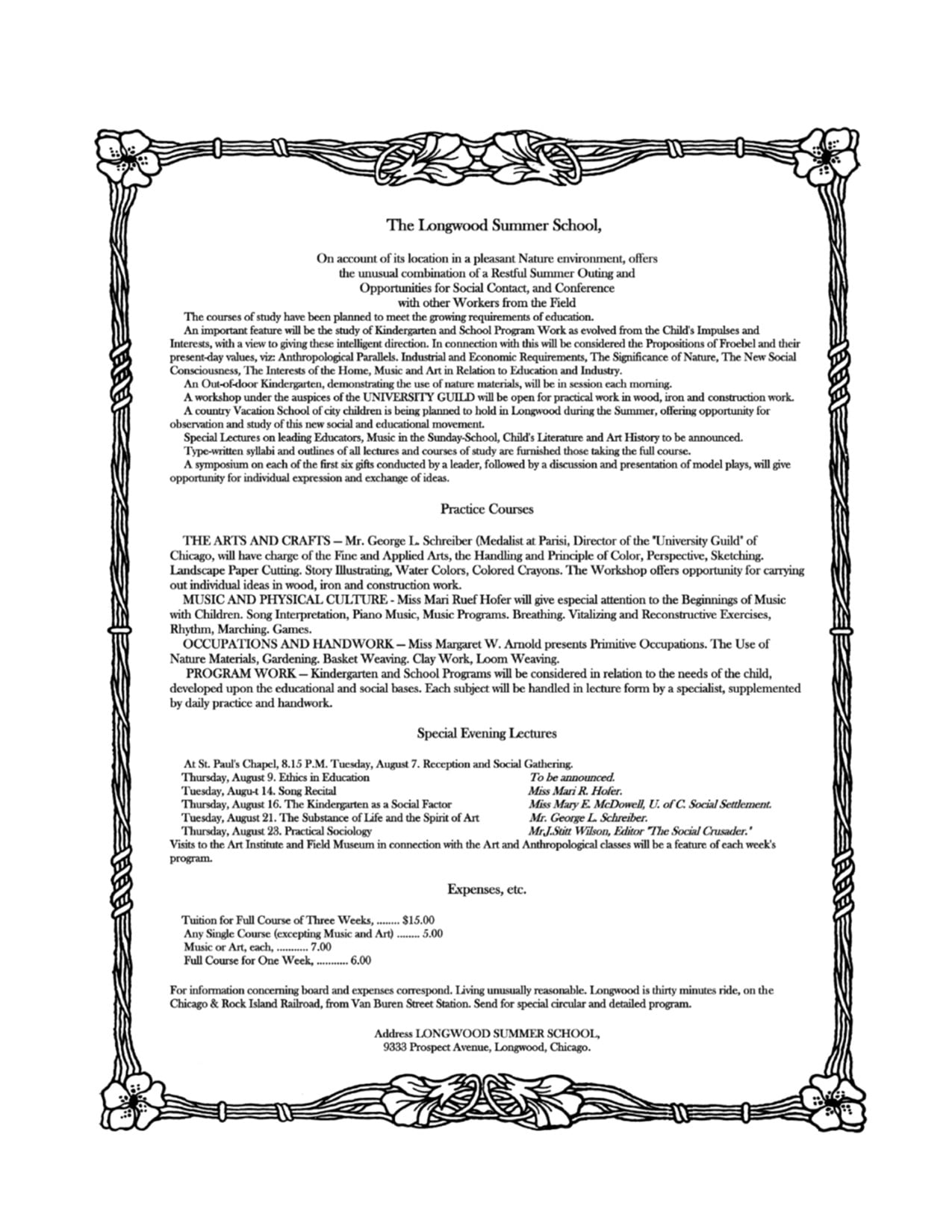
The five daughters in the family all went into education, writing and publishing, and social reform work. They were leaders in establishing kindergartens and training programs for kindergarten teachers. They were covered in a 2013 RHS newsletter, and those pages are presented here in jpeg form. A PDF version is also available that can be sent by Messenger upon request.
Next post: Amalie Hofer Jerome and the Civic Music Association
The Ridge Historical Society
The First Chicago Christmas Tree and the Ridge –
Part 3 – Amalie Hofer Jerome and the Civic Music Association
By Carol Flynn
Amalie Hofer Jerome came from a distinguished family of educators, writers, musicians, and publishers that lived and ran a school on the Ridge. She was an honorary vice-president for the lighting of the first Chicago Christmas tree.
Amalie was born in 1863, the sixth of the eight Hofer children, the third of the five girls who all went into education and social reform. She was raised in McGregor, Iowa, and attended McGregor High School. Amalie had training as a kindergarten teacher with Elizabeth Harrison, a pioneer in early childhood education who established programs in Iowa and Chicago.
Amalie and her sisters became leaders in the kindergarten movement, which was covered in the previous post. She was the editor and publisher of the Kindergarten Magazine, the leading publication of the movement, and other related publications.
Moving to Chicago, she was involved in the kindergarten-training schools her sisters established, including serving as principal.
Her work with the kindergartens led her to become involved with many more causes.
This was the era of “settlement houses,” made most famous by Jane Addams’ Hull House in Chicago. These were institutions of the “Progressive reform era” in which social workers, clergy, educators, and other concerned people came together, often living together in the institution, to offer services to the poor, new immigrants, and others in need. They usually started with outreach to mothers and children, and established day care services, kindergartens, and playgrounds; English lessons; household training; and arts and crafts.
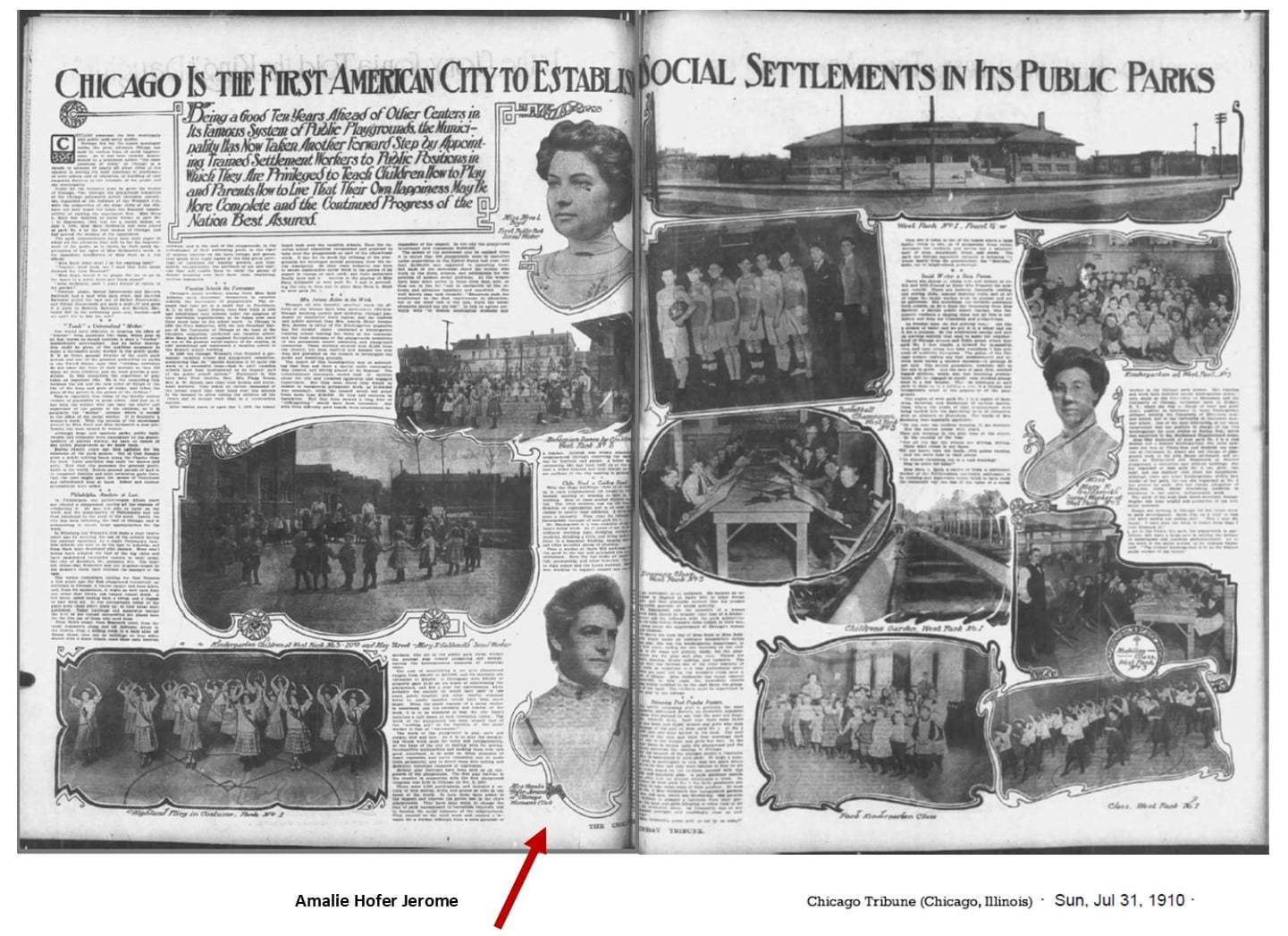
Amalie married Frank Jerome, a furniture merchant, in 1909. For several years, she was head resident of Fellowship House Social Settlement at 831 West 33rd Street, established in 1895. She resigned in 1916, but still stayed on the board, managing the settlement house activities.
Amalie was a founder of the International Kindergarten Union and the Playground Association of America. She traveled the world studying kindergartens and childhood education, and wrote articles and gave talks on the topics around the country.
In 1913, Amalie was a founder of the Civic Music Association in Chicago. For several years, free concerts had been given in the field houses of the city’s parks by notable musicians, and the time had come to organize the activities. As a leader of the Playground Association and also of the Chicago Woman’s Club, Amalie had been instrumental in arranging the concerts. She now took on the role of chairman of the executive committee of the new organization. Numerous groups, such as the Northwestern University choir and the Illinois Theater orchestra, provided free concerts in the parks.
Although she was recognized throughout Chicago for her many accomplishments, it was in her role as a leader of the Civic Music Association that Amalie was named one of the fifty-plus honorary vice-presidents for the lighting ceremony for Chicago’s first municipal Christmas tree.
Next post: Chicago’s First Christmas Tree
Ridge Historical Society
The First Chicago Christmas Tree – Part 4
By Carol Flynn
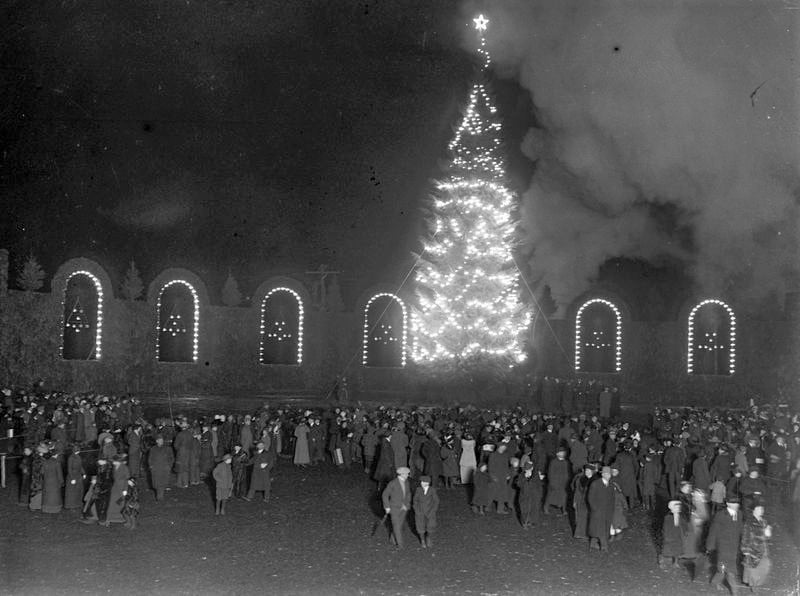
Chicago displayed its first municipal Christmas tree in 1913. This was the first time a giant tree lit with electric bulbs was displayed in a public space for everyone in the Chicagoland area to enjoy. A lavish lighting ceremony was held on Christmas Eve.
New York City displayed the first municipal tree in 1912, and Chicago, Boston, and other cities followed the next year. In Chicago, the Municipal Christmas Festival Association was formed to plan and manage the activities. The honorary president was Mayor Carter H. Harrison. There were over fifty honorary vice-presidents representing business and industry, civic associations, churches, newspapers, welfare and social agencies, and education. Amalie Hofer Jerome, from the Hofer family on the Ridge, represented the Civic Music Association. Artists including the famous sculptor Lorado Taft donated their design talent to create the display.
The tree was set up off of Michigan Avenue, just north of the Art Institute on land considered part of Grant Park then.
The tree was created from a 35-foot Douglas spruce mounted on a 40- foot base, covered by smaller trees, topped with a star of Bethlehem. The trees were donated by Frederick A. Jordan, of Roselawn, Michigan. He was the partner of the late Captain Herman Schuenemann, whose “Christmas Tree Ship” had gone down in Lake Michigan the year before while bringing trees to Chicago.
The tree was set in a 25-foot-tall arcade composed of arches and smaller Christmas trees, all lit with colored lights. Commonwealth Edison supplied the lights for the tree and arcade. Steam train engines from the Illinois Central Railroad were behind the arcades, blowing steam to create a special effect of fog. The tree was doused with water and frozen first, then slowly lit for a dramatic, icy effect.
A hospital station with volunteer doctors and nurses was set up to deal with injuries and lost children.
The lighting event on December 24th was almost curtailed by a blizzard earlier in the day. The streets were impassable and local transportation was impeded. Thousands of men poured out from lodging houses to help clear the snow – there was not enough work for all of those who showed up to help. The snow was soon cleared, and the event was able to go on as planned.
Thousands of free train tickets were made available for children so that families could come to the event, and over 100,000 people showed up.
The lighting ceremony started with a parade down Michigan Avenue, which included the police force and mounted Illinois National Guard cavalry. Speeches, and musical performances from a variety of sources, including the Chicago Grand Opera Company, followed, broadcast through huge megaphones. Motion pictures for children, mostly public safety features, were shown on a huge screen near the Art Institute.
Mayor Harrison pushed the button to illuminate the tree around 6:15 p.m., and the crowd gave out “lusty cheers.” The mayor’s speech was included in the record for the City Council. He stated that he hoped this would inaugurate a long series of celebrations for the city, and that the lights may serve as an inspiration to charity, the greatest of all virtues.
The festivities went on for several hours. There were a few minor glitches – the train engines, promised to be silent, were not, and drowned out some of the performances. The star of the opera who was promoted for the event was a no-show. Children were confused about the identity of Mayor Harrison – he was not fat enough to be Santa Claus.
The program was completed with the singing of the Star-Spangled Banner.
The police had assigned 250 men to detail the event. The officer in charge declared the crowd to be the “biggest, happiest, most cheerful, best and easiest handled” crowd he had seen.
The tree was illuminated nightly until the New Year.
The great success of this first tree led to the tradition that has now been going on for 108 years.
Image: The first Chicago Christmas Tree, 1913.
Next post: Some background information on early electrical technology in the City of Chicago.