
Explore the RHS Facebook Archives, a rich repository of local history written by Carol Flynn. For two decades, Carol brought a deeply dedicated voice to public education at RHS. Her role as Facebook administrator through mid-2025 naturally extended her prolific research into meticulously detailed articles, most notably her multi-part historical series posts. Today, Carol continues her local history writing for The Beverly Review and other outlets.
December 2023
The Ridge Historical Society
The New Year Approaches One Hundred Years Ago
By Carol Flynn
Prohibition was in full swing in 1923, having begun with the Eighteenth Amendment to the U.S. Constitution in 1920, as New Year’s Eve approached one hundred years ago.
Federal law prohibited the production, importation, transportation, and sale of alcoholic beverages, but private ownership and consumption of alcohol were not illegal under federal law, and some uses, for example, religious use of wine, were permitted.
Within a week after Prohibition began, illegal production and bootlegging, the smuggling of alcoholic beverages, also began. In the larger cities, such as Chicago, rival crime syndicates fought for control of the illegal alcohol markets.
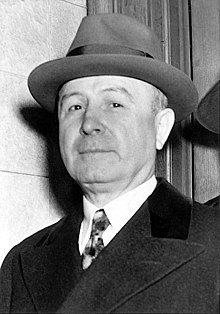
John Torrio rose to the top in Chicago organized crime. Historically, he is considered “unsurpassed in the annals of American crime; he was probably the nearest thing to a real mastermind that this country produced,” according to author and historian Hal Asbury.
In 1909, Torrio was invited to Chicago from New York by “Big Jim” Colosimo to help eliminate extortionists, which Torrio quite ably accomplished. He stayed in Chicago to help manage Colosimo’s 100+ brothels. In 1919, Torrio brought a young man named Al Capone from New York to Chicago to join their operation.
When Prohibition started, Torrio encouraged Colosimo to go into the bootlegging business, but Colosimo refused. Colosimo was gunned down at his restaurant in 1920 and Torrio, with Capone’s assistance, took over as Chicago’s organized crime boss. They soon became the leaders of the illegal alcohol operations in the city and suburbs.
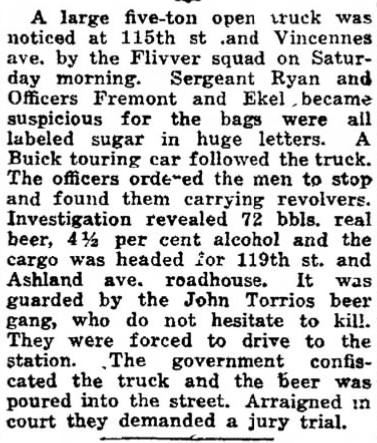
This story appeared in the Englewood Times on December 28, 1923.
A truck carrying a substantial amount of illegal beer was stopped at 115th Street and Vincennes Ave. It was reported to be under the protection of John Torrio’s “beer gang.” The members of the beer gang were not identified, but there was always the possibility that a young Al Capone was there that day.
The truck was on its’ way to a roadhouse at 119th Street and Ashland Ave., no doubt delivering supplies for New Year’s Eve celebrations.
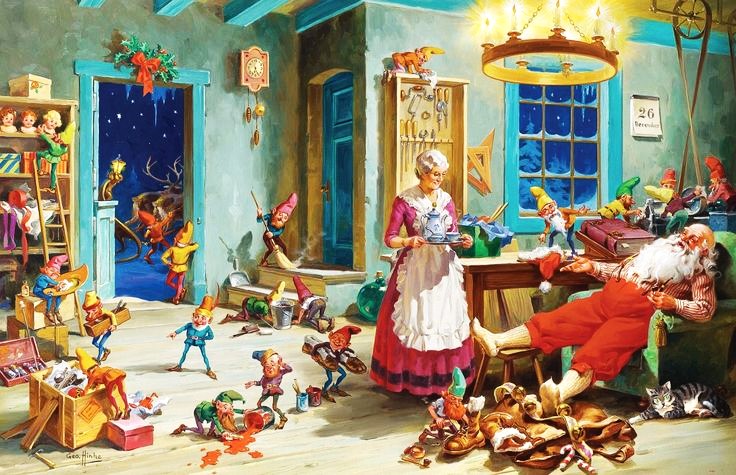
The day after Christmas by George Hinke.
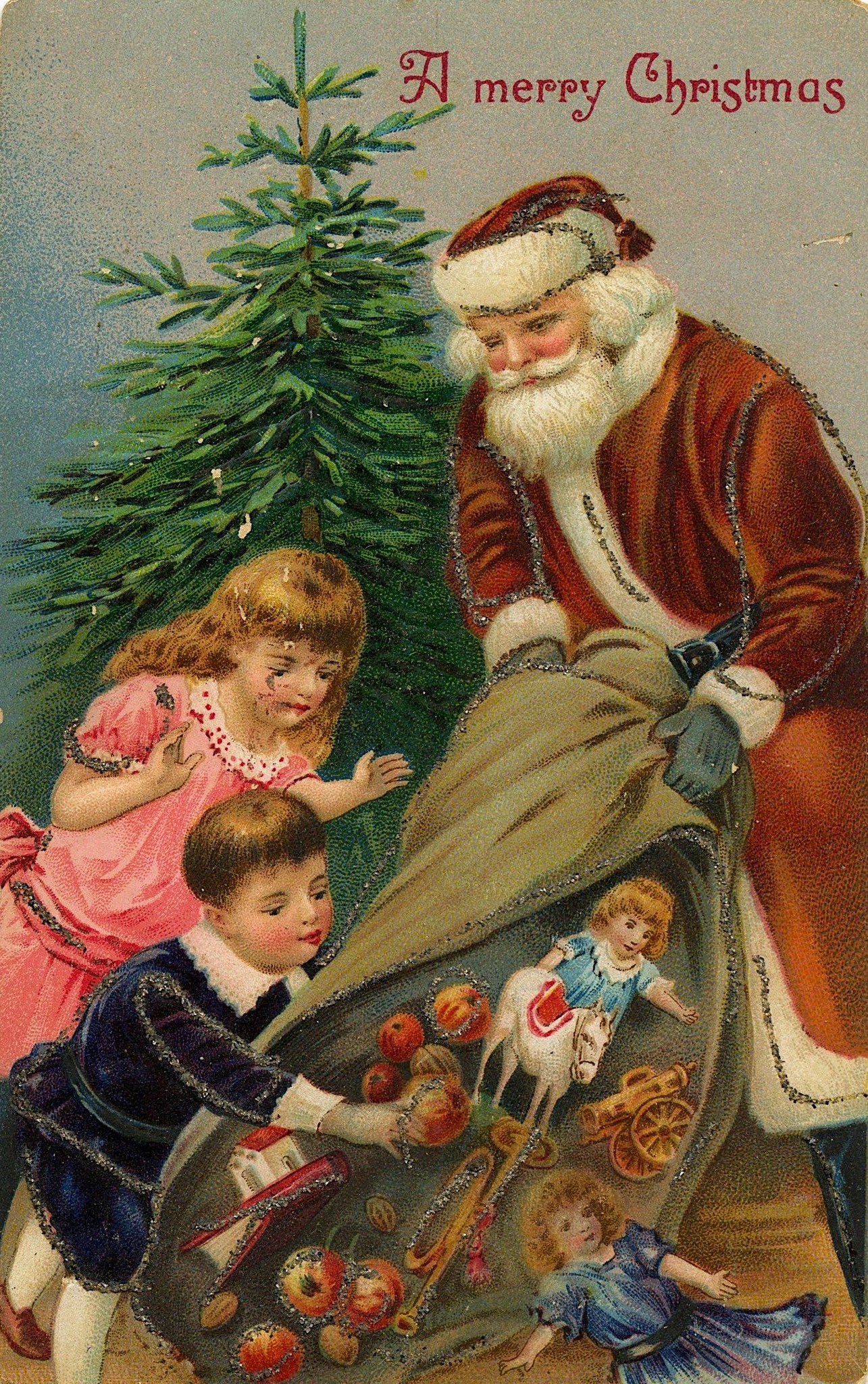
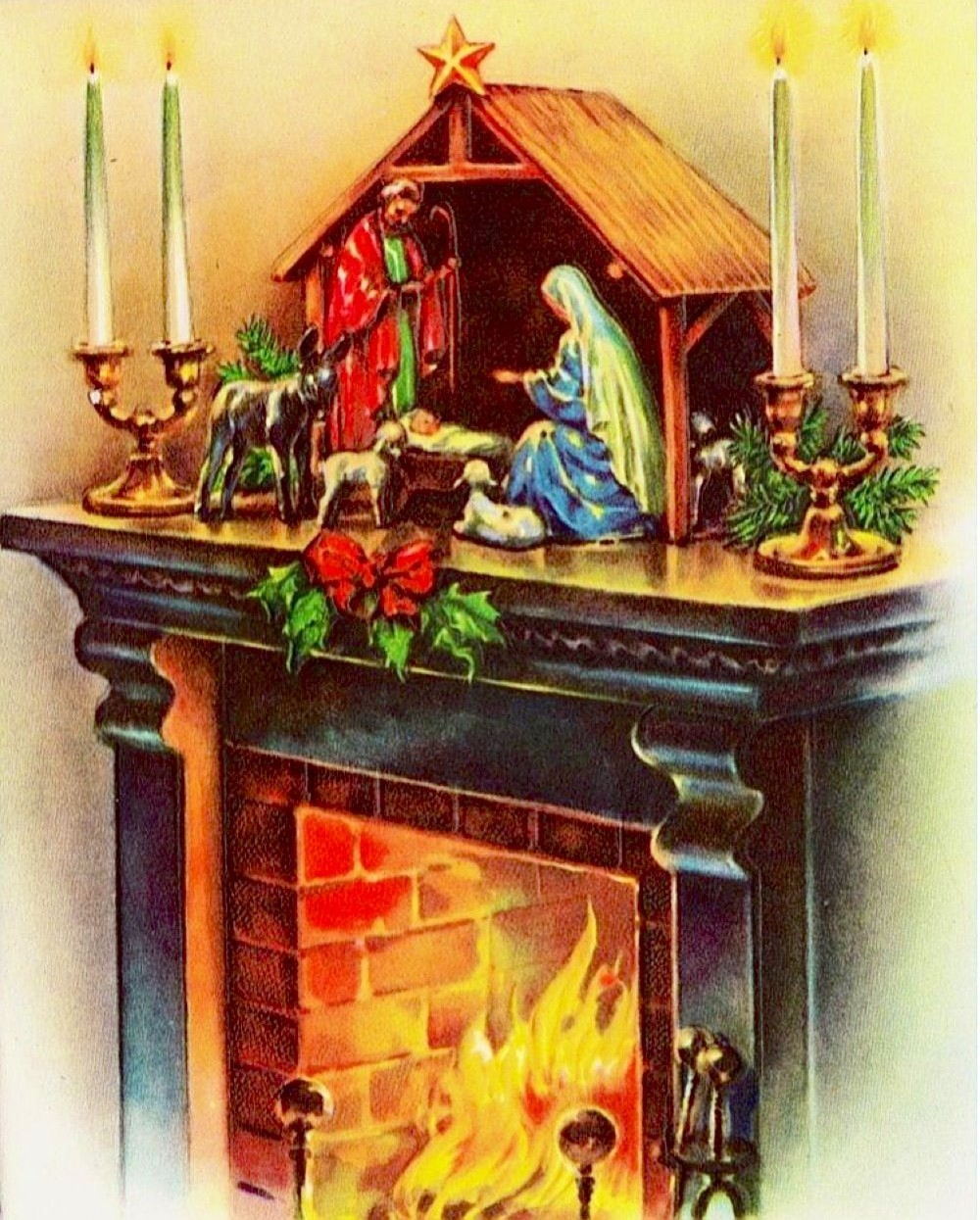
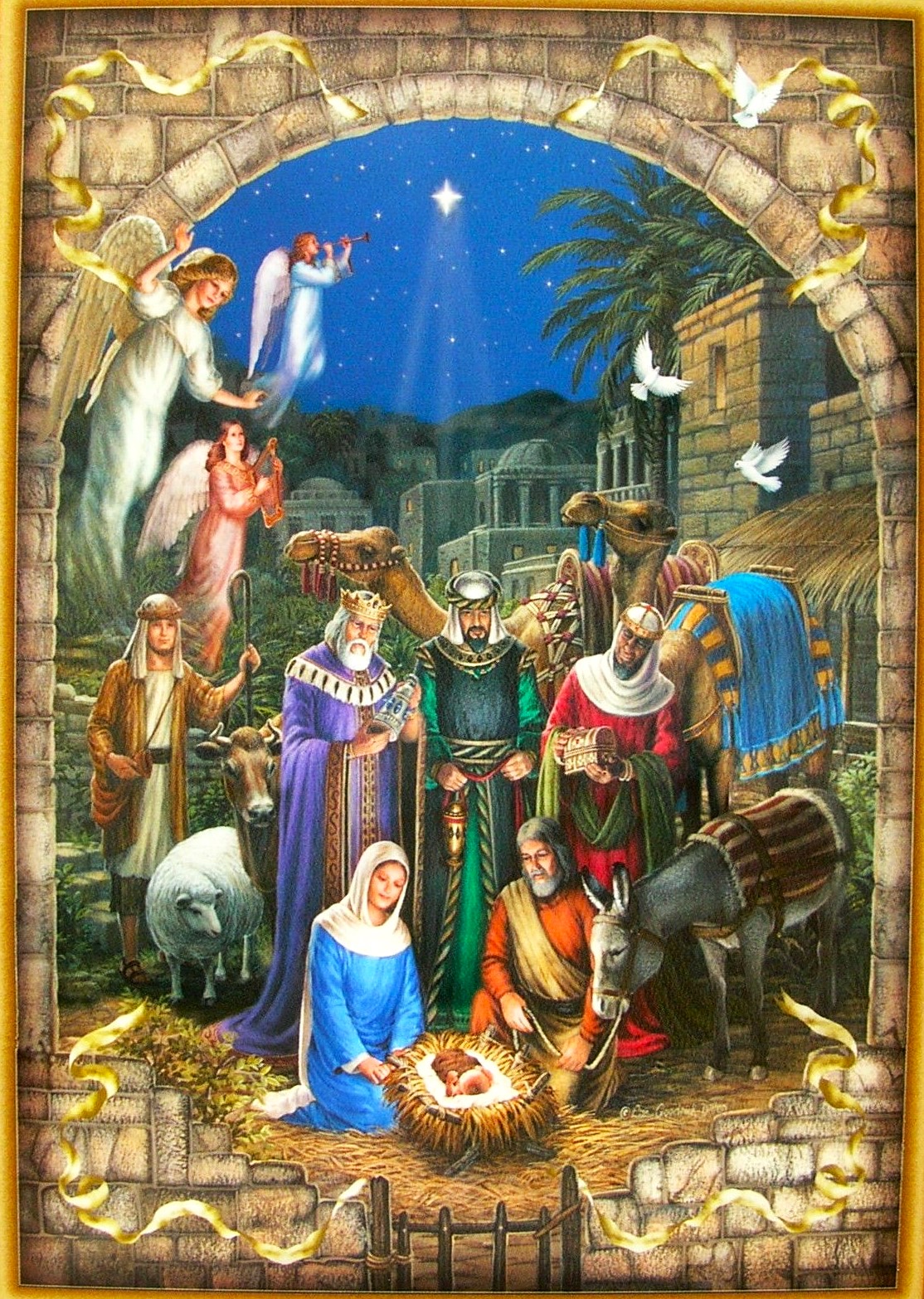
Taking us back to the reason Christmas exists through vintage postcards.

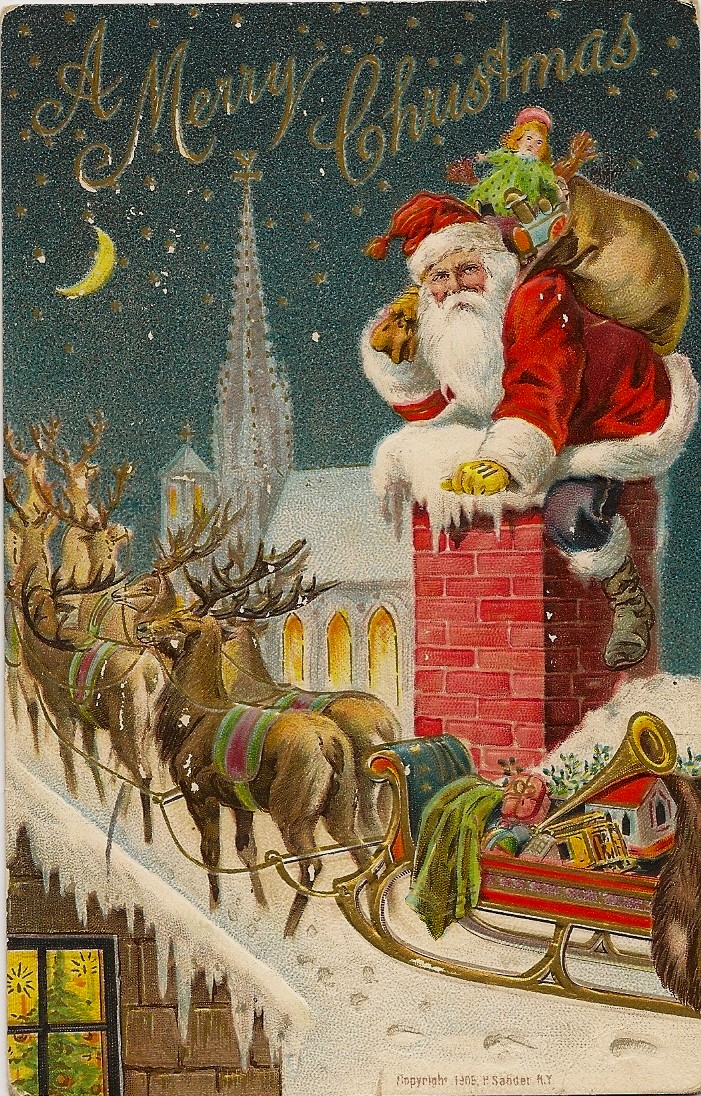
Tonight's the night! How does Santa fit down all those chimneys? It's magical!

The Ridge Historical Society
Christmas Cookies
By Carol Flynn
Homemade cookies at Christmastime are a time-honored tradition.
People spend the month of December planning and shopping, and then days in the kitchen baking family favorites and traditional ethnic delights, and perhaps trying a new recipe or two.
For decades, Chicagoans looked to the Chicago Tribune and food editor Mary Meade for Christmas cookie recipes and ideas, and Mary never disappointed.
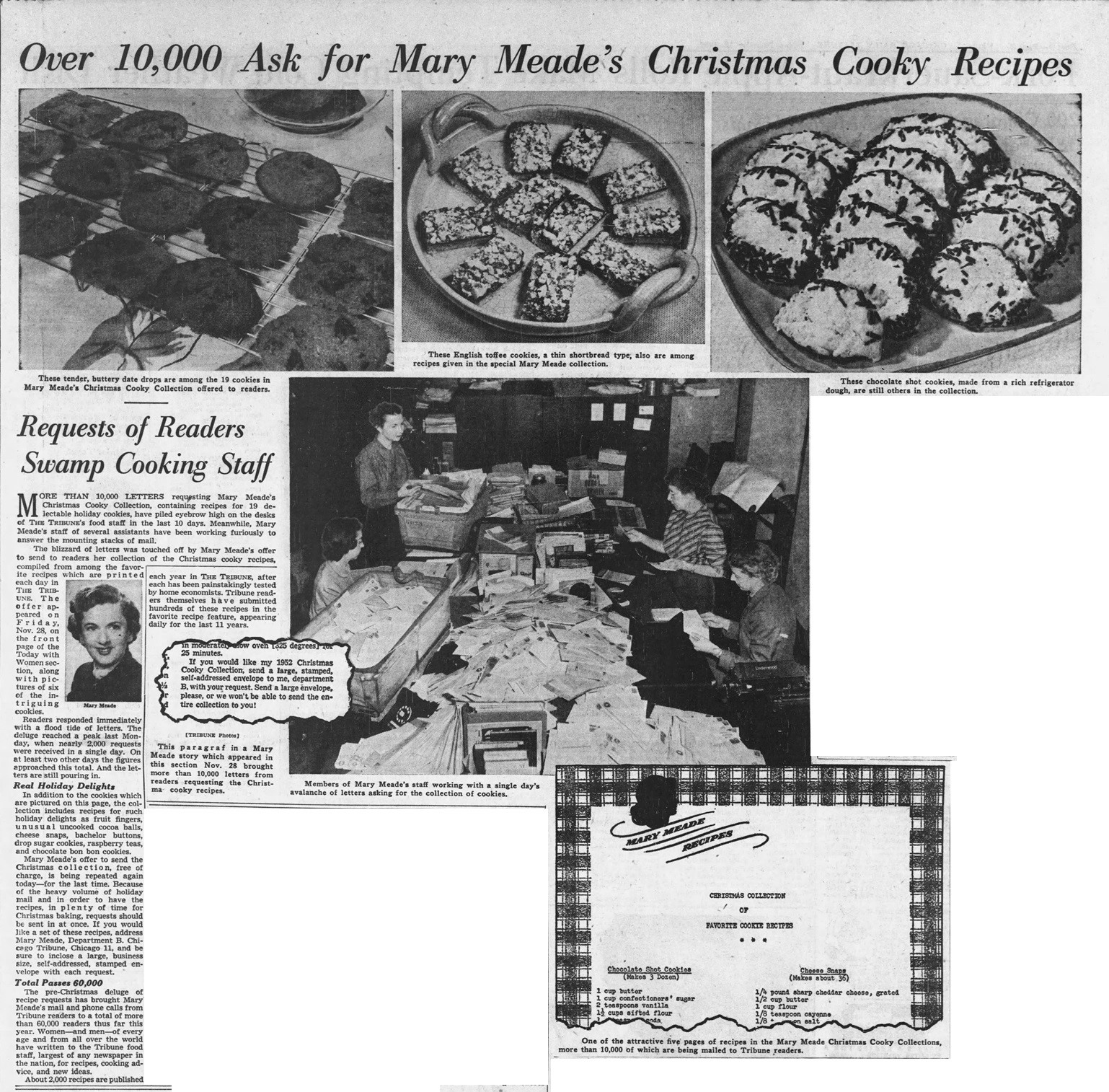
Take the year 1952, for example. As the attached article reports, on Friday, November 28, Mary offered her readers a free copy of her Christmas Cooky Collection, a selection of recipes that had appeared in articles, if they sent in a large, stamped, self-addressed envelope. Within 10 days, she had 10,000 requests.
Mary Meade, of course, was none other than Beverly’s own Ruth Ellen Church.
“Mary Meade” was the name the Tribune used for its women food writers for years, and Church was the fourth Mary Meade. A generic name was used because it was common practice that women did not stay long in professional jobs but left to marry and become full-time homemakers and mothers.
Ruth Ellen Church broke that mold. She served as food editor from 1936 to 1974, while marrying and raising two sons. She started the first wine column in a U.S. newspaper and published over a dozen cookbooks and also served as a Boy Scout den mother and a trustee for the Morgan Park Academy.
At the Chicago Tribune, Church oversaw the largest food staff of any paper in the country, which included five home economists. She established a kitchen in the Tribune Tower for recipe testing and food photography. Every recipe the Tribune published, about 2000 per year, was tested first in the kitchen.
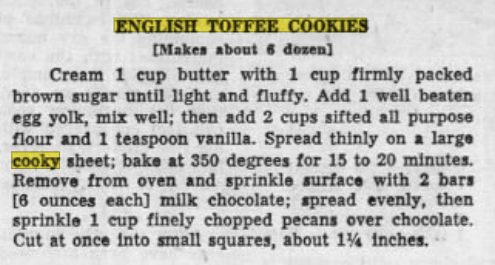
One of the recipes featured in the 1952 cooky collection was English toffee cookies. This recipe was published in the Chicago Tribune during Church’s time and is shared here.
And while they are delicious any time of the year, rumor has it that they are among Santa's favorites, so make a few extra to leave out on Christmas Eve for the big guy in red.
The Ridge Historical Society (RHS) will be open today, Sunday, Dec. 17, and Tuesday, Dec. 19, from 1 pm to 4 pm, for viewing the exhibit, "Louise Barwick's Lost Ridge." RHS is located at 10621 S. Seeley Avenue, Chicago. Admission is free. Parking is available on Seeley Avenue. RHS is not handicapped accessible.
One section of the exhibit is on KITE PHOTOGRAPHY
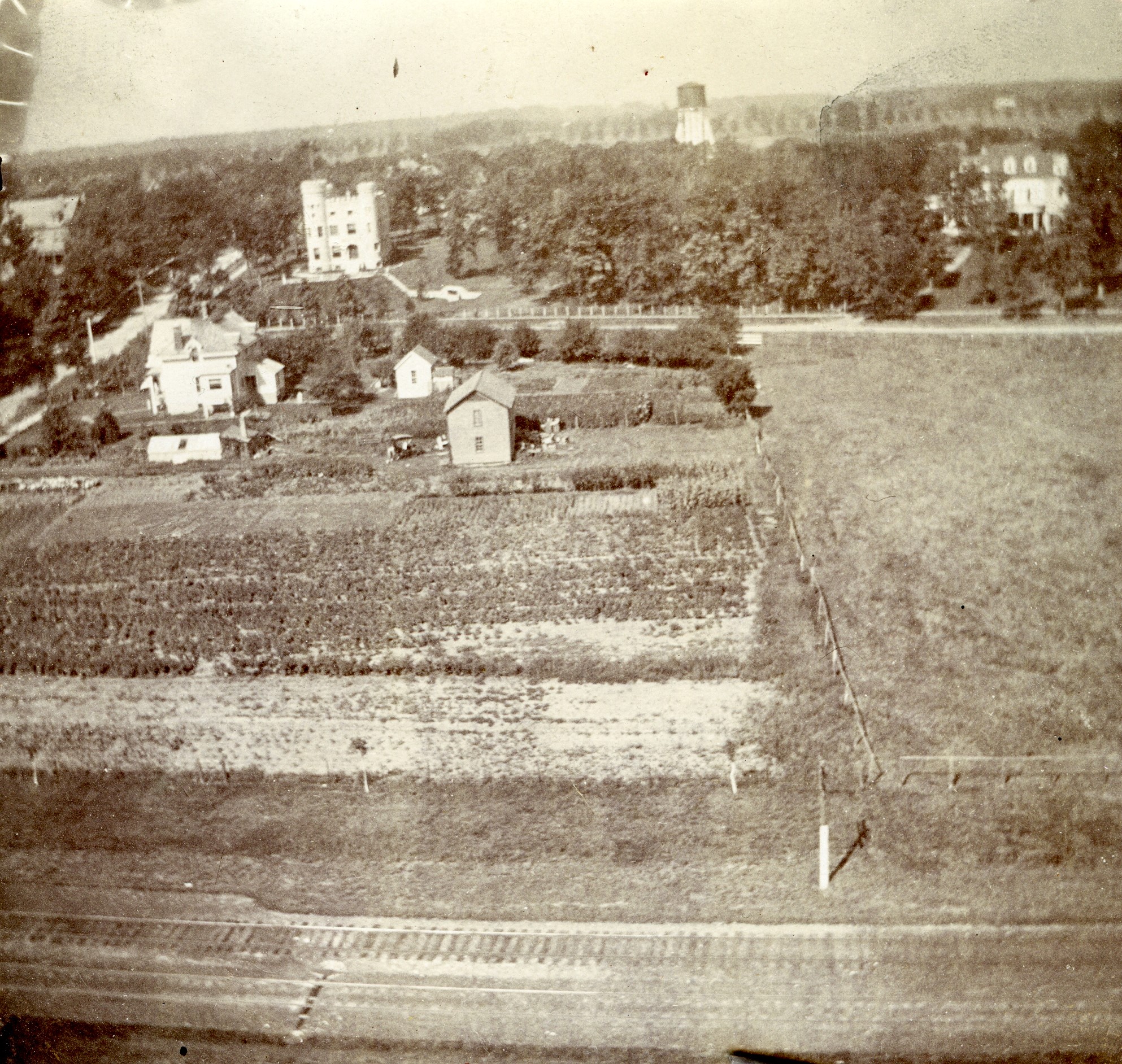
In 1899, two enterprising young men, Robert Heffron Murray and Frank Cox, attached a camera to a kite to take aerial photographs in the Beverly neighborhood. Murray, 17 years old at the time, and Cox, 21, both lived locally.
Fortunately, their experiments in aerial photography and their photos were reported in the local newspapers and therefore this historical record exists.
Several of the aerial photographs they published looked down on Longwood Drive at 103rd Street, giving us, literally, images frozen in time that document the corner as it existed almost 125 years ago.
This photo is one of them, and was posted a few days ago, inviting viewers to identify the location and buildings, which they readily did. Today is a follow up, with more information on the photo.
At the time, this area was known as “Tracy.” It was part of Washington Heights, which had annexed to the City of Chicago in 1890.
The name “Beverly Hills” was being used for a section in what is now North Beverly, around 91st Street, but it would not be until the 1910s that the name became commonly used for the entire section we know as Beverly today.
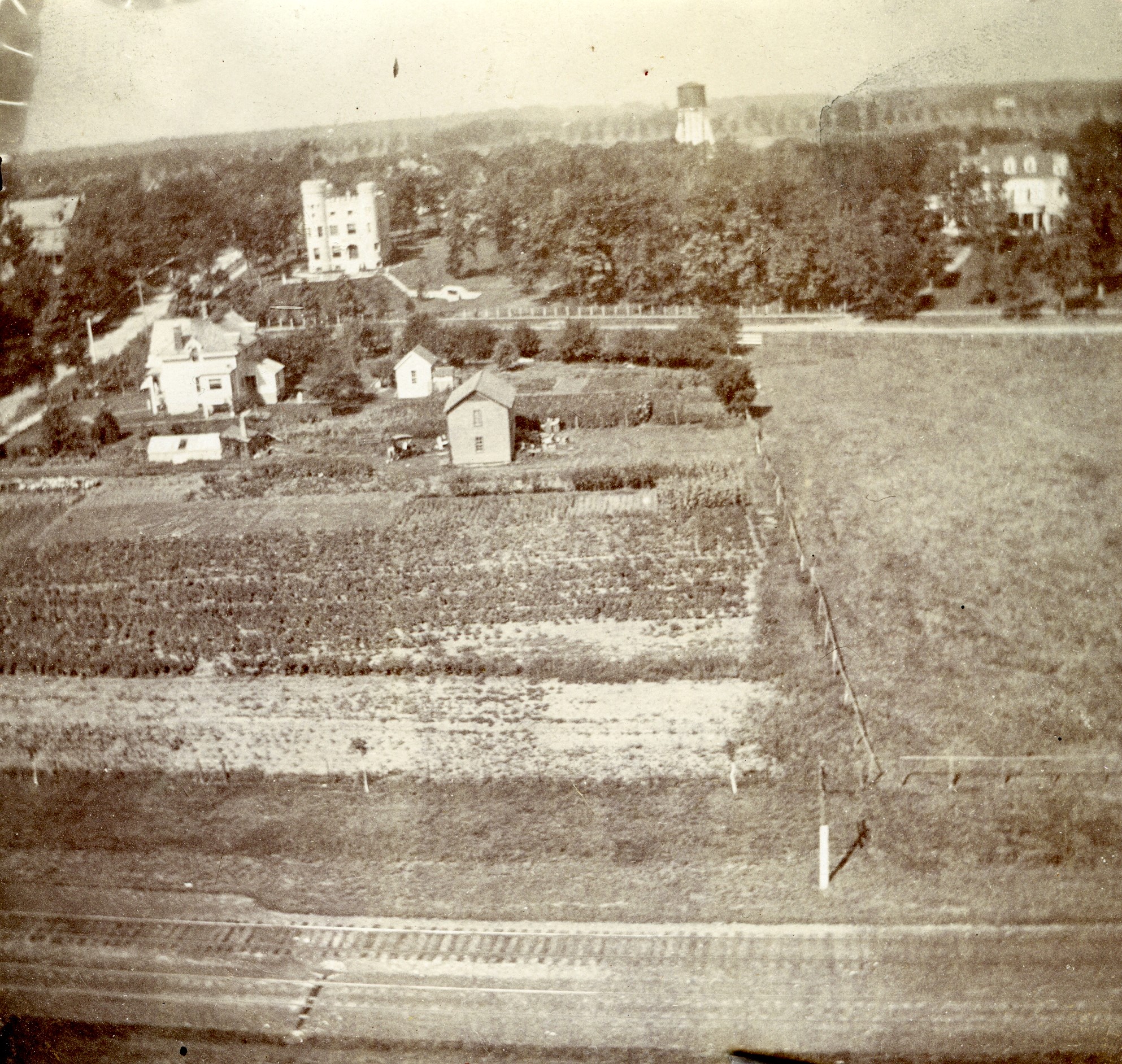
This photograph was taken from a field around today’s 102nd and Wood Streets. It is facing west, and shows in the foreground the train tracks of the Chicago, Rock Island, and Pacific line, which is today’s Metra Rock Island line.
Easily identified in the upper left is the Robert C. Givins House, also known as the Givins Castle, built in 1886-87, still prominent today as an area landmark. For orientation, this is the northwest corner of 103rd Street and Longwood Drive.
East of the Castle, where today there is a CVS Pharmacy on the northeast corner, is the Barnard seed farm. The Barnards were very early settlers in the area, and they grew primarily flowers on their farm which they harvested for their seeds and sold on the retail market.
To the north of the Castle (right side of photo), the large white house is the Horace E. Horton House, 10200 S. Longwood Drive, built in 1890 for the founder of the Chicago Bridge & Iron Company. The house is still there today. The rest of the block is still wooded territory. Incidentally, in 1905, Robert Heffron Murray married Sue Mary Horton, Horace’s daughter.
In the upper middle background is the Washington Heights water tower, which was located between Hoyne and Seeley Avenues. The water tower has an interesting history of its own. Before being annexed to the city, Washington Heights had its own water supply drawn from artesian wells. After annexation to the city, the water was drawn from Lake Michigan from a main at the Hyde Park pumping station at 68th Street. The water was pumped to storage reservoirs. The Blue Island Ridge, being of a higher elevation, had a separate water supply system and an additional pumping station at 104th and Charles Street, which brought the water up to this tank, which also had a small pumping station.
Eventually, technology advances did away with the need for this additional system, but the remains of the buildings were evident in the backyards of homes along Seeley and Hoyne for years.
For more information on this “kite photography experiment” visit the RHS exhibit. There were other photos taken with different views of the area that are explored in the exhibit.
The Ridge Historical Society
Skis and Toboggans in Dan Ryan Woods
By Carol Flynn
Someone posted on another page about the toboggan slides at Swallow Cliff.
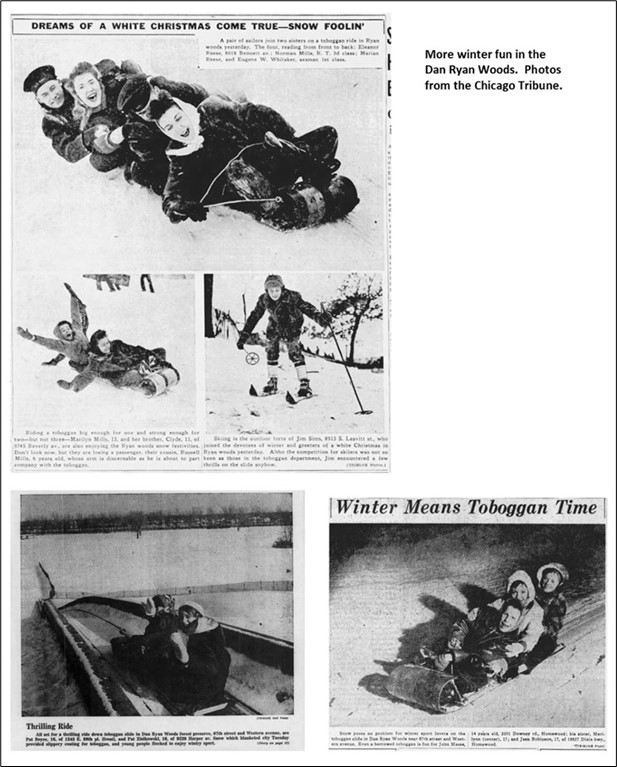
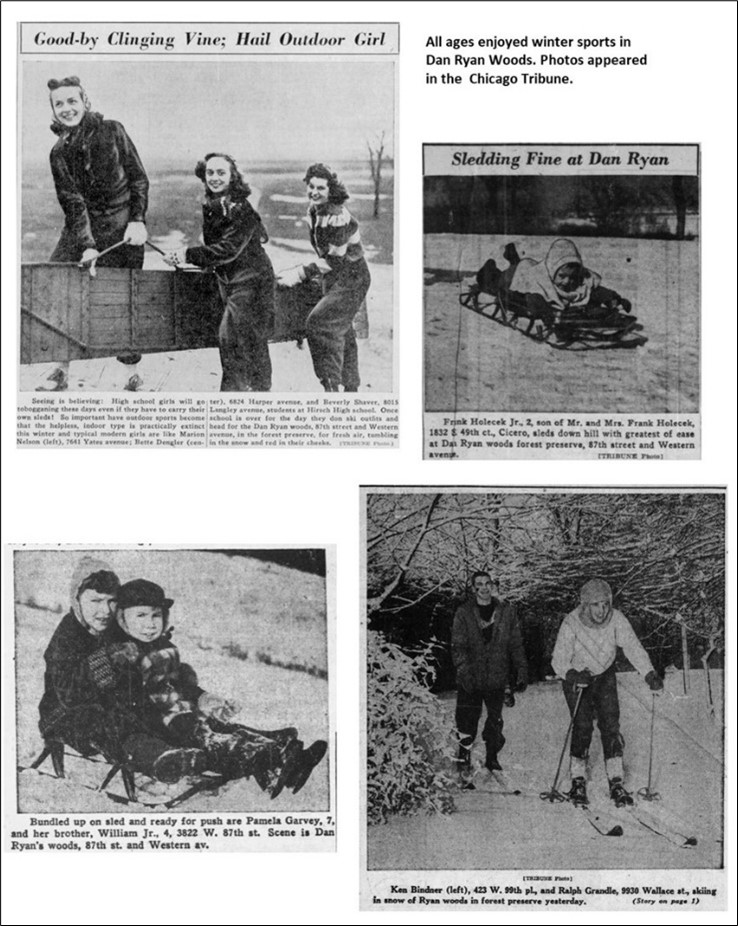
Winter sports were also very important at our own Dan Ryan Woods (DRW).
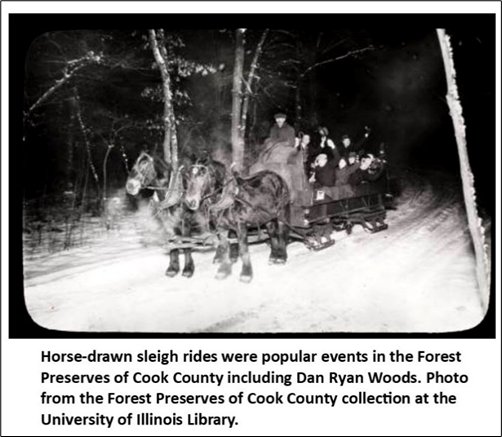
The high, steep Blue Island Ridge, a glacial moraine just like Swallow Cliff, was perfect for ski jumping, tobogganing, and sledding. When flooded, the baseball diamonds and sports fields made great ice skating and hockey rinks. The open meadows and hiking trails accommodated sleigh rides, snowshoeing, and cross-country skiing. And of course, building snow forts and snowmen, and having snowball fights, were all part of winter fun.
Winter parties and events in DRW were regularly held by school and church groups, Scouts, businesses and associations and private families. Of course, the weather was always a factor. On more than one occasion, what was billed as a sledding outing turned into a hike and weenie roast when there was no snow to be found. When the snow did come, there was nothing local students loved better than a “snow day” so they could head over to DRW with their sleds.
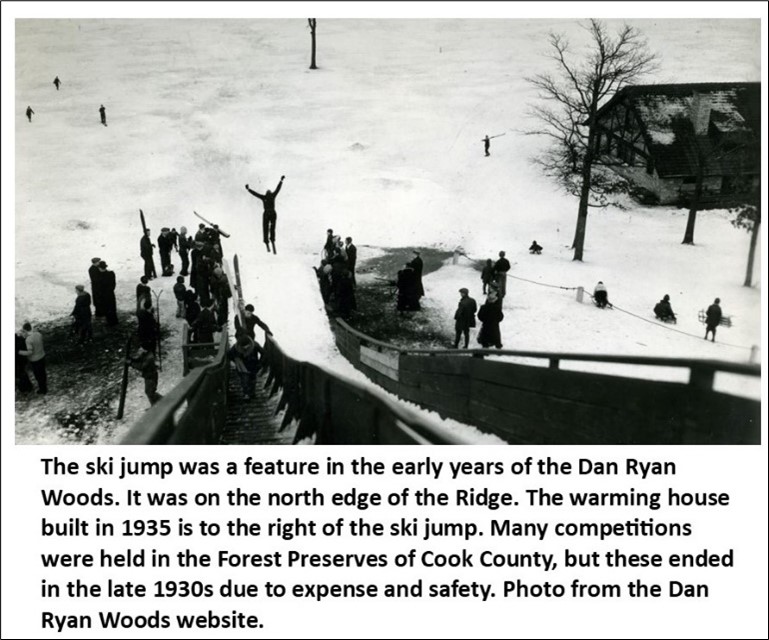
The Forest Preserve Ski Club started in 1925 under the auspices of the Cook County Board of Commissioners. The Club conducted professional and amateur ski jump competitions in several of the preserves, and the Ridge in DRW was one of the sites where a ski slide was built. It was to the north of the warming shelter.
The competitions were held for over a decade. Then in the late 1930s, while the Great Depression was still affecting finances, the Forest Preserves of Cook County (FPPC) decided that maintaining the ski slides, running the competitions, and funding the prizes were too expensive.
An issue was always the weather because back then artificial snow did not work well on the slides. One article reported, “Ammonia pipe snow is too lumpy for use on the slide, according to August H. Loula, chief of forest preserve police and secretary of the Forest Preserve ski club.”
FPCC got out of the ski jump business and the ski slides were converted to toboggan runs. Cross-country skiing was promoted as a continuing option.
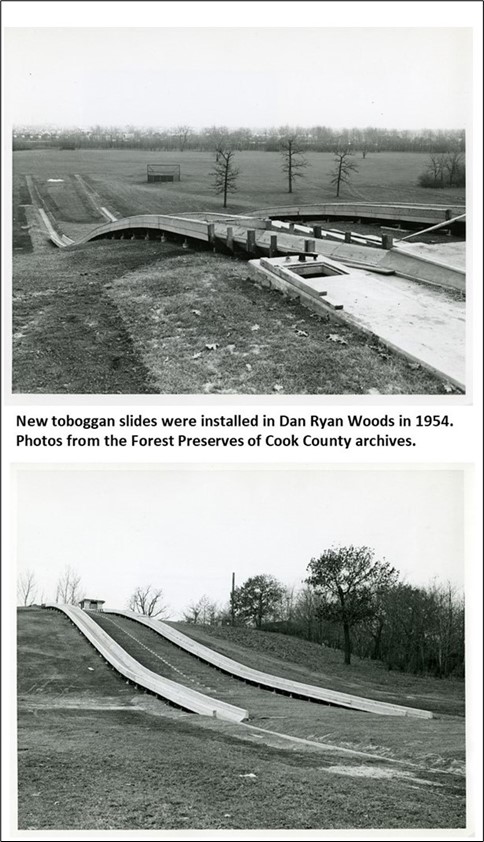
DRW had toboggan slides from its earliest days. They were routinely updated and/or replaced. In 1937, it was reported that six toboggan slides were newly constructed at DRW, likely by one of the New Deal government agencies. These toboggan slides were “banked, ‘S’ curve runs.”
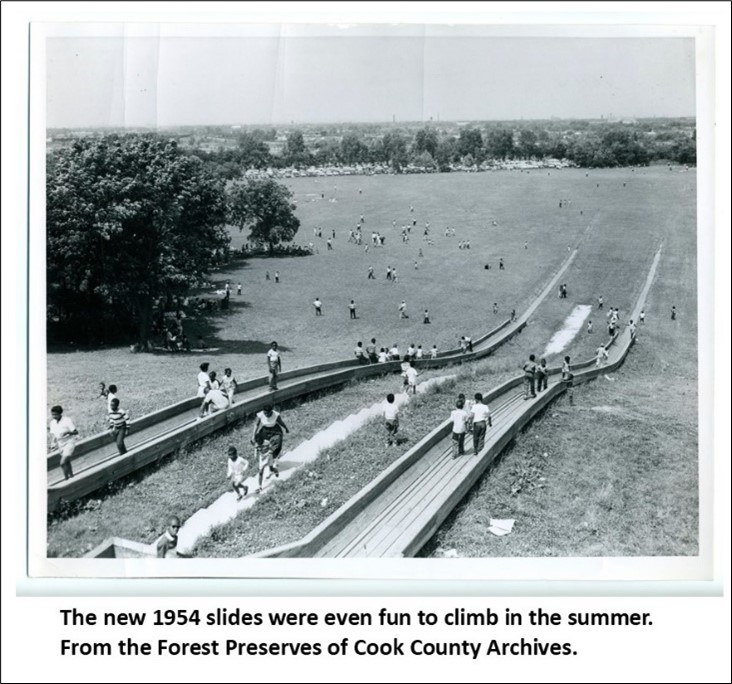
By 1954, DRW was down to one functional slide, and a new slide and platform area were built. Also at that time, the entrance to the parking area at 87th Street and Western Avenue was changed to have the opening on Western Avenue. Congestion around the area on week-ends because of DRW had become an on-going problem.
Tobogganing remained a favorite recreation at DRW for the next four and a half decades, but there were always issues. Maintenance of the slides was a constant expense. And then there were the accidents. The newspapers carried many reports of wintertime accidents in the FPPC. Broken bones, injured backs – and lawsuits – were not uncommon. At DRW, one 1960 Sunday afternoon alone saw seven accidents at the toboggan slides.
The emergency room at Little Company of Mary Hospital frequently treated the injured. In one case, a 12-year old boy fell off his toboggan and wound up with a stick impaled in his side. In another case, a young woman took a bad tumble off a toboggan during its run down the slide and was seriously injured. In a third example, an 18-year old boy was hit by two toboggans, suffering cuts and bruises, and prompting Superintendent Sauers to call for an investigation into the slides at DRW.
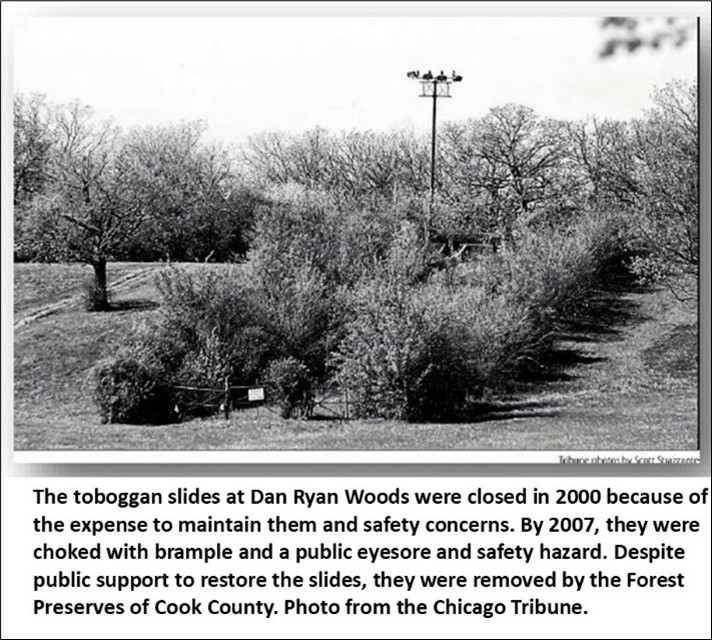
In 2000, the toboggan slides at DRW closed for much needed repair work. They never reopened. The cheapest bid the FPPC received for the work was over $700,000. By 2004, more than $4 million was needed to repair or replace the aging slides throughout the FPCC. Although there was protest from the public, the decision was made to close all of the slides, and by 2008, the slides were removed from FPCC.
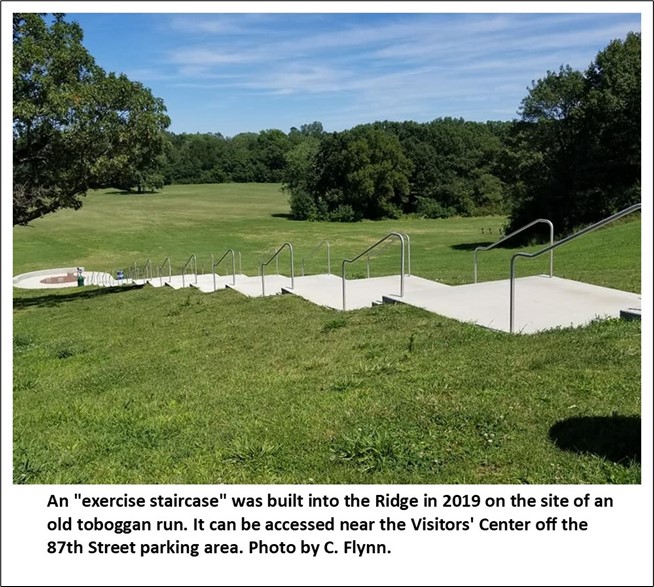
Alas, a favorite pastime in DRW became part of memories and history. Today, sledding and hiking are allowed on the Ridge, and a new exercise staircase was added to the hill in the spring of 2019 on the site of an old toboggan run. Cross-country skiing and snowshoe hiking remain popular in DRW.
The Ridge Historical Society is open today, Tuesday, December 12, from 1:00 p.m. to 4:00 p.m., and people may stop by to see the current exhibit “Louise Barwick’s Lost Ridge” for free.
This exhibit gives fascinating glimpses into how the community appeared around 1900, through the watercolor paintings of Miss Barwick, an educator and artist.
Also included in the exhibit is aerial photography of the Ridge taken from a camera attached to a kite from the same time period.
This is one of the iconic aerial shots.
Do you recognize the location?
Tomorrow’s post will describe in detail what is viewed here.
If you can’t wait that long, go over to RHS today. RHS is located at 10621 S. Seeley Avenue, Chicago.
Robert Heffron Murray, Kite and Aerial Photography Experiments, 1899
The Ridge Historical Society
Louise Barwick – Part 3
By Carol Flynn
The Ridge Historical Society’s new exhibit, “Louise Barwick’s Lost Ridge,” may be viewed on Tuesdays and Sundays from 1:00 p.m. to 4:00 p.m. or by appointment. RHS is located at 10621 S. Seeley Avenue in Chicago. The exhibit is free.
This exhibit focuses on life on the Ridge from 1893 to 1905 as seen through the watercolor paintings of Louise Barwick, an artist and educator who lived on the Ridge. Other components of the exhibit include a section on aerial photography taken by cameras attached to kites, and “lost and found” architecture – historic photos of buildings, some of which remain and some of which are gone from the Ridge.
This Facebook series on Louise Barwick complements the exhibit, but does not repeat it. More information on Louise herself, her family and her history, is being presented in this series. The exhibit concentrates more on visual images of the Ridge in the late 1800s.
This post will continue to look at Louise’s maternal ancestors.
Louise Barwick’s maternal grandmother, Mary Brookes Cleaver, was the daughter of Samuel Brookes, the first florist in the City of Chicago. He was described as “an old-fashioned English gardener” by the American Florist magazine in 1912.
However, Brookes was so much more than that.
Before deciding to bring his family over to the New World, he was a distinguished botanist, florist, horticulturist, and carpologist (one who studies fruits) who owned and operated one of the largest London nurseries, where he studied and dealt in exotic imported plants. He introduced the azalea, the chrysanthemum and the Chinese cherry, among other plants, into Europe, from cuttings from China. He won numerous awards for his plants.
Brookes came to Chicago via Canada in 1833, bringing along his family, servants, various pets, and rootstock to establish a new business. Charles Cleaver claimed that Brookes also brought the first piano to Chicago.
Brookes built Chicago’s first commercial greenhouse in 1845. He eventually moved his business and his home to Cleaverville. He was as respected in America as in Europe for his horticultural knowledge. He was called the “Father of the Chrysanthemum” in the trade because no one had as much experience with the flower as he did.
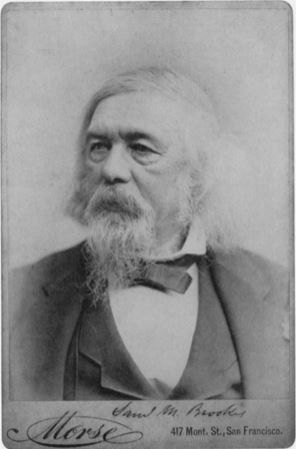
Besides daughter Mary, who married Charles Cleaver, two of the Brookes sons, Frederick William (F. W.) Brookes and Samuel Marsden Brookes, are notable for this story.
F.W., who seemed to always be referred to by his initials, started a career as a printer and worked with the Chicago Tribune, but eventually joined his father in the greenhouse business. He spent his later years as a resident of Morgan Park, and his home for many years was a showplace for some of the original Norway pines from the first greenhouse.
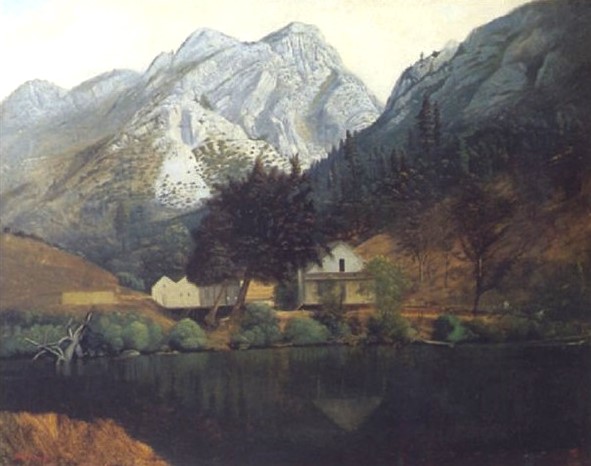
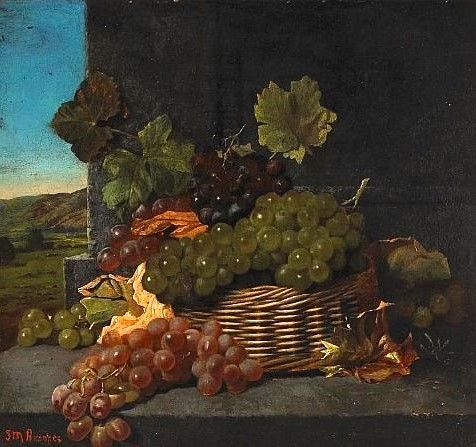
Samuel Marsden Brookes was 17 when his family left England, a graduate of a private school, and a budding artist. Once in Chicago, although his father disapproved, young Samuel continued his pursuit of studying art anywhere and anyway the opportunity presented itself, eventually giving art lessons himself. He moved to California, where he became a well-known artist in San Francisco, specializing in portraits, landscapes and still life paintings.
Perhaps Louise Barwick’s artistic leaning was a family gift.
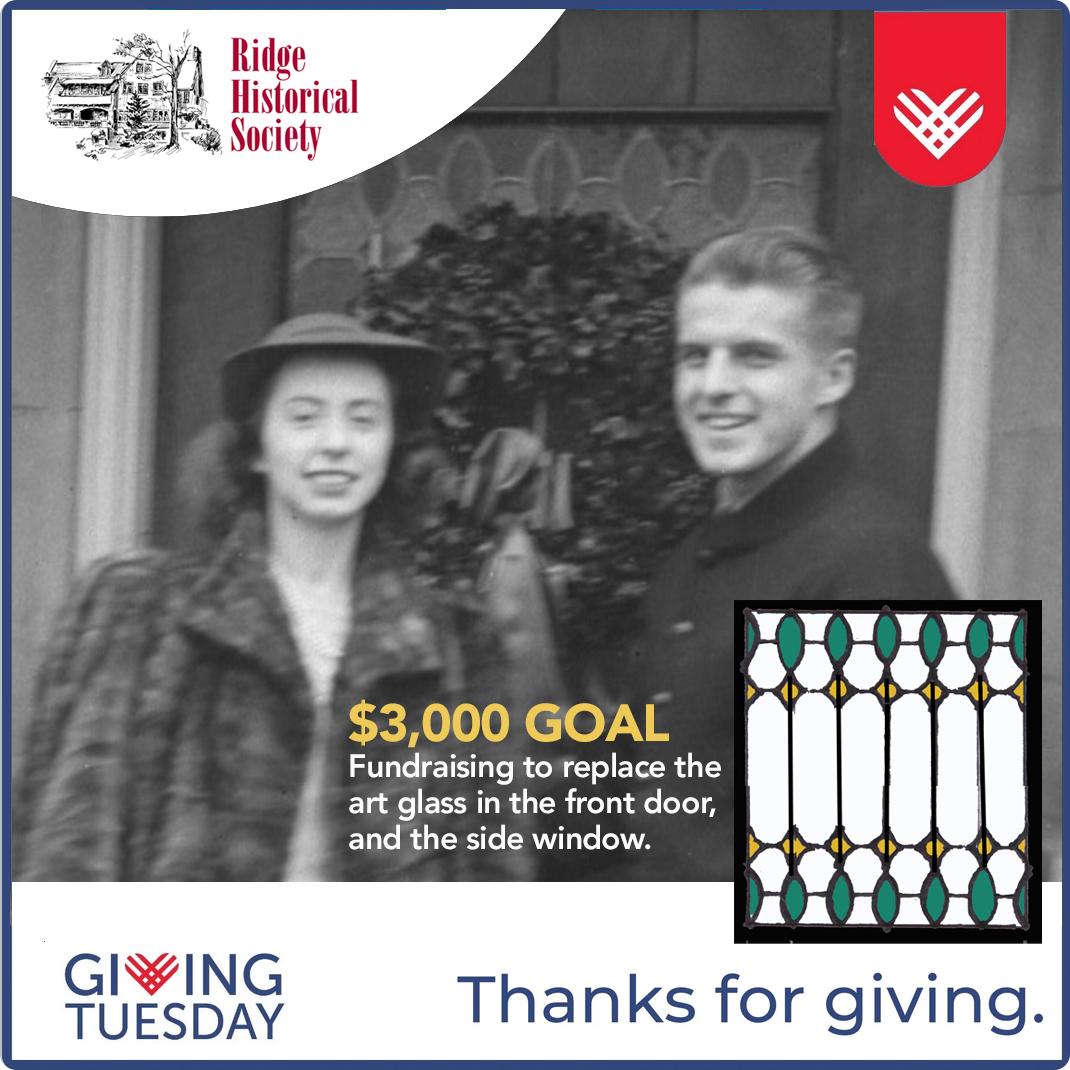
Thank you to those who made donations!
We received $493.06 towards our goal of $3,000 to recreate the art glass window in the front door and a small leaded glass window.
These windows were lost in the 1962 fire, started by the family Christmas tree, that devastated the house. We are working with Colorsmith Stained Glass Studio of Riverside to reverse engineer the pattern based on historic photographs.
Ongoing work in recent years has included replacement of the slate roof, repair of brickwork, and rebuilding our one-of-a-kind veranda overlooking Longwood Drive.
There is still time to give. All money raised for this campaign will be used for the Window Restorations. Donations to RHS, a tax-exempt entity, are considered gifts to a charitable organization and will be acknowledged as such.
PayPal Donation Link: https://bit.ly/RHS-donation