Explore the RHS Facebook Archives, a rich repository of local history written by Carol Flynn. For two decades, Carol brought a deeply dedicated voice to public education at RHS. Her role as Facebook administrator through mid-2025 naturally extended her prolific research into meticulously detailed articles, most notably her multi-part historical series posts. Today, Carol continues her local history writing for The Beverly Review and other outlets.
January 2020
This will be a five-installment post over the next few days. To access the entire story, visit the Ridge Historical Society Facebook page.
Part I. RHS usually shares upbeat stories, but the Ridge also saw its share of tragedy. As we enter the New Year, this entry is a reminder that every day is a gift.
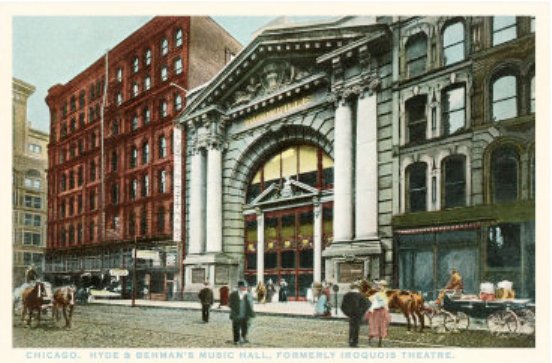
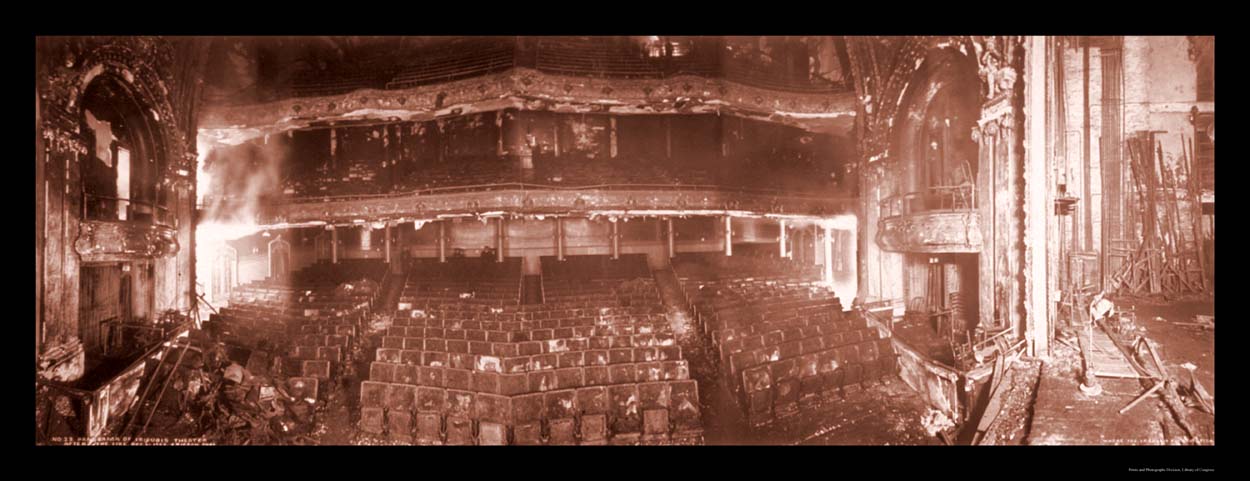
The holidays didn’t always bring “glad tidings of comfort and joy.” On December 30, 1903, one of the biggest tragedies in Chicago’s history occurred. The Iroquois Theater caught fire, resulting in an estimated 602 deaths. This remains the deadliest theater fire and deadliest single-building fire in U. S. history. There were twice as many fatalities with this fire as with the Great Chicago Fire of 1871.
The theater had opened to much fanfare just the month before. It was considered architecturally beautiful and was advertised as “absolutely fireproof.” But in reality there were numerous safety deficiencies that were known by the builders and owners, city officials, fire inspectors and fire department.
The afternoon matinee of the musical play “Mr. Bluebeard, Jr.” on that fateful Wednesday was packed with almost 2,200 people. Most were women with children, enjoying an outing during school break.
Sparks from a stage light, believed to have been caused by a short circuit, ignited a curtain. Seeing the fire, the audience panicked. Many people were trapped – just one safety flaw among many was that the doors at the Iroquois opened inward with locks the people could not operate. The crush of people trying to exit kept the doors pushed shut. People were trampled, asphyxiated and/or burned.
There isn’t space here to recount the horrors inside the theater, or the many acts of heroism that occurred. There are numerous accounts of the fire that can be accessed on-line.
A police officer on patrol saw people running from the theater with their clothes on fire and raised the fire alarm. After the fire was extinguished, the gruesome task of recovering and identifying the victims began. Many were burned beyond recognition.
Investigations led to criminal charges that were later dismissed. Numerous new safety laws were implemented throughout the world as a result of this fire. Just one example that we take for granted today is that exit doors are required to open outward, with crash bars to deactivate the locks.
The Iroquois Theater later reopened as the Colonial Theater and was demolished in 1925. Today, the Oriental Theater occupies that site on Randolph St. between State and Dearborn Streets.
The next installments will cover some of the connections between the Ridge and the Iroquois Theater fire.
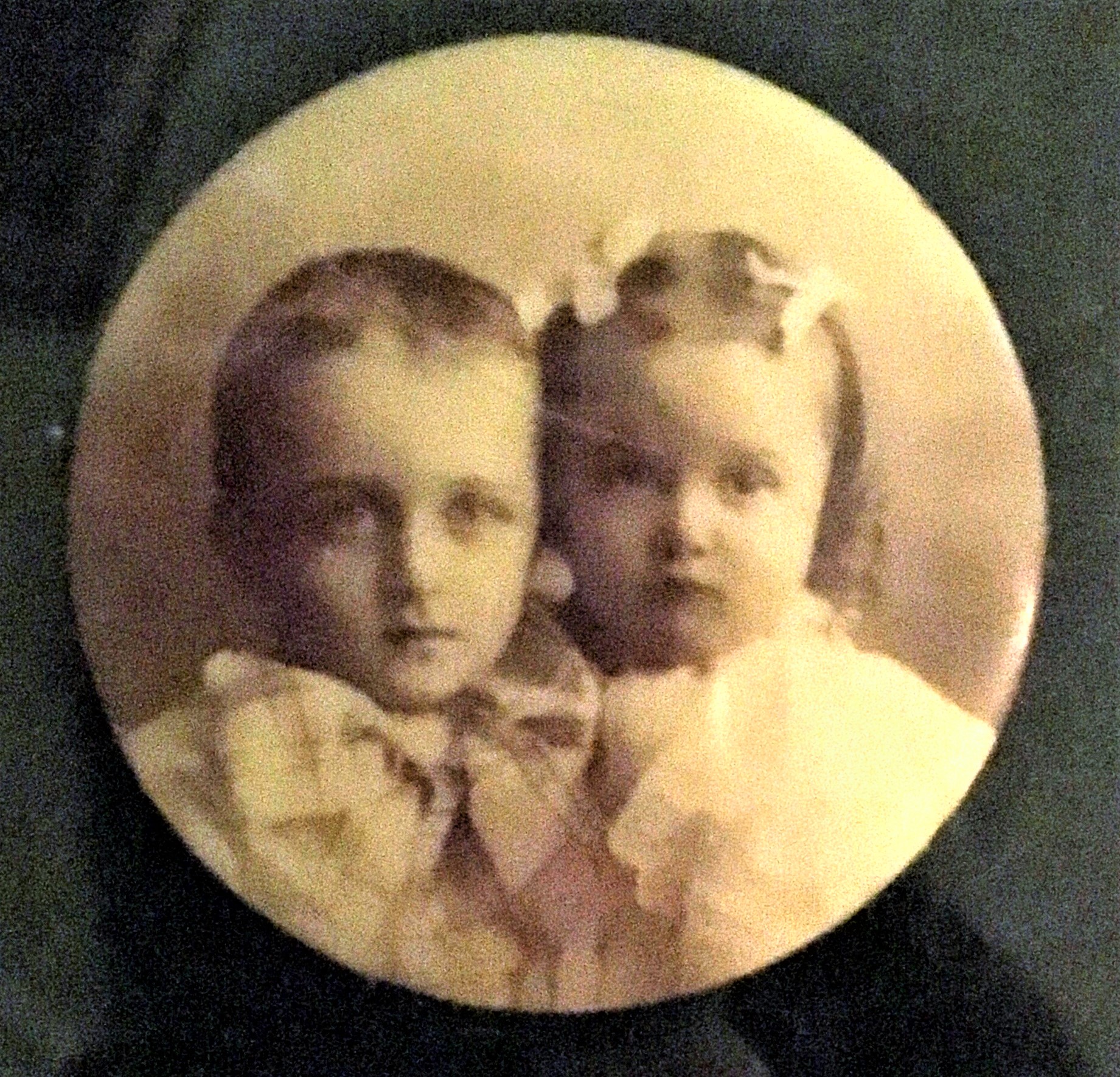
This is a five-installment post about the connections between the Ridge and the Iroquois Theater fire. To read the entire story go to the Ridge Historical Society Facebook page.
Part 2. Entire families were lost in the Iroquois Theater fire on December 30, 1903. What started for some families as a delightful, much-anticipated holiday event, going downtown to see the musical “Mr. Bluebeard, Jr.” at the new theater, turned into a devastating tragedy.
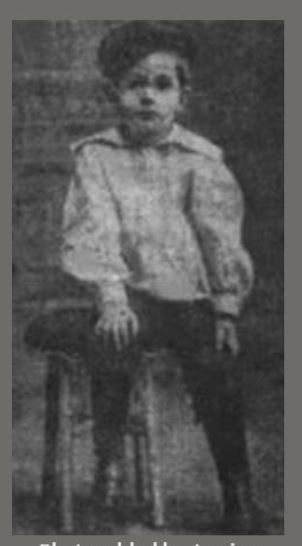
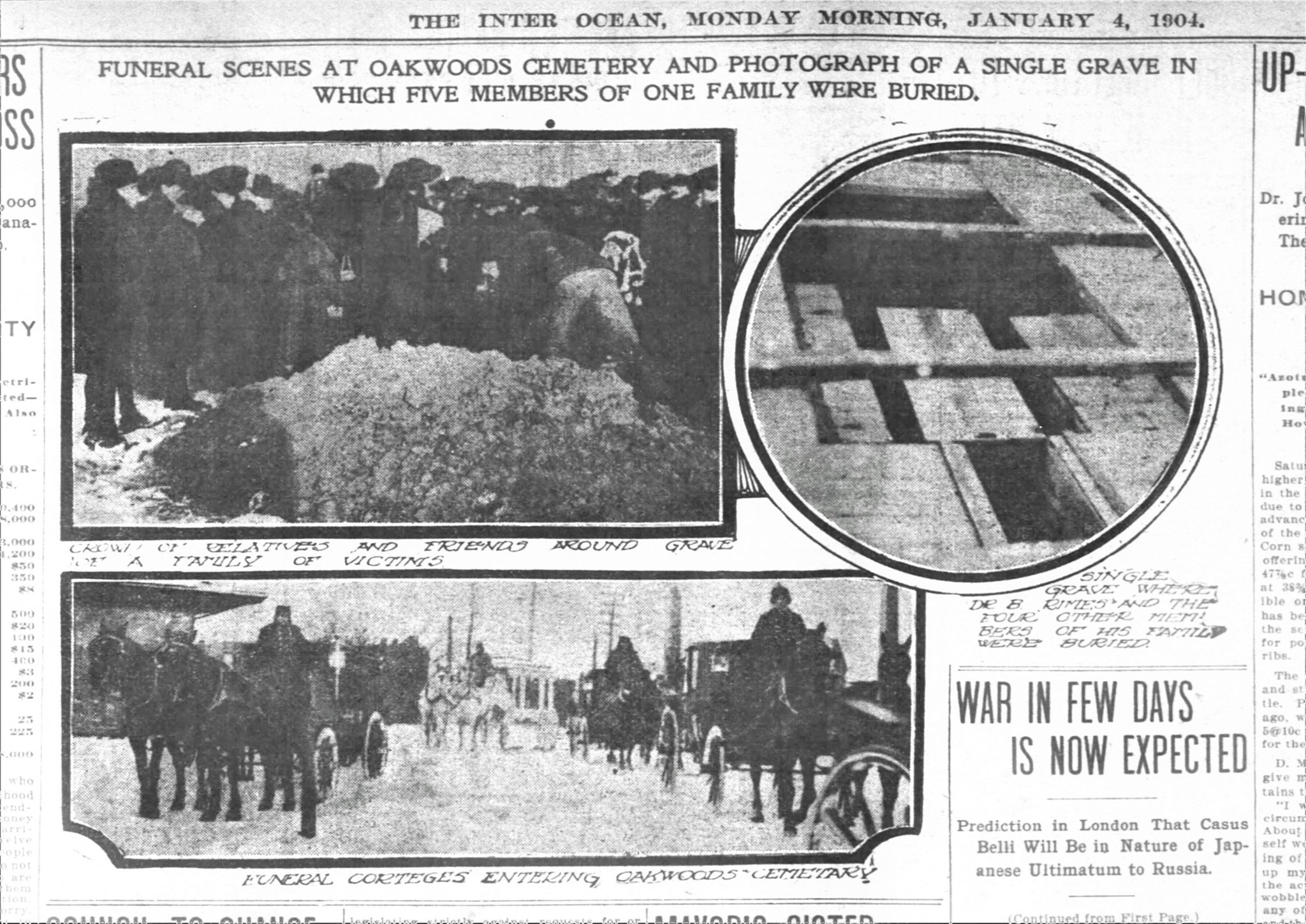
One case was that of a prominent dentist from Englewood, Dr. Mervin B. Rimes, 36. He and his wife Bertha and their three sons, Myron, 10, Thomas, 7, and Lloyd, 5, all perished. According to the history passed down by the family, they were identified by their socks, knitted with their initials by their grandmother as Christmas presents. A 3-year old daughter left at home was the only remaining family member.
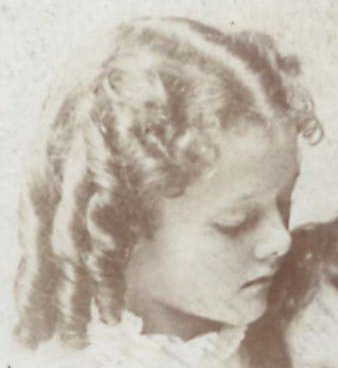
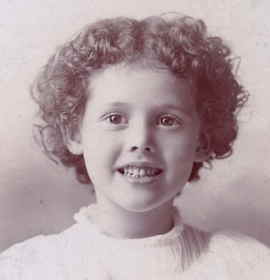
The Rimes family was originally scheduled to attend the play with relatives, but that family cancelled due to illness. It appears Dr. Rimes then invited another Englewood dentist, Dr. Albert Oakey, and his daughters Lucile, 13, and Marian, 11. All three Oakeys died that day, also.
The relatives of the Rimes family who cancelled that day were Emma Francis, cousin of Bertha Rimes, and her children, Arthur (Art), 10, and Flora, 7, who had fallen ill. Husband/father John W. Francis had a dry goods establishment in Englewood called The Fair Store. It was a fixture in that community for many years. Emma’s great grandfather was Richard Bingle, who settled on the Ridge in 1842. John and Emma are buried in Mount Greenwood Cemetery.
Art and his family moved to Beverly. Linda Lamberty, RHS Historian, is Art’s granddaughter.
Said Linda, “I recently looked around at a large Christmas gathering of cousins descended from Aunt Flora and it hit me that, by falling ill and causing her mother, brother and herself to miss the play at the Iroquois theater, she saved all of our lives. Had the three of them attended, likely none of us descendants would be alive today.
“But the Oakeys then apparently used those tickets. There is the sobering thought that their descendants never had a chance to exist. Of course, it was not the fault of any of these people that the fire occurred. The dangerous conditions within the theater led to this tragedy.”
The next installments will share more connections to the Ridge.
This is a five-installment post about the connections between the Ridge and the Iroquois Theater fire. To read all the posts go to the Ridge Historical Society Facebook page.
Part 3. Poignant reminders of the Iroquois Theater fire tragedy that occurred on December 30, 1903, are the family gravesites of the victims found in many Chicago cemeteries.
Mt. Greenwood Cemetery at 2900 West 111th Street has documented the graves of victims buried there. It is likely other victims are buried in other Ridge cemeteries.
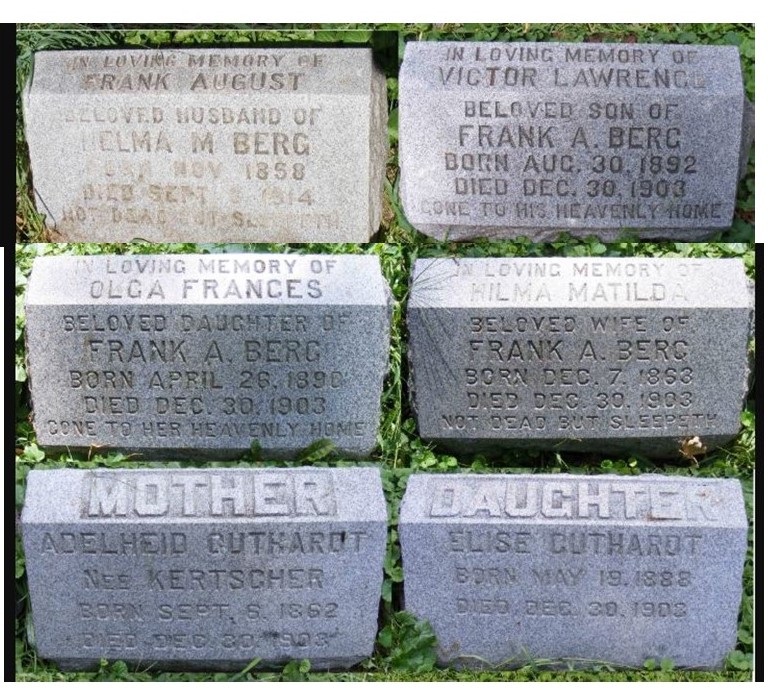
One of the touching sites at Mt. Greenwood Cemetery is the Berg/Guthardt family plot. Frank A. Berg, an immigrant from Sweden in the real estate business, lost his entire family to the fire – his wife, Hilma, also from Sweden, and both of their children, Olga, 13, and Victor, 11.
Buried in the same plot are Adelheid Guthardt and her daughter, Elise (“Libby”), 15. These were neighbors of the Bergs, and assumedly, the mothers and children went to the play together, perished together, and the gravesite was started by the two families together. The Guthardts were from Germany and husband/father John was a machinist. Two sons remained.
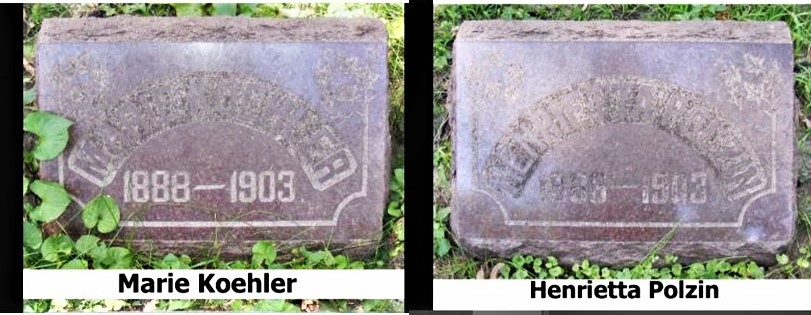
Also buried together at Mt. Greenwood Cemetery are cousins who perished together in the fire, Henrietta (“Etta”) Polzin, 17, and Marie Koehler, 15. The Koehlers lived at 9900 S. Vincennes Ave. and kept a saloon, and the Polzins lived in Lyons, Illinois. The girls’ mothers, Elizabeth Polzin and Bertha Polzin Koehler, sister of Etta’s father, were with their daughters at the theater, but many family members became separated in the crowds trying to escape. Both mothers were burned but survived, according to the website iroquoistheater.com.
Two other victims of the fire buried in Mt. Greenwood Cemetery were young men and their stories are also found on the website iroquoistheater.com.
Arthur Caville, 24, was a tenor from New York, originally from England. He was at the Iroquois Theater that day to apply for a job. The production he had been in at the Illinois Theater had just closed two days before due to the star’s untimely death from pneumonia, putting the cast out of work. He was waiting for the manager in the auditorium when the fire broke out. He reportedly died trying to save a child. His young widow could not afford to transport his body back to New York for burial.
John Steve Hartman was 22 and attended the performance with his step-mother and, likely, some younger siblings, all of whom survived the inferno. He was an apprentice engineer, and the family lived on the 5700 block of South Halsted, where they ran a harness business. He was buried in Mt. Greenwood Cemetery next to his father, Andrew Hartman, who had died in 1893.
Next installment: The aftermath of the fire.
This is a five-installment post about the connections between the Ridge and the Iroquois Theater fire. To read all the posts go to the Ridge Historical Society Facebook page.
Part 4. The Iroquois Theater fire on December 30, 1903, which resulted in at least 602 deaths, spread shock waves and fear throughout the entire world. Even in faraway Germany, the Kaiser closed the royal opera house in Berlin until it could be remodeled with better safety features.
The fire led to immediate government and legal action in Chicago and Cook County. The coroner’s office began an investigation into the causes of the fire. Anticipating criminal charges, a special grand jury was appointed to deal solely with the fire.
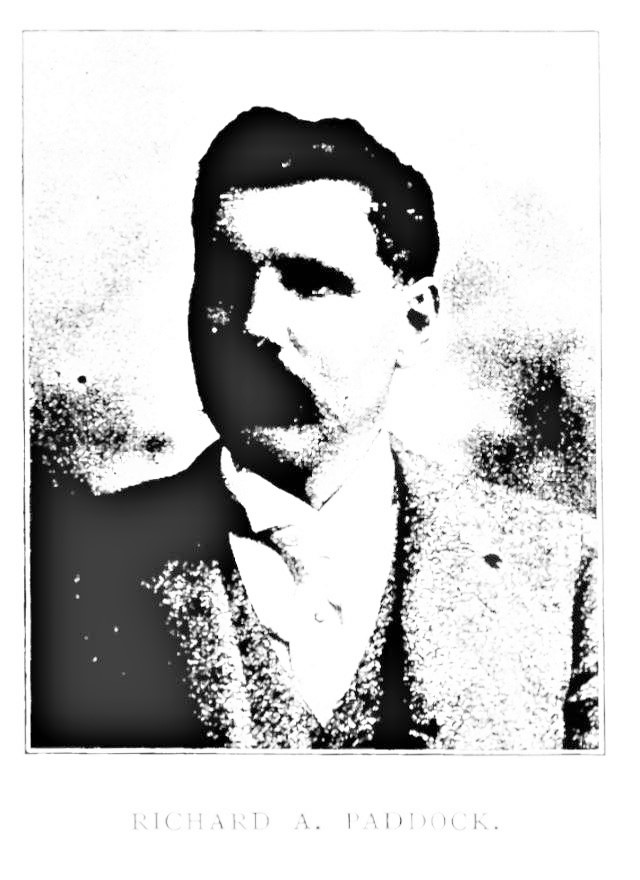
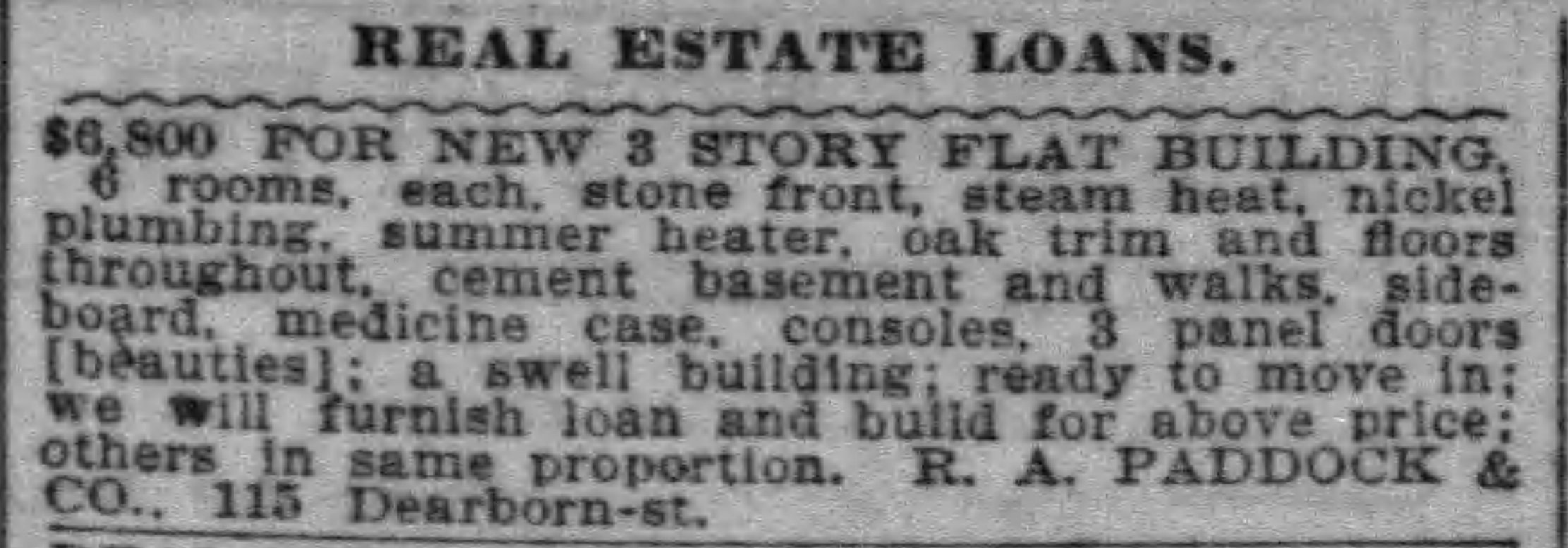
Beverly resident Richard A. Paddock was selected to serve as one of the 23 members of the special grand jury panel. Paddock, 45, and his wife Rosa, lived at 9648 Howard Court, now Vanderpoel Ave. No children are listed on the U. S. census.
Paddock was president of Richard A. Paddock & Co., a real estate, general contractor and mortgage loan business with its office at 115 Dearborn St. Born in Antioch, IL, he began his career as a carpenter. He moved to Chicago to be a supervisor of construction companies and started his own company. One can assume he was a very knowledgeable member of the jury.
Paddock was considered a genial, likable man. He was known for his skills as an avid fisherman and hunter. The Paddocks eventually retired to Florida.
The special grand jury began its work by touring the theater ruins. The panel studied numerous reports and heard testimony from the fire and police departments, and witnesses and survivors.
The jury concluded its work on February 23, 1904 by bringing indictments against five men. Included were manslaughter charges against the theater manager and treasurer, who were part of the ownership group of the theater, and the head carpenter. Charges were brought against the city’s building commissioner and a building inspector for not having adequately inspected the building.
However, in February 1905, the manslaughter indictments against the theater defendants were quashed in court on technical grounds. Although legal action continued for several more years, ultimately no one was ever held criminally liable.
The last installment will look at a related story involving the fire department.
This is the last installment from the Ridge Historical Society about the connections between the Ridge and the Iroquois Theater fire. All the sections may be viewed on the RHS Facebook page.
Part 5. A side story to the Iroquois Theater fire involves the Chicago Fire Department.
December 1903 found the Chicago fire department dealing with two important and complicated issues. First, the city council was investigating charges of graft and incompetence brought against Fire Chief William H. Musham.
Second, firemen were beginning to join and form unions. They sought to improve their working conditions, specifically, reducing the workday from 21 to 12 hours and hiring more fire fighters. Firemen only got off every tenth day to spend with their families.
City officials, and many members of the public, were against firefighters and police joining unions, fearing there could be a conflict of interest between public welfare and union demands. Strikes were especially worrisome. At Musham’s insistence, Mayor Carter Harrison, Jr., issued a rule prohibiting fire department employees from joining any organization that could conflict with their employment duties.
The Chicago Underwriters Association, made up of men who assessed the risk of applications for insurance, was a vocal critic of Musham. The members believed that his poor management was causing undue fire losses and demanded his removal. It was widely surmised that they were behind the charges pending in the city council although they denied this.
Musham, with the mayor’s backing, accused six firemen of sharing their grievances against him with the underwriters in order to advance their labor causes, leading to the city council charges. He retaliated by suspending the six men, pending their appearances before the fire trial board, which was expected to result in their dismissals from the department.
One of the six was William L. Sullivan of Hook and Ladder Company No. 8. He was born in Illinois and his father was from Ireland. He and his wife Katherine had a growing family and were living in the Pullman area at the time.
On December 30, at 2:00 p.m., the trial of the six men began at city hall. At 3:33 p.m., the fire alarm rang. News of the magnitude of the fire at the Iroquois Theater reached them. The trial broke up in confusion and Musham led everyone, including the accused, to fight the fire.
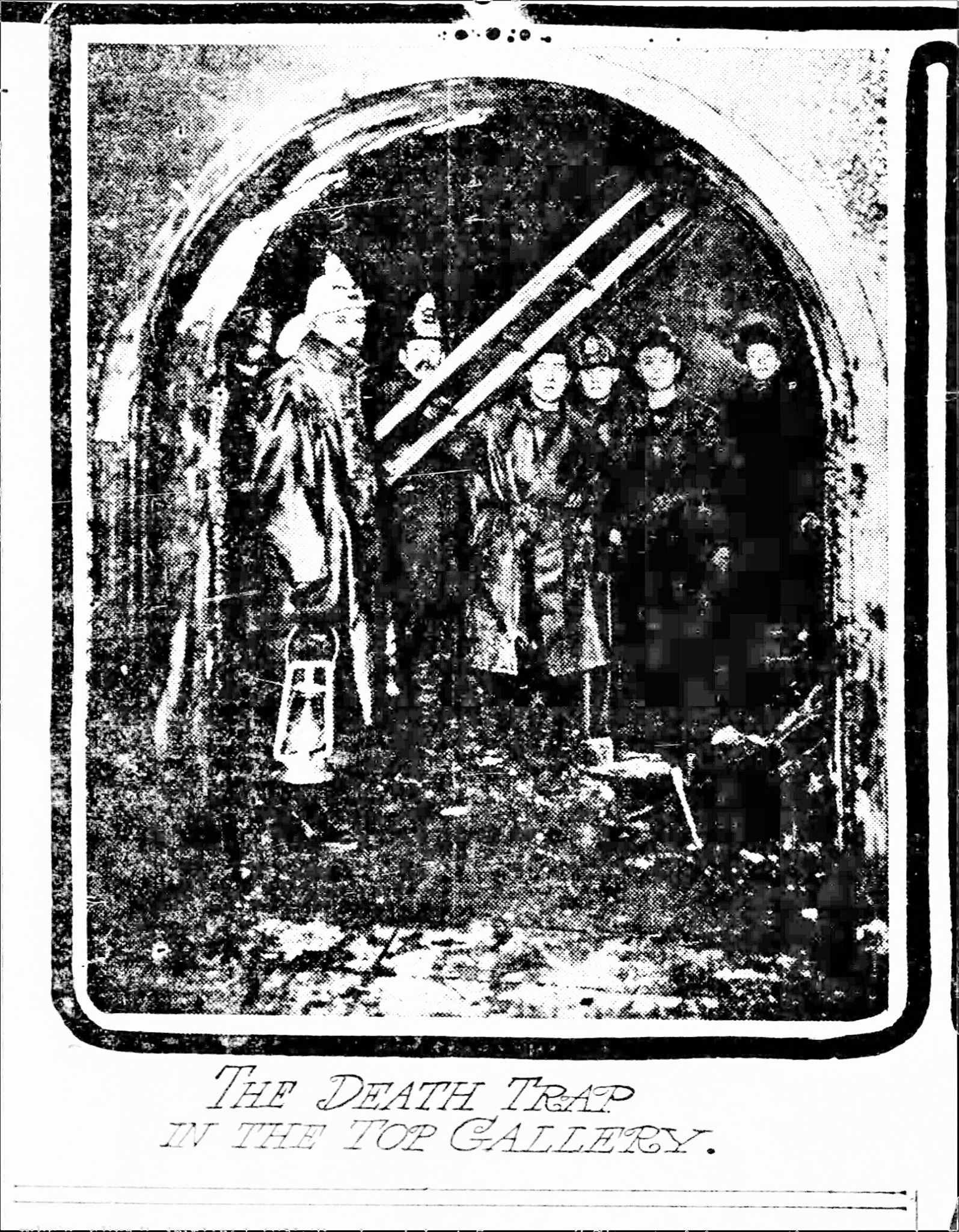
By the time they got to the theater, the worst of the fire was over. They worked their way through the smoke to the top of the theater. The first firemen to reach the second balcony, they were confronted with a wall of bodies so high they could not see over the top. They began the gruesome task of removing the dead. Being late December, it soon turned dark and they worked into the night.
On January 5, 1904, Musham restored to duty the six firemen for “gallant and heroic conduct at the Iroquois Theater fire.” He also announced he was hiring 200 additional fire fighters.
The firemen secretly organized a union, and with other organized labor help, convinced the city council to reduce their workday to 12 hours, over Musham’s objection. This necessitated hiring hundreds more firemen.
The coroner’s jury laid considerable blame for the fire on Musham, who had inspected the theater himself, although no formal charges were brought against him. The insurance underwriters continued their complaints about Musham, and he left the fire department in October of 1904.
William Sullivan died on St. Patrick’s Day in 1911 at the age of 37 and was buried with honors in Mt. Olivet Cemetery on 111th Street. He died of chronic smoke inhalation and other health issues.
The Sullivans had a large family and Katherine raised them on the pension she received as a fireman’s widow. Their sons became firefighters and a policeman.
Daughter Margaret, who married John Sullivan (same last name), and her family moved to Washington Heights and lived at 9956 S. Throop Street. They were members of St. Margaret of Scotland Parish, where the children went to school. Margaret had attended Academy of Our Lady on 95th Street and her daughters did also.
Sullivan family descendants continue to live on the Ridge.
This picture is of a group of firemen in the top gallery of the burned out theater. Musham's group was the first to reach the top of the theater. Chicago Tribune, December 31, 1903
It’s been an incredible four months but they say all good things must come to an end. The closing reception for the “Threads of Imagination” exhibit at the Ridge Historical Society will be on Friday, January 17, 2020, from 7:00 to 9:00 p.m. at RHS, 10621 S. Seeley Ave., Chicago.
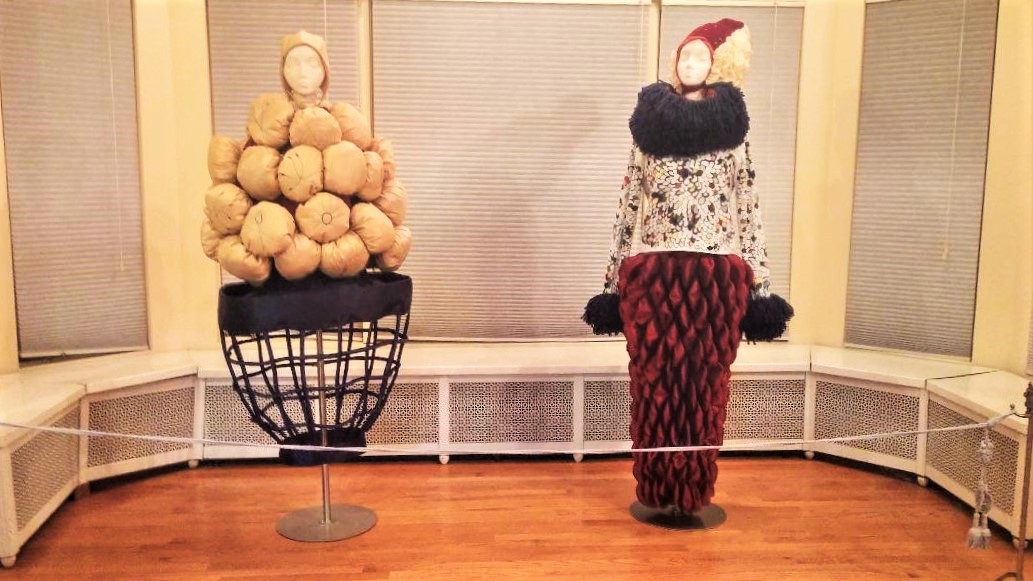
The event is titled “Final Threads with Sandra Leonard.” Sandra creates sculptural costumes that turn the human form into living sculpture. Performance artists arrayed in some of Sandra’s creations will interact with the guests. Sandra’s work appears internationally in performance art productions, improvised theater, alternative fashion shows and installation projects.
This will be the last chance to view the “Threads of Imagination” exhibit, a look at the intersection of fashion, art and business through the creative work of five Beverly artists. Featured are the historic Madame Alla Ripley, a famous fashion designer and savvy businesswoman who lived on the Ridge 100 years ago, and four current artists.
Judie Anderson displays a selection of her fashion illustrations from the 1960s-70s. Nicole Burns of NiBu Design shares her eclectic artwork inspired by vintage fabrics, and her collection of antique sewing items. Maggie O’Reilly showcases items from her two entrepreneurial companies – Maggy May line of girls’ clothing, and The MAYTA Collection of personal and home accessories produced by artisans in Peru and Morocco through fair trade agreements. These three artists have been profiled in recent programs and plan to be at the reception. And the fourth artist, Sandra Leonard, will be profiled this evening.
Admission is free; refreshments will be served. Reservations are requested but not required. Contact RHS at 773/881-1675 or ridgehistory@hotmail.com.

Be sure to get this event on your calendars!

Tomorrow night, Friday, January 17, 2020 – the closing reception for the "Threads of Imagination" exhibit at the Ridge Historical Society, 10621 S. Seeley Ave., Chicago, from 7:00 to 9:00 p.m. The featured artist will be Sandra Leonard who will have performance artists there in some of her sculptural costumes. Free admission, refreshments will be served. Send a Message to RHS with any questions.

Last reminder! Attend this event before we get snowed and iced in for the next few days – the storm is due to get pretty bad during the night, after this is over. Tonight, 7 to 9 p.m., at the Ridge Historical Society, 10621 S. Seeley Ave., Chicago, the closing reception for the "Threads of Imagination" exhibit featuring performance artists wearing the sculptural costumes of Sandra Leonard. Free, great refreshments! Come on over! Reservations not required! Last chance to see this great exhibit!

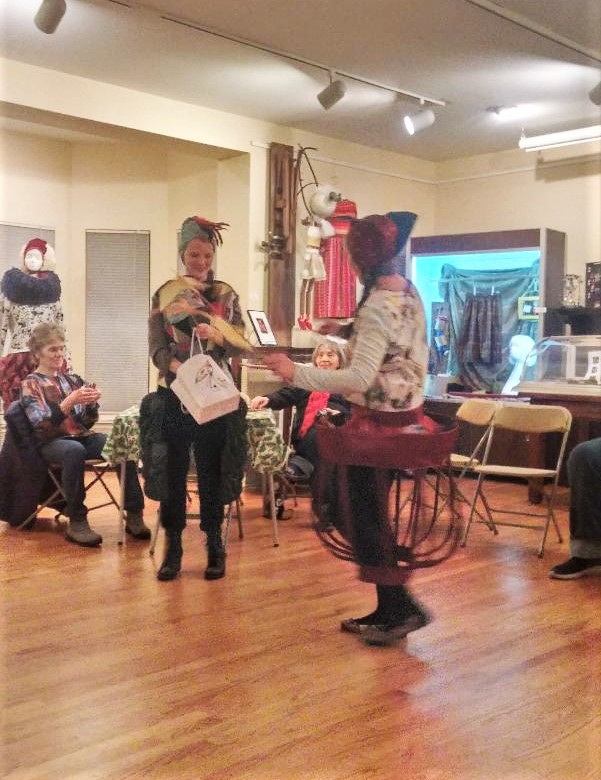
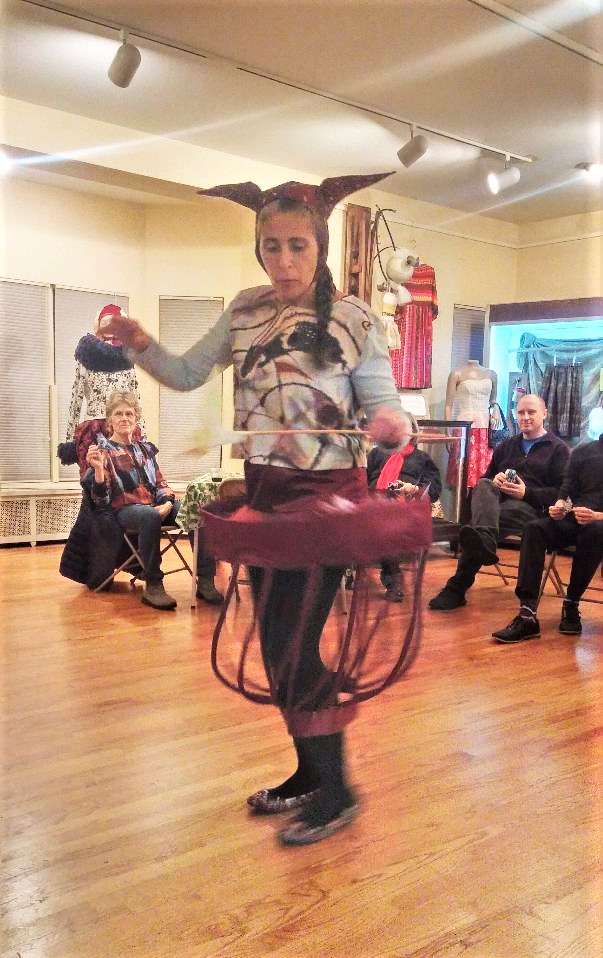
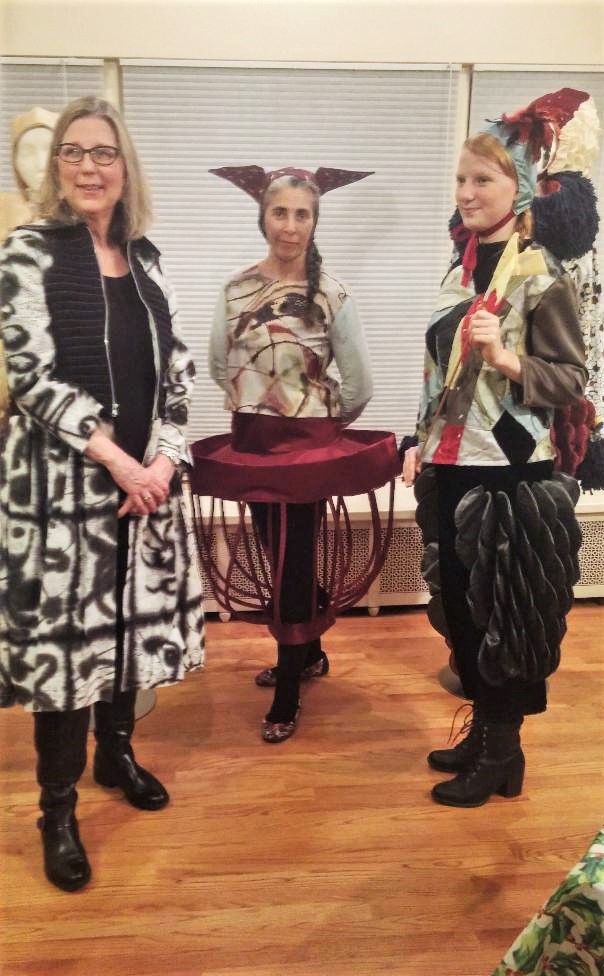
Oh, the weather outside was frightful, but the party inside was delightful …. Thank you to the brave souls who came out tonight during Chicago's first major snowstorm of the season for the closing reception for the "Threads of Imagination" exhibit at the Ridge Historical Society.
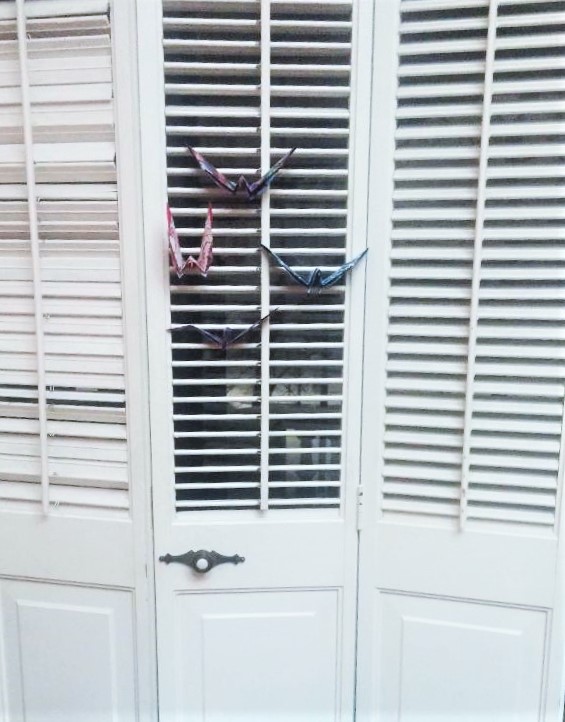
Performance artists donned Sandra Leonard's sculptural costumes for an improvised art performance event. Sandra offers a rich visual experience often based on birds and that was tonight's theme. The performers distributed origami birds to the guests which made for a nice keepsake. Some of the birds found a new home at RHS.