Explore the RHS Facebook Archives, a rich repository of local history written by Carol Flynn. For two decades, Carol brought a deeply dedicated voice to public education at RHS. Her role as Facebook administrator through mid-2025 naturally extended her prolific research into meticulously detailed articles, most notably her multi-part historical series posts. Today, Carol continues her local history writing for The Beverly Review and other outlets.
July 2020

The history of Dan Ryan Woods – Part 10: More on the 1920s
By Carol Flynn
Throughout the 1920s, the newspapers carried hundreds of stories about the Dan Ryan Woods (DRW). Community groups did their part to make the woods an interesting place to visit.
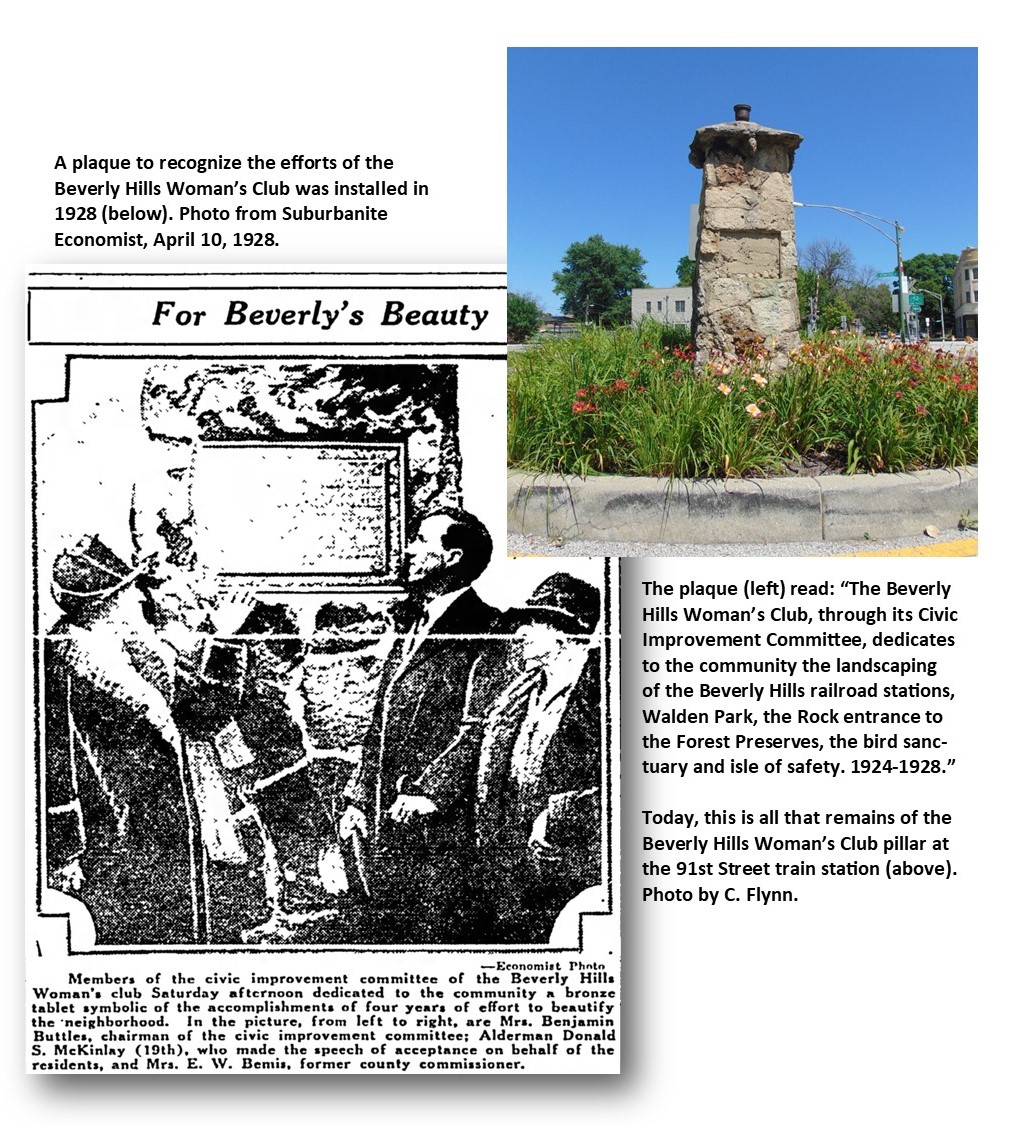
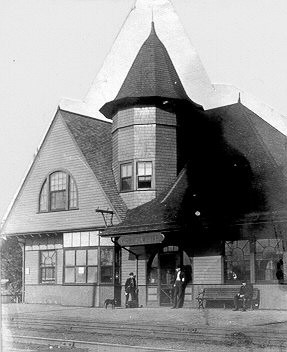
The Beverly Hills Woman’s Club (formerly the Ridge Woman’s Club) adopted the train stations along the Rock Island line (now the Metra line) and the 91st Street entrance to the DRW and spent four years landscaping and beautifying the sites. The Club raised the funds for the materials and the labor was furnished by the railroad company.
The Club worked with the Cook County Board to establish a bird sanctuary at the edge of the forest preserve around 91st Street and Winchester Avenue. The sanctuary included fifty bird houses of all sizes and types built by local Boy Scouts and their fathers. The Club planned a banquet for the Scouts at which awards would be given for best and most unique houses.
On a snowy day in April of 1928, a dedication ceremony for a bronze plaque in a stone pillar installed in a “safety isle” near the 91st Street train station took place, attended by members of the Club and county and city officials. The plaque read: “The Beverly Hills Woman’s Club, through its Civic Improvement Committee, dedicates to the community the landscaping of the Beverly Hills railroad stations, Walden Park, the Rock entrance to the Forest Preserves, the bird sanctuary and isle of safety. 1924-1928.”
The plaque is long gone and all that remains is the decaying stone pillar.
Among the first employees to be hired for the preserve system were rangers, and a set of ordinances for the preserves was established in 1918.
In August of 1927, the Suburban Economist newspaper reported that “picnickers and lovers of the forest preserves will find a welcome protection from tramps and other undesirables in the establishment of the forest preserve police stations” at several locations, including DRW.
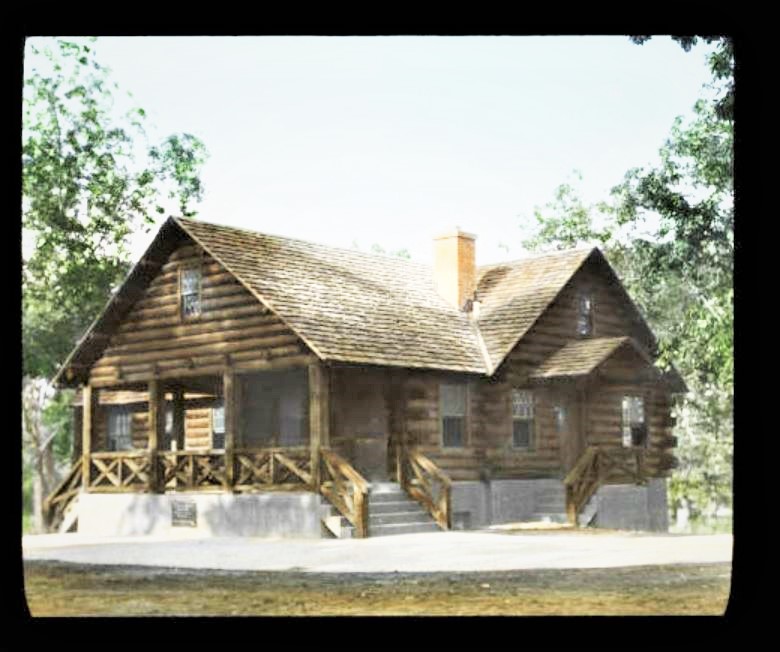
Under the supervision of Sergeant Arthur Woeks, six officers, including mounted and motorcycle policemen and one plainclothes man, made up the command at DRW. Their headquarters, which also doubled as a Red Cross station when large gatherings were scheduled, was set up in the reconditioned log cabin, the former shelter for campers, and telephone service was installed. There was no holding cell; anyone arrested would be taken to the Gresham station. The article reported that “the forest preserve cops” would combine “ranger duties” with their police beat.
Ranger duties included enforcement of the Forest Preserves of Cook County (FPCC) ordinances, as well as conservation and education. Directing campers, protecting wildlife and vegetation, preventing fires, and controlling crowds, traffic and parking were routine duties.
A few incidents of violent crime were reported in the forest preserves in the 1920s. A man was robbed of his car and money at gunpoint. Couples parked for “necking” were occasionally robbed.
Major concerns for safety and health were mentioned more often – providing clean water for drinking and swimming; preventing the spread of brush fires from untended camp and cooking sites.
One issue was preventing the illegal use of fireworks and firearms at Fourth of July outings in the preserves. A double danger was present here – injuries and fires. Every year, dozens of people were hurt on preserve land at private parties using fireworks. Even when the fireworks display was legal and supervised, there were accidents. In 1927, at an American Legion event inside a preserve, a defective skyrocket plunged into a pile of fireworks, setting them on fire and panicking 1000 spectators. Twenty-five people were burned or trampled. The FPCC often “banned” fireworks but people still did what they wanted to do. Finally, in 1935, FPCC officially banned fireworks and spent more effort enforcing the ban.
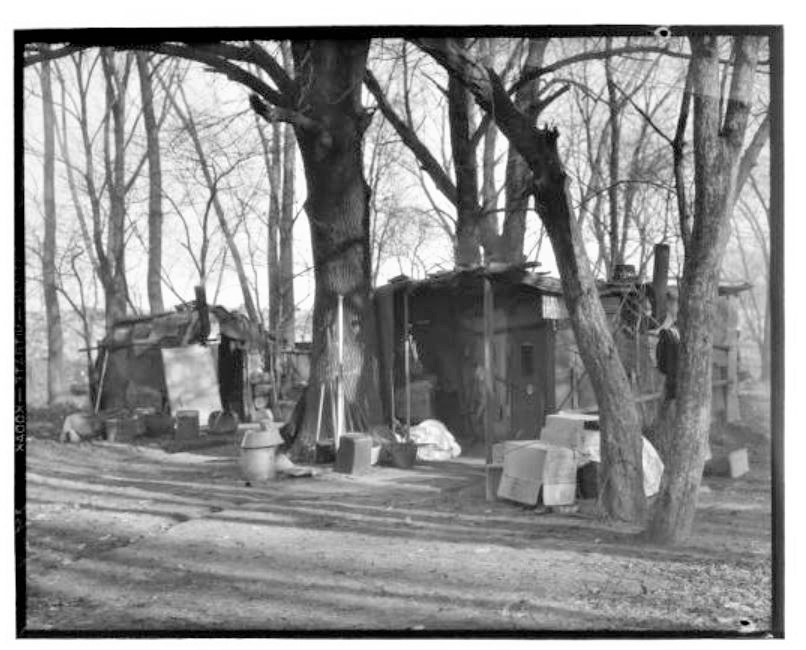
There was an occasional issue with “hobo shelters.” Homelessness was always an issue in a big city and the forest preserves offered a secluded spot for building lean-tos and setting up camps. Periodically, the FPCC would crack down and evict the squatters.
Hunting was not allowed in the preserves; they were considered refuges for wildlife, the property of the people. In the larger preserves, there were problems with poachers encroaching upon preserve territory during pheasant hunting season to take hundreds of birds illegally. In 1929, the FPCC rangers and highway police joined efforts to reduce poaching by patrolling the roads around the preserves.
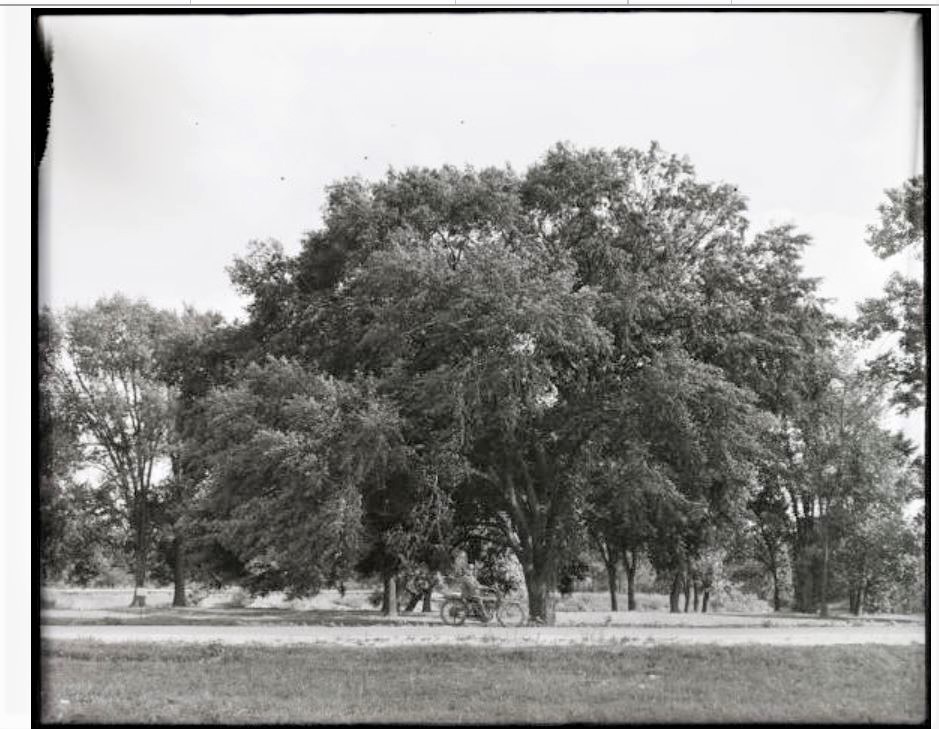
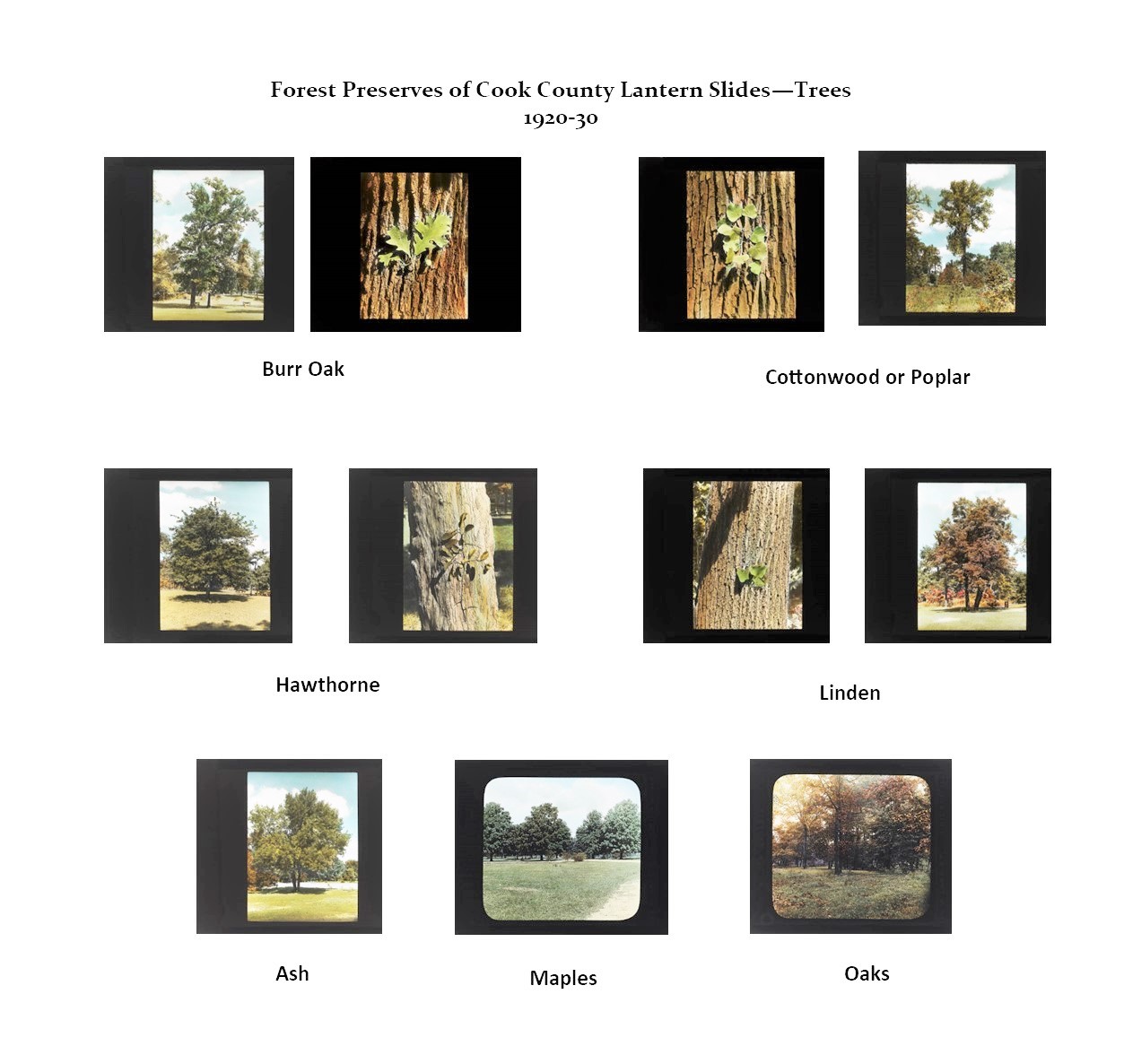
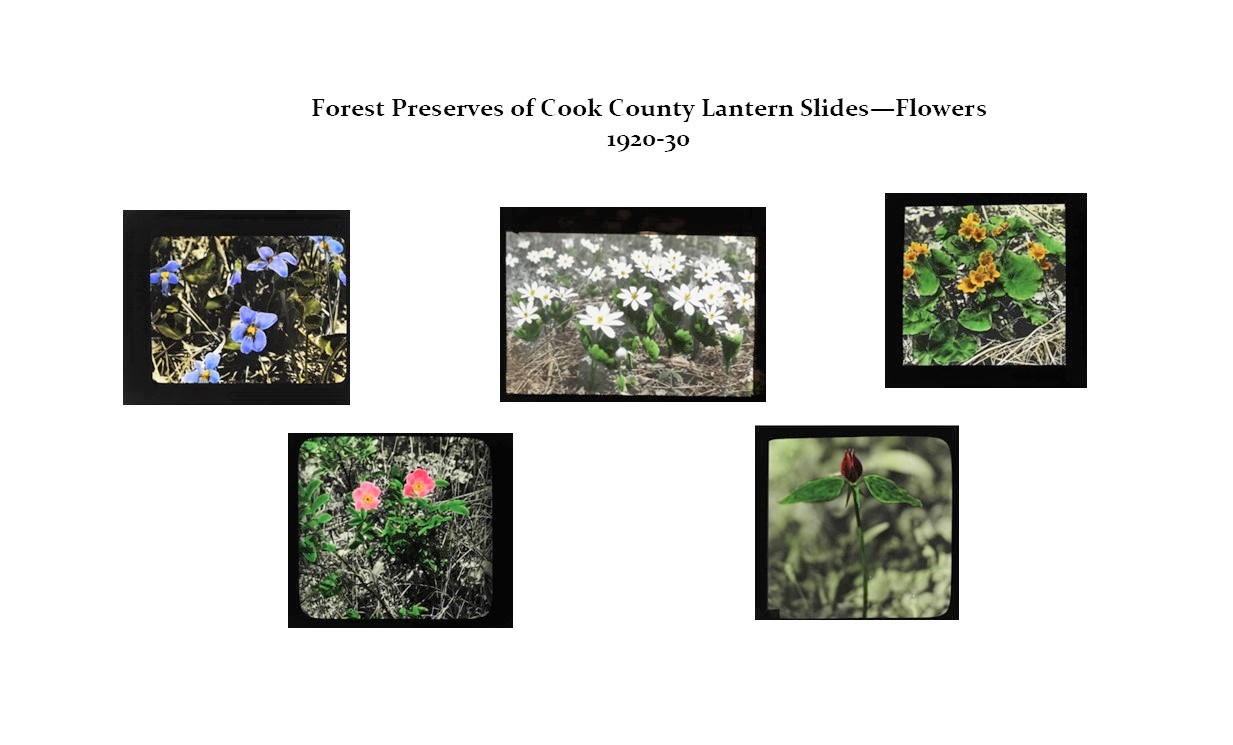
Ranger duties included education programs. During the 1920s the FPCC produced a series of hand-colored lantern slides depicting images and scenes from the preserves. “Magic lanterns” were early image projectors that used hand-painted pictures on transparent glass plates, lenses, and a light source. Many of the slides showed the flora and fauna that could be encountered in the woods – trees, flowers, and animals – and were likely used for nature programs. Some of these slides are shared here.
Next installment: A park or a preserve?
The history of Dan Ryan Woods – Part 9: A very popular place
By Carol Flynn
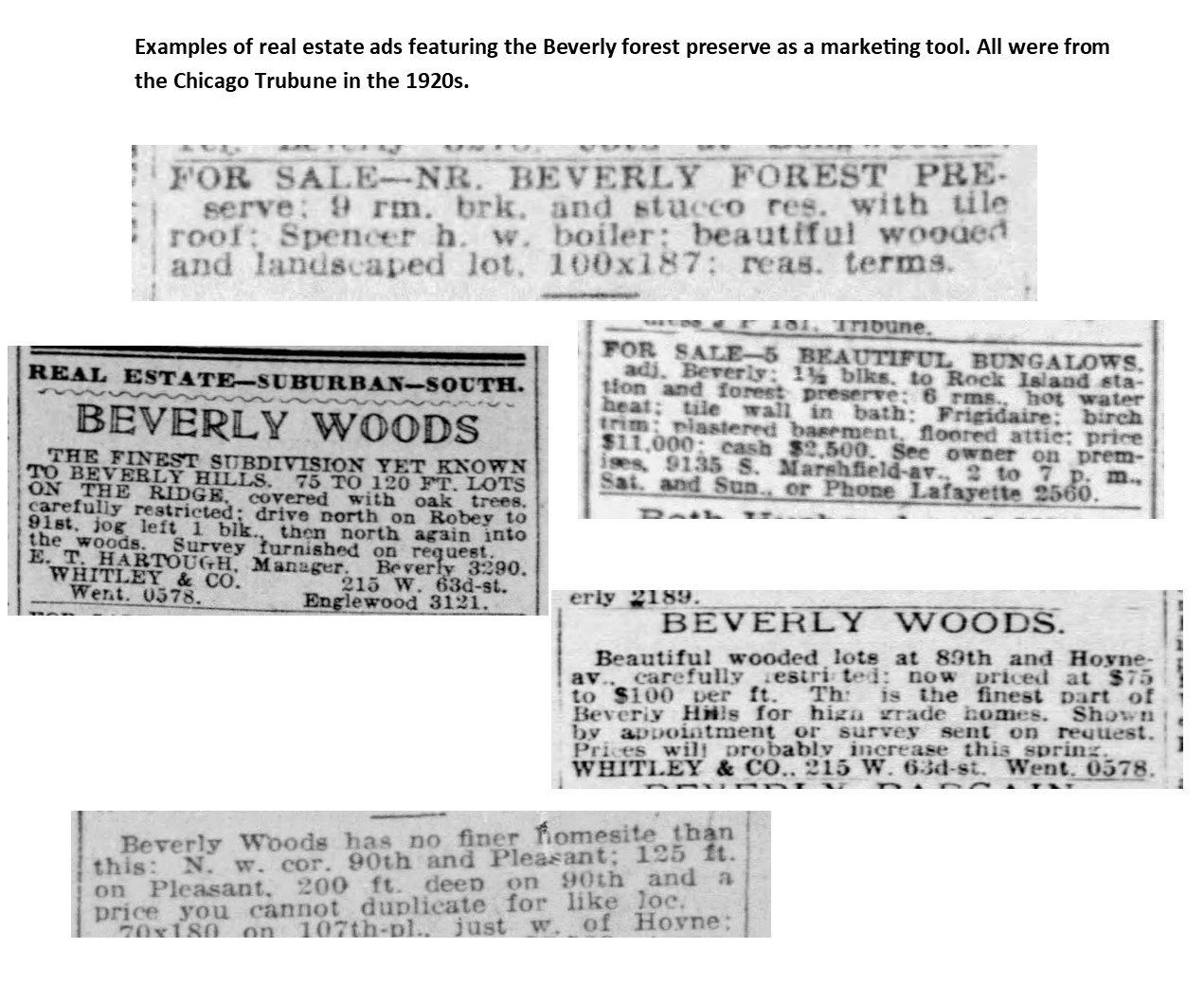
The Beverly Hills Preserve, renamed the Dan Ryan Woods (DRW) in 1924, was a popular place from the beginning. It influenced growth and development in the area. Real estate agents used the preserve advantageously in advertisements, even giving the name “Beverly Woods” to the neighborhood around the preserve.
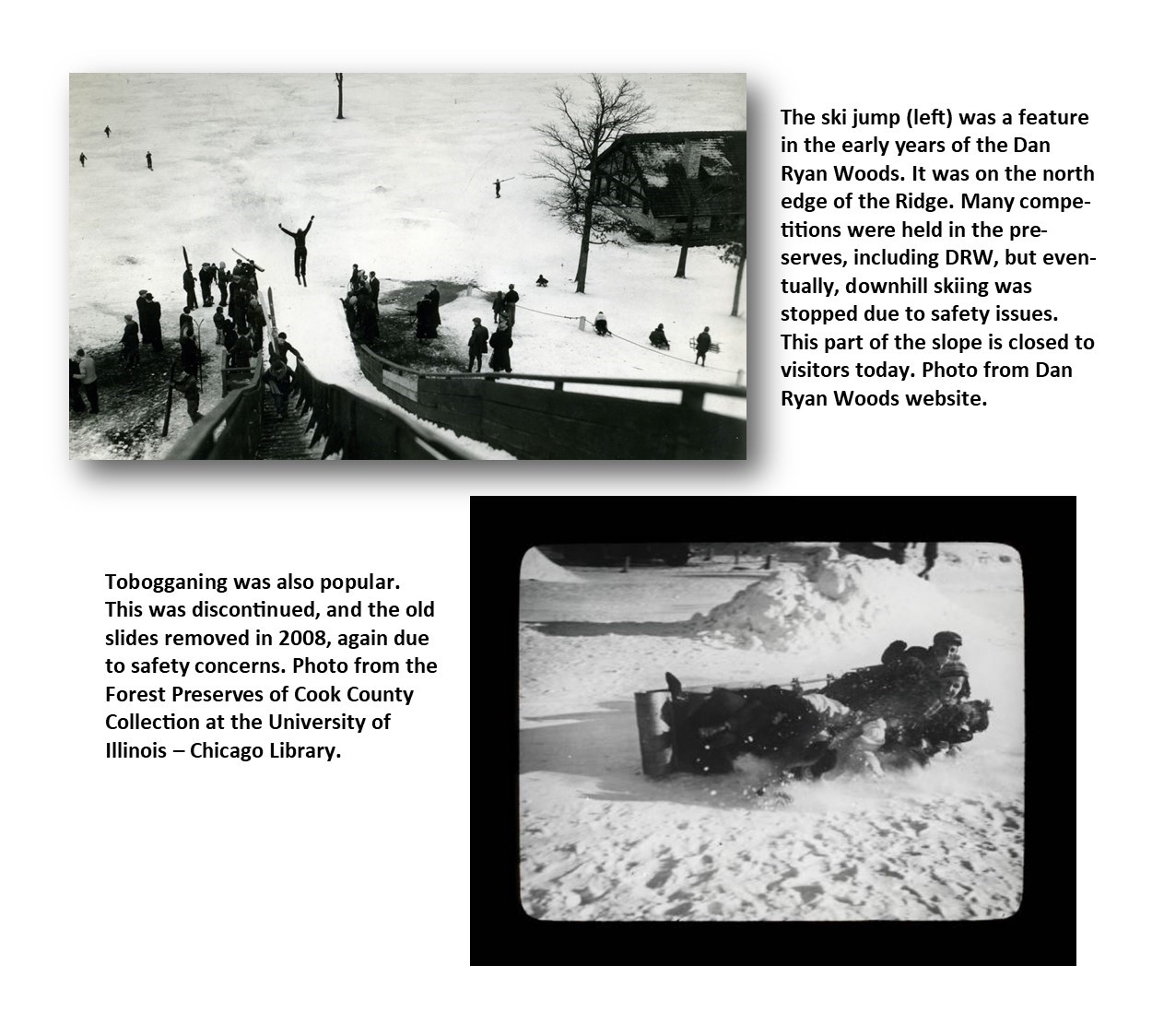
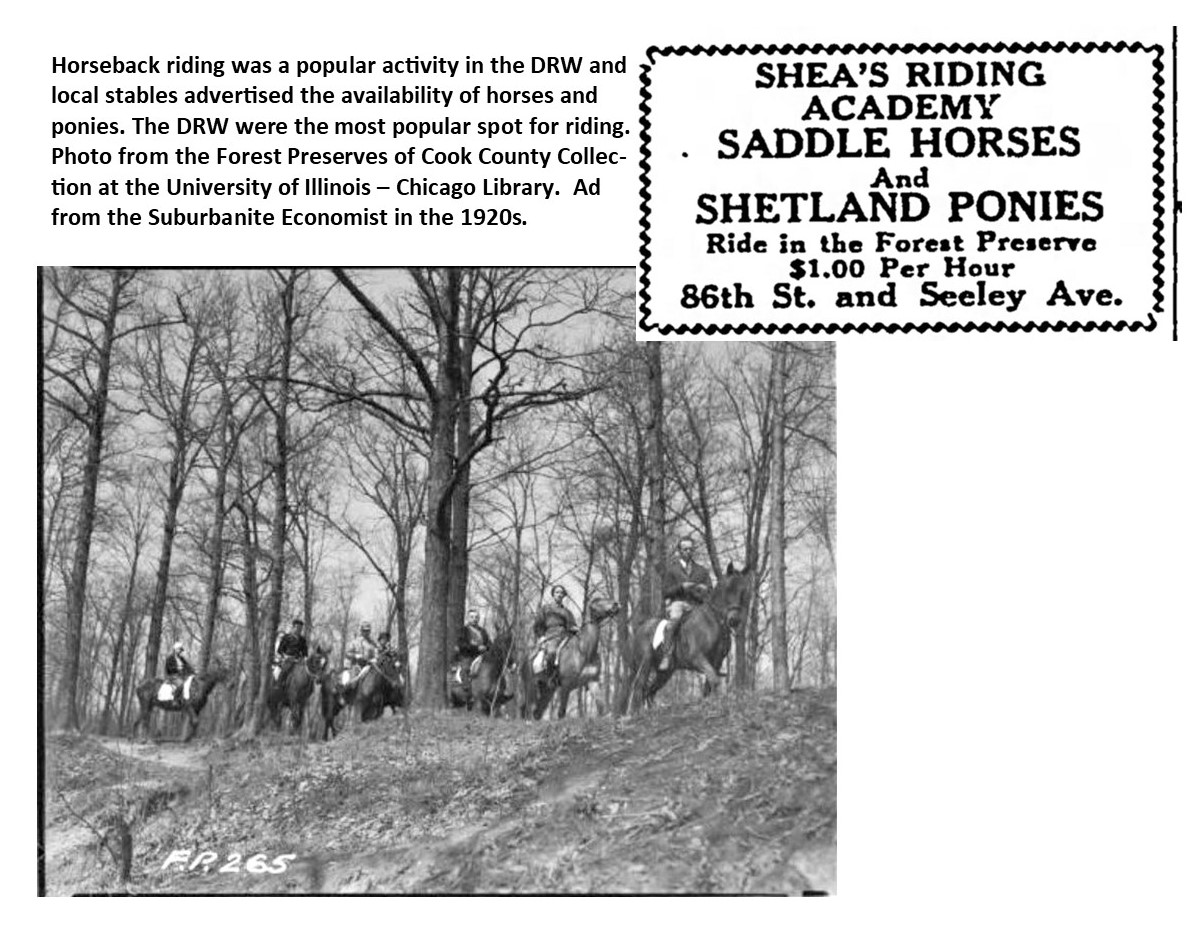
Early sports facilities included baseball diamonds, tennis courts and a cinder track. Horseback riding was very popular and there were stables in the area where visitors could rent horses and ponies. For winter sports, there was a 30-foot ski jump, toboggan slides, and flooded baseball diamonds for ice skating.
At one point, there was talk of establishing a public golf course. The small patch of land north of 83rd Street bordered by the train tracks and Western Avenue was purchased in the early 1920s with this in mind, but no golf course was built.
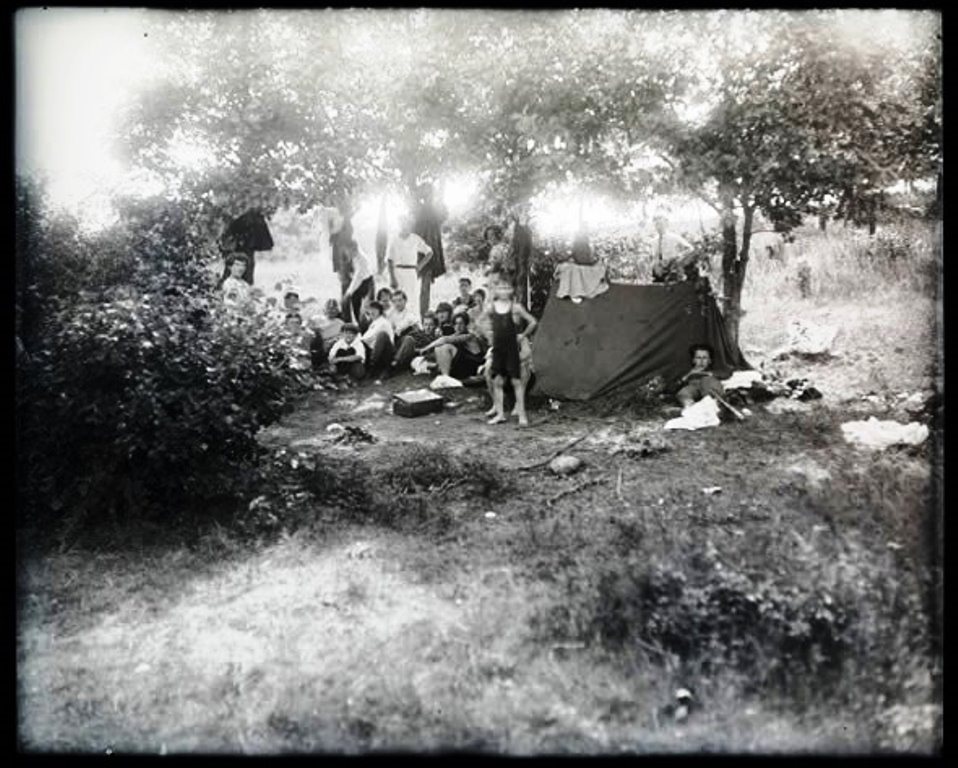
Instead, the DRW were made one of the twelve free tourist camps for automobile travelers in Cook County.
By the early 1920s, there were over nine million automobiles and trucks in the U.S. This new means of transportation offered people more freedom to travel and road trips became very popular. New roads were built and old ones like Western Avenue were improved. Tourist camps popped up all over the country to provide camping sites.
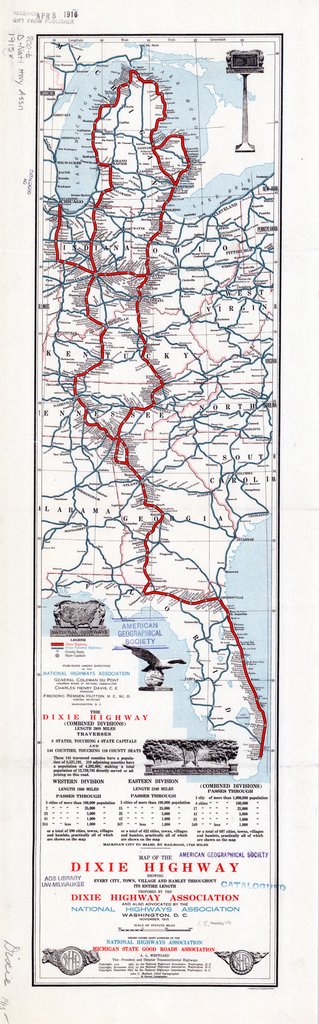
Western Avenue was part of the Dixie Highway, a system of roads started in 1915 that connected the northern states with the South, ending in Miami, Florida. The DRW were strategically located along the Dixie Highway.
In 1923-25, Chicago Tribune articles noted the extensive use of the DRW by motoists. “Deluxe” facilities included a log cabin shelter house with lounge areas and fire places; showers, toilets and laundry tubs; and gas cook stoves. Throughout the preserve, tables and benches, water and firewood supplies, and “sanitary equipment” could be found. The DRW could accommodate 600 cars.
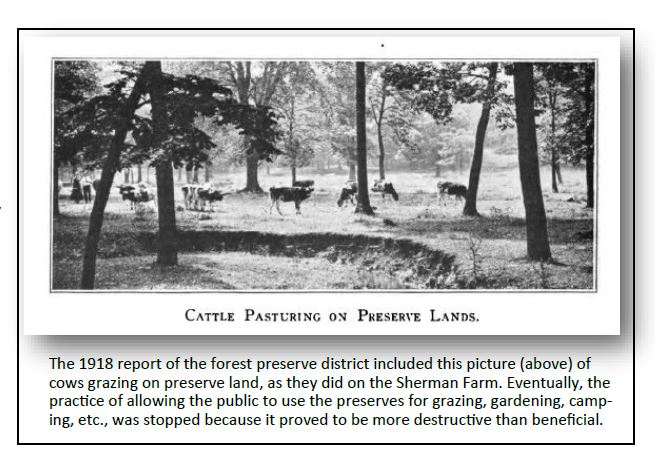
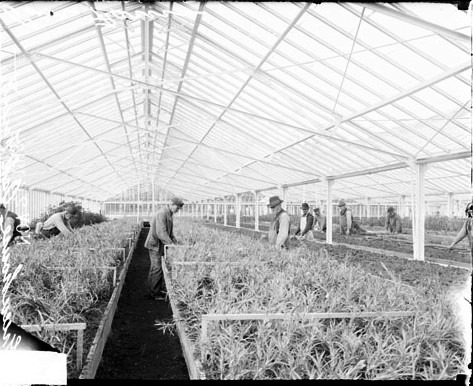
In addition to camping, the FPCC allowed local farmers to graze their cows on forest preserve land, and allowed people to have gardens in the preserves. Eventually, camping, grazing and gardening were all discontinued because they proved to be more destructive than beneficial to the preserves.
From spring through fall, hundreds of events were held in the DRW, including picnics, weddings, sports competitions, graduations, retirement parties, church socials, school outings, nature classes, Scouting activities, dances, concerts and political rallies. Associations holding conventions in Chicago often included an outing to DWR. The newspapers covered everything from very small events, like a birthday party for a six year old boy, to very large ones with thousands of attendees.
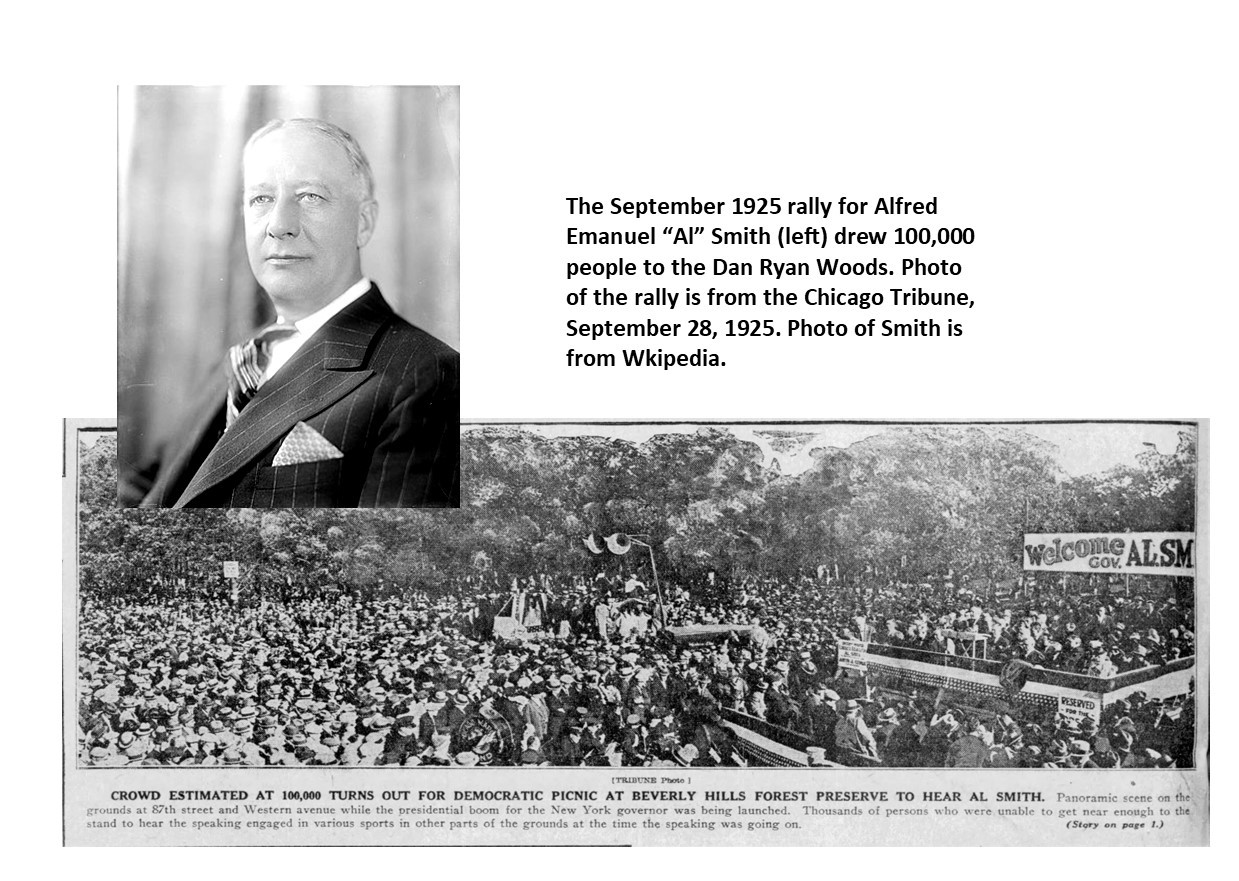
Possibly the largest event in DRW history, and certainly one of the most prestigious, was the 1925 Democratic rally that featured Alfred Emanuel “Al” Smith (1873-1944), attended by over 100,000 people. Smith, elected Governor of New York four times, was an influential leader in the Progressive Era, achieving a wide range of reforms. He improved the conditions for factory workers and for women and children in the workforce, and he condemned social injustices like lynchings and other racial violence. He was an opponent of Prohibition, recognizing that a nationwide ban on alcohol could never be enforced.
The rally in DRW was the kick-off for Smith’s campaign to run for U.S. President in 1928. On Sept 27th, he traveled from the Blackstone Hotel downtown on Michigan Avenue to the DRW in a motorcade of hundreds of autos filled with his supporters, accompanied by a detail of motorcycle police.
At DRW, Smith spoke from a make-shift wooden platform about inefficiencies in Washington and his proposals to cut spending. He stopped just short of announcing his presidential bid at the rally but it was understood that was the real purpose of the event.
Smith had made an unsuccessful bid for the Democratic nomination in 1924. He did win the nomination in 1928 but lost the presidential election to Herbert Hoover. He again sought the nomination in 1932 but lost to Franklin D. Roosevelt. Smith was the first Catholic to run for President. He mobilized Catholic women to vote for the first time after the 19th Amendment was enacted. It would take until 1960 for John F. Kennedy to be elected the first (and to date, only) Catholic President.
Next up: More on the early days of DRW.
The history of Dan Ryan Woods – Part 8: Good old Dan Ryan
By Carol Flynn
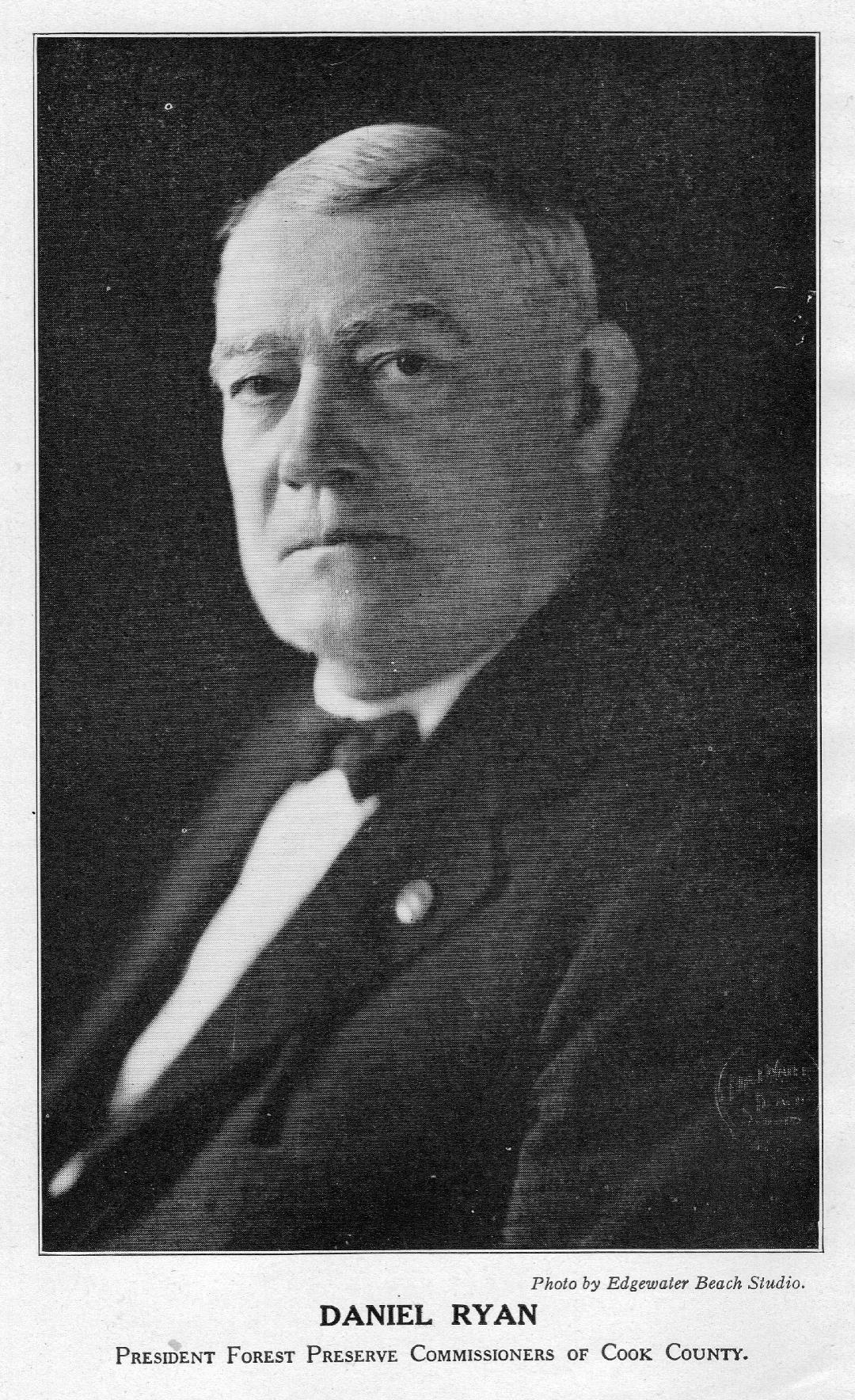
Dan Ryan became President of the Cook County Board of Commissioners and the Forest Preserves of Cook County (FPCC) in February 1921.
It was no secret that many government jobs were handed out through patronage, to thank supporters and pay back favors, and the forest preserves were no exception. In November 1921, a decision had to be made about which forest preserve employees to lay off for the winter, and Ryan pointedly asked the Board members which employees actually worked. The Chicago Tribune reported that the commissioners began squabbling at the Board meeting about who had received more patronage jobs within the forest preserve district. As the situation deteriorated and several commissioners accused Ryan of trying to control all the jobs, Ryan settled the matter by declaring, “Everyone is fired!” Then he abruptly adjourned the meeting. The Chief Forester had to come back to him with recommendations for which of the 200 employees to keep on for the winter.
Ryan carefully guarded the intent of the preserves. He did not want to allow captured World War I German cannon to be displayed in the preserves, stating, “God has given us the peaceful forests, and it is not right to place these grim reminders of war in them.” He suggested they go in city parks, or better, be melted down to create items “for use in the arts of peace.” But veterans’ groups persisted in the request to display cannon in the preserves, so Ryan relented.
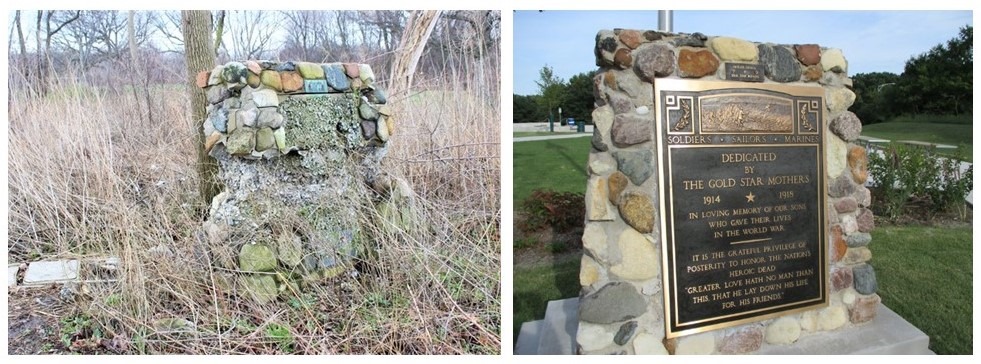
Ryan did allow Gold Star Mothers to place markers in the preserves, commemorating sons and daughters lost in the war. The Gold Star concept originated with service flags hung in windows to indicate family members currently serving in the U. S. military (blue stars) and those who had lost their lives while in service (gold stars). An official national organization for American Gold Star Mothers was formed in 1928 although there were groups active at local levels for a decade before that.
A Gold Star marker was installed in the Beverly woods in the 1920s. Over the years, the stonework deteriorated, and the plaque disappeared. It was beautifully restored in recent years and now is prominently displayed near the visitors’ center.
Ryan also worked with the American Legion, Boy Scouts and Kiwanis to plant 11,000 trees for Armistice Day (now Veterans Day) that were dedicated to individual veterans. People sent in money to buy a tree, usually for a family member.
“I had four sons who served,” Ryan was quoted as saying in the Chicago Tribune. “I know I would like for them to have trees upon these roads of remembrance, and I want to see other soldiers have the same honor shown them.”
Some people mistakenly sent in money for non-veterans, and they were asked by Ryan if, instead of a refund, they would allow their money to be used to buy a tree for a veteran who did not have family to buy one for him/her.
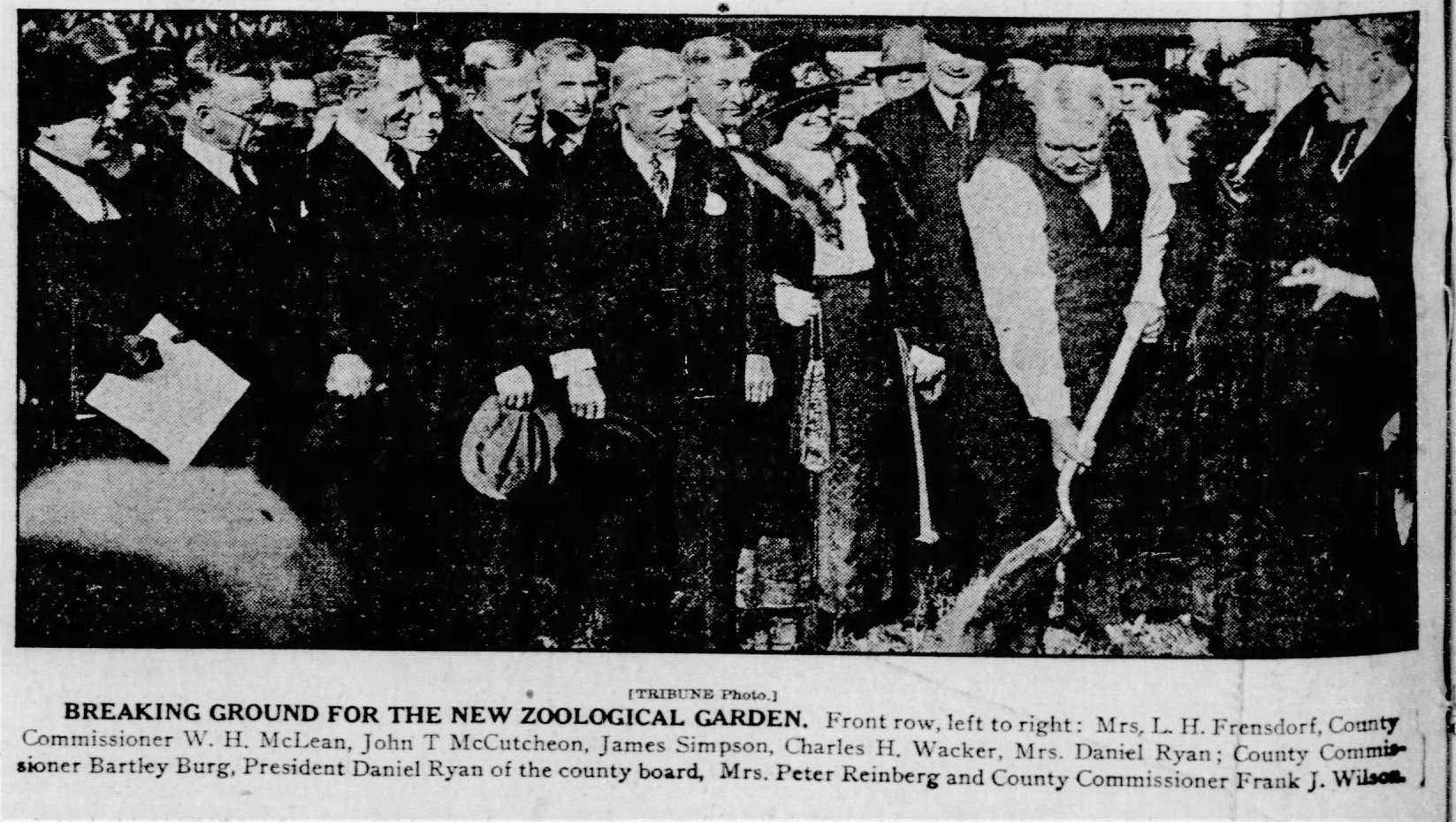
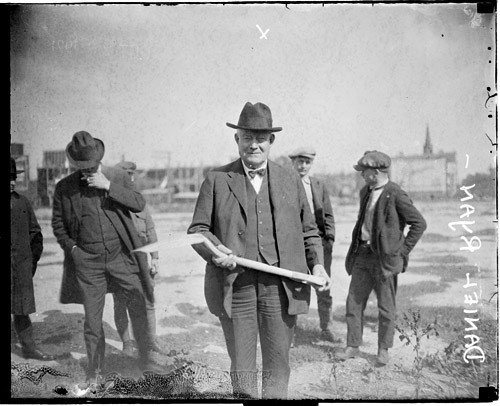
Brookfield Zoo, whose official name is the Chicago Zoological Park, was established as part of the FPCC during Ryan’s tenure as County Board President. Ryan headlined the ground-breaking ceremony for the zoo in 1921 although construction did not begin in earnest until 1926. More delays due to lack of funding brought on by the Great Depression prevented the zoo from opening until 1934 but it was an immediate success when it did open.
When it came time for re-election for the Cook County Board presidency, the Democratic party boss George Brennan put up Anton J. Cermak instead of Ryan as the candidate. This was due to long-standing rivalries between Ryan and Brennan going back to their ward days a decade before.
Ryan ran as an Independent and was supported by local papers. The Palatine Enterprise and the Chicago Daily Herald ran a piece that said, “Daniel Ryan has proved himself a faithful, honest, dependable official. He has administered the affairs of the county in a most efficient and economical manner.”
Ryan lost the presidency to Cermak, but he did retain a seat on the board. [Note: Cermak became Mayor of Chicago in 1931 but was assassinated in 1933 during a presumed attempt on the life of President Franklin D. Roosevelt.]
Ryan suffered a stroke and died in 1923. He was buried in Mt. Olivet Cemetery. Upon his death, the Suburbanite Economist referred to him as “good old Dan Ryan.” The newspapers of the day were respectful and complimentary of Ryan. The Chicago Tribune stated “he was considered one of the most valued members [of the Cook County Board of Commissioners], as he was the leader in giving the county the wonderful system of Forest Preserves. He was highly respected in all circles.”
His son, Dan Ryan, Jr., for whom the expressway is named, was elected to fill his father’s vacancy on the Cook County Board.
In 1924, one of the gems of the forest preserve system, the Beverly Hills Preserve, close to the Ryan home in Englewood, was renamed in honor of Dan Ryan, Sr.
Next installment: The Dan Ryan Woods in the 1920s
The history of Dan Ryan Woods – Part 7: Dan Ryan and his contributions
By Carol Flynn
According to user-submitted information on Ancestry.com, and U.S. and Irish census records, Daniel Ryan was born at Carhue House, Dundrum, County Tipperary, Ireland, in 1860. He immigrated to the U.S. in 1880 and became a naturalized citizen.
A man named John C. Ryan of Carhue House, Dundrum, born in 1892, active in the Irish independence movement of the early 1920s, submitted his history in 1956 to the Irish Bureau of Military History. He stated that his uncle, Dan Ryan, was a member of the “Fenian Movement” and subsequently emigrated to the U. S.
“Fenians” was the common name for members of the Irish Republican Brotherhood (IRB), a secret organization dedicated to establishing an independent Irish republic, started in 1858. The name came from the Fianna, a band of warriors in Irish folklore. The IRB engaged in campaigns to end British rule in Ireland. John Ryan reported that a cache of old Fenian rifles was kept in a dump by their home, and he took these into his possession and was able to use them in 1920-21. The IRB staged the Easter Rising in 1916, which led to the Irish war for independence, and ultimately the 1921 treaty that brought about the Irish free state.
Involvement with the Fenians was illegal in British-controlled Ireland. In the U.S., the brother organization to the IRB was called the Fenian Brotherhood and later, Clan na Gael. It was not unusual for a young Irishman to have to hightail it out of his native country due to his nationalist activities, and then continue to support the cause from his adopted land.
Now, the surname “Ryan” was very common around that area of Ireland, and there is no verification that this is our Dan Ryan. In Chicago, Dan Ryan’s attendance at events supporting Irish independence was noted in the papers. He was an honorary pallbearer at the funeral of Richard Burke, a well-known Fenian. Even if he had not been a revolutionary in Ireland, like many Irish Catholic immigrants in America, he continued to support the causes of his old country at the same time he fully embraced American citizenship and loyalty.
When Ryan came to the U. S., his first job was at the Union stockyards, under John B. Sherman, whose farm would become the Dan Ryan Woods. Ryan soon became a successful livestock buyer. He then moved into the building trades.
He married Alice Carroll, also from Tipperary, and they became the parents of seven children. By 1910, they were well settled in Englewood, the owners of a concrete contracting company.
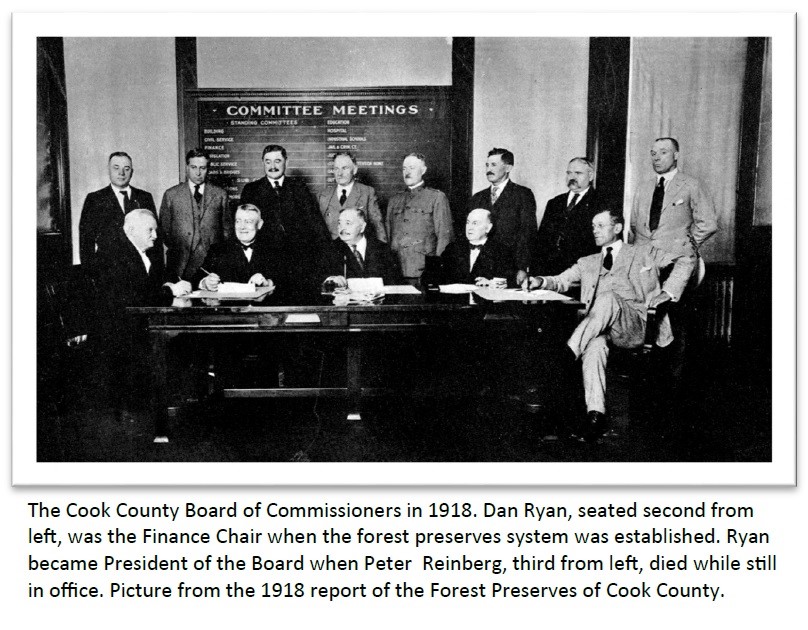
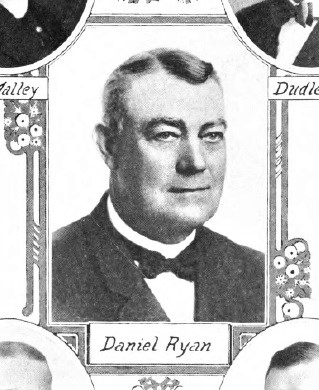
Ryan became involved in local politics, where, according to the Chicago Tribune, his “political genius” became evident. He was a Democratic leader in the 32nd ward, which included Morgan Park when it annexed to the city in 1914. Ryan was elected to the Cook County Board of Commissioners that year, and within a year, he was Chairman of the Finance Committee.
In early 1921, Peter Reinberg, Cook County Board President, died while in office. Ryan was unanimously elected by the Board to fill Reinberg’s unexpired term, which lasted until December 1922. The Cook County Board oversaw a wide variety of facilities and services, including hospitals, roads, jails, courts, schools, tax collections, records, and the forest preserves.
Ryan championed a number of causes. Although he barred “busy-body women” from budget meetings so they would not “bother” the committee, he did support women’s issues. One example is that he called for revising the state code to make wife and child abandonment a criminal offense.
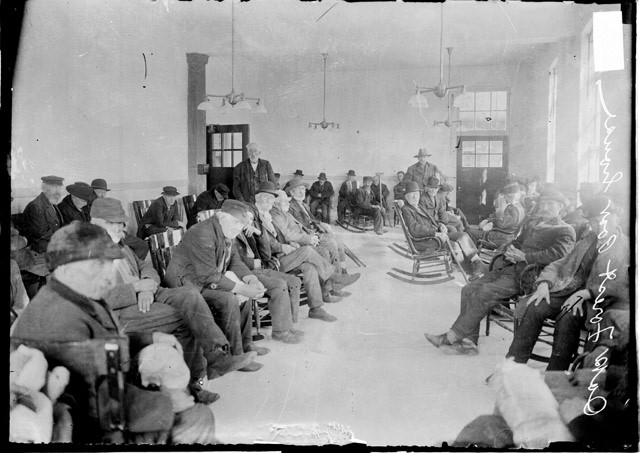
He was also concerned about the Oak Forest facilities run by the county, which included a poor farm, infirmary, and tuberculosis hospital. He had first-hand experience with poor farms in Ireland. In August 1921, a writer from the Englewood Economist observed Ryan inspecting the facilities. Wrote the reporter, “Mr. Ryan’s interest and attention toward the inmates and their kindly feelings toward him indicate that the welfare of this institution occupies no small place in the president’s thoughts.”
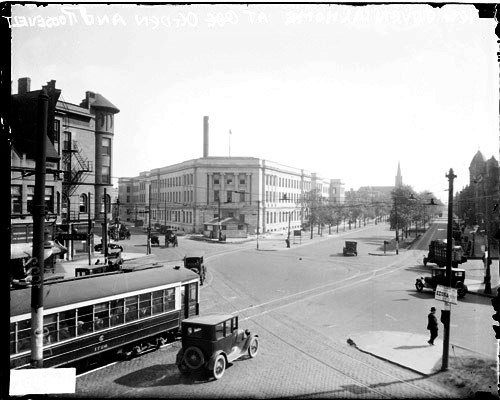
During Ryan’s term as President, work began on the Cook County Juvenile Home and Court, at Roosevelt Road and Ogden Avenue. Although the city tried to block it, the county built the first-ever facility for dependent and delinquent children that included living quarters, classrooms, playgrounds, and courtrooms. The building was renamed the Arthur J. Audy Home in 1950 for a former superintendent and now it is called the Juvenile Temporary Detention Center. Although it came to be plagued with problems, the juvenile home was established with good intentions.
Another cause important to Ryan was improving roads. In 1922 he wrote in a Chicago Tribune newspaper article, “Cook county is fast becoming a paradise for the automobilist. The forest preserve is a natural adjunct to our system of good roads. More than 4,000,000 persons there found rest and relaxation in 1921. So the forest preserve district is a promoter of the automobile, and the motor car, in turn, is a populizer of the preserves. Cook county intends to continue extension of its paved highways, as well as its forest preserves,” wrote Ryan.
Many sources consider the forest preserves and improved roads to be Ryan’s most lasting legacy.
The next installment will look at his role with the forest preserves.
The history of Dan Ryan Woods – Part 6: The Pike estate and early 1920s changes
By Carol Flynn
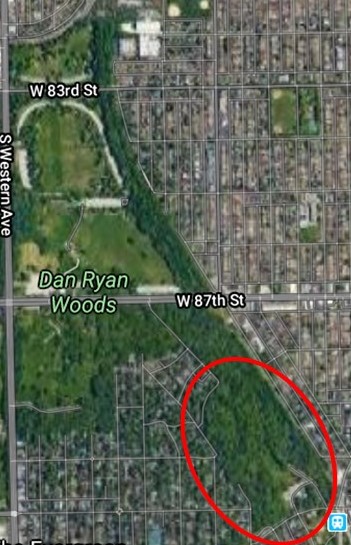
In 1921, Eugene R. Pike, former city comptroller, sold family property to the Forest Preserves of Cook County (FPCC) that added 32 acres to the southeast corner of the Beverly woods. The area was bordered by Hopkins Place, Pleasant Avenue, 91st Street, and the railroad tracks. The Chicago Tribune wrote, “We believe one of the prettiest spots to be found in the state is now located in the Beverly Hills district.”
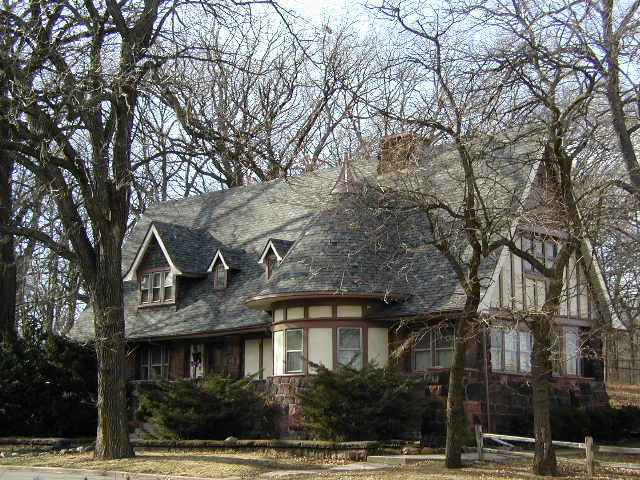
The property included a fine home, the E. S. Pike House at 1826 West 91st Street, designed by architect H. H. Waterman in 1894. The FPCC planned to use the house for the superintendent’s headquarters. The house is in a Tudor Revival style, with a base and lower exterior walls of red sandstone and upper walls of wood beams and stucco. Architectural elements include a round tower and a steeply pitched roof with tiny dormers with flared ends. The building is a contributing structure to the Ridge Historic District on the National Register of Historic Places.
[Note: Unfortunately, the house has not been maintained and is in very poor condition. It was gutted in 1962 and none of its original interior features were preserved. The FPCC has been studying adaptive reuse of the building and its future is uncertain.]
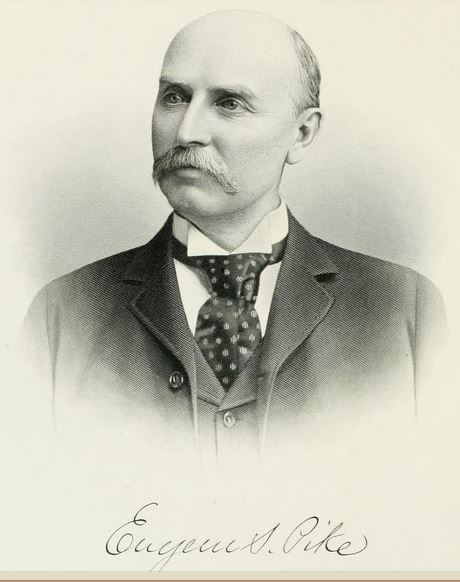
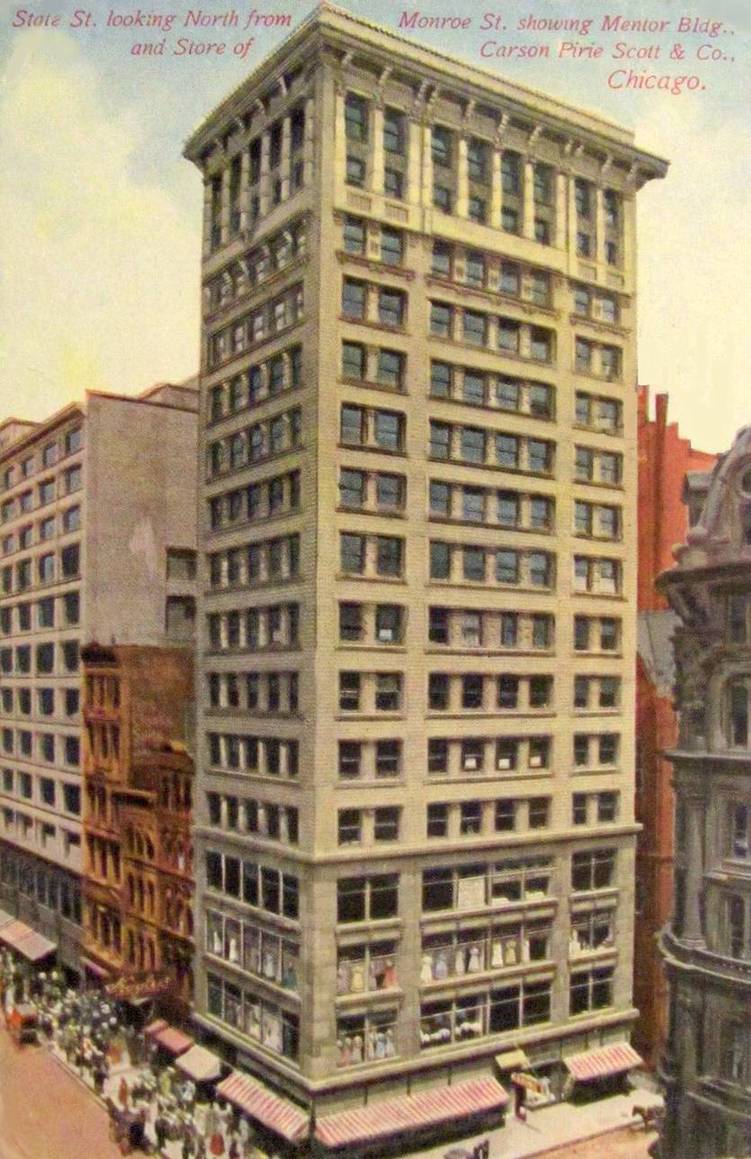
Eugene S. Pike (1835-1916), Eugene R.’s father, was a real estate developer and financier. He built several early skyscrapers on State Street in downtown Chicago. One was the Pike Building which was the first home of the Art Institute of Chicago, then called the Academy of Fine Arts. He also built the Mentor Building on the same block as Carson, Pirie, Scott and Co., and the department store used the bottom floors of the building.
Pike’s main dwelling was at 2101 S. Prairie Avenue, across the street from the home of John B. Sherman, who had owned most of the land which became the Beverly Hills Preserve. Pike sat on the Board of Directors for the 1893 World’s Fair, which was planned by Sherman’s son-in-law, Daniel Burnham. Pike had real estate/building projects with Burnham.
AMENDED 7/23/20: Pike purchased over 100 acres of land in 1888 from L. P. Hilliard in Washington Heights to sub-divide for residential lots. The purchase started at 95th Street and went north along the line of the Rock Island railroad branch. He sold about 2/3 of the land and built this house in the northern section of his holdings.
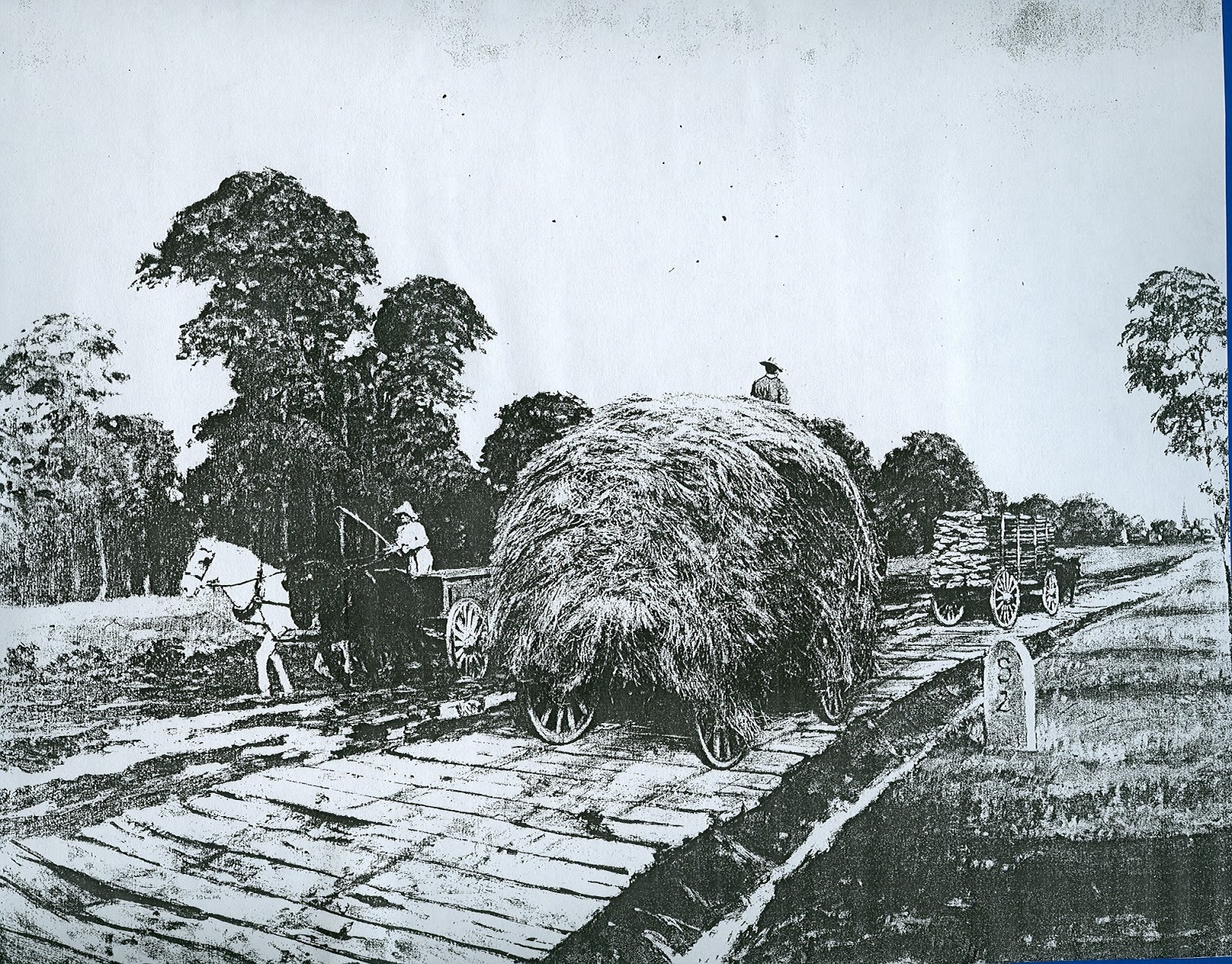
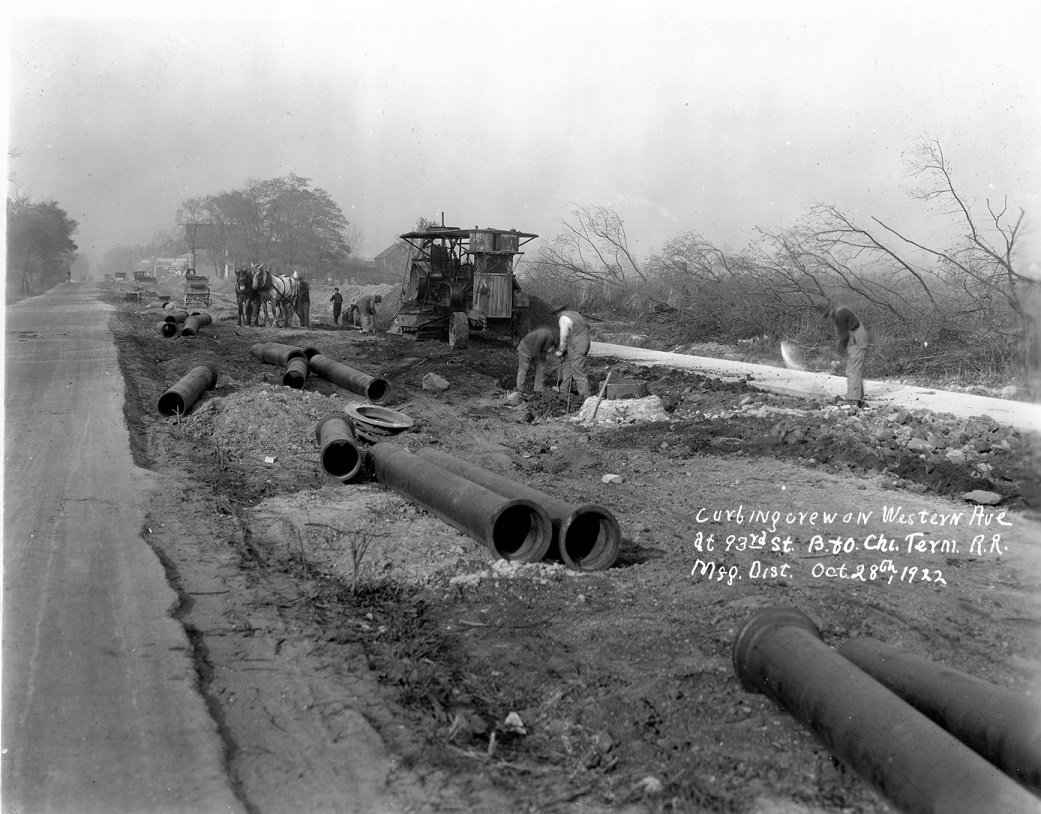
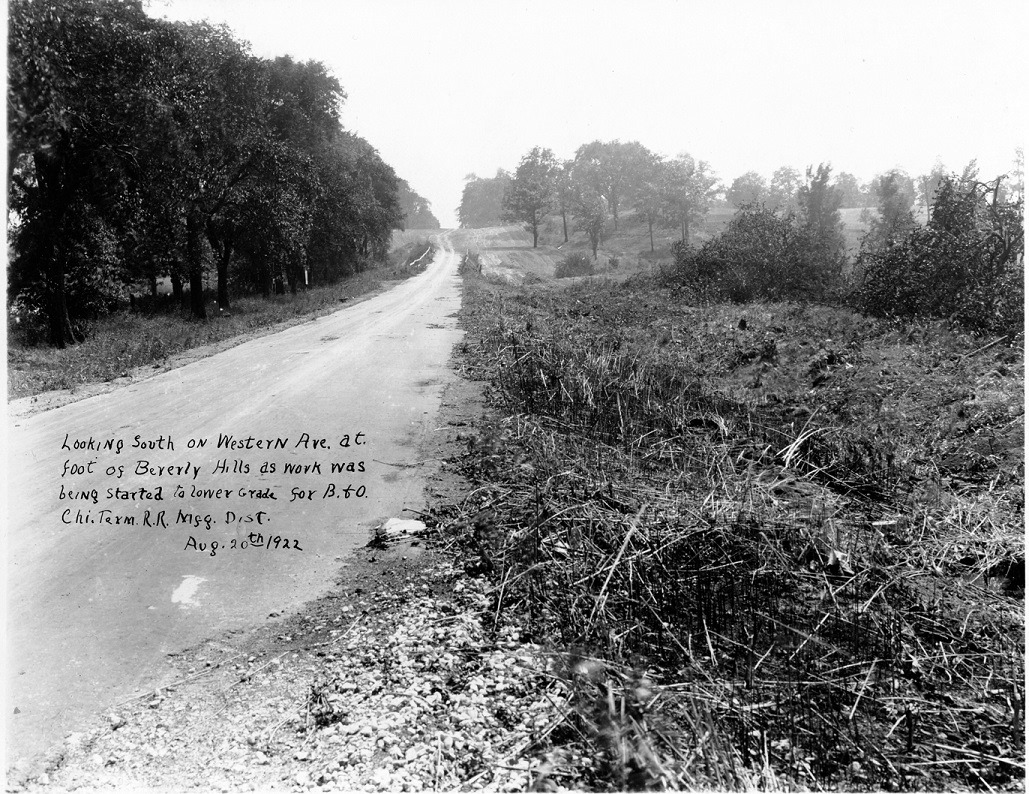
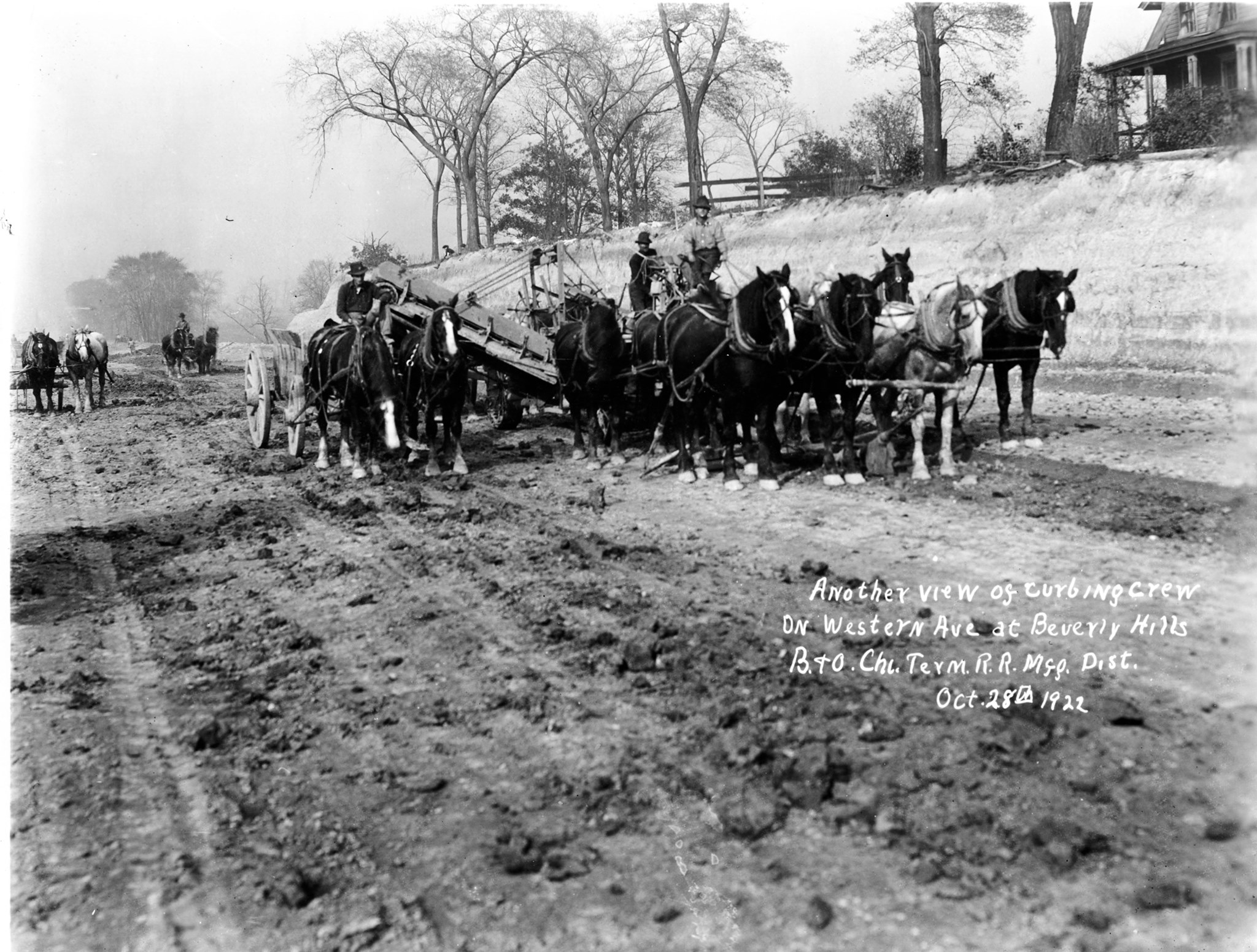
Other changes also occurred in the 1920s. Improving roads and building new ones were big priorities for the Cook County Board. More and more people were turning to automobiles as their means of transportation and the old dirt roads with their muddy quagmires were just not workable anymore – they had been barely passable for horses and wagons.
Western Avenue was an old and important north-south thoroughfare, going back to the 1850s. It showed up on early Ridge maps as the “Plank Road.” Wooden boards, or planks, were laid down on roads but this did not last long because the boards warped and decayed, and were washed away or “borrowed” by the settlers. These were replaced by gravel and brick roads and eventually concrete and asphalt.
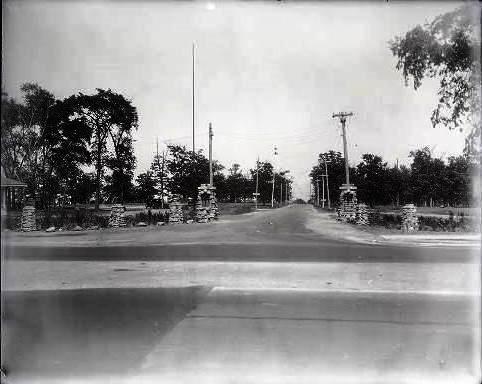
An important project in the early 1920s was the widening, grading and paving of Western Avenue. The Ridge Historical Society has a scrapbook of pictures of this project and some are shared here.
This project included paving and extending 87th Street west through the woods to Western Avenue. Up to this time, 87th Street was not much more than a dirt track cutting through Sherman’s Farm. An attractive new entrance to the preserve was built at 87th and Western. The plan was to make 87th Street a boulevard connecting the Beverly Hills Preserve with the Palos-area woods to the west, but that never happened.
The new 87th Street access made for two convenient entrances to the woods, the other being at the 91st Street train station.
Next installment: Good old Dan Ryan.

The history of Dan Ryan Woods – Part 5: The “Mystic Forest Preserve”
By Carol Flynn
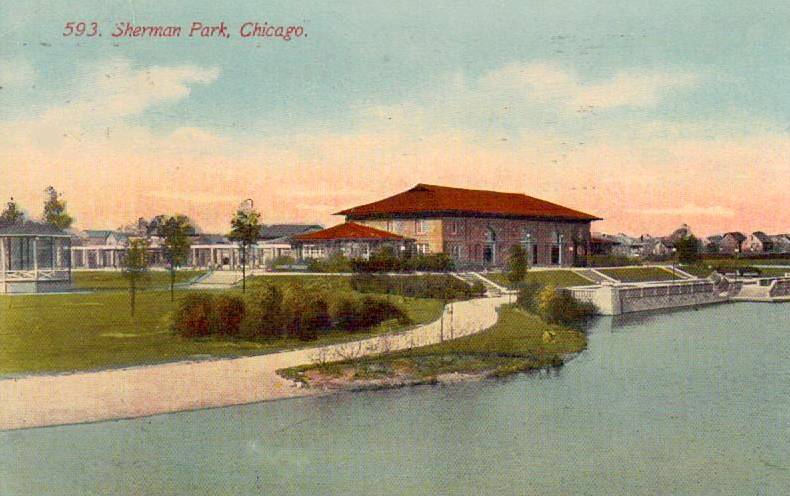
In 1902, John B. Sherman, who owned the land that became Dan Ryan Woods, died of influenza. He was buried in Oak Woods Cemetery. Sherman Park on Garfield Boulevard was established in his honor and his son-in law, architect Daniel Burnham, designed the buildings.
Parcels of his original land holdings had been sold off through the years. In 1889, Sherman sold his land north of 79th Street to a developer. The land north of 83rd Street followed in 1891. Land had been rented west of Western since 1889 for an equestrian and golf club, and after Sherman’s death, investors bought more land to further develop the Beverly Country Club. The old apple orchard became part of the golf course.
It was rumored that Sherman intended to donate his Forest Hill Farm on the Ridge to the City of Chicago to be used as a park. There was also speculation that the land would become a residential development. Neither happened, and the land went undeveloped for over a decade until the Forest Preserves of Cook County (FPCC) purchased it. People continued to enjoy the woods unofficially during those years.
In 1912, a Chicago Tribune article stated: “What is the best place around Chicago to go botanizing? On large tracts of land held for speculation at the edges of the city, say southwest of Western avenue, you will find practically the original prairie vegetation. In season many kinds of prairie flowers bloom there – resin weed, several varieties of sunflowers, compass plants, daisies and the like. Down along the Calumet River there are violets a plenty, and all sorts of wild beauties at Blue Island ridge and Forest Hill.”
The new Beverly Hills Preserve, commonly referred to as the Beverly woods, was added to the FPCC in 1917. The location immediately engaged the public’s imagination. It was a unique piece of land within the city itself, not connected to the outer belt of preserves.
On August 6, 1919, the Chicago Tribune featured an article, “Beverly Hills Unique Among City Viewpoints,” authored by an anonymous Eye Witness. The subtitle was “Mystic Forest Preserve is ‘Good Place to Muse In,’ says Eye Witness.”
The article was just so eloquent it begged to be shared.
“I was telling the boys yesterday about the accessibility of Beverly Hills tract of the Forest Preserve for their purposes of scouting and Indian make-believe, and remarked … that the spot also had its appeal for grownups.
“’Tis a great place to mull over many things relative to the now, and the then, and the what’s to come, for it combines solitude with the teeming associations of an age when this seat of present quiet was a point for briefly marking time in the westward march of an empire.
“Many a time I have passed that way, and ever found it worth while to tarry. Always there is a witchery of sunlight and shadow gliding over the prospect the height commands – in winter when it rears itself, austere and white, above miles of slow-shifting, frosty vapor; in the menace of storm when all the plain is empurpled and the thunder-wind comes scudding down from the north with its lashing sound; at the July noonday when the rock radiates visible heat like a gigantic oven and the locusts make the place vibrant with their metallic sawing, and at twilight when the locomotives, like fire-eyed monsters, creep across the darkening purple and the White City tower … takes on the aspect of something Florentine and fine.
“Yes, next to its accessibility … the value of the Beverly Hills preserve is its view, for in this low lying region, … the natural eminences that give us a spacious survey of our town are few and meager. Of these few the Beverly rise is perhaps the most impressive. Citadel like, it bulwarks the soft region of farms and woodlands behind it.
“Furthermore … it arises from unspoiled wildwood, while the picture beneath is all emblematic of commerce and industry. … I don’t know in what land you could survey a more pregnant panorama, or one fraught with fresher or more decisive contrasts. … Before you, a city grumbling and sweating and aspiring under its mantle of smoke and under the midsummer sun; behind you, children shouting, birds whistling, and the hot wind in the trees.
“But ‘tis futile and mere space filling to try to catch with words the elusiveness of such light and shade or to mark the routine of these regularly recurrent wonders. … Ah, mystery and magic of the craft of words. …
“I told you Beverly Hills was a good place for musing.”
The identity of this “Eye Witness” has never surfaced, but based on writing style and choice of words, one possibility is David Herriott, the Morgan Park Postmaster and the owner/publisher/editor/writer of the Morgan Park Post newspaper. He was a great one for “musing” in his writings.
Next installment: The Pike estate joins the Beverly Hills Preserve
The history of Dan Ryan Woods – Part 4: Murder comes to the Sherman Farm at Forest Hill
By Carol Flynn
John B. Sherman’s Farm, which became Dan Ryan Woods, was involved in two murder investigations in the late 1890s. Both murders occurred elsewhere in the city, but the remains of the victims were hidden on the Ridge. Apparently, the seclusion of the area made it appear a perfect spot to do this, but in both cases, the victims were recovered and the murderers brought to justice.
In February 1895, local children found the remains of murder victim Fritz Holzhueter partially buried by brushwood under a tree near 95th Street and Western Avenue. This was outside of Sherman’s property, on the Evergreen Park side of the road. An oil can used in an attempt to burn the body was found a few blocks away on Sherman’s property.
The newspapers reported that the foreman of Sherman’s Farm had seen the man accused of the murder, Nicolas Marzen, in the area the night the body was left, but the foreman was not called to testify at the trial. Marzen was found guilty of the crime and sentenced to 30 years in prison.
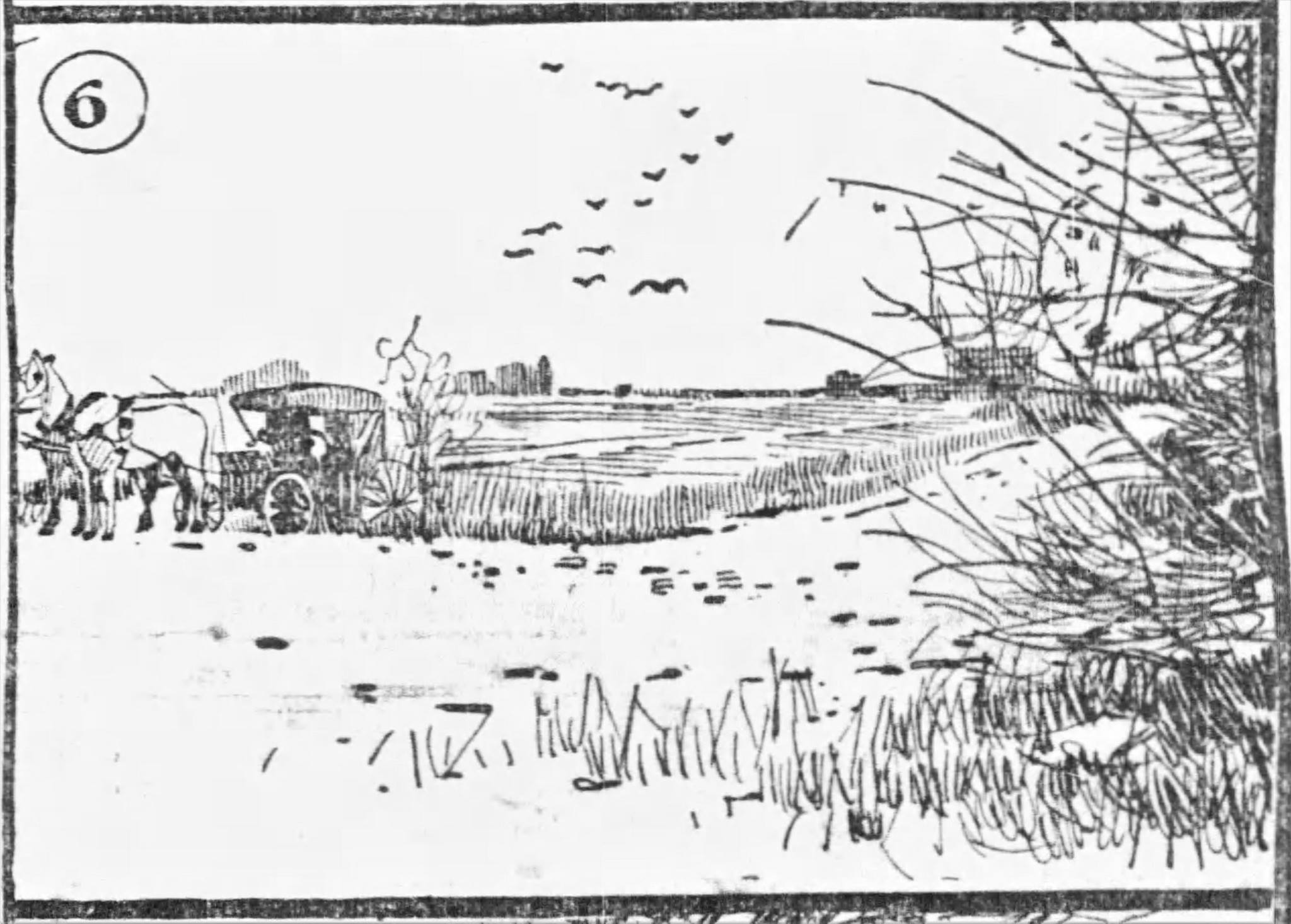
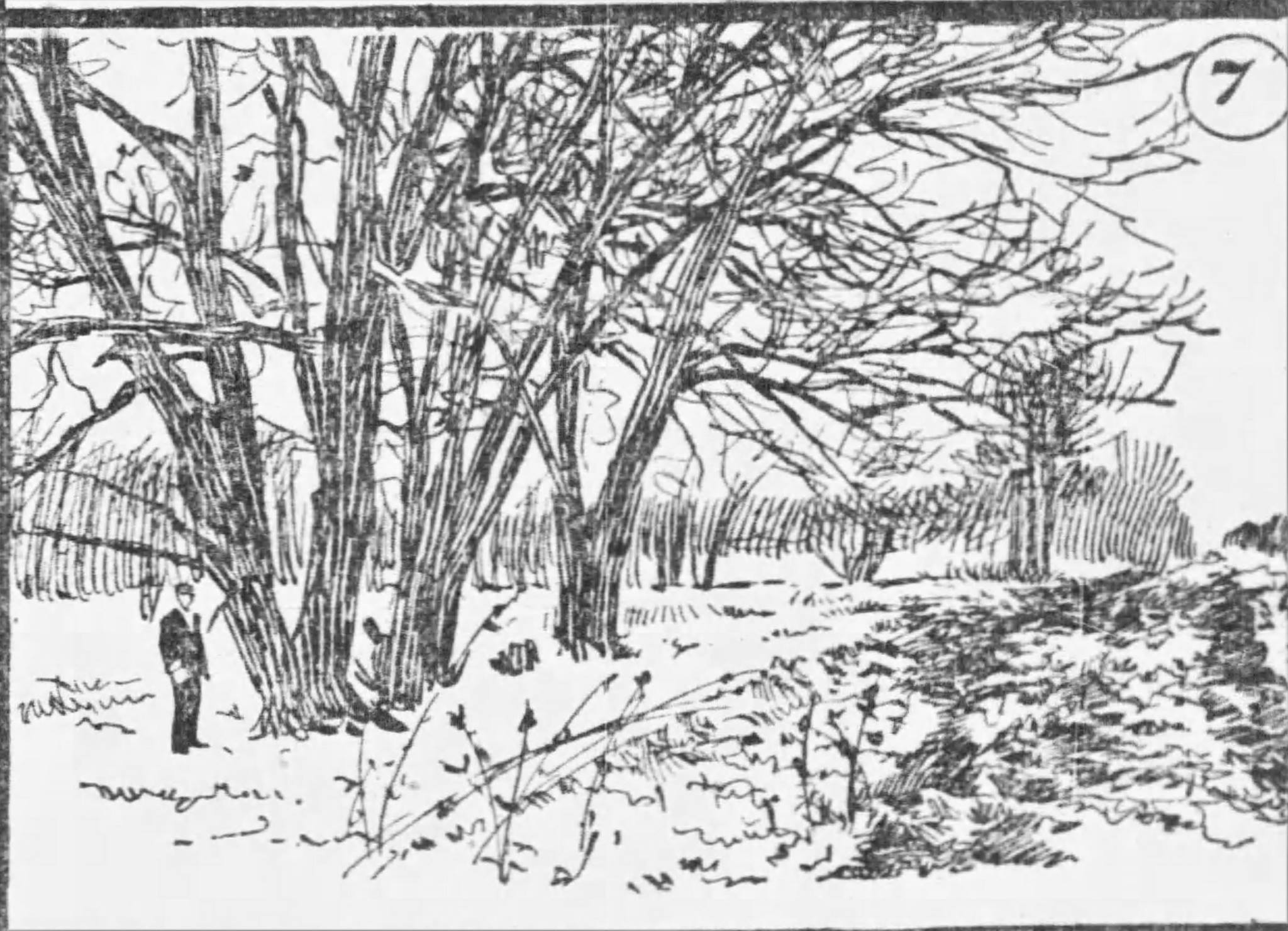
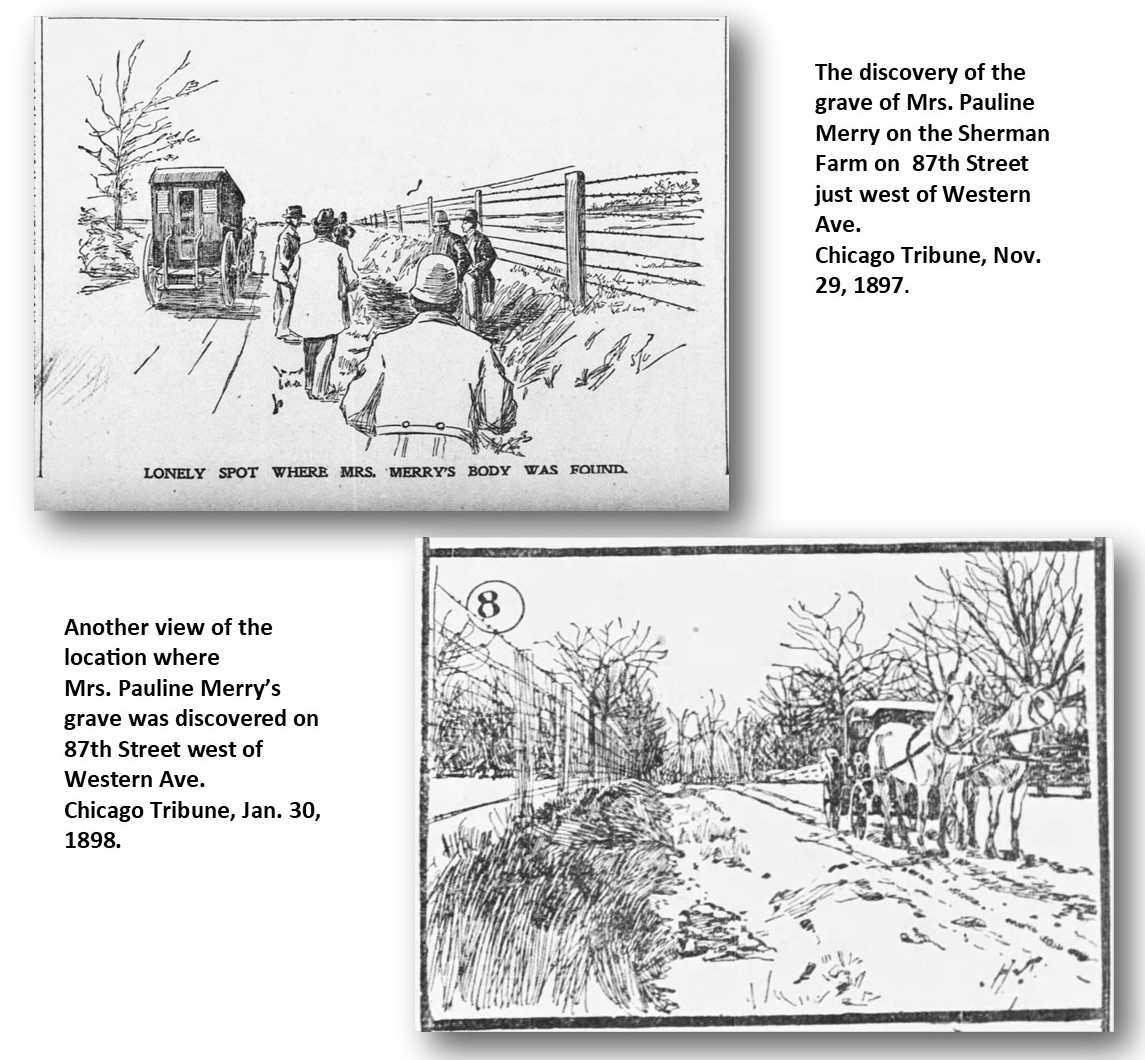
The second murder, of Mrs. Pauline Merry, took place in November 1897. An accomplice who had helped her husband, Christopher Merry, bury her body broke down under questioning and took the police to the site, a shallow grave in a ditch on the north side of 87th Street just west of Western Avenue, next to the Sherman Farm apple orchard. While the police were recovering the body, an employee of the farm came over to the site to inquire as to what was going on. He was told “to take a walk” while the police combed the area for evidence.
Christopher Merry was convicted of the crime and was hanged in April 1898.
The newspapers covered the investigations and trials of both murders in great detail. As with most stories of this nature, this was sensational news. Although the crimes were committed in other parts of the city, attention was given to the places on the Ridge where the victims were found. The Chicago Tribune gave several descriptions of the sites at the time of these incidents.
The area along Western Avenue was isolated, still mostly farmland with few houses. Ninety-fifth Street and Western Avenue was described as a “desolate” area with dirt roads bordered by broad ditches with “trees and brushwood everywhere.” There were only two houses close by. One was the summer residence of Dr. John Kellogg and his family, which included Kate Starr Kellogg, the educator for whom the school in North Beverly is named, and her sister, artist Alice Kellogg.
The other residence, at 93rd Street, housed Mrs. Marie Zeder, a widow who kept a roadhouse, and her family. It was two of the Zeder children who discovered Holzhueter’s body hidden behind a hillock covered with a dense cluster of trees.
Likewise with the 87th Street location, there were only two houses near the site. Both were on the Sherman Farm, used as residences for the foreman and his assistants.
The Chicago Tribune gave several descriptions of that area in November, 1897: “As the [Western Ave] roadway ascends the sharp incline to the top of Forest Hill [at 87th Street], it passes under the broad boughs of the giant trees of that point, reaching the top of Forest Hill with its great spreading trees, and in this season of the year, presenting a weird and desolate appearance.”
The Tribune also reported that the trees, “relics of the primeval forest,” cast a heavy shade on Western Avenue and 87th Street. Deep trenches ran along the sides of 87th Street, which was a rural dirt road, scarred with furrows from wagon wheels.
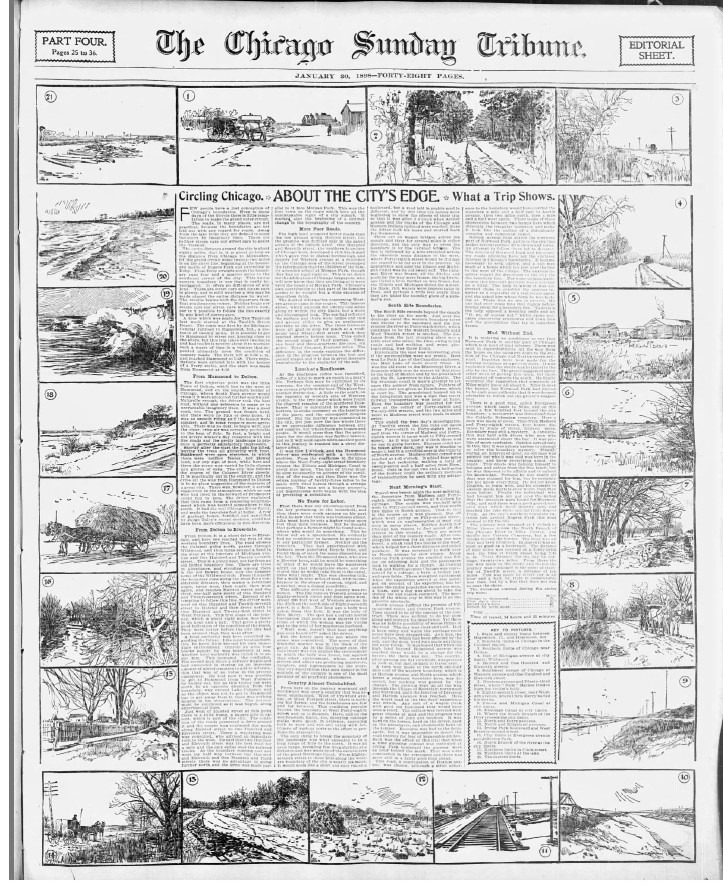
In an article in the Tribune on January 30, 1898, the unnamed author reported on a road trip he and two companions took around the city’s edge, starting from the southeast. They came west along 111th Street, and at Western Avenue, they turned north. The article described Western Avenue as having “a worn and discouraged look. The sun had softened the surface and there were lumps and ruts and greasy slides to give an unpleasant diversity to the drive.”
They were glad to stop for lunch at a roadhouse near 91st Street where they were served coffee “of a kind to mark an epoch in a man’s life.” They noted that most of the places on Western Avenue usually pushed beer. Although not identified in the paper, this could have been the roadhouse owned by Mrs. Zeder.
The author then focused on the locations where the two murder victims had been found. Several drawings depicting the scenes were included with the article. A more positive, wholesome image of the Ridge likely might have been preferred by the local residents, but the murders and the trials were of major interest to the public at the time of the article.
The author did point out that while it was evocative to “comment on the loneliness of the place and the consequent dangers thereof,” the murders had occurred in other places in the city, “where there are houses and people.” Although there was “a certain horrid fascination” with the Western Avenue locations, “the indictment was not against the environment in which the body was found, but against that other environment – the thick of the great city, whose crowded streets and alleys are producing murderers, burglars, and highwaymen by the score.”
The article noted that “the city superstition that sees danger in the solitude of the country is one of the most peculiar of all psychical phenomena.”
The next installment on “the Mystic Forest Preserve” will present a much more favorable image of the area.
The history of Dan Ryan Woods – Part 3: The Sherman Farm at Forest Hill
By Carol Flynn
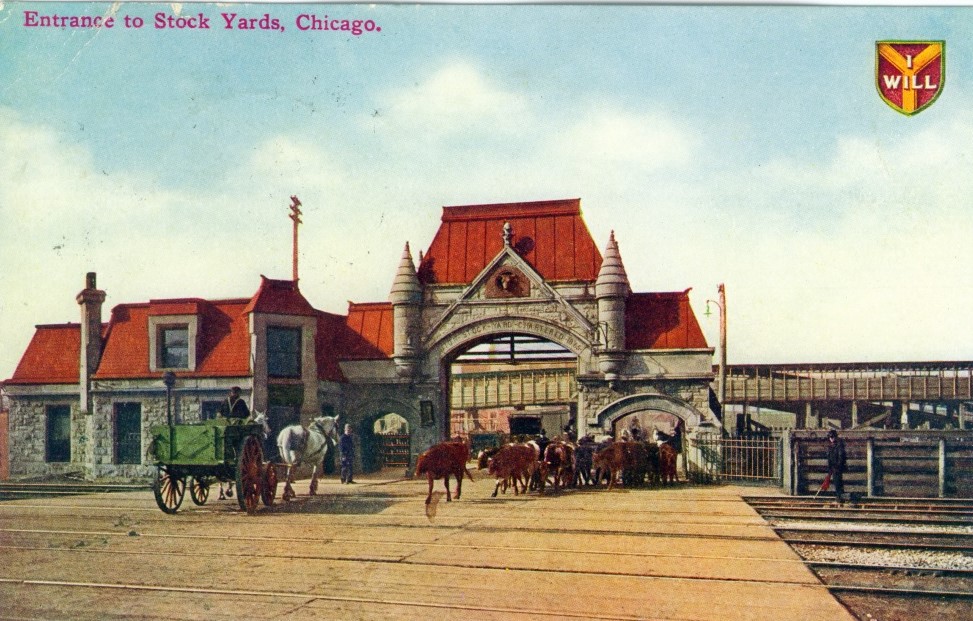
John B. Sherman of the Union Stock Yard and Transit Company purchased the land that is now the Dan Ryan Woods in 1872 and used it as a livestock farm. Railroad tracks were laid to connect the stockyards and the farm. The farm was referred to as Sherman’s “laboratory.”
Prize cattle and hogs were bred there or brought in for breeding. The cattle grazed on the farm’s meadows. Other parts of the farm were used for hay crops, and the section west of Western Ave. and north of 87th Street included an apple orchard.
Sherman won many awards for the size of his livestock. Prize animals were slaughtered, and cuts of meat given to his friends at Christmas and other times. Some of the more famous steers had their heads mounted for display at the stockyards.
Veterinary medicine experiments were also conducted there. In 1888, Sherman allowed some of his healthy cattle to be placed in a pen with cattle from Texas infected with “Texas fever” to see if the disease was contagious. All of Sherman’s cattle became infected. It later was determined the disease was caused by a parasite transferred by cattle ticks, which were eventually eradicated.
Sherman was described as a “venerable gentleman farmer” when at the farm on “a high ridge covered with oak and hickory trees.” He used the farm for social events. One newspaper in 1883 reported that the twelfth annual clam bake of the Union Stock Yard was held at the farm, with over 100 guests. At another time, he offered a night of dog-fighting and chicken-fighting for his guests.
There were a number of stories in the papers through the years about the farm. Wolves in transit to a menagerie escaped and were found in the woods at the Farm. Of course, wolves were once plentiful in the area but the settlers had hunted them all down a half century before. Other stories included a cow stolen from the farm, and the enormous hay crops produced in the fields there.
One curious story from 1902 involved John Andrews, 46, the manager of the farm. A calf had been attacked by a wild dog and developed rabies in 1898, four years before. While helping the calf, Andrews’ hand and arm were scratched. He showed no signs of being infected with rabies at the time, but he had “never been free from the dread that the disease might appear.” Now, four years later, he was bitten by a hog which gave him a “severe shock to his nervous system” and brought on the symptoms he had feared – “barking like a dog, snapping at his attendants, and fearing water.”
It was supposed this was acute hydrophobia, or rabies, that dated back to the incident four years earlier. After two weeks, his physicians pronounced him fully recovered. This was brought to the attention of the medical community as a rare survival from supposed rabies. [Note: Rabies, a viral disease, can actually have an incubation period of over six years. Inflammation of the brain can cause hallucinations and abnormal behavior. Once the symptoms begin, rabies is almost always fatal. If this really was rabies, and not a different illness or a psychosomatic illness, it was indeed a remarkable recovery.]
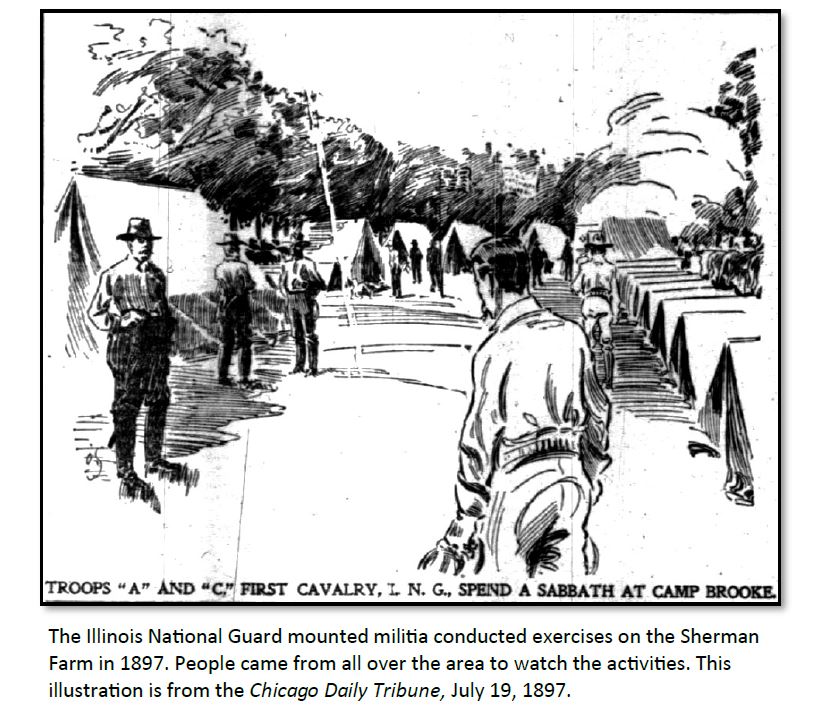
Another story was that in 1897, the mounted militia of the Illinois National Guard set up camp for several days and held maneuvers at 95th and Western. The ground used for drilling was a newly mown meadow of forty acres on the Sherman Farm. It was reported that the public – especially young ladies – enjoyed visiting the camp and watching the events.
Next installment: Murder comes to Sherman’s Farm
The history of Dan Ryan Woods – Part 2: The forest preserves and Sherman Farm
By Carol Flynn
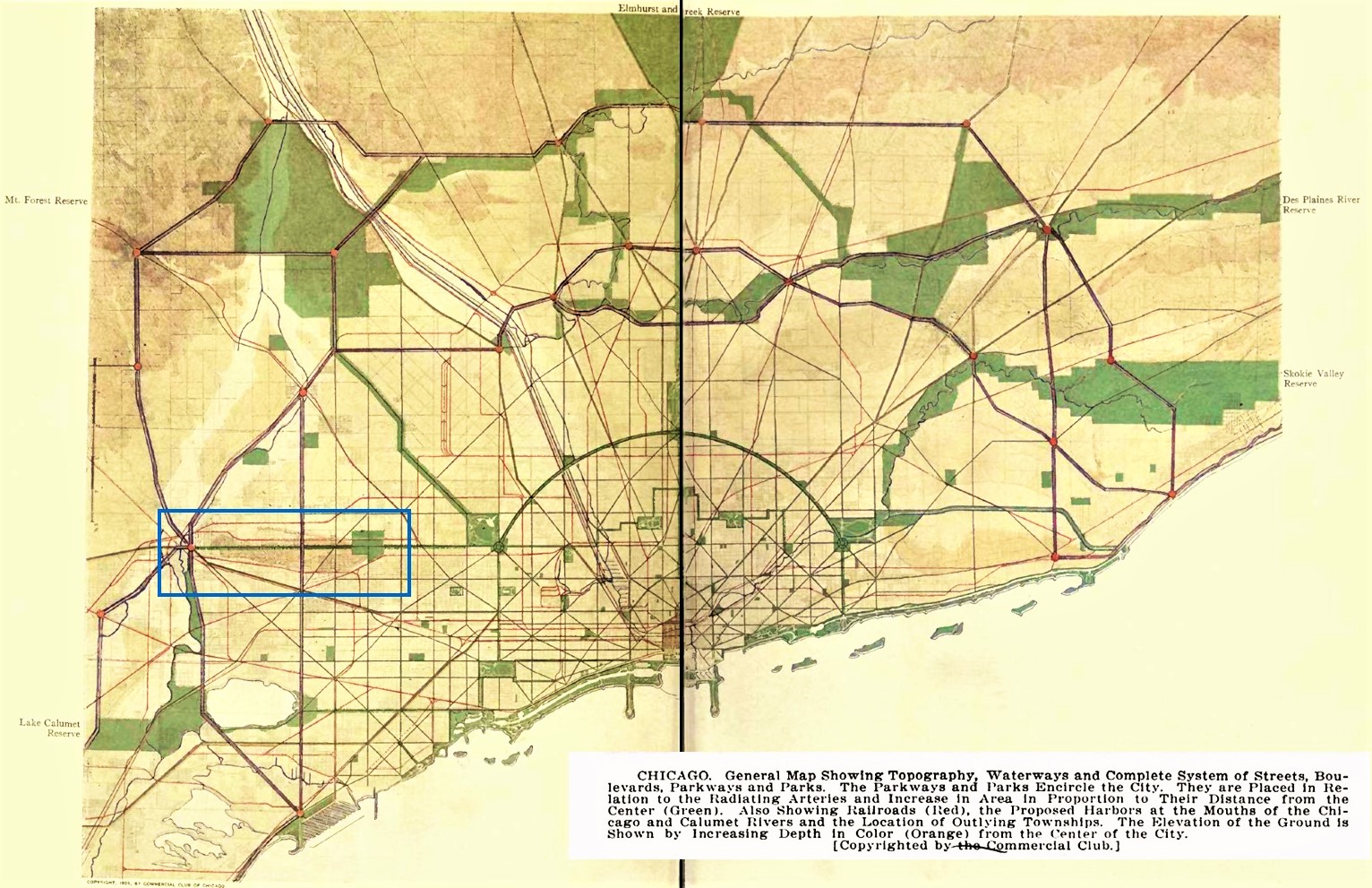
Picture Chicago as sitting in the bottom of a big shallow bowl, an ancient lake bed. The east side is cut away allowing water to flow out into Lake Michigan. The other sides of the bowl slope upward around the city. Along the sides and on the wide rim of the bowl are forested areas. These forests to the north, west and south became known as the “outer belt.”
As early as the 1860s, Chicagoans were concerned about adequate space for recreation and outdoor activities. By the 1890s, there was a growing commitment to preserve this outer belt of forested lands for recreation and aesthetic purposes. In an 1899 outer belt report, the Blue Island Ridge and its woods were mentioned as one of the areas that should be preserved “for the benefit of the public … and for their own sake and scientific value.” The uniqueness of the geology of the area was fully recognized.
Daniel Burnham, the architect and urban planner who gave Chicago the White City at the 1893 World’s Fair, the Columbian Exposition, worked with city business, civic and government leaders to develop the 1909 Plan for Chicago. This plan called for developing the outer belt into natural preserves as next in importance to developing the lakefront into a system of parks. The plan called for connecting all the parks and preserves with a boulevard system.
Other notable leaders in the forest preserve movement included landscape architect Jens Jensen and architect Dwight D. Perkins, who is called the “father of the forest preserves.” Perkins led Saturday afternoon hiking trips that introduced thousands of Chicagoans to the outer belt. Jensen led tours of prominent politicians to win over votes in the Illinois General Assembly. Because they were accessible by public transportation, the Beverly woods were a popular destination for hikers and for artists, who set up their easels to capture the natural beauty.
The implementation of the plan was overseen by businessman Charles Wacker, who was profiled a few weeks ago because a school in a Ridge community is named for him. He was Chair of the Chicago Plan Commission from 1909 to 1926. Wacker Drive is also named for him.
In 1913, Cook County passed the Forest Preserve District Act that set the mission of the district “to acquire, restore and manage for the purpose of protecting and preserving public open space with its natural wonders, significant prairies, forests, wetlands, rivers, streams, and other landscapes with all of its associated wildlife, in a natural state for the education, pleasure and recreation of the public now and in the future.”
In 1915, the Board of Commissioners of Cook County assumed the role of Board of Forest Preserve Commissioners, an arrangement that continues today. Dan Ryan was the Finance Chair for the county, so he became the same for the preserves. Bonds were issued to raise money to purchase land, and the first tract purchased was the 500-acre Deer Grove in Palatine in 1916.
Private land, some of it already turned into farms, was reclaimed for the forest preserves. At the time Cook County purchased the Beverly Hills woods in 1917, it was owned by the estate of John B. Sherman, the founder of the Union Stock Yard and Transit Company. Sherman had purchased the land in 1872 and used it as a vast working farm that was known for decades as the “Sherman Farm at Forest Hill.” Forest Hill was the name for the area around today’s 87th Street and Western Avenue.
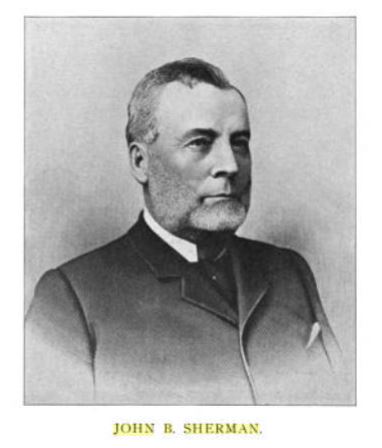
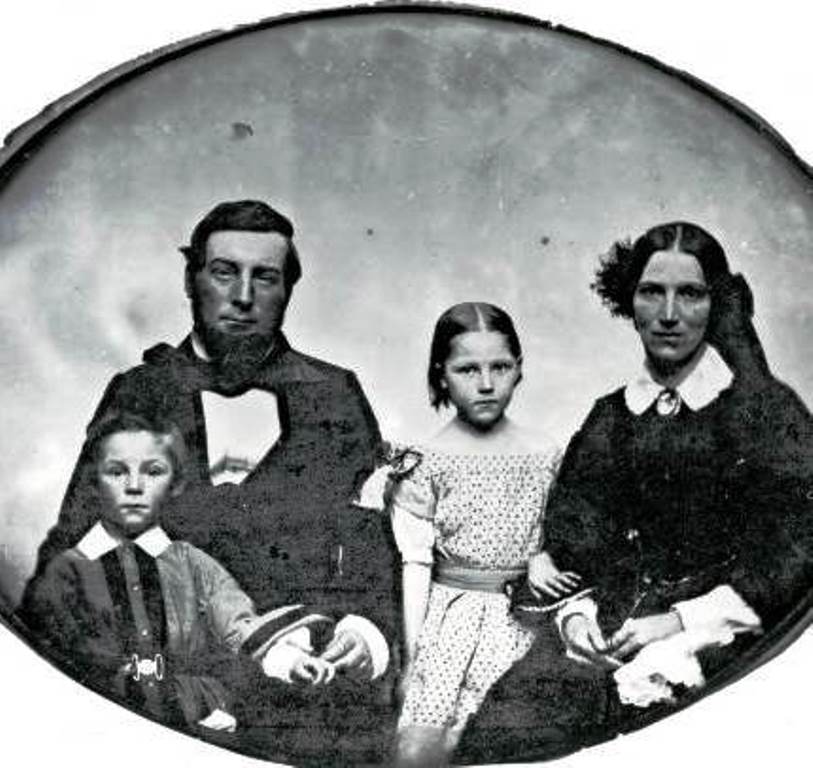
John Brill Sherman (1825-1902) was born in New York and grew up on a farm. In 1849, the Gold Rush led him to California where he made several thousand dollars. On his way back east, he stopped in Illinois and bought farmland. He moved to Chicago and bought up several small stockyards. He convinced the owners of other small operations to consolidate with him, and in 1965, the Union Stock Yard and Transit Company of Chicago was formed.
He was considered a friend of the common working man, establishing a minimum wage of $2 per day, roughly $55-60 today, for laborers in Lake Township where he lived and where the stockyards were located. The average daily wage at the time was about $1.30. Lake Township was not part of the city of Chicago at that time, it was a section of Cook County.
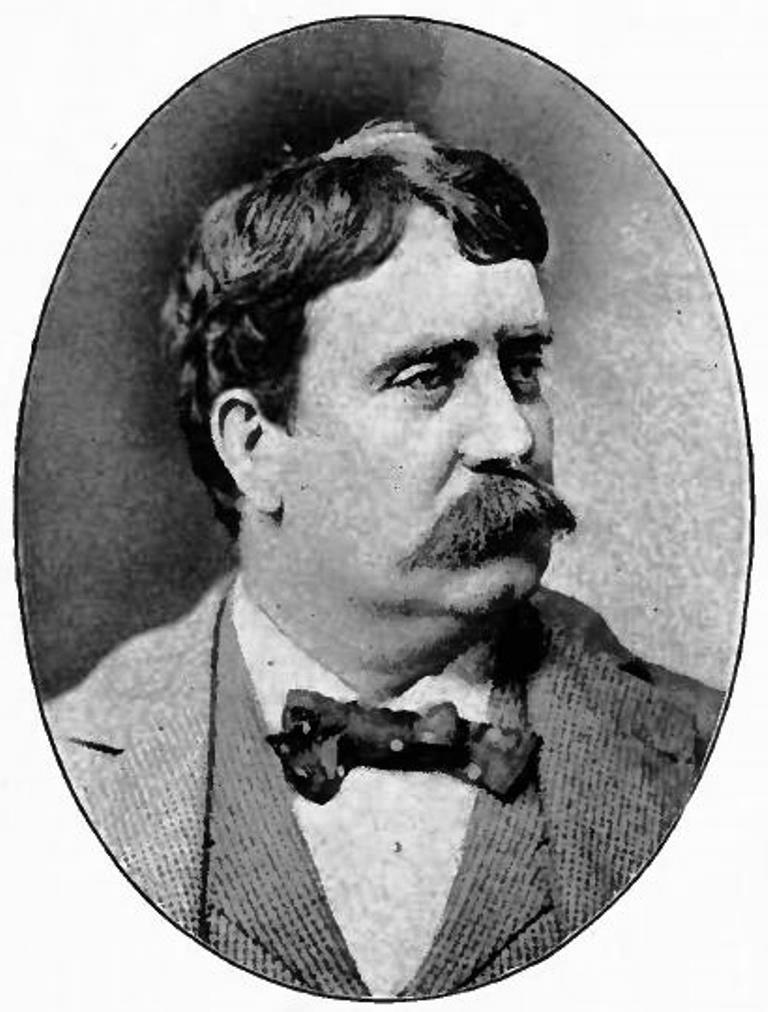
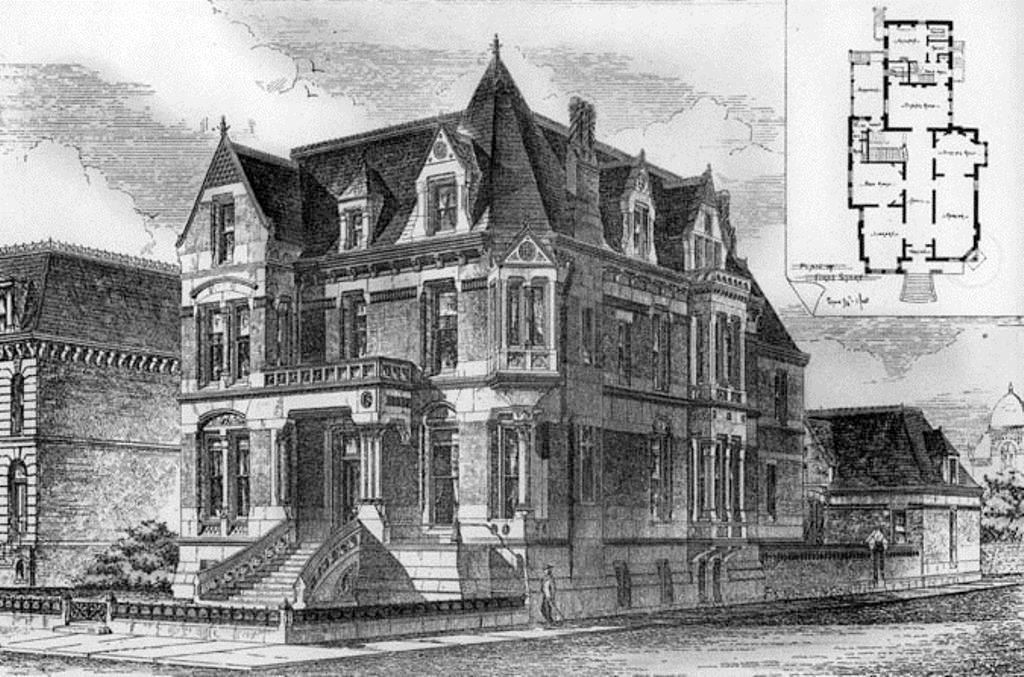
The Sherman family was living on Michigan Avenue when they decided to build a home on fashionable Prairie Avenue. In 1874, Sherman took a chance on a young architect, Daniel Burnham, and his partner, John Root. Burnham and Root designed a house for the Shermans at 2100 S. Prairie Avenue. Neighbors included Marshall Field and George Pullman.
Around this time, the original gate of the Union Stock Yard, which still stands at Exchange Avenue and Peoria Street, was built. The gate is believed to have been designed by John Root and was named a National Historic Landmark in 1981.
When meeting with Burnham about the plans for the house, Sherman often called in his daughter Margaret for her opinion. Margaret and Burnham fell in love and married in 1876. Burnham moved in with his in-laws on Prairie Avenue. Later, Burnham and Margaret moved to Evanston. They had five children.
Sherman was very much opposed to the annexation of Lake Township, which also included most of Beverly, to the city of Chicago. But the residents of the township voted in favor of annexation in 1889, so the Union stockyards became part of Chicago.
Described as a “public-spirited man,” Sherman took particular interest in designing and developing the public park system. For 25 years he was a member of the South Park Commission Board and, although he declined election to other public offices, he agreed to serve as president of that board. The South Park Commission oversaw Jackson Park, Washington Park, and the Midway Plaisance. These sites were selected for the 1893 World’s Fair, and his son-in-law Burnham was selected to oversee the design and construction of the fairgrounds. (Root died from pneumonia in 1891 at the age of 41, during the planning of the Fair.)
Sherman guided the growth of the Chicago stockyards. He was recognized as the ablest manager in this industry in the world. During his lifetime, the Chicago livestock market came to be called one of the greatest wonders of the age and the greatest institution of Chicago.
He became known and respected for his efforts to improve stock. Central to this work was the 640-acre Forest Hill Farm. Sherman owned big stretches of land from 75th and Ashland Avenue west to Western Avenue and south to 95th Street. Around 87th Street, his holdings also included the land west to around California Ave. The Chicago Livestock World, a newspaper he helped found, called this the largest farm within the city of Chicago if not in Cook County.
Next installment: The particulars of the Sherman Farm at Forest Hill.
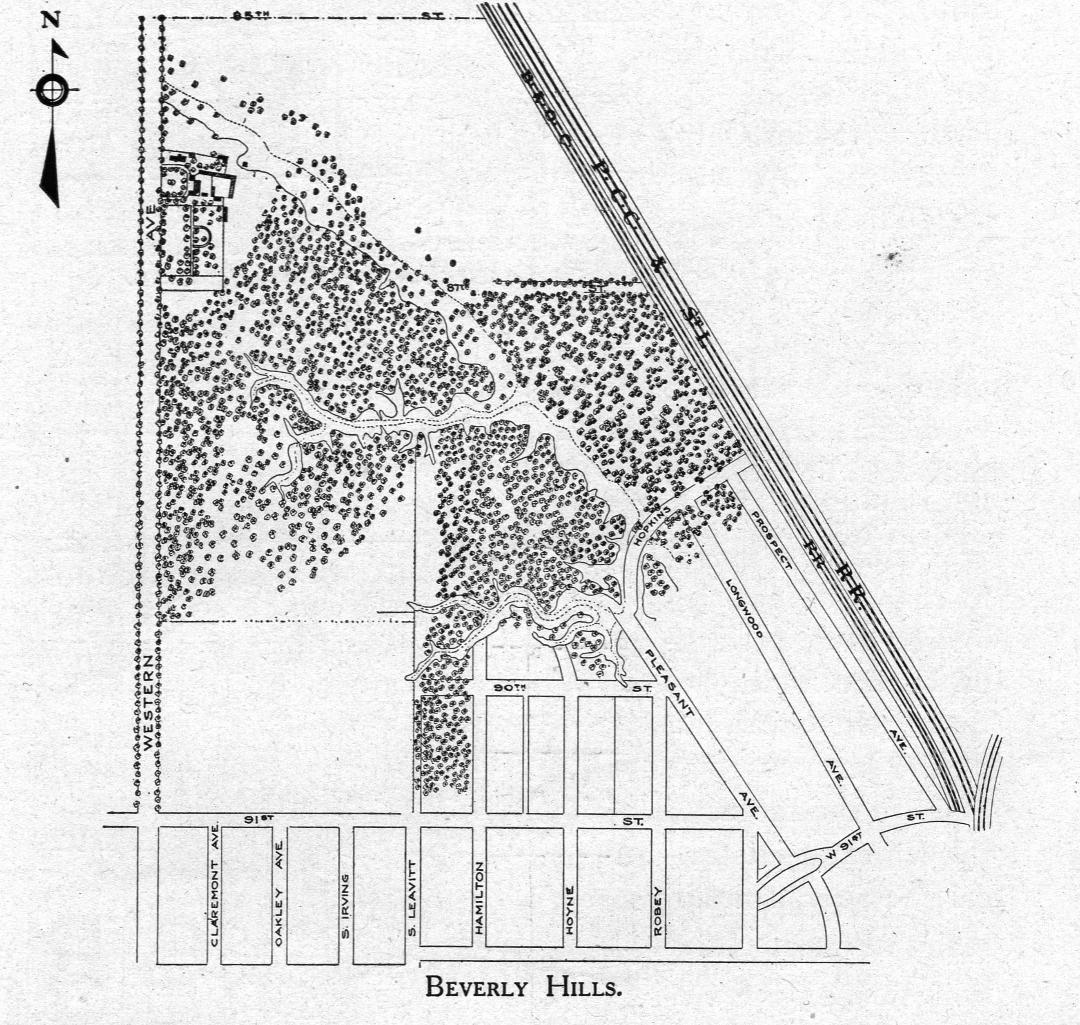
We are going to switch up things a little bit. We are starting a series on the history of Dan Ryan Woods, and we will still continue to run the profiles on people for whom public schools on the Ridge are named.
The history of Dan Ryan Woods – Part 1: The woods become part of the forest preserves
By Carol Flynn
On November 10, 1916, a small article in the Chicago Daily Tribune reported that the Cook County forest preserve board would have a walk through the woods at Beverly Hills that day, with an eye toward purchasing them. That visit surely went well, because in September 1917, for the price of $152,937, the forest preserves district purchased 112.88 acres from the estate of John B. Sherman. The area was roughly bordered by Western Avenue, 83rd Street, the Rock Island railroad tracks and 89th Street.
The following year, the Forest Preserves of Cook County (FPPC) issued a report that enthusiastically praised the Beverly Hills Preserve. Peter Reinberg was President of the Cook County Board of Commissioners at the time, and the board also had responsibility for the forest preserves. Daniel Ryan was on the Board and was Chairman of the Finance Committee and Chairman of the Depositories Committee, and a member of the Real Estate, Plan, and Forestry and Improvement Committees.
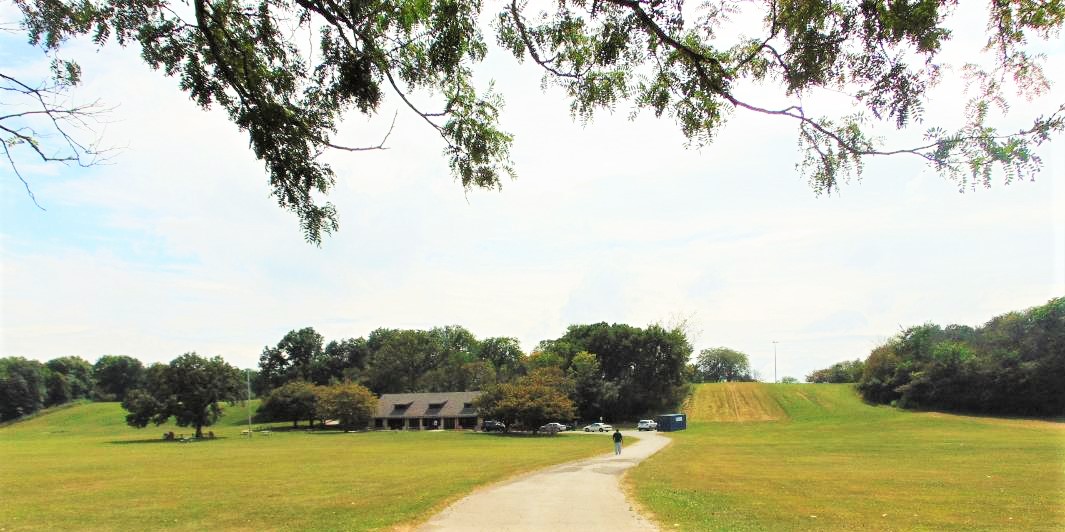
The 1918 report stated that the location had long been recognized as a historical attraction because of the towering bluff “Indian warriors utilized as a look-out and signal station in the days when they were fighting to hold their homes against the invading white men.”
This version of the early history of the land recounted the tale of the signal station atop the “Beverly Bluff” bursting into flame with the bonfires of the Indians, which produced ribbons of smoke that warned tribes for miles around.
Of course, as colorful as this story is, it is largely folklore. Without any doubt the Native Americans knew the northern tip of the landmass the white settlers called the Blue Island. There were Indian villages along the Calumet River at the southern end of the island and settlers found many Indian artifacts around the Ridge. Standing on the bluff, one could see all the way to Fort Dearborn, about 12 miles to the northeast. The fort was located about where the Michigan Avenue bridge is today, where the Chicago River joins with Lake Michigan (333 N. Michigan Ave,).
For some time, white trappers and traders had been following the Vincennes Trail through the prairies and wetlands and oak savannas of the Blue Island Ridge area. This trail was first worn by animals keeping to the high ground, then used by Native Americans. It ran south from Chicago, then east to Vincennes, Indiana.
Settlement of the Blue Island area by white families was gradual. By the time they began to put down roots here in earnest in the 1830s, the Native Americans in this area were almost all gone, due to the federal Indian Removal Act of 1830. The Treaty of Chicago in 1833 led to the final withdrawal of the Potawatomi, Chippewa, and Ottawa tribes from the Lake Michigan area.
Native Americans were still spotted in the area for decades afterwards. Although there was some fear and mistrust of them on the part of some of the white settlers, there were no large scale hostilities reported in the early histories. One early settler wrote about riding his pony as a boy across the prairies with the local Indians.
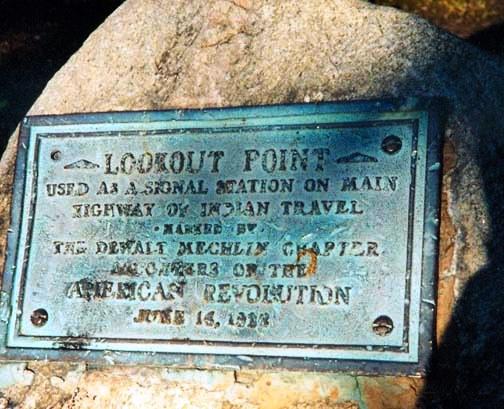
In 1922, the Dewalt Mechlin Chapter of the Daughters of the American Revolution placed a marker in the woods along the north side of 87th Street to commemorate the Indian lore that earned the bluff the name “Lookout Point.” That marker should still be there. [Note: It has since been reported that this plaque went missing 2-3 years ago. Pictures are all that remain.]
The 1918 report was full of praise for the Beverly woods, stating, “In Beverly Hills, the southern end of Cook County has a real beauty spot. It is a preserve only 126 acres in extent but for its acreage it boasts more spectacular points of interest than any other stretch of forest land in the county. It is an ideal natural park.”
The report also pointed out that the Beverly preserve had the distinction of being the only one accessible to all of Chicago “on a five cent fare.” Visitors could take the Ashland Avenue streetcar to 87th Street and walk west to the Ridge. Another option was to take the Rock Island train from the LaSalle Street station to the Beverly Hills station at 91st Street.
The 1918 report included a map of the woods as they were at the time they became part of the forest preserves. The map includes structures that likely dated back to the days when the land was the Sherman Farm, filled with “splendid herds of stock.”
The next installment will look at the formation of the forest preserves, and the “Sherman Farm at Forest Hill.”