Explore the RHS Facebook Archives, a rich repository of local history written by Carol Flynn. For two decades, Carol brought a deeply dedicated voice to public education at RHS. Her role as Facebook administrator through mid-2025 naturally extended her prolific research into meticulously detailed articles, most notably her multi-part historical series posts. Today, Carol continues her local history writing for The Beverly Review and other outlets.
July 2023
The Ridge Historical Society
The History of the Graver-Driscoll House – Part 10: The Cummings Family
By Carol Flynn
Every house has a history.
To celebrate the 100th anniversary of the Graver – Driscoll House, owned by the Ridge Historical Society (RHS) at 10621 S. Seeley Avenue, we’ve been running an intermittent series on its various owners. The house, designed by architect John Todd Hetherington, was built in 1922-23 for Herbert and Anna Graver. Graver was an executive with his family’s business, the Graver Tank Works.
The next two owners are timely subjects for summer. Grant and Grace Harrison Fenn owned the house from 1940 to 1946. Fenn was a mechanical engineer active in the new air conditioning industry. Their story was covered in past posts.
Ownership then passed to the Nicholas Cummings family. Their story revolves around ice cream.
Nicholas Cummings was born Nicholas Athaniscos Kumungis on September 10, 1891, in Sparta, Greece, according to immigration records. He arrived in the U.S. on March 14, 1912. He became a naturalized U.S. citizen on January 2, 1920.
On his 1917 World War I draft registrations card, he listed his employment as bookkeeper with Rusetos and Co. On the 1920 U.S. Census, he was living with his married sister Libby Rusetos’s family on the north side. His brother-in-law, Peter Rusetos, owned an ice cream manufacturing company.
Nicholas married Matina Papadakos, also from Greece. They had one son, Thomas. In 1930, Nicholas was listed as a wholesaler in ice cream. In 1940, the Cummings family was living at 10501 S. Bell Ave., and his occupation was an ice cream manufacturing business.
On his World War II draft registration card, completed in 1942, he listed his employment as Rusetos and Co. at 4801 S. Western Avenue. It appears he went into business with his brother-in-law and later either took that business over, or that business dissolved, and Cummings formed a new one at the same address.
In April 1946, Nicholas and Matina Cummings bought the Graver House, still using the 10616 Longwood Drive address, although the owners before them had purchased land to also establish the entrance used today at 10621 S. Seeley Avenue.
Around 1950, Nicholas and his son Thomas started their own company, Central Ice Cream Company, with father as president and son as vice-president, at the 4801 S. Western Avenue address.
They got involved in some interesting projects. The U.S. Army started a training program, the Army Medical Service Meat and Poultry Hygiene School, to train officers and enlisted men as inspectors for the meat and dairy products procured for the Army. In 1951, Central Ice Cream was one of the field sites for practical application of classroom studies, along with other companies like Campbell Soup and Kraft Foods.
In 1955, Central Ice Cream bid for and won the contract to supply ice cream for the Chicago Public Schools lunch program. They replaced Golden Rod Ice Cream Co., which retaliated by trying to take over other clients served by Central. Central sued Golden Rod for damages but the court dismissed the case.
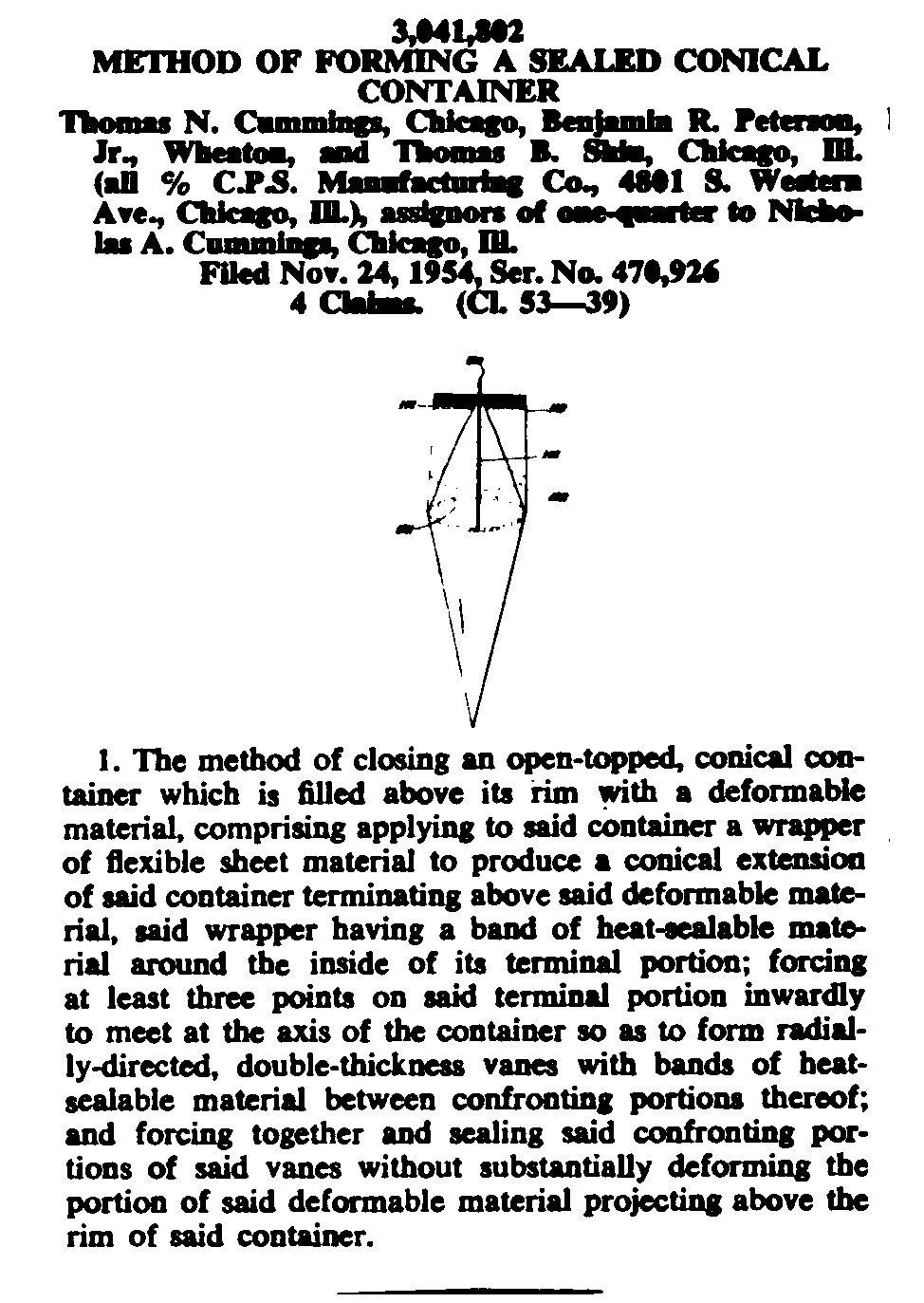
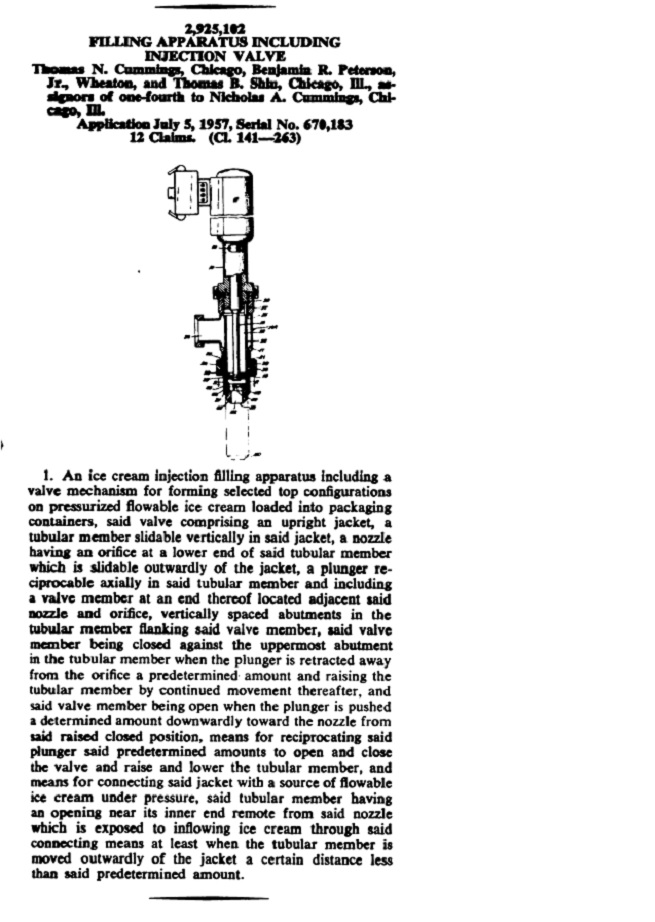
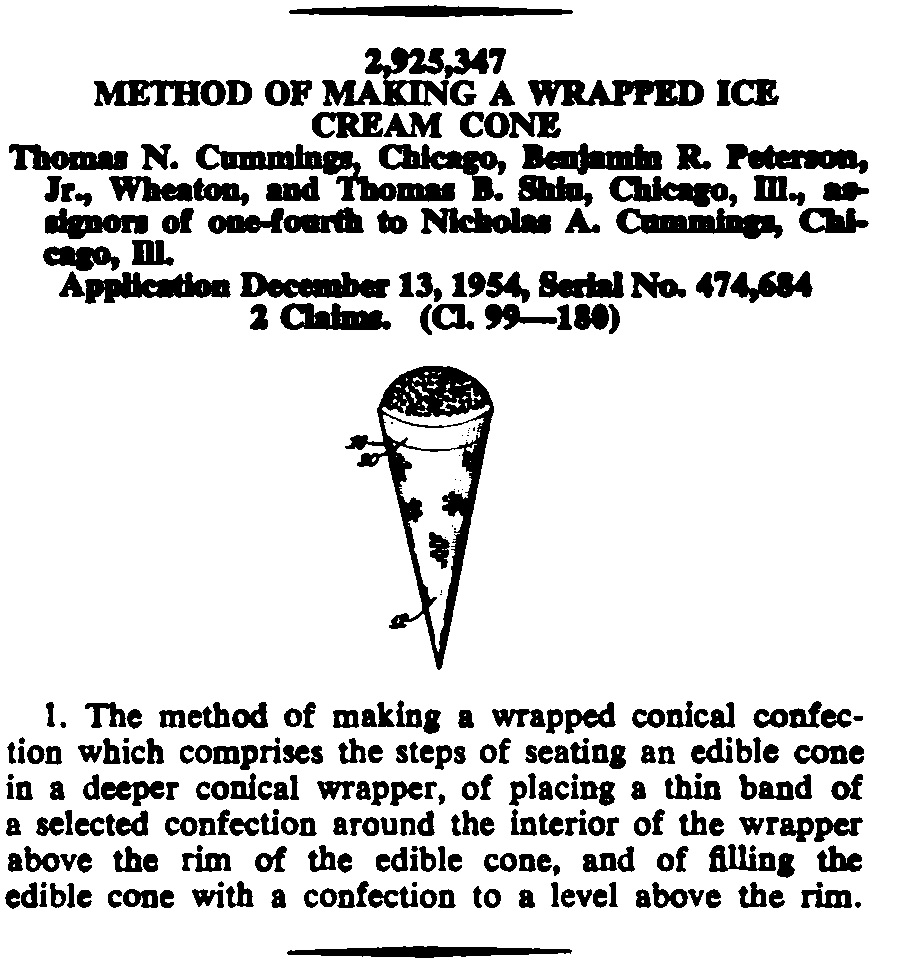
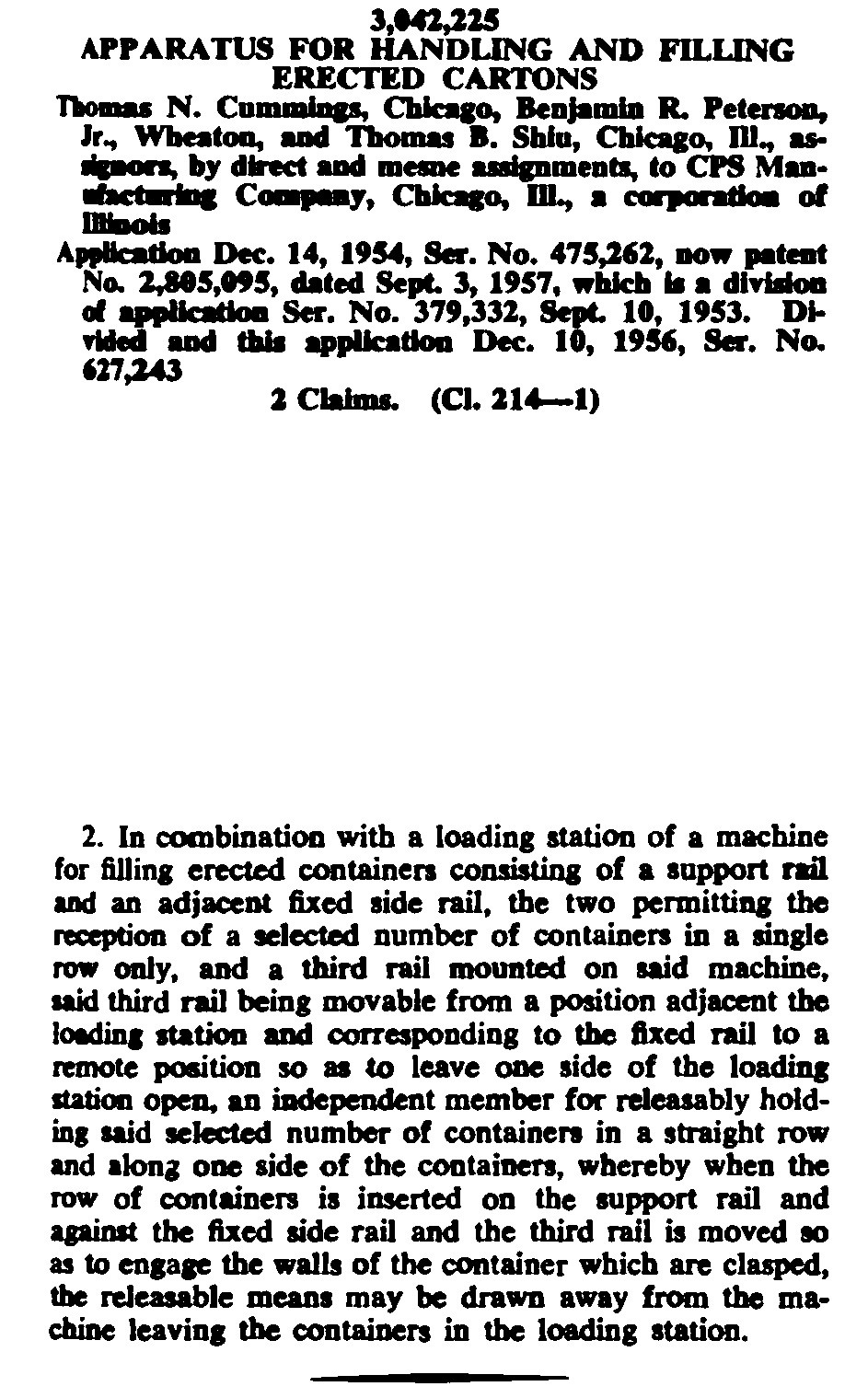
In the late 1950s-early 1960s, Thomas Cummings, working with two other men, was granted at least four patents for innovations in the ice cream industry, and the patents were shared with Nicholas.
The patents were for a filling apparatus including injection valve, a method of making a wrapped ice cream cone, a method for forming a sealed conical container, and an apparatus for handling and filling erected cartons. Those patents are attachments to this post.
The Cummings family listed the Graver House for sale in the summer of 1961.
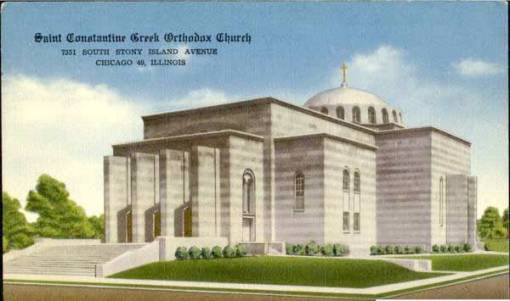
Nicholas Cummings died in November of 1961. His services were held at St. Constantine Church at 74th and Stony Island, once the largest Greek Orthodox church in North America. (The building in now the headquarters of the Nation of Islam.) He was buried in Evergreen Cemetery.
The Graver House remained on the market in 1962. Around Christmastime of that year, the Christmas tree caught on fire. The family escaped without harm, but the living room and foyer were destroyed. The family sold the house in February of 1963.
The next owners, William and Myrtle Heim, repaired the house but didn’t stay there for long. They will be covered in the next post in this series.
For many years, RHS did not know the original appearance of the living room and foyer. Then a few years ago, the Fenn family who sold the house to the Cummings family shared numerous photos that showed details of the house up to the early 1960s.
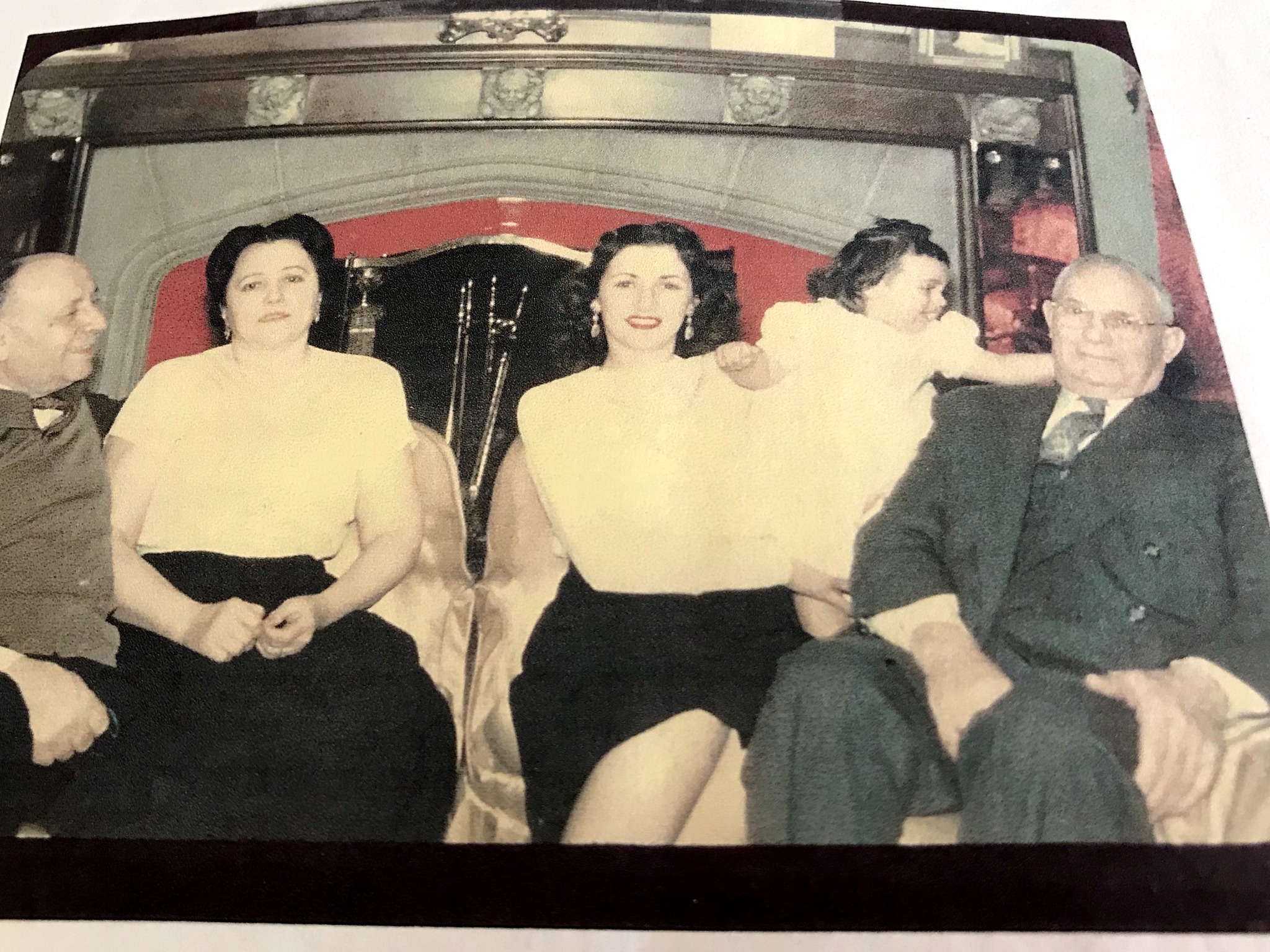
There also is one picture from the Cummings family that shows them in front of the fireplace that was destroyed in the fire, attached to this post.
TODAY.
Reminder – this event is tomorrow. There are two showings – one in the afternoon from 1:30 – 3 pm, and this one in the evening. No ticket required, no fee – just come!
Reminder! FREE one-time showing of the mural of the Beverly/Morgan Park community on Wednesday, July 26. Two times – also 1:30 to 3:00 pm. See the link below for details.
See the details in the link below. A special, one time only opportunity, to view the mural of the community painted by the late Jack Simmerling.
Covered in the @[100063654336223:2048:The Beverly Review], online today and out in print tomorrow, the planned "Pop-Up History" event at Smith Village next week.
I hope people will take advantage of this opportunity to see this interesting mural by the late Jack Simmerling. If this is a success, we will explore other "Pop-Up History" opportunities.
The Ridge Historical Society
Part 13 – The Hofer Sisters – Conclusion
By Carol Flynn
By 1920, after having lived on the Ridge for about twenty-five years, the Hofer family had departed from the Beverly area. Some of the sisters stayed in Chicago, and some relocated to other states. They continued active careers for many more years.
Oldest sister Mari Ruef Hofer was recorded as living with her sister Andrea’s family in Hyde Park on the 1920 U.S. Census. By the late 1920s, she had relocated to Santa Monica, California, where her youngest sister Elsa Hofer Schreiber and Elsa’s family lived.
Mari died in 1929 at the age of 71 and was buried in Santa Monica.
The Oakland, California, Tribune noted at the time that Mari had been a faculty member at the University of California, Berkeley and in the summer of 1929 had presented pageants in the university’s Greek theater. She had just started the Greek Art Club of Berkeley.
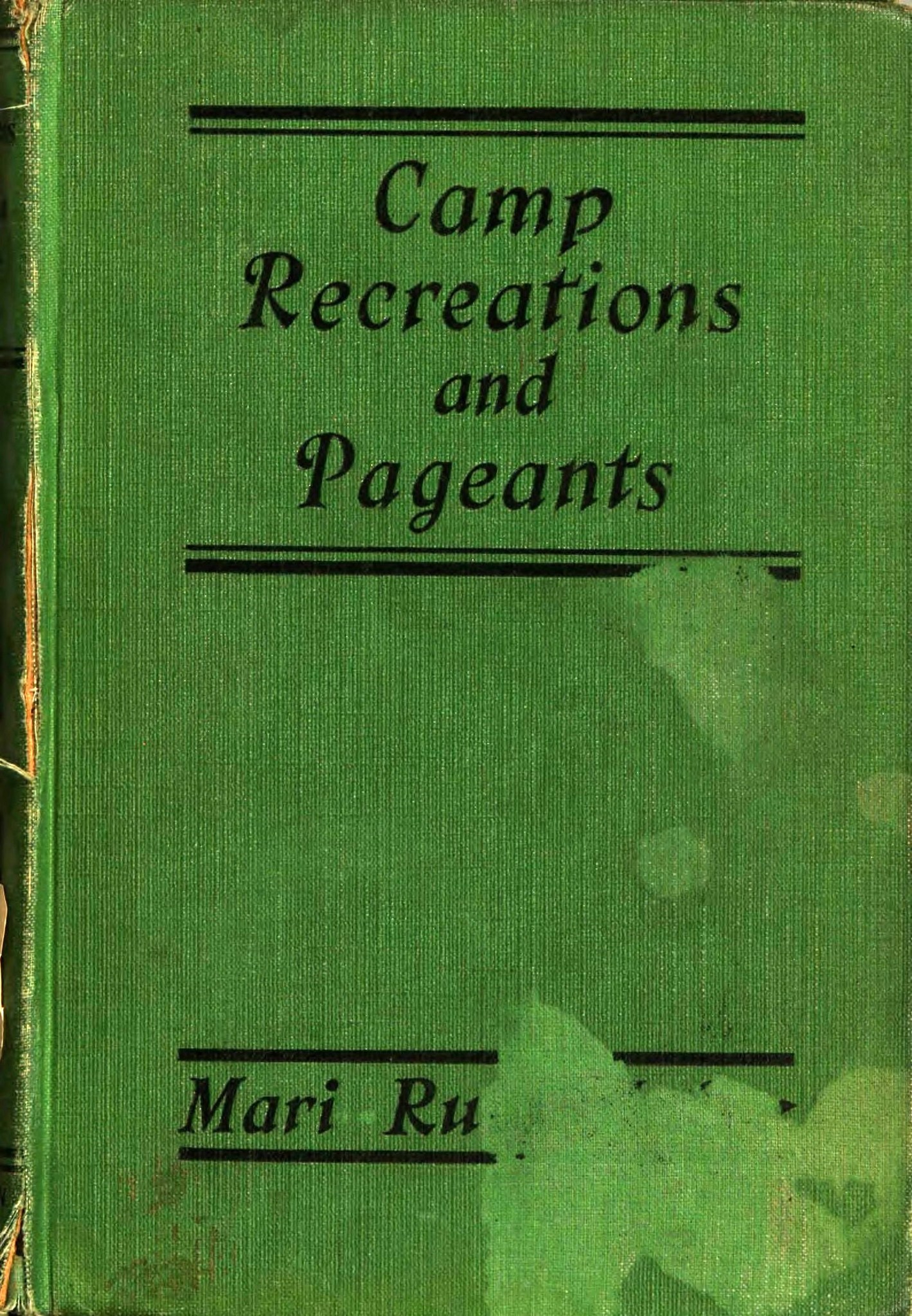
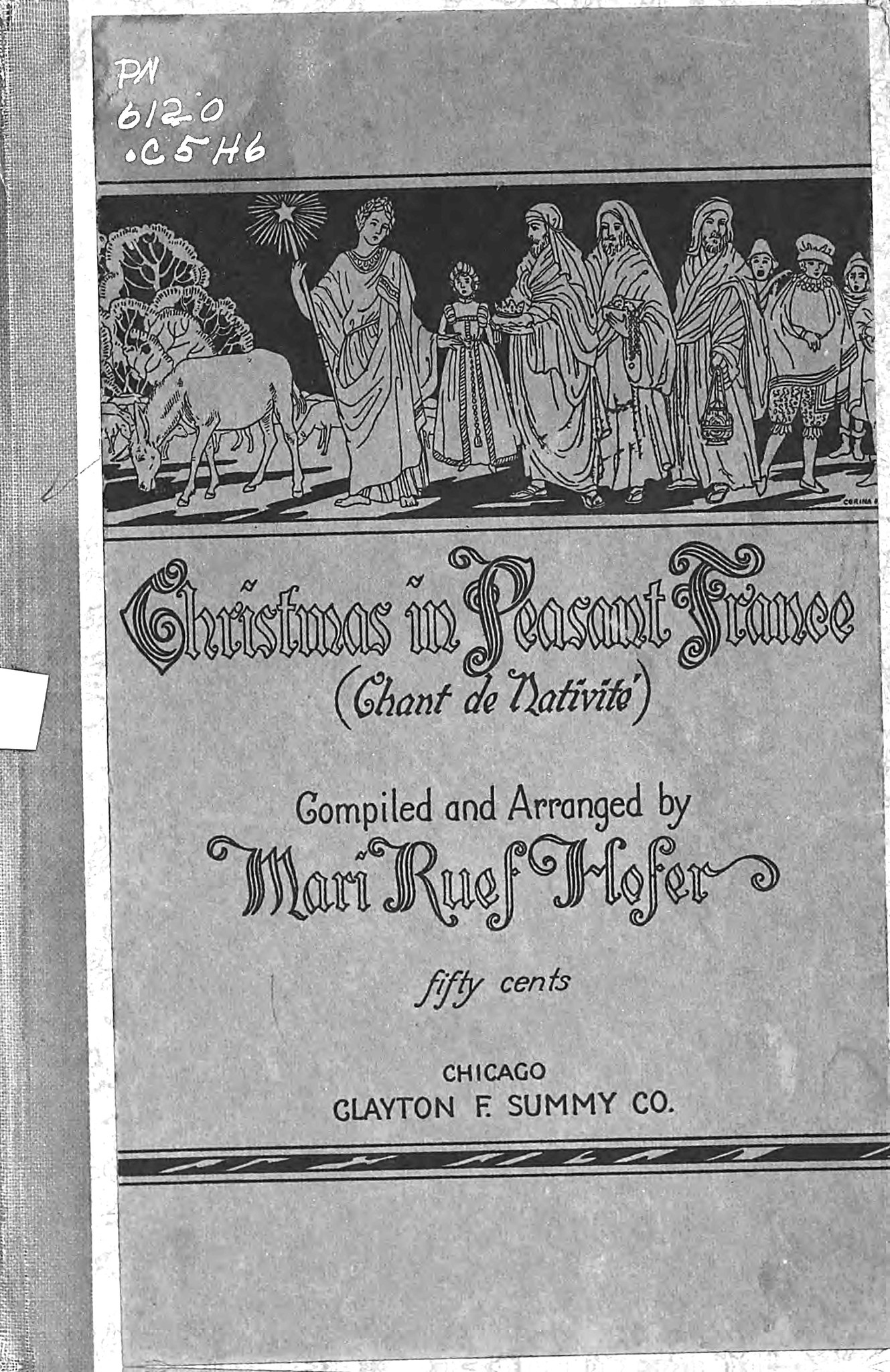
Mari had continued to write and adapt music and folk dances for use in education and recreation programs. In 1926, she published “Christmas in Peasant France,” a Christmas play, and “Festival and Civic Plays from Greek and Roman Tales.” In 1927, she published “Camp Recreations and Pageants.”
Second sister Bertha Hofer Hegner lived in West Chicago, and upon her death in 1937 at the age of 75, was buried in Graceland Cemetery on Chicago’s north side.
Bertha was the President of both the Pestalozzi-Froebel Teachers College and the Columbia College of Expression until her retirement in 1936.
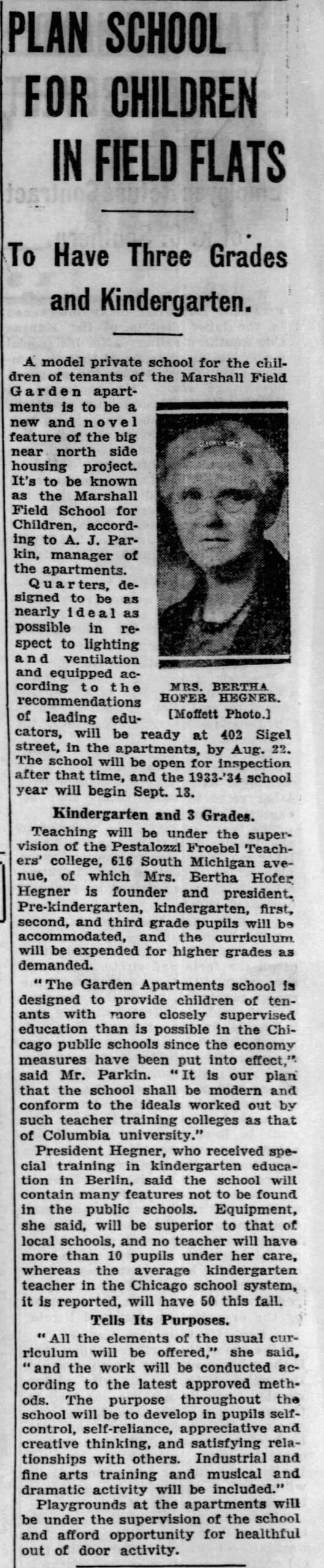
Bertha developed new education programs throughout her career. One of her later accomplishments was detailed in a 1933 Chicago Tribune article which is attached to this post. She developed and administered a kindergarten, grade school, and playground in the Marshall Field Garden Apartments, a housing development directed by Marshall Field III of the department store family to provide affordable housing and to spur development in the surrounding areas. The apartments, located at 1400 North Sedgewick Street in Old Town, are still in use today as subsidized housing.
Amalie Hofer Jerome, the third sister, and her husband Frank, were living in Hyde Park in 1920. After her husband died in 1933, she moved to their summer house in Michigan. She died in 1941 at the age of 78, and was buried in Mount Hope Cemetery on 115th Street on the Ridge, where her husband was also buried. She is the only Hofer sister to be buried on the Ridge.
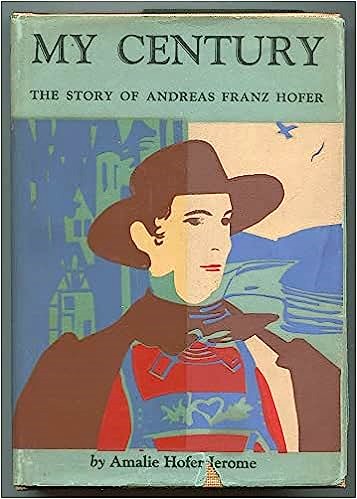
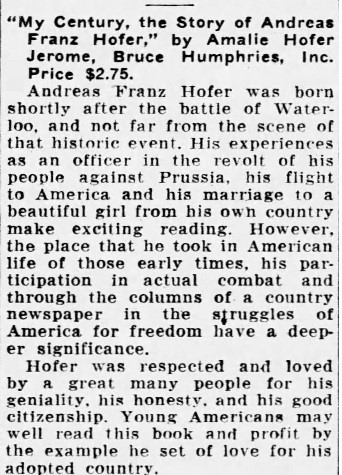
Amalie adapted her father’s diary into a biography, and in 1939 published “My Century – The Story of Andreas Franz Hofer.” The book was reviewed by newspapers around the country. The Shreveport Journal in Louisiana gave a poignant review of the book that is attached to the post.
Andrea Hofer Proudfoot also stayed in Chicago, living in Hyde Park. Later, she and her husband Frederick apparently had homes in both Iowa, where Andrea grew up, and in Chicago. They both died in Chicago and were buried in McGregor, Iowa. Andrea was the last of the Hofer sisters, dying in 1949, at the age of 83.
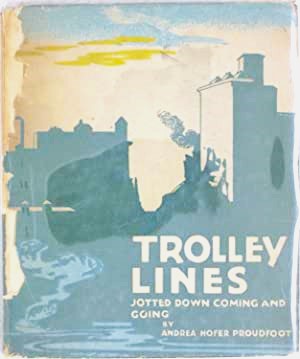
Andrea was always a poet at heart. In 1919, she published a book of poetry called “Trolley Lines, Jotted Down Coming and Going.” It was called “Cubist verse” by Reedy’s Mirror, a literary journal of the day. Cubist writing took its cues from artists like Picasso during the Cubism period of the early 1900s. The objective observation of the external world was replaced by the “stream of consciousness” inner workings of the mind. One review said of Andrea’s work that it was “the new poetry but one can understand it.”
Andrea was president of the Poetry Lovers of America, and a member of the Dill Pickle Club, an unconventional Chicago social club that fostered free speech and good conversation for uninhibited people. “The Pickle” was Chicago’s answer to the “Bohemian” clubs of Greenwich Village in New York City. Andrea was instrumental in raising the money to build a clubhouse for the group on the near north side.
Elsa Hofer Schreiber and her artist husband George and their children moved to the west coast, first to Salem, Oregon, where several of the Hofer brothers lived, and by 1920 they were settled in Santa Monica, California, where George became known in the California arts scene.
Elsa died in 1942 at age 73 while at a daughter’s house in Battle Creek, Michigan. Her death certificate records she was cremated at Graceland Cemetery in Chicago, and burial records report she was buried in Woodlawn Cemetery in Santa Monica.
Elsa had participated in numerous professional activities with her sisters and had run the school she and Andrea started in Beverly, but she was also very home- and family-oriented, a pattern set by her own mother, who lived with Elsa in her final years. Most of the later stories about Elsa revolve around her family.
In 1923, a double wedding took place at the Schreiber house the day after Christmas. Daughter Madelaine and son Armin married their respective fiancés in a gala ceremony with holly and poinsettia as the backdrop, and their brothers and sister in attendance. The following week, at New Year’s, a reception for the newlyweds was held at the Schreiber house.
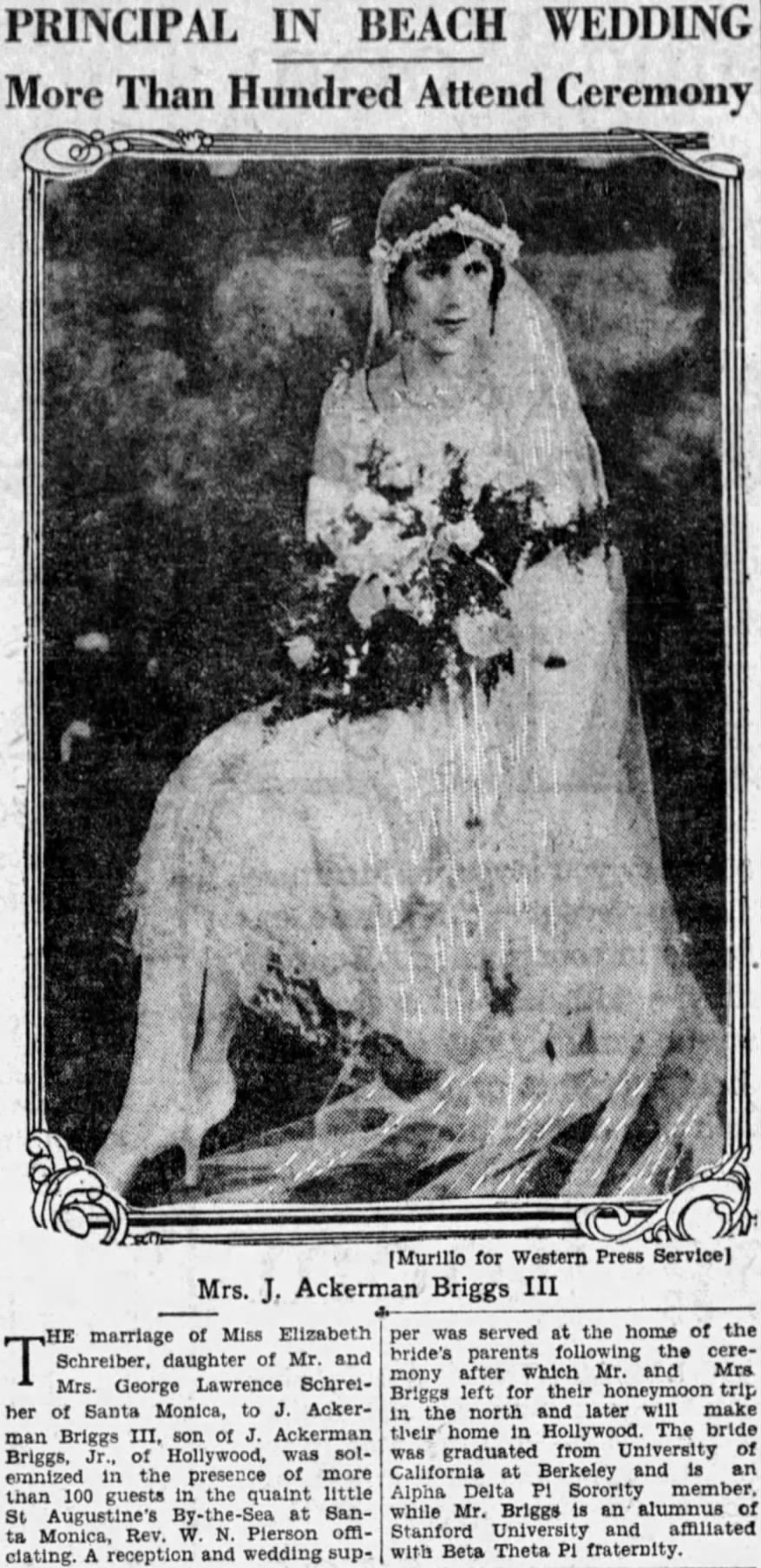
In 1927, daughter Elizabeth was married in Santa Monica. The announcement is attached to this post. As no pictures of Elsa as an adult have been located so far, this picture of her daughter gives a clue as to her possible appearance.
In 1928, tragedy struck Elsa’s family when their youngest child, George L. Schreiber, Jr., died just as he was graduating from the University of California, Berkeley. The cause of death was attributed to ptomaine poisoning.
Father Andreas Franz Xavier Hofer died in 1904 in Beverly and was originally buried in Mount Hope Cemetery in Chicago. Mother Mari Ruef Hofer relocated with youngest daughter Elsa. Mari died in Santa Monica, California, in 1918, and was buried there in Woodlawn Cemetery. Her husband’s remains were relocated from Chicago to that cemetery to be buried with her.
Sons Frank and Andrew were buried in Salem, Oregon, and son Ernest in Portland, Oregon.
This concludes the series on the Hofer family who called Beverly home. Truly, this family personified the spirit of the Progressive Era.
Second showing!
The "Pop-Up History" event is a go! Please join us – first showing.
Pop-Up History on the Ridge – View the Jack Simmerling Mural "Life on the Ridge" at Smith Village
Mark your calendars!
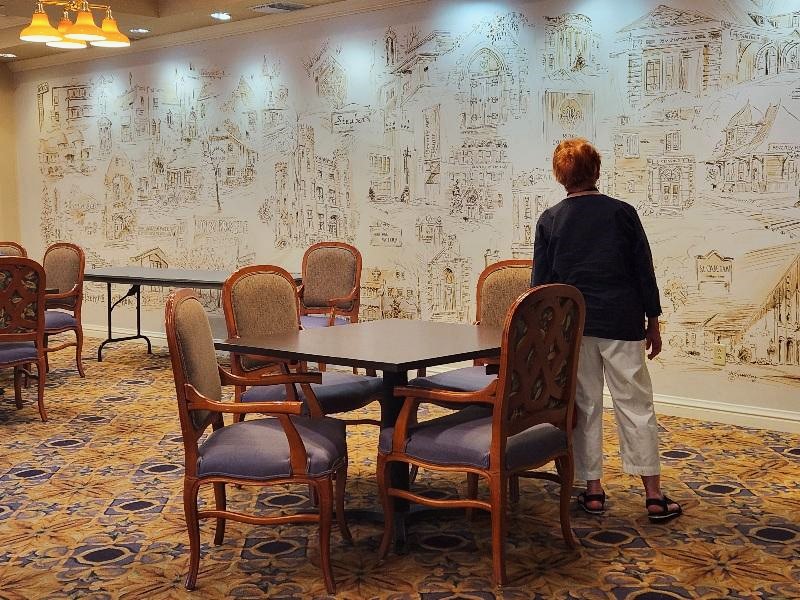
The interest in the Jack Simmerling mural, "Life on the Ridge," at Smith Village is leading to the first ever (to my knowledge) Pop-Up History event in the Beverly/Morgan Park community. If this is successful, maybe we'll be able to do others at places not usually open to the public, like some of the churches with great stained-glass windows, etc.
I did not get any feedback that this event would be a scheduling conflict with other events in the neighborhood but if it is, please let me know.
Details:
What: View the Jack Simmerling Mural at Smith Village – "Life on the Ridge"
Date: Wednesday, July 26, 2023
Times: Two showings – 1:30 to 3:00 p.m., and 7:00 – 8:00 p.m.
Address: 2320 West 113th Place, Chicago – come into the main entrance and you will be directed from there.
Hosts for the day: Elaine Spencer, Past RHS President and Smith Village resident, and Carol Flynn, local historian/journalist
Cost: Free, parking on site or on the local side streets
Jack Simmerling’s daughter Meg Simmerling is expected to be our guest for the first session. We look forward to her insights on her father’s work.
Any questions? Message me through Facebook – Carol Flynn.
Note that this is not an official RHS program. Elaine and I are doing this as a pilot test to see if events like this go over with the public. Thank you for your support!
This image is of Elaine Spencer viewing the Jack Simmerling mural at Smith Village.