
Explore the RHS Facebook Archives, a rich repository of local history written by Carol Flynn. For two decades, Carol brought a deeply dedicated voice to public education at RHS. Her role as Facebook administrator through mid-2025 naturally extended her prolific research into meticulously detailed articles, most notably her multi-part historical series posts. Today, Carol continues her local history writing for The Beverly Review and other outlets.
June 2020
Notice to the followers of the Ridge Historical Society. Our website is currently down because we are revamping the entire thing. We are even changing the domain name. It will become www.ridgehistory.org to match our email address which is ridgehistory@hotmail.com. So delete any connection you have to the old address – ridgehistorical.org. That no longer exists! Thank you!
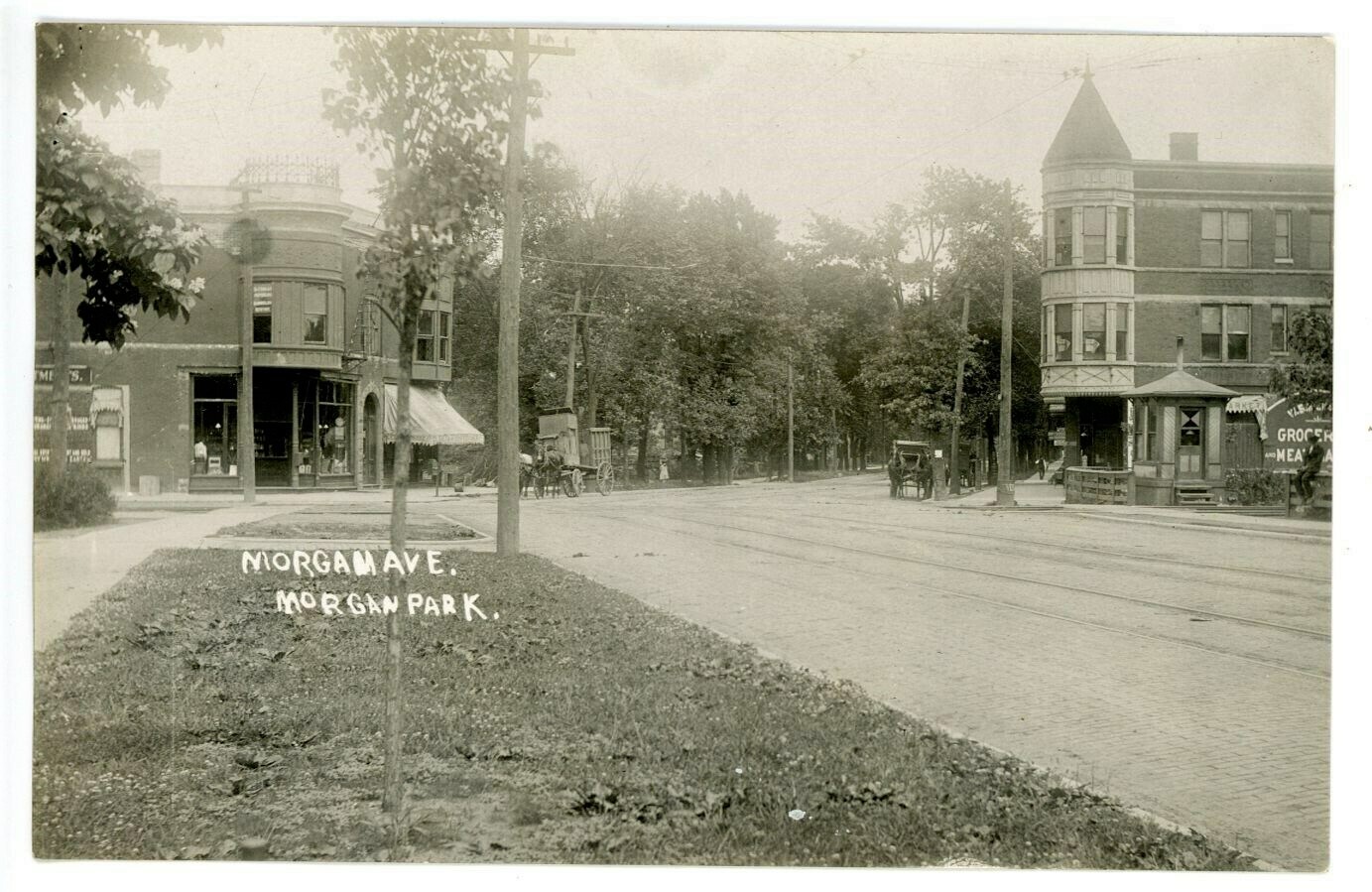
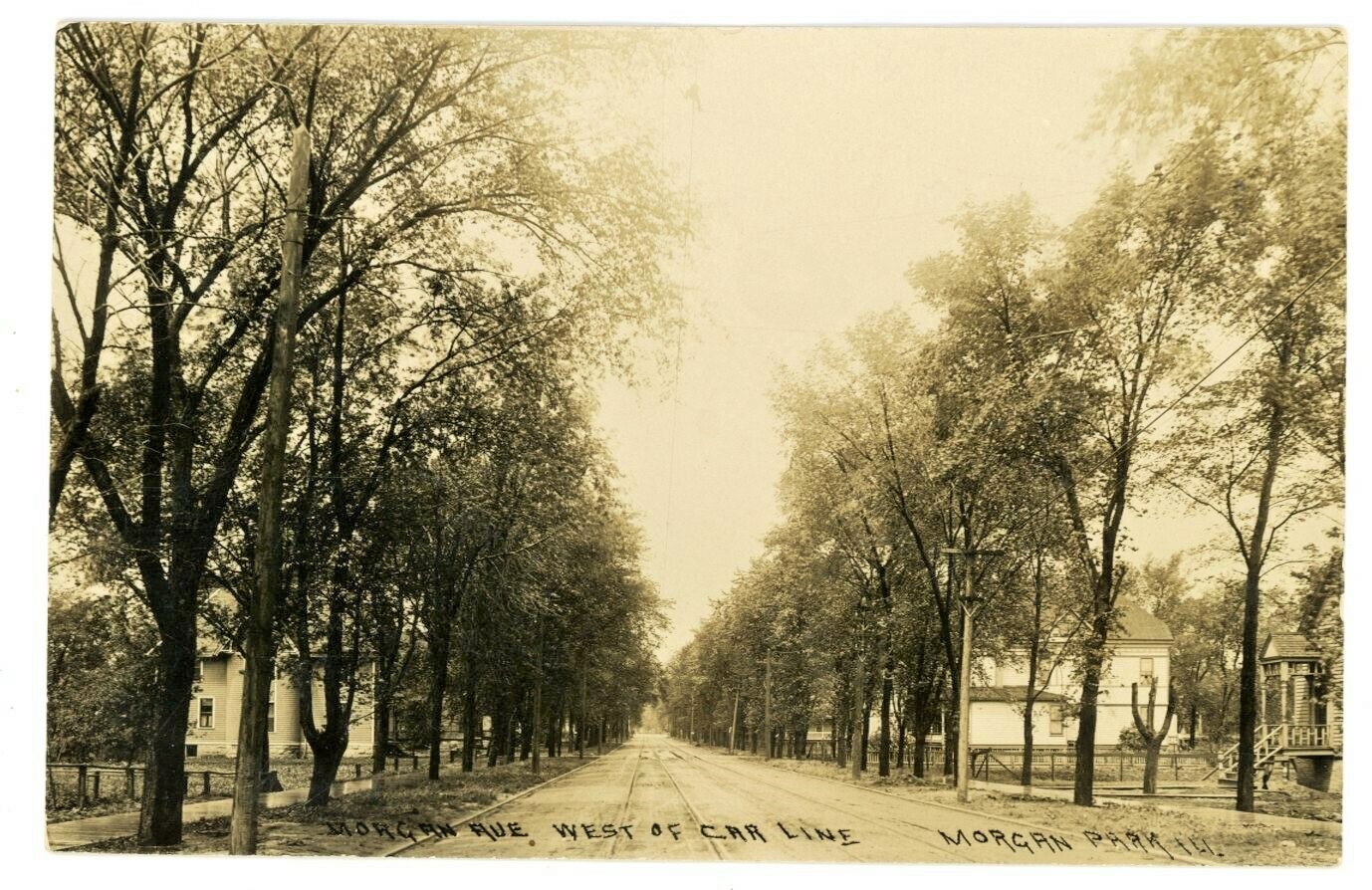
Here are some real picture postcards (RPPCs) that show Morgan Avenue ca. 1910. We've posted before about RPPCs being very popular in the first decade of the 1900s. Cameras were becoming more affordable and portable, and traveling photographers took pictures of everything from neighborhoods to parades to disasters. And we are happy they did so, because these RPPCs are invaluable documentation of local history.
Morgan Avenue was the old name for 111th Street and Monterrey Ave. The picture of the stores would be just east of the Metra tracks, facing east. We're trying to place the other one. It could about where Morgan Park High School is now, facing west. The high school was built in 1914-16, so this would predate that. Actually, it predates Morgan Park's annexation to Chicago, which happened in 1914. Another option is that it could be west of Western Ave., heading toward the cemeteries.
Ridge Historical Society
By Carol Flynn
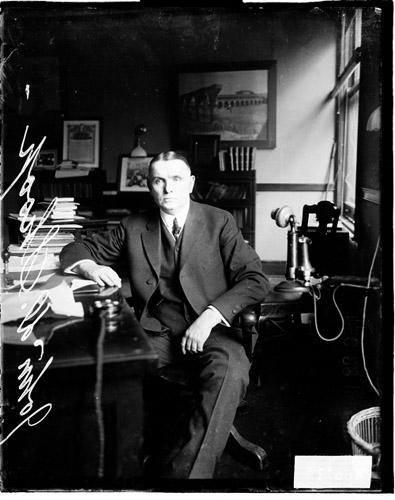
School Series – Profile 6: John D. Shoop (1857- 1918)
This is sixth in our series on people for whom schools on the Ridge are named.
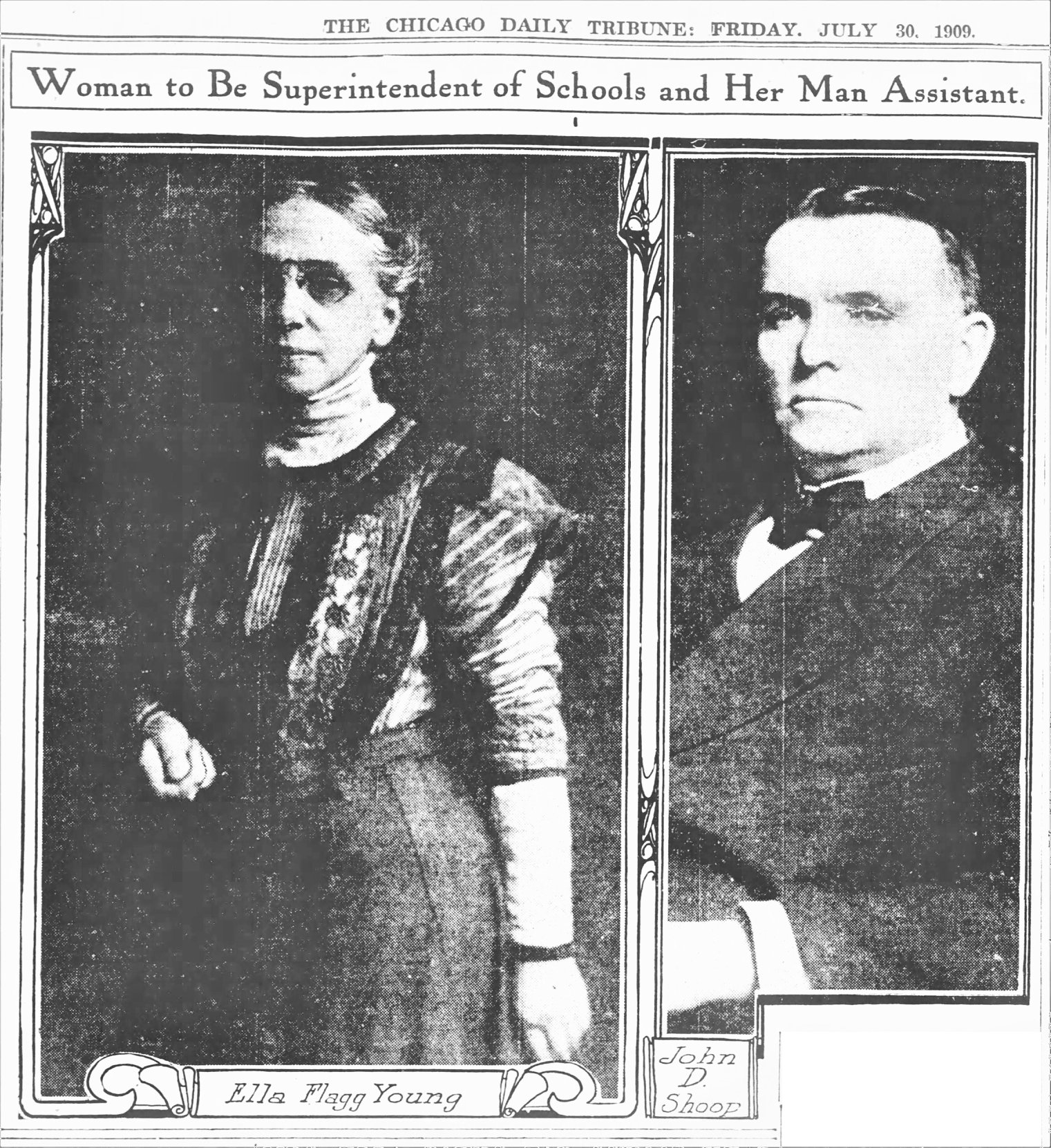
John Daniel Shoop was Superintendent of the Chicago Public Schools from 1915 to 1918. He was a highly regarded educator and administrator. His history is closely linked to that of Ella Flagg Young (1845-1918), the first woman elected as Superintendent of Chicago schools.
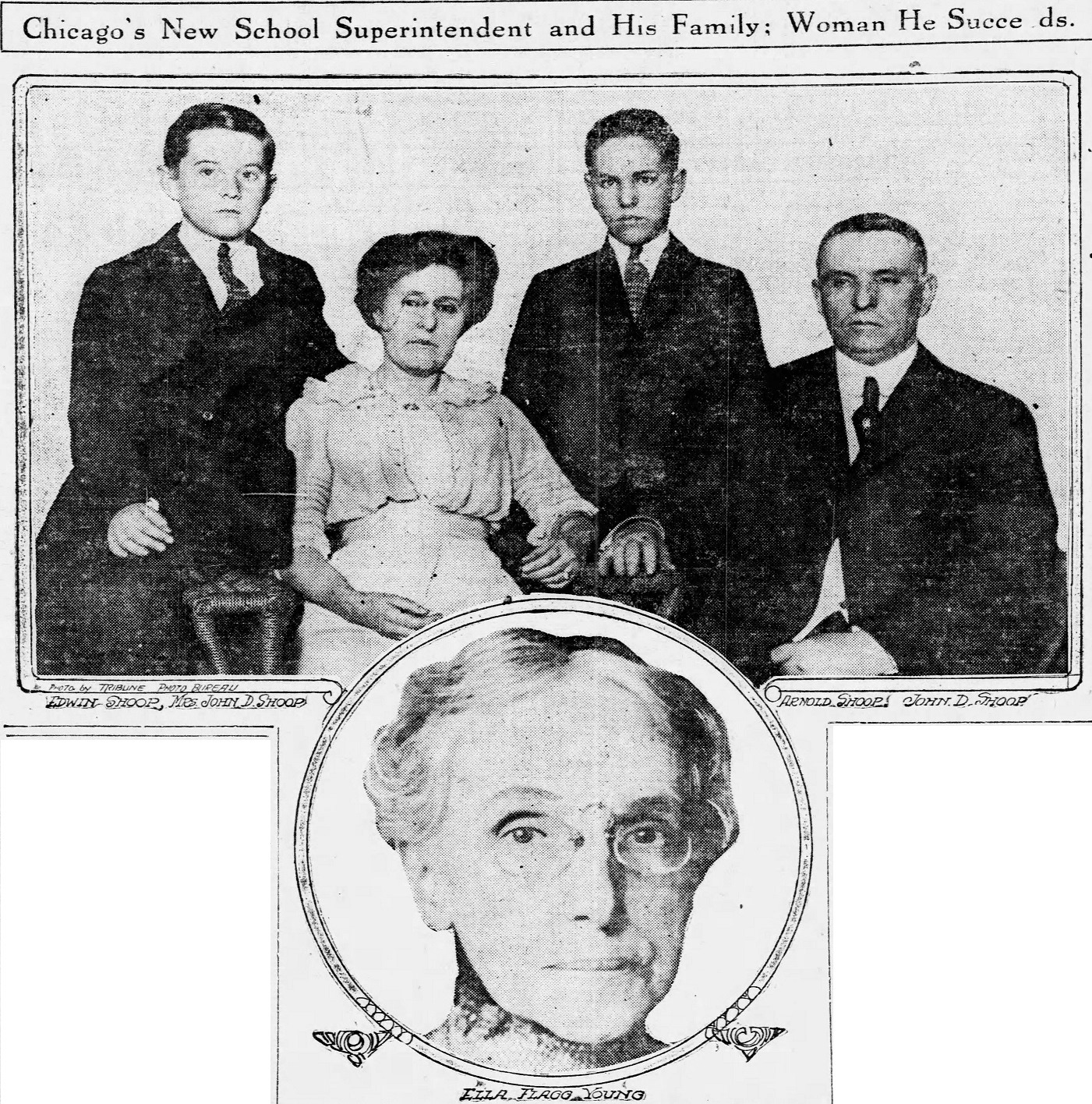
Shoop was born on a farm in Ohio. He attended the Indiana Normal University (“normal” schools trained teachers in the “norms” or standards for how to educate children) and the University of Chicago. He served as superintendent of schools in Gibson City, IL, from 1890 to 1896, and then in Paris, IL. In 1901, he moved to Chicago with his wife Jennie and their two sons to become the principal of a public school.
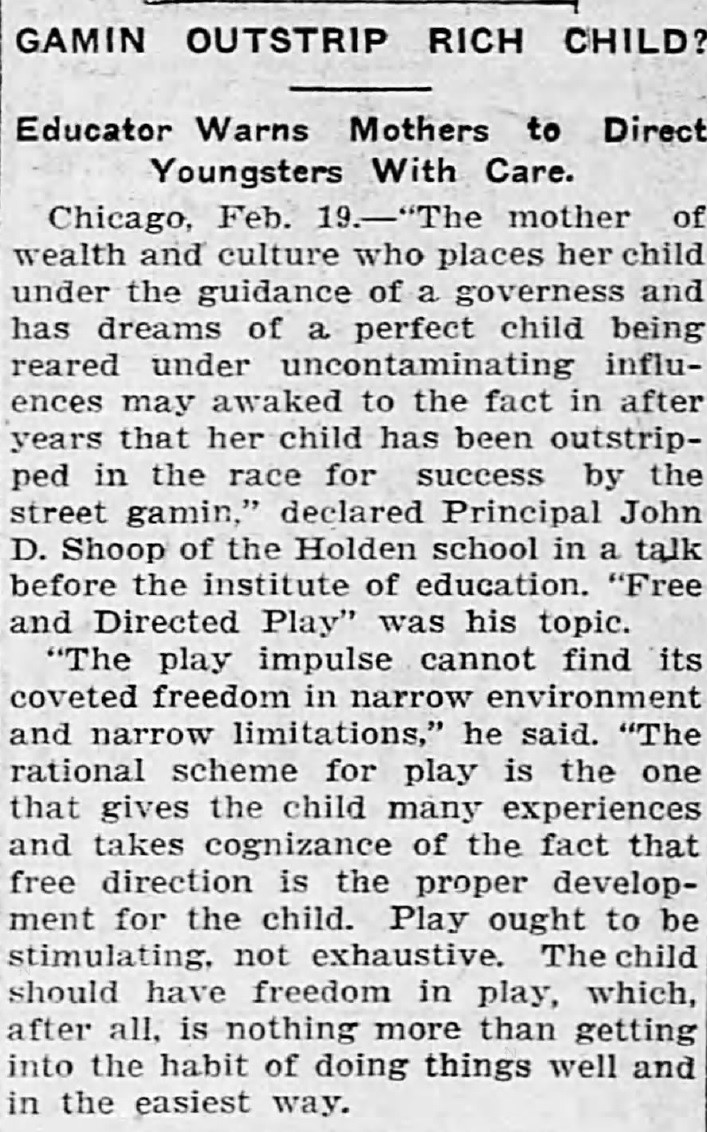
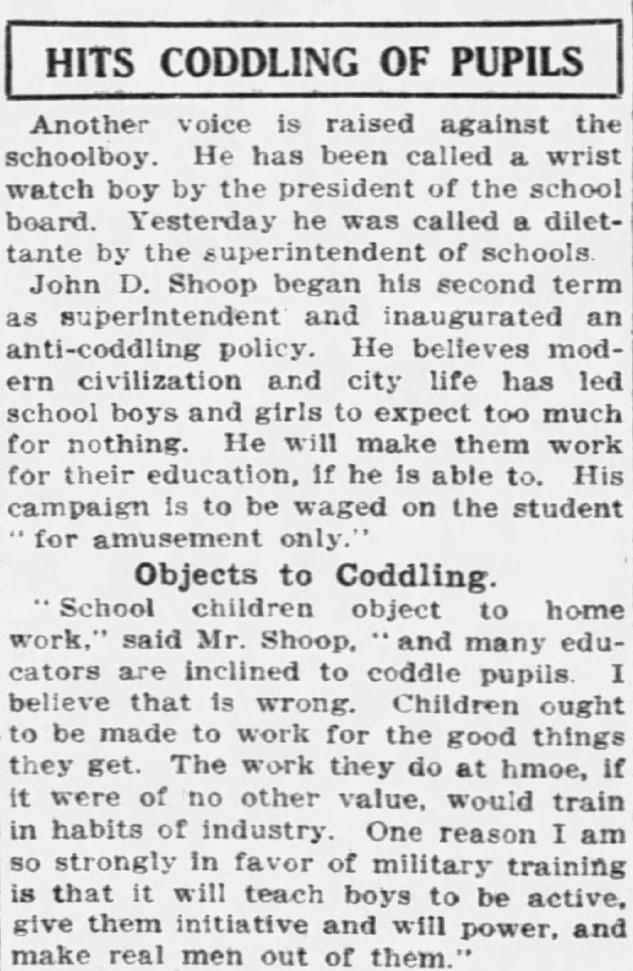
Shoop established himself quickly in Chicago. He had excellent public speaking skills and loved to recite poetry. He was a frequent and popular guest speaker, often quoted in the newspapers. Two examples of his views are attached to this post. He was made chief of “vacation schools” in 1908. These were summer programs, mainly for poorer inner-city children, designed to provide educational and recreational activities during the summer months.
In 1909, the Chicago Board of Education (CBOE) was tasked with electing a new Superintendent of schools. Candidates included Shoop and several other men, and Ella Flagg Young. Shoop was considered by many as the front runner. Then the Board made a surprising and historic decision; they elected Young as the Superintendent, the first woman to advance to this position. Shoop was elected as the Assistant Superintendent.
If any woman was going to break through the “glass ceiling” of the CBOE, Ella Flagg Young had the qualifications. She was recognized as a brilliant and progressive educator and had many supporters in the public arena as well as the education field. She had a Ph.D. from the University of Chicago and was now a professor there. She had been a district superintendent and she was currently principal of the Chicago Normal School.
Shoop embraced his duties as Assistant Superintendent. He dealt with many of the everyday issues of running the schools. He was an advocate of industrial/vocational training. He worked with city businesses to develop paid work/school programs for children forced by economic necessity to quit school to go to work. (Note: The U.S. Census showed that between 1890 and 1910, at least 18% of children in the U.S. ages 10 to 15 worked. There were cases of children as young as 5 years old working in factories or in “street trades” like selling newspapers.)
Shoop helped bring the new Boy Scouts of America organization to Chicago. And he was no stranger to the Ridge. In 1912, he spoke at the graduation exercises at Morgan Park Academy.
For three years, Young and Shoop were unanimously re-elected to their positions. Then in 1913, without warning, school board directors who were against Young managed to gather enough votes to remove her from the Superintendent position. They accused her of mismanagement of funds and making the school system inefficient. They called into question her integrity and competence. Realizing she did not have the support to continue, Young resigned. The Board elected Shoop to the Superintendent position. Stating publicly that he was surprised and had no knowledge of the plans leading up to this, Shoop accepted the promotion.
Young’s numerous supporters, largely concentrated in the powerful women’s clubs of the day, were outraged by the Board’s decision and treatment of Young. Their call for Shoop’s resignation and Young’s reinstatement was supported by the legendary Jane Addams of Hull House and many other leaders. The teachers of the city strongly supported Young and “hinted” they would strike if she were not reinstated.
Witnesses came forward stating that Shoop had been informed of what the Board planned before it happened, but he continued to deny this. He had his supporters also, making for intense debates.
Mayor Carter Harrison Jr. had appointed five of the directors who led the campaign against Young. He declared himself “betrayed” by their actions. When he appointed them two years previously, he had them all write letters of resignation he could invoke at any time. When they refused to voluntarily step down, he used those letters to declare them “resigned.” He then appointed new directors who supported Young.
Young was asked if she was willing to return if voted back in. She replied she would return if Shoop resigned. Shoop refused to do so.
On Christmas Eve, 1913, the Board voted Young back in as Superintendent and Shoop back in as Assistant. Shoop and the ousted directors said they would seek legal advice. They all took Christmas Day off from political maneuvering, then after Christmas, Shoop surprised everyone by announcing he would accept the new Board decision. He said the good of the school system was more important than his position.
Young and Shoop, both dedicated professionals, met a few days later, resolved their differences, and went back to work. The next year they were once again re-elected unanimously to their positions.
In 1915, Young announced she would not seek re-election as Superintendent, allowing Shoop to finally move into the position. The night of Shoop’s election, Young quietly boarded a train for California. She died in the 1918 influenza epidemic.
As Superintendent, Shoop dealt with many issues, but his term was largely dominated by World War I. He strongly supported establishing military training programs for boys in the schools. He had the “household science” teachers become certified in dietetics (nutrition therapy) by the Red Cross so they could teach the subject to high-school girls. He allocated funds to establish “victory gardens” at any school with a patch of land for the students to farm.
He continued to work closely with business and industry to find training and employment opportunities for high school students. One example was downtown stores training and paying girls to learn sales skills. A number of schools advertised work/study programs for boys.
Shoop was seriously injured in an automobile accident in August 1916 while visiting friends in Paris, IL. He was thrown from the car and knocked unconscious, breaking his collar bone and seven ribs. He had a long, painful recovery.
During his recovery, he had to deal with a scandal on the Ridge. Morgan Park was annexed to the city in 1914 so all the schools were now under his supervision. The principal of Morgan Park High School, John Henry Heil, was accused of sending “poison pen” letters to a woman. Shoop really had little choice but to fire Heil and appoint a new principal. Heil was eventually exonerated but by then his career was ruined. (Note: This is a story we will cover in detail another day.)
In early August 1918, the Illinois Assistant State’s Attorney began investigating irregularities in the school census conducted in 1916 under Shoop’s direction. Allegations included padding the census to receive more money from the state, and filling the census taker positions, paid for by the CBOE, with campaign workers for Mayor “Big Bill” Thompson. Shoop was ordered to turn over all files from the Superintendent’s office that related to the census. He agreed to do so but dragged his feet.
Shoop was in Indiana for a public speaking engagement on August 9 when two policemen set up camp in his office. It was assumed by Shoop’s staff they were waiting for Shoop to return and produce the files.
And then on that same day, while waiting for his ride in the hotel lobby in Indiana, John Shoop died of a heart attack at the age 61.
Shock waves went through the communities that knew Shoop. His remains were brought back to Chicago. He lay in state in the Chicago Normal School rotunda, then followed a funeral service attended by thousands of people. His family took him back to Ohio for burial.
The Assistant State’s Attorney Office declared it would continue investigating the census but that Shoop himself had not been involved in any wrongdoing.
Shoop was remembered for “giving to every boy and girl the maximum of opportunity.” He was remembered for “never losing sight that the children were the chief factor” in the education system.
The new John D. Shoop school at 11140 S. Bishop Street opened in 1926.
Ridge Historical Society
By Carol Flynn
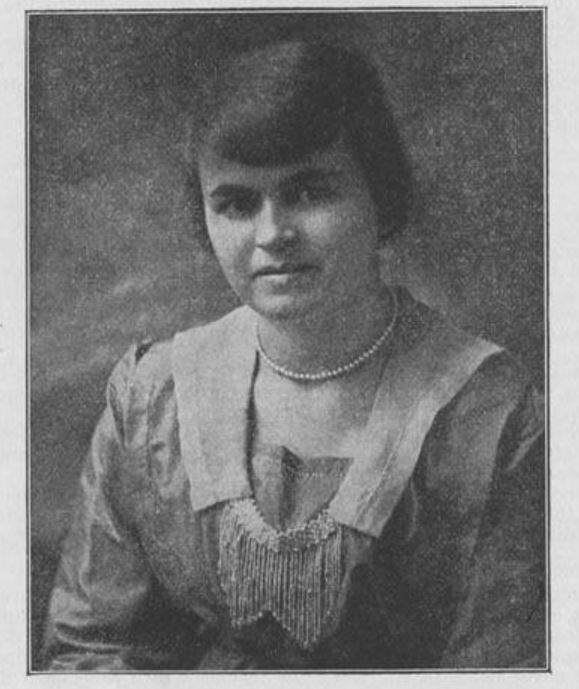
School Series – Profile 7: Annie Keller (1901 – 1927)
This is the seventh profile in our series on people for whom schools on the Ridge are named.
Anna Louise Russell Keller was a young teacher who lived downstate and became a hero. Although she never lived in Chicago, her story was so compelling it earned her a school named in her honor, at 3020 West 108th Street.
“Annie,” as she was known, was born in Greene County, IL, on October 31, 1901. Greene County is in the west central part of the state, just north of the St. Louis area. Her mother’s family, Russell, was a pioneer family in that community. Annie attended Illinois State Normal University with her younger sister Mary, and both became teachers.
In 1927, Annie was in her third year of teaching in Centerville, a town in Greene County. She was the only teacher in a one-room brick and wood schoolhouse built in 1848 that still used an old coal stove for heat. The building was described as weather-beaten and “growing feeble,” with cracks in the walls. Still, it had always been sturdy enough to withstand Midwestern weather, and had served many generations of the local community. There were 21 students in the school then, at various grade levels; the oldest student was 15, the youngest, 6.
On April 19, at noontime, there was a severe rain and hail storm, so Annie and the students had to eat their lunches inside. Three of the students ran home for lunch.
A woman who was a 9-year-old student at the school that day recounted forty years later what happened next: “We were all standing at the window. Suddenly there was a lull in the storm and the sky turned black. The wind was getting stronger and stronger. We could see debris flying across the fields. The coal shed next to the school was blown away, and we realized we were in for a tornado.”
With only a few seconds to think, Annie ordered the class to flatten themselves on the floor under their desks. She grabbed the little ones who were too frightened to act and pushed them down.
The students had just gotten to safety and Annie was still by the door when the roof of the schoolhouse was blown off and the school collapsed. Annie was hit by the timber doorframe as it fell.
Another student, then 12, remembered seeing Annie get hit, and called out to her, but there was no response. Then the student was buried by falling bricks and glass as were most of the other students.
Those few students who were not buried frantically started to dig out their classmates. Three farmers who had been working in the fields nearby and witnessed the disaster rushed to the school. One of them was Howard Hobson, Annie’s fiancé. They came across a scene of chaos and devastation, with terrified students screaming and buried in the rubble.
Miraculously, all of the students survived, and there were only minor injuries. Thanks to Annie’s quick thinking, the desks had shielded the children from the worst of the destruction.
Annie’s body was found buried in the debris. Her neck had been broken by the collapsing timber. She was 25 years old.
In 2002, one of the last living students, then age 83, said, “Miss Keller was a wonderful teacher. We respected her and always obeyed her. It hurt us badly that she was killed. I think she saved us all.”
Annie’s funeral two days later was the largest the town had ever seen, attended by over 1,000 people crowding in and around the little Methodist church in White Hall, her hometown in Greene County. A truck was needed to transport all the floral displays people sent.
The papers of the day reported that the tornado had crossed the Mississippi river from Missouri and ripped a path through central Illinois, leaving at least 21 people dead and over 120 injured, and causing over a million dollars in damage. The injured were brought by train to the hospitals in Springfield and other larger towns. Greene County was hit the hardest, right where Annie’s school was.
Within days of the Annie’s death, two memorials were planned. A tablet was to be erected In Carrollton, the county seat, near where the school had been located. In White Hall, the historical society announced plans to raise funds to erect a monument at the public park.
Funds were raised by the schools of Illinois to provide the memorial. Students donated their pennies and the money was sent to Francis G. Blair, the state superintendent of schools, in Springfield. When they raised $5,000, they began a search for an artist to create the memorial.
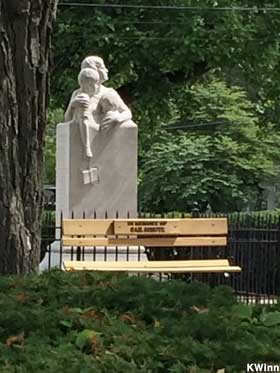
Famous sculptor Lorado Taft contacted them. At the time, he was an instructor at the School of the Art Institute of Chicago. He was interested in the project and offered his services for a greatly reduced fee, and of course they accepted. The memorial originally was to be made of bronze, but Taft decided he wanted to work in Tennessee pink marble instead. The $5,000 did not cover the cost of the marble, so Taft paid the difference himself.
In January of 1929, Mary Keller, Annie’s sister, and a friend, traveled to Chicago to meet with Taft. They were joined by Blair, who also had become personally committed to the project. Mary posed as the model, and Taft also worked from photos of Annie. Mary visited a second time, and reported she was pleased with the sculpture, a bust of Annie with one arm around a boy student and the other arm hugging a small girt student close to her.
Over 3000 people attended the dedication of the monument in August 1929. Her students made a human chain around the monument and laid roses at the base. Superintendent Blair was the host for the event, and a highlight was Taft’s attendance and speech. Said Taft: “There is no more beautiful story than that told in the life and death of Miss Keller. I rejoice in my profession that makes possible this memorial to her if it becomes an inspiration to others.”
People that knew Annie during her brief life described her as a talkative, jolly, light-hearted person, and a good teacher. She was always doing something for someone else. She was not a flashy person. She was an average girl from an average small town who became an average teacher and never had a chance to distinguish herself. She would never have thought of herself as a hero. But when the emergency came, it took her less than 10 seconds to prove herself. She rose to the occasion.
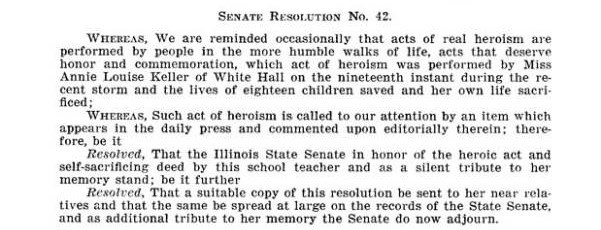
The Illinois State Senate passed a resolution paying honor to Annie’s heroism. A copy of that resolution is attached.
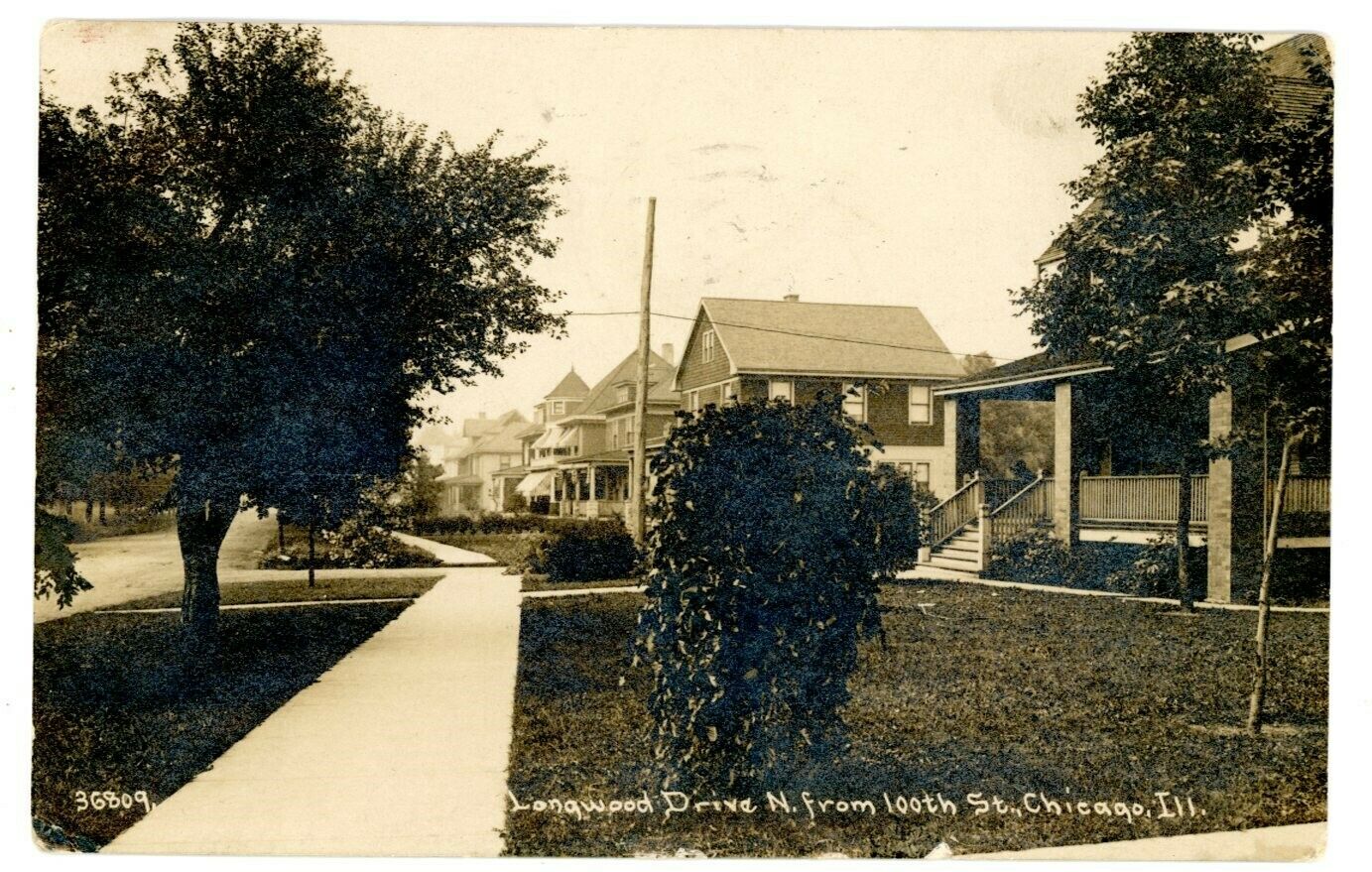
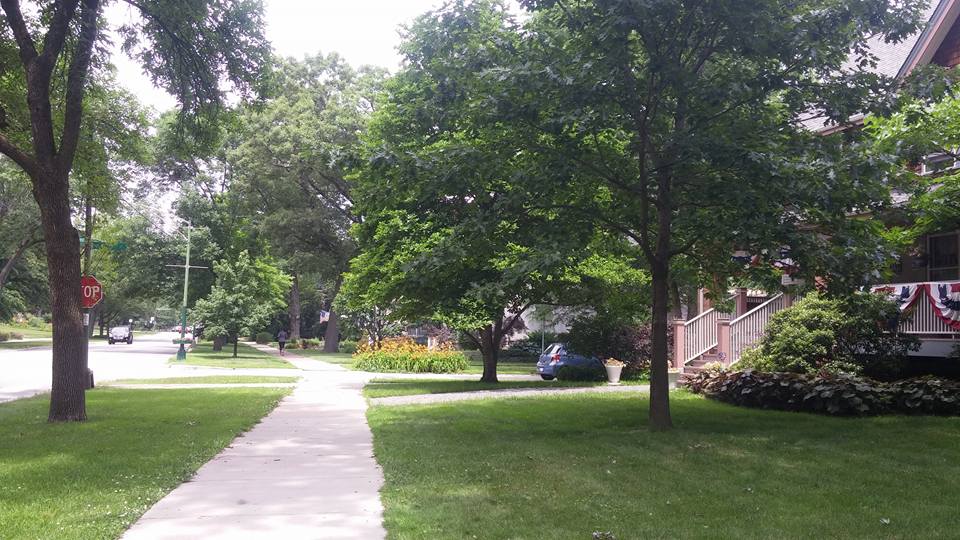
Time for another real picture postcard (RPPC) scene, then and now. This is standing about two houses in on 100th Street and Longwood Drive, east side of street, looking north. Looks like most of these houses are still there – the post card is probably ca. 1910. But there are so many trees (good!!) you can't really see the houses. We'll have to do this again in the fall/winter.