Explore the RHS Facebook Archives, a rich repository of local history written by Carol Flynn. For two decades, Carol brought a deeply dedicated voice to public education at RHS. Her role as Facebook administrator through mid-2025 naturally extended her prolific research into meticulously detailed articles, most notably her multi-part historical series posts. Today, Carol continues her local history writing for The Beverly Review and other outlets.
May 2022
The Ridge Historical Society
Happy Mother’s Day!
By Carol Flynn
“All that I am, or ever hope to be, I owe to my angel mother.” —Abraham Lincoln
For thousands of years, societies have honored motherhood. The ancient Greeks and Romans paid homage to the mother goddess Cybele. In Rome, she was known as Magna Mater, the Great Mother.
In the United States, modern Mother’s Day has its origins in the pacifist movement and concern for veterans.
Mother’s Day was founded to honor peace activist Ann Jarvis, by her daughter Anna. Jarvis cared for wounded soldiers on both sides during the Civil War. She created Mother’s Day Work Clubs to address public health needs. Her daughter wanted to continue the work her mother started and to honor mothers for all they do.
In 1908, the U.S. Congress rejected the proposal to officially establish Mother’s Day. The men joked they would have to create a “Mother-in-Law’s Day” also. But by 1911, all the states had adopted the day, and in 1914, President Wilson proclaimed it a national holiday.
Anna Jarvis came to regret she ever came up with the idea when the holiday became excessively commercialized. Hallmark Cards began selling pre-made cards in the early 1920s, and this exploitation of the day for profit infuriated Jarvis. She wanted people to really think about their mothers, to honor their mothers with hand-written testimonials, not to resort to just buying gifts and pre-made cards. She wound up organizing boycotts of Mother’s Day, and was even arrested for disturbing the peace.
Now, the moral of this story is not to stop buying gifts for Mom! It is to sincerely and personally reflect upon her importance in one’s life, and to acknowledge this to her.
Today Mother's Day is one of the most recognized and celebrated days of the year. It not only honors the mothers of our families; it honors maternal bonds and the influence of mothers in society.
REMINDER!! TONIGHT!!
Friday, May 13th, from 6:00 to 8:00 p.m., RHS will host a "BAPA Porch concert, featuring the band Leadfoot"
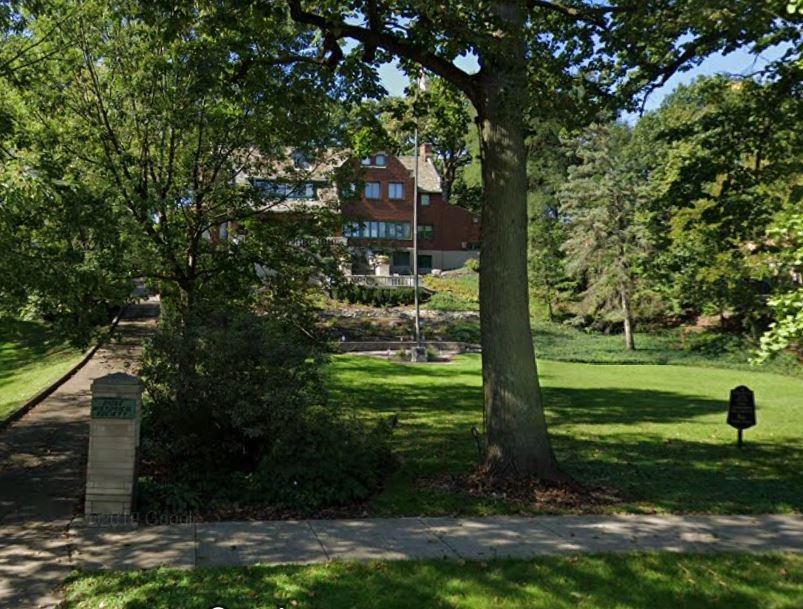
The first Beverly Area Planning Association (BAPA) Porch Concert of 2022 will be at RHS, kicking off the Home Tour Weekend. Join us on the big lawn on the Longwood Drive side for this great event featuring the popular local group Leadfoot. Bring a blanket or chairs and any beverages and snacks you would like. Reps from RHS and BAPA will also have tables there to answer any questions. Free Event. The Longwood Drive address is 10616 S. Longwood Drive.
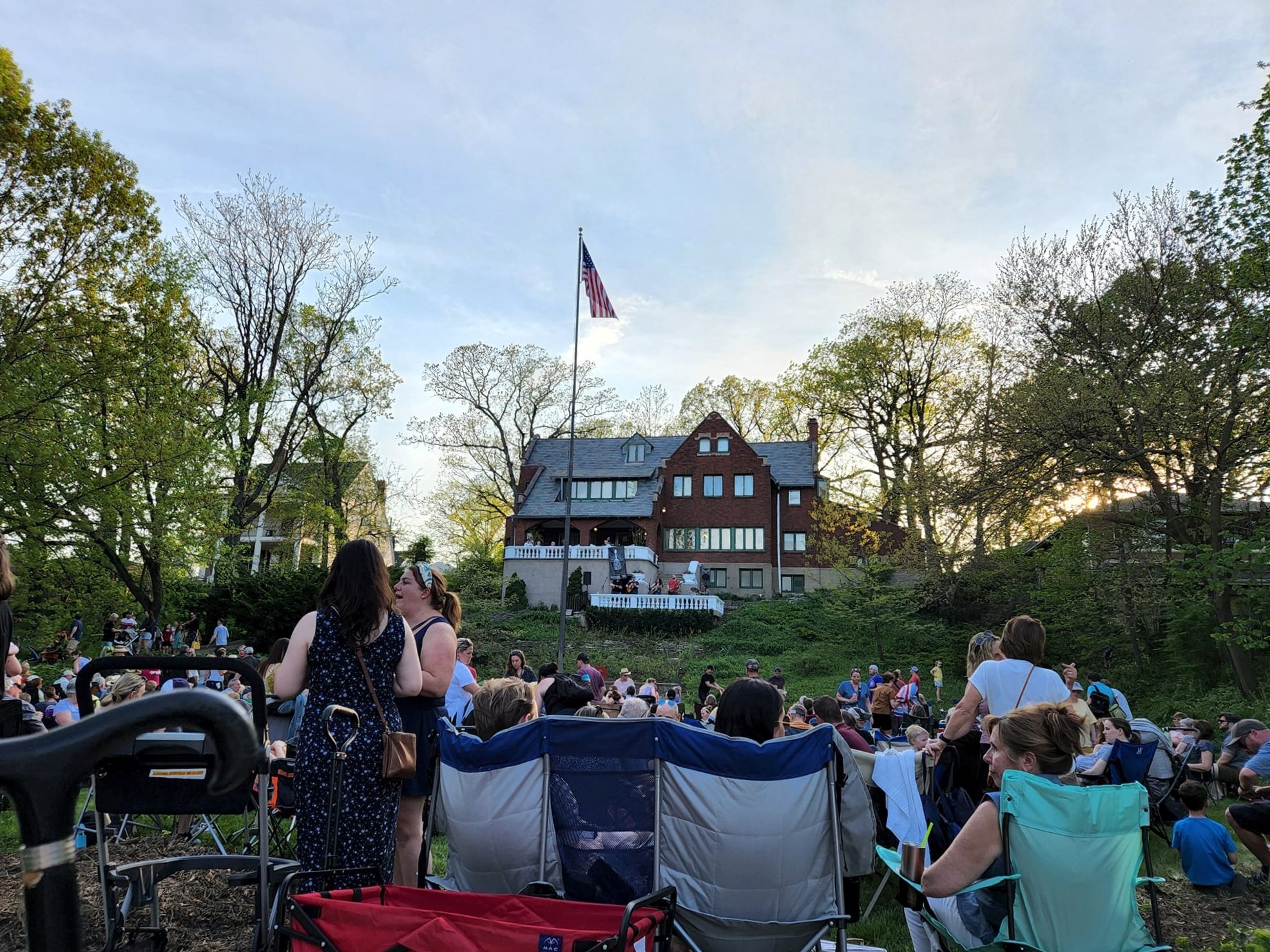
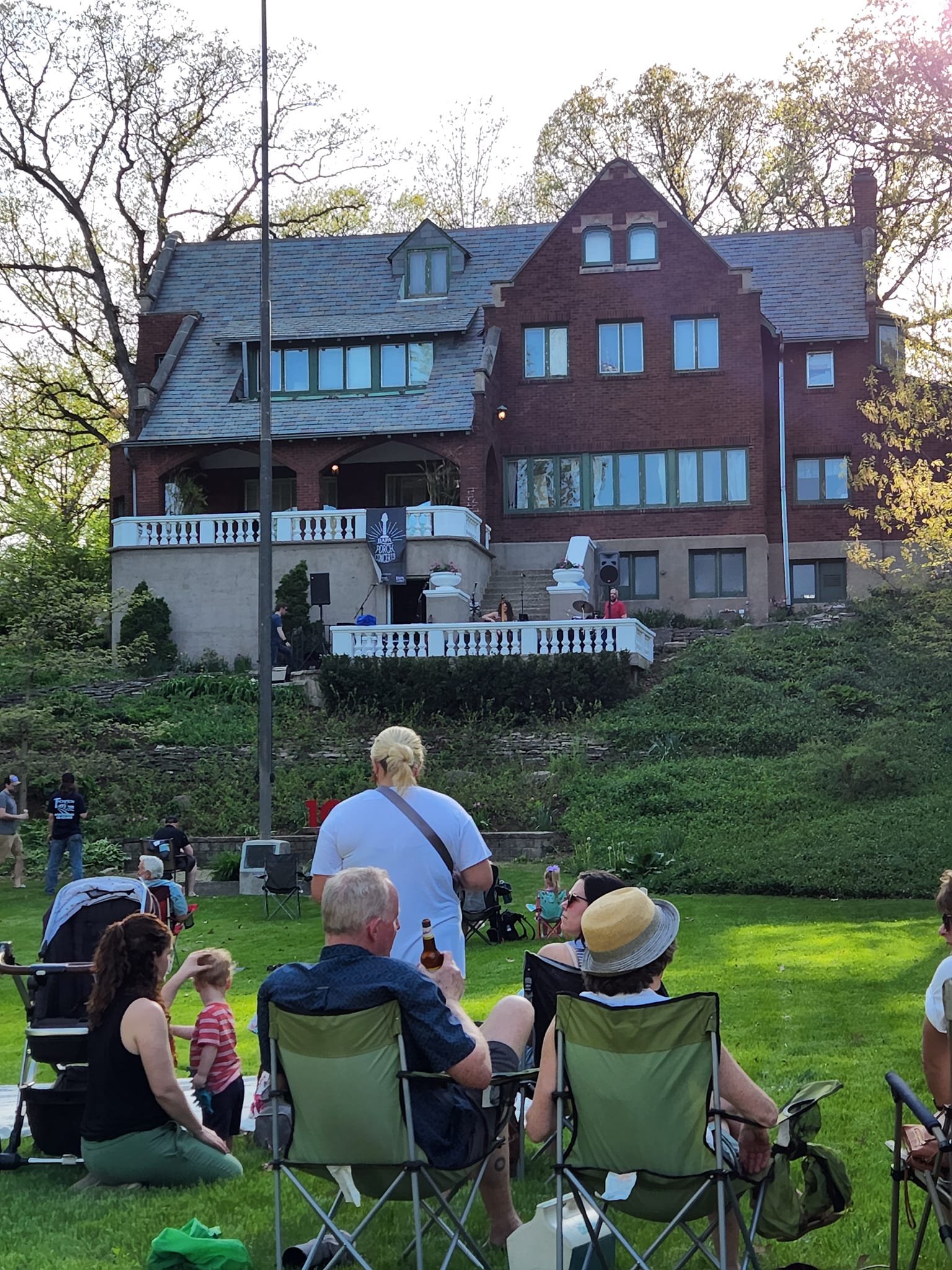
What a great night! The first "porch concert" of the season featuring The Leadfoot Band was held at the Ridge Historical Society's Graver-Driscoll House and it was a phenomenal success! The free porch concerts are brought to the public by the Beverly Area Planning Association. This is "community" in action!
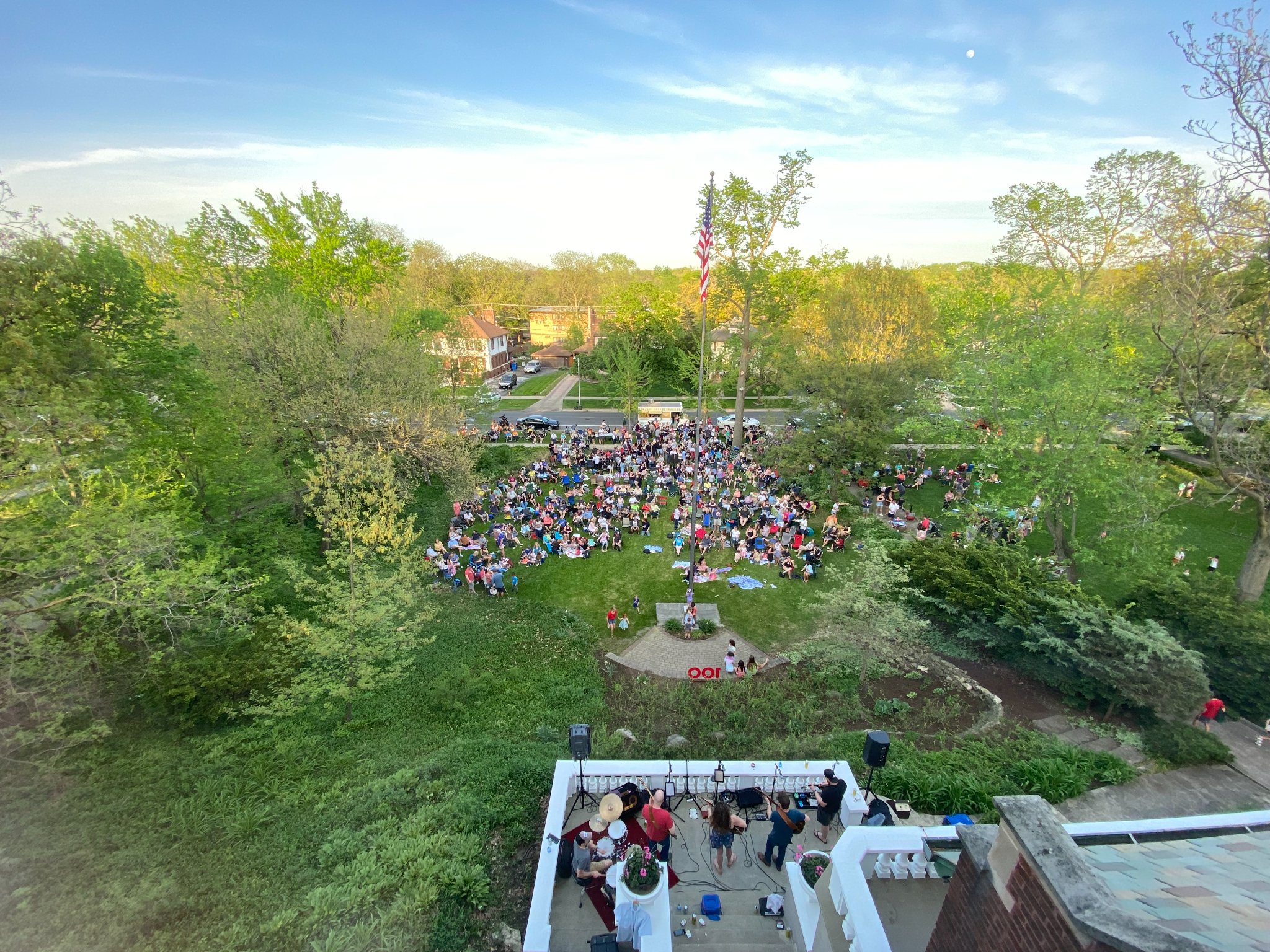
This is another view of tonight's event at the Ridge Historical Society's Graver-Driscoll House, the first of the season's porch concerts, brought to the community by the Beverly Area Planning Association, featuring The Leadfoot Band.
The picture was taken from the house's third floor attic, looking east a loooong way down to Longwood Drive. It was still early in the evening – the crowd grew to at least double this size.
The photo was taken by Mike Wilk, RHS Vice-President, the man to thank for proposing that RHS host this event.
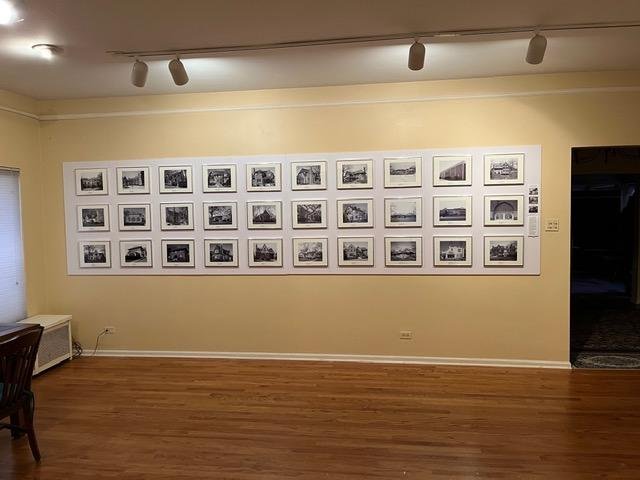
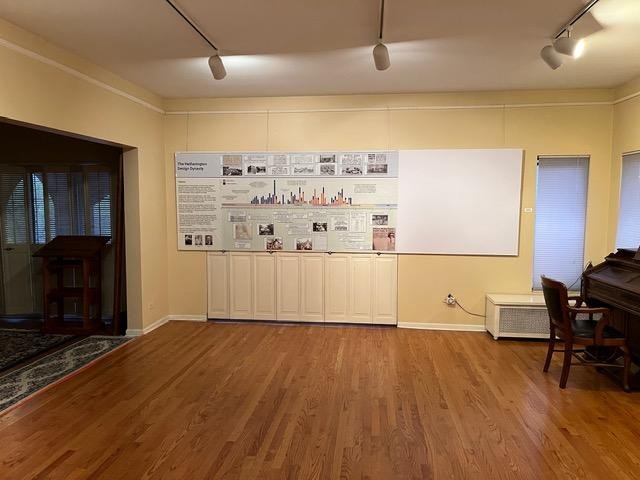
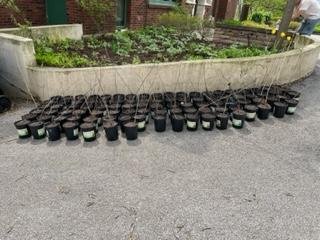
Tomorrow is the big day! The Beverly Area Planning Association Home Tour kicks off at the Ridge Historical Society (RHS) at 12 noon!
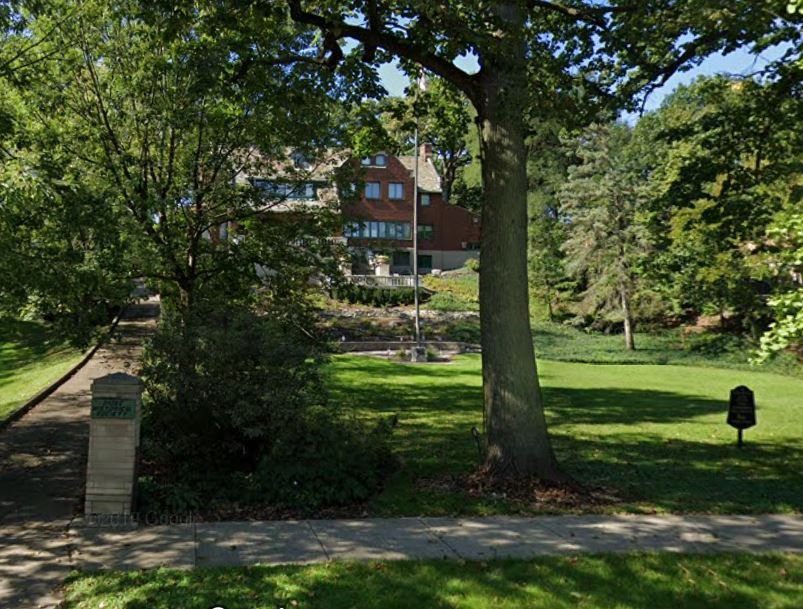
This is an annual event that has gone on for decades, showcasing the wonderful and unique architecture of the Beverly community. This year, because it is the 100th birthday of the Graver-Driscoll House, RHS’s headquarters, the houses on the tour are all “Hetheringtons,” that is, designed by the architecture family dynasty started by John Todd Hetherington, who designed the Graver-Driscoll House. Beverly residents John Todd, and his son and grandson designed upwards of one hundred buildings in the community. In addition to the Graver-Driscoll House, five more buildings will be on the tour.
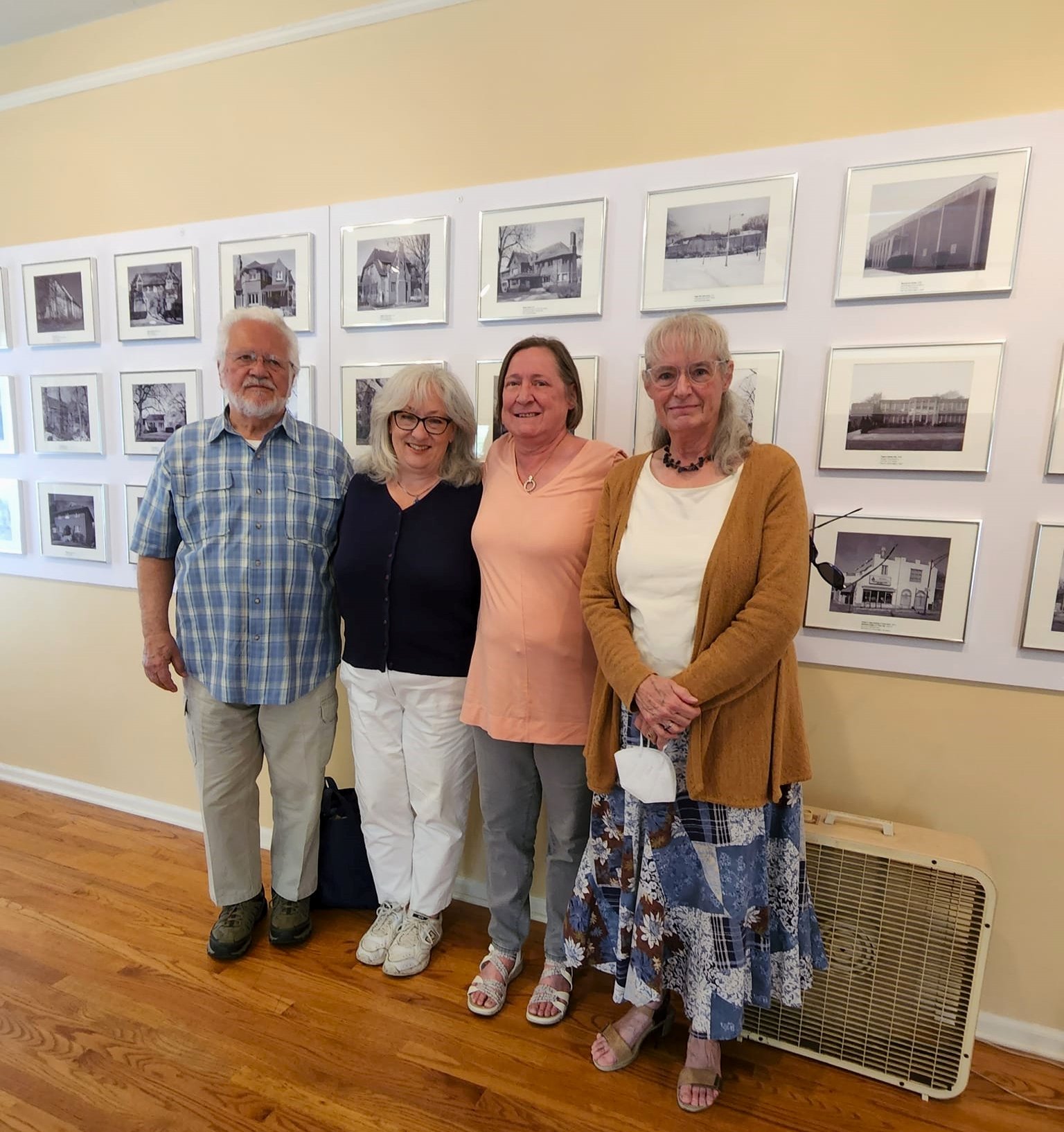
RHS will premier a new exhibit on Sunday on the Hetherington family and their contributions to the community, and on the Graver-Driscoll House. Here are just a few photos of the exhibit being set up – photographs by Mati Maldre and displays by Tim Blackburn, Carol Flynn and Linda Lamberty. And this was just the beginning – there is a wealth of NEW information that will be shared!
Also at RHS, we will be giving away oak tree saplings. The community is losing its old growth oak trees to old age. Much of the historic tree canopy for which Beverly/Morgan Park is famous will be gone in the next 30 to 50 years. It’s not too late to start reversing this decline by planting trees NOW.
Tickets are still available online or in person tomorrow. All the details can be found at https://bapa.org/home-tour/?
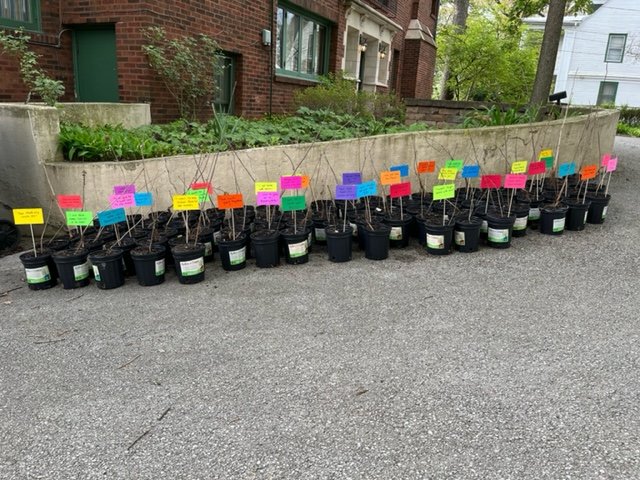
Today's the day! The BAPA House Tour is finally here!! Starts at 12 noon at the Ridge Historical Society, 10621 S. Seeley Avenue. You can buy tickets at the door, and tour five residences designed by the famous Hetherington family of architects.
You have until 3 p.m. to purchase tickets and until 5 p.m. to tour the facilities. For information, visit the Beverly Area Planning Association Association website at: https://bapa.org/
You can also pick up an oak tree ready to be planted on your own property to help preserve the tree canopy in the Chicago area. Old growth oak trees are dying off on the Ridge and need to be replaced.
The Ridge Historical Society
Jean Hetherington – Part 1
By Carol Flynn
The Ridge Historical Society (RHS) premiered a new exhibit on the Hetherington family of architects at the Beverly House Walk last Sunday. This post begins a series of stories that augment the exhibit.
John Todd Hetherington (1858 – 1936) and his family moved to Beverly around 1901. He, his son Murray Douglas Hetherington, and his grandson John Murray Hetherington are credited with designing upwards of a hundred buildings in the Ridge communities, including the Graver-Driscoll House that is owned by RHS. Upcoming posts will cover the stories of these men.
Today, however, the story will start with the Hetherington whose contributions largely go unnoticed – Jean Hetherington, John Todd and Jane Hetherington’s youngest child and only daughter who lived to adulthood.
Jean was born in 1895, which made her about six years old when the family moved to the Ridge, and about eleven when the family built their home at 9326 South Winchester Avenue in 1906. Jean spent her life in Beverly.
In 1917, Jean graduated with first honors from the three-year School of Normal Instruction of the Art Institute of Chicago. A “normal” program trained teachers – the word “normal” came from the “norms” or standards established for subjects to be taught in school. The Normal program at the Art Institute included courses in the history and philosophy of art, the masterpieces, drawing, composition and design, color, and manual training, which included modeling in clay and other materials.
Teaching was a traditional career route encouraged for women. Jean’s older brother Murray had graduated from the Chicago School of Architecture, a joint program of the Art Institute and the Armour Institute, in 1914, but there were few women pursuing architecture as a career option back then. For the Art Institute’s summer program in 1916, for example, forty-six women and three men attended the Normal program, while fifteen men and one woman attended the Architecture program.
There were only two licensed woman architects in Chicago at the time. One was Marion Mahony Griffin, the first employee to be hired by Frank Lloyd Wright. She married Walter Burley Griffin, the architect who designed the houses in Beverly’s Walter Burley Griffin Place District, a Chicago landmark site on 104th Place. It is well known that Wright took credit for much of Marion’s work. The Griffins left Chicago in 1914 for Australia.
That left Elisabeth A. Martini as the only woman architect. She shared the story that to keep her job as an architect, she also had to take on tasks such as helping the boss’s wife clean out their pantry.
Jean Hetherington became known for the architecture models she created, and this will be explored further in the next post.
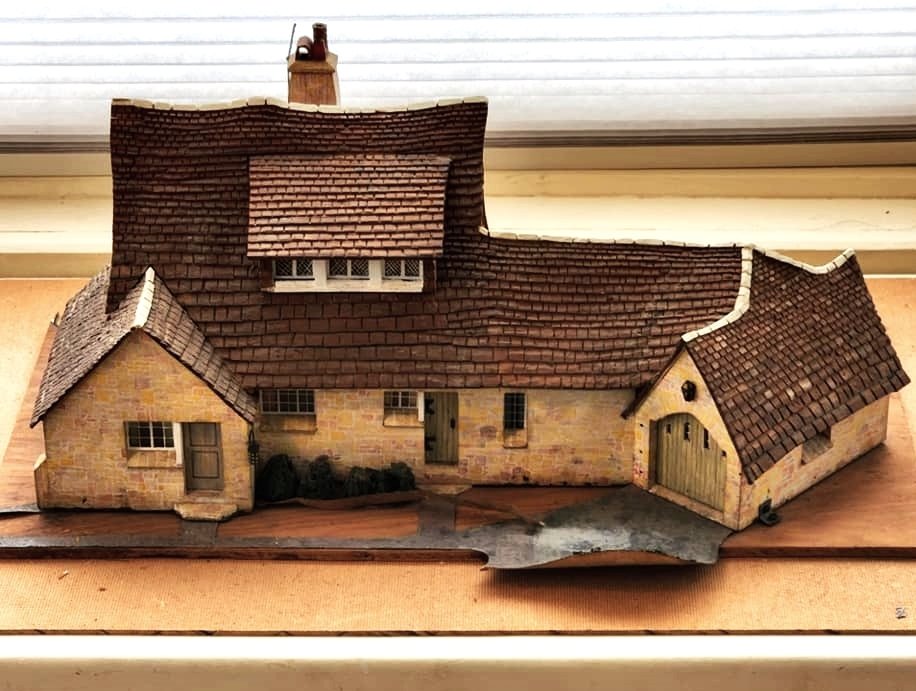
On the day of the Beverly House Walk, RHS was fortunate to have members of the Hetherington family as visitors. They loaned to RHS for that day one of Jean’s models that was a family heirloom. The model is of a charming cottage-style house, but the family does not know what house this model might depict.
Arrangements may be made to view the exhibit by contacting RHS at 773/881-1675, or ridgehistory@hotmail.com.
Next post: Jean Hetherington’s career and life.
The Ridge Historical Society
Jean Hetherington – Part 2
By Carol Flynn
The Ridge Historical Society (RHS) recently premiered a new exhibit on the Hetherington family of architects that will run through 2022. The exhibit is in honor of the 100th anniversary of the Graver-Driscoll House, RHS Headquarters, which was designed by John Todd Hetherington. This series of Facebook posts augments the exhibit.
John Todd (1858 – 1936) was born in Canada but was raised and educated in Scotland. He came to Chicago in 1881 and entered the architecture profession. In 1888, he wed Jane C. Welsh, from the same village in Scotland.
They had four children. The first, Grace, lived less than a year in 1889. Alec was born in 1890 and Murray in 1891, and these sons will be covered in later posts. Daughter Jean was born in 1895. The family moved to Beverly around 1901.
Jean graduated from the Art Institute of Chicago Normal Program, which trained teachers, in 1917, and began a career as a “draftswoman.” A “drafter” produces drawings for architecture projects that are primarily used in construction. On the 1920 U.S. Census, Jean is listed as living at home with her parents and brothers at 9236 South Winchester Avenue and working for a railroad company as a draftswoman.
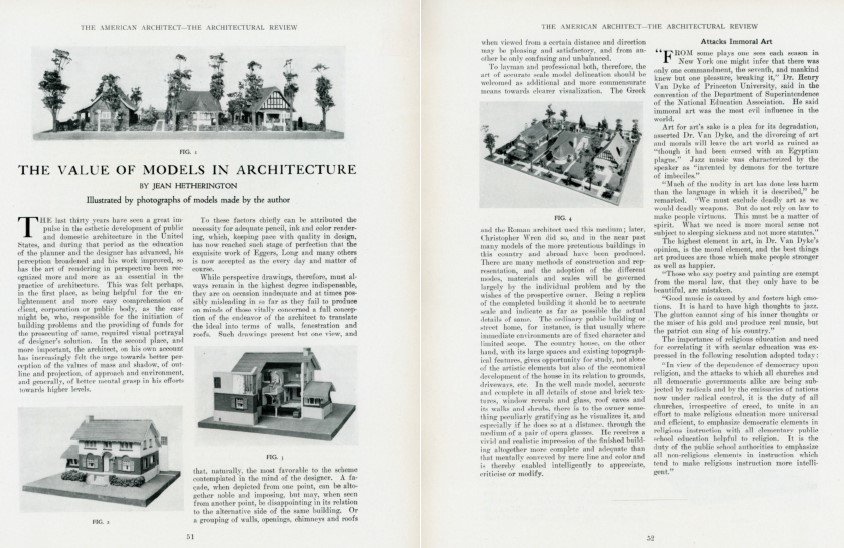
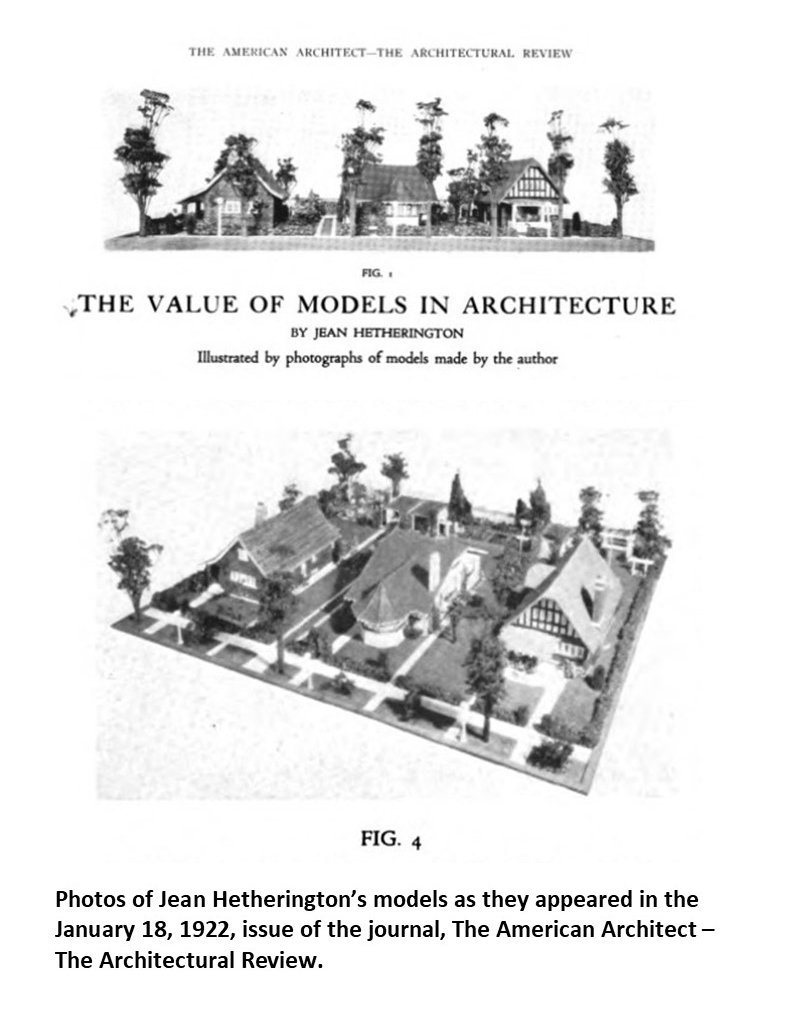
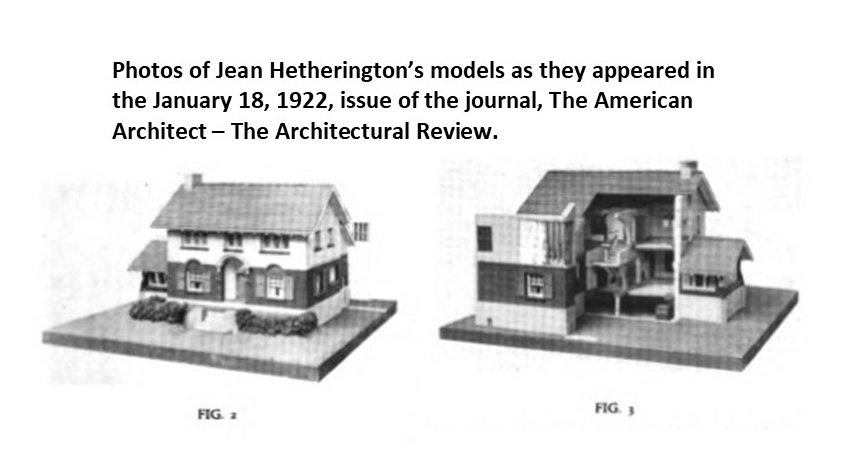
Jean took the illustration process one step further to create actual miniature models of buildings. In January 1922, she published an article titled “The Value of Models in Architecture” in the journal, The American Architect – The Architectural Review.
In this article, Jean noted that architectural drawings remain indispensable, but models can help people visualize the translation of the ideal plans “into walls, fenestration and roofs.” She noted that the ancient Greek and Roman architects used this technique, as did the revered British architect Christopher Wren. She stated that the model should be built to scale, be accurate and complete in details such as stone and brick texture, and include the relationship to landscaping, driveway, and other topographical features.
To paraphrase Jean in her article, this enabled the owner to intelligently appreciate, criticize or modify the scheme contemplated in the mind of the designer, as what looked good on paper might be confusing and unbalanced when built.
The article included photographs of some of her models. In 1919, son Murray had joined with John Todd in practice, and RHS researchers have identified Hetherington-designed houses in the Ridge communities that resemble Jean’s models. It’s likely they were made for her father’s and brother’s clients, meaning Jean had a vital role in visualizing and marketing the family’s designs.
In 1922, five of Jean’s models were included in an Art Institute of Chicago Alumni Association exhibit. Two were of the Barrington Heights Golf Club, the details of which are still being tracked down.
The other three models were of the Prior de Cranden’s (or Crauden’s) Chapel, a famous structure in Ely, Cambridgeshire, England.
Research shows that Jean visited England, Scotland, Ireland, and France in 1926 with two of her cousins, but whether she visited England previously or worked from illustrations to create the Chapel models is not known.
The important point is that not only did she make architecture models for her family’s or other architectural business clients, she apparently made models for her own interests also. At the 1927 Women’s World Fair in Chicago, the exhibit of the Women’s Architectural Club included a wooden model of Prior de Cranden’s Chapel, and it is probable this could have been Jean’s model. Unfortunately, what became of the models is not known, and no pictures have yet been found.
Next post: Jean Hetherington – Part 3
The Ridge Historical Society
Jean Hetherington – Part 3
By Carol Flynn
This continues the series of posts related to the Ridge Historical Society’s exhibit on the Hetherington family of architects.
Jean Hetherington was the youngest of the Hetherington children. She worked as a draftswoman and became known for her skills in making architectural models.
In 1922, the Englewood Times newspaper reported that Jean, “one of the Ridge’s enterprising young women,” made miniature homes for Chicago real estate dealers. Her picture and one of her “perfect” models had been covered in the Herald-Examiner, one of Chicago’s daily newspapers. The article reported she used cockle burrs from the fields near her home, which was with her parents at 9236 Winchester, to create the hedges for her models.
By 1922, the Hetheringtons had moved to 9122 Longwood Drive. Jean remained with her parents. On the 1930 U.S. Census, Jean’s occupation was listed as architectural drafting in an architect office. This was the business of her father, John Todd Hetherington, and her brother, Murray Hetherington. Likely, Jean’s models were an asset in promoting their designs.
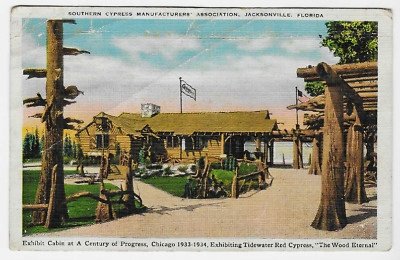
Murray Hetherington designed one of the “Homes of Tomorrow” for the exhibition at the 1933 Century of Progress at the World’s Fair in Chicago. This exhibit, considered one of the most noteworthy of the Fair, featured twelve full-size houses that showcased innovations in architecture and building materials.
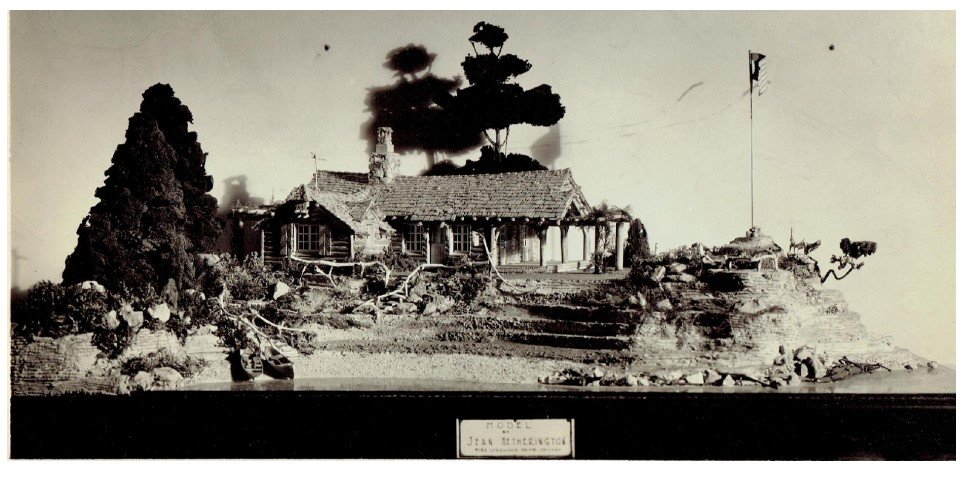
Murray’s contribution was the Cypress Log Cabin, which actually was made of traditional materials rather than experimental materials like those used in the other houses. The house was eventually moved to Beverly Shores, Indiana, where it is part of the Indiana Dunes National Park. More on this house will be covered in a future post.
Jean created a model of the Cypress Log Cabin, which was displayed at the Fair. She had other models on display, also.
John Todd Hetherington died in 1936, leaving Jean and her mother Jane living in the home on Longwood. Son Alec had also lived with the parents on and off, but he died in 1939 in Wyoming. There will be more on Alec in the next post.
Then in 1948, at the age of 53, Jean married William Geanopolos.
Geanopolos was born in Greece in 1888 and immigrated to the U.S. in 1905. He married Clara Cooper in 1914. He became a naturalized U.S. citizen in 1925.
The Geanopoloses took up residence in Rockford, where he worked in various capacities in the restaurant and food business. In different records, he is listed as the merchant in the confectionary industry, a clerk in a fruit store, a grocer, and a soda dispenser in an ice cream parlor.
Clara died in 1936. In 1942, on his World War II draft registration, Geanopolos is listed as working in a restaurant at 70th and South State Street.
William and Jean Geanopolos lived with her mother, Jane Hetherington, at 9540 S. Prospect Avenue. In 1950, his occupation is listed as chef in a restaurant, and Jean is listed as a draftsman for an architect.
Jane Hetherington died in December 1950, and Jean Hetherington Geanopolos died in August 1956, at the age of 61. Jean spent her life, from the age of 5 or 6 on, in Beverly.
Next post: Alec Todd Hetherington
Ridge Historical Society
Post 4: Alec Todd Hetherington for Memorial Day
By Carol Flynn
The Ridge Historical Society (RHS) recognizes Memorial Day with a story from the current exhibit on the Hetherington Dynasty of Architects.
John Todd Hetherington designed the Graver-Driscoll House, RHS’s headquarters, in 1921. Two of his children, Murray and Jean, entered the architecture and drafting professions, and two more generations have followed them. But architecture was not for everyone in the family. Son Alec followed a different path, which included a term of U. S. military service.
While the focus of the RHS exhibit is the contributions to architecture made by the Hetheringtons, “honorable mention” covering what is known about Alec is shared in this post.
Alec Todd Hetherington was born to Jane and John Todd Hetherington on July 13, 1890, in Chicago. Their firstborn, Grace, had died the year before at the age of eight months, so Alec became the oldest child. He was followed by brother Murray in 1891 and sister Jean in 1895.
At the age of 20, he was employed as an electrician with a city railway company. At the time he registered for the draft for World War I, he was a superintendent of building construction in his father’s firm.
Alec also had an interest that varied from architecture and electrical engineering. For a while, he became a fruit farmer and moved to southern Illinois.
But first, the war intervened. Alec served in the U.S. Army in 1918-1919. He shipped out on the Matsonia from Hoboken, New Jersey, as a corporal in the 270th Squadron Air Service, and returned as a sergeant.
The Air Service, or “Aero Squadrons,” were the first aviation units, the forerunners of the U.S. Air Force. The squadrons provided combat flying and ground support, as well as training. The 270th Squadron was sent to northeastern France to serve at the First Air Depot, the largest U.S. facility on the Western Front. The 270th Squadron was part of the Services of Supply Advance Section.
Upon his return to the U.S. after the war, Alec established a farm in New Burnside in Johnson County in far southern Illinois. The area was known for its fruit-growing properties.
In 1924, Alec married Jeanette Ballance. She was from a well-known historic family in New Burnside. Her family owned one of the early newspapers and were founding members of the Burnside Methodist Episcopal Church. Her grandfather was a teacher-turned-lawyer, and her grandmother was a charter member of the women’s club. Her father, Thomas Ballance, was a prominent farmer, a county commissioner, and the town’s federal food administrator during World War I. Her mother Winifred’s family, the Lauderdales, were also early settlers, known for their popular singing quartet that showed up for community events.
A daughter, Elizabeth, was born to Jeanette and Alec on June 1, 1925, in New Burnside. Tragically, Jeanette died a few weeks later on June 26 at the age of 22. The cause of death was given as peritonitis due to childbirth. Peritonitis is an infection of the lining of the abdominal cavity.
Elizabeth was raised by her maternal grandparents on their farm. After high school, she did live in Chicago for a few years in the mid-1940s to attend secretarial school. She returned to New Burnside where she married Robert Mowery in 1948. They had two daughters and lived in Ohio. She died in 2008.
Alec stayed in New Burnside for a few more years after Jeanette’s death. He was listed as attending the Illinois Agricultural Association’s meeting in Urbana in 1926, and being named to the board of the Ozark Growers Association in a nearby town in 1927.
By 1930, however, he was back in Chicago, living in the family home in Beverly, and working as an airplane mechanic in a factory. It’s possible that Alec trained in airplane mechanics while he was in the U.S. Army Air Service.
In 1931, Alec married Winifred M. Toomey in Cook County. She was an Irish Catholic immigrant, born about 1897. In 1934, they had a daughter Winifred, born in Chicago.
Alec’s occupation took them to Cheyenne, Wyoming, where he was listed in 1937 as a foreman for United Air Lines.
And then tragedy struck again. Alec died at the age of 48 on January 6, 1939, in Cheyenne. The cause of death was attributed to an appendectomy. A ruptured appendix often causes peritonitis, the same infection that took his first wife Jeanette’s life.
Alec’s remains were returned to southern Illinois and buried in the New Burnside Cemetery, where Jeanette was buried.
Winifred and their daughter Winifred moved to San Francisco, where mother Winifred died in 1964. Daughter Winifred married William Medin in 1958. They had a daughter and two sons. “Winnie” was an active volunteer who received the First Lady of California Volunteer Award in 1995. She died in 2018.
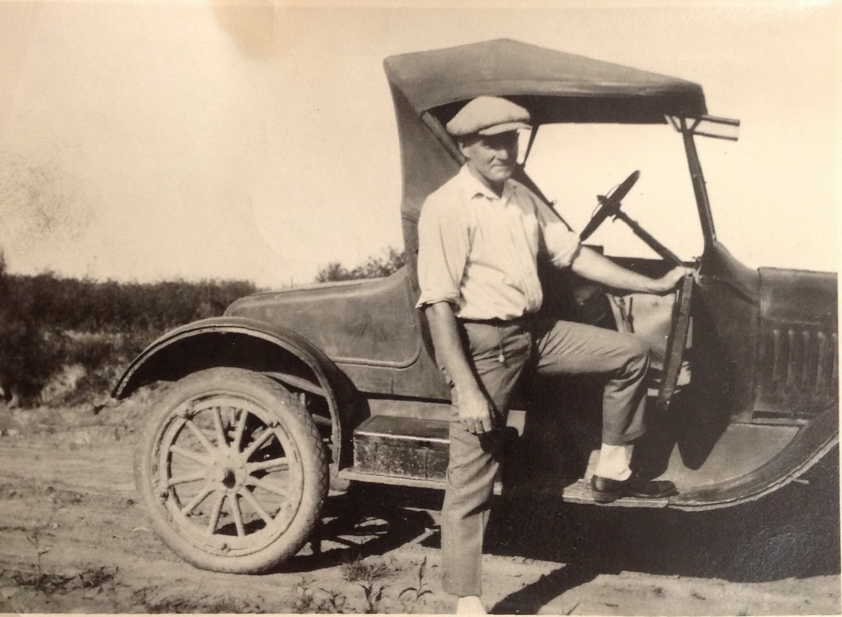
Photo of Alec Todd Hetherington from family submission on Ancestry.com.
The Hetherington exhibit will be on display at RHS through 2022. Arrangements to view the exhibit may be made by contacting RHS at 773/881-1675 or ridgehistory@hotmail.com. RHS is located at 10621 South Seeley Avenue, Chicago.
Next post: Meet the RHS exhibit team.