
Explore the RHS Facebook Archives, a rich repository of local history written by Carol Flynn. For two decades, Carol brought a deeply dedicated voice to public education at RHS. Her role as Facebook administrator through mid-2025 naturally extended her prolific research into meticulously detailed articles, most notably her multi-part historical series posts. Today, Carol continues her local history writing for The Beverly Review and other outlets.
October 2020
The Paranormal Ridge: Part 1 – The History of Ghost Stories
By Carol Flynn
Ghost and paranormal stories have been around forever. Every culture and every nationality and every religion have their versions of ghost folklore. Every one, from the Vikings to Tibetan Buddhists.
The intent of this series, as was stated in the previous post, is to share information on the ghost stories connected to Givins Beverly Castle at 103rd and Longwood, which were covered last year in a presentation at the Castle. Some general information on the history of paranormal stories will help put those surrounding the Givins Beverly Castle into perspective.
In Egypt, archaeologists discovered 4,000-year-old pottery fragments with a ghost story recorded on them. In this story, a high priest encountered a restless spirit whose tomb had collapsed.
A tomb was considered not just the final resting place for a person’s physical remains, but the home of his spirit as well, and therefore tombs needed to be maintained like any house would be. While interactions with ghosts were not considered horrifying supernatural occurrences, the living still wanted the dead to stay content so they would not become a nuisance.
In the story, the priest promised to build a new tomb, but the ghost was skeptical because others had promised but failed to do so. Some pieces of the story are missing, but then the priest sent out three men to find a good location for a new tomb. They found one and reported back to the priest. The last shard states the priest declared his intent to build the tomb. No further parts of the story have been discovered but it is assumed the priest kept his promise.
Religious people like saints often reported paranormal experiences – apparitions, dreams, messages from the supernatural.
A personal favorite story is a little piece about St. Paul of the Cross who was born in 1694 in Italy. A series of visions led him to establish the religious order called the Passionists.
Paul claimed that demons in the form of cats often walked across his bed while he was trying to sleep, keeping him awake. Anyone who has cats knows this is the kind of thing cats indeed do.
One cat owner asked a member of the clergy, “My cats walk across the bed all the time when I’m trying to sleep. How did Paul know these weren’t just regular cats?”
The clergyman replied, “How do you know your cats aren’t demons?”
This might off a new perspective for some cat owners.
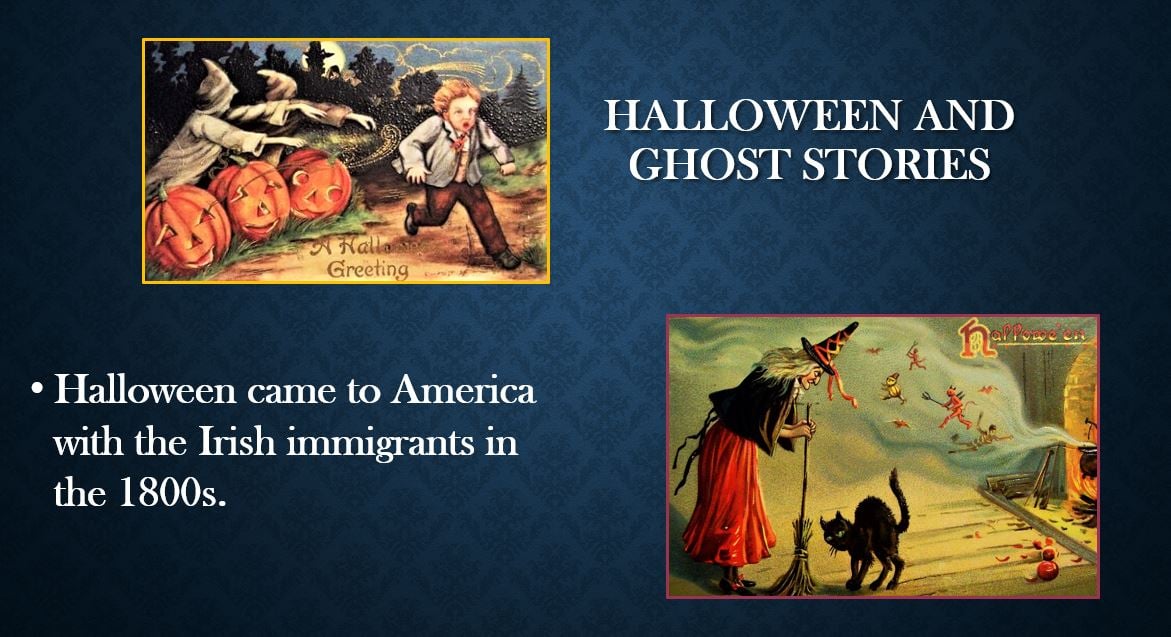
This is the time of the year, Halloween, when imagination turns to ghosts. Halloween is an old Celtic tradition, and it came over to America with the Irish and Scots in the 1800s. Its origins are likely in the Gaelic pagan harvest festival Samhain, Old Irish for “summer’s end.” It was believed this was one of the times of the year, in between the harvest and the coming of winter, when the barrier between the physical and spiritual worlds was thinnest, and it was easier for the spirits of the dead as well as non-human entities like demons and fairies to cross over into the living human world. With time, many of the pagan holidays were adapted to Christianity, and Samhain apparently evolved into All Souls’ Day and All Saints’ Day.
The Celts welcomed the spirits of their deceased loved ones into their homes; they even set places at the dinner table for them.
But the non-human spirits, the demons and the fairies, were another matter. The Celts did things to keep these beings at bay and these became some of our American Halloween traditions.
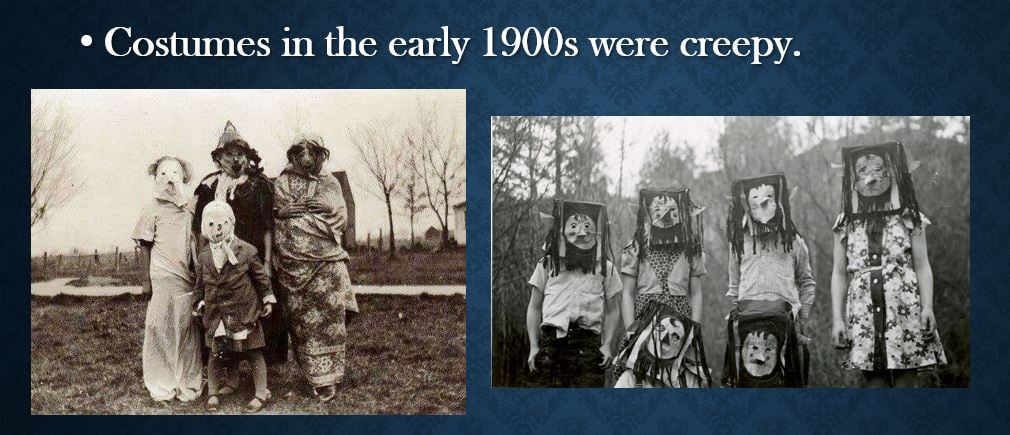
First, the Celts dressed up like frightful demons so the real spirits would be confused and leave them alone. This is where costumes came from. Starting in the 16th century, “mumming” became popular – dressing in costumes and going door to door reciting verses or singing, in exchange for food or offerings on behalf of the spirits. Costumes in the U.S. around 1900 were homemade and “creepy” by today’s standards. They had to be creepy to represent or drive off the spirits. It would be decades before princess and superhero costumes became the norm.
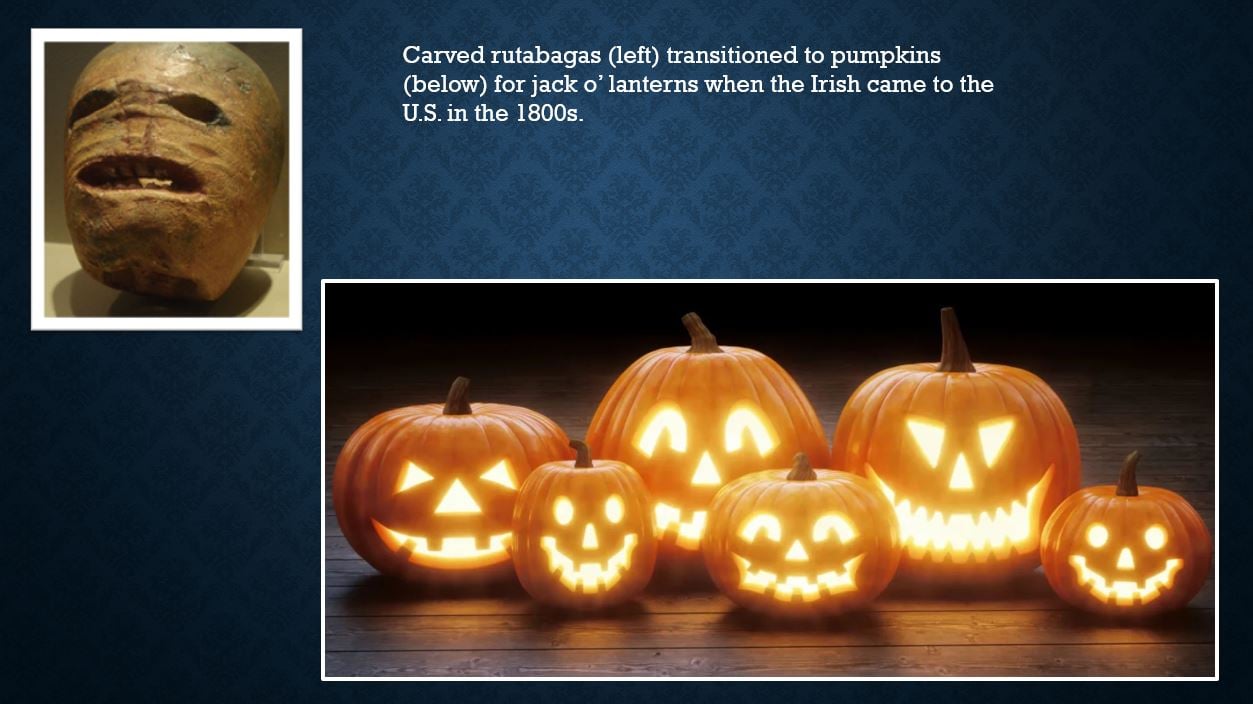
The Celts carved gruesome faces in rutabagas (yellow turnips) and lit them from inside with candles and put them on their stoops or in their windows to scare away spirits. When they got to America, they switched over to pumpkins, a native vegetable that was very plentiful. These are jack o’ lanterns, of course. One Irishman recently new to the U.S. said that he was happy to find that pumpkins are much easier to carve than rutabagas.
The Irish also left out treats of food and beverages so the fairies would not play tricks on them but would instead help them and their farm animals survive through winter. This, plus mumming, led to trick or treating.
A few years ago, a ghost explorer from Chicago was invited to a farm in another state that reportedly is a portal where fairies cross over from their world. As an experiment, they left out a variety of food items to see what the fairies preferred. The favorites were chocolate brownies and Starbucks Frappuccinos. Fairies apparently like sweets.
Fairies are much more common in Ireland and England but sometimes they pop up over here. There is evidence we have visits from the fairy folk here on the Ridge.
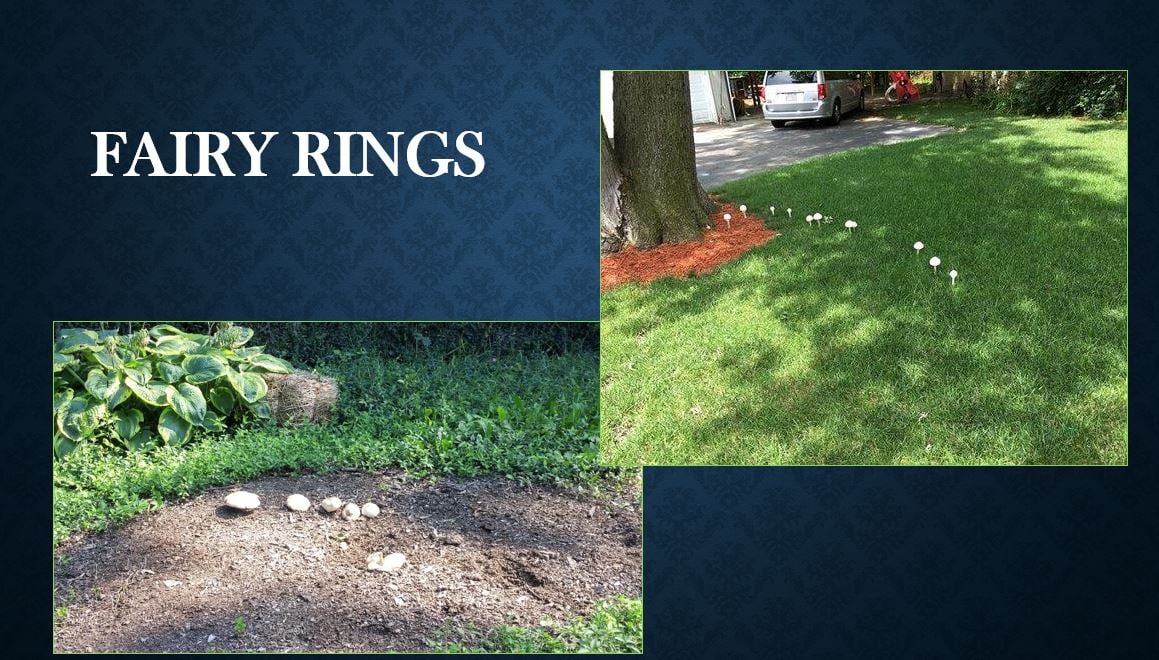
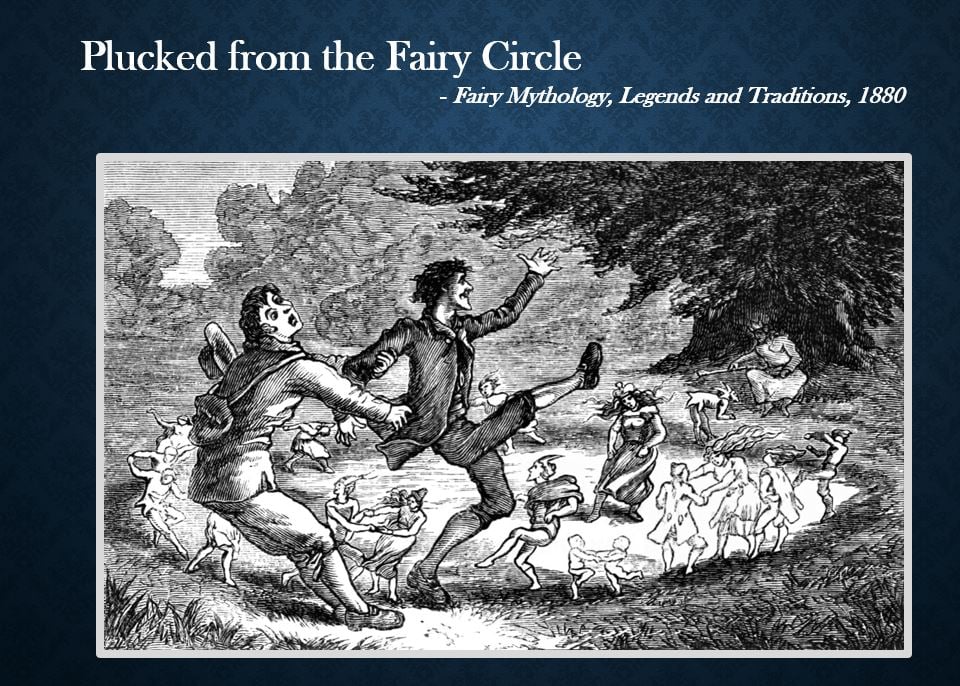
Sightings of “fairy rings” on lawns in the Ridge area are not uncommon. These are mushrooms that grow in an arc or a circle. Sometimes the fungus is underground and displays as a circle of thick or tall grass. There are a lot of superstitions about fairy rings. Folklore says these are made by fairies dancing. Fairies use these rings to trap humans. If a human steps in a fairy ring, he or she may be stuck in the fairy world forever dancing. It is considered bad luck to destroy a fairy ring.
Part 2 will look at the Victorian love for ghost stories.
For those who need a little break from current news.
The Paranormal Ridge: Part 2 – The Victorian Era and Ghosts
By Carol Flynn
The Victorians were enthralled with ghosts. Consider fictional ghost stories during the Victorian Era.
Halloween was brought over to the U.S. in the 1800s by descendants of the Celts, the Irish and the Scots. It has since become the time of the year when people really take interest in ghost stories and events.
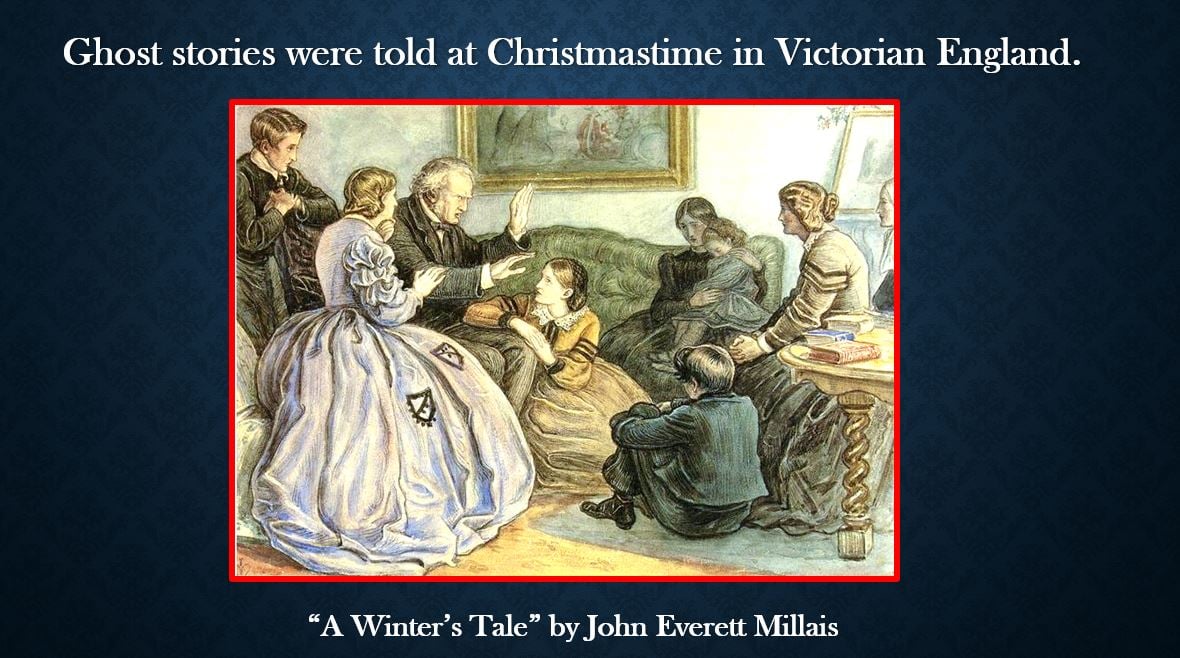
However, the earlier settlement of the U. S. was largely by people from England, and they followed the customs of that country. In England and for the English settlers in the U.S., the traditional time of the year to tell ghost stories was Christmas time.
Ghost stories were very popular in the Victorian era, from the 1830s well into the early 1900s. Some famous ghost and “psychological horror” fiction story writers from this period include Sheridan Le Fanu, M. R. (Montague Rhodes) James, and Algernon Blackwood, whose very names seem perfect for writing ghost stories. There were women writers, also, including Charlotte Riddell and Edith Wharton. They influenced generations of authors who followed them, from H. P. Lovecraft to Anne Rice to Stephen King.
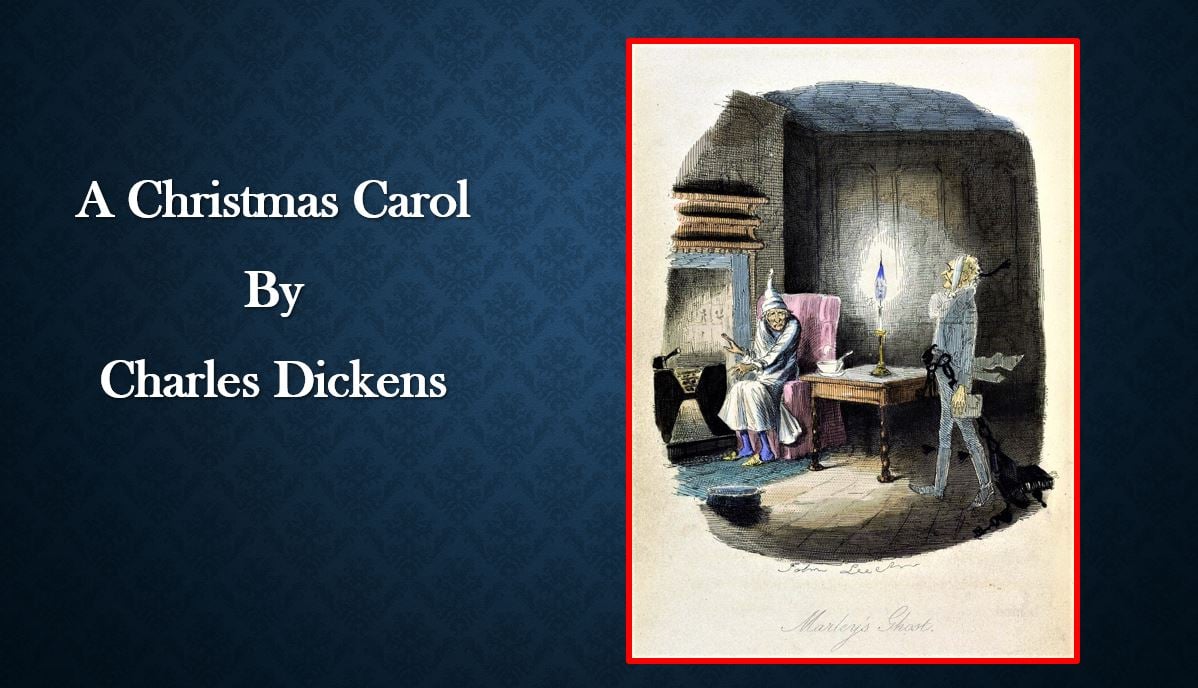
The most famous fiction ghost story of all time is “A Christmas Carol” by Charles Dickens, published in 1843. Its full name is actually “A Christmas Carol. In Prose. Being a Ghost Story of Christmas.”
The plot of this story is well known. Spiteful, miserly Ebenezer Scrooge is nasty to his employees, his relatives, and, well, everyone. He especially hates Christmas. But then one Christmas Eve, he is visited by the ghost of his deceased partner Jacob Marley, and by the ghosts of Christmas Past, Present and Yet to Come. Thanks to the intervention of these spirits, he changes his ways to become a good, generous, caring man.
This story has been adapted over and over for other books and stories, movies and TV shows.
We can easily envision Scrooge’s experience from Dickens’ descriptions. Dickens included many of the signs of a haunting that have been consistent throughout history and that people report to this day.
It all starts when Scrooge sees Marley’s image in common objects he has looked at thousands of times – the door knocker, the fireplace tiles. He feels unsettled, like he is being watched. He checks every corner; he looks under the bed. “Humbug,” he keeps telling himself – this must be his imagination; there are no such things as ghosts.
An old disused servants’ bell on the ceiling begins to ring on its own, followed by a clanking noise from the wine cellar below. The cellar door flies open with a bang. There is a “chilling influence” in the air. At last the phantom of Marley appears in the room. Scrooge can see right through to the back buttons of the ghost’s waistcoat.
Scrooge has a verbal exchange with Marley’s ghost who delivers a message – people who do not create happiness while alive are doomed to wander forever as spirits.
As the ghost begins his exit, the window flies open by itself, and there are confused noises in the air, incoherent sounds of lamentation and regret, sorrow and self-accusation. The ghost floats out through the window and Scrooge feels compelled to look, where he sees the air filled “with phantoms, wandering hither and thither in restless haste, and moaning as they went.” Many had been personally known to Scrooge in their lives and now “the misery with them all was, clearly, that they sought to interfere, for good, in human matters, and had lost the power forever.”
Victorian-era fictional ghost stories were often written not only to entertain and thrill, but to educate and deliver a moral message. “A Christmas Carol” certainly continues to deliver on all counts.
The Victorians were enthralled with ghosts at the same time they were embracing new technology and scientific advancements. The two became intertwined – technology and the spirit world.
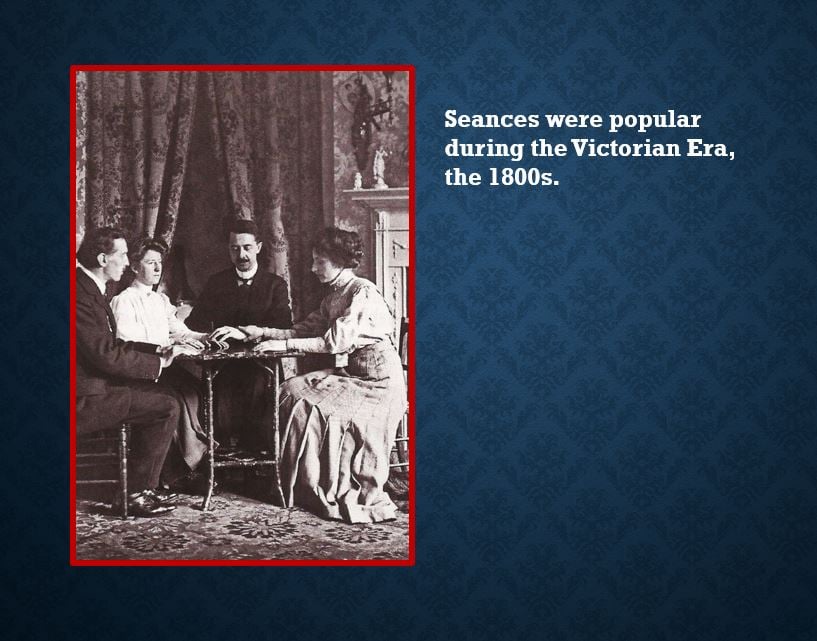
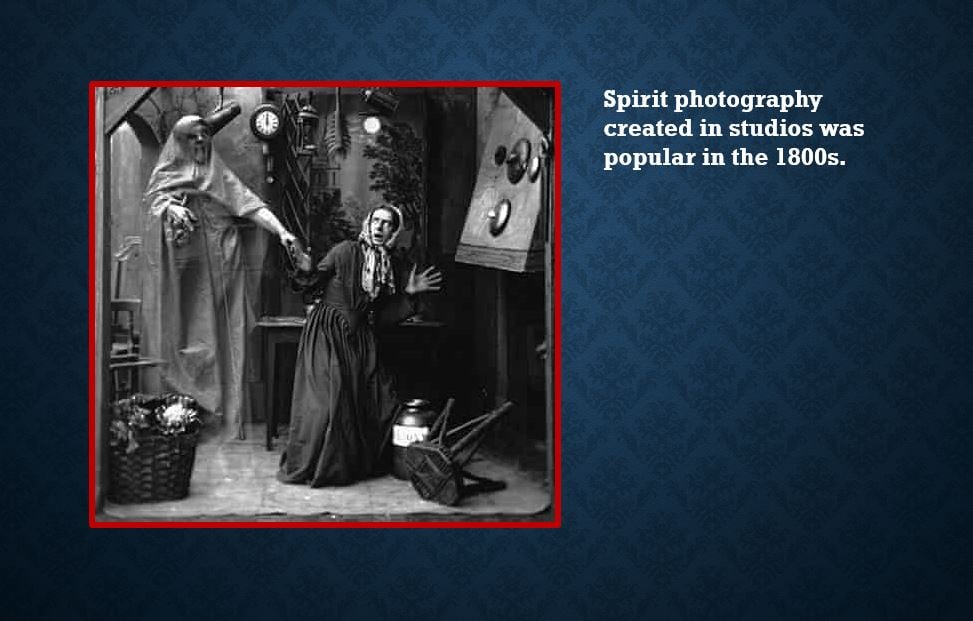
In addition to written ghost stories, seances and “spirit photography” became popular in Victorian times.
People reasoned that if new inventions, like the telephone and telegraph and photography, made it possible to communicate with people thousands of miles away, and record images of anything, then it was also possible to communicate with and record the spirit world.
Seances, in which a human “medium” acted as an intermediary between the living and the dead, were conducted in studios and parlors throughout England and the U.S. The spirits usually communicated by rapping on the tables or walls; moving objects; causing the lights to blink; “spirit writing” in which the medium wrote out the spirit’s message; and even by possessing the body of the medium and speaking through that person. It was reported that Queen Victoria herself participated in seances to communicate with her late husband Prince Albert.
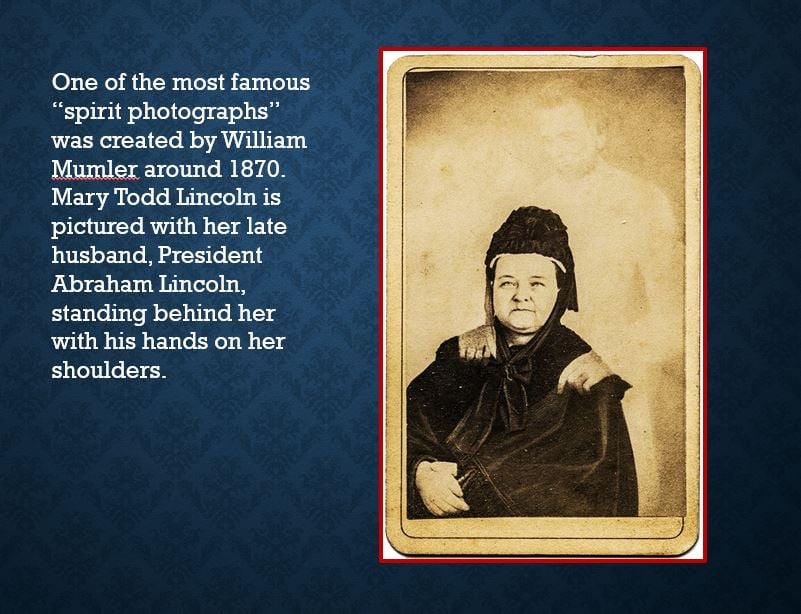
“Spirit photography” captured the images of ghostly presences, often of deceased loved ones interacting with the living. One famous U.S. ghost photographer was William Mumler, who produced a photo of Mary Todd Lincoln with the image of her late husband, President Abraham Lincoln, hovering over her with his hands on her shoulder.
People in the throes of grief were easy victims for charlatan mediums and spirit photographers. Such victims were comforted to think their loved ones were still nearby. Eventually, the skeptics started to outnumber the believers, and some spiritual practitioners were charged with larceny and fraud. Mumler was arrested and put on trial, but the prosecution could not prove how Mumler had created a hoax so he was exonerated. It was after this trial, around 1870, that he created the photo of the Lincolns.
The next post in this series will explore the signs of a haunting, leading up to the ghost stories connected to Givins Beverly Castle.
If you need a break from the news.
The Paranormal Ridge: Part 3 – Signs of a Haunting
By Carol Flynn
As was mentioned in the first post of this series, the reports of ghostly activity go back for thousands of years.
Pliny the Younger, a lawyer, author and magistrate in ancient Rome, described the haunting of a house in Athens by a noisy ghost in the year 50 A.D. The ghost scared everyone away and the house was falling to ruins. Then a man brave man came upon the house, and not afraid, he stayed overnight. He realized the ghost was trying to communicate. He followed the apparition to a spot where it disappeared. Digging up the spot, the man found bones. He gave them a proper burial, and the ghost stopped appearing.
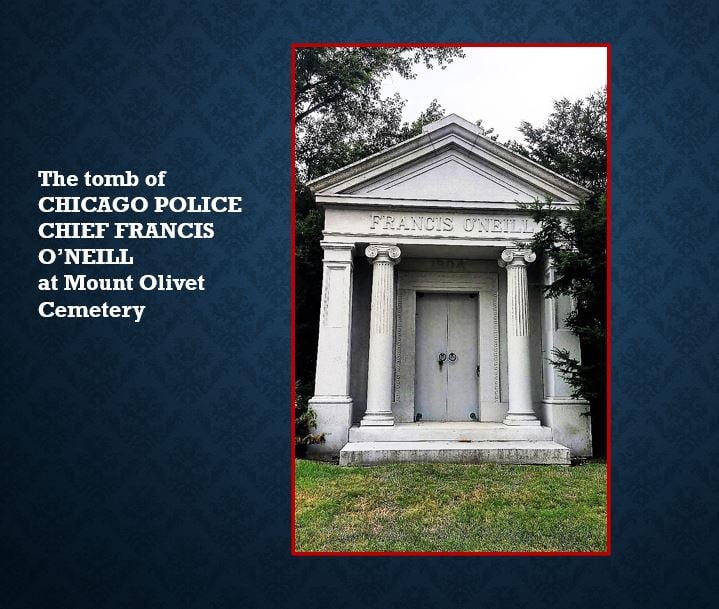
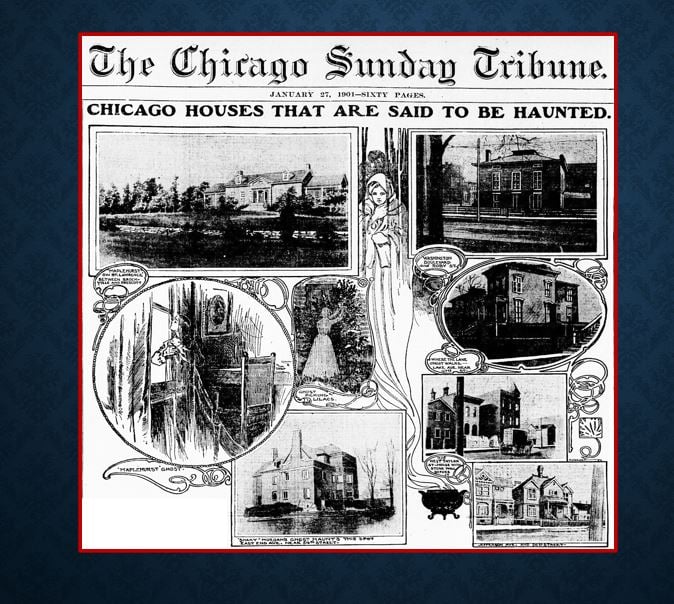
Here in Chicago, there have been haunted houses for over a century. In 1901, the newspapers carried the story of a woman named Mrs. E. A. Stuart who wrote to the Police Chief of Chicago, the famous Francis O’Neill who is buried in Mt. Olivet Cemetery here on the Ridge, to inquire about renting a haunted house she had heard about in the Woodlawn area. She wanted one where the ghosts “must be on hand every night, clank through the corridors in their chains, open and shut doors mysteriously, and shriek murder till sleep is out of the question.” Her intention was to disprove the existence of ghosts.
O’Neill knew the house that interested Mrs. Stuart. It was at 4801 S. Lake Avenue, and had been occupied for many years by John Lane, and it was believed his ghost still lingered there. A well-known lecturer, Mrs. Mary H. Ford, and her family lived in the house after Lane, and complained about nightly visitations from Lane’s spirit.
The Ford family’s first experience with the ghost was when the bathroom door became locked from within. They thought there might be a burglar in there and sent for the police. One of the Ford children suggested it might be Lane, and Mrs. Ford replied that if it were, he might be kind enough to open the door. The door unlocked, and pushing it open, Mrs. Ford saw that there was no one inside the room.
Another time, Mrs. Ford forgot to close the furnace door before going to bed. She did not want to go down to the cellar to do this and she wished that Mr. Lane would close that door. She heard the furnace door close.
The family experienced many other phenomena – loud knocking and pounding that went on all night and orange flames floating through the air. Mrs. Ford’s son, 10 years old, claimed he saw an old man sitting in a corner. His descriptions of the man fit those of Lane. The family became so used to the manifestations they came to think of Lane as one of the family.
Mrs. Stuart decided not to rent the house. O’Neill received letters from other people who were interested in living in the house. That house is no longer standing today.
This was just one example of the many haunted houses that the newspapers carried stories about in the earlier days of Chicago.
The signs of a haunting have remained consistent for thousands of years, from Ancient Greece to early 20th-century Chicago.
These signs are:
1. Feeling of being watched or that someone is near you, when there is no other physical person there.
2. Feeling that someone or something has touched you. Cobwebs, a tug on your sleeve, a tap on the shoulder, feeling like you just bumped into someone, etc.
3. Feeling a cold spot or a temperature drop, or a feeling of dread or discomfort in one certain spot.
4. Lights coming on and off or flickering. Appliances, also.
5. Sounds that when you go to investigate them don’t appear to have a cause. Footsteps, doors knobs being turned or the sound of doors opening or closing, things being dropped, whispers, crashes and bangs.
6. Smells. Cigarette smoke, a certain perfume. The smell of flowers, particularly roses, is associated with a presence, usually a more saintly one.
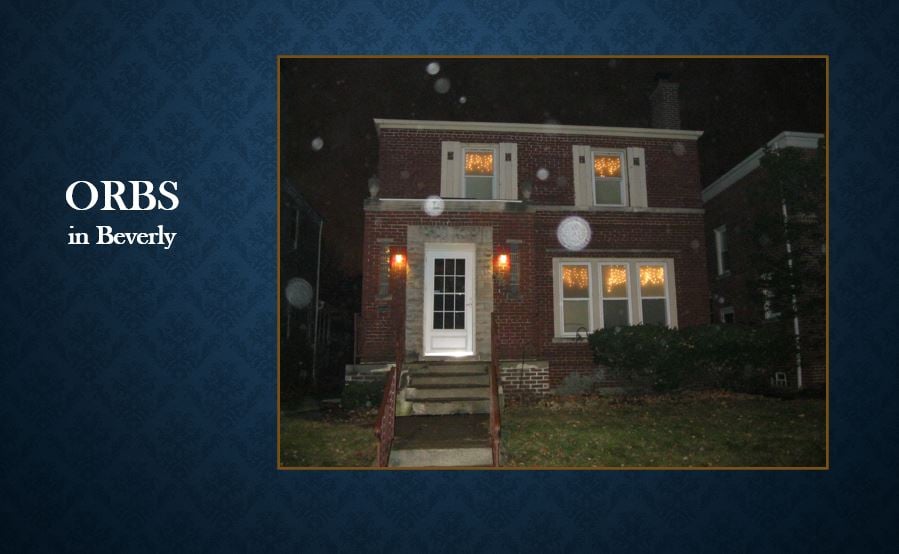
7. Seeing unexplained shadows, or something moving out of the corner of your eye, or sometimes a mist. Then there are orbs, circles of light that may not be visible to the naked eye but sometimes show up in pictures. Of course, some people say orbs are just reflections off of something in the atmosphere or something wrong with the lens of your camera. There is a picture of orbs around a house in Beverly and the person who took this never had this happen in photos taken at other times.
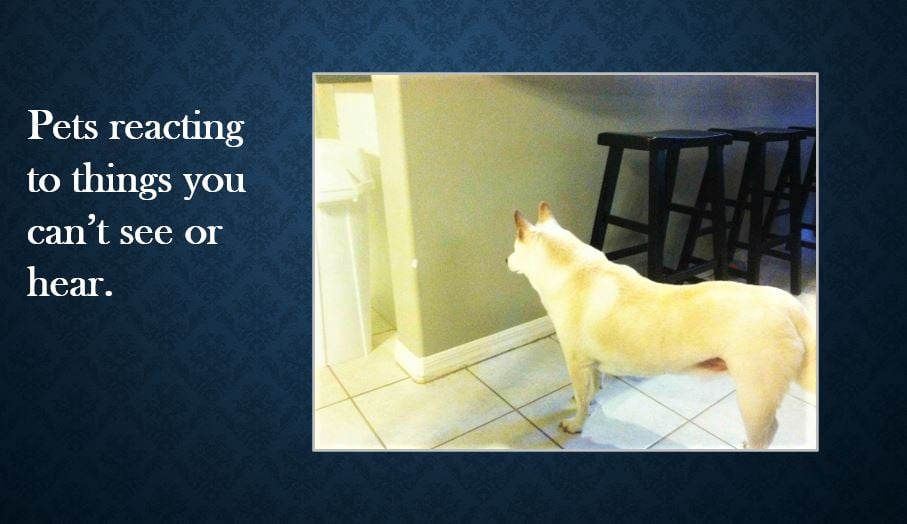
8. Strange behavior from your pets. Dogs barking at things, cats staring at things, that you don’t see. This is a common one – it seems animals are much more receptive to spirits. A photowas posted on the Internet by someone whose dog was staring and barking at one particular spot on the wall.
9. Children are much more open to spirits and often have experiences that adults do not have. Imaginary playmates might be an example of interacting with spirits.
10. Objects moving on their own. Cabinet doors, windows, doors opening and closing. Things falling, breaking. Something found in a place where you know you did not leave it.
11. Seeing an actual apparition of a person, or even an event played out.
In the next post, reasons the Ridge has paranormal occurrences will be explored, then Castle ghosts are coming up after that.
The Paranormal Ridge: Part 4 – Why the Ridge has Paranormal Activity
By Carol Flynn
The Blue Island Ridge seems to have a fair amount of paranormal activity going on; so far, over seventy ghost stories have been reported here. It appears that at least four factors come together to support and even encourage this paranormal activity. The four factors are limestone, water, railroad tracks and Native American heritage.
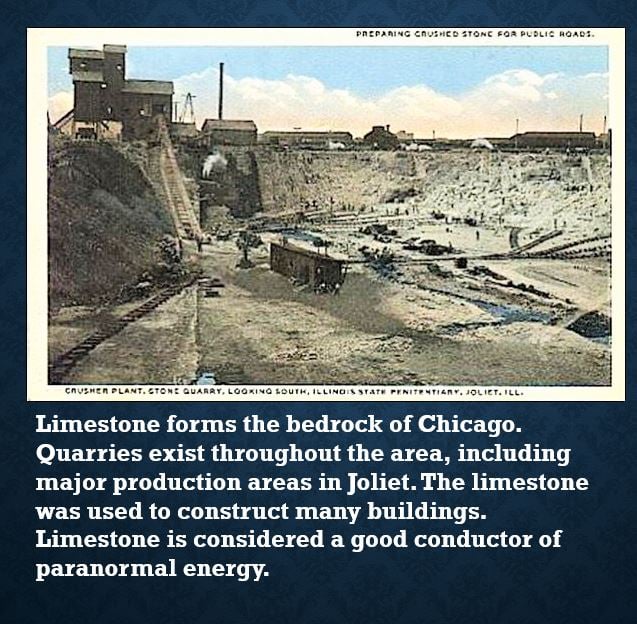
First, the bedrock that Chicago sits on is 400-million-year-old limestone. This limestone base formed from deposits left on coral reefs in the shallow inland seas that covered most of the area. Limestone is considered to have the strong capability to absorb and release electromagnetic and psychic energies.
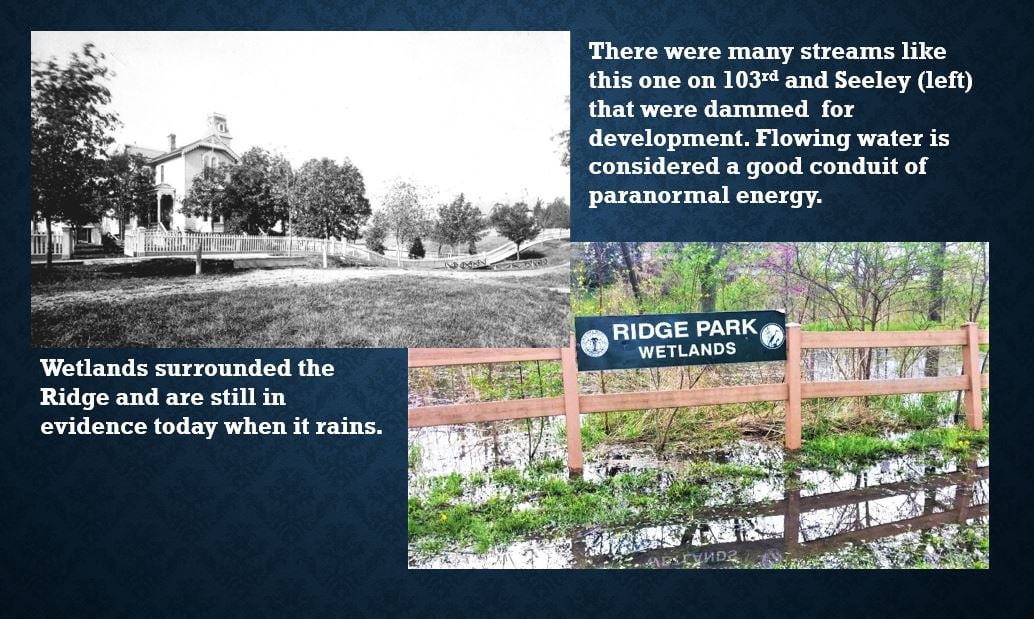
The second factor encouraging paranormal activity is flowing water. Water is considered a great conductor of paranormal energy and there is water all around and under the Ridge. The Ridge has underground streams and wells that were dammed up and built over. The land to the east of the Ridge was originally seasonal wetlands. When it rains, the water drains to the east, flooding lawns and streets and sometimes basements.
Thanks to an article with an interview with Jason and Grant of the original Ghost Hunters TV series, the third factor was identified. Jason and Grant were the Roto-Rooter employees in New Jersey who had the first and the best show on the Sci-Fi channel for exploring the paranormal. They investigated hundreds of sites, and they found over and over three things came together – limestone, water, and railroad tracks.
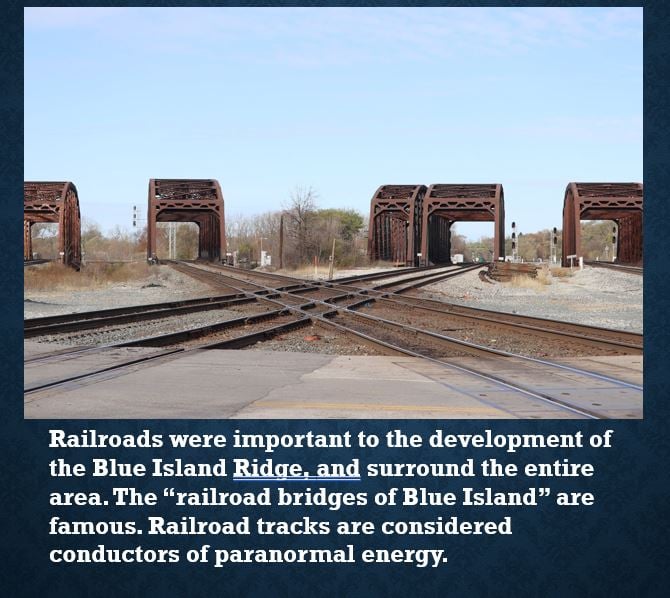
Railroad tracks are all around the Ridge. The railroads have been of major importance to development here. The stations along the Metra line are a Chicago landmark district, and Blue Island was a major railroad hub – it still has that enormous railroad yard. Again, it seems railroad tracks hold and conduct energy.
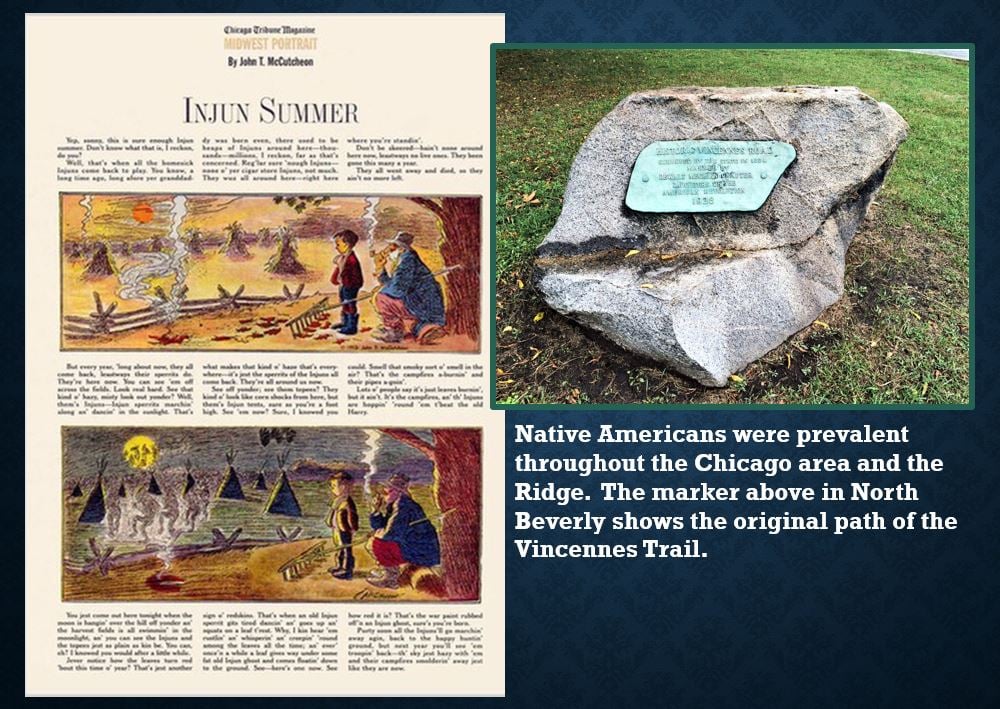
The last factor is the strong historical presence of Native Americans. These were lands for the Pottawatomie tribe, and before that the Illinois tribe. An old Indian trail, the Vincennes Trail, runs through the Ridge. A marker for the original route that ran across the top of the Ridge can be found in North Beverly.
One psychic shared, completely unsolicited, that she can really feel the Native American presence here and at times the veil is so thin that she can sense the phantoms of Indians along the Cal-Sag Channel at night. That waterway was originally the Stony Creek back in the day of the Indians. They lived along the Calumet River and the creek until being removed as a group from the Chicago area in the 1830s. Spirits figure prominently in Native American folklore and beliefs.
A little on the history of ghost stories and Halloween, the signs of possible hauntings, and the factors influencing paranormal events on the Ridge have been covered as background material. The next post will get into the ghost stories surrounding the Givins Beverly Castle.
The Paranormal Ridge: Part 5 – Introduction to the Givins Beverly Castle
By Carol Flynn
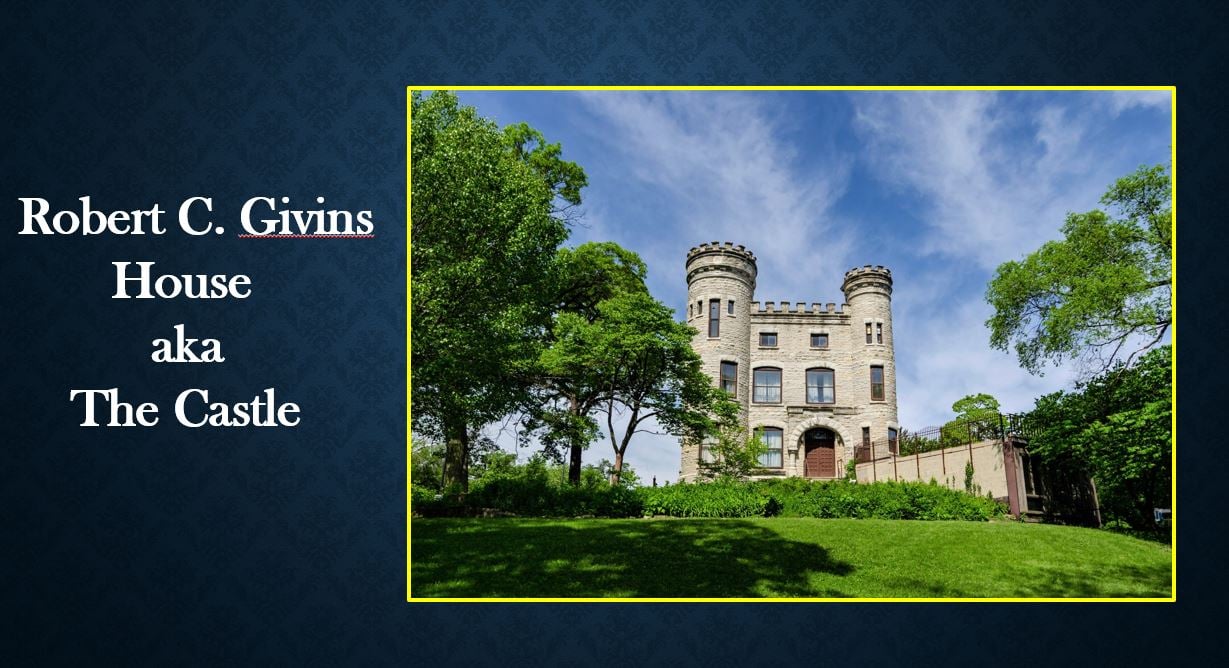
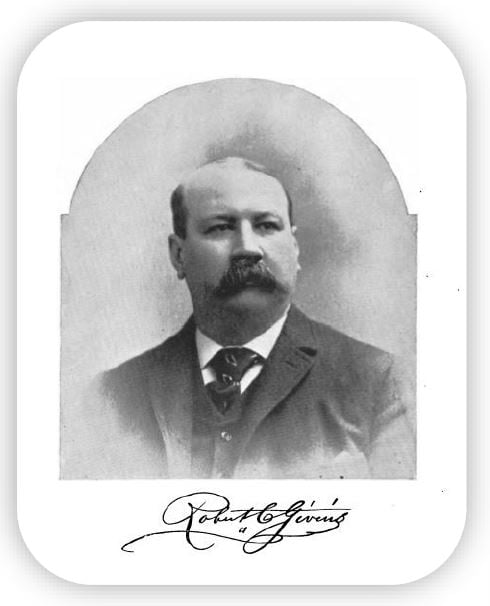
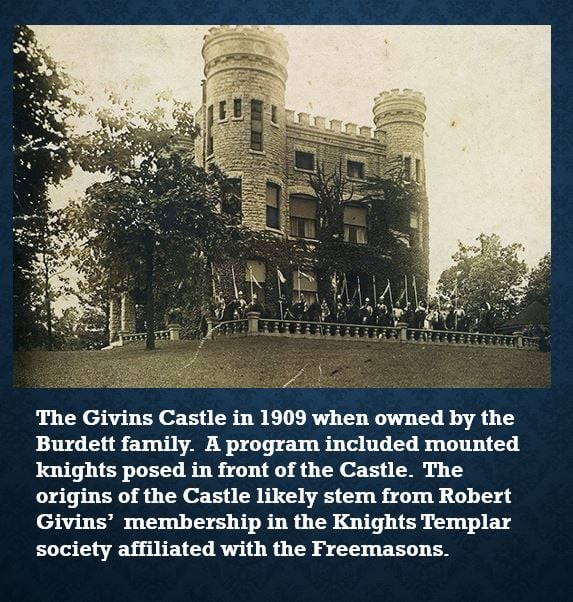
The Givins Beverly Castle, at the northwest corner of 103rd Street and Longwood Drive, is Beverly’s best-known landmark. It was built in 1886-87 by Robert C. Givins, a real estate developer who was also a lawyer, novelist, auctioneer and world traveler. Givins was a very likeable and popular man, a Chicago personality. The newspapers loved him and referred to him by the nickname “Bob,” something unheard of back in those more formal days in the press. It was even proposed that Bob Givins run for mayor of Chicago. Givins was a tireless booster of the city.
Givins’ ancestors came from Northern Ireland to Canada, and Bob Givins moved to Chicago in 1863 at the age of 17. His first wife Sophia and three of his four children unfortunately died very young, and only one son survived to adulthood.
Givins married a second time in 1884 to Emma Steen, a Chicago public school teacher. Emma was his wife when they built the Castle.
Local folklore about the Castle includes a lot of misinformation. For example, it is said that Givins and his wife never lived in the Castle. They most certainly did live there, and entertain there, and participate in local events. There were many newspaper articles to attest to this.
Givins could often be seen coming “on the double-quick down from his hill-top chateau” to catch the Rock Island train to his downtown office. They kept a cow, horse and chickens at the Castle. Bob played the banjo and Emma sang at musicals they held at the house.
They attended a town fair put on by the Washington Heights Improvement Society, where Bob Givins was observed “eating all the ice cream he could take care of,” and Emma “bought all the peaches that were left over to make peach preserves out of them for the folks on the hill.”
Bob was a member of the Prospect Club and helped plan and run leading social events in the community. He served on the finance committee to build the Church of the Mediator at 110th Street and Hoyne Avenue.
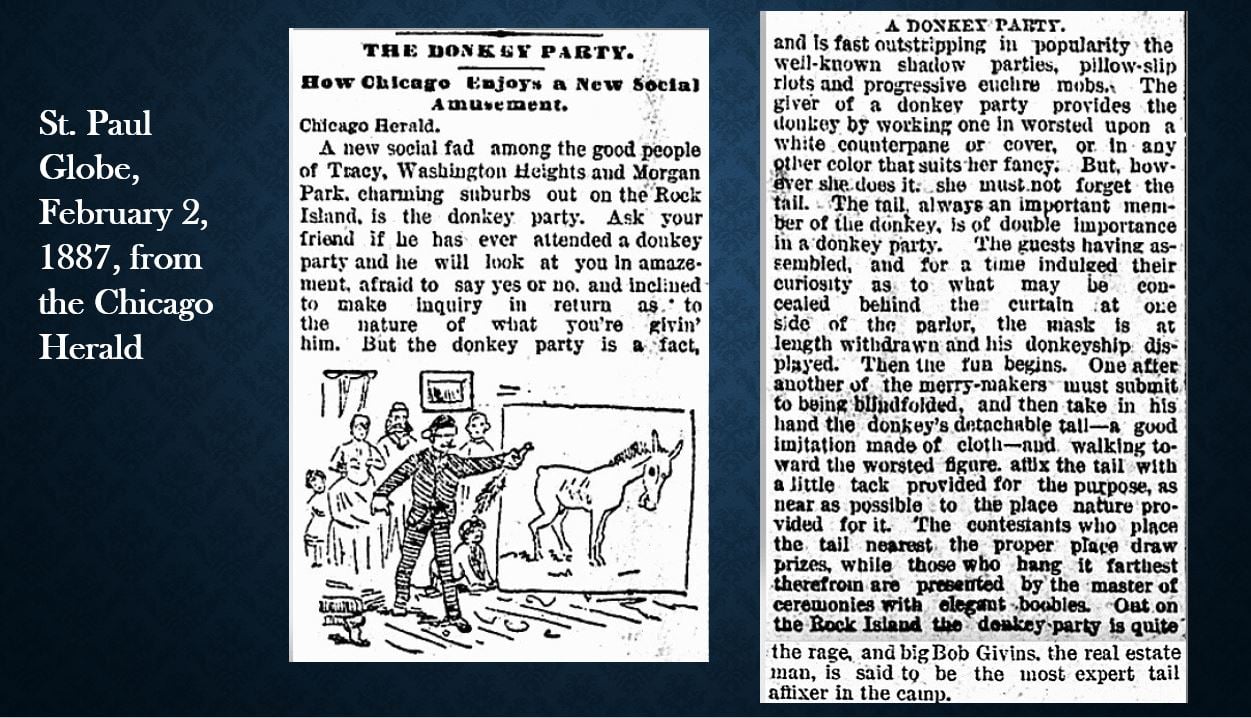
One fun example of Bob and Emma Givins’ life here was that they introduced Pin the Tail on the Donkey to the Ridge. There was an article in 1887 about this new social fad, a “donkey party,” in Tracy. Tracy was the name for the area when Givins built the Castle, and 103rd Street was known as Tracy Avenue. The area was part of Washington Heights, and annexed to Chicago in 1890, something Givins was behind all the way. The article explained how the game was played, and reported that big Bob Givins was the best donkey tail affixer out on the Rock Island line.
But the allure of living in a castle did wear off eventually. From Fall 1895 to Spring 1897, Givins rented the Castle to a private academy for young women called the Chicago Female College, and Emma and he lived in a hotel downtown. Givins finally sold the house in 1909, and they moved to the north suburbs and eventually spent most of their time in Sarasota, Florida.
The Castle was owned successively by two more private families. First came the John Burdett family, and then Dr. Miroslaw Siemens and his family. The Beverly Unitarian Church (BUC) bought the building in 1942 and has owned and operated it since that time.
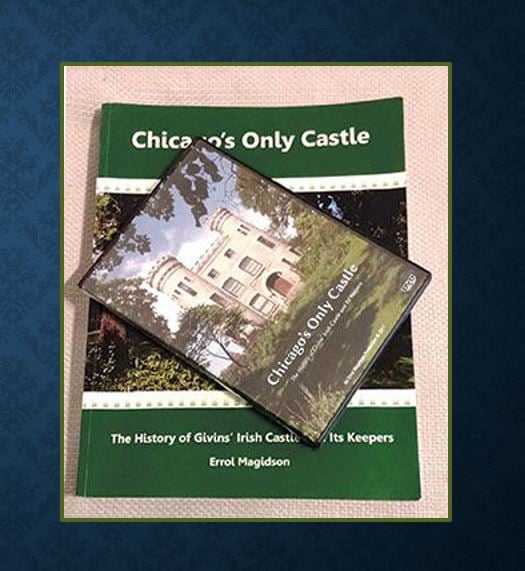
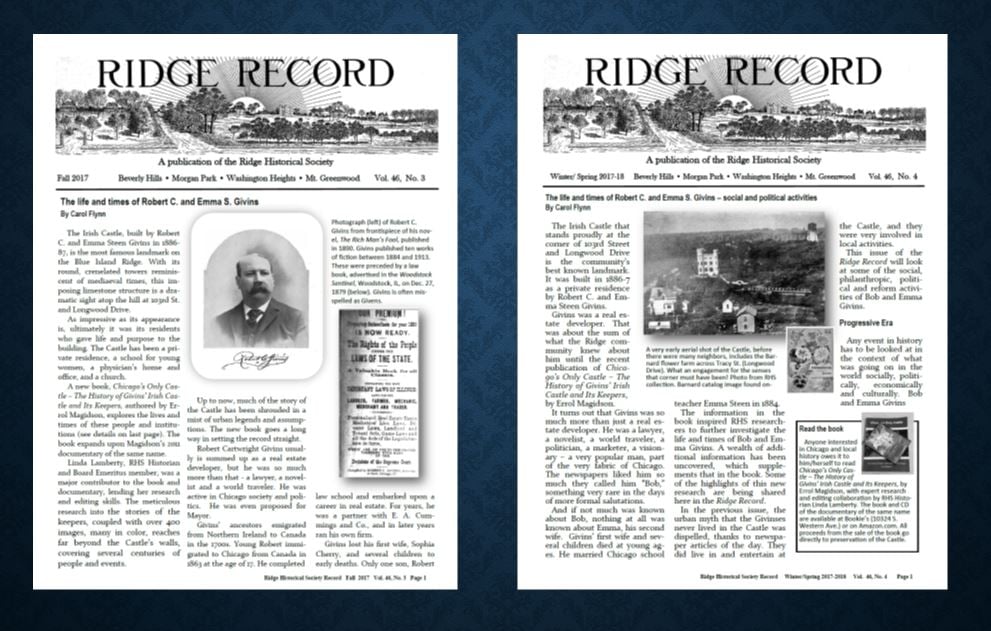
The history of the Castle is covered in the book “Chicago’s Only Castle – The History of Givins’ Irish Castle and Its Keepers,” by Errol Magidson with research assistance from Linda Lamberty, Ridge Historical Society (RHS) Historian. The book does not include much detail on Givins’ life in the Castle nor on Emma Steen Givins, so these topics were researched further leading to several RHS newsletters that are available through RHS.
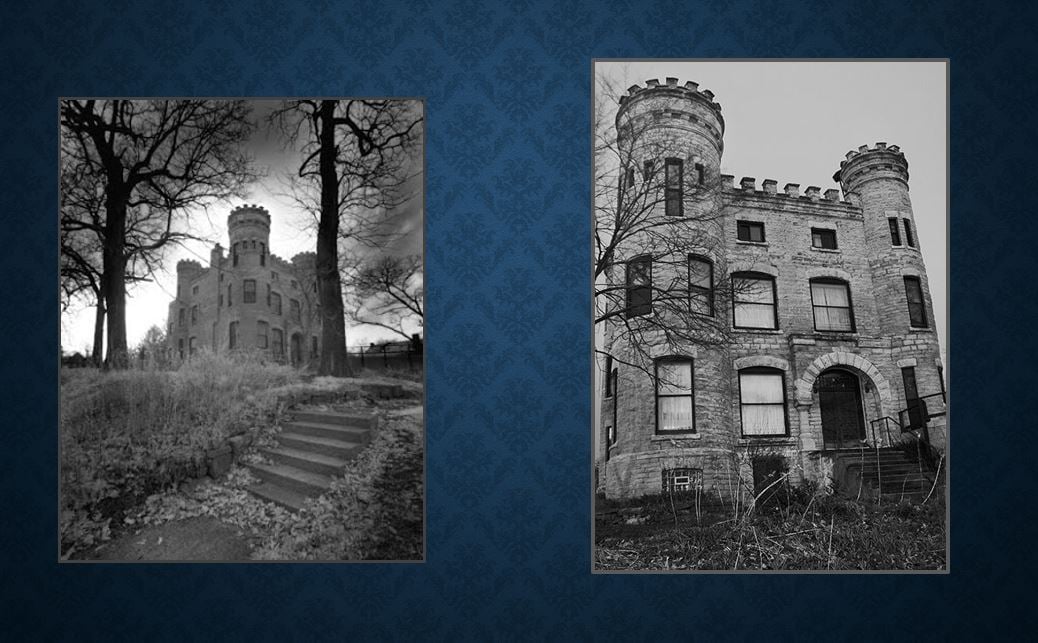
Although the Castle is a bright, proud historic landmark perched on the Ridge, it is often presented by “ghost experts” as a dark and forbidding place. Any image can be turned sinister if it is taken at a gloomy and barren time of year, emphasizing the negative, and presented in black and white using special effects. Just last year on a so-called “legitimate” Facebook Chicago history page, the Castle was reported as abandoned, derelict, and definitely haunted. A number of people, including an RHS representative, posted to correct the misinformation.
Most of the ghost stories about the Castle that are in print in books are erroneous from a historical perspective. Once a myth gets started, it just keeps being repeated. However, people have had experiences there that they have been willing to share and these stories will be presented here.
There are four categories of Castle ghost stories that will be explored in the next few posts: stories based on folklore that cannot be backed up by historical facts; significant experiences that individual people have had at the Castle that they have shared publicly; common experiences that multiple people have reported; and stories people have claimed that are extremely unlikely.
The Ridge Historical Society
The Paranormal Ridge: Part 6 –Questionable Folklore about the Givins Beverly Castle
By Carol Flynn
Ghost stories are by nature subjective – the person having the experience is really the only one who can say what happened. For that reason, it is hard to say a ghost story is not true. However, a ghost story that is attributed to incorrect historical information can be challenged for its likelihood. And that is the biggest issue with the stories about the Givins Beverly Castle that have been printed over and over for decades in books and on websites – they are not supported by historical facts.
The ghost stories most often related for the Castle involve some variation of a young woman or girl ghost. She pops up in various ways, from appearing in the living room/church sanctuary, to walking the grounds, to knocking on the door in the middle of a blizzard, to making an appearance at social events, to following people up and down stairs.
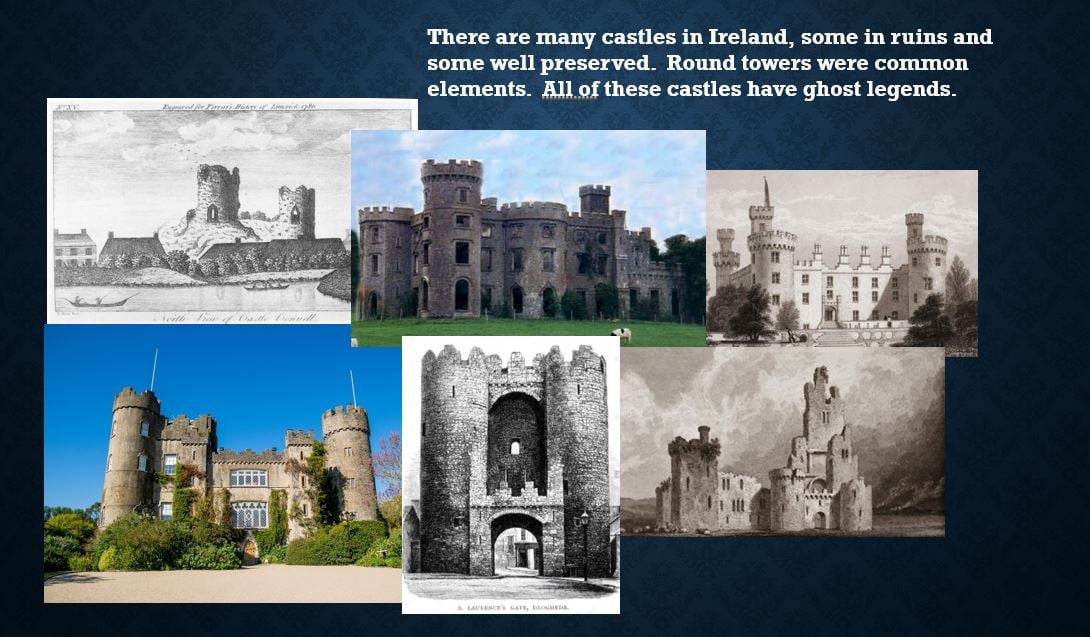
The most common story is that caretakers and others have encountered a young woman with an Irish brogue said to be the ghost of Robert Givins’ Irish fiancé. This is based on the folklore about the “Irish” origins of the Castle. The usual story is that Givins visited Ireland and came across a castle along the River Dee. He so liked the Castle that he sketched it, and when he returned to Chicago, he built his Castle as a replica. Some stories say the limestone used to build the Castle was brought over piece by piece from Ireland.
The ghost legend part is that Givins built the Castle for his fiancé, who remained back in Ireland. She died before she could come to America to live in the Castle, and it is her ghost that haunts the house.
The truth is that none of this information can be verified – in fact, more than likely the Castle is not “Irish” at all.
The Castle was built by Robert Givins in 1886-87 from limestone quarried in and transported from Joliet, Illinois; this is verified by the family of the stonemason who did the work. Research so far shows that the Castle was never referred to as an Irish Castle until it was about 50 years old, and then the Ireland story was mentioned in a newspaper article that had many facts wrong about Givins and the Castle. His name was not even spelled correctly in the article. No record of Givins taking a trip to Ireland can be found. Travel to Ireland was not the norm in the 1800s due to the living standards and political strife there. In fact, this was the period in history when hundreds of thousands of people were emigrating from the country.
Givins sold the Castle in 1909 to the Burdett family. Decades later, in the 1940s, the Beverly Unitarian Church (BUC) bought the Castle. A member of BUC contacted the Burdetts for information on the building and Mrs. Burdett had never heard the Irish story before. The Castle was not known as “Irish” in its early years.
It is always possible that Givins did get over to Ireland and the evidence of the trip – a ship’s passenger list, etc. – just has not turned up yet. Or it is possible Givins saw a print or painting of a castle in Ireland and modeled it on that. The architect for the Castle has not been identified. The structure is typical of what many castles were like – a box with towers.
But even if Givins did get over to Ireland, the ghost story about a deceased fiancé is highly unlikely. Givins married Emma Steen, his second wife, in 1884, and she was very much alive when the Castle was built two years later. She was a Chicago schoolteacher of Norwegian descent, and her family was from Minnesota. They lived in the Castle for many years.
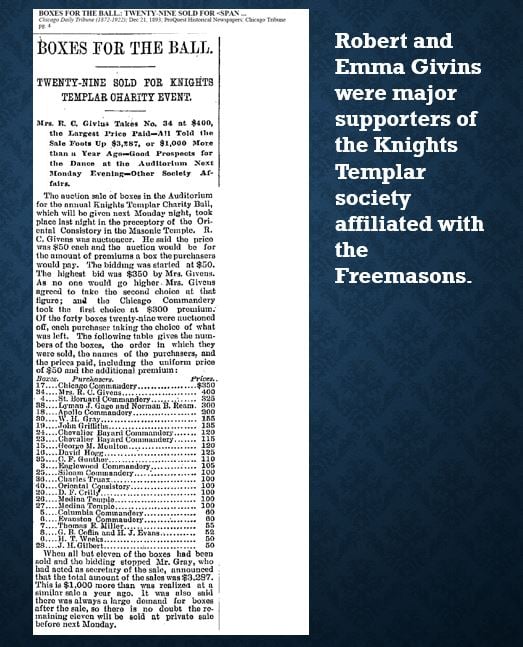
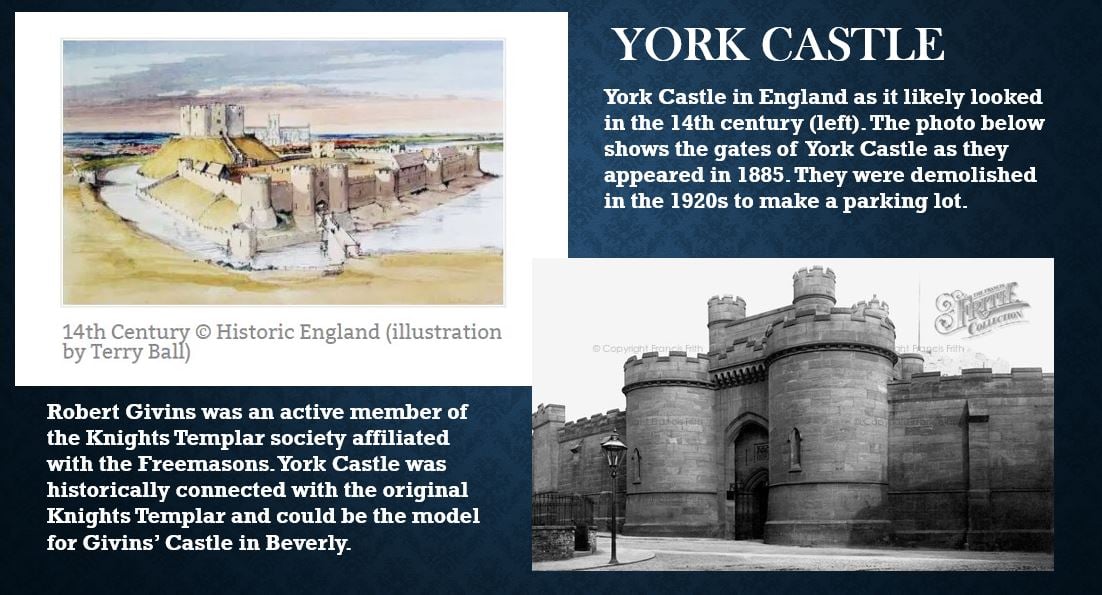
An alternative, and more likely, theory is that the Castle is based on York Castle in England. Givins was an active member of the Knights Templar fraternal organization affiliated with the Freemasons, as were numerous other prominent men of his day. Emma and he participated in many events with this group, which had no historic connection with the medieval Crusaders other than borrowing their name. However, there was much interest in the original Knights Templar.
The Knights Templars had a strong historic connection to York Castle. In 1308, twenty-five knights were held prisoner there while they were tried for heresy. They were found innocent, but the order was disbanded and stripped of its possessions. In France, Templars were burned at the stake.
Givins was a romantic at heart – he even wrote romance novels – and certainly would have been familiar with York Castle. The York structure with its round towers looks very similar to the building Givins constructed in Beverly.
The second most common story is that the young woman whose ghost haunts the Castle died of influenza while she was a student at the female academy in the 1930s.
The problem with this story is that the Chicago Female College was in the Castle in 1895-97, and long gone by the 1930s.
The house was owned by Dr. Miroslaw Siemens in the 1930s and he saw patients there. A young woman could have died during that time or could have died during the 1890s when the school really was there. Neither of those time periods had widespread influenza outbreaks, but the flu certainly could have been around. The major influenza outbreak was in 1918-19. More research could be done to try to identify a female influenza victim from any time period that somehow had connections to the Castle.
The origins of the “Irish fiancé” and the “female academy student” stories are not known but they are likely just urban folklore.
There are other stories about a young woman or girl ghost at the Castle. These will be explored in the next sections which will look at unusual experiences people have actually reported at the Castle.
The Ridge Historical Society
The Paranormal Ridge: Part 7 – The “real” ghost stories from the Givins Beverly Castle
By Carol Flynn
The last post covered the two ghost stories from the Castle that appear most often in print – the Irish fiancé and the influenza victim. The origins of these stories are not known, and neither is supported by historical facts. They fall into the realm of folklore or urban myth.
But while it may be disappointing that those two old stories are probably not true, there were – and continue to be – many other experiences at the Castle reported by “real” people that keep things interesting. The next few posts will cover some of those stories.
In an earlier post, it was mentioned that several factors come together on the Ridge that appear to encourage paranormal activity. Three of these factors – limestone, flowing water, and railroad tracks – are considered conductors of paranormal energy, and
they certainly come together at the Castle.
First, the building blocks of the Castle are limestone quarried from the banks of the DesPlaines River in Joliet, Illinois. This limestone formed in the reefs of shallow seas that covered the area 400 million years ago. Joliet limestone was used for many buildings in the 1800s, including the Castle built by Robert C. and Emma Steen Givins in 1886-7.
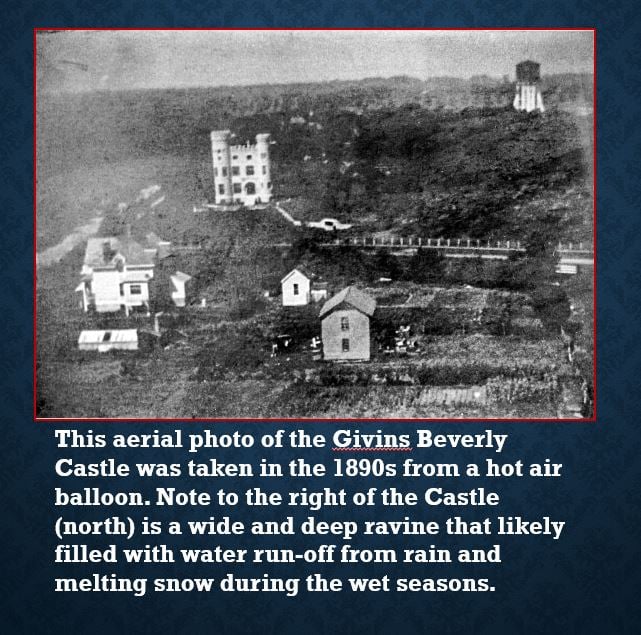
Second, just north of the Castle building was a large and deep ravine which likely included a stream at least during the “wet” season. This geological feature is evident on U.S. survey maps and in early pictures, and was mentioned in an article when Givins first built the Castle. The article stated that “stretching down the ravine from the house is a woodland park where the squirrels still bob up the big oaks and the rabbits have their warren.” The land was originally set up as a garden. The Beverly Unitarian Church (BUC), which has owned the Castle since the 1940s, built its school annexation in that section of the property.
Railroad tracks, the third factor, are just a few blocks to the east of the Castle. Bob Givins was often observed hurrying down the hill in the morning to catch the train on the Rock Island line at the Tracy stop (103rd Street) to go to his office downtown.
The first ghost stories on record for the Castle date to the 1920s. A man, who grew up on the Ridge 100 years ago, and was involved in the Ridge Historical Society but has now passed away, was asked in a newspaper interview about the Castle being haunted. He said he remembered stories, going back to his childhood in the 1920s, of people seeing ghostly lights floating in the windows. This is a common story for haunted houses. Such lights are usually dismissed today as reflections of streetlights or passing car lights, but 100 years ago, there were few streetlights, much less traffic, and no cars with high-beam headlights. The newspaper article is the only mention of these lights that has been found.
Some of the ghost guidebooks mention a story dated to the 1940s in which a caretaker at the Castle encountered a young woman with an Irish brogue dressed in old-fashioned clothes in the main room. She asked him what he was doing in her house. She then vanished. This would have been around the time that the Castle was purchased by the BUC and started being referred to as the “Irish Castle.” Unfortunately, no verification or further elaboration of this story for this time period has been found.
The earliest stories for which people can still be located for interviews start in the 1950s. The families hired by the BUC to be caretakers of the property lived on the second and third floors in the Castle. The ministers and other church personnel lived offsite.
One son from the family of caretakers who lived in the Castle from 1951 to 1962 is in his 80s now and lives in the southwest suburbs. He was 12 years old when the family moved into the Castle. In October 2019, he shared his memories for the “Phantoms and Folklore” program that was given at the Castle. The next post will relate his experiences.
The Ridge Historical Society
The Paranormal Ridge: Part 8 – Personal experiences reported at the Givins Beverly Castle in the 1950s
By Carol Flynn
This is the first of the in-person accounts of experiences at the Castle.
Rudy Visser was 12 years old when his family – father, mother, and three brothers – moved into the Castle in 1951 to be the caretakers. He attended Sutherland grammar school and Chicago Vocational high school. Now in his 80s and living in the southwest suburbs, in the fall of 2019 he shared his remembrances for a special event held at the Caste on “Folklore and Phantoms.”
As caretakers, the Vissers maintained the grounds and buildings, including everyday cleaning. It was a lot of work and they knew every inch of the Castle. The Vissers lived in rooms on the second and third floors. Back then, the Castle maintained its original floor plan, a lot of small rooms lined with dark wood. [Note: When originally built in 1886-87, the Castle was reported to have 15 rooms, paneled with red oak, including a spacious drawing room and ballroom, a library in the largest tower, and beautiful tapestries, chandeliers and gas lighting fixtures.]
Rudy said it was “very creepy” for a child living in the Castle. It was not comfortable and there was little privacy, being a church building open to the public. There were noises and creaking floors and the wind howling through the building. There were no screens in the windows and bats flew in at night, and they encountered rats when they first moved in.
One experience that Rudy found memorable involved a boarded-up opening in the basement. The family did not like going down to the basement, but it was necessary to tend the furnace and change blown fuses, as this pre-dated circuit breakers. The basement included a large room lined with benches that was used for parties and events.
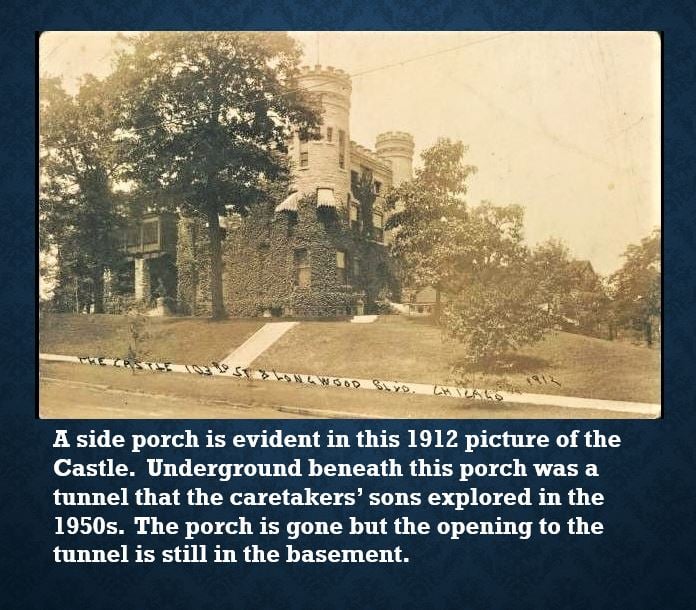
The boarded up “window” opened underground beneath a stone side porch on the south side of the Castle. The side porch is now gone but it is evident in old pictures. The opening entered a tunnel system that Rudy and his brothers crawled through that was full of mud and cobwebs and very constricted in places. Although they did not have a good perspective of distance underground, Rudy believes they crawled south at least as far as 103rd Street, but he does not know how much farther the tunnel extended past that. He said the tunnel was very old and he had no idea why it was built.
A lot of the renovations made to the Castle occurred while the Vissers lived there. In 1958, the school extension was built onto the building to the north. The school extension was supposed to be part one of a plan to tear down the Castle and build a new church, but that never happened. Before the school was built, that area was a garden.
One strange experience involved a lady in a flowing white dress that Rudy described as being like a nightgown. Rudy’s mother observed this woman several times walking around in the garden. Then one day, the woman was suddenly behind Mrs. Visser in the second-floor apartment. No one saw or heard her come in through the door. Back in the 1950s, the practice was to leave churches open during the daytime but locked at night, and the Castle followed this routine, so the woman would have been able to enter the building.
Mrs. Visser was startled and asked the woman what she wanted. The woman said she thought there was a service that day and she was looking for the minister. This was on a weekday, and Mrs. Visser explained that the services were on the weekends, and that is when the minister would be there. The woman said all right and left. Mrs. Visser immediately followed her to the door but when she looked out, the woman was gone. They never saw the woman again. They asked around and no one had any idea who the woman might have been. And for the record, the woman did not have an Irish brogue.
Another strange experience occurred one summer they lived there. The castle was closed and locked during the summers. There were no classes or services for three months. The family went away for a week, and before leaving, went through the entire building to make sure all the lights were off, the windows were closed, and the building secure. They locked the place up tight before they left.
When they returned, as they were driving down the street, they noticed a light was on in a third-floor turret window. They knew they had turned all the lights off, and there was no reason for anyone to be in the Castle while they were gone, especially up there in their family quarters – the room was the bedroom of one of the children. However, there certainly were other people with keys, including the minister, the piano teacher, and other church people.
The Castle was securely locked when they got to the building. Rudy’s father and the boys went up to the third floor, and as they were approaching the door of the room, it opened by itself with a loud squeaking noise. It scared all of them. There was no one in the room and the light was indeed on. No one ever admitted to going up there and turning on a light.
These were the experiences this family had at the Castle. They moved out in 1962. Rudy is a practical man and does not consider these to be “ghost stories.” He felt their walking on a certain floorboard or something of that nature might have made the door open on the third floor.
One story attributed to Rudy’s mother that appears in print did not happen. It is often reported that the caretaker in the 1950s reported that one time during a winter storm, there was a knock on the door, and when she answered, a girl with an Irish brogue was standing there in a light dress and no coat. Sometimes the story is that she is barefoot out there in the new snow. Supposedly, Mrs. Visser left the room to get the girl a wrap and when she returned, the girl was gone, and there were no footsteps left in the snow.
Rudy had never heard this story before and said this never happened to his mother.
Rudy said he receives calls, usually at Halloween time, about the ghost stories. He admitted that sometimes he embellishes the truth or makes something up just for his own amusement.
In the next post, stories from the 1960s will be shared.
The Ridge Historical Society
The Paranormal Ridge: Part 9 – Southtown Economist Interview
By Carol Flynn
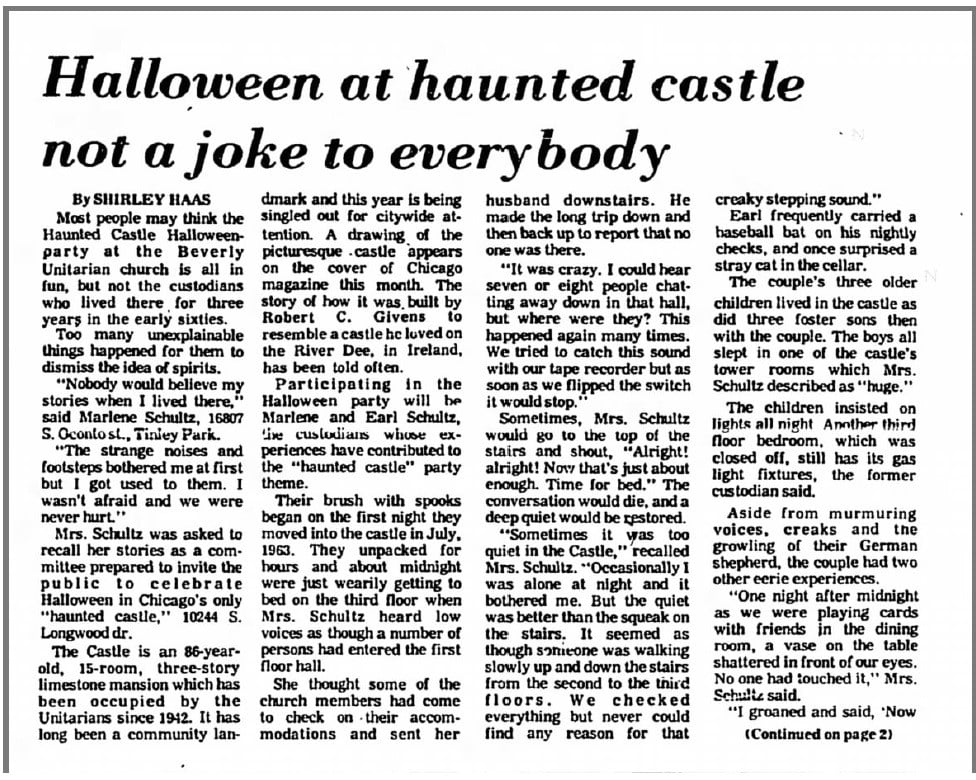
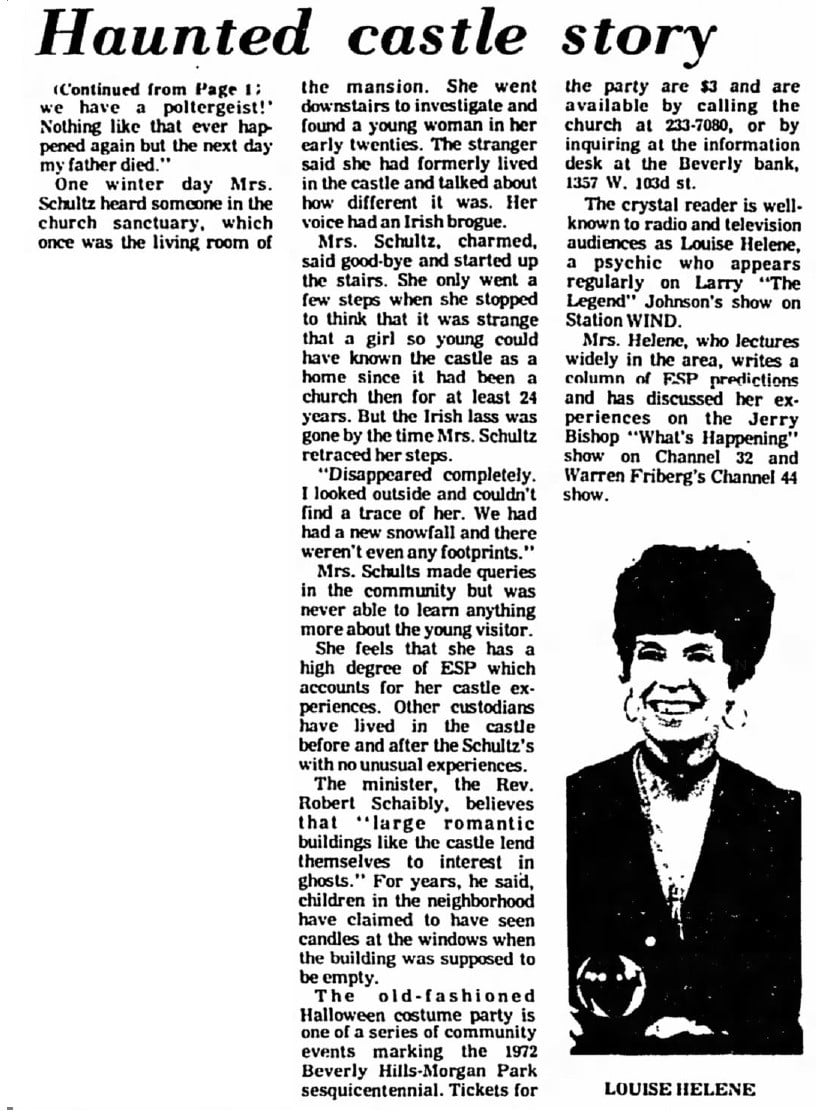
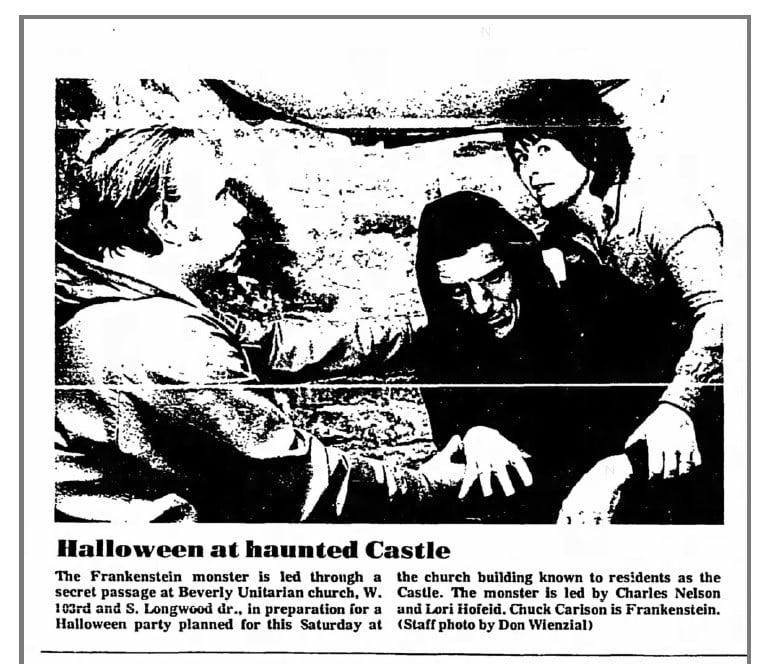
In 1972, the Beverly Unitarian Church (BUC), owner of the Castle since the 1940s, briefly embraced the Castle’s reputation as a “haunted house.” As part of the sesquicentennial anniversary celebrations of the area, BUC held an event at the Castle to “celebrate Halloween in Chicago’s Only Haunted Castle.”
The event included a walk through the appropriately decorated basement; ghost stories in one of the turret rooms; astrological, tarot card and crystal ball readings; dancing; a costume contest; and “spooky surprises.”
Leading up to the event, Shirley Haas, a newspaper reporter for the Southtown Economist, interviewed Marlene Schultz, a past caretaker of the Castle, about the strange experiences Marlene had while living there.
Shirley lived in Beverly and was a founding member of the Ridge Historical Society. She is 96 years old now, living on the north side in Lincoln Park. Just a few days ago in a phone conversation, Shirley explained that she reported what she was told, but she did caution that the interview was done in the context of promoting the Halloween event at the Castle.
Marlene participated in the 1972 event at the Castle. She is in her 80s now and RHS was not able to reach her to further discuss her experiences.
The entire article is included as an attachment to this post.
In the next post, other newspaper articles and personal accounts will be shared.
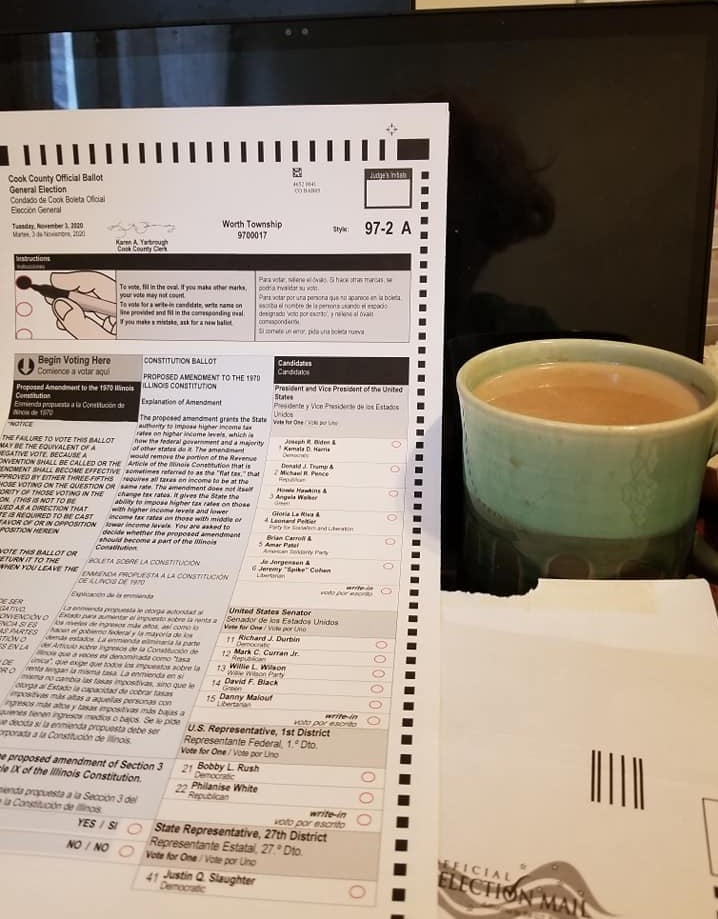
Message from the Ridge Historical Society: VOTE.
People made great sacrifices throughout history so that U.S. citizens have the right to VOTE for their leaders. Many gave their lives so future generations would have this right. VOTE.