
Explore the RHS Facebook Archives, a rich repository of local history written by Carol Flynn. For two decades, Carol brought a deeply dedicated voice to public education at RHS. Her role as Facebook administrator through mid-2025 naturally extended her prolific research into meticulously detailed articles, most notably her multi-part historical series posts. Today, Carol continues her local history writing for The Beverly Review and other outlets.
October 2023
The Ridge Historical Society
Breweries on the Ridge – Part 1
By Carol Flynn
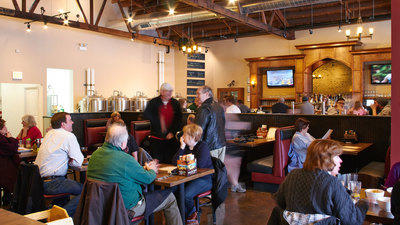
History was made on September 23 of this year when Horse Thief Hollow Brewing Company (HTH), the first brewery ever established in “North Blue Island,” that is, Beverly, Chicago, won the top-honors gold award at the Great American Beer Festival in Denver for its international-style pilsner beer, Little Wing.
In May, Little Wing won the top gold medal at the World Beer Cup competition in Nashville.
Both awards are sponsored by the Brewers Association, a not-for-profit organization that promotes and protects American craft brewers. These are the most prestigious awards that a craft beer can win in the industry, in the U.S., and possibly in the world. The awards are decided by peer-review by judges from around the world, based on a number of factors and standards set by the industry.
That HTH won both awards, and for an international pilsner, the most widespread style of beer in the world, by beating out over one hundred competitors, is truly laudable, and definitely one for the history records.
Neil Byers, the founder of HTH, and his “brewing team” members Jacob Nelson and Andrian Morrison have the goal to turn Little Wing into “Chicago’s pilsner,” that is, have it associated with the city as are the Magnificent Mile, Al Capone, and Chicago-style hot dogs.
As a start, Little Wing can be known as “Beverly’s beer” and be associated with the community, joining the Givins Beverly Castle and Rainbow Cone.
It’s ironic that the best beer in the country is being made in Beverly, a community historically known for being an exclusive residential area and a leader in the temperance, Prohibition, and post-Prohibition “dry” movements.
There are now three craft breweries on the Ridge, one in each of the three historically distinct communities. HTH opened in Beverly in 2013. The Blue Island Beer Company opened in 2015 in the City of Blue Island at the southern tip of the Ridge, and in the middle in Morgan Park is Open Outcry Brewing Company which opened in 2017.
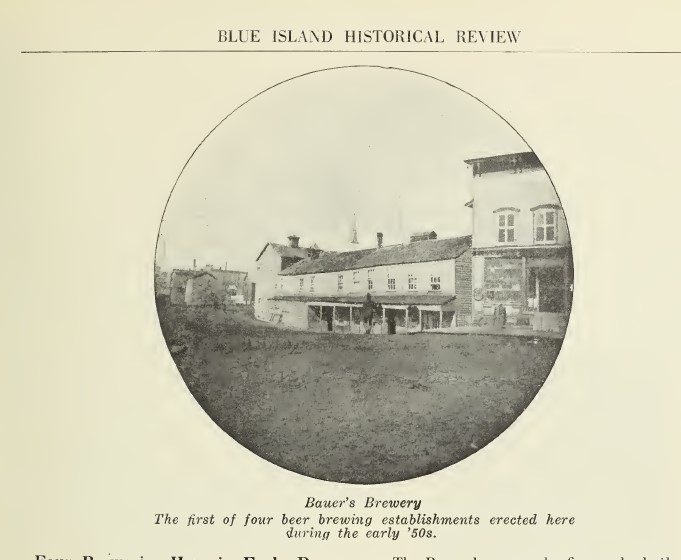
These are the first breweries on the Blue Island in ninety years. Before Prohibition, the city of Blue Island was famous for its breweries. The next post will look at the early breweries in Blue Island and the coming of Prohibition.
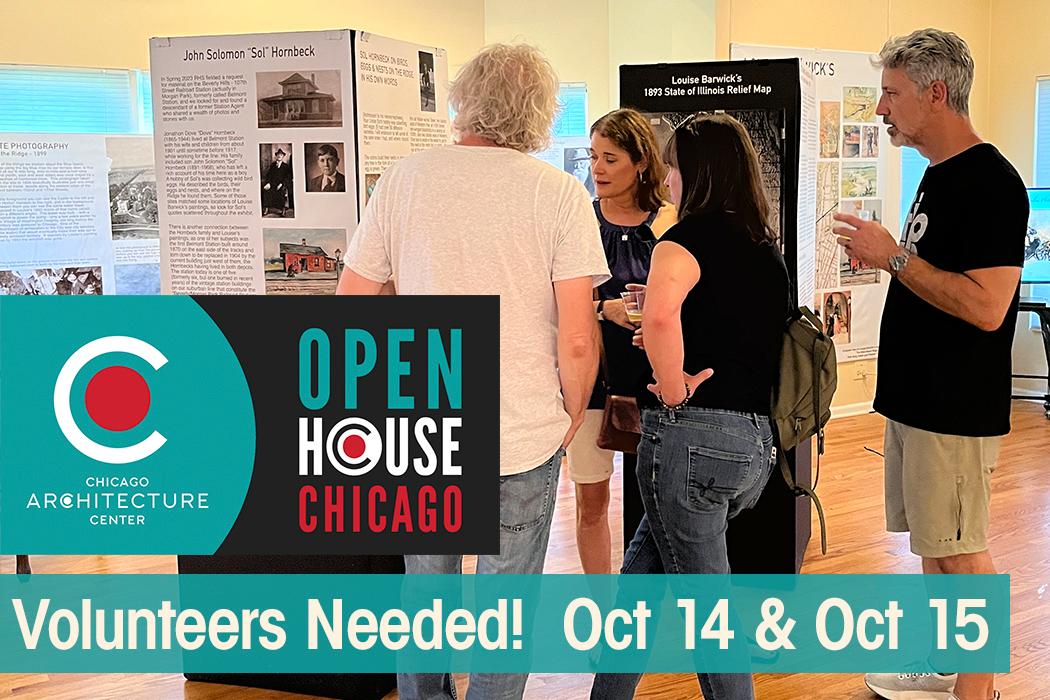
OPEN HOUSE CHICAGO is next week-end, October 14 and 15. The Ridge Historical Society will be one of the venues open for touring.
Volunteers are needed to staff RHS at the Graver-Driscoll House, 10621 S. Seeley Avenue, Chicago, on both of those days from 10 a.m. to 5 p.m. to greet and assist visitors. This is an excellent opportunity for those who would like to learn more about RHS.
Any new volunteers will be paired with a Board member, and the exhibit curators will be there to explain the exhibit (Louise Barwick's Lost Ridge).
If you are interested in volunteering, please send a message to ridgehistory@hotmail.com.
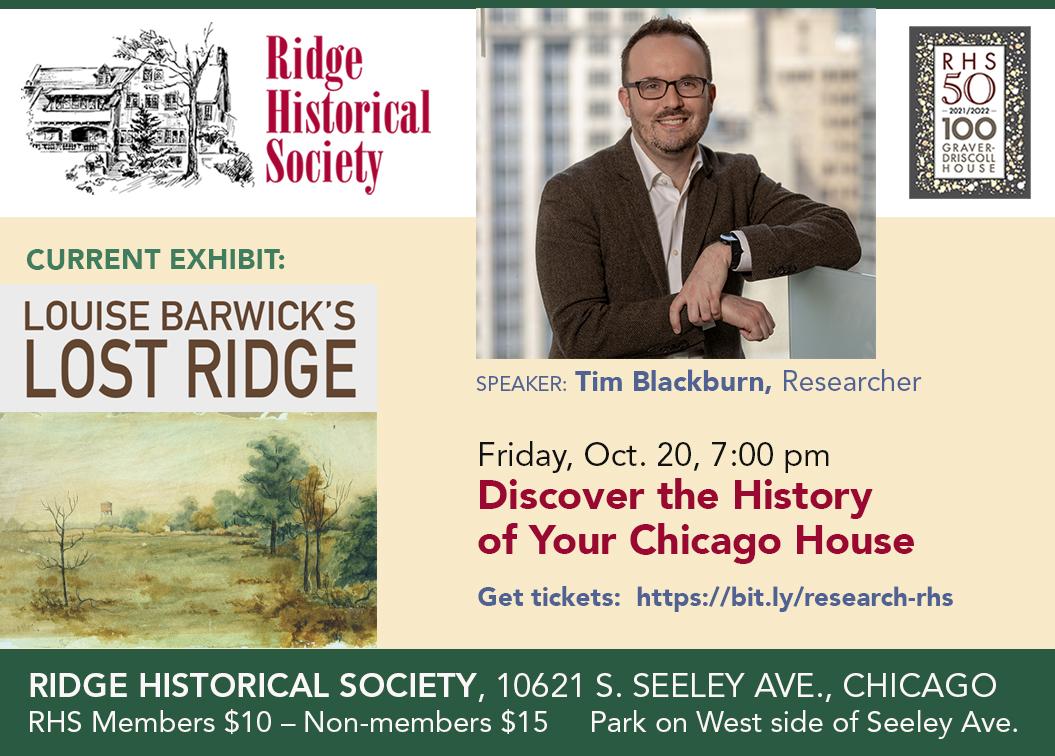
Friday, Oct. 20, 7:00 pm
“Discover the History of Your Chicago House” – Tim Blackburn, Researcher
You will learn how to research the history of your Chicago home, including the architecture, construction, inhabitants, and owners. You’ll develop research methods that will help you gain a new understanding and appreciation for your home’s history. The research methods covered will be useful for anyone researching a building older than 1955 in Chicago. You’ll learn about building permits, local history, Chicago street renumbering, Sanborn maps, and more.
Join us to find out more!
Tickets: Members: $10.00 Non-Members: $15.00 buy tickets online here:
https://bit.ly/research-rhs
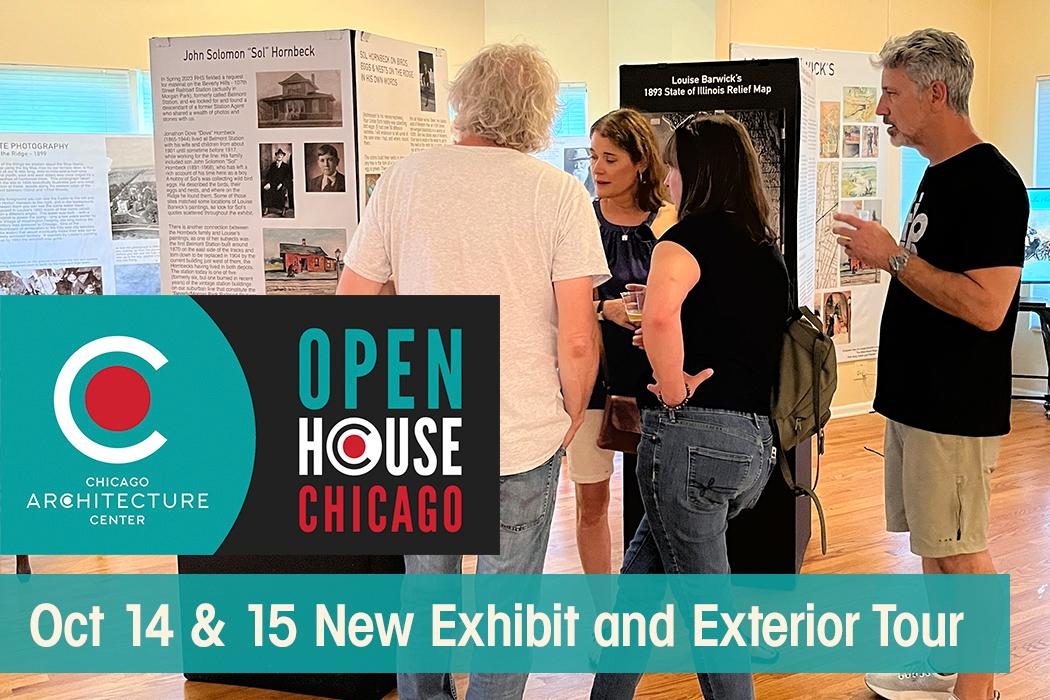
This week-end! Open House Chicago at the Ridge Historical Society.
Saturday and Sunday, October 14 and 15, 11 a.m. to 5 p.m. 10621 S. Seeley Avenue, Chicago.
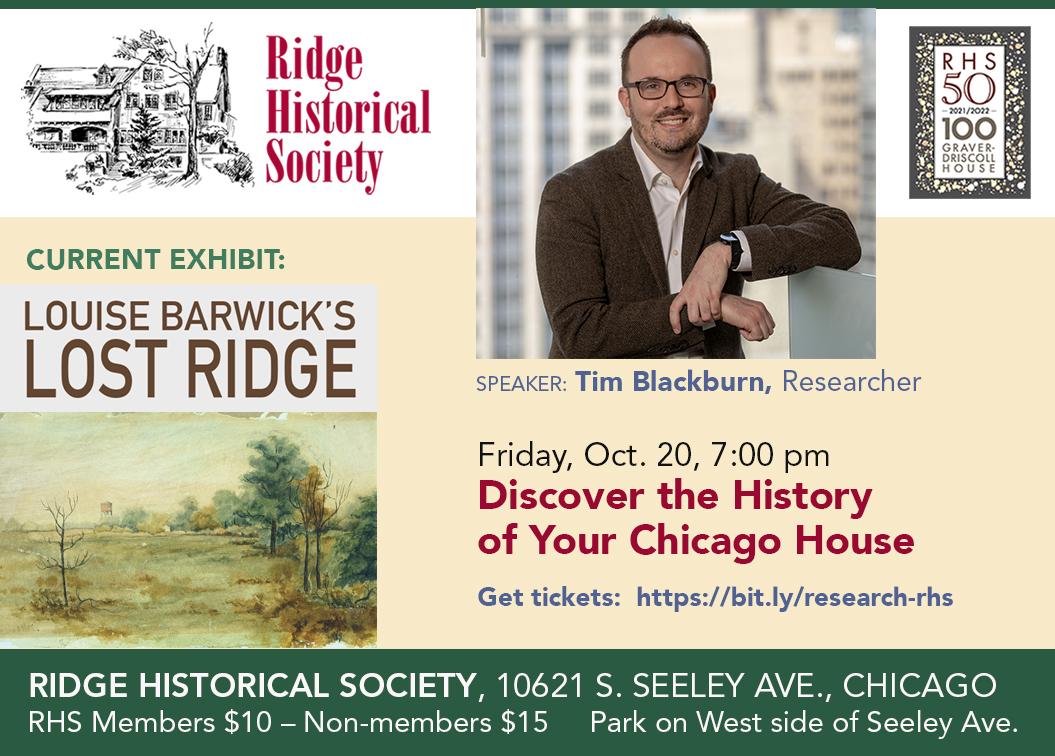
Friday, Oct. 20, 7:00 pm
“Discover the History of Your Chicago House” – Tim Blackburn, Researcher
You will learn how to research the history of your Chicago home, including the architecture, construction, inhabitants, and owners. You’ll develop research methods that will help you gain a new understanding and appreciation for your home’s history. The research methods covered will be useful for anyone researching a building older than 1955 in Chicago. You’ll learn about building permits, local history, Chicago street renumbering, Sanborn maps, and more.
Join us to find out more!
Tickets: Members: $10.00 Non-Members: $15.00 buy tickets online here:
https://bit.ly/research-rhs
The Ridge Historical Society
The Early Days of Morgan Park – Part 5: More Founders of Morgan Park
By Carol Flynn
In previous posts, we looked at two of the prominent Chicago businessmen who developed Morgan Park, Frederick H. Winston and John F. Tracy. Both were executives with the Chicago, Rock Island, and Pacific Railroad (CRI&P) and both were founders of the Blue Island Land and Building Company (BILBCo).
Other men important to Chicago’s history were also part of the BILBCo.
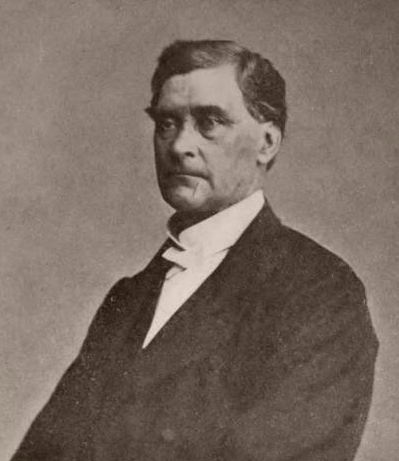
CHARLES VOLNEY DYER (1808-1878) was a physician who came from Vermont to Chicago in 1835, where he served as Surgeon for the garrison at Fort Dearborn, and later went into private practice.
Dyer made the wise decision to invest in real estate, and he was able to retire in 1858. Presumably, his investment in the BILBCo paid off favorably.
He and his wife Louisa had three children and an adopted daughter who lived to adulthood.
Dyer is best known for being an ardent abolitionist. As early as 1837, he held a protest meeting in reaction to the murder of Elijah Lovejoy by a pro-slavery mob in Alton, Illinois. Lovejoy was the owner of a newspaper that advocated for ending slavery. The Lovejoys were good friends of Abraham Lincoln, and their nephew Austin Wiswall lived in Morgan Park and was a member of the Village Board of Trustees in the 1890s.
Dyer actively fought against slavery. He became a stationmaster on the Underground Railroad, hosting many escaped slaves, some brought to him by Owen Lovejoy, Elijah’s brother.
In a famous incident, a young escaped slave staying with Dyer was re-captured by slave traders and held at a hotel. Dyer burst into the room and cut the ropes to free the youngster and told him to flee through the window. One of the slave traders attacked Dyer with a knife and Dyer beat him unconscious with his walking stick.
A later connection between Dyer and Beverly/Morgan Park was the Loring School for Girls. Dyer’s daughter Stella Dyer Loring established this private school in 1876. From 1935 until the school’s closing in 1962, it was located in the England J. Barker House at 107th Street and Longwood Drive.
Dyer's photo is attached to this post.
CHARLES W. WESTON (1833-1880) was born in Massachusetts and had a career in manufacturing and merchandising. He came to Chicago in 1866 and made a new career in real estate investment. He also invested in elevated railways, or streetcars, and was named as Treasurer of the West Chicago Elevated Railway in 1879.
Weston died of consumption (tuberculosis) at the age of 48. He was living at the Palmer House at the time with his wife Mary and their ten-year old son. A special funeral train brought his coffin and mourners to Mount Greenwood Cemetery.
JOHN BACON LYON (1829-1904) was born in New York in 1829 and came to Chicago as a grain merchant in 1857. He joined the Board of Trade and became one of the longest-standing members. It was reported that he was involved in more deals than any other grain trader in the west.
Lyon was also involved in real estate, and had interests in the timber, turpentine, oyster, and sugar industries. He was known for his insightful investments, and keen judgment, making him one of the most successful businessmen in Chicago. He was also a founding member of the Chicago Historical Society.
He, his wife Emily, and their five children lived at 262 Michigan Avenue.
The next post will look at some of the BILBCo men who lived in and developed sections of Beverly.
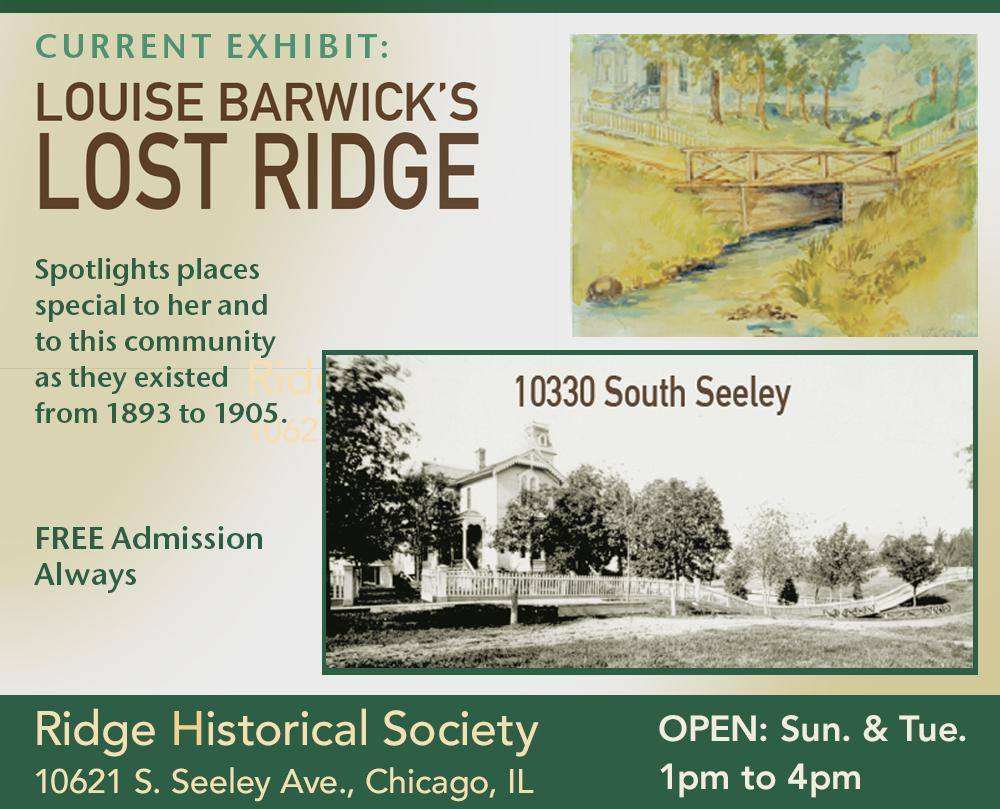
The Ridge Historical Society (RHS) has premiered a new exhibit that is now open for public viewing. There is something in this exhibit for everyone – art, rare photographs, architecture, and the stories of people who called the Ridge home. Curators of the exhibit are Linda Lamberty, RHS Historian, and Tim Blackburn, RHS Board member.
“Louise Barwick’s Lost Ridge” presents the area from 1893 to 1905 as experienced through the watercolor paintings and their descriptions by Louise Barwick, a local teacher and artist. Viewers will be taken back to the days when daisies stretched for acres, gaslights were lit by hand every night, and young women arrived for events in horse-drawn carriages.
A related story is that of Sol Hornbeck whose family lived and worked in one of the historic train stations. Sol shared stories about the wild bird life in the area.
Also on display are images of the area caught by kite photography, cutting edge technology of the 1890s, foreshadowing today’s drone photography.
Another part of the exhibit is an architecture feature on early buildings from Beverly and Morgan Park. Some are still standing but many others have fallen to the wrecking ball.
The fates of the Vanderpoel Block on 95th Street and the Charles Silva House on Esmond Avenue reveal that, unfortunately, progress and preservation are not always compatible. The Vanderpoel Block is preserved in a wonderful model on loan from Tim Blackburn. Artifacts salvaged from the Silva House are on display from the RHS collection.
Viewers will also enjoy rare early panoramic photos of the area, and can guess which of twenty-three original buildings are still standing. Hint: It’s more than half!
RHS is located at 10621 S. Seeley Avenue in Chicago. Exhibit hours are 1:00 p.m. to 4:00 p.m. on Sundays and Tuesdays, or by appointment. Admission is free. There is some parking on site, and more on Seeley Avenue. RHS is not wheelchair accessible. RHS may be contacted at 773/881-1675 or ridgehistory@hotmail.com.
The Ridge Historical Society
Wild Turkeys on the Ridge
By Carol Flynn
In the last few years, turkeys have been spotted roaming the streets of the Blue Island, from the city of Blue Island on the southern tip of the island to Beverly on the north.
Last year, a turkey was captured in Beverly and taken to an animal refuge in Indiana. There it was identified as an escaped domestic turkey.
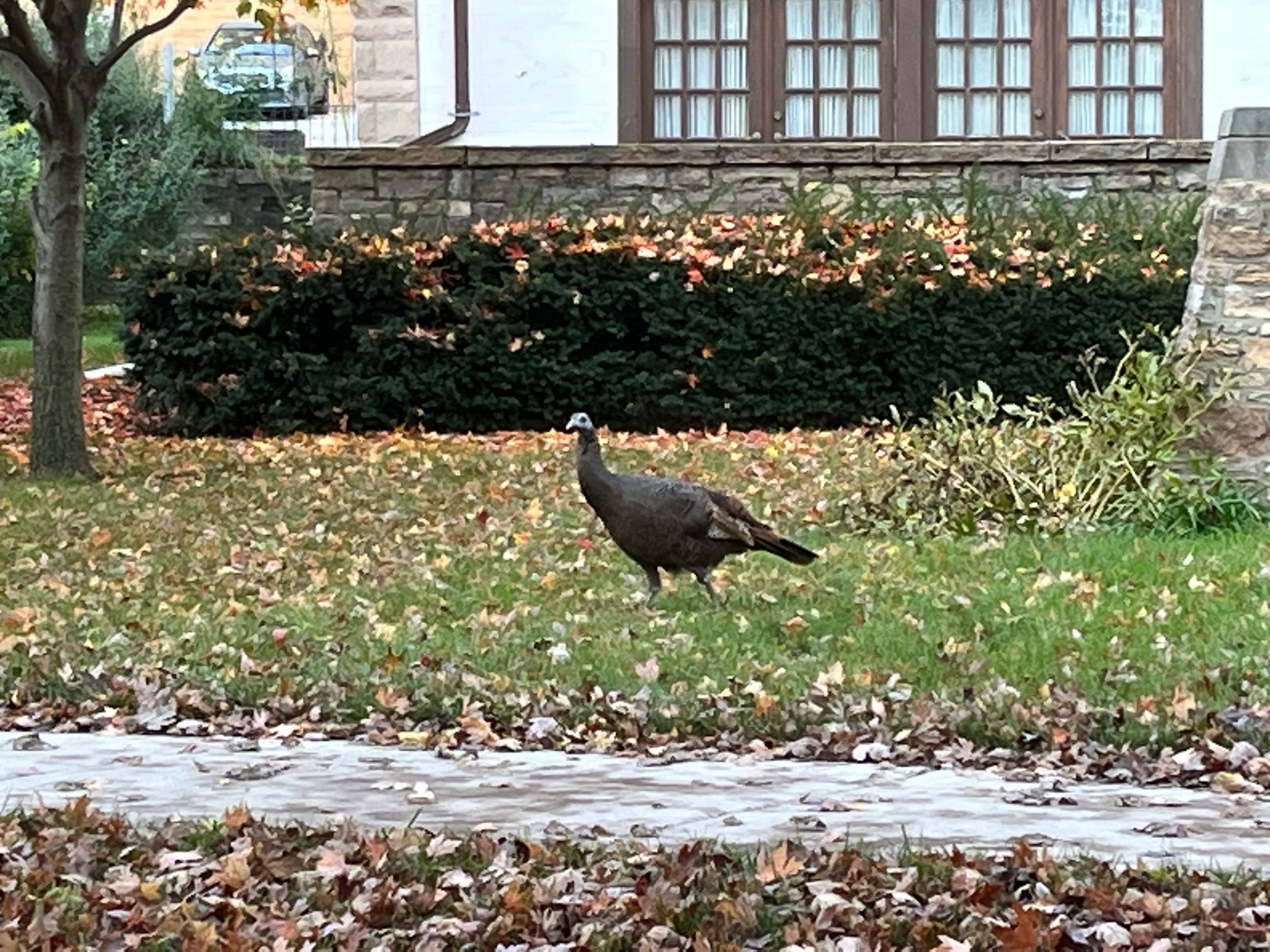
Right now, at least one turkey is walking around Beverly/Morgan Park. RHS President Debbie Nemeth caught this photo of it outside of the Morgan Park Presbyterian Church at 110th and Longwood Drive.
The history of wild turkeys in this country, and in Illinois, is very interesting.
In the mid-1800s, an English “sportsman and conservationist” named Parker Gillmore visited the northern Illinois/Indiana area and wrote up his stories in a book called “Prairie Farms and Prairie Folk,” which he published in London in 1872.
Gillmore shared this recollection:
“I had a sight which few have seen. I took the old hound with me…. Backward and forward the faithful old dog trailed his game … till at last a drove of over thirty full-grown turkeys took wing through the inundated portion of the forest. What splendid birds these were, and with what brilliancy the sun was reflected off their burnished plumage! The sight was before me for hours afterwards. Shall I ever forget it? My feelings answer no.”
Within three decades of Gillmore sharing that remembrance, wild turkeys had almost disappeared from the United States altogether.
The U.S. Department of Agriculture once stated that “the Wild Turkey is the largest and the gamiest game bird native to North America.”
Native Americans made use of turkeys long before white settlers came; they even domesticated them. They used the feathers for arrows, blankets, clothing, and ornamental headdresses. They ate the meat and used the bones for tools. Native Americans were environmentalists. They were always careful not to overhunt the wildlife so the supply was sustainable.
Starting in the 1600s, European settlers came along and became dependent upon the turkey as a mainstay of their pioneer lifestyle and diet.
Benjamin Franklin preferred the turkey to the bald eagle for use on the national seal. Franklin said the eagle was “a bird of bad moral character.” He said that “the Turkey is in Comparison a much more respectable Bird, and withal a true original Native of America… a Bird of Courage, and would not hesitate to attack a Grenadier of the British Guards who should presume to invade his Farm Yard with a red Coat on.”
Clearing the land for farms destroyed the bird’s habitat, and overhunting caused the turkey to disappear from Massachusetts by the 1820s.
A publication called “The Auk” reported in 1909 that in 1903, a man by the name of Mr. F. B. Smiley led a hunting party that killed five wild turkeys in Clinton County, Illinois. Smiley bragged that, “as far as he knew, these were the last Wild Turkeys ever seen in Illinois.”
By the early 1900s, only about 200,000 wild turkeys were left in the U.S. when once there were millions of these birds throughout the forests and prairies. The U.S. government began a program to bring them back from impending extinction.
Illinois was one of the first states to set up breeding farms for wild turkeys. One report said that a flock of thirty-five wild turkeys from an Arkansas breeder was brought to a wooded farm downstate.
Unfortunately, the early attempts were not too successful. A 1980 report shared that:
“The wild turkey was extirpated from Illinois during the early 1900s because of habitat destruction and excessive hunting. Attempts by the US Forest Service in 1935 and by the Illinois Department of Conservation in 1954 and 1955 to introduce pen-reared wild turkeys were not successful. The birds were too tame.”
Another article reported that it seemed the birds were quite able to fight off natural predators, like fox, but they did not recognize “their greatest enemy – the man with a gun.” The first releases hung out around the populated farms; it took a few generations of breeding in the woods before they “reverted back to their original shyness and cunning.”
The 1980 report went on to say that in 1958, wild turkeys live-trapped in West Virginia were released in Illinois, and this, and subsequent additional releases, began a successful increase in the wild turkey population in Illinois.
Apparently, it was best to leave the plan to Mother Nature.
Today, the eastern wild turkey is the only subspecies found in Illinois, according to the Illinois Department of Natural Resources (IDNR). They are large birds with dark, iridescent feathers in shades of bronze, red, purple, blue, and green.
The populations of wild turkeys reintroduced from 1958 to 1967 produced offspring that have now been reintroduced to all Illinois counties. They are found in woodlands and grasslands. They mainly eat plants but also insects, acorns, and berries.
In Illinois, wild turkeys are legally protected by the Illinois Wildlife Code. In urban areas, wild turkeys may not be removed except by a professional approved by the IDNR.
However, the turkeys spotted in urban areas are often escaped or released pen-raised turkeys from game-farm stock. According to IDNR, these birds often look like wild turkeys, but they lack a wariness of humans, are not adept at living in the wild, and often associate people with food. Besides leading to human–turkey conflicts, the escape of pen-raised turkeys has wildlife biologists concerned about the spread of disease to wild flocks and the loss of genetic purity caused by hybridization.
The IDNR is the organization that would oversee the identification of the turkey or turkeys roaming around the Ridge, and determine how to deal with the situation safely.
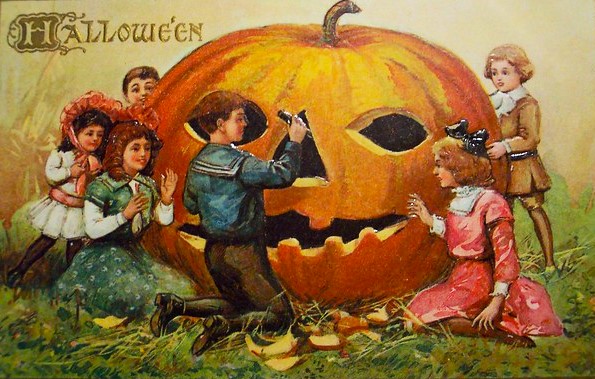
Happy Halloween from the Ridge Historical Society.
Halloween has become a truly American holiday but its origins are in Ireland. The traditions that the Irish brought over to the U.S. in the 1800s turned into today's Halloween customs.
About 2,000 years ago, the Celtic New Year of Samhain was born. The new year started with the end of the harvest. The people believed that at this time of year, the barrier between the physical and spiritual worlds was thinnest, and spirits could cross over into the physical world.
This included the spirits of deceased loved ones, who were welcomed. Places at the table were even set for these spirits.
It also included non-human spirits, like demons and fairies. To scare away these beings, people carved gruesome faces into turnips (rutabagas) and lit them from inside with candles, and placed them on their stoops or in their windows.
When they came to the States, rutabagas were less plentiful , and they discovered pumpkins were much easier to carve.
Thus, jack-o-lanterns began.
They also dressed in fearsome outfits to confuse the demons, leading to costumes. They left out treats for the fairies so the fairies wouldn't play tricks on them, leading to trick-or-treating.