
Explore the RHS Facebook Archives, a rich repository of local history written by Carol Flynn. For two decades, Carol brought a deeply dedicated voice to public education at RHS. Her role as Facebook administrator through mid-2025 naturally extended her prolific research into meticulously detailed articles, most notably her multi-part historical series posts. Today, Carol continues her local history writing for The Beverly Review and other outlets.
October 2021
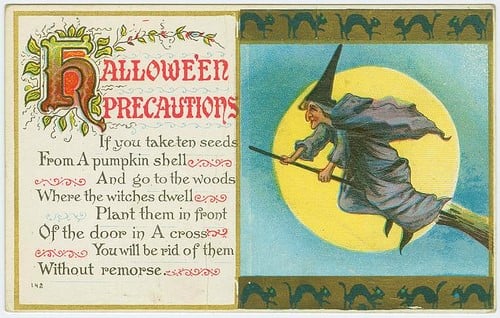
Happy Halloween from the Ridge Historical Society. Here is a vintage postcard with some sage old folklore advice. Of course, it depends if it is a good witch or a bad witch ….
October is Squirrel Awareness Month. Love 'em or hate 'em, they are part of the fabric of the community. I'm looking for anyone who has spotted, and preferably managed to photograph or videotape, the white squirrel(s) that live in Beverly Park (103rd Street, Chicago) for an article I am working on. Any pictures or stories to share about these little guys?
The Ridge Historical Society
History of the Chicago Wards – Post 2: The Beginning
By Carol Flynn
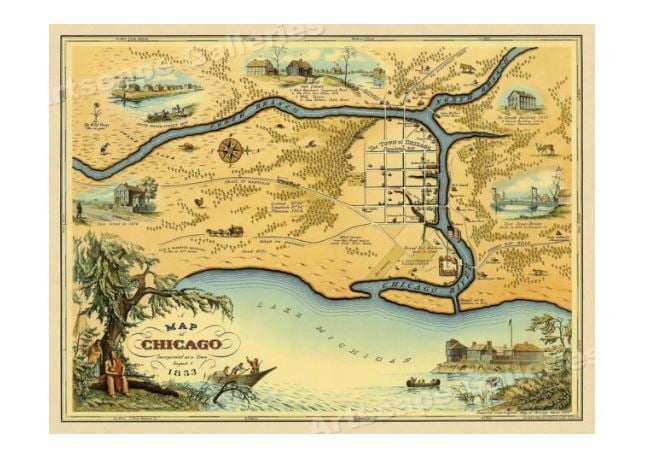
In 1830, Chicago was not yet a city, and Cook County did not exist. For voting in State of Illinois elections, the Chicago area was considered a precinct of Peoria County. Cook County was formed in 1831, and the unincorporated Fort Dearborn settlement at the juncture of the Chicago River and Lake Michigan became the county seat. The area continued to grow, and Chicago incorporated as a city in 1837 and became the county seat.
There are a variety of models for U.S. city governments. Chicago uses a variation of a system brought over from England where wards were administrative units centered around castles. Many American municipalities used the early model of a city council made up of aldermen elected by local citizens to represent geographic units of the city called wards. The council is led by a full-time, paid mayor elected separately, that is, not chosen from or by the aldermen.
Other cities now use other models such as paid city managers or small governing boards with commissioners. The ward system is considered democratic, but can also be cumbersome and result in gridlock. Other systems are considered more efficient, but some are less representative of the will of the people.
The Act of Incorporation for the City of Chicago, 1837, established the city’s form of government, which is the only form the city has ever known. The charter specified as officers an elected mayor heading a “common council” made up of the aldermen from the city wards. Other city officers included a Clerk, a Treasurer, Collectors (for taxes and assessments), and others to be established.
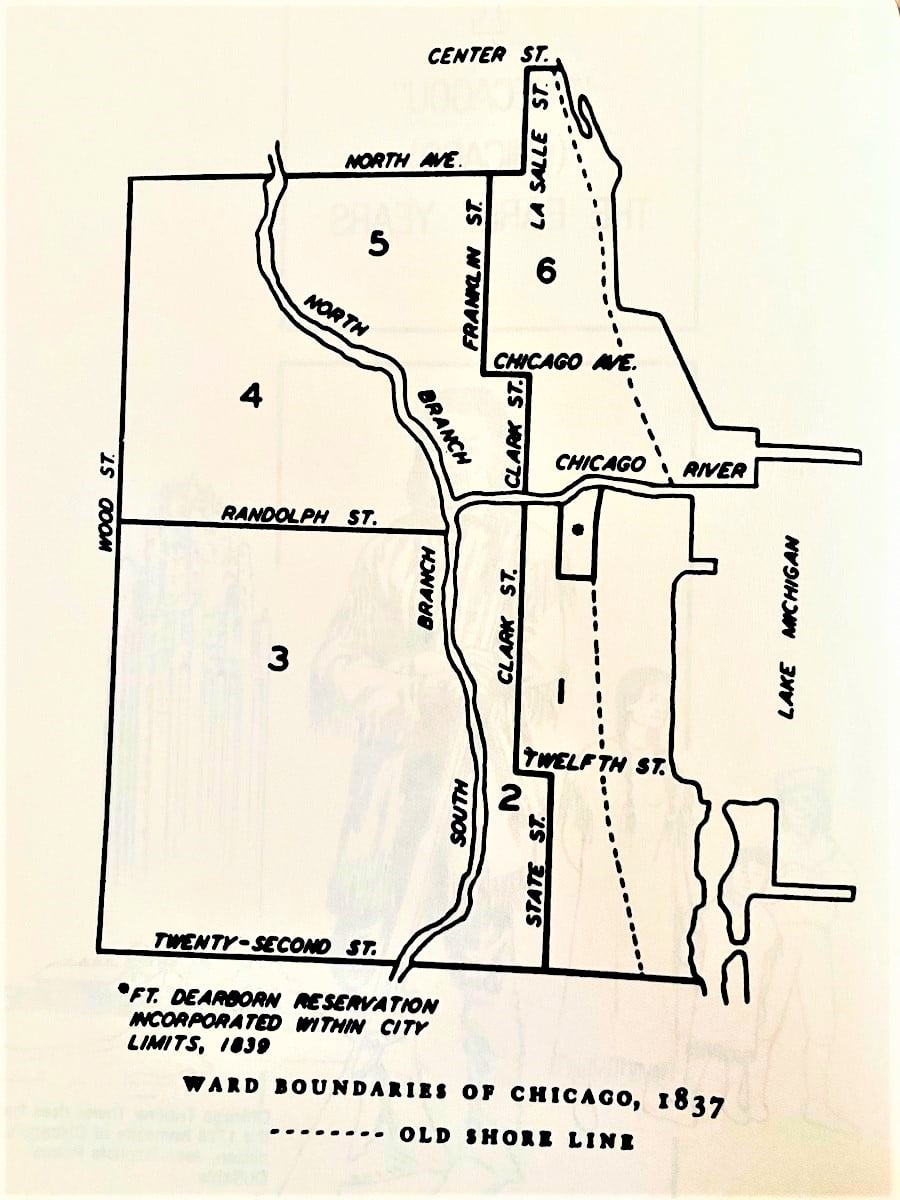
Initially, there were six wards. Two aldermen and one assessor from each ward were elected. Annual elections on the first Tuesday in March for all the offices were mandated.
The “common council” was empowered to handle all aspects of city management, ranging from the control of city finances and property to “preventing the rolling of hoops, playing at ball or flying of kites or any other amusement … having a tendency to annoy persons … or to frighten horses.”
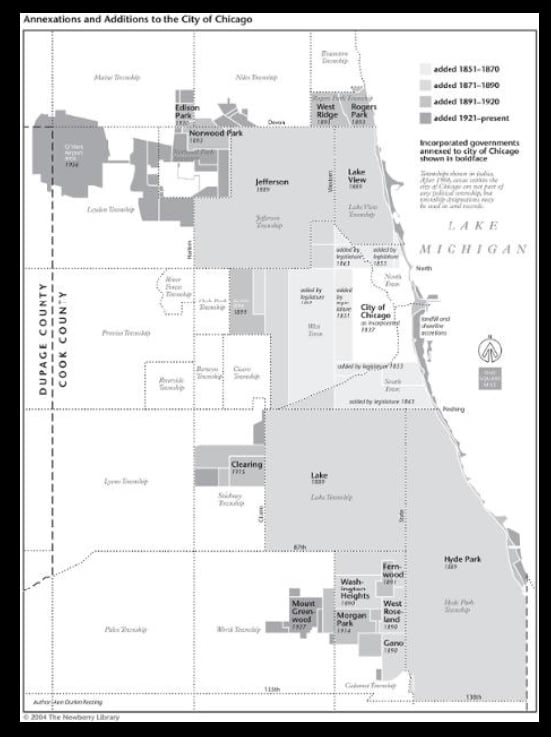
The first six wards were clustered around the site of Fort Dearborn. However, the city didn’t stay small for long. As the city expanded due to population growth and annexation of neighboring communities, the number of wards increased. Also, by 1860, the city had begun to further divide the wards into election precincts. Major acquisition and annexation of land to Chicago occurred during the 1800s, and by 1890, when the Blue Island Ridge territories began to annex, the city was up to 34 wards and 68 aldermen.
Wards were theoretically established based on population size, and determining the boundaries of wards was always a political ordeal.
For example, in 1859, a group proposed that the number of wards be increased from ten to twenty-one because, it was alleged, the wards were too large both population- and geography-wise for efficient voting, resulting in some people having to travel miles to a voting place, and others being denied the opportunity to vote because the lines were so long. The Chicago Tribune called this “brazen lies” and reported the redistribution carved the city into “parallelograms, rhomboids, polygons, diamonds, triangles, and trapezoids, wholly regardless of population, property or propriety.” The paper stated that the “Graveyard on the North Side” (now Lincoln Park) was laid out as a ward in the new system. The proposal went nowhere.
Next post: Washington Heights, including Beverly, is annexed to the City of Chicago and joins the ward system.