Explore the RHS Facebook Archives, a rich repository of local history written by Carol Flynn. For two decades, Carol brought a deeply dedicated voice to public education at RHS. Her role as Facebook administrator through mid-2025 naturally extended her prolific research into meticulously detailed articles, most notably her multi-part historical series posts. Today, Carol continues her local history writing for The Beverly Review and other outlets.
October 2024
The Ridge Historical Society
Living History: Brick Streets of Yesteryear
By Carol Flynn
"Seizing the educable moment:" For a wonderful opportunity to see what the brick streets were like, back in the late 1800s – early 1900s, visit our neighbor to the south, the City of Blue Island.
Blue Island, in its continuing efforts for revitalization, which are proving to be very successful, is redoing streets, curbs, and sidewalks.
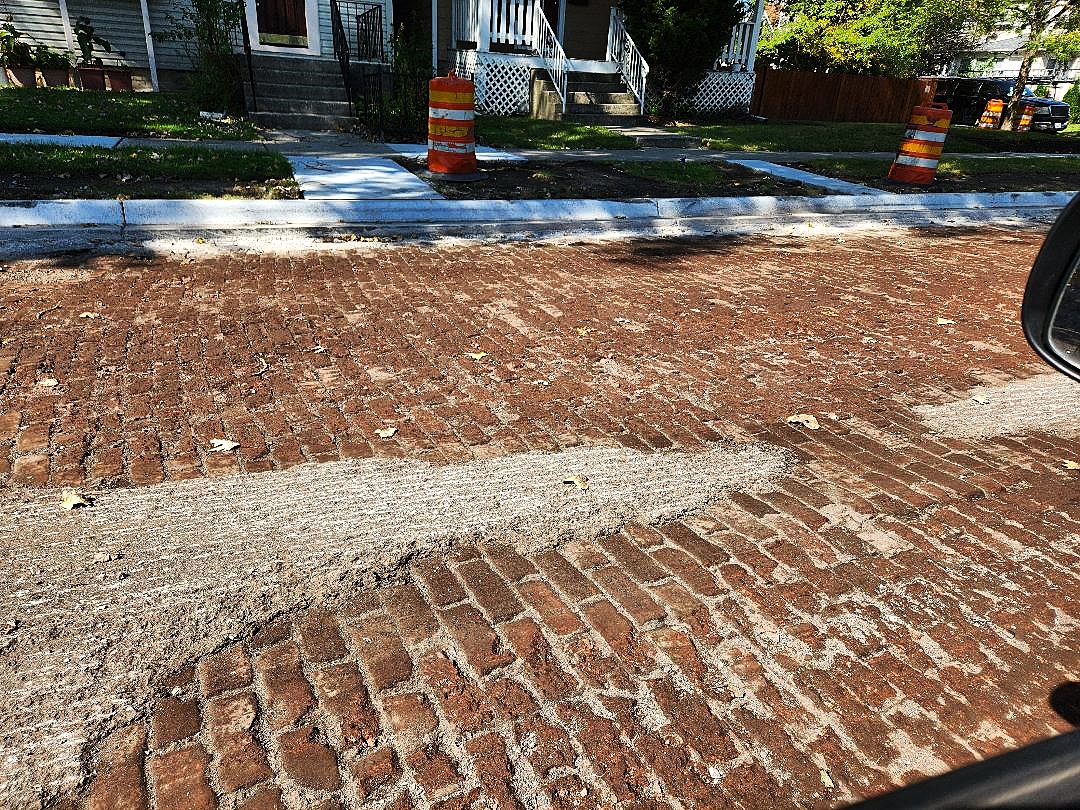
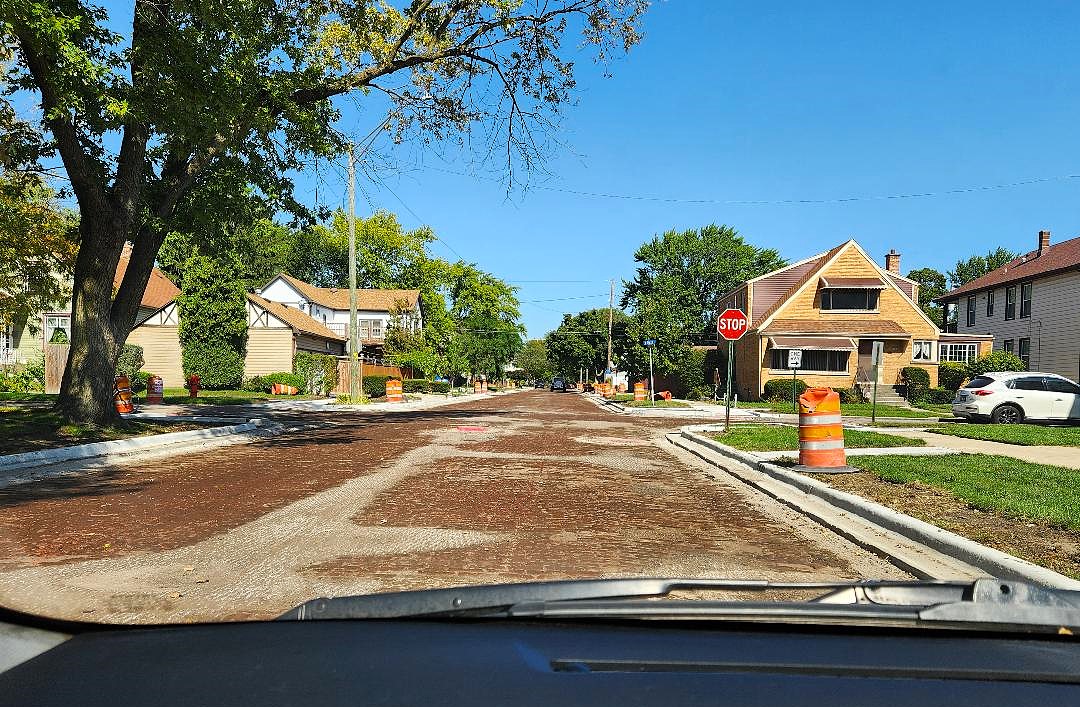
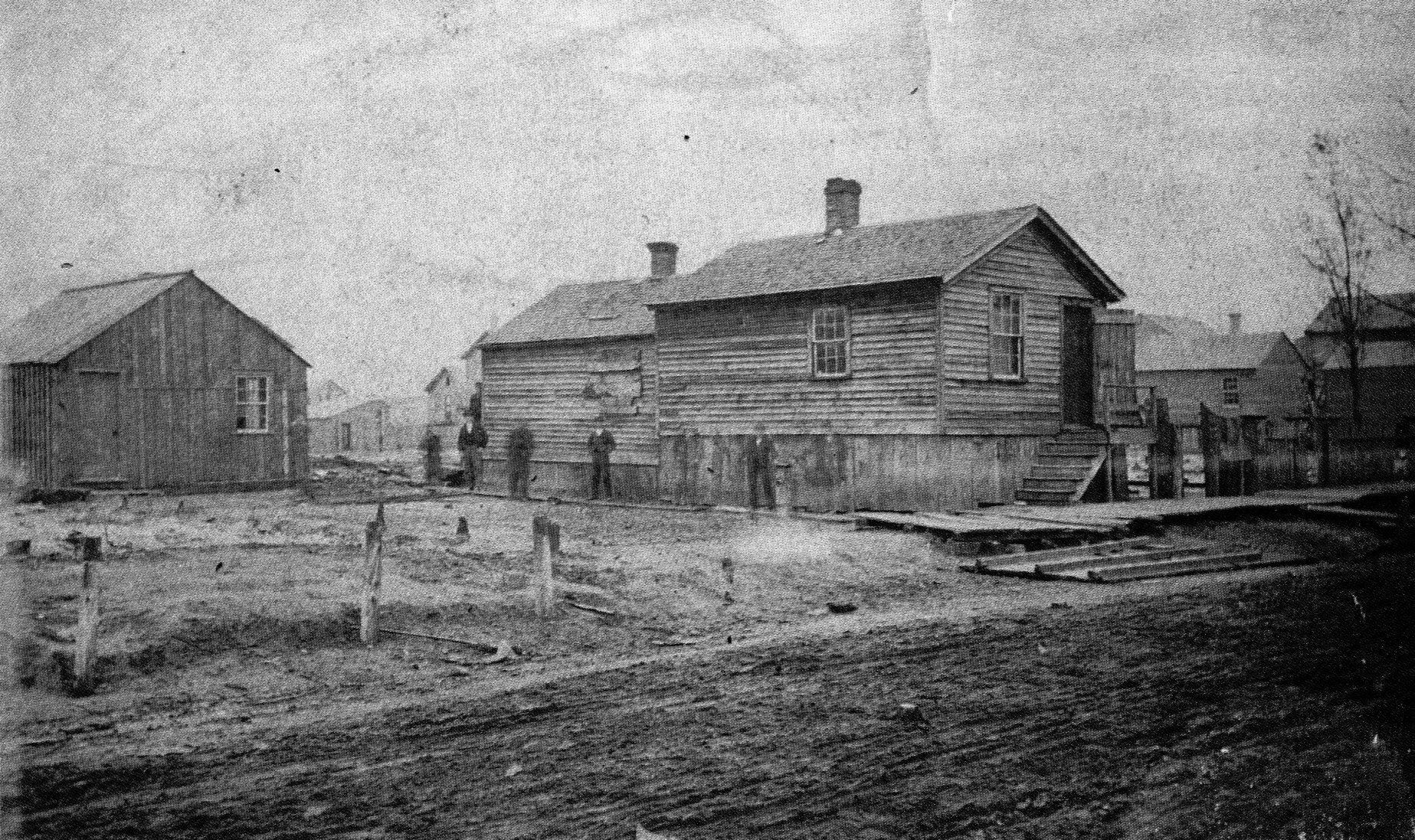
Right now, Greenwood Avenue, which is one block west of Western Avenue, between 123rd and 127th Streets, has been excavated down to the original brick street. Here are some views of the street.
In the next few days, the streets will be covered with concrete and blacktop, so if you want to see the old streets, do it now.
There are several isolated blocks of brick streets in Morgan Park, on 110th Place, but not a half mile stretch like this.
According to Preservation Chicago: "Originally, Chicago streets were packed dirt, which turned to thick mud when wet and were a constant source of frustration for
early Chicagoans. Dirt roads were initially paved with inexpensive wooden planks and later with wooden blocks; however, this
practice was largely phased out after the Chicago Fire of 1871. Between the 1880s and the 1910s, brick pavers were widely
used throughout Chicago’s highly traveled streets, as they were much stronger, highly durable, fire-proof, and remained functional when wet or snow-covered. These new brick paved streets proved up to the challenge of the wear and tear from steel
rimmed wagon wheels of pre-automobile street traffic.
Chicago’s street pavers were typically fired-clay bricks made from the tough clay abundant under the prairie grass."
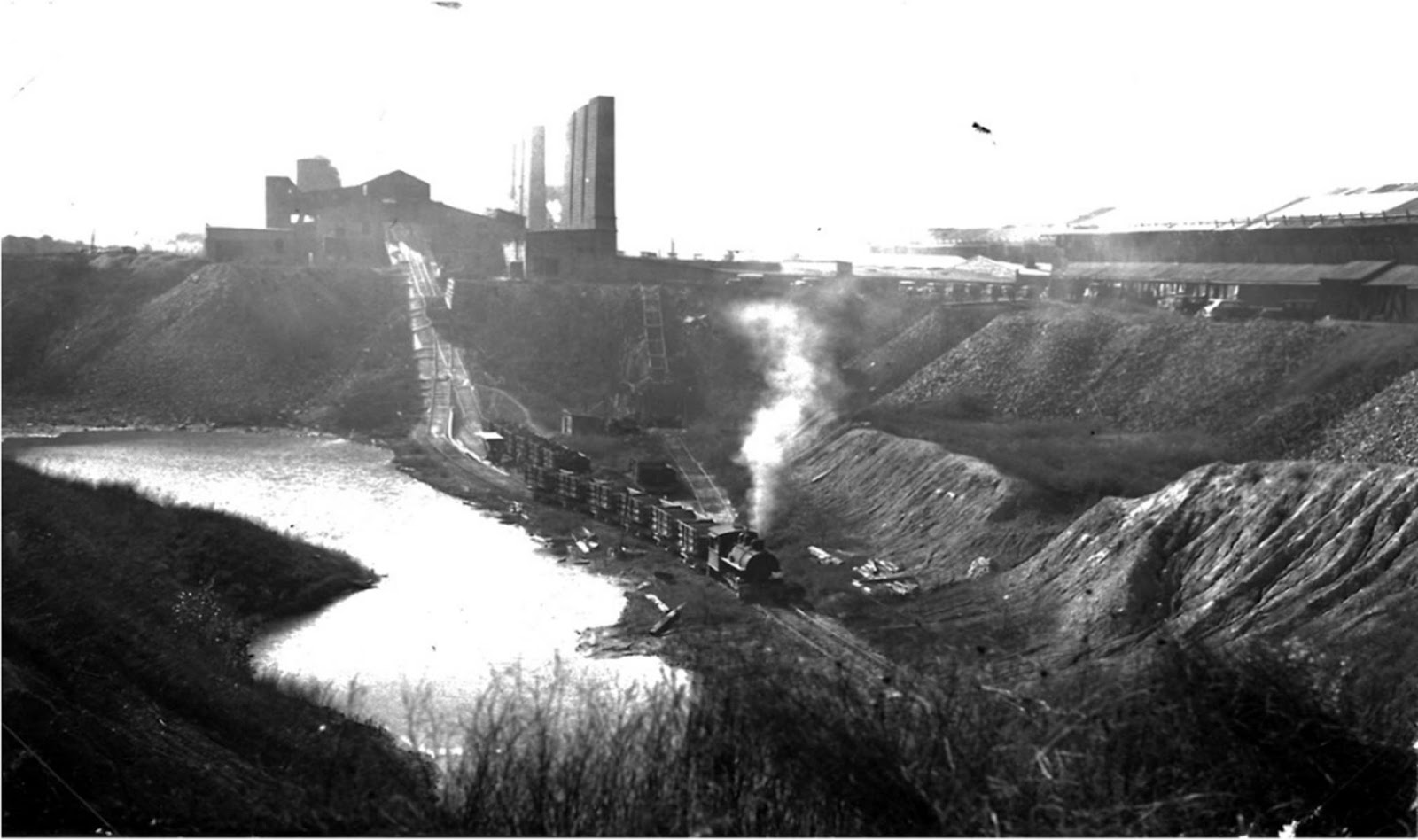
There were massive clay deposits around Blue Island, and brick making was an early industry here. From a history of Blue Island:
"After it was discovered in the early 1850s that rich deposits of clay surrounded the ridge, Blue Island became the center of a significant brick-making industry that lasted for over a century. In the early years, these efforts were small, with the bricks being made by hand and the turnout created mostly for local use, but by 1886 the Illinois Pressed Brick Company (organized in 1884) was employing about 80 men and using “steam power and the most approved machinery”, which allowed them to produce 50,000 bricks per day.] By 1900, the Clifton Brickyard alone—which had opened in 1883 under the name of Purington at the far northeast corner of the village was producing 150,000,000 bricks a year. In 1886, the Chicago architectural firm of Adler and Sullivan designed a large complex for the Wahl Brothers brickyard (the main building of which was 250 by 350 feet on the west side of the Grand Trunk tracks between 119th and 123rd streets. These buildings had been demolished by 1935, and all of Blue Island’s brickyards were re-purposed by the latter part of the mid-20th century. The larger ones for a while become landfills, and the Wahl Brothers location is now the site of the Meadows Golf Club."
There are still families in the area that worked at the brick yards. They are welcome to share their stories and pictures here.
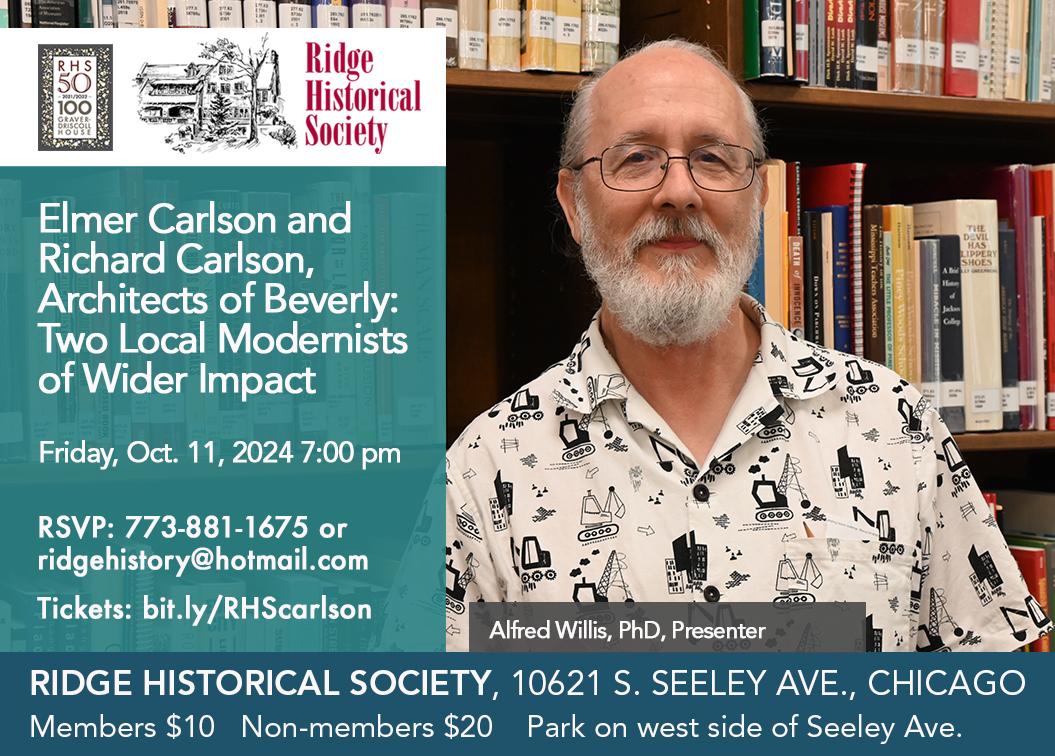
Friday, Oct. 11, 7:00 pm
Elmer Carlson and Richard Carlson, Architects, of Beverly: Two Local Modernists of Wider Impact
– Alfred Willis, PhD, Presenter
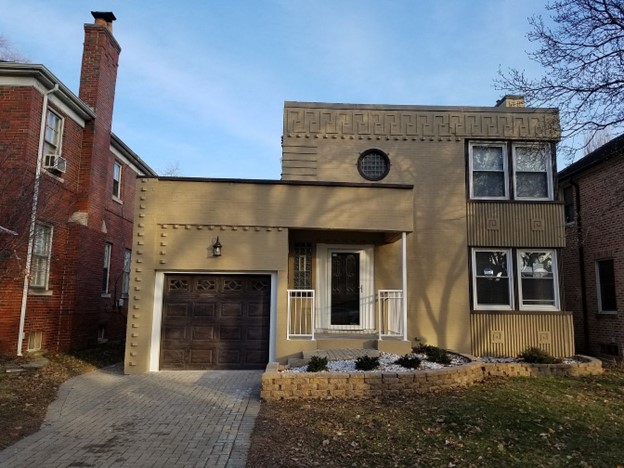
Elmer C. Carlson (1897-1956) was a Chicago architect of Swedish descent who settled in Beverly in the 1920s. Despite the depressed economic circumstances of the 1930s, he managed to prosper in that decade as a designer of residential, commercial, and institutional buildings in southern Chicago and several of its suburbs. While an accomplished creator of 'period' designs of striking charm, he simultaneously evinced a fine flair for Modernism.
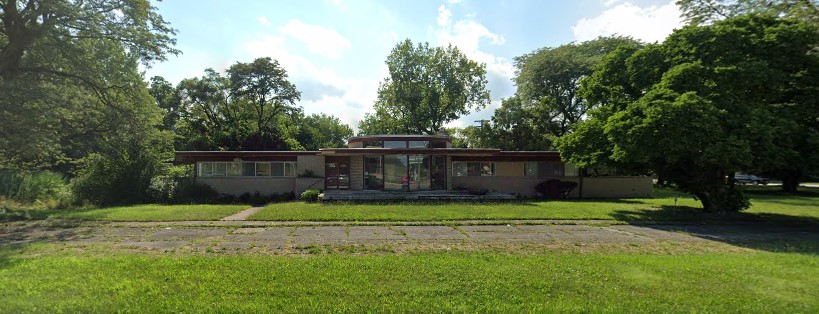
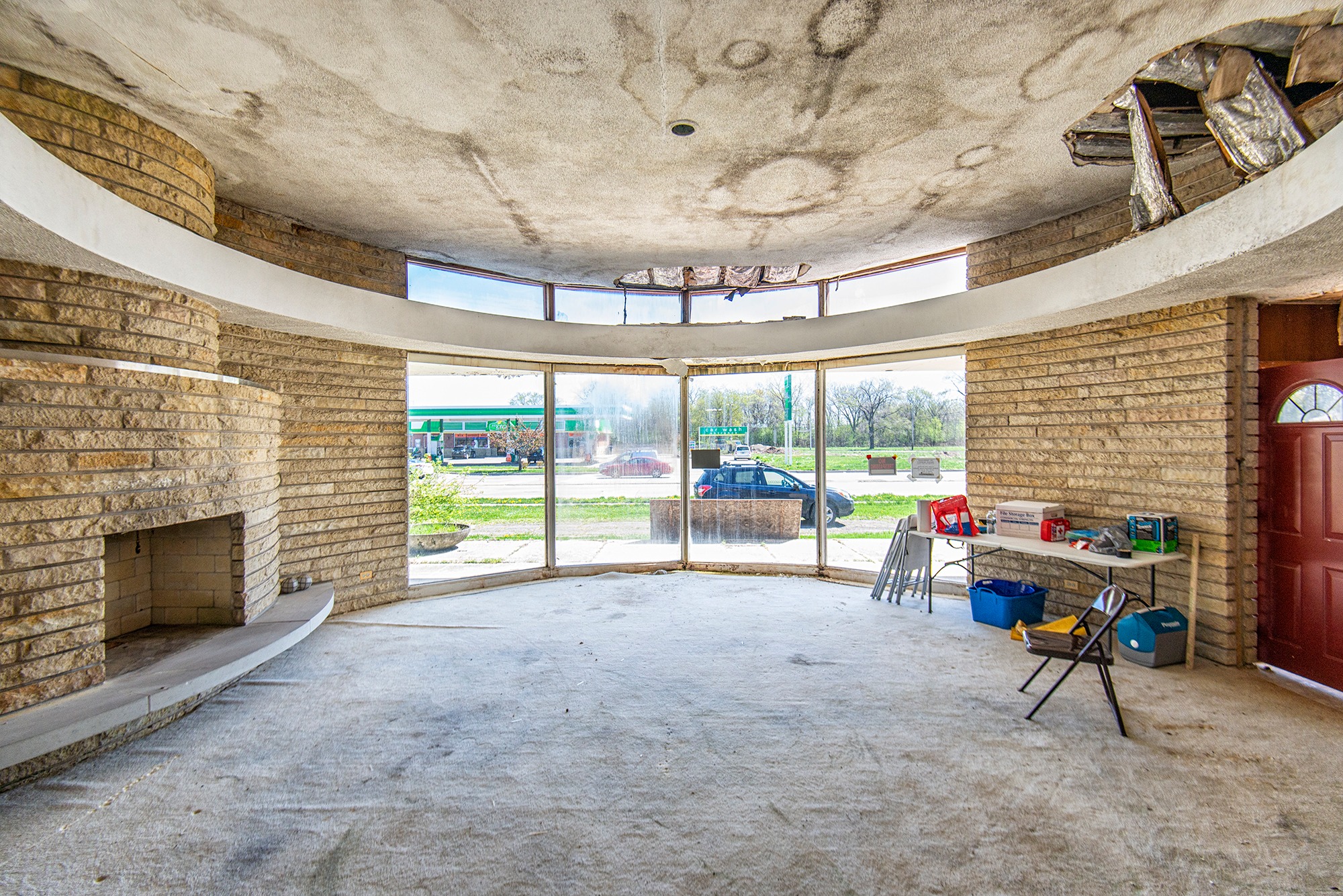
Working out of an ultramodern building on 95th Street, completed to his own design in 1946-47, he went on to even greater success after World War II as a prolific local architect of major projects sited both close to home and further afield. Elmer Carlson died in 1956 while developing a proposal for what should have been his greatest achievement in the residential sector, a villa in Robbins for the wealthy African-American entrepreneur S. B. Fuller.
Responsibility for refining the preliminary form of that interrupted project passed to his son, Richard E. Carlson (1930-2017) who had recently graduated in architecture form the University of Illinois and joined his father's Beverly practice. Thus making the most of a rare opportunity to begin his own career with what for his father (and mentor) had been the blank-check chance of a lifetime, Richard Carlson soon landed a wealthy clientele of his own that permitted a full display of his own unique taste and talent. His subsequent professional success unfolded first in Beverly but later in Colorado Springs.
About the Presenter: Alfred Willis, PhD is an architectural historian who grew up in Georgia. He was educated at Clemson University, Columbia University, and the University of Chicago. After retiring from a career in academic librarianship, he is now working as a consultant specializing in Modernism on nominations to the National Register. He is currently working as a contract librarian with the Historic Preservation Division of the Mississippi Department of Archives and History.
Ridge Historical Society
10621 S. Seeley Ave., Chicago, IL 60643
Limited Capacity. Get tickets here: https://bit.ly/RHScarlson
The Ridge Historical Society
The Great Chicago Fire and the Ridge
By Carol Flynn
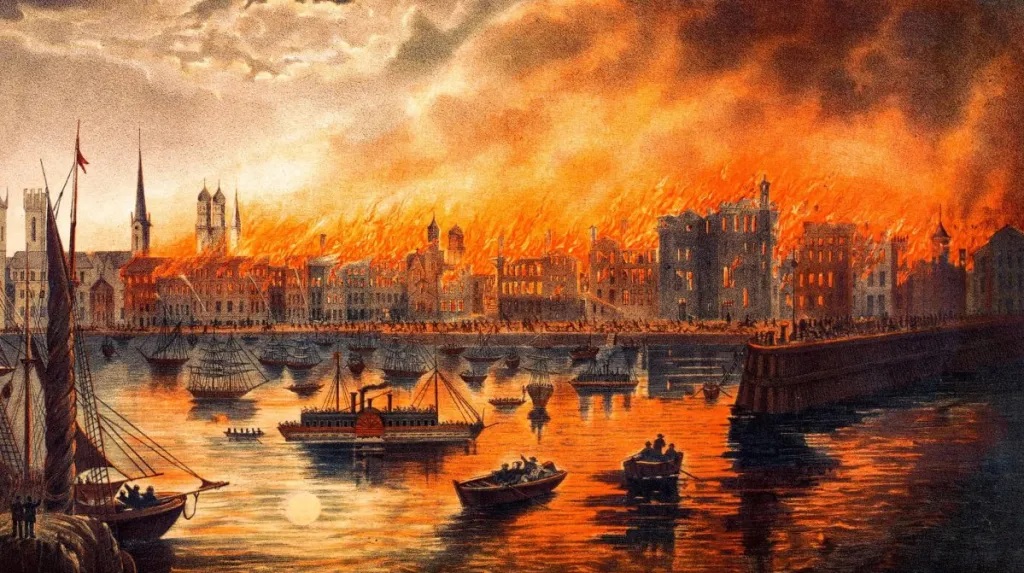
Today, October 8, is the anniversary of the beginning of the Great Chicago Fire in 1871. The fire burned until October 10 when rain finally squelched the flames.
The Great Chicago Fire had a profound effect on all the areas around the city, and the Blue Island Ridge was no exception.
In 1871, the Blue Island was still a distant suburb from the City of Chicago, and development was in the early stages.
A large part of the Morgan estate had been bought by a group of investors known as the Blue Island Land and Building Co. (BILBCo) in 1868 – 69. These men were also owners and investors in the railroads, and in 1870 had expanded the commuter railroad line west along today’s 99th Street, creating the Rock Island line, today’s Metra. This made the area much more accessible.
North of 107th Street was known as Washington Heights and plots of land were being sold. BILBCO was planning a new village south of that to be called Morgan Park.
On that October 8th night, the tip of the Ridge in today’s Dan Ryan Woods at 87th Street and Western Avenue offered a one-of-a-kind vantage point for the local residents to watch the vivid colors of the fire lighting up the northeast sky.
Jack Simmerling, the late artist who grew up on the Ridge, remembered his grandmother telling him how she watched the fire while sitting on the stoop of their family’s house on Vincennes Avenue.
Another story related to a man named Michael Smith, who came to Chicago after the U.S. Civil War and entered the hotel business, owning the National Hotel at Wells and Randolph. In 1869, he divested himself of those interests, purchased 40 acres of land just northwest of today’s 111th Street and Western Avenue, moved to the Ridge and started an orchard of apple and pear trees.
In 1871, Mr. Smith watched the sky over Chicago as all his former holdings went up in flames.
The biggest effect of the fire occurred after the fire, as people left their old neighborhoods and started to move to the suburbs. This led to a major building boom for idyllic places like the Blue Island Ridge.
The Barnard family first came to the Ridge in 1844. At the time of the fire, some of the family was living on Ontario Street, and were forced to flee, throwing their possessions out of windows and grabbing what they could as they ran down the street.
They escaped to the Ridge, and built a new home at the northeast corner of 103rd and Longwood, where the CVS is now, and the flower seed farm they started joined their other holdings in the area.
One unfortunate outcome of the fire was the destruction of loads of records and archives. The Morgan family lost all of their belongings stored in the city.
Right after the fire, pioneer families formed the Old Settlers’ Society, which started to recreate records of the past. People connected to the Ridge participated in this effort.
Out of the ashes of the Great Chicago Fire grew a new Chicago, one of “skyscrapers” and exciting new architecture. Many of the influential men from this period became connected to the Ridge.
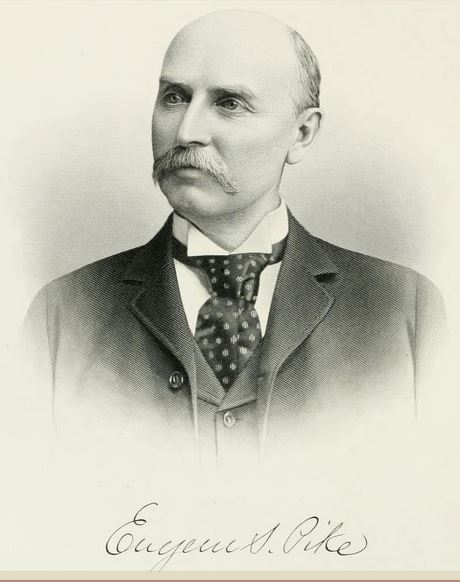
Just one example was Eugene S. Pike, the real estate developer who built major new buildings downtown. His primary residence was on Prairie Avenue, and he bought land in North Beverly for development. Some of the land he kept for himself, where he grew nursery plants for landscaping, and that land became part of the Forest Preserve District of Cook County.
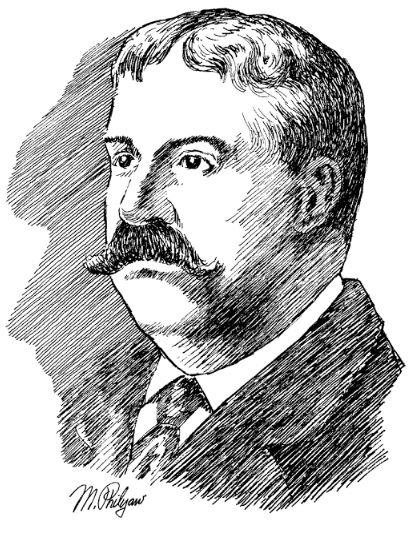
The gardener’s cottage Pike had built there, designed by architect Harry Hale Waterman, is today’s Eugene S. Pike House, undergoing restoration into a community cultural center.
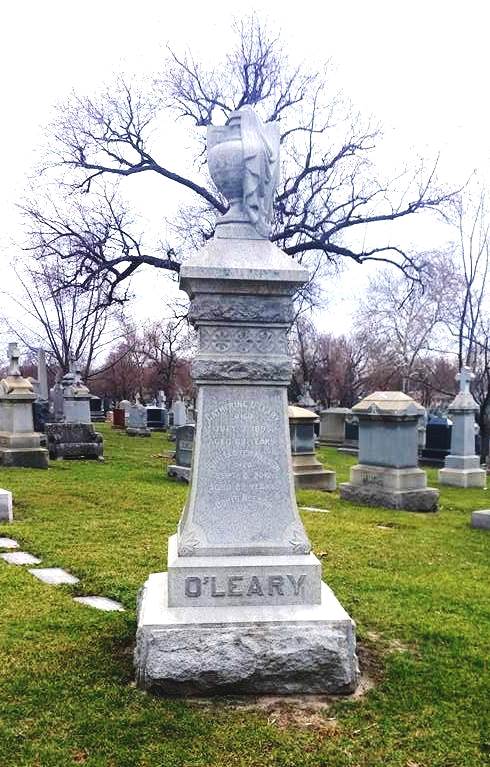
Of course, today, the most famous connection of the Ridge to the Great Chicago Fire is the gravesite of Mrs. Catherine O’Leary in Mount Olivet Cemetery on 111th Street.
Chicago folklore for years claimed that the fire originated from Mrs. O’Leary’s cow kicking over a lantern. Years later, newspaper reporters admitted they made that up.
Although the fire did start in the O’Leary barn, the cows were settled for the night and Mrs. O'Leary was in bed nursing an injured ankle at the time.
The exact cause of the fire was never determined. Theories included a stray spark from men smoking in the alley; the neighbors going into the barn with a lantern to get milk for “oyster stew,” an alcoholic punch they were making for a party; and even arson from a milk business competitor. Other theories included spontaneous combustion and a comet flying through the cosmos.
Big Jim O'Leary, the son, became a famous Chicago gambler. The people loved him – he was honest; he always paid off the bets people made at his (illegal) establishments. He was involved in gambling operations along 111th Street in the early days of Mt. Greenwood.
Big Jim was the nemesis of the famous Irish police chief, Francis O’Neill. Big Jim bought the grave sites in Mt Olivet and is buried there with his parents, right down the way from the mausoleum of Chief O’Neill.
Thanks to Linda Lamberty, past RHS Historian, for some of this information.
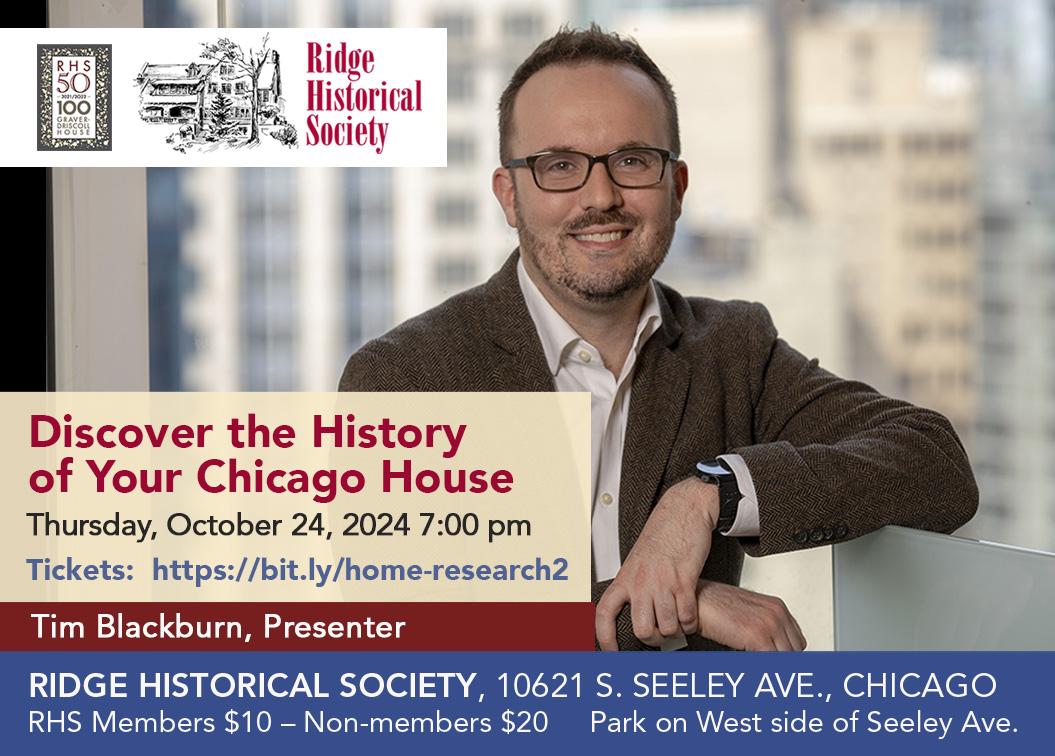
Back by popular demand, RHS Board member and house history guru Tim Blackburn will explain how to research the history of a Chicago house using a multitude of available resources.
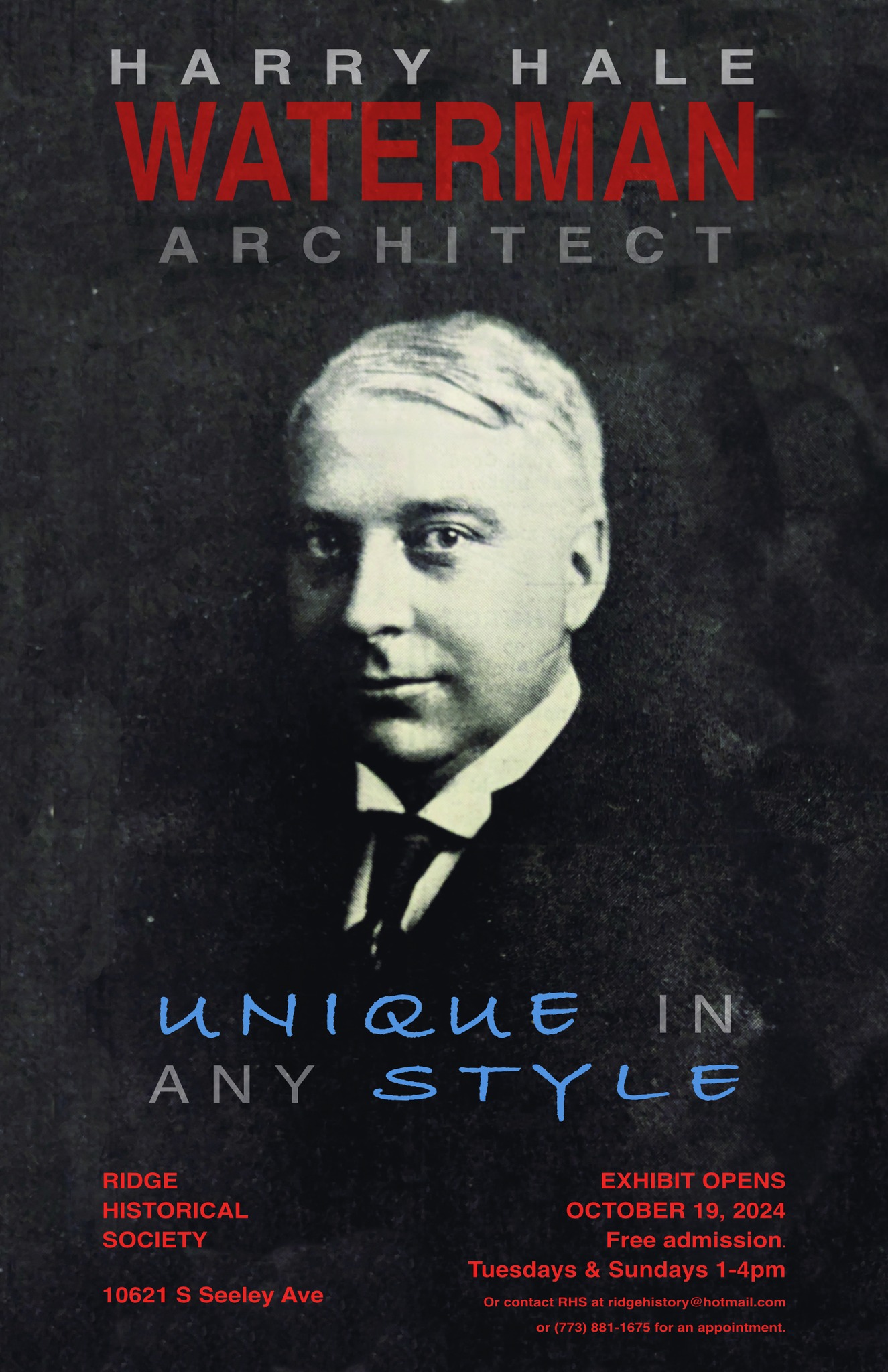
Open House Chicago takes place this coming week-end, October 19 and 20.
As one of the featured locations, the Ridge Historical Society (RHS) will be open both days from 10:00 a.m. to 5:00 p.m.
We are very excited about opening our new exhibit for this event: “Harry H. Waterman, Architect: Unique in Any Style.”
Waterman designed at least 40 buildings on the Ridge, including some well-known ones that go by popular names – the beloved “honeymoon cottage;” the “watchman’s residence” in Dan Ryan Woods; the “Walgreens’s mansion,” part of the Mercy Home for Girls; the “Beacon School;” and the “tombstone house.” All of these are covered in the exhibit.
This exhibit will focus on the contributions made by “the village architect,” as he was fondly known, as well as his personal life, and preservation of his work in the future. The exhibit will also look at some of his clients, like the Barker/Gregson and Pike families.
“Harry H. Waterman, Architect: Unique in Any Style” is curated by RHS Board member Tim Blackburn; with research and writing by Carol Flynn; architectural photography by Mati Maldre; research support by Linda Lamberty; and promotion by Grace Kuikman.
The exhibit will be up at least through the New Year. Admission is free.
RHS is located at 10621 S. Seeley Avenue. Regular open hours are Tuesday and Sunday from 1:00 p.m. to 4:00 p.m. or by appointment.
Look for the upcoming series about Waterman on the RHS Facebook page, written by Carol Flynn.
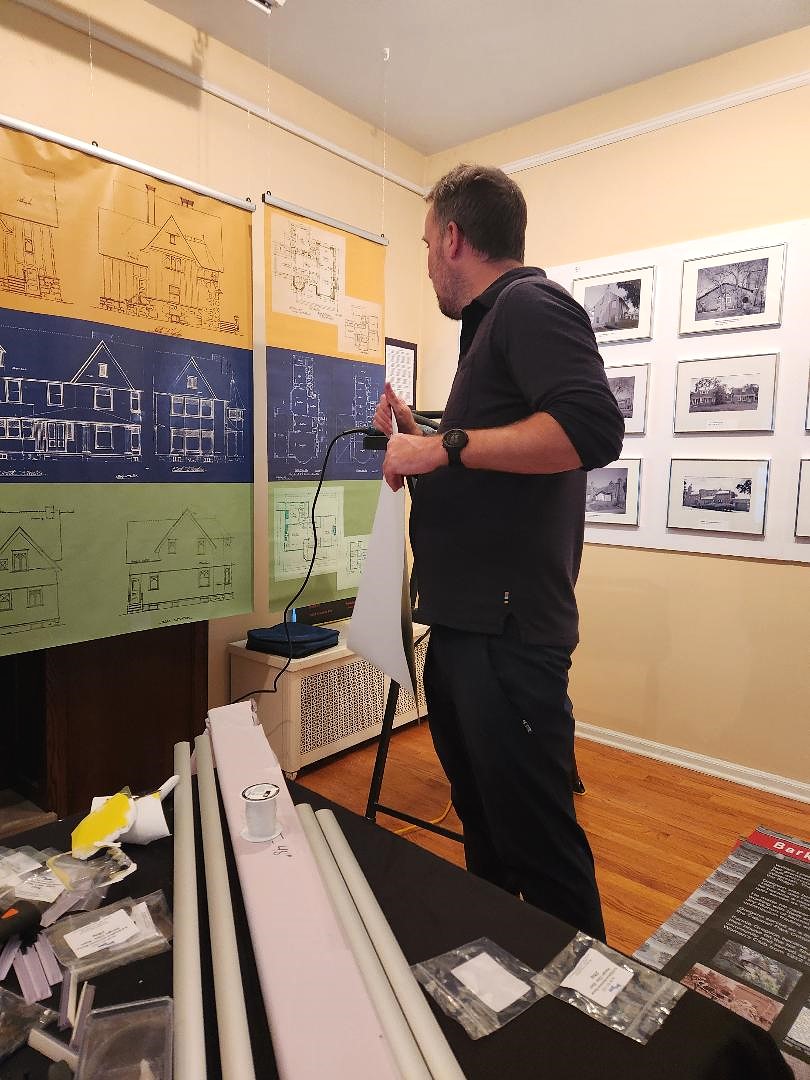
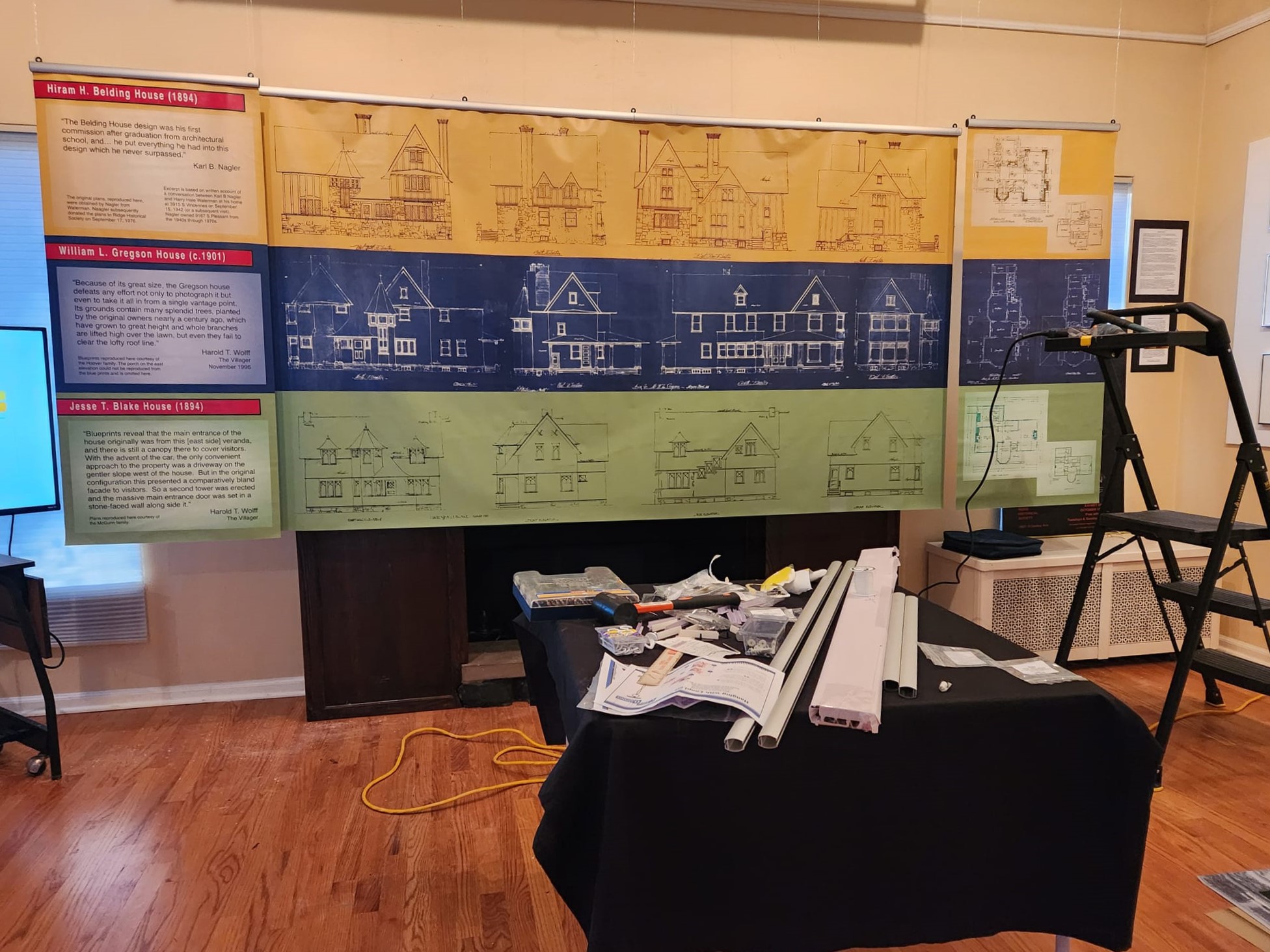
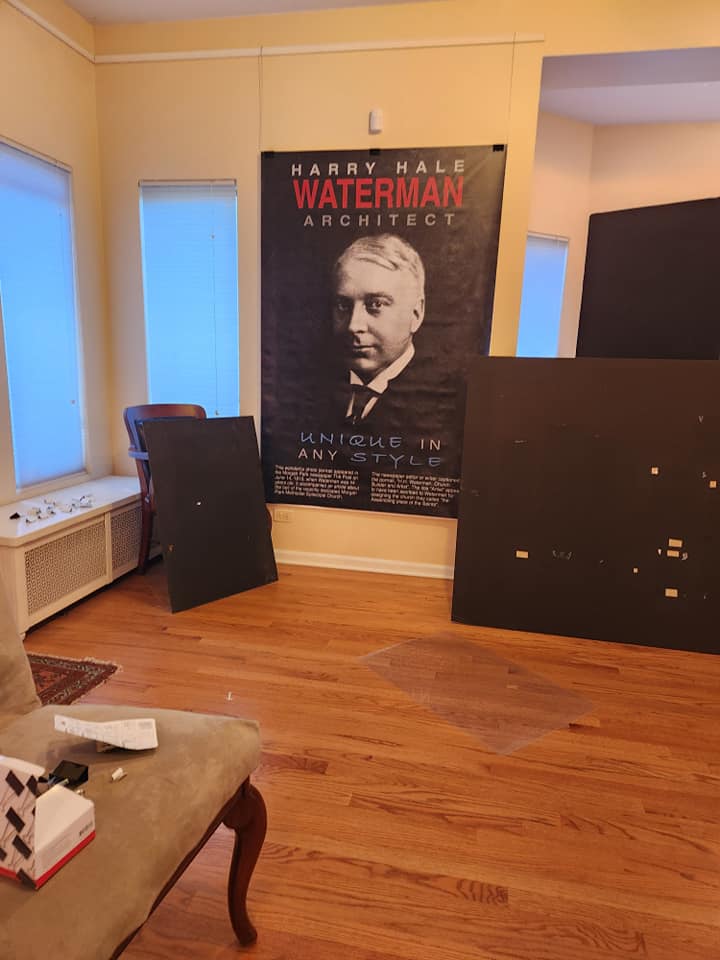
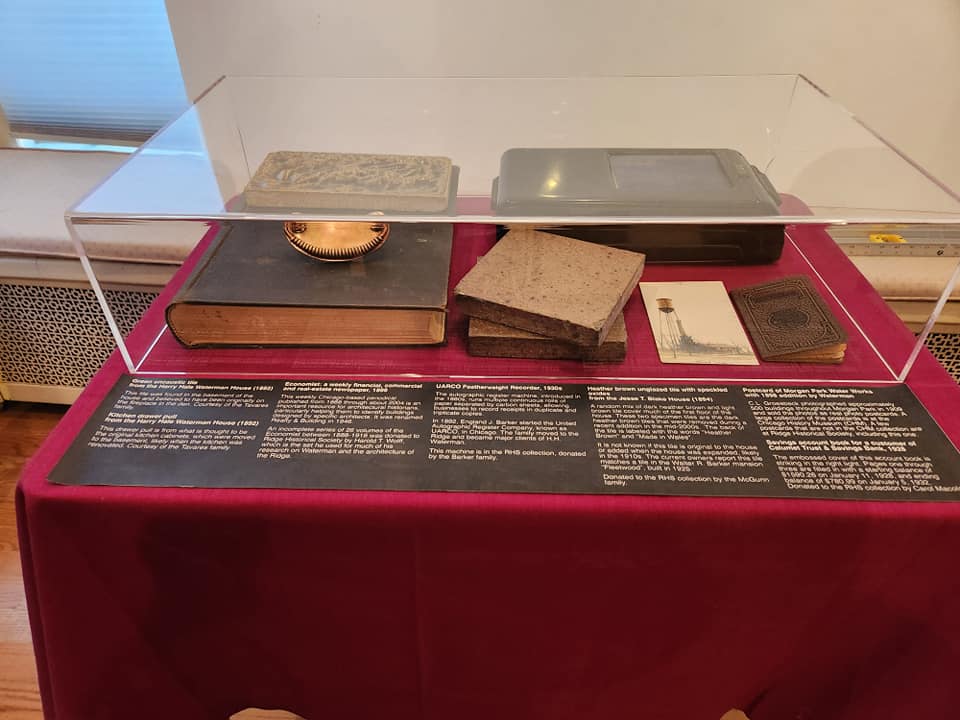
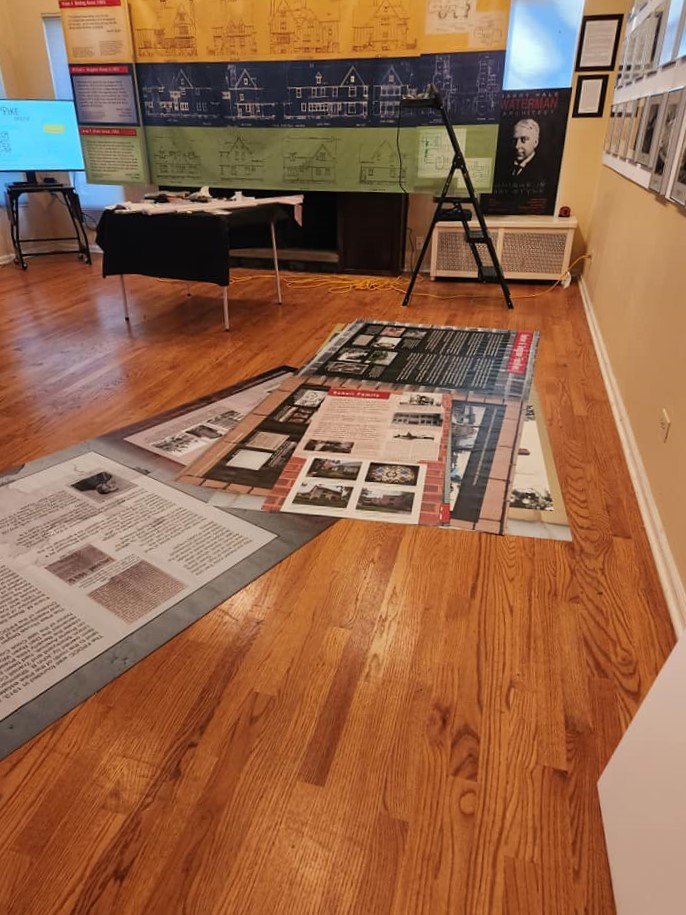
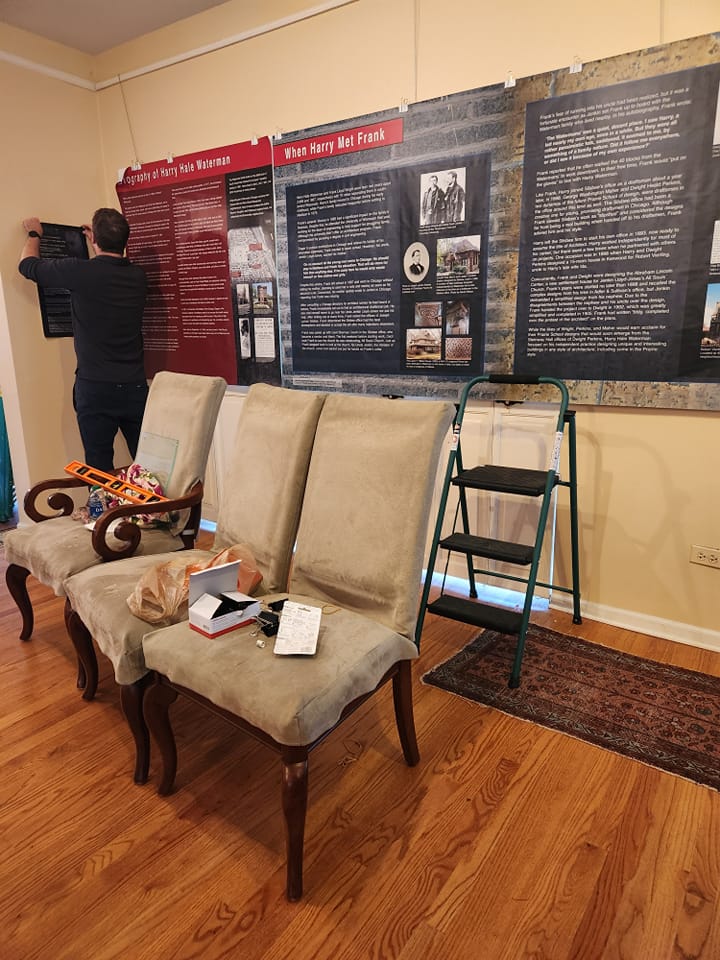
Exhibits don't happen by magic – it takes time, effort, brainpower, and physical work to put them together.
Here's RHS Board member and Curator of the new RHS exhibit "Harry Hale Waterman, Architect: Unique in Any Style," Tim Blackburn, at work today installing the exhibit to premier at Open House Chicago this week-end, October 19 – 20.
RHS will be open both days from 10 a.m. to 5 p.m. Address: 10621 S. Seeley Avenue, Chicago. Free admission.
Photos by C. Flynn
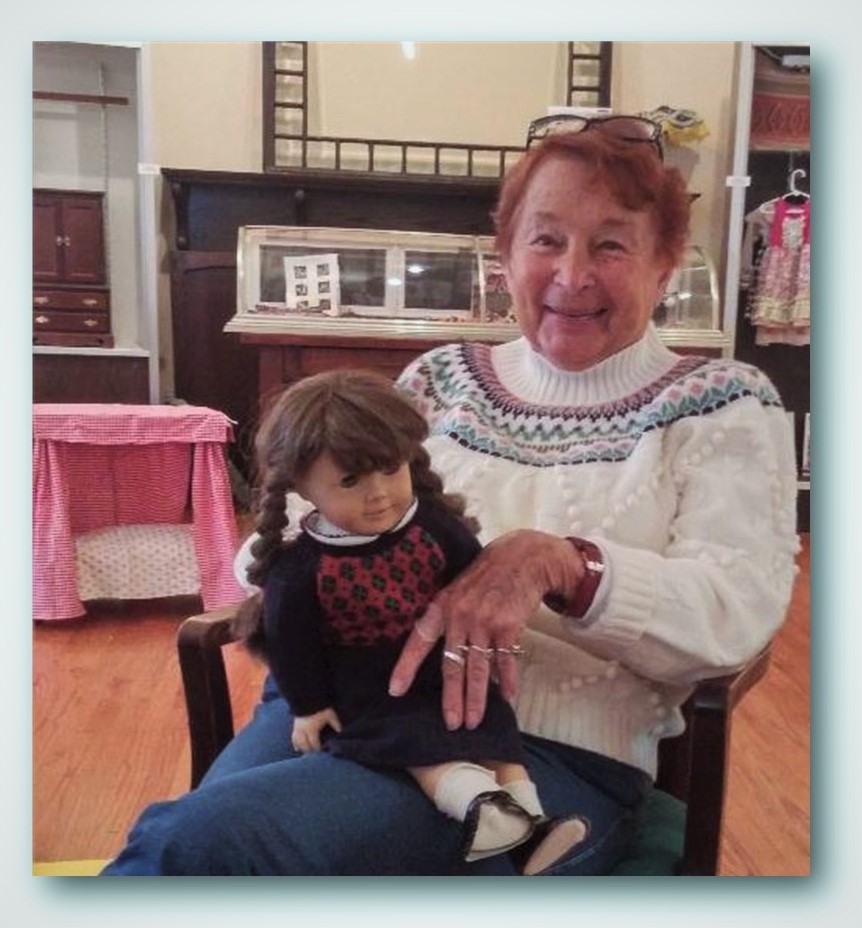
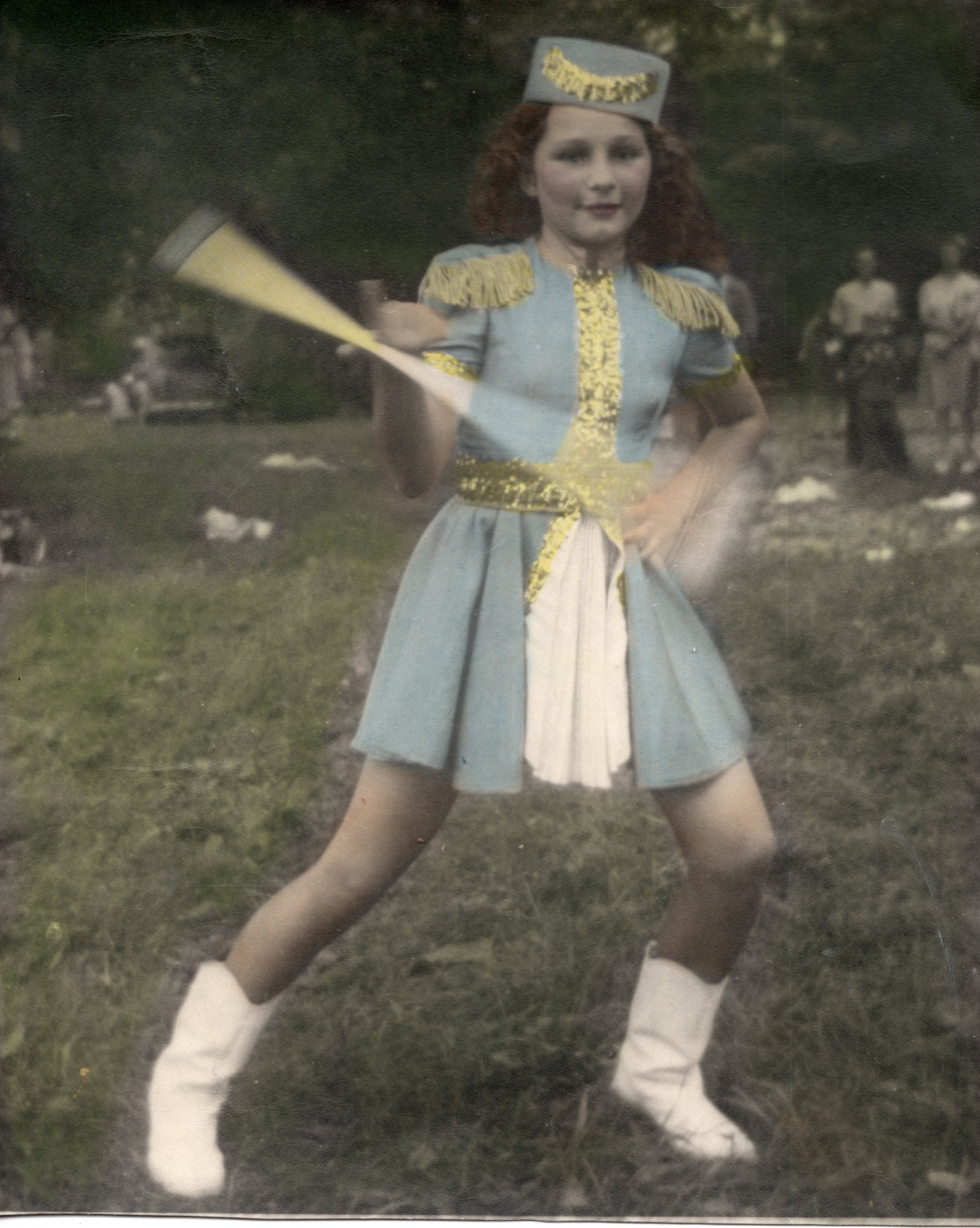
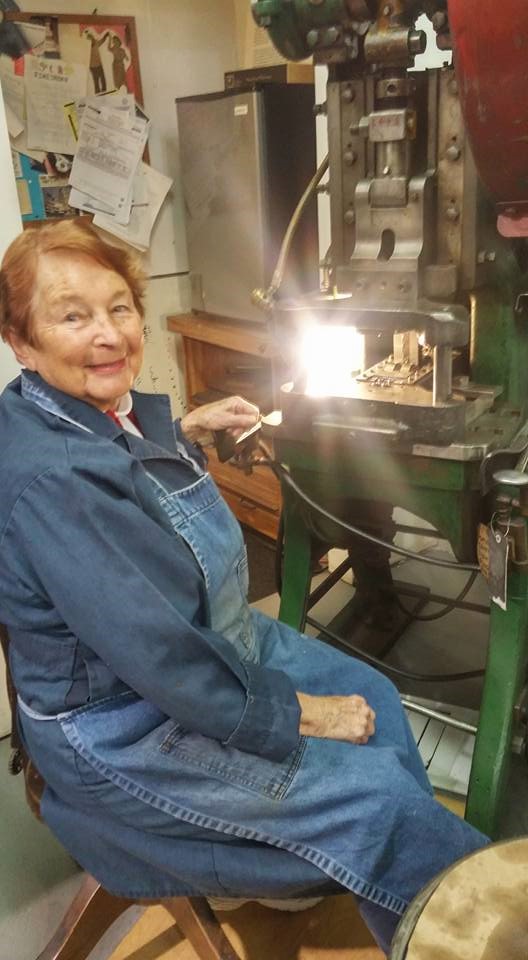
The Ridge Historical Society (RHS) is saddened to report the death of Elaine Spencer, RHS Board member and past RHS President.
Elaine had deep ties to the Ridge communities, having lived here for her 92 years of life, attending Barnard elementary school and Morgan Park High School, marrying (the late) Carl Spencer, and raising four sons here.
She was active in the Beverly Hills Junior Woman’s Club for many years, and loved performing on stage in their drama endeavors to raise money for nursing scholarships.
As RHS President, she supported restoring the RHS Facebook page to its original intent to increase communication and share more local history with the public. She led the society through the COVID pandemic. Elaine could always be counted on to volunteer her time to help at RHS events.
At 92, she was still taking trips around the world (most recently to the Panama Canal and Iceland) and spending time on the family’s island where she kayaked and painted docks and used an outhouse and outdoor shower. She was an avid book reader and a whiz at Scrabble.
Elaine had a favorite saying, “If you’ve made it this long, you’ve already won all the marbles.” She was a vibrant and alive person, and her presence will be missed.
Elaine Spencer’s story is the history of this community.
The Ridge Historical Society
Sacred Heart Church
By Carol Flynn
Sacred Heart Church in Morgan Park was part of Open House Chicago (OHC) this past week-end, prompting questions about its history. The researchers/writers of RHS have published articles on the history of all the local places participating in OHC at one time or another, and are always willing to share that information.
Here is information on Sacred Heart Church, one of the true gems of the community.
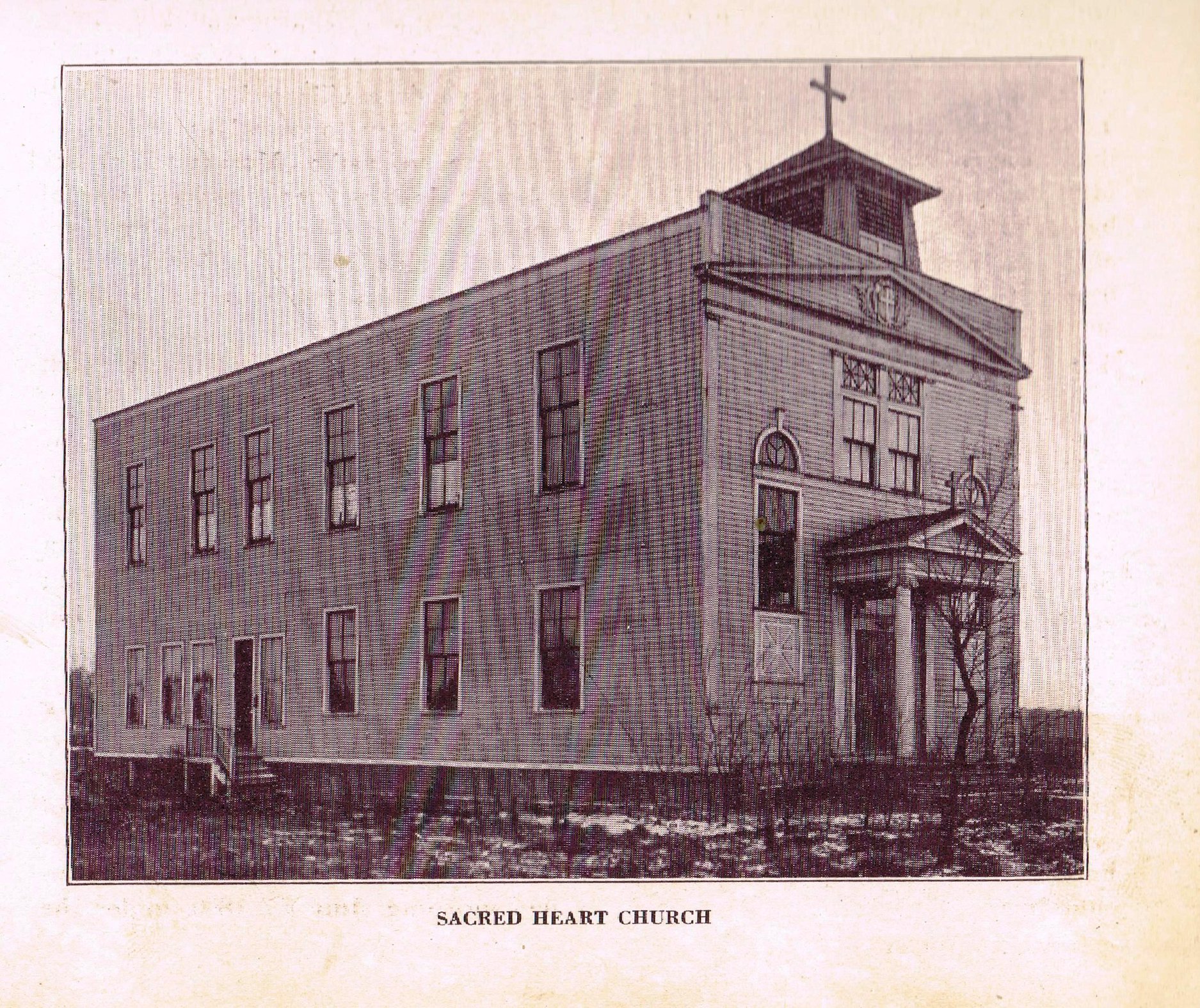
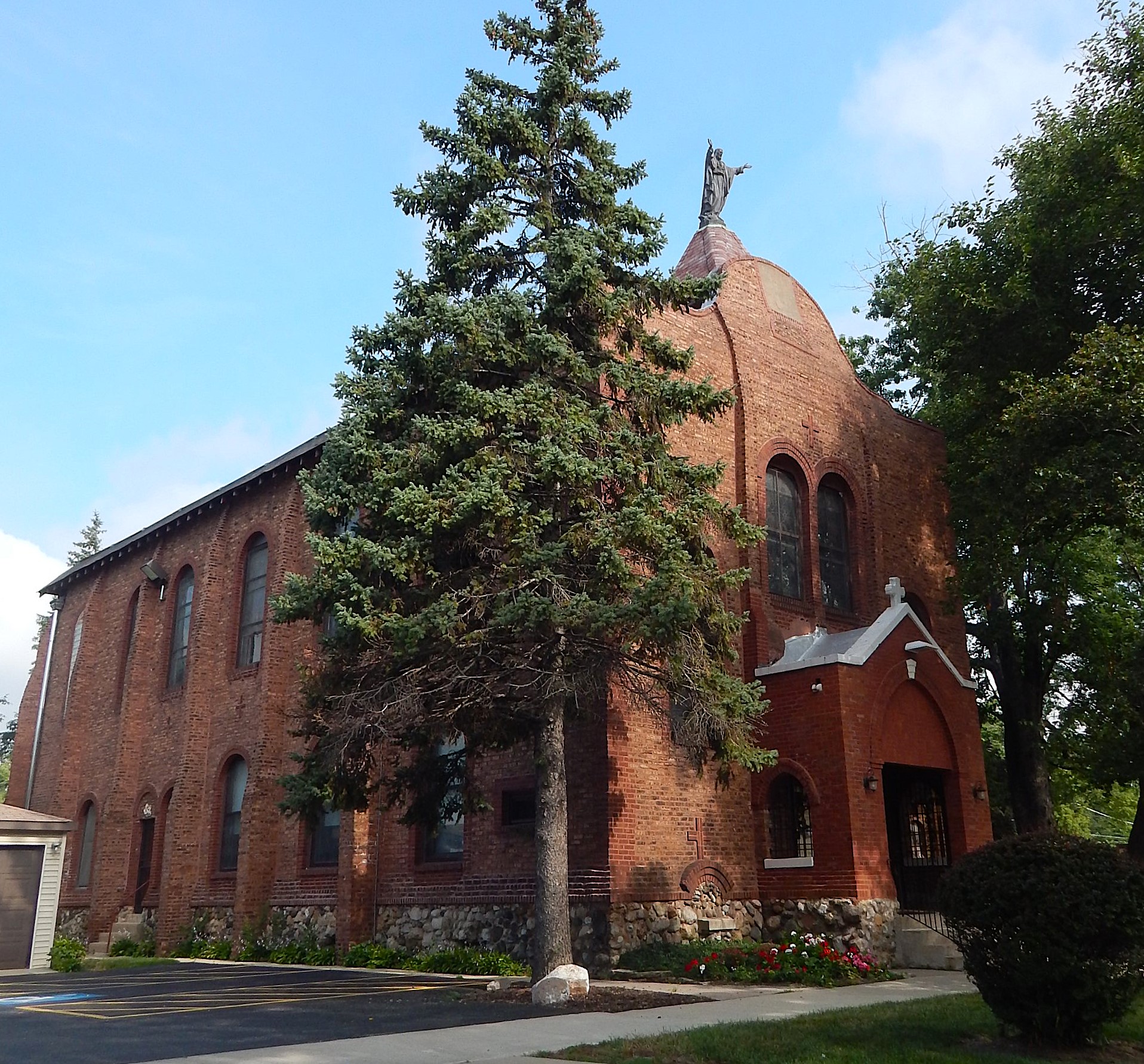
The Blue Island Ridge has its own “French connection.” There was an early group of settlers here, and their legacy to the community is the historic and charming Sacred Heart Church at 11652 S. Church Street.
Rich clay deposits on and around the Blue Island Ridge led to brick-making becoming an important local industry in the early 1900s, and the workers established their homes in the area. Sacred Heart was originally founded in Alsip in 1892. After an unfortunate fire, the church moved to its current location to be closer to the Purington Brick Yards at 119th and Vincennes, where many of the French people worked.
The current church was built in 1904-5 originally as a wooden frame church, built on posts in a swamp. The church was established as a “national church” which meant it would serve a particular nationality, not a defined geographic area.
The story goes that the workers were allowed to take “seconds” of bricks from the brick yard, those bricks that were burnt in the ovens and therefore couldn’t be sold, over to the frame church one or two at a time. By 1922, when enough bricks had been saved, the present brick facade was added. The church as it stands now is actually the old frame church clad with this donated brick.
Father Raymond DeNorus, a missionary priest born in France, became pastor in 1912. From all accounts, he was a very charismatic man. He loved a good time, yet he was a man deeply devoted to his faith. He dispensed medicine, holy water and blessings from his side door.
Numerous miracle cures were reported to have taken place over the years. Crutches, canes and braces left abandoned at the church were hung on the side walls. Services at the church drew large crowds and it became a place for pilgrimages.
During this time the church became known as the Shrine of the Sacred Heart, a shrine being a special place of devotion that attracts travelers from afar.
Fr. DeNorus retired in 1935. With time, most of the French families moved on and were replaced by German and Irish workers.
In 1979, the Archdiocese of Chicago under John Cardinal Cody decided to close and demolish Sacred Heart, citing as its main reasons a shortage of priests and the expense of construction needed to correct building code violations.
Members of the congregation and the greater community rallied to restore and preserve the church. “Save Our Shrine” became the rallying cry.
The church was stripped of all its possessions. The congregation held Mass out in the parking lot. Sacred Heart Church was closed from 1979-1982. It likely would have been demolished, but then Cardinal Cody died.
The new Archbishop, Joseph Bernardin, agreed to review the matter. He reopened the church and celebrated Mass there in 1983. The church was reestablished as a "mission church" operating as part of the Holy Name of Mary Parish in Morgan Park.
The people of Sacred Heart have maintained their church for an additional 40 years. The church was visited by the late Francis Cardinal George, who was so taken with the church he said he could consider living there when he retired.
The devotion to the Sacred Heart of Jesus originated in France in the late 1600s when a nun, Saint Margaret Mary Alacoque, claimed that during a series of apparitions, Jesus promised certain blessings to those who practiced devotion to his Sacred Heart. The Vatican’s position is that the manifestation and promises are true. The name Sacred Heart was very fitting for a French mission church in Alsip/Morgan Park.
The Ridge Historical Society
October is National Pizza Month – Pizza on the Ridge
By Carol Flynn
People spend countless hours debating which restaurant serves the “best pizza” but it doesn't really matter. One person might like cracker-thin crust with pepperoni, someone else might like “Chicago-style” deep dish with spinach. They’re both correct, and neither is likely to change his or her mind. Pizza preferences, like any other food choice, are subjective and individual.
U.S. residents love pizza and helped take it from a traditional Italian dish to a worldwide favorite.
The annual calendar has at least 10 recognitions for pizza, starting in January with National Pizza Week and ending in November with National Pizza With the Works Except Anchovies Day. October is National Pizza Month, when people are encouraged to patronize local pizza places – as if extra encouragement is ever really needed.
Pizza has been popular in the U.S. since the late 1940s. Although there were a few pizza restaurants prior to that, it was soldiers returning from World War II service in Italy who brought back a newfound taste for the dish, causing it to go mainstream.
Newspaper articles helped Americans learn that the correct way to
pronounce the word was “pete-za.”
The concept of pizza, a flat bread with toppings, goes back to antiquity. Many cultures had some version of that. After tomatoes were introduced to Europe from South America in the 16th century, Naples and Sicily, then part of Spain but later within the boundaries of Italy, came up with the basic template for the “modern” version of “traditional” pizza: flat dough covered with tomatoes in some form and cheese.
Italian immigrants brought pizza with them to the U.S. starting around the late 1800s. They mostly settled in the large northern cities – New York, Boston, Chicago. Like many ethnic dishes, each family had its own favorite pizza recipe. It was quick to prepare, easy to serve, and inexpensive, which helped stretch dollars between paydays.
Pizzas first started showing up in taverns as free snacks, using the tavern owner’s personal recipe. The more pizza the patrons snacked on, the more beer and wine they ordered.
Pizza was also served at church events and festivals in Italian neighborhoods.
To make it authentic pizza, the dough had to be hand-made and stretched out by hand, and the pizza baked in a brick oven over a wood fire. Pizzas were as often made in rectangular form in sheet pans as they were made in the round form. The standard of a pizza as a "pie" came later.
Although its actual origins are obscure, the pizza Margherita from Naples, comprised of simple dough (flour, water, yeast, and salt) topped with extra virgin olive oil, crushed peeled tomatoes, mozzarella cheese, and fresh basil leaves, was one of the earliest “standard” pizzas. It was made in a round shape.
Pizza was mentioned in Boston in 1904, but the first pizza restaurant in the U.S. is considered to be Lombardi’s in New York City. The Lombardi family started with a grocery store in 1897 and sold “tomato pies,” an early name for pizzas, to factory workers at lunch time. In 1905, they opened a pizzeria restaurant.
In Chicago, historians recognize Tom Granato’s restaurant at 907 West Taylor Street near Halsted Street as the first pizza restaurant in the city. The Granato family, with roots in Naples, started with a bakery, then opened the restaurant in 1924.
In a newspaper article, Granato’s pizza was described as “a dough similar to that of an English muffin rolled out as a pie crust with fresh cut up Italian cheese, covered with little Italian pear tomatoes and sprinkled with olive oil” baked in a brick oven for a few minutes. It was served in a tin pie plate, cut into sections, and eaten with the fingers.
Granato’s was torn down in the early 1960s to make way for the new University of Illinois Chicago Circle campus.
Other places started offering pizza as a “specialty.” Tufano’s in Little Italy served it on Friday and Saturday nights. Uno’s opened up and created deep dish pizza which has become a Chicago trademark. The Malnati and Baracco families got involved early in the pizza business.
In the late 1940s, restaurants serving pizza started to proliferate.
Today’s Vito and Nick’s Pizza at 8433 S. Pulaski Road, which grew out of a tavern started in 1923, expanded its menu to include pizza in 1946. One of the oldest pizza places still in existence in the city, people from the Ridge likely visited there as they still do today.
Although it will never be known with any certainty when the first bite of pizza was enjoyed on the Ridge, pizza likely first showed up in the city of Blue Island, which had a large Italian community. By 1950, pizza was mentioned as being served in taverns, and at the annual festival and carnival at St. Donatus Church, where it was made by the women of the parish.
At the time, a store in Blue Island advertised the ingredients for making pizza at home – homemade sausage, scamorza and other cheese, and oregano.
At least two restaurants on Western Avenue in Blue Island advertised pizza by 1950–51. They were Nino’s Club Trieste at 13312, and the Pizzeria Palace at 12424. These restaurants served “American” dishes like ribs, steaks, and chicken along with Italian specialties.
In the 1950 – 70s, musical entertainment in restaurants in the Blue Island area was frequently provided by the Garetto Twins, Larry and Angelo, who had a music business. They eventually got involved with their own pizza establishment, Beggar’s Pizza, started in 1976. Still in operation with multiple outlets, this is the oldest pizza business in Blue Island.
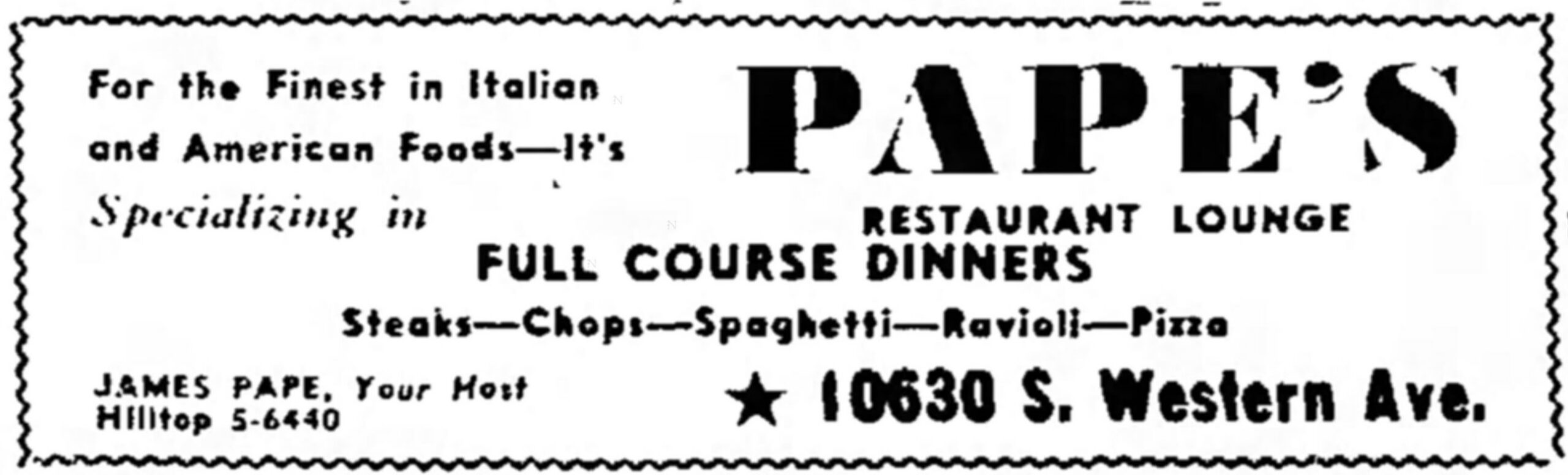
The first advertisement found for a restaurant serving pizza in Beverly was for Pape’s Restaurant and Lounge at 10630 S. Western Avenue in 1950. In a review, Pape’s was described as “a handsome restaurant and lounge where every attention goes into making your dining and wining visit a most enjoyable one.”
Owner James Pape featured “wonderful Italian food” including pizza pie, “along with plenty of American items.”
Around this same time, fresh and frozen pizzas were made available to the South Side at the popular food court in the lower level of Gately’s Peoples Store at 112th Street and Michigan Avenue.
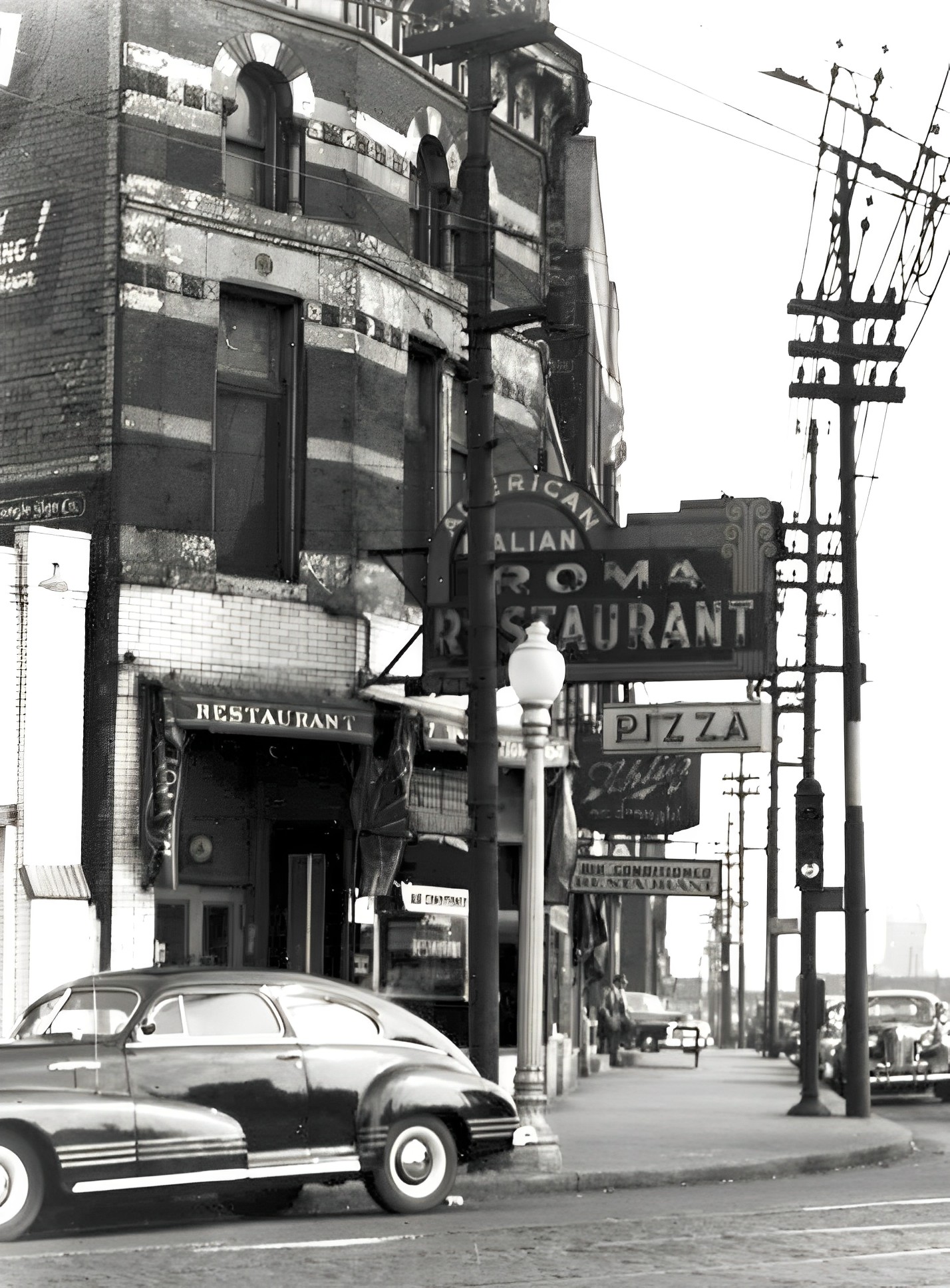
James Gately, head of the Irish family who owned the store and a resident of Beverly, apparently purchased the pizzas from Roma’s Banquet Hall, Restaurant and Tavern at 93rd Street, Commercial Avenue, and South Chicago Avenue.
By then, restaurants were not only delivering hot pizzas (for free), but they were also selling fresh unbaked pizzas and frozen pizzas. Frozen dinners were just being introduced to the post-war baby-boom families.
According to the Southeast Chicago Historical Society, the Roma’s location started as a restaurant in 1918. In 1948, the business was bought by the Lombardi family, and Roma’s began. A pizza oven was installed at that time. Roma’s is still open.
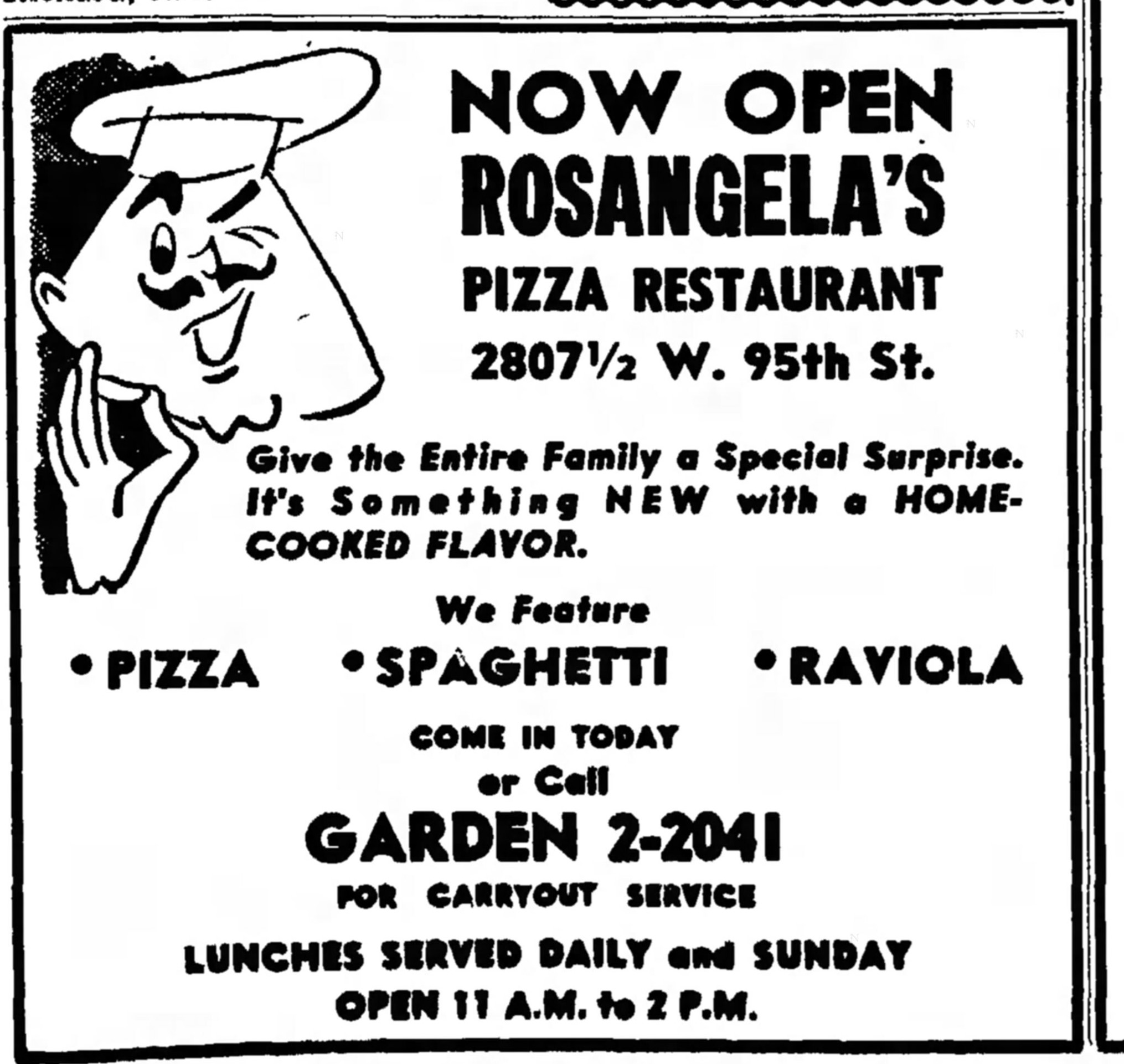
Rosangela’s Pizza on 95th Street in Evergreen Park started as a luncheon place that served pizza in 1954. Often described as an “old school pizzeria” the restaurant is still in operation today, now likely the oldest pizza place on the Ridge, celebrating 70 years in business.
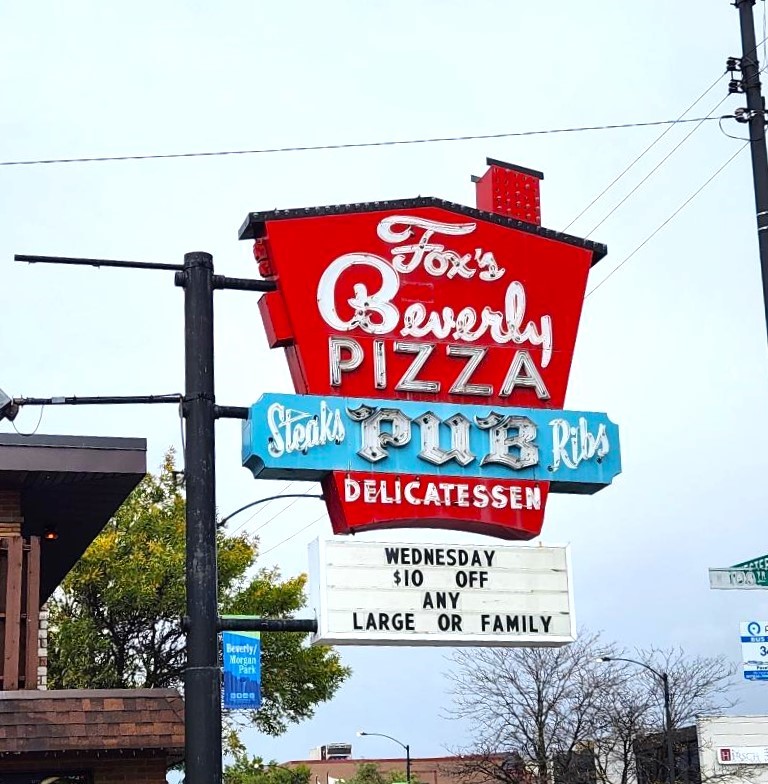
In 1964, Tom and Therese Fox took over a pizza carry-out business on 99th Street and Walden Parkway, and they renamed it the Beverly Pizza House. In 1967, they took over the building and deli business at 100th Street and Western Avenue from Mafalda Capone Maritote, Al Capone’s sister, and opened Fox’s Pub, an Irish pub serving pizzas as its specialty.
Now the oldest pizza place on the Ridge in Beverly/Morgan Park, Chicago, Fox’s Restaurant and Pub is run today by Tom Fox, Jr., and is celebrating its 60th anniversary this year.
To answer the question of who has the best pizza – well, it depends on what you have a taste for, as each pizza restaurant has its own way of doing things, growing out of the tradition of serving a family’s specialty.
For patrons who want to check out the pizza places near or on the Ridge that have stood the test of time, here is the summary:
Vito and Nick’s Pizza at 8433 S. Pulaski Road, although not on the Blue Island Ridge, started serving pizza in 1946 and is one of the oldest pizza places in the city of Chicago.
Rosangela’s Pizza at 2807 W. 95th Street in Evergreen Park, likely the oldest pizza place on the Ridge, started serving pizza for lunch in 1954.
Fox’s Restaurant and Pub, 9956 S. Western Avenue, started serving pizza at its first location on Walden Parkway in 1964, making it the likely the oldest pizza place on the Ridge in Beverly/Morgan Park, Chicago.
Beggar’s Pizza opened in 1976 at the corner of 127th Street and Western Avenue, and today with multiple outlets is likely the oldest pizza place still in operation in the city of Blue Island.
The Ridge Historical Society
Happy Halloween
By Carol Flynn
Halloween originated in Ireland and came to the U.S. with the Irish immigrants in the 1800s.
They believed that at this time of year, the veil between the spirit world and the physical world was the thinnest and human and non-human spirits could more easily cross over. They were fine with visits from their deceased loved ones; in fact, they even set places at the dinner table for them.
But the non-human spirits, the demons and the fairies, were another matter.
The traditions of wearing costumes and placing lit-from-within turnips in windows to drive away the evil spirits, and leaving out treats to keep the fairies from playing tricks, were customs that the Irish brought with them to the U.S.
Since that time, U.S. residents of all backgrounds have embraced the day with its traditions and turned it into a day of celebration. In Chicago, “autumn” is synonymous with “Halloween time.”
Creating “haunted houses” started to become popular in the U.S. in the 1930s. In more recent years, decorating houses for Halloween has become a huge part of the holiday. According to the National Retail Federation, it’s estimated that in 2023, people in the U.S. spent $3.9 billion on home decorations.
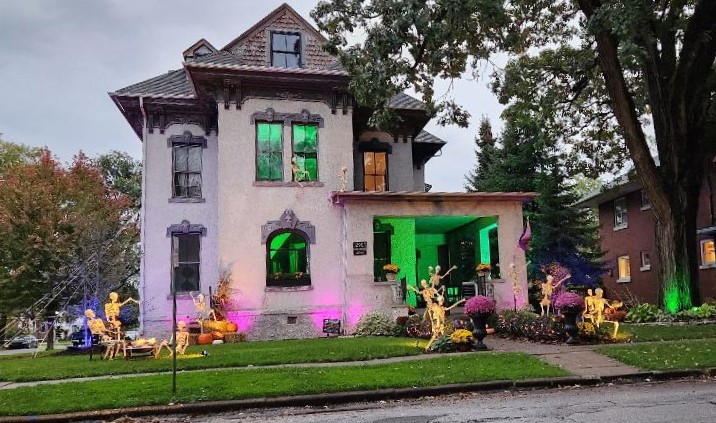
The Ridge area has many finely decorated houses for today, and one in Blue Island is proving to be popular, both because of the decorations and because of the house itself.
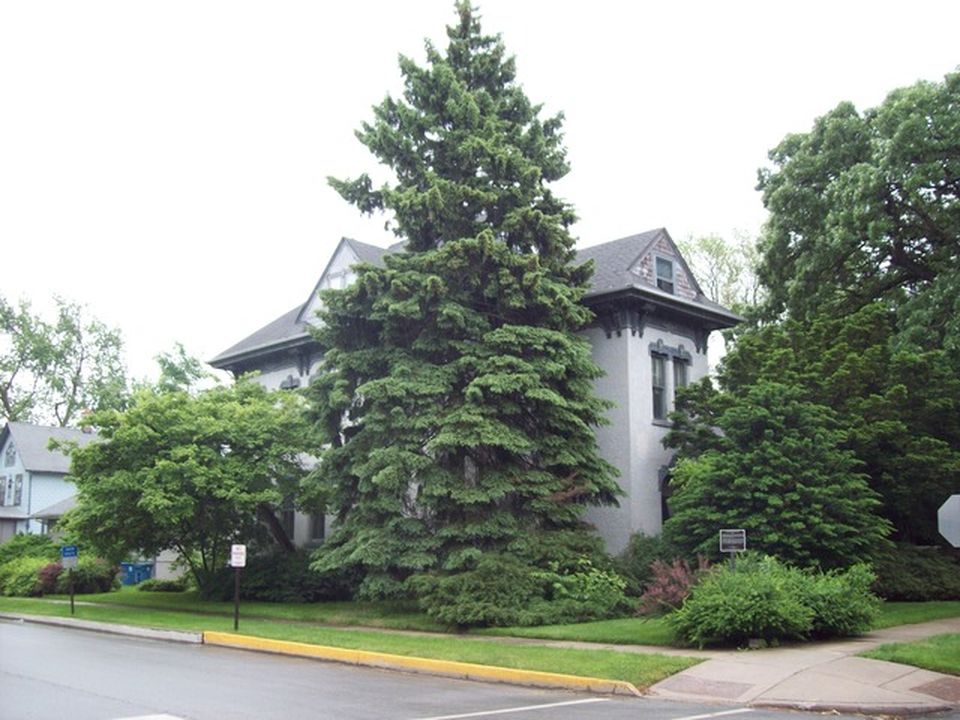
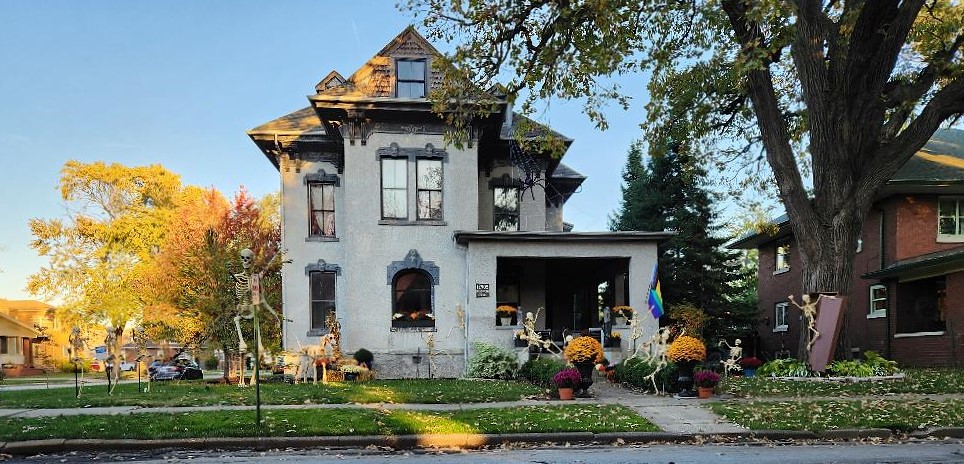
The Charles S. Young House at 12905 Greenwood Avenue, has a collection of skeletons at the front entrance and on the front lawn that has been added to each year, displayed in various poses – climbing out of a coffin, etc. Lit at night, it has the desired dramatic and spooky, yet fun, effect.
The house itself, of Italian Gothic Revival style with large, dramatic proportions, was built in 1886 for Young, part of a prominent family of real estate investors. The architect is not known.
Charles Young was the first president of the Blue Island Library Association, and his wife Jennie Alexander Young was a charter member of the Blue Island Woman’s Club.
The next tenant rented the house and ran a residential hotel for railroad employees there. The house was then purchased and lived in for many years by a member of the well-known Blue Island business family. The third owner was a Holocaust survivor who was known for helping people in need, including housing recovering substance abuse patients in the house.
Upon that owner’s death, the house became vacant and was on and off the market for years. It became derelict, overgrown with evergreen trees and other vegetation. Of course, it developed the reputation for being haunted.
When the current owners purchased the house in 2019, the realtor asked them if they realized they were buying a haunted house. They responded, enthusiastically, “Oh, yeah!”
They have spent the last five years lovingly restoring the house to its former glory, and they do admit that they have had a few unusual experiences in the house.
They took those as welcoming signs, and believe that any presence there is positive, not menacing.