Explore the RHS Facebook Archives, a rich repository of local history written by Carol Flynn. For two decades, Carol brought a deeply dedicated voice to public education at RHS. Her role as Facebook administrator through mid-2025 naturally extended her prolific research into meticulously detailed articles, most notably her multi-part historical series posts. Today, Carol continues her local history writing for The Beverly Review and other outlets.
Black History Month – School Profile Series
The Ridge Historical Society
February – Black History Month –#5
By Carol Flynn
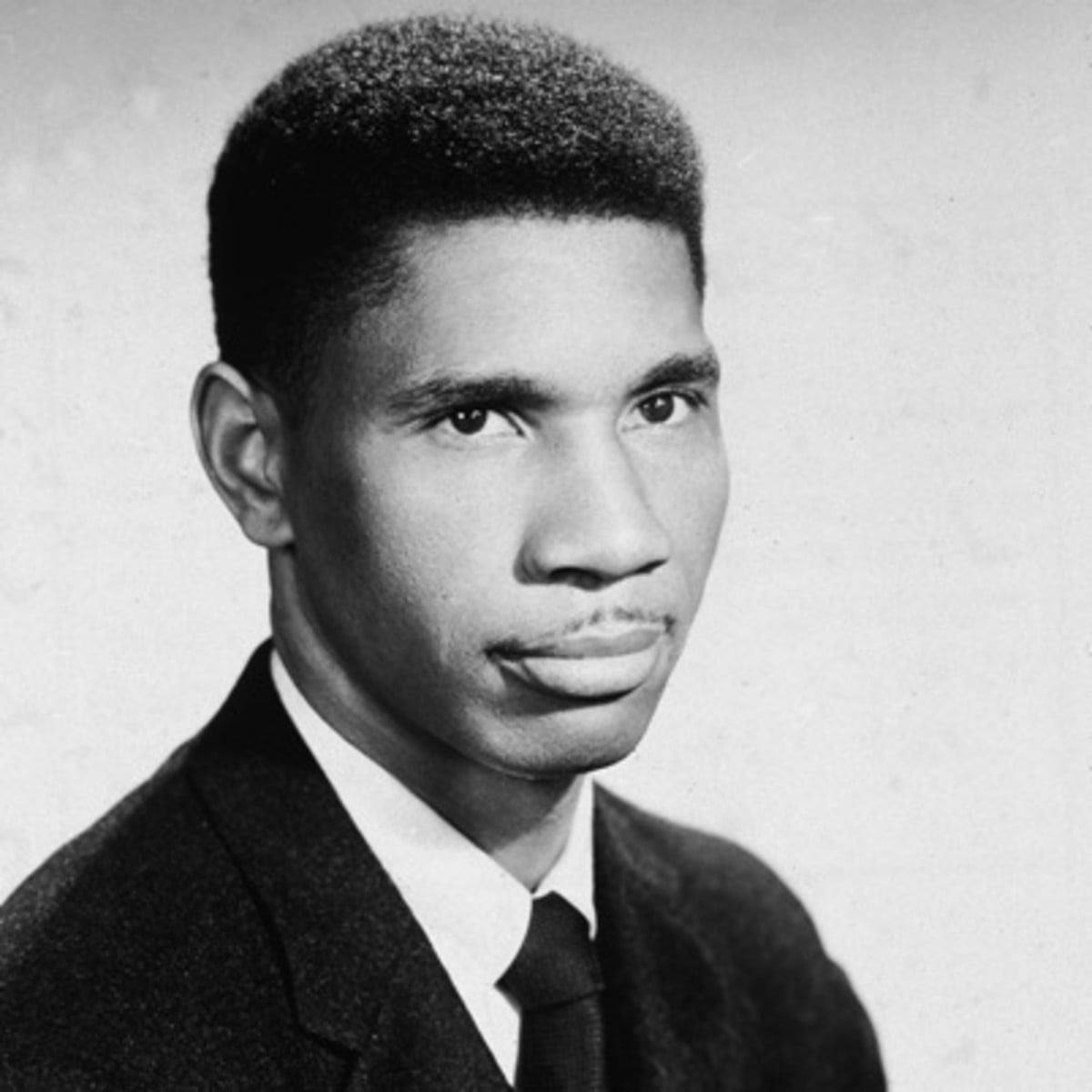
Our fifth person of distinction with a school on the Ridge named for him to be profiled for Black History Month is Medgar Evers.
Medgar Wiley Evers (1925-1963) was a civil rights activist in Mississippi who worked to end segregation and expand opportunities for Blacks, including the enforcement of voting rights.
Evers was a World War II veteran who served in the segregated U.S. Army, rising to the rank of sergeant. His unit participated in the D-Day invasion of Europe.
As a field worker for the National Association for the Advancement of Colored People (NAACP), his first assignment was to investigate the murder of Chicagoan Emmet Till, the 14-year old African American boy kidnapped and killed for flirting with a white woman in 1955 in Mississippi. Evers helped locate and protect witnesses.
Evers was assassinated outside his home by a white supremacist. He was buried in Arlington National Cemetery with full military honors.
It took thirty-one years for justice for his murder. All-white juries refused twice to convict his murderer in the 1960s. In 1991, a racially mixed jury found the un-repentant murderer guilty and sentenced him to life in prison.
The Medgar Evers School at 9811 S. Lowe Street opened in 1969.
The Ridge Historical Society
February – Black History Month –#4
By Carol Flynn
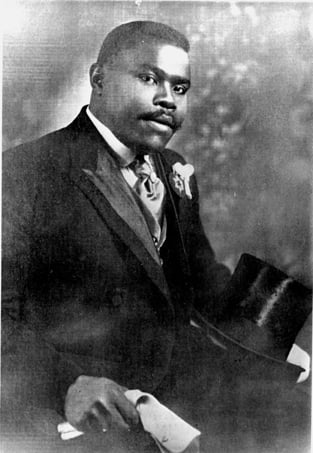
Our fourth person of distinction with a school on the Ridge named for him to be profiled for Black History Month is Marcus Garvey.
Marcus Mosiah Garvey, Jr. (1887-1940) was a political activist, journalist, and businessman born on the Caribbean island of Jamaica. He lived for over a decade in the United States. Although during his lifetime his viewpoints were considered controversial, with time his encouragement of pride and self-worth for people of African descent influenced Black leaders and movements. Some have called him the “Father of African Nationalism.”
Garvey’s entire history is too involved to cover in a Facebook post. There are many sources of information about him online that readers are encouraged to investigate.
From an early age on, Garvey’s experiences with social and economic hierarchies based on color led him to become an advocate for improving the status of people of African origin. His belief was that the initiative had to come from within the African community itself.
Garvey believed strongly in the equality and separation of the races, and in racial purity. Although he established a loyal following, his separatist views were at direct odds with most Black leaders of the day, including W. E. B. DuBois and the National Association for the Advancement of Colored People (NAACP), who were working for integration into American society.
After his death in London in 1940, his status as an advocate grew. In 1964, his remains were returned to Jamaica and buried with a ceremony worthy of a national hero.
African American and world leaders have acknowledged they were influenced by Garvey. Martin Luther King, Jr., visited his tomb in 1965 and said: "Marcus Garvey was the first man of color to lead and develop a mass movement. He was the first man on a mass scale and level to give millions of Negroes a sense of dignity and destiny, and make the Negro feel he was somebody."
In 1971, a new Chicago public school at 10309 S. Morgan Street in Washington Heights was being built and the residents of the community the school would serve, primarily African Americans, had been asked to submit potential names. They submitted several, including Marcus Garvey. All of the names were rejected. This happened twice, and then they decided to rally for Garvey’s name.
The School Board maintained that Garvey was not appropriate because he was a separatist and had been in jail, and this would not be a good example for children. The community leaders’ response was that they had the right to pick their own heroes. Garvey was the first real global activist for Black pride, solidarity, and power, and therefore a worthy model. Naming a school for a person did not mean agreement with all his beliefs.
The School Board finally voted narrowly in favor of the name. In 1974, it was announced that the new would be named for Marcus Garvey.
The Ridge Historical Society
February – Black History Month –#3
By Carol Flynn
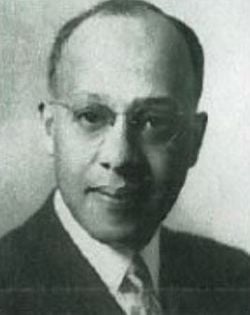
Our third person of distinction with a school on the Ridge named for him to be profiled for Black History Month is Judge Wendell Green.
Wendell Elbert Green (1887-1959) was a lawyer and judge who had a distinguished career in Cook County, Illinois. He was considered a brilliant defense attorney, with a “forceful expression.” As a judge, he was known for his “clarity of judgment” and professional decorum.
Born in Kansas, Green was the son of an Episcopalian minister and a social worker. He yearned to become a lawyer, but others convinced him that the opportunities for Black men were limited in this field. He earned a degree in pharmacy from the University of Kansas in 1908. He worked as a pharmacist for a few years, but he still dreamt of practicing law.
In 1913, Green married Loraine Richardson, who would also become well-known in Chicago as the first Black woman to serve on the Chicago Board of Education. He took a civil service job as a postal clerk in order to transfer to Chicago in 1916 so Lorraine and he could attend the University of Chicago. Green worked his full-time postal job, went to school at night, and took a second job serving meals on campus to pay their tuition. He was told by the dean of the school he would never be able to complete the law program.
He graduated in 1920.
Establishing a private practice, he built his reputation as a defense attorney who rarely lost a case. The Chicago Defender newspaper carried many stories about Green’s appearances in court. One pivotal event happened in 1924.
Green was defending a Black man against the charge of intoxication. One white police officer said the man had been intoxicated at an event; nine Black witnesses said this was not the case. Green asked for the charges to be dropped but the judge replied that in his opinion the nine witnesses were lying.
The judge said, “It has been my experience in this court that colored people lie on the slightest provocation. They will lie when there is no need to lie. That is why I believe one white witness against your nine.”
Green was speechless for a moment, then he addressed the court, “his voice charged with anger, re-sounding through the courtroom.” He berated the judge for not being fair and impartial; by law, color should not be the test for credibility. He said that veracity and perjury belonged to no particular race, that the lying and perjured testimony of white witnesses had done great wrong, and that the judge had no right to decide the case based on the color of the witnesses.
Green then withdrew from the case and, taking up his hat and coat, left the courtroom.
The courtroom sat in an “electrified” silence. Then the judge, with “a flushed countenance,” dismissed the defendant. Attendees of both races rushed into the corridor to congratulate Green.
Green served as a public defender, then as a Civil Service Commissioner appointed by Mayor Edward Kelly. In 1942, he was elected as a judge to the Municipal Court of Chicago.
Governor Adlai Stevenson appointed Green to fill a vacancy on the Cook County Circuit Court in 1951, and he won re-election to this position the following year. Green was the first Black person to reach this judicial level. During his time on the Municipal and Circuit Courts, Green tried cases ranging from a landlord accused of overcharging a tenant $1.25 on his rent, to a sensational case of a police officer charged with the murder of two young men following an off-duty altercation in a bar.
From 1956 to 1958, Green was assigned by his fellow Circuit Court justices to head Juvenile Court. He was the first Black judge to oversee associate judges hearing cases for runaways, truancies, and delinquencies. He helped set up a facility focused on psychological services and training for the juveniles who came before the bench. His effort to help young people is considered by many to be Green’s greatest legacy left to the city and the people.
Because Blacks were not allowed to join white legal associations, they started their own groups. Green was active in the Cook County Bar Association (CCBA), the oldest association for Black lawyers and judges in the country. In 1925, he was one of the thirteen founders of the National Bar Association (originally the Negro Bar Association). When the Chicago Bar Association finally accepted Black members beginning in the 1940s, Green joined. The Chicago Bar Association always gave the highest ratings to Green for his performance as a judge.
Green served as president of the board of Provident Hospital, the first Black-owned and operated hospital in the country, established in Chicago in 1891 to provide medical services and training to Blacks denied access at other institutions. Green was also a board member of the National Conference of Christians and Jews.
In 1973, the Chicago Board of Education voted unanimously to name the new school at 1150 W. 96th Street in Wendell E. Green’s honor.
The Ridge Historical Society
February – Black History Month –#2
By Carol Flynn
The second person who has a school named for her in a Ridge community to be profiled for Black History Month is Reverend Johnnie Colemon.
Johnnie Colemon (1920 – 2014) was a religious leader who inspired tens of thousands of people. She was a trailblazer who opened paths for other African American women to enter the ministry. And even though she had numerous honors and distinctions, she always insisted people just call her Johnnie.
Johnnie was born in Alabama and raised in Mississippi. In 1943, she earned a bachelor’s degree from Wylie College, a historically Black college located in Texas. She moved to Chicago and became a Chicago public school teacher.
In 1952, a health crisis took her to the Unity Church, which was founded in 1889 as a spiritual healing ministry. Today it is part of the “New Thought” movement.
Johnnie visited Unity headquarters near Kansas City, Missouri, and immediately felt at home with the teachings. She was accepted into the Unity School of Christianity, but even though the church taught that each person was a unique expression of God, sacred and worthy, Black students were not allowed to live in the school’s cottages or eat in the school restaurant, and had to sit in a segregated, roped off section in church.
Johnnie voiced her objections to these arrangements, and many of the whites considered her “arrogant.” But an unused cottage was made ready for her, although it was set apart from those of the white residents. She was the first Black person to live on campus.
She became an ordained Unity minister in 1956, the first African American woman to do so. Returning to Chicago, Reverend Colemon started her own church, at first meeting in a YMCA, but in a few years raising the money for her own building.
In 1968, Rev. Colemon was elected the first Black president of the Association of Unity Churches, causing some churches to quit. She then withdrew her church from the Unity organization, in part due to the systemic racism, and also because her philosophies were developing in other directions.
At that time, she renamed her church Christ Universal Temple (CUT). She also formed her own denomination, the Universal Foundation for Better Living, that now has thirty member churches internationally.
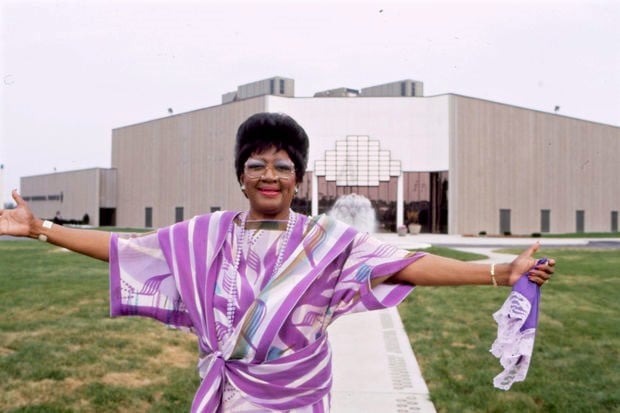
Rev. Colemon’s influence spread. Her sermons with positive, practical, understandable messages were well-received and her congregation kept growing. By 1985, CUT had grown into a megachurch and needed a building to accommodate its size.
Financial loans were almost impossible to come by for an African American woman, but Rev. Colemon persisted, and succeeded in obtaining funding through loans and donations. She had a new facility built at 119th Street and Ashland Avenue. This facility included a 3,500-seat auditorium, chapel, bookstore, banquet facility, and prayer center. She started an institute to train ministers and teachers. Her following grew to 20,000 members.
CUT has been the site for memorable events, including a 2005 Father’s Day address by then U. S. Senator Barack Obama. Rev. Colemon lived on the same block as the Obamas in Hyde Park/Kenwood. She ordained actress/singer/author Della Reese a minister in the 1980s; they became close friends.
In addition to her ministry, Rev. Colemon also held civic positions. She was a director of the Chicago Port Authority and a commissioner on the Chicago Transit Authority Oversight Committee. Her awards, including honorary doctorates, are too numerous to list here.
In 1999, she built a private elementary school as part of the CUT complex, which was named the Johnnie Colemon Academy. Because of the necessary tuition, the school met with limited success, and beginning in 2001, the Chicago Board of Education (CBOE) took over the building for a public school.
The Johnnie Colemon name was kept for the school, even though today’s CBOE rules, in keeping with the separation of church and state, prohibit naming a public school for a religious leader.
Picture: Rev. Johnnie Colemon outside her new Christ Unity Temple when it opened in 1985. Ebony magazine.
The Ridge Historical Society
February – Black History Month
By Carol Flynn
Last year we started a series on the people for whom schools in our Ridge communities are named. We paused that series to cover other things.
For Black History Month, we will profile the five people of color who have schools named in their honor. We covered three last year, but we will start with repeating those, then cover the other two.
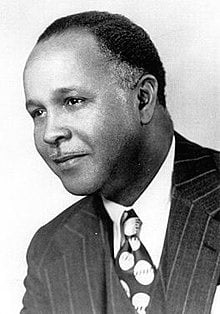
Percy Julian has the distinction of having a high school named for him.
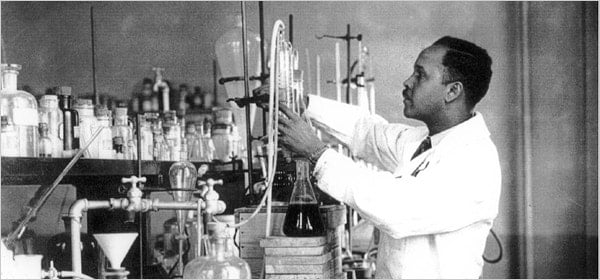
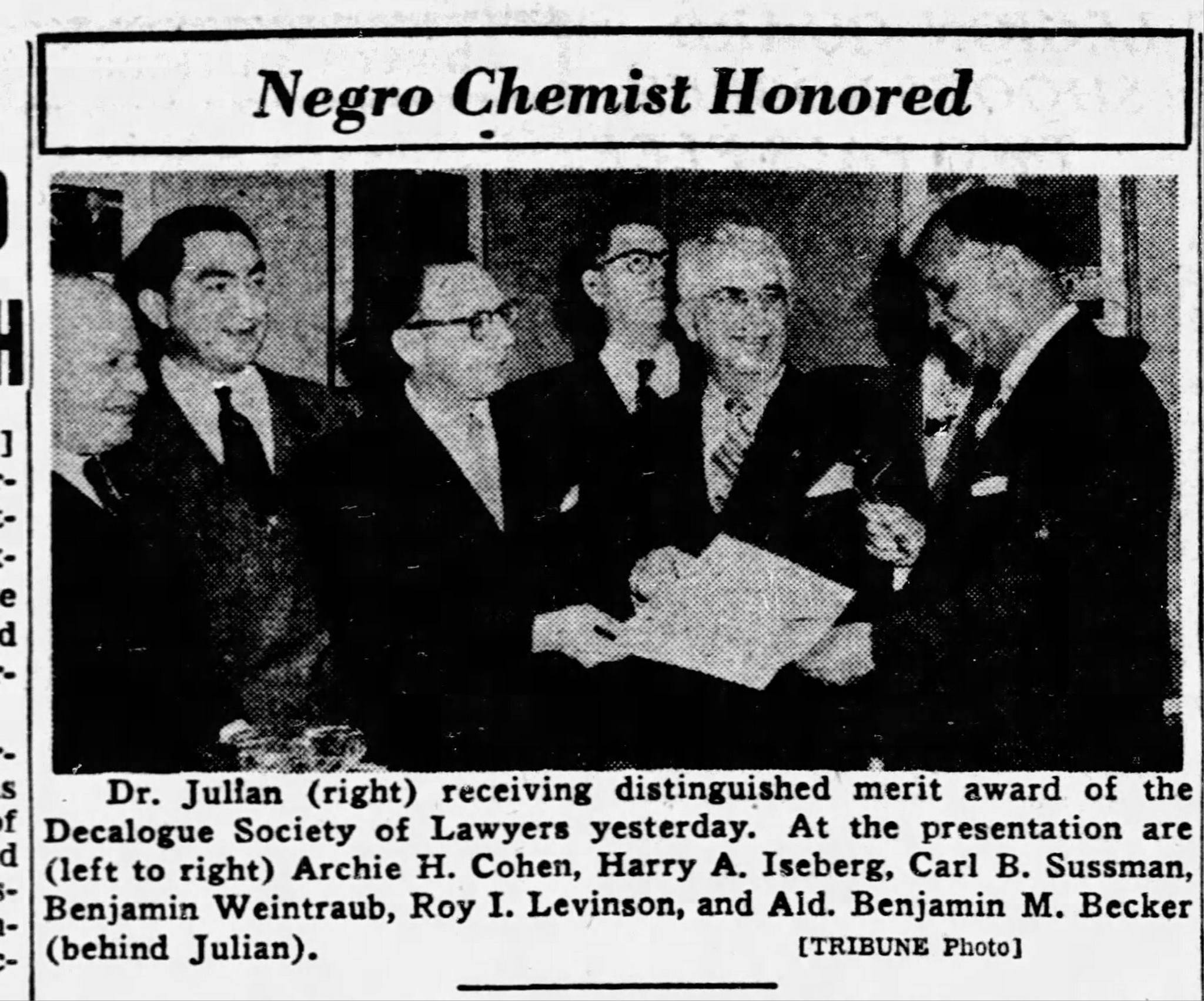
Percy Lavon Julian (1899-1975) was a research scientist who received over 130 chemical patents during his lifetime. He was inducted into the National Academy of Sciences in 1973, the first African American chemist to receive this honor. He was a pioneer in the chemical synthesis of medicinal drugs and human hormones from plants. His work led to treatments for glaucoma and infertility. When researchers showed the effectiveness of cortisone in treating rheumatoid arthritis, Julian improved the process for producing cortisone, greatly reducing costs.
Dr. Julian spent his life trying to overcome racial discrimination in education and employment. In his later years, he stated, “I feel that my own good country robbed me of the chance for some of the great experiences that I would have liked to live through. Instead, I took a job where I could get one and tried to make the best of it. I have been, perhaps, a good chemist, but not the chemist that I dreamed of being.”
Percy Julian was born in rural Alabama; one grandparent was an emancipated slave. He attended segregated schools until a white teacher who had taught Julian’s parents pulled strings to get him admitted to DePauw University in Indiana.
The school accepted him but would not allow him to live in the dorm. He found a boarding house, but they would not feed him. He went for days without eating before he found a place that would serve him. He later found work firing the furnace, waiting tables, and doing other odd jobs in a fraternity house; in return, he was allowed to sleep in the attic and eat at the house.
He was years behind the white students academically and took remedial classes at night while attending college classes during the day and working as a ditch digger. Despite all of this, he graduated first in his class and was valedictorian.
The practice at DePauw was to help students find post-graduate opportunities, however, the school would not help Julian because of his race. He was discouraged from pursuing a Ph.D. or employment in industry, and advised to find a teaching job in a “Negro college in the south.”
He received a scholarship to earn his master’s degree at Harvard University. However, because white students objected to a Black instructor, he was refused a teaching assistantship that would lead to a Ph.D.
Julian was awarded a fellowship to the University of Vienna, Austria, and earned his Ph.D. in 1931. In Europe, he was welcomed into the social, intellectual, and academic life he was denied in the U.S. He made life-long friends in the European community and helped Jewish friends escape the Holocaust.
Returning to the U.S., finding employment was difficult. Julian took a position teaching at Howard University, the historically Black university in Washington, D.C.
He then accepted a research fellowship back at DePauw, and his career as a research scientist began. However, when the fellowship ended, he was denied a teaching professorship there and had to find new employment. He was told by DePauw University “the time wasn’t right” for a Black professor.
DuPont offered a job to Julian’s research partner at DePauw, who was white, but declined to hire Julian, apologizing that the company was “unaware he was a Negro.” He turned down another position because Blacks were not allowed in the town past sundown.
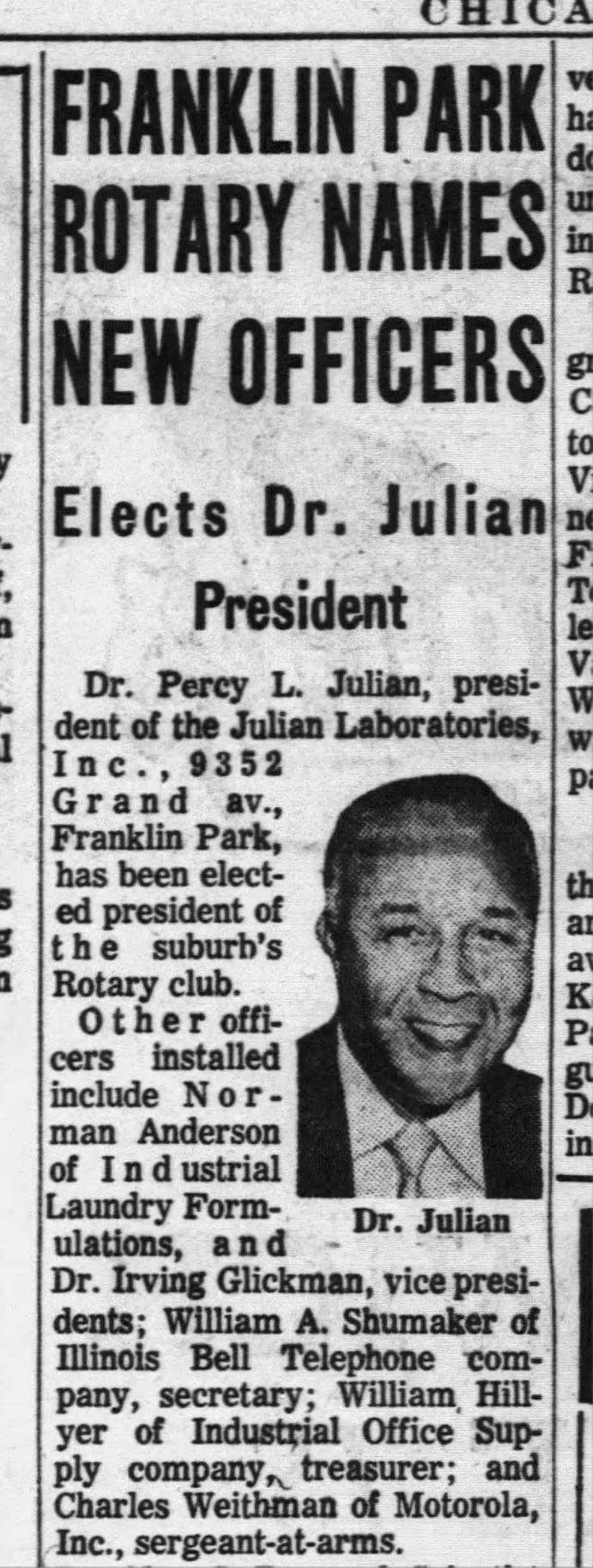
Julian accepted a job at Glidden company in Chicago where he was able to continue his research. He left there in 1953 and formed his own company, which he sold in 1961 for $2.3 million.
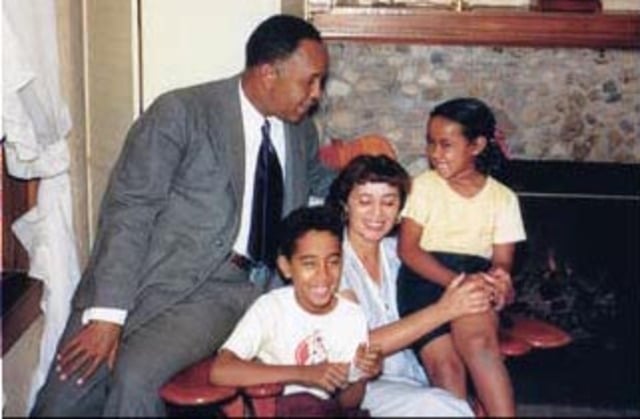
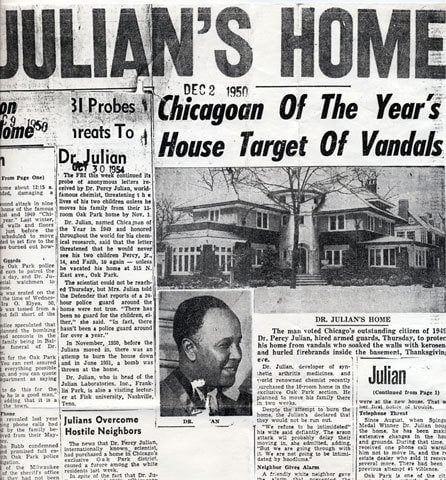
The Julians were the first African Americans to move into Oak Park. Attempts were made to burn their house down, and a bomb was thrown at the house. The police reported they could not identify any suspects for the crimes. White neighbors formed a group to support them but even so, threats continued for many years.
Chemistry was the break-through “technology” of the early and mid-1900s. Dr. Julian achieved great things – by any standards, he was much more than a “good” chemist. But for him, the issue was how much more he might have accomplished if given the same opportunities available to white chemists. After his death, he received recognition from the schools he attended, but as one DePauw scholar noted, the university finally had to embrace Julian because he became a success, Julian did not become a success because the university embraced him.
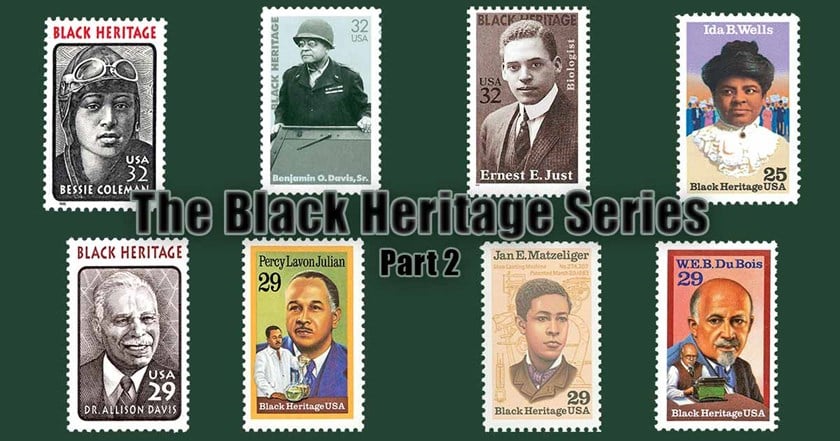
The Percy L. Julian High School opened at 10330 S. Elizabeth Street in 1975. In 1993, he was featured on the Black Heritage stamp, a series initiated by the U.S. Postal Service in 1978.