Explore the RHS Facebook Archives, a rich repository of local history written by Carol Flynn. For two decades, Carol brought a deeply dedicated voice to public education at RHS. Her role as Facebook administrator through mid-2025 naturally extended her prolific research into meticulously detailed articles, most notably her multi-part historical series posts. Today, Carol continues her local history writing for The Beverly Review and other outlets.
Hofer Sisters
The Ridge Historical Society
March: Women’s History Month – Part 3 on the Hofer Sisters
By Carol Flynn
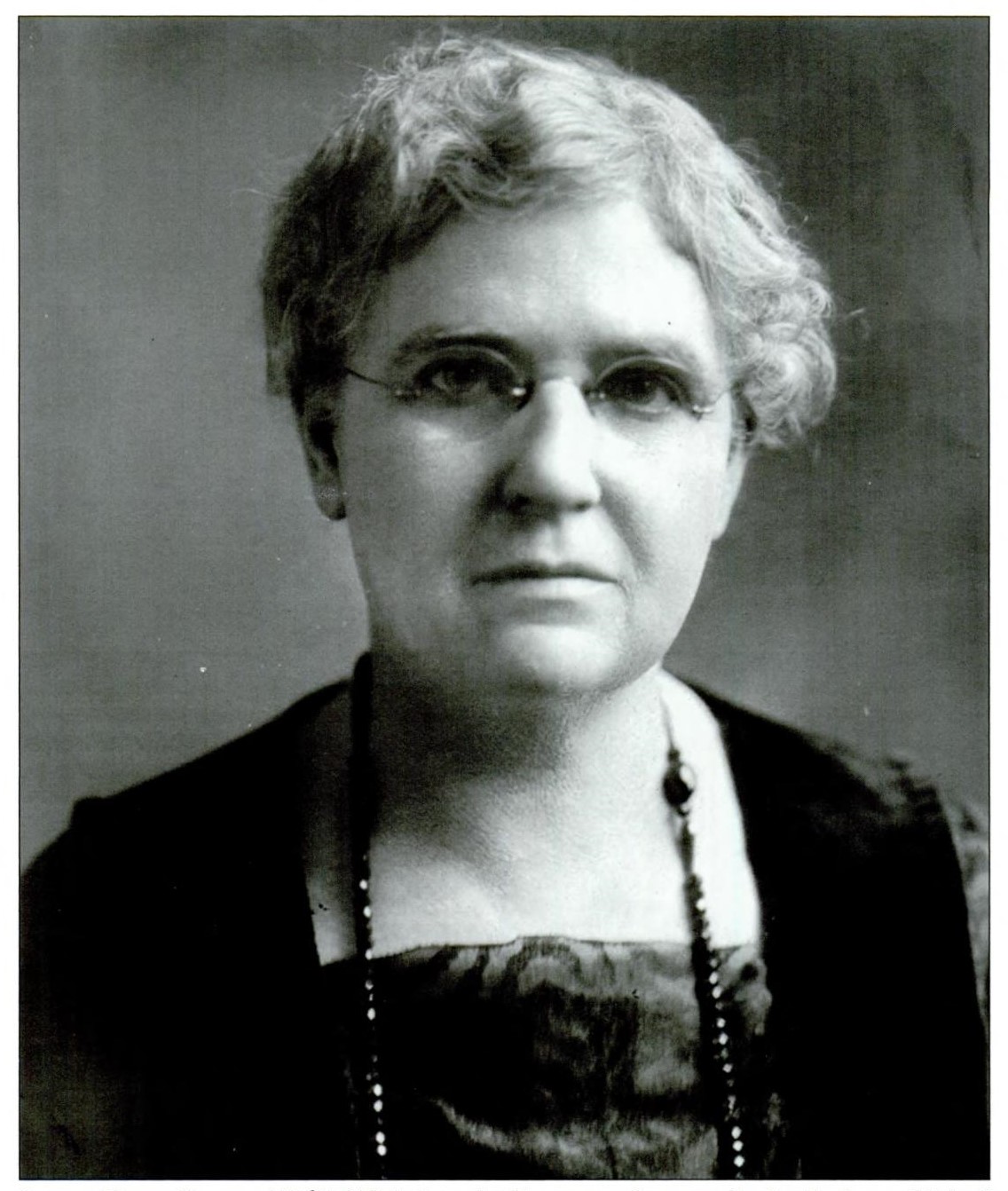
The five daughters of the Hofer family that lived in Beverly were leaders in the kindergarten movement in the U.S.
Oldest daughter Mari, profiled in the last post, was an expert in music education for children. This post will look at the second daughter, Bertha, whose career focused on education, administration, and social settlement services, especially for mothers and children.
Bertha Hofer Hegner (1862-1937), like her siblings, was born in Iowa, where her parents settled after immigrating from Baden, on the German-Swiss border.
In the 1880s, several of the Hofer daughters moved to Chicago. Bertha enrolled in a training school for kindergarten teachers run by Elizabeth Harrison, a well-respected educator, as part of the Loring School, a private day and boarding school for girls in the Kenwood area.
[As an aside, the Loring School moved to Beverly and operated in the England J. Barker House at 107th and Longwood Drive from 1935 to its closure in 1962.]
Bertha graduated from that program in 1890, the same year her parents sold the newspaper they were running in Iowa and moved to Chicago, to 1833 West 96th Street, in Beverly, about where the entrance to Ridge Park now exists.
Bertha taught in Lake Forest for a few years, then in 1894, she completed graduate studies in Berlin, Germany, at the Pestalozzi-Fröbel-Haus. The kindergarten movement had started with Swiss educator Johan Pestalozzi in the late 1700s, and was furthered in the 1800s by Friedrich Froebel in Prussia/Germany. Froebel’s niece ran the program in Berlin. Bertha later did further graduate study at the University of Chicago and Columbia University in New York.
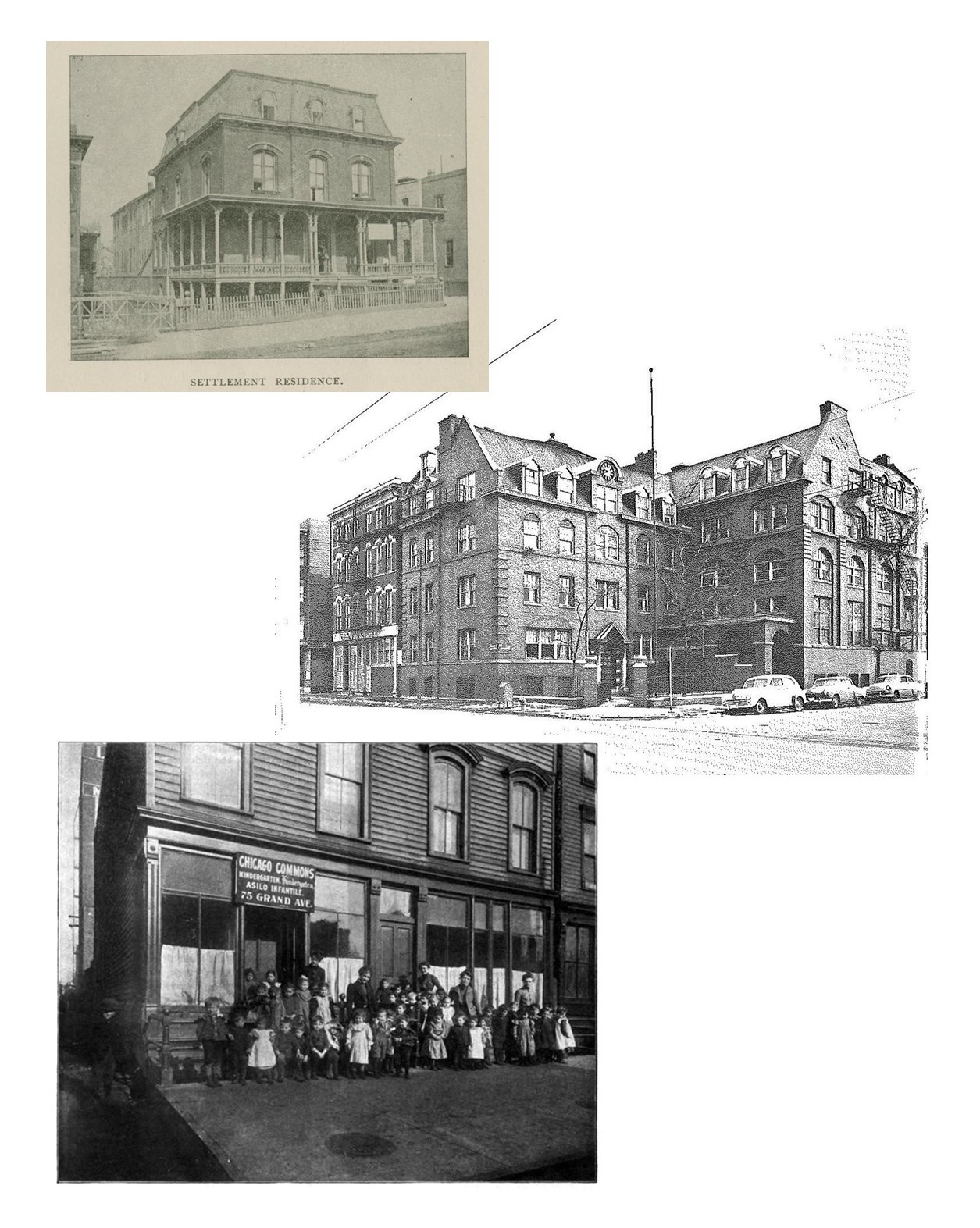
Chicago saw its first kindergarten in 1873, followed by a training course for teachers a few years later. In 1895, Bertha started the first kindergarten and teacher training program at the Chicago Commons Social Settlement.
Social settlements, started during the Progressive Era of reform, were centers for neighborhood social services usually located in crowded, low-income city areas, primarily populated by recent immigrants. The centers were called settlement houses because social workers, educators, ministers, and health care workers lived on site, or “settled” there, to be close to the people they were assisting.
In addition to providing food, clothing, medical care, and other basic needs, the settlements offered schooling to help people develop skills and knowledge for better jobs and advancement, and to improve their lives in general. Many of the settlements were affiliated with churches.
Hull House, started by social worker Jane Addams, was the most famous U.S. social settlement, but there were others in Chicago that were just as well-regarded.
The Chicago Commons Social Settlement was founded in 1894 by Graham Taylor on the near northwest side of the city.
Taylor was a professor at the Chicago Theological Seminary who specialized in training social workers at the University of Chicago. He was joined in his efforts by Herman F. Hegner from Wisconsin and Iowa, who had graduated from the Milwaukee Normal School for training teachers in 1890, and from the Chicago Theological Seminary in 1894, and was ordained a minister in 1895. Taylor and Hegner were the head residents at the Commons.
Bertha was also a resident at the settlement, and in June of 1896, she and Herman Hegner married.
By this point, the Hofer sisters were developing reputations for their various expertises, and Bertha was described as “one of the Hofer sisters, a graduate of the Pestalozzi School in Berlin, whose kindergarten work is widely known through her lectures and her writings.” The Hofer sisters were appearing on stage now with people like Jane Addams and Elizabeth Harrison.
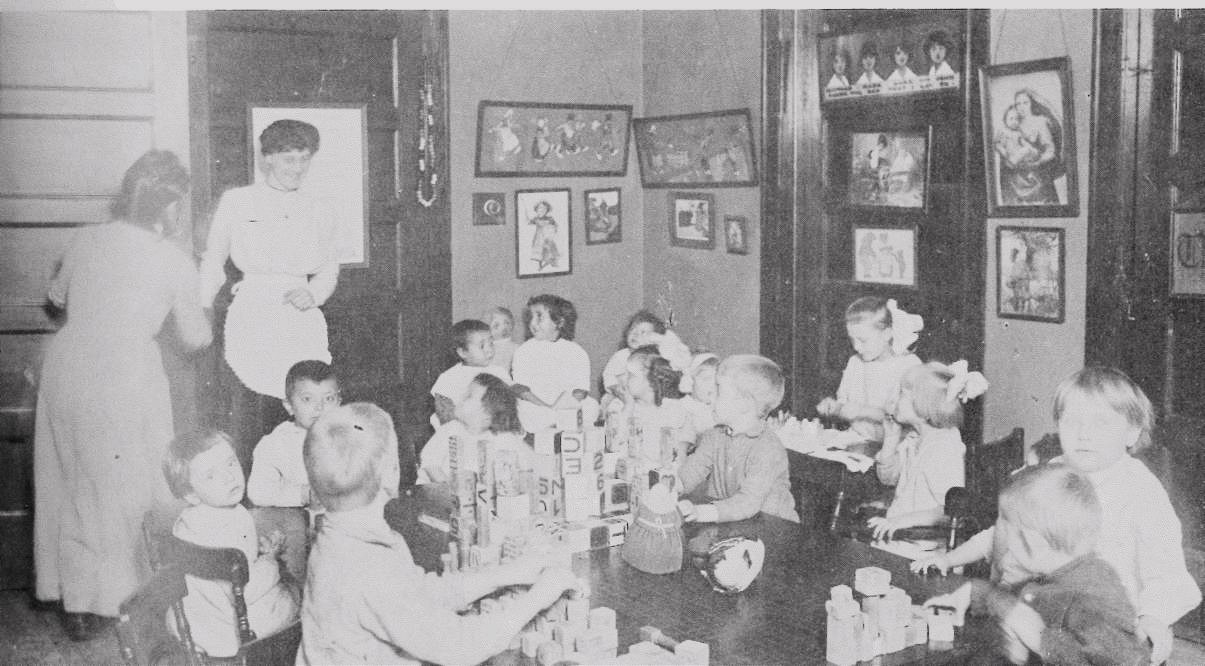
Bertha’s kindergarten became an important part of the Commons’ operations, the foundation for other education programs, like an industrial training school, and services for mothers, children, and families, like a mother’s club and childcare classes. The neighborhood residents strongly supported the kindergarten.
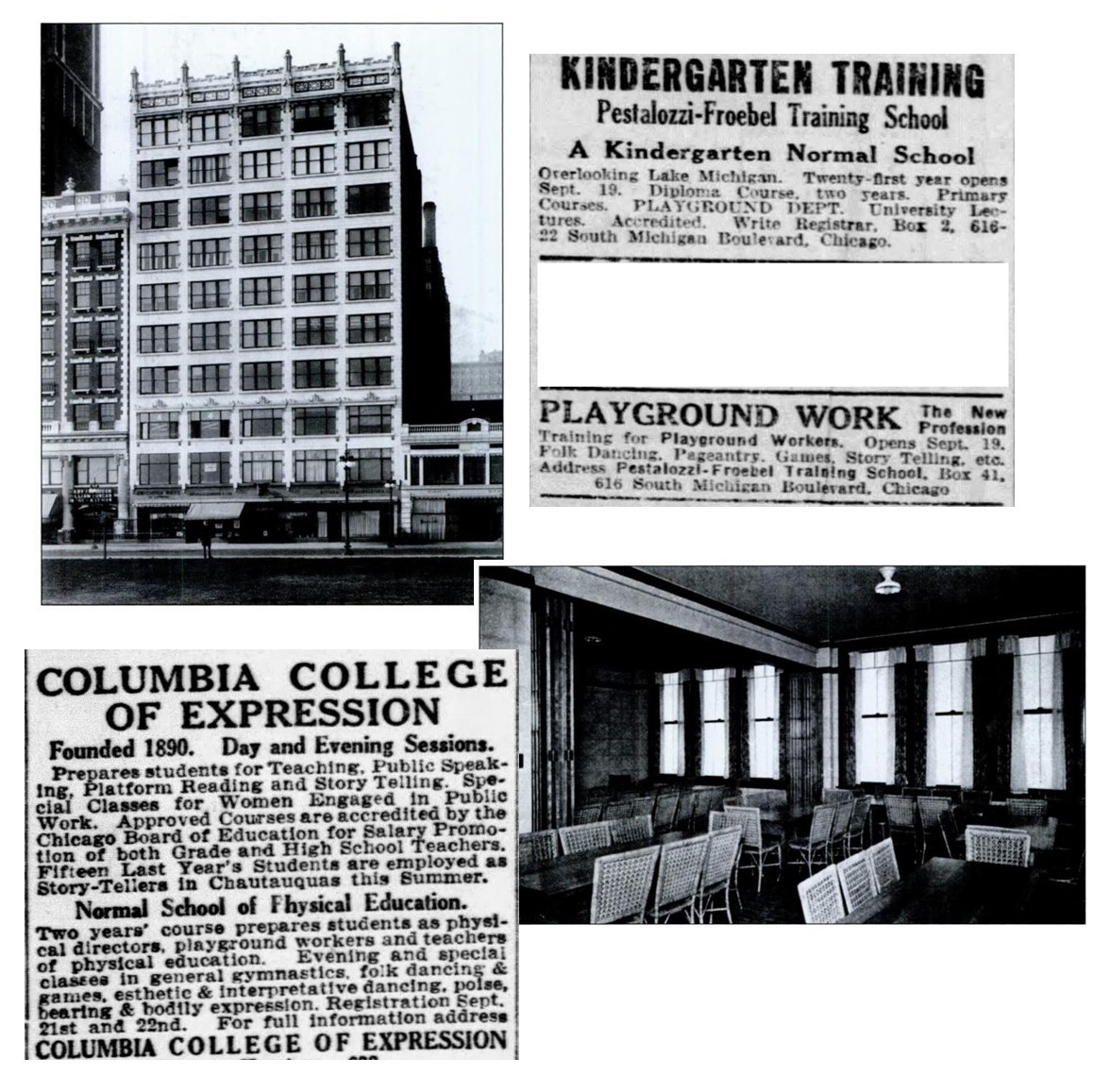
In 1896, Bertha started the Pestalozzi-Froebel Teachers College through the Commons to train kindergarten teachers. In the summers, they offered special teacher institutes. Usually, teachers preferred to attend summer programs in resort areas, not inner cities, but they flocked to Bertha’s program, described at the time as “a boon to would-be successful kindergartners.”
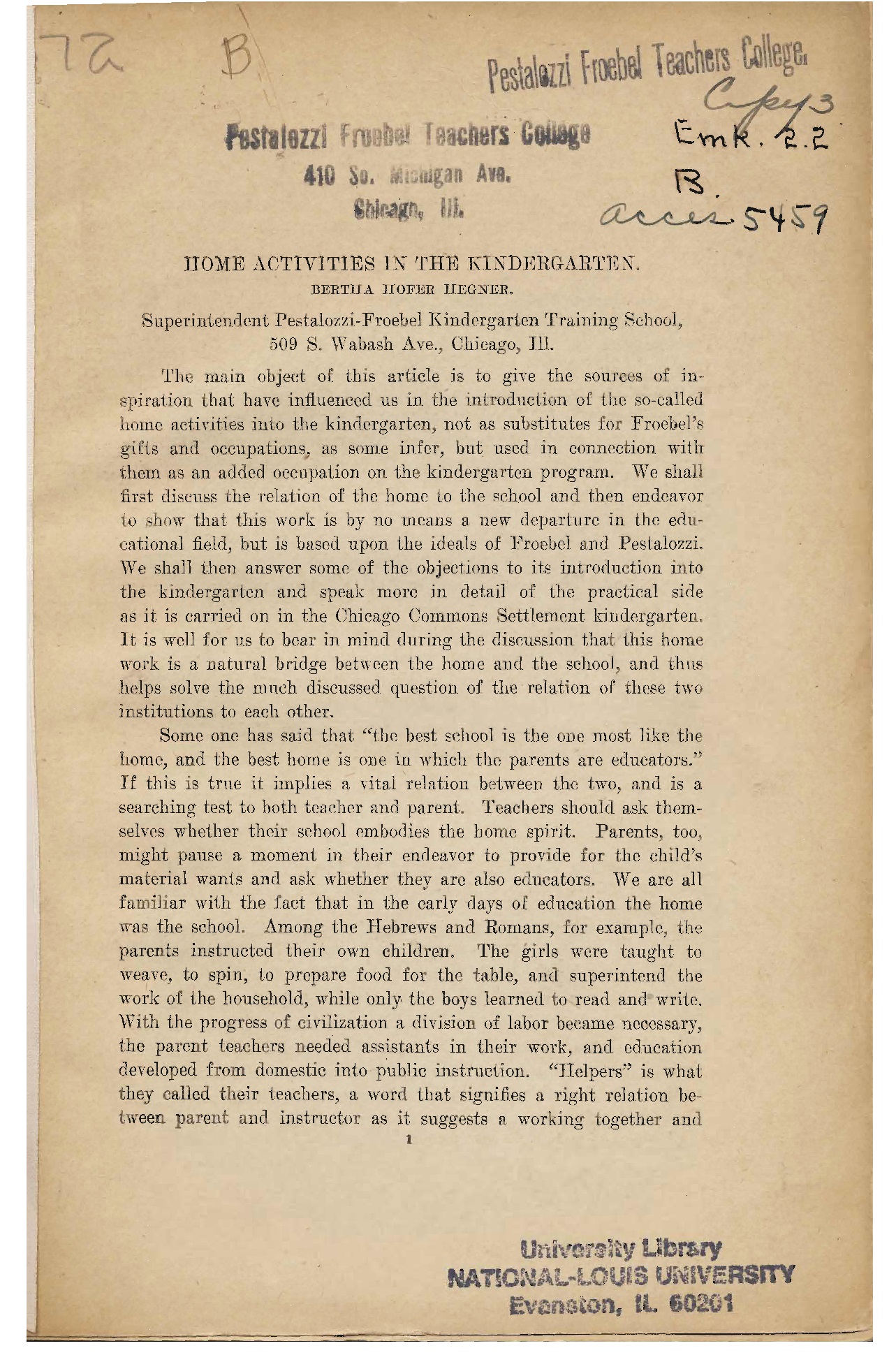
Progressive theory called for educating people to become useful and contributing members of society in general, as well as learning trades for employment. Supportive of working mothers, Bertha introduced “home activities” in her kindergarten to train children to help with basic home chores. This did not replace the teachings of Pestalozzi and Froebel, but, in Bertha’s words, added activities based on their “ideals” to create “a natural bridge between the home and the school.”
Some of the activities the kindergarten children engaged in included washing and putting away items they used including small-scale utensils and dishes; dusting the classroom furniture like the piano; emptying the waste basket; caring for the fish, birds, and plants; and washing the dolls and their clothes. Older children in the settlement’s other education programs helped in the settlement kitchen and dining room, and with the residents’ quarters and general housekeeping. The little ones assisted the older children.
They did these chores accompanied by songs, stories, and pictures. At holiday times, they did special projects like jack-o-lanterns and popcorn garland. In spring, they helped with the outside gardens and milking the cows.
The children loved these projects, and so did the parents. Mothers reported their children willingly helped at home as a result of these activities at school. The children helped throughout the neighborhood, for example, by cleaning up litter.
Training teachers on how to incorporate these home activities into school activities became part of the training program of Bertha’s college.
In 1904, Bertha published a scholarly article titled “Home Activities in the Kindergarten” in Kindergarten Magazine, which was reprinted numerous times. The U.S. Department of Education reproduced the article and distributed thousands of copies.
Bertha and Herman moved from the Commons to raise their family, two daughters and a son, and for Herman to take ministries at several churches in the city. They did some traveling to Europe and the Holy Land.
In 1904, Bertha resigned as head of the kindergarten to concentrate on the training school. Her sister Amalie joined her at the school for several years as principal, and her sister Mari was on the faculty for Music and Games. Herman and Graham Taylor were also on the faculty.
In 1913, Bertha moved the school, now free-standing from the Commons, to a new location, at 618 S. Michigan Ave. Herman became the full-time business manager for the school.
In 1927, the Columbia College of Expression, which offered programs in dramatics, public speaking, and physical education, ran into financial difficulties, and was purchased by the Hofer-Hegner school, and moved to the same building. Bertha ran both schools until she retired in 1936, and her son took over. Bertha introduced a program in 1934 to train people for radio work, something new at the time.
Bertha died in 1937. She left a legacy of education programs that lasts today. Both her kindergarten training school and the dramatic arts school were incorporated into other schools that still exist.
The third daughter, Amalie Hofer Jerome, was a pioneer in the playground movement and will be profiled next.
The Ridge Historical Society
March: Women’s History Month – Part 2 on the Hofer Sisters
By Carol Flynn
A few weeks ago, posts on the Hofer sisters started. The Hofer sisters are stellar examples of the intelligent, accomplished women who lived on the Ridge whose stories need to be shared. The five Hofer sisters were leaders in the kindergarten, social settlement, and playground movements in the U.S.
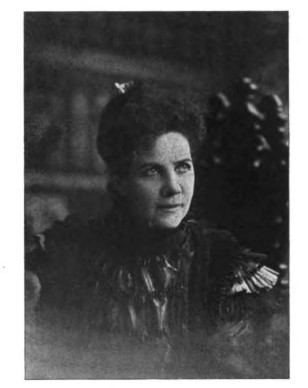
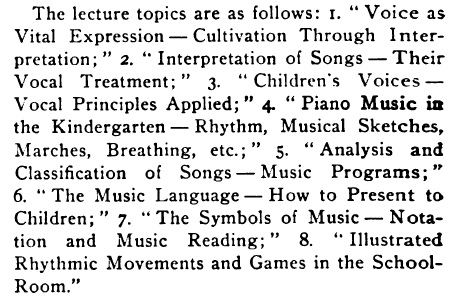
Oldest daughter Mari Ruef Hofer (1858 – 1929) was the musician in the family. She was a pioneer in music education for children, and in incorporating singing, dancing, pageantry, and games into regular classroom and playtime for children.
Young children learn by observing, experimenting, and doing, not by being lectured to and forced to memorize a bunch of facts. While this seems like an obvious concept today, it was a novel thought in the 1800s. It was people like Mari Hofer and her sisters who revolutionized the way child education was viewed, leading to the kindergarten and early childhood programs of today.
Mari graduated from the Mount Carroll Seminary, Illinois, in 1887, and did graduate work at the University of Chicago in 1897-99.
Mari taught school children herself, in Chicago and other locations, and she taught teachers how to educate young children, as a faculty member at several universities and a frequent guest lecturer. Her credentials are just way too long to include in a Facebook post.
She never married or had children of her own, but her understanding of children was profound. She advised that teachers had to recognize and nurture both the child sitting at the desk learning the “three R’s” and the unknown “other child,” the “inner child,” the “child of imagination and feeling, the creative, originative child.” This could prove to be the more difficult task.
Mari was an expert on the development of speech in children, and the interconnection of speech and song. She advocated that the mind, speech, and song should be cultivated together in young children, using simple songs with words and concepts children could grasp.
As she said, “Words and thoughts associated with melody remain graven in the mind when more important data vanish away.” Anyone with a song stuck in his or her head recognizes the truth of this – and it’s why the abc’s are taught as a song.
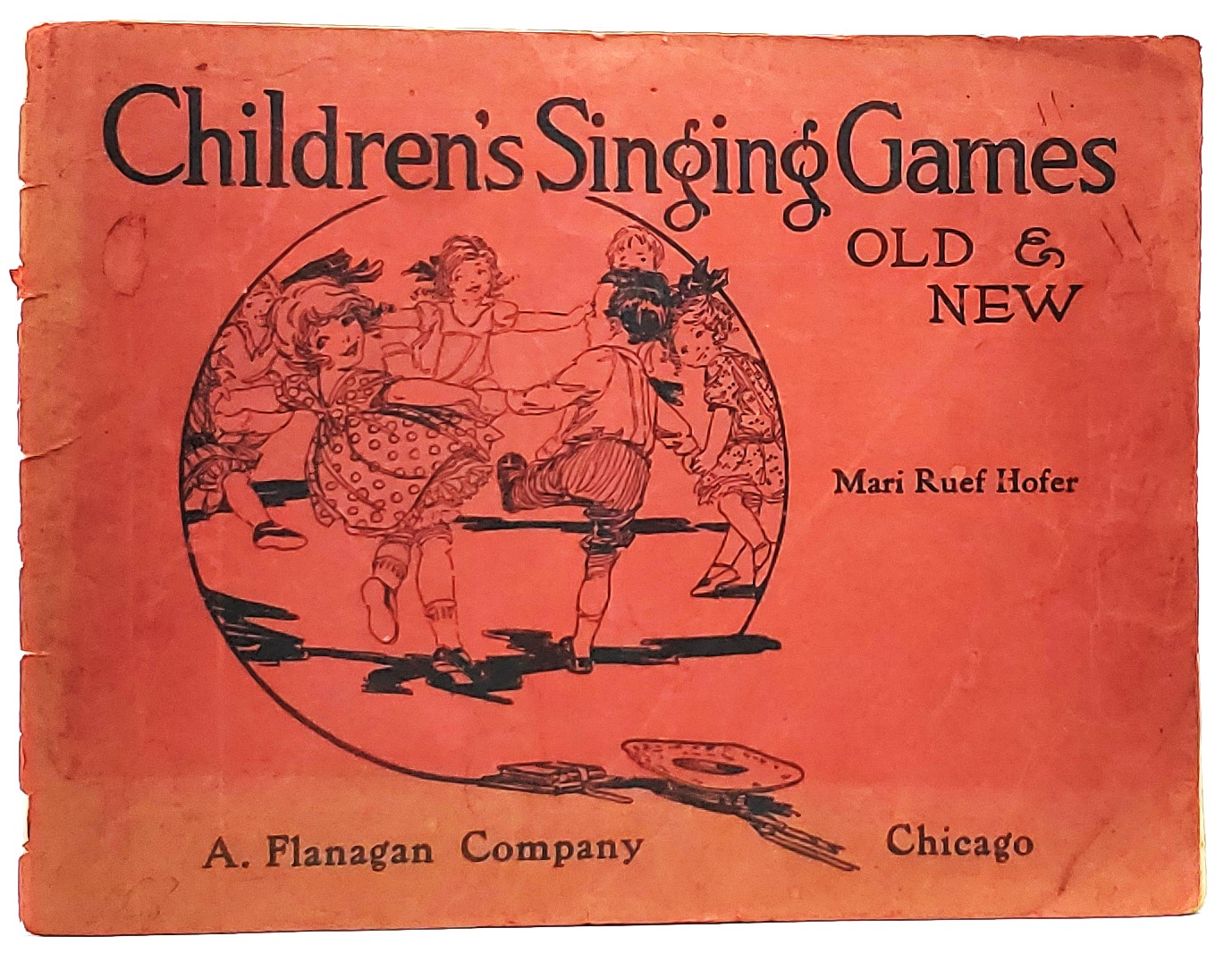
Mari’s expertise was in folk music, and she authored at least twelve publications. Some of the titles include Children’s Singing Games, Popular Folk Games and Dances, Music for the Child World, Camp Recreations, and Educational Playbook Series for Junior and Senior High Schools.
She arranged and managed plays and games for festivals, playgrounds, and settlement houses, including at the World’s Fair in Chicago in 1893.
Perhaps her work can best be illustrated through case studies of some of her events while she was on the faculty at the University of Tennessee in Knoxville.
The National Guild of Play held its annual meeting there in 1907, and Mari was president of the Guild and in charge of the program. It started with a big outdoor playtime festival for the children, parents, and teachers of Knoxville, with events ranging from kindergarten games to athletics (leap frog, racing, baseball) for the older boys. Singing, dancing, and ring games arranged by Mari were included. Male faculty members volunteered to teach the children how to play marbles and other games.
The next morning included a series of professional speakers on playgrounds and their organization, plays and games for schools and school yards, and playtime festivals. One of the speakers was her sister Amelie Hofer, a founder of the Playground Association of America.
For years, the University held a “Summer School of the South” program for teachers, well attended by people from all over the country, and Mari was on the faculty. In 1908, a summer festival was arranged, with Mari as the chairman.
Today, when we think of summer festivals, we think of beer tents and outside concerts. Back then, summer festivals meant physical activity – games and athletics for all ages.
And there were plenty of activities. The afternoon started with events for children, like Robin Hood and his Merry Men, with costumes, archery contests and bouts, and Maid Marion and a maypole dance, all arranged by Mari.
Just some of the other events included pony races, Olympic sports, tug-o-war, potato and sack races, ring toss, horseshoes, and plenty of costumes, plays, songs, and dances.
Evening events included pantomime and other social games, guild activities like wool weaving and shoe making, and folk activities and performances featuring the cultures of Sweden, Denmark, the Netherlands, Germany, Switzerland, Norway, Russia, France, Scotland, Poland, and of course, the U.S.
The coordination of this event had to have been amazing, attesting to Mari’s organizational skills as well as her educator and musical talents.
Settlement houses were organizations set up to provide services to help alleviate poverty. They were usually found in large buildings in urban areas heavily populated with recent immigrants.
The most famous settlement house was Hull House in Chicago started by Jane Addams.
All of the Hofer sisters were involved in settlement houses, and they will be covered in more detail in the next posts. Mari ran the music programs for children in several settlement houses. She managed the children’s chorus, made up of 150 youngsters, at the University of Chicago Settlement, founded in 1894. The chorus was considered very well trained, and the concerts they gave were heavily patronized. She was also known to “sympathetically help” the children at the settlement houses in other ways.
When the friends and neighbors of the Hofer family in Beverly managed to find Mari at home, they loved her involvement in community endeavors. For example, at Christmastime, 1915, Mari arranged a “Community Concert of Christmas Carols” at Ridge Park. She was also busy that year staging Nativity plays at St. Paul’s Evangelical Sunday School and the Fellowship House, another Chicago settlement house.
It wasn’t unusual for her sisters to build an entire party around Mari’s talents, back in the days before there were even radios. As an example, in 1911, her youngest sister Elsa and Elsa’s artist husband George Schreiber invited forty friends over for an evening of folk songs conducted by Mari, who was visiting Elsa and George on the west coast.
“Music,” an illustrated magazine on the art, science, and technique of music, or, as the magazine described itself, “music as musicians understand it,” wrote of Mari that “few personalities are more interesting than that of Miss Mari Hofer.”
Mari had her own philosophy on life: “A thoroughly good time is not incompatible with learning something worthwhile.”
Today, parents and grandparents who attend the performances of their beloved little ones in kindergarten holiday shows can thank Mari Hofer for the experience.
Our next post will look at the second daughter, Bertha Hofer.
The Ridge Historical Society will be open today, Sunday, March 5, from 1 to 4 p.m. The address is 10621 S. Seeley Avenue. Admission is free.
The Ridge Historical Society
March: Women’s History Month and Irish American Heritage Month – Part 1
By Carol Flynn
March is both Women’s History Month and Irish American Heritage Month so for the next few weeks we’ll alternate in exploring these topics in relationship to the Ridge.
Many remarkable women have had connections to Beverly/Morgan Park. The Hofer family stands out because all five daughters – Mari, Bertha, Amalie, Andrea, and Elizabeth – were pioneers in the kindergarten movement and other social causes at the beginning of the 1900s.
The kindergarten movement helped to revolutionize the way children’s education was viewed. The work of the Hofer sisters helped establish kindergarten as the foundation of the American school system.
In the traditional model for educating young children, they were taught at home how to read and write and do simple arithmetic. They learned by lecture and memorization, and they were expected to be quiet and industrious to prepare themselves for the working world.
In the late 1700s, Johan Heinrich Pestalozzi, a Swiss educator and reformer, shared his observations that children learned best by investigation, imagination, and doing. He started experimental schools with activities like drawing, writing, singing, physical exercise, model making, collecting, and field trips. He allowed for individual differences and grouped students together by ability.
In 1837, Friedrich Froebel, a follower of Pestalozzi, opened a program in Prussia/Germany he called “kindergarten,” or child garden, to signify children should be nourished like flowers in a garden.
Froebel sought to teach children how to think, not what to think, and used the natural play of children to enhance learning. He developed learning experiences using educational toys, stories, songs, games, and crafts.
He trained women as teachers for his program, believing they had superior nurturing ability for working with young children.
Froebel’s work was banned in Prussia for being too radical, causing those trained in his methods to leave the country to establish programs elsewhere.
Famous "graduates" of early revolutionary kindergarten programs included Albert Einstein and Frank Lloyd Wright.
The first kindergarten in the U.S. was started in Wisconsin in 1855 by one of Froebel’s students, and was conducted in German. The first English-language kindergarten opened in Boston.
The kindergarten movement became closely tied to two other social reform movements of the Progressive Era of the late 1800s, settlements and playgrounds.
Settlement houses were organizations set up to provide services to help alleviate poverty. They were usually found in large buildings in urban areas heavily populated by recent immigrants. Social workers, teachers, ministers, and other service providers lived or “settled” in the facility to be closer to the people with whom they worked.
The most famous settlement house in this country was Hull House in Chicago started by Jane Addams. Other Chicago settlement houses included the Chicago Commons Social Settlement and the Fellowship House.
The first outreach at the settlement houses was to children and mothers, with daycares, kindergartens, and playgrounds; classes in English, crafts, and homemaking; and mothers’ clubs.
The playground movement was started in the 1890s by reformers who advocated that supervised play could improve the mental, moral, and physical well-being of children. Private athletic clubs had always been around for the wealthy, but now city parks and playgrounds, swimming pools and fieldhouses were built, and trained play leaders were hired to plan and conduct activities. This soon expanded to include adult activities as well.
The Chicago park system developed as one of the largest and best in the country.
The Hofers were leaders in all of these movements.
The five Hofer sisters and their three brothers were the children of Mari Ruef and Franz Xaver Hofer.
Born in 1821 in Baden, a state in Germany bordering France and Switzerland, Hofer fled to the U.S. in 1849 after participating in a failed revolution. He and Mari Ruef, born in Baden in 1836, married in 1853 in New York. They moved to Iowa where they farmed. He served as a lieutenant in the Union Army during the U.S. Civil War.
The Hofers had a passion for social justice and reform that they passed down to their children. They bought a newspaper in Iowa through which they shared their “progressive” views, and all the children were trained in the newspaper and printing fields.
The sons left to seek their fortunes on the west coast and started several newspapers. The daughters worked at the family newspaper and attended colleges to become teachers.
Two of the daughters moved to Chicago, and were soon followed by the parents and the other three sisters. They made their home at 1753 West 96th Street, where their house still stands on the edge of Ridge Park.
One of the sons wrote in his newspaper out west that his parents “are now comfortably settled in a cosy (sic) home in one of the most charming and healthful suburbs – Longwood.”
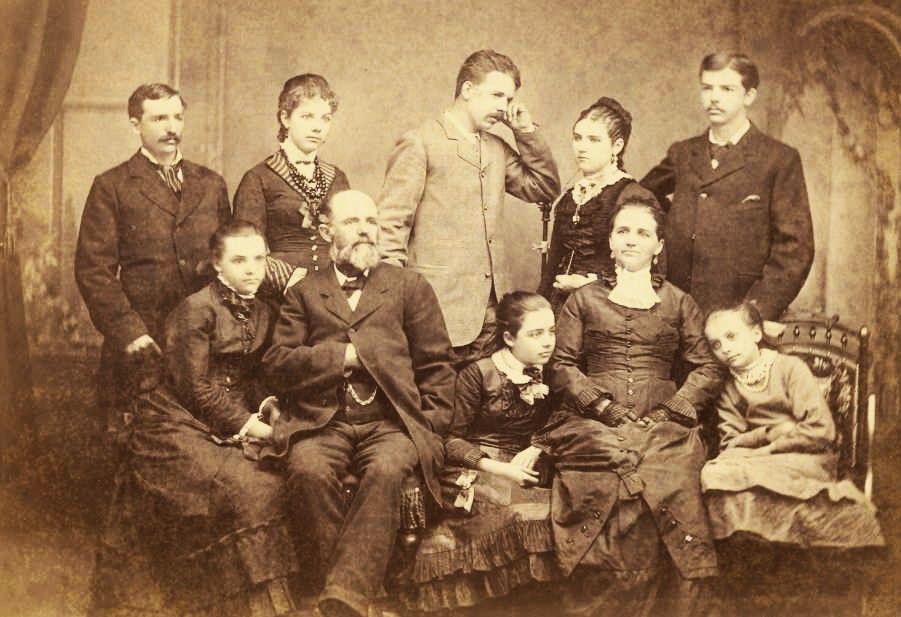
In the next posts we will look at the amazing work of the Hofer sisters. This picture of the Hofer family was user submitted on Ancestry.com.