
Explore the RHS Facebook Archives, a rich repository of local history written by Carol Flynn. For two decades, Carol brought a deeply dedicated voice to public education at RHS. Her role as Facebook administrator through mid-2025 naturally extended her prolific research into meticulously detailed articles, most notably her multi-part historical series posts. Today, Carol continues her local history writing for The Beverly Review and other outlets.
Hofer Sisters
The Ridge Historical Society
Part 11 – The Hofer Sisters and Politics Continued
By Carol Flynn
During the Progressive Era of the late 1800s-early 1900s, women began to come into their own as political activists. Much of their work was done through women’s clubs. Long denied membership in traditional men’s clubs, women formed their own civic organizations which became powerful forces for reform and change.
The Chicago Woman’s Club (CWC) was one of the most influential of these organizations, with members including Jane Addams of Hull House and Bertha Palmer of Palmer House hotel money and fame, who chaired the women’s events for the 1893 World’s Fair in Chicago. Women from the Ridge actively participated in the CWC, and Gertrude Blackwelder from Morgan Park served as president from 1906 to 1908.
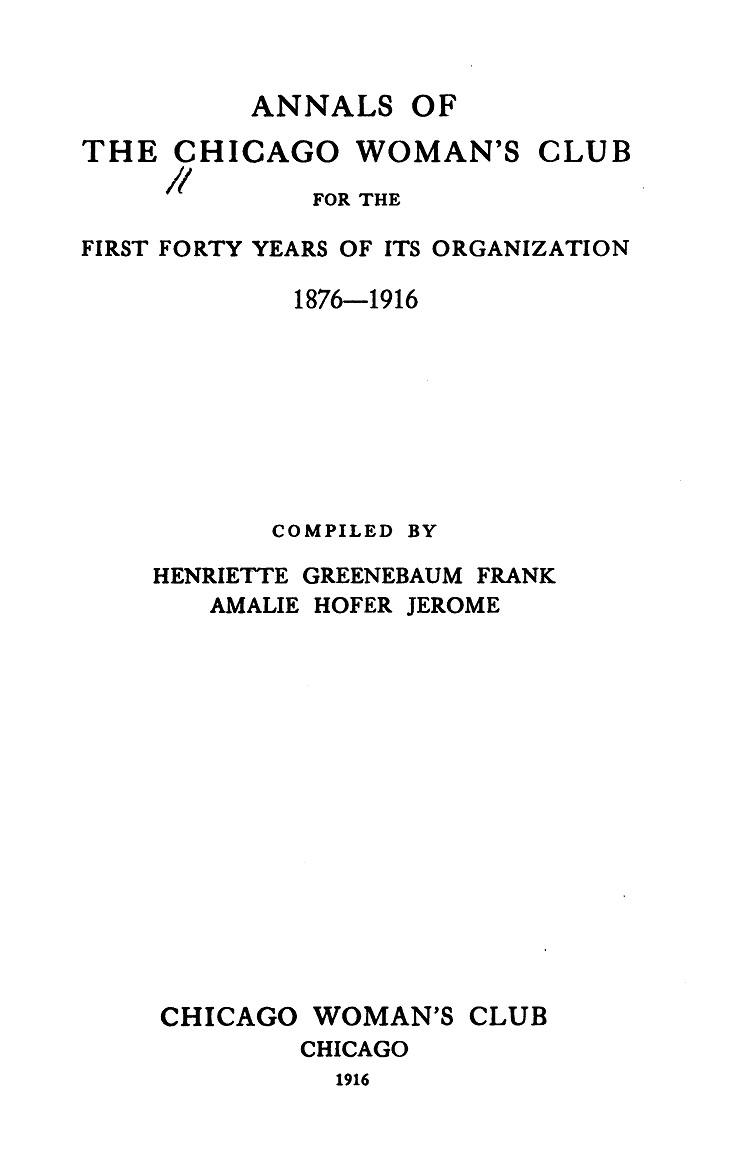
The Hofer sisters were members of the CWC. Bertha Hofer Hegner was prominent in the club’s education endeavors. In 1916, Amalie Hofer Jerome co-authored the Annals of the Chicago Woman’s Club for 1876 to 1916, a compilation of the Club’s first forty years of business.
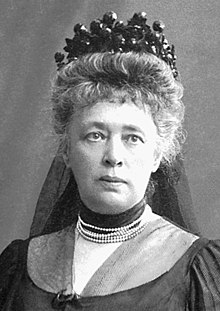
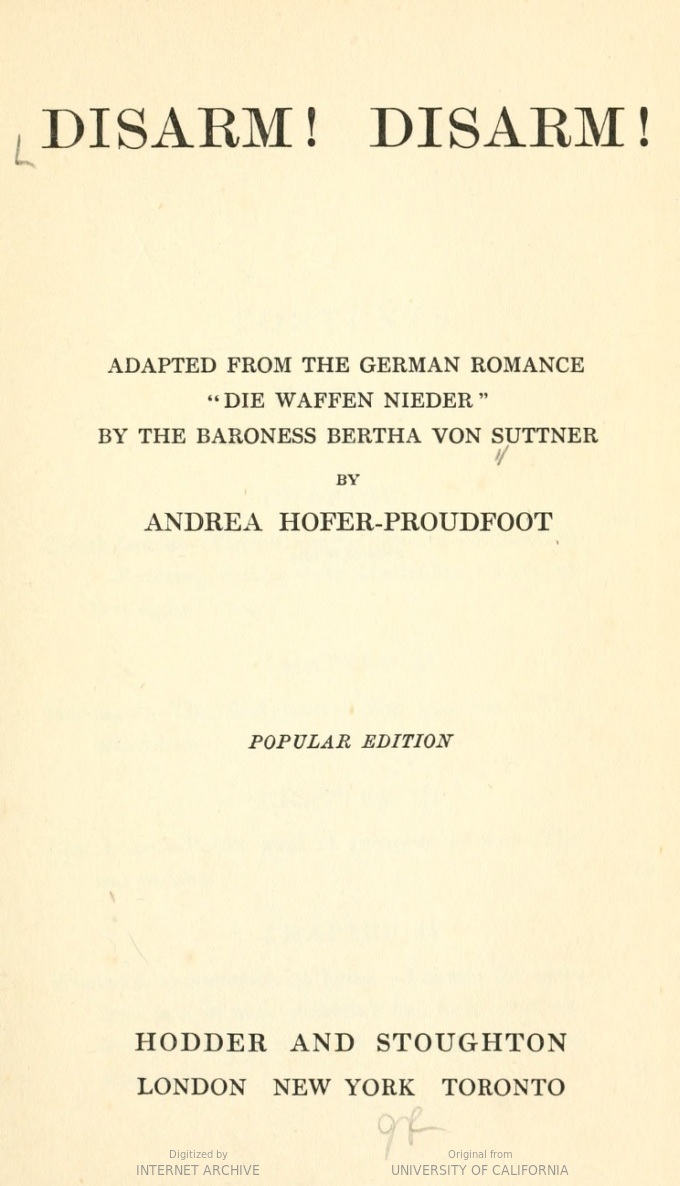
In 1912, through their CWC involvement, the Hofer sisters brought about an internationally significant event, a country-wide tour by pacifist Baroness Bertha Von Suttner of Vienna, Austria.
Andrea Hofer Proudfoot spent increasing amounts of time living in Europe in the early 1900s with her children. She and her husband regularly traveled back and forth between Chicago and Vienna, where her daughter Helen attended the Leschetizky School.
The international kindergarten movement, in which the Hofer sisters were leaders, shared many ideals with the international peace movement, and Andrea became acquainted with Baroness Von Suttner, who won the Nobel Peace Prize in 1905.
Mounting social unrest leading to increased militarism had many fearing a European war was imminent, and indeed, World War I was just around the corner. Peace organizations were established in Europe and the U.S., and women like Jane Addams were active participants.
Suttner was a leader in the international pacifist movement of the time, and was emerging as a leader of the growing feminist movement. She was an influential pro-disarmament writer, believing that world peace was inevitable due to technological advancements, and that more powerful weapons would increasingly deter war.
In February 1912, Mari Hofer presented a motion to the Chicago Woman’s Club recommending that they arrange an address by the Baroness during the coming year. This was approved, and the Club reached out to the General Federation of Women’s Clubs (GFWC), the “mother” organization that all the local clubs belonged to, and other groups for involvement. A joint Peace Committee with the GFWC and groups like the Chicago Peace Society was formed, with Mari and Amalie doing the work.
While male international pacifists had been making speeches in the U.S. for years, this was the first initiative by women to include pacifism and international affairs as part of the women’s clubs’ agenda, and have a woman address the American people. Suttner was invited to address the GFWC national convention in San Francisco in late June of 1912. She accepted the offer.
The Hofer sisters procured funding from the World Peace Foundation, which supported peace education, to cover all the expenses for the Baroness to visit the U.S. Leaving for the U.S., Suttner stopped in Paris to address the Carnegie Peace Foundation. She stated, “I shall try to put in motion a new and great force in the uplifting to good all mankind, and that force is found in the federated American women.”
Standing next to her on the platform was the personification of those women, Andrea Hofer Proudfoot, from the Chicago Woman’s Club, who served as Suttner’s full-time manager, secretary, and companion for her trip to the U.S.
They travelled by ship to New York, then across country to San Francisco by train, picking up GFWC delegates along the way. The GFWC event, with 5,000 attendees, became the first of 1,220 engagements, with the Baroness speaking at universities, churches, and organizations including peace, labor, business, and suffrage groups. Major American newspapers and journals carried the Baroness’s speeches in full, allowing her a widespread reach to the public. Although this visit is rarely mentioned now, it was very big news at the time.
The Baroness’s primary goal was to advocate for universal peace, but she saw the connection to women’s rights for education and employment, and particularly to suffrage. She encouraged women to be active in the peace movement and she encouraged peace activists to support suffrage to increase their efforts in promoting peace.
The Baroness and Andrea came to Chicago in July, where the Baroness made presentations at the 50th annual convention of the National Education Association and other meetings, and visited Jane Addams and Hull House. From there, they went on to meet with President William Howard Taft.
They returned to Chicago in November, and Suttner addressed the Chicago Woman’s Club. Women like Mrs. George Pullman held receptions for them in their homes. Suttner also addressed other groups like the Chicago Federation of Labor.
The Inter Ocean newspaper quoted part of one of Suttner’s Chicago speeches: “We must come to realize that our present, modern times have outgrown the system of war, of violence. Now we all live under the law of violence. I hope that the tool of war will be laid down, and that the workers will lay down their tools against the preparation of the implements of war. Instead of the outstretched fist, we want the outstretched hand of friendship.”
Charles Beals, the Secretary of the Chicago Peace Society, noted although the U.S. visit was “a laborious task,” that “the peace workers of the United States have been greatly strengthened by the visit of the foremost woman pacifist of the world.” This group also had great praise for Mari Hofer’s role in the endeavor, stating that “Miss Hofer served entirely without pay, gave up her summer vacation in order to make the undertaking a success, and for months, in no small measure, bore the responsibilities and did the clerical work.”
As Suttner returned to Vienna in December, accompanied by Andrea, she declared that the U.S. was ahead of other countries in the suffrage movement, and she was sure American women would get the vote franchise. That took eight more years.
The Baroness was 69 years old when she made this trip. She died of cancer eighteen months later in 1914, right before the start of World War I.
Andrea went on to more prominence in the peace movement, which will be covered in the next post.
The Ridge Historical Society
Part 12 – The Hofer Sisters and Politics Continued
By Carol Flynn
The Hofer sisters became recognized as international peace workers with the successful visit of Baroness Bertha Von Suttner to the U.S. in 1912. Andrea Hofer Proudfoot stood by the Baroness’s side as her personal manager and secretary. Mari Hofer worked tirelessly behind the scenes, making the arrangements for over 1,200 presentations in sixteen states. Amalie Hofer Jerome also helped.
The Hofer sisters were known for their organizational skills. All were active in the Chicago Woman’s Club. In 1892, Mari, Bertha, Amalie, and Andrea were instrumental in starting the International Kindergarten Union, and all were charter members and served as officers or in other leadership roles.
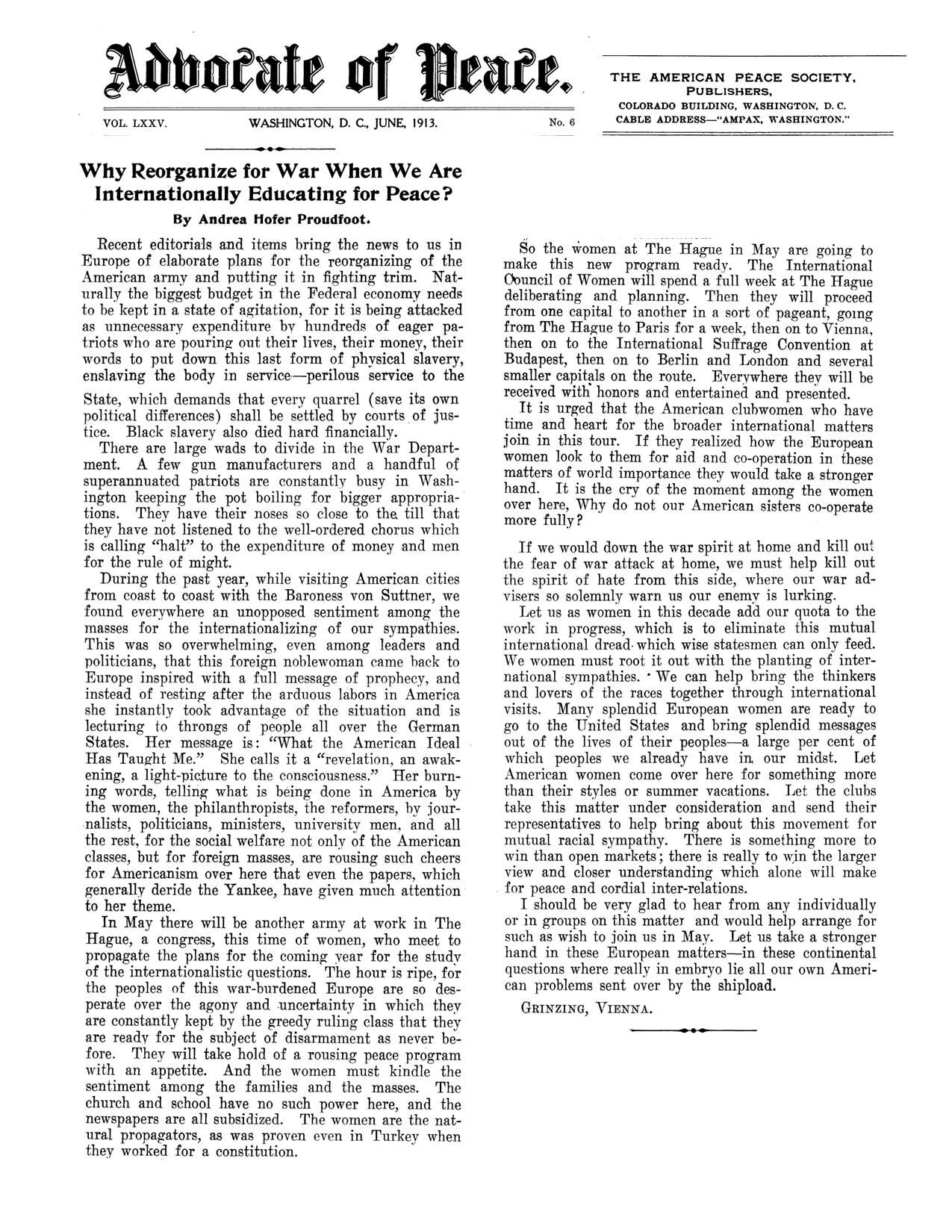
Through her education programs at the settlement house, Bertha was involved in a number of groups. Amalie and Mari were founding members of the Playground Association of America, which included President Teddy Roosevelt. Amalie was a founder of the Civic Music Association of Chicago. Andrea and Elsa started the League of American Mothers. In 1913, Andrea founded the League for International Amity to continue the suffrage and disarmament education efforts started by the Baroness.
The Hofer sisters were also accomplished writers and speakers. Using Andrea as our continuing example, one of her calls for action in the peace movement is attached to this post. She became a sought-after speaker at international meetings of women. She was prominently featured at the International Council of Women meeting at the Hague in the Netherlands in 1913. The theme adopted by women’s groups throughout this time was: “In time of war prepare for peace; in time of peace prepare for its continuance.”
Andrea lived in Vienna for a few years, where her children went to school. They returned to Chicago when World War I started in 1914.
That year, Mari and Andrea were part of a national undertaking to raise funds for suffrage and peace causes in honor of Belva A. Lockwood. Working with Illinois women’s clubs, a pageant, totally under the direction of Mari, along with dancing and card games, was held at the Hotel LaSalle. The pageant included “dances of the nations,” that is, folk dances, one of Mari’s specialties, performed by young people of various organizations. Members of the Chicago Woman’s Club portrayed the queens of the world, including Queen Elizabeth and Marie Antoinette. They easily met their goal to raise $3,000 to contribute to the total goal of $20,000.
Mrs. Lockwood was the featured guest of the pageant, sitting in the center box. She was a very famous woman whose story has been mostly lost to history. She was active in women’s rights and women’s suffrage, and became one of the first women lawyers in the U.S. She was the first woman to practice before the U.S. Supreme Court. She ran for president in 1884 and 1888 and was the first woman to appear on official ballots. She supported the world peace movement and the temperance movement.
In 1915, Andrea was a leader of the International Conference of Women Workers to Promote Permanent Peace, known as the Women’s Peace Conference, held in San Francisco as part of the World’s Fair. She was joined on the planning committee by fellow Chicagoan Jane Addams. Miss Addams oversaw the programs on Social Service and War, and Andrea oversaw the section on International Amity and War.
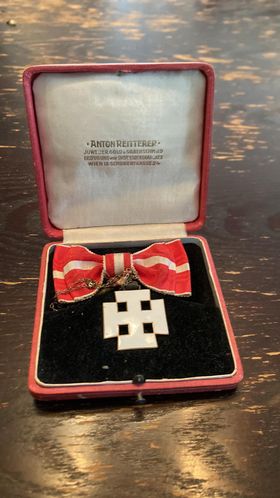
After World War I, Andrea served as Secretary of the American Committee for Vienna Relief in Chicago. She was awarded the “Eiserne Salvator-Medaille” (Iron Salvator Medal) from the City
of Vienna in 1921, and the “Silbernes Ehrenzeichen” (Silver Insignia of Honor) from the Republic of Austria. Andrea’s great-granddaughter shared a picture of one of the medals with RHS.
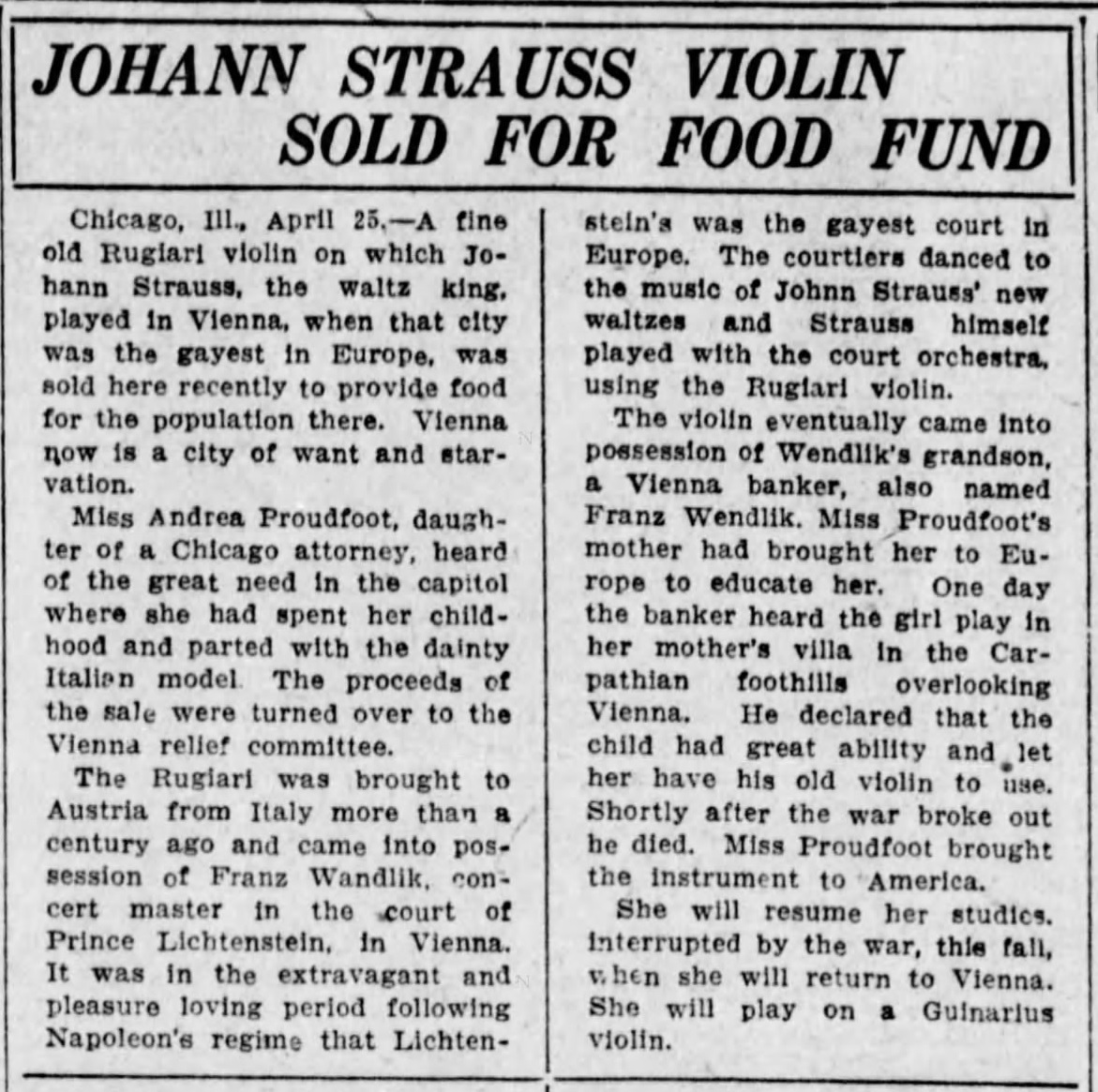
Altruism was passed down to the next generation of Hofer descendants, as evidenced by a 1920 newspaper article about one of Andrea’s daughters donating a valuable violin that she acquired in Vienna for the Vienna relief effort.
In the next post, the later years of the Hofer sisters will be explored.

The Ridge Historical Society
Part 13 – The Hofer Sisters – Conclusion
By Carol Flynn
By 1920, after having lived on the Ridge for about twenty-five years, the Hofer family had departed from the Beverly area. Some of the sisters stayed in Chicago, and some relocated to other states. They continued active careers for many more years.
Oldest sister Mari Ruef Hofer was recorded as living with her sister Andrea’s family in Hyde Park on the 1920 U.S. Census. By the late 1920s, she had relocated to Santa Monica, California, where her youngest sister Elsa Hofer Schreiber and Elsa’s family lived.
Mari died in 1929 at the age of 71 and was buried in Santa Monica.
The Oakland, California, Tribune noted at the time that Mari had been a faculty member at the University of California, Berkeley and in the summer of 1929 had presented pageants in the university’s Greek theater. She had just started the Greek Art Club of Berkeley.
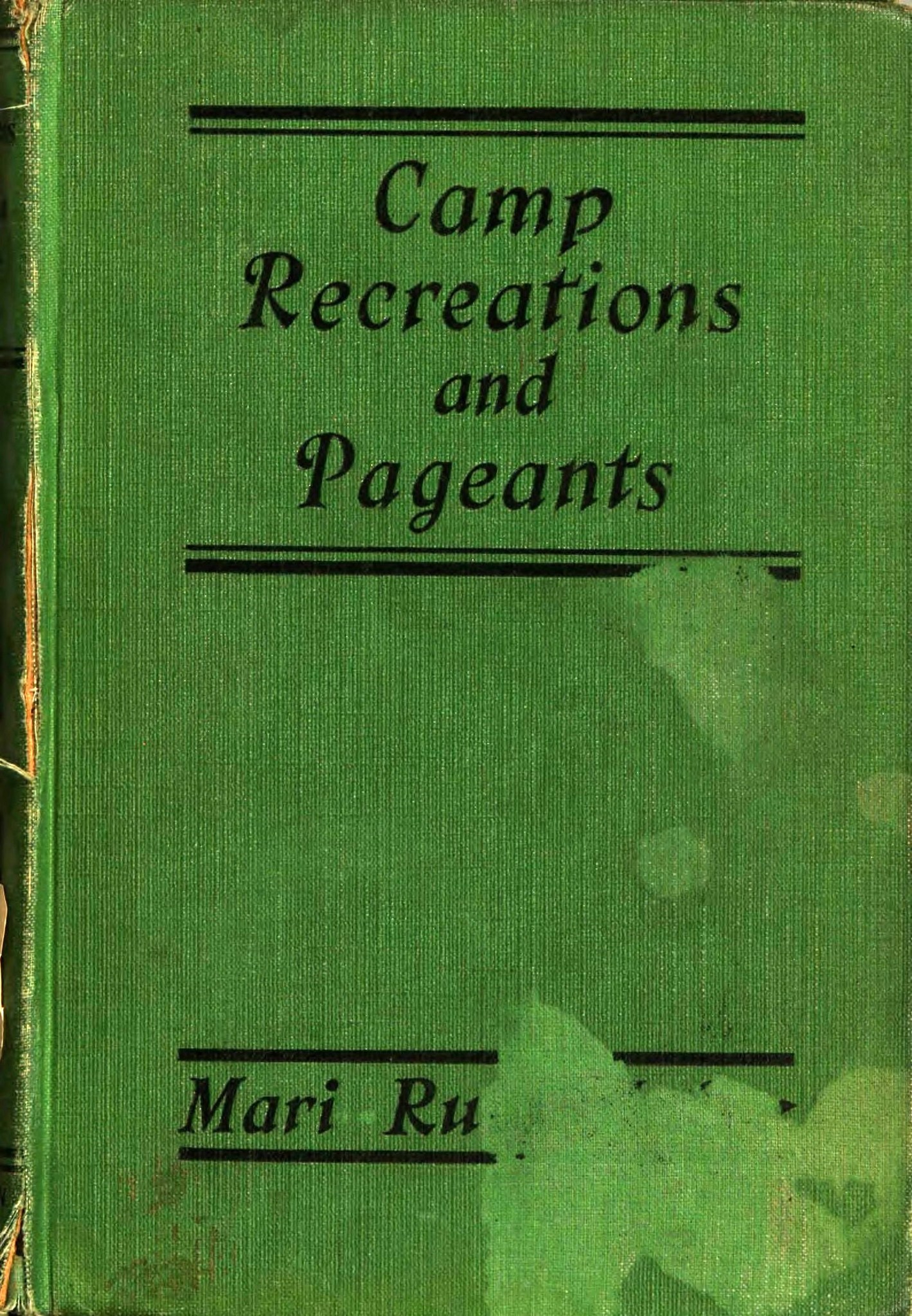
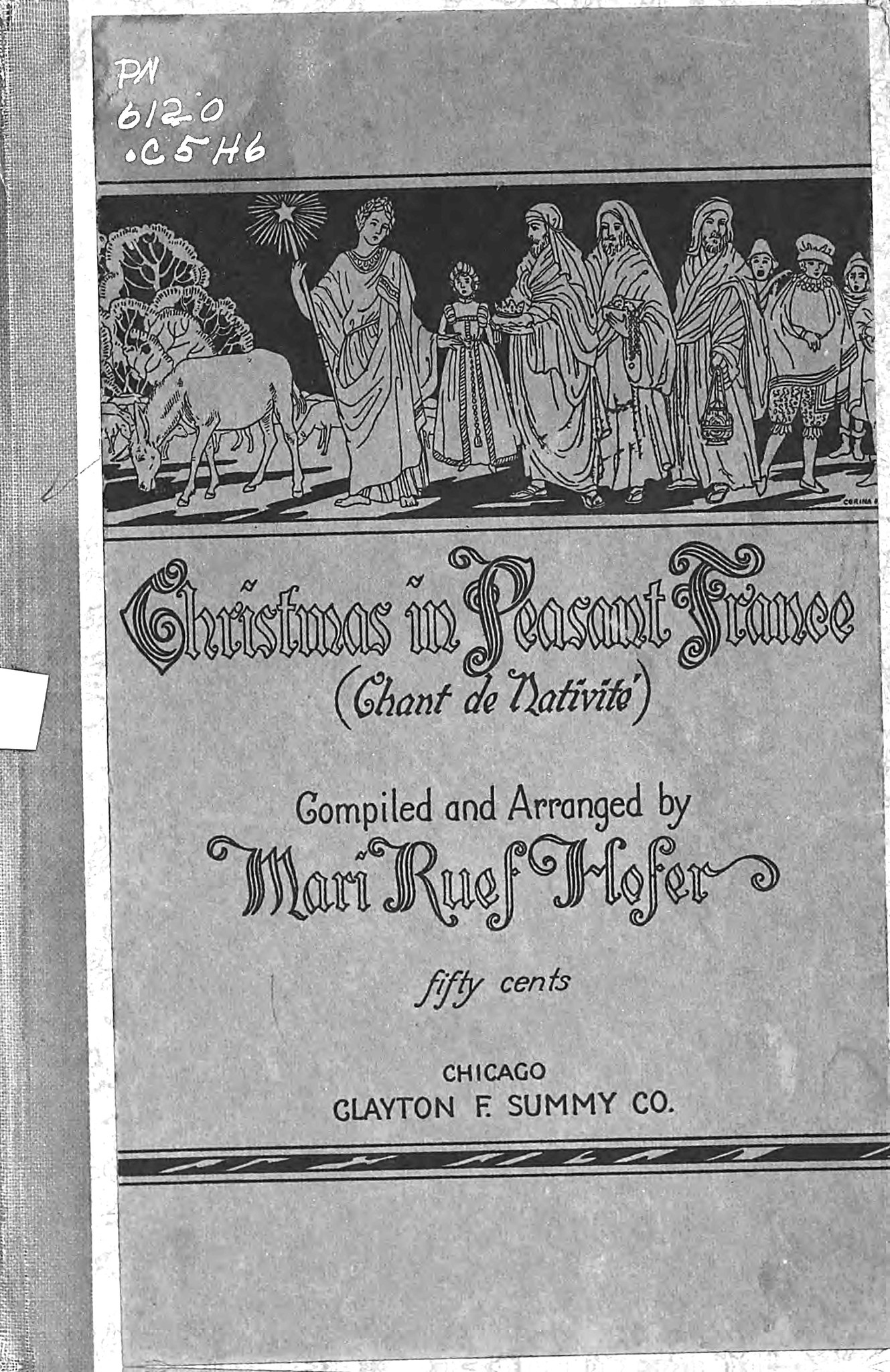
Mari had continued to write and adapt music and folk dances for use in education and recreation programs. In 1926, she published “Christmas in Peasant France,” a Christmas play, and “Festival and Civic Plays from Greek and Roman Tales.” In 1927, she published “Camp Recreations and Pageants.”
Second sister Bertha Hofer Hegner lived in West Chicago, and upon her death in 1937 at the age of 75, was buried in Graceland Cemetery on Chicago’s north side.
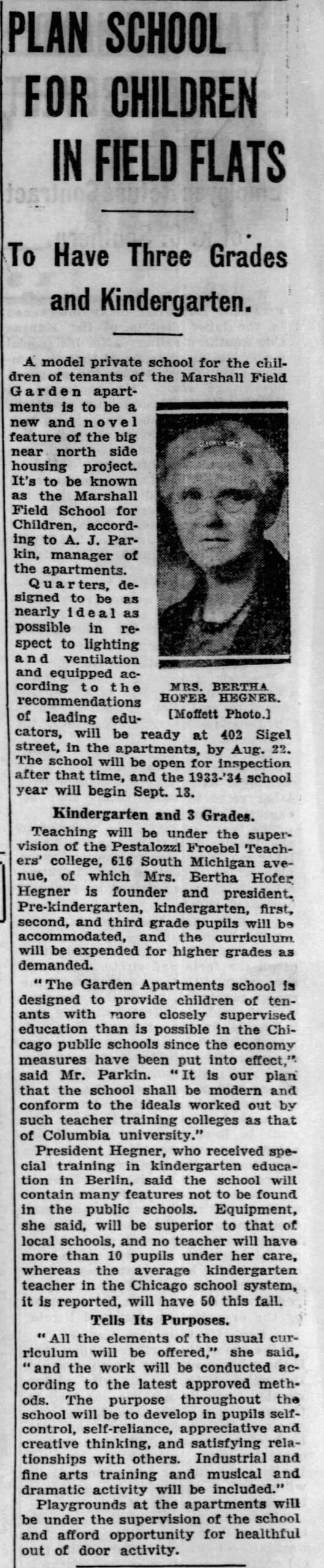
Bertha was the President of both the Pestalozzi-Froebel Teachers College and the Columbia College of Expression until her retirement in 1936.
Bertha developed new education programs throughout her career. One of her later accomplishments was detailed in a 1933 Chicago Tribune article which is attached to this post. She developed and administered a kindergarten, grade school, and playground in the Marshall Field Garden Apartments, a housing development directed by Marshall Field III of the department store family to provide affordable housing and to spur development in the surrounding areas. The apartments, located at 1400 North Sedgewick Street in Old Town, are still in use today as subsidized housing.
Amalie Hofer Jerome, the third sister, and her husband Frank, were living in Hyde Park in 1920. After her husband died in 1933, she moved to their summer house in Michigan. She died in 1941 at the age of 78, and was buried in Mount Hope Cemetery on 115th Street on the Ridge, where her husband was also buried. She is the only Hofer sister to be buried on the Ridge.
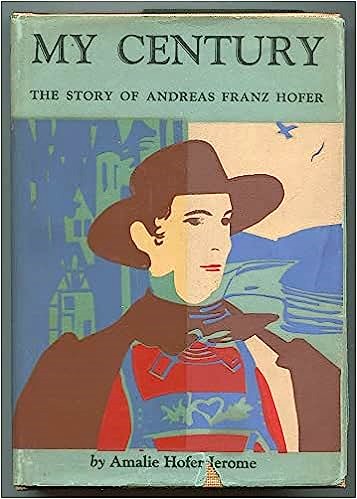
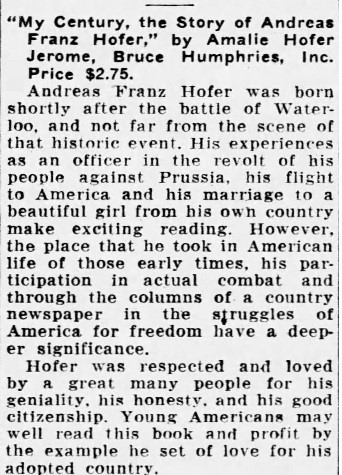
Amalie adapted her father’s diary into a biography, and in 1939 published “My Century – The Story of Andreas Franz Hofer.” The book was reviewed by newspapers around the country. The Shreveport Journal in Louisiana gave a poignant review of the book that is attached to the post.
Andrea Hofer Proudfoot also stayed in Chicago, living in Hyde Park. Later, she and her husband Frederick apparently had homes in both Iowa, where Andrea grew up, and in Chicago. They both died in Chicago and were buried in McGregor, Iowa. Andrea was the last of the Hofer sisters, dying in 1949, at the age of 83.
Andrea was always a poet at heart. In 1919, she published a book of poetry called “Trolley Lines, Jotted Down Coming and Going.” It was called “Cubist verse” by Reedy’s Mirror, a literary journal of the day. Cubist writing took its cues from artists like Picasso during the Cubism period of the early 1900s. The objective observation of the external world was replaced by the “stream of consciousness” inner workings of the mind. One review said of Andrea’s work that it was “the new poetry but one can understand it.”
Andrea was president of the Poetry Lovers of America, and a member of the Dill Pickle Club, an unconventional Chicago social club that fostered free speech and good conversation for uninhibited people. “The Pickle” was Chicago’s answer to the “Bohemian” clubs of Greenwich Village in New York City. Andrea was instrumental in raising the money to build a clubhouse for the group on the near north side.
Elsa Hofer Schreiber and her artist husband George and their children moved to the west coast, first to Salem, Oregon, where several of the Hofer brothers lived, and by 1920 they were settled in Santa Monica, California, where George became known in the California arts scene.
Elsa died in 1942 at age 73 while at a daughter’s house in Battle Creek, Michigan. Her death certificate records she was cremated at Graceland Cemetery in Chicago, and burial records report she was buried in Woodlawn Cemetery in Santa Monica.
Elsa had participated in numerous professional activities with her sisters and had run the school she and Andrea started in Beverly, but she was also very home- and family-oriented, a pattern set by her own mother, who lived with Elsa in her final years. Most of the later stories about Elsa revolve around her family.
In 1923, a double wedding took place at the Schreiber house the day after Christmas. Daughter Madelaine and son Armin married their respective fiancés in a gala ceremony with holly and poinsettia as the backdrop, and their brothers and sister in attendance. The following week, at New Year’s, a reception for the newlyweds was held at the Schreiber house.
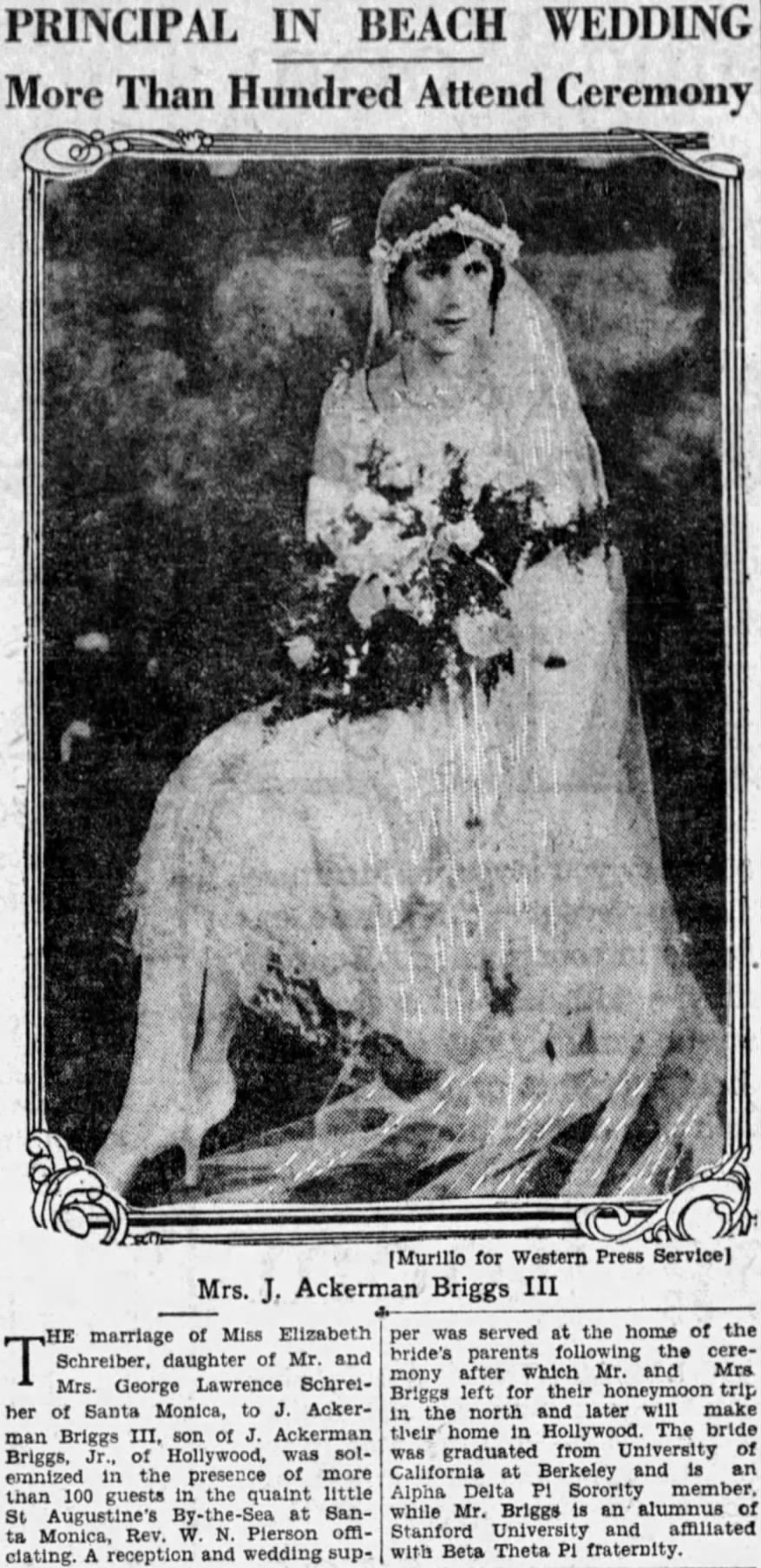
In 1927, daughter Elizabeth was married in Santa Monica. The announcement is attached to this post. As no pictures of Elsa as an adult have been located so far, this picture of her daughter gives a clue as to her possible appearance.
In 1928, tragedy struck Elsa’s family when their youngest child, George L. Schreiber, Jr., died just as he was graduating from the University of California, Berkeley. The cause of death was attributed to ptomaine poisoning.
Father Andreas Franz Xavier Hofer died in 1904 in Beverly and was originally buried in Mount Hope Cemetery in Chicago. Mother Mari Ruef Hofer relocated with youngest daughter Elsa. Mari died in Santa Monica, California, in 1918, and was buried there in Woodlawn Cemetery. Her husband’s remains were relocated from Chicago to that cemetery to be buried with her.
Sons Frank and Andrew were buried in Salem, Oregon, and son Ernest in Portland, Oregon.
This concludes the series on the Hofer family who called Beverly home. Truly, this family personified the spirit of the Progressive Era.