Explore the RHS Facebook Archives, a rich repository of local history written by Carol Flynn. For two decades, Carol brought a deeply dedicated voice to public education at RHS. Her role as Facebook administrator through mid-2025 naturally extended her prolific research into meticulously detailed articles, most notably her multi-part historical series posts. Today, Carol continues her local history writing for The Beverly Review and other outlets.
Local Architecture
Happy Easter from the Ridge Historical Society.
RHS will be closed tomorrow, Easter Sunday, April 20, 2025.
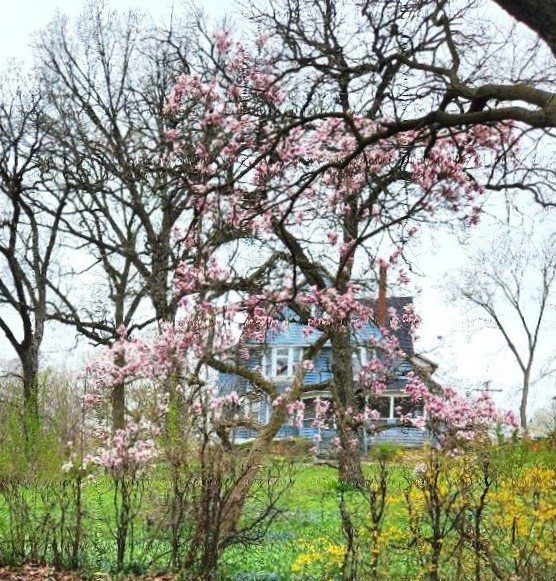
Some lovely springtime views can be found around Beverly and Morgan Park. This is the Reuben P. Layton House at 10324 Longwood Drive, glimpsed through magnolia, forsythia, and Siberian squill.
Siberian squill and forsythia were introduced into the U.S. by English settlers, and both became popular for gardens in the late 1800s.
Magnolias traveled in the opposite direction – the magnolias native to the southern U.S. were introduced into England and Europe by returning explorers and traders.
Edited: There are daffodils here, too – also introduced into the U.S. In fact, most of the gardens we build are full of plants not native to the U.S. They come from tropical areas so they only last through the summer, or they have been hybridized to withstand our northern climate. Too many people still think of our native prairie plants as "weeds."
Ridge Historical Society
Letter to Metra about 115th Street Station
By Carol Flynn
Metra, the state agency that runs the Rock Island commuter line through Beverly and Morgan Park, recently announced projects for the Rock Island stations along the Beverly line.
The major project that has prompted concern in the community relates to the 115th Street station.
Metra announced it has earmarked $8.69 million for a multi-year plan that includes a new plaza and sidewalks, parking lot resurfacing, accessibility improvements, new lighting, bicycle parking, and landscaping improvements. The funding includes any environmental analyses required by law and will address stormwater management needs.
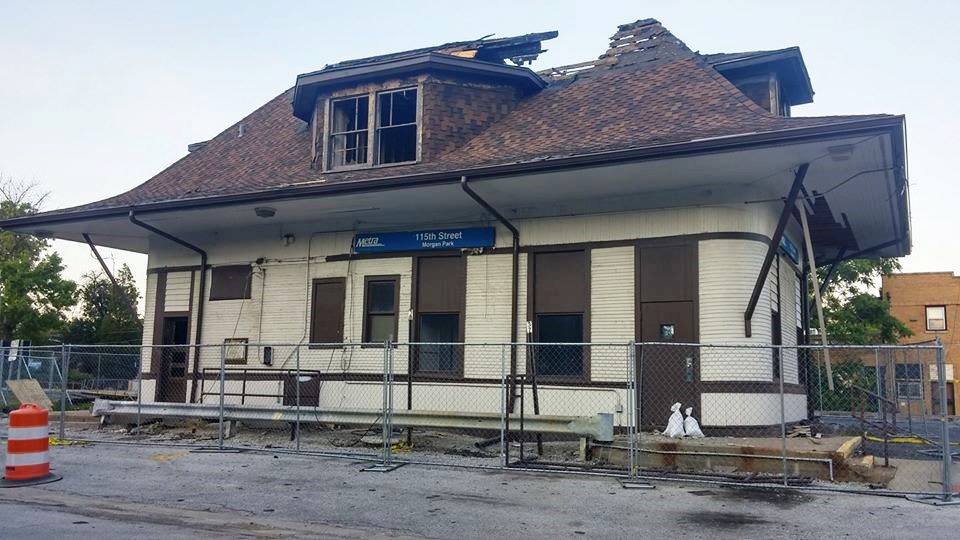
Most significant, the plan includes building a new warming shelter to replace the historic station built in 1892 that was destroyed by fire in 2017.
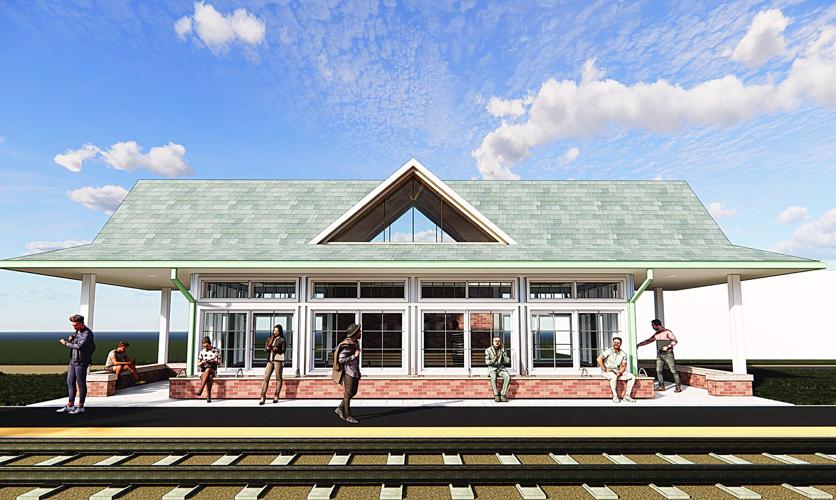
An illustration of the proposed shelter from Legat Architects was shared publicly at the time of the announcement.
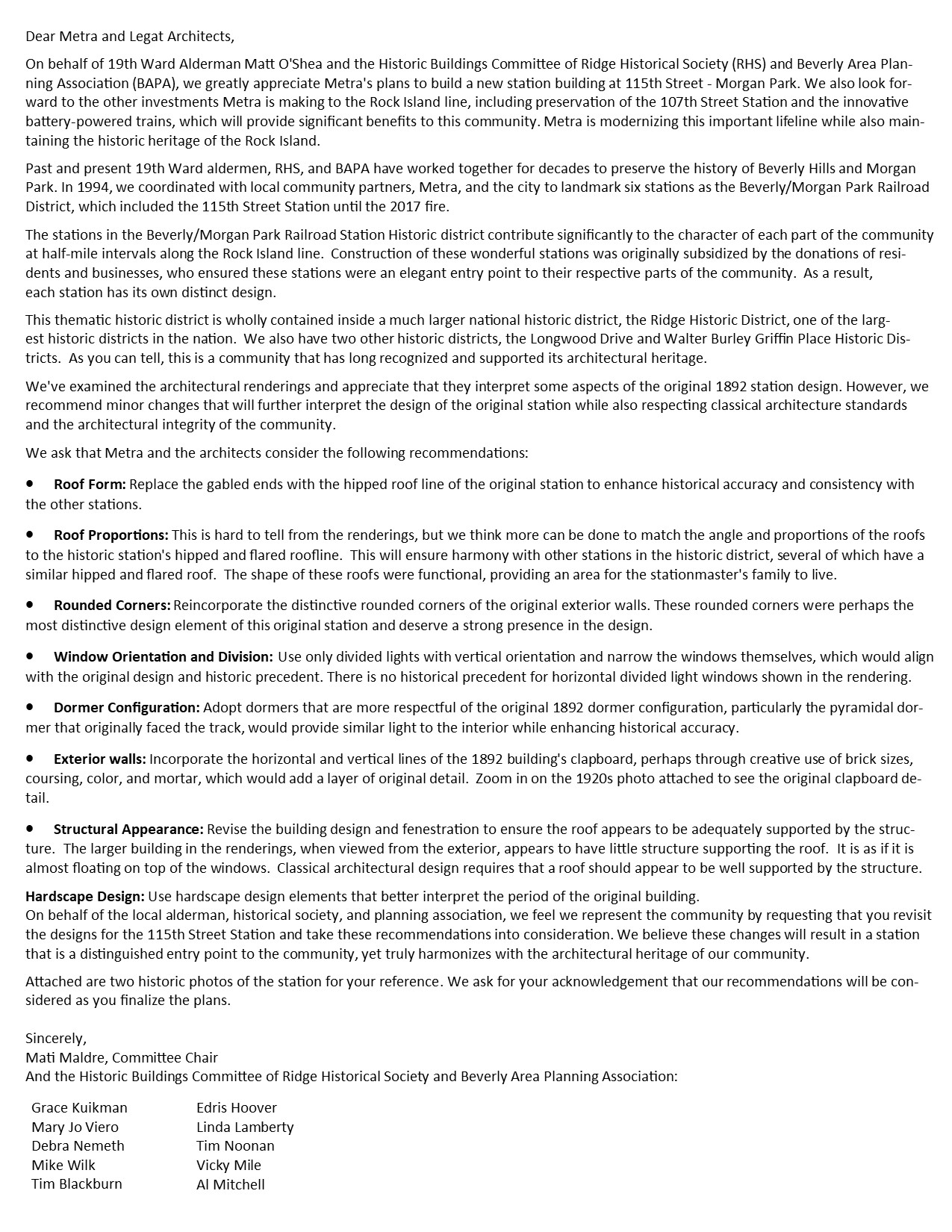
The design of the structure raised concern among members of the Ridge Historical Society (RHS) Historic Buildings Committee (HBC). This prompted them to write a response to Metra, detailing the committee’s concerns and recommendations.
The letter was supported by 19th ward alderman Matt O’Shea, and was signed onto by the Beverly Area Planning Association.
The letter to Metra is attached to this post.
To better understand the situation and the letter, here is background Information.
The reason the design is of concern to RHS is that the train stations are historic buildings, and their look is very important for preserving the visual cohesiveness of the neighborhoods around them and reinforcing the unique historic identity of the Beverly/Morgan Park community. The Historic Buildings Committee feels the proposed structure could be better designed from a historic perspective.
The Metra Rock Island railroad commuter line has always been more than just a convenient means of transportation to downtown Chicago, it is a vital part of the history, tradition, and culture of Beverly, Morgan Park, and Mount Greenwood.
The Chicago and Rock Island Railroad, the original branch to the east of the Beverly branch, running between Chicago and Joliet, began in 1852, and by 1866 had expanded into the Chicago, Rock Island, and Pacific Railroad (CRI&P) connecting Chicago to Denver and Houston.
In 1869-70, the men who owned and operated the CRI&P formed the Blue Island Land and Building Company and bought most of Thomas Morgan’s original estate north of the city of Blue Island.
They built a new branch of their railroad west along 99th Street from the original line to this new land, then south to merge with the original line in Blue Island, creating the route used today.
The land was developed into Beverly and Morgan Park, creating “railroad suburbs” along the commuter line that allowed people to live in the idyllic countryside and easily travel to downtown for jobs, business, shopping, and social and cultural events.
In 1889, the commuter line was extended north to 91st Street.
The train stations along the route, designed to fit in architecturally with the community, became hubs for local business and society and influenced the placement of parks, public buildings, and residences.
In the early 1980s, the state of Illinois took over the line from the declining railroad company through the newly formed Regional Transportation Authority (RTA). Metra is a division of the RTA.
The train stations that mark the stops along the Rock Island commuter line from 91st Street to 115th Street were designated the Beverly/Morgan Park Railroad Stations District by the Commission on Chicago Landmarks in 1995. They are also included in the national Ridge Historic District.
The six stations in the original Chicago landmarks district at 91st, 95th, 99th, 107th, 111th, and 115th Streets created a “thematic-style” landmarks district, with the buildings connected to each other by common purpose, not by geographic closeness.
The stations were built between 1889 and 1945, and, according to Commission staff, “are rare survivors of a once common nineteenth century building type.” They share the scale, materials, and architecture style of nearby buildings, making them “strong visual features” in the community.
The station at 103rd Street was not included in the original landmarks district because it was built in 1967, replacing an 1890 building.
In 2017, the station at 115th Street, built in 1892, was demolished following irreparable fire damage, so that station became another loss to the landmarks district.
At the time the115th Street station was badly damaged by fire in 2017, it was no longer in use for ticket sales and was only occasionally open in winter as a warming house.
The replacement structure is not required by law to meet any historic standards, so Metra’s intent to honor the community’s history is voluntary.
The letter to Metra details several areas that need change.
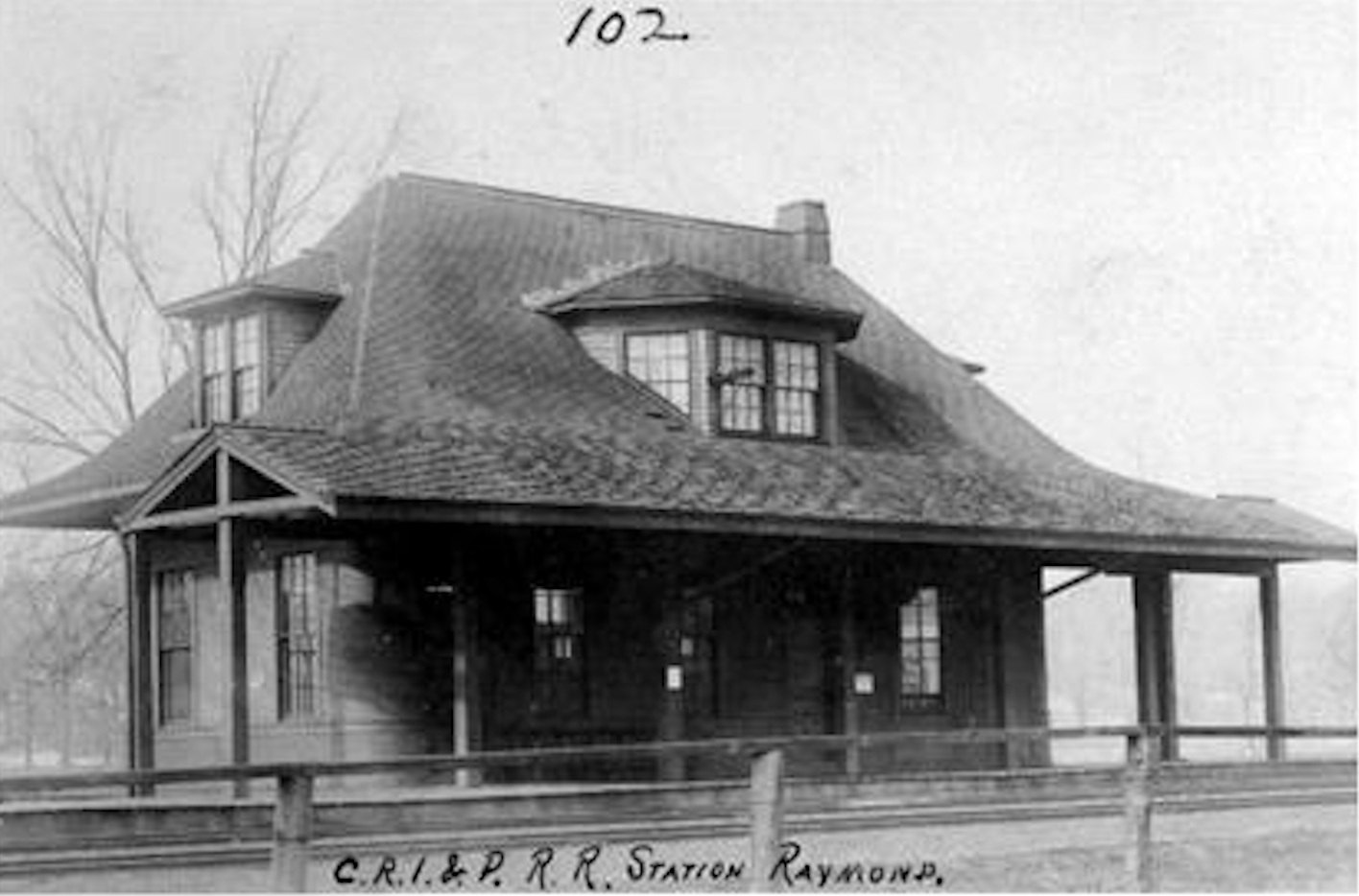
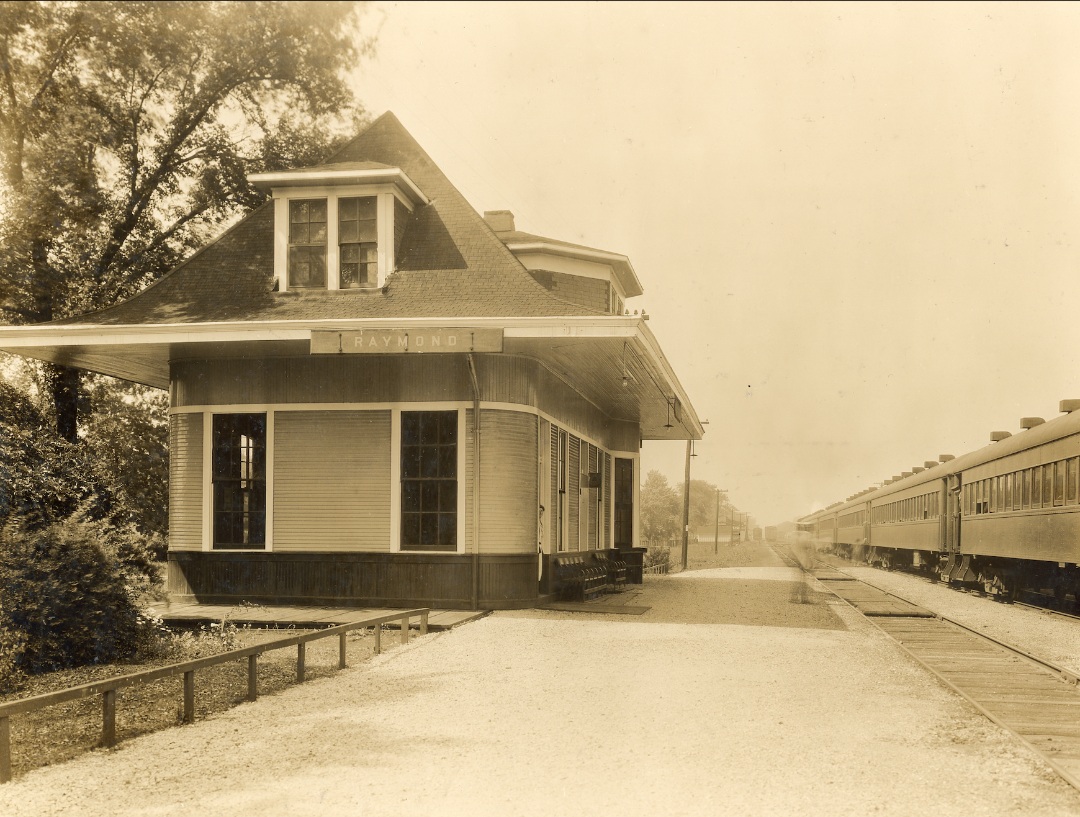
The concerns and recommendations stated in the letter relate to the roof form and proportions, the loss of rounded corners that were distinctive to the original building, the window orientation and division, the dormer configuration, the lines of the exterior walls, and the lack of a strong structural appearance.
The committee recommended that hardscape design elements be used that better interpret the historic time period of the original building.
Several early pictures of the 1892 building were included with the letter to Metra.
Call to Action
RHS preservationists have raised a call to action, and encourage commuters, residents, and other interested parties to submit public comments on the proposed design to Metra. Please send email comments to the Metra Board at metraboard@metrarr.com.
Another option is to use the Metra "contact us" form at:
https://metra.com/contact-us
Metra also announced other projects along that line as follows:
– 95th Street – Beautification landscape work
– 99th Street – Accessibility and state of good repair improvements
– 101st Street – Crossing replacement
– 103rd Street – Beautification landscape work
– 111th Street – Accessibility and state of good repair improvements
These improvements may include ramps, handrails, curbs and gutters, parking lots, pavement markings, signage, retaining walls, canopy alterations, and other alterations required to meet accessibility criteria.
In 2024, Metra announced that the historic station at 107th Street would undergo rehab, but did not set a date for that project or provide other details. That structure was built in 1908, and any changes to it would have to meet landmarks criteria.
Metra announced the work on the 115th Street station would begin in 2025.
According to Tim Blackburn, RHS Board member and member of the Historic Buildings Committee, the new 115th Street Station was unveiled and approved with no public debate or feedback at the Metra board meeting on February 19, 2025. Given that Metra plans to start construction in 2025, the committee members knew they needed to act fast to influence changes to the design.
Although the project page for the 115th Street Station reports that Metra will use "distinctive architectural elements and materials that are appropriate for the historic neighborhood," the committee members feel the current plans do not achieve that goal.
Any questions about this should be sent directly to the RHS Historic Buildings Committee at ridgehistory@hotmail.com or 773/881-1675.
And please feel free to share this with any groups that may be interested. Thank you!
How did a sex scandal connected to Beverly almost derail one of Chicago's most prominent families in the early 1900s?
What is the lasting effect the 1893 World's Fair had on Beverly's streetscape?
Learn the answers to these interesting questions at this Friday's program at the Ridge Historical Society.
This is a repeat of the sold-out program from last November, and it has three components: A look at Waterman's connections to the 1893 World's Fair; a review of the process for the photographs used in the exhibit; and stories about some of the people who lived in Waterman-designed houses on the Ridge.
Attendees will be able to view the exhibit "Harry Hale Waterman: Unique in any Style." The exhibit is also open Tuesdays and Sundays from 1:00 – 4:00 p.m., or by appointment, through at least May 2024.
Members: $10 | Non-members: $20 | Students under 18: $5
Ridge Historical Society
10621 S. Seeley Ave., Chicago, IL 60643
Limited Capacity. Get tickets here: https://bit.ly/RHSwaterman1
RSVP: ridgehistory@hotmail.com 773.881.1675
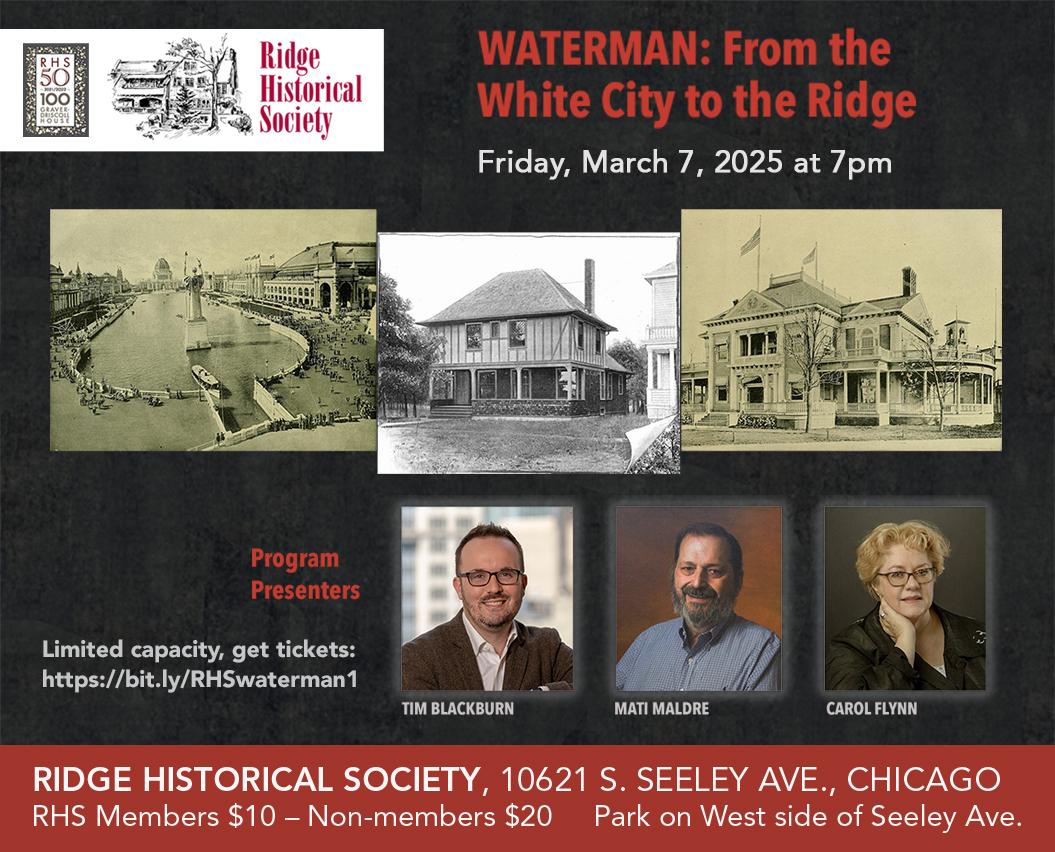
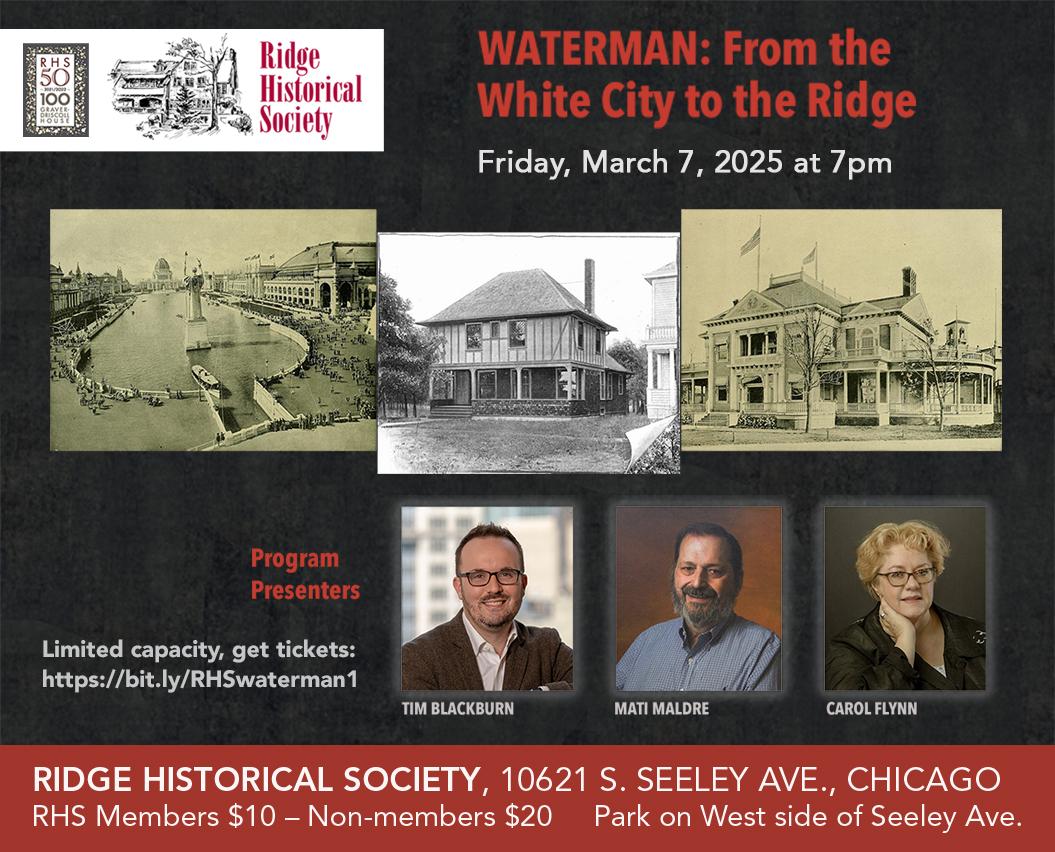
Waterman: From the White City to the Ridge
Friday, March 7, at 7:00 p.m.
Repeating our popular presentation:
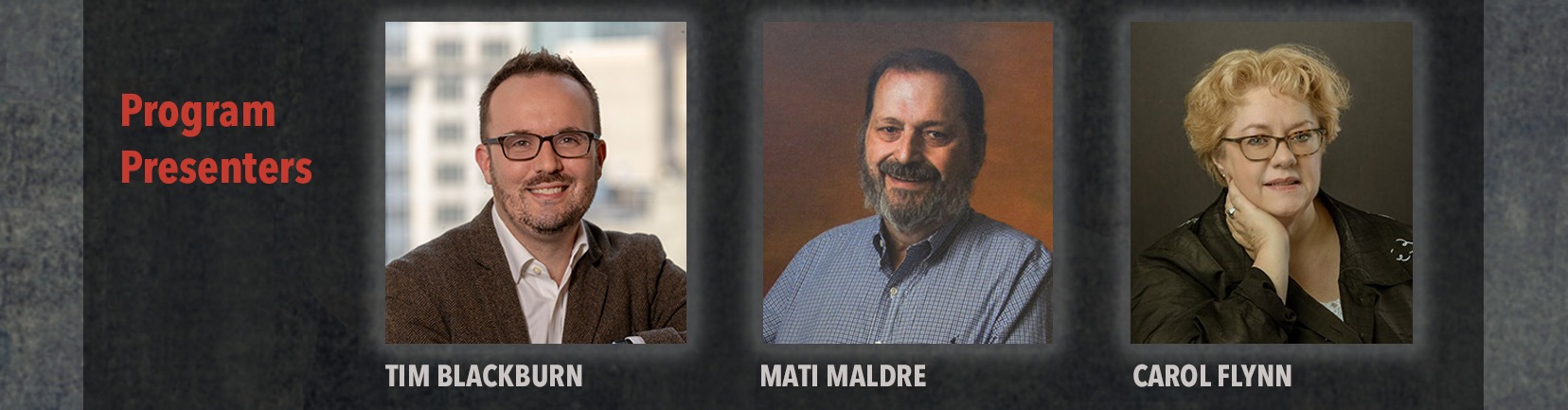
Architect Harry Hale Waterman, who is the subject of our latest exhibit, was just 23 years old when he started to build some of his most memorable buildings on the Ridge. In the first part of this program, Exhibit Curator Tim Blackburn will focus on Waterman's influences of the Columbian Exposition and his first employer, Joseph Lyman Silsbee.
Mati Maldre will discuss his architectural photos of thirty Waterman buildings, which were mostly taken in the mid-1980s with a Deardorff 4×5/5×7 view camera.
RHS Facebook Page Author Carol Flynn will then share stories from the lives of Waterman's early clients on the Ridge who made interesting impressions on the community in their day. This has been continued as a series on Facebook to complement the RHS exhibit.
Attendees are encouraged to view the exhibit "Harry Hale Waterman: Unique in any Style" after the program. The exhibit is also open Tuesdays and Sundays from 1:00 – 4:00 p.m., or by appointment, through at least May 2024.
Members: $10 | Non-members: $20 | Students under 18: $5
Ridge Historical Society
10621 S. Seeley Ave., Chicago, IL 60643
Limited Capacity. Get tickets here: https://bit.ly/RHSwaterman1
RSVP: ridgehistory@hotmail.com 773.881.1675
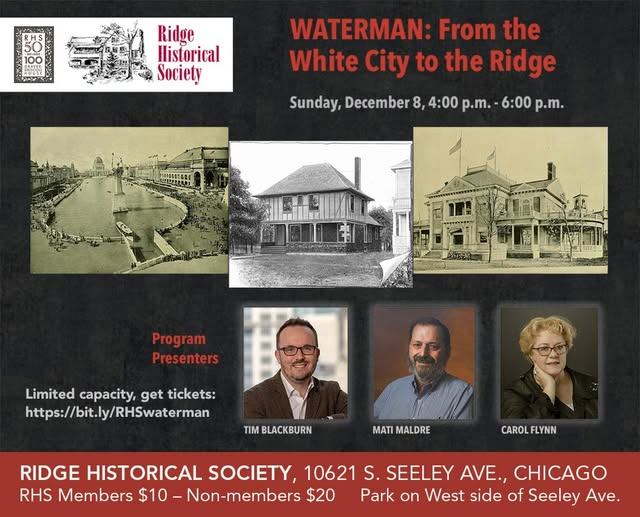
SOLD OUT!!
We are completely booked for tomorrow's presentation – Sunday, December 8. We have so much great new info to share with everyone on Waterman's buildings and the people who called them home on the Ridge.
We'll likely do a second event in January – February. Plus I'll be doing a new series on Facebook built around the Waterman houses so watch this page. (I've been quiet lately while I prepared for this presentation but I'll be back this week.)
– Carol Flynn, RHS FB Administrator
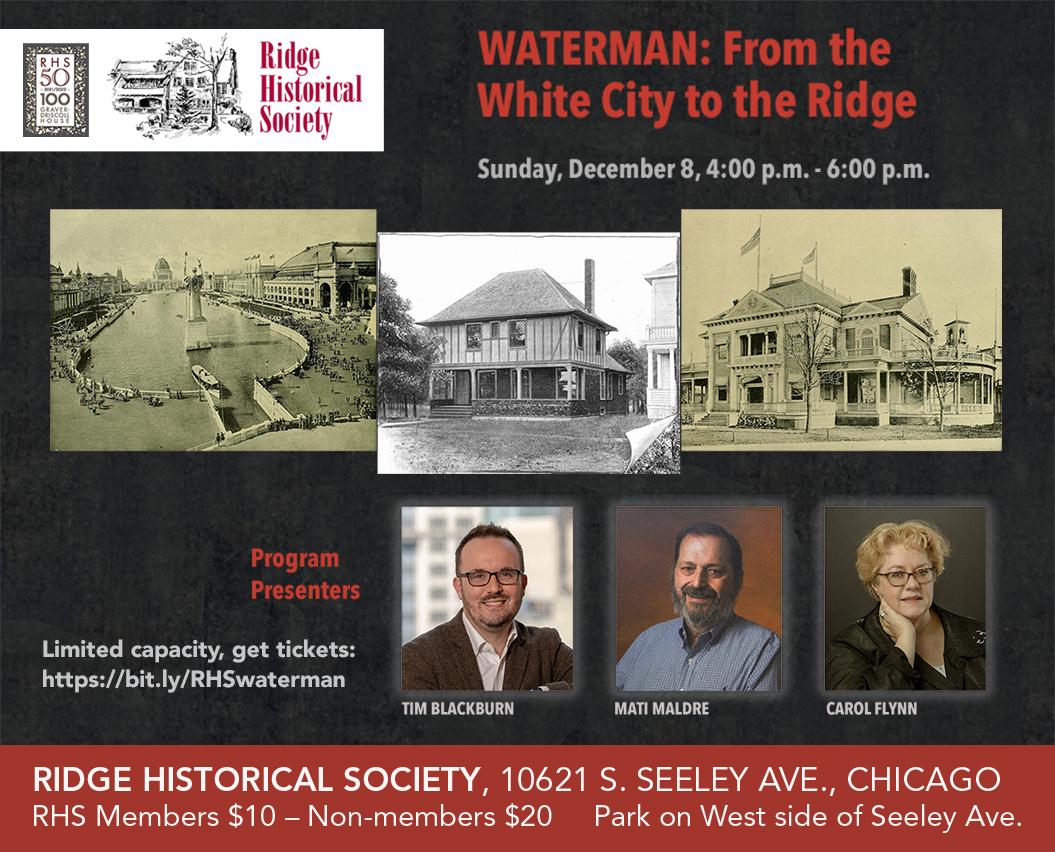
Waterman: From the White City to the Ridge
Sunday, December 8th at 4:00 p.m.
Architect Harry Hale Waterman, who is the subject of our latest exhibit, was just 23 years old when he started to build some of his most memorable buildings on the Ridge. In the first part of this program, Exhibit Curator Tim Blackburn will focus on Waterman's influences of the Columbian Exposition and his first employer, Joseph Lyman Silsbee.
Mati Maldre will discuss his architectural photos of thirty Waterman buildings, which were mostly taken in the mid-1980s with a Deardorff 4×5/5×7 view camera.
RHS Facebook Page Author Carol Flynn will then share stories from the lives of Waterman's early clients on the Ridge who made interesting impressions on the community in their day. This will be continued as a series on Facebook to complement the RHS exhibit.
Attendees are encouraged to view the exhibit "Harry Hale Waterman: Unique in any Style", which will be open from 1:00 – 4:00 p.m. before the program. The exhibit is also open Tuesdays and Sundays from 1:00 – 4:00 p.m., or by appointment, through at least spring 2024.
Ridge Historical Society
10621 S. Seeley Ave., Chicago, IL 60643
Limited Capacity. Get tickets here: https://bit.ly/RHSwaterman
Or RSVP by phone 773.881.1675
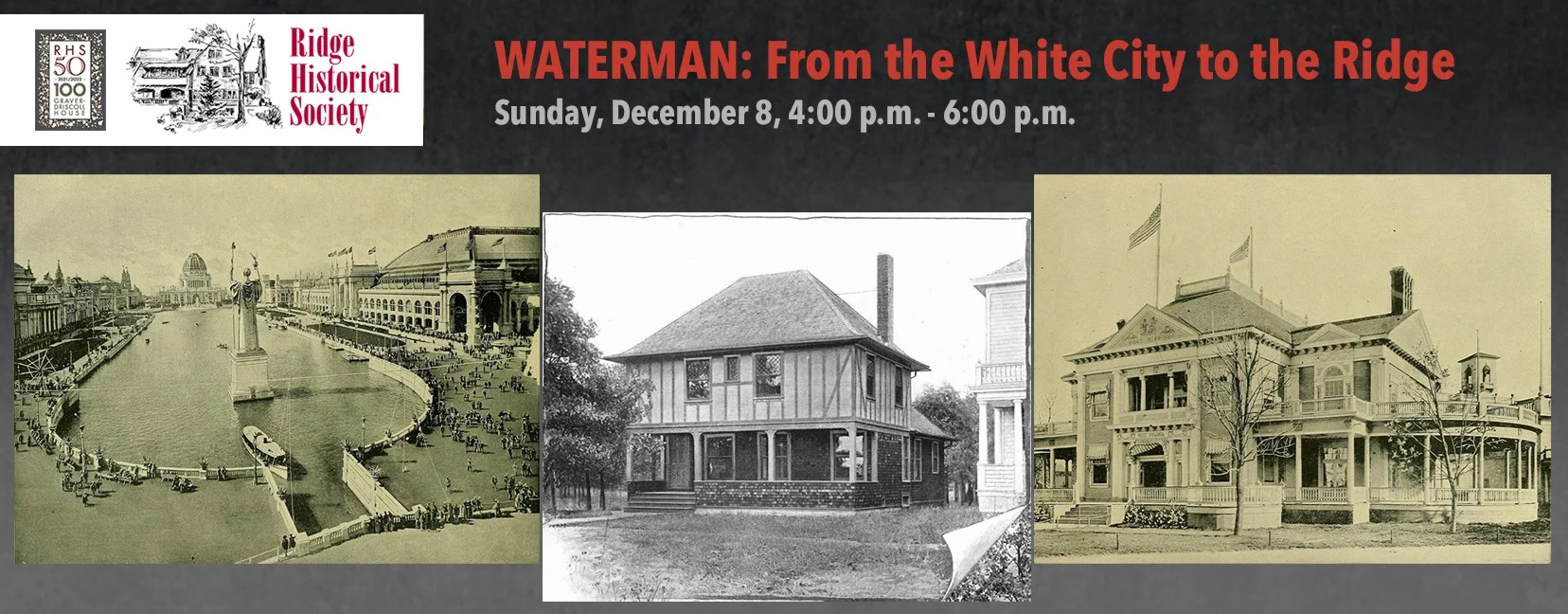
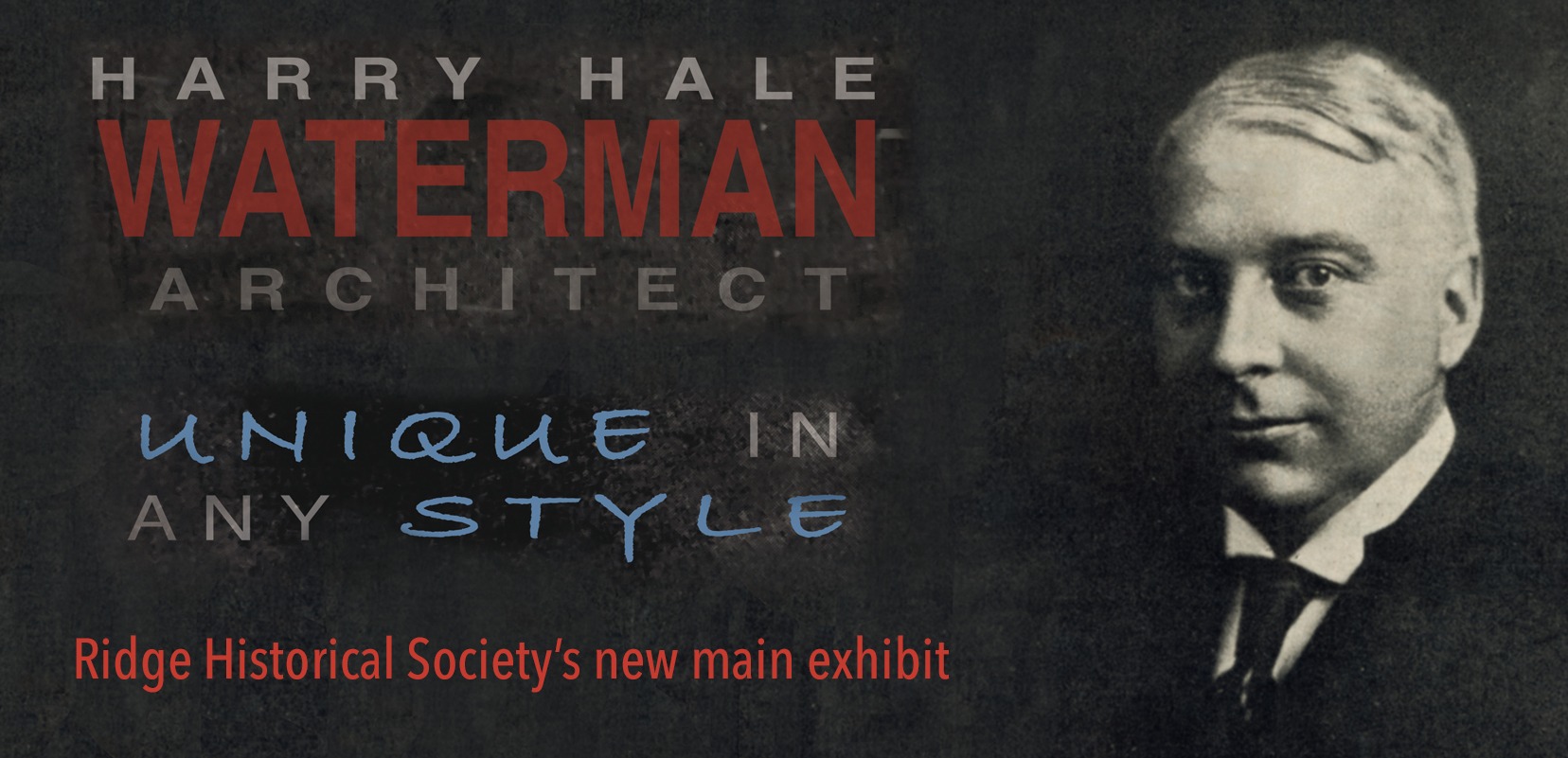
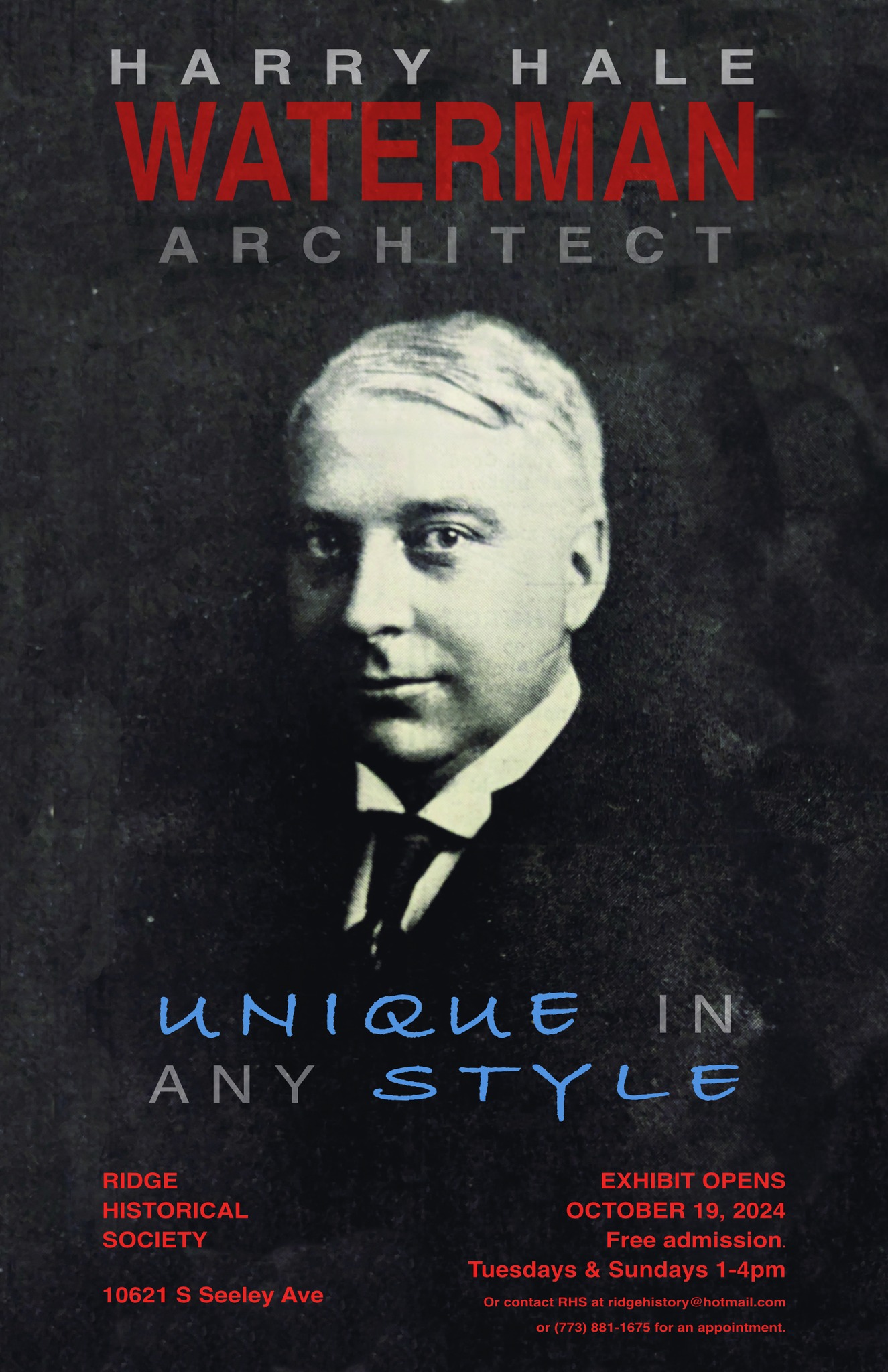
The new exhibit has opened at The Ridge Historical Society: "Harry Hale Waterman, Architect: Unique in Any Style."
The exhibit is open to the public for free on Tuesdays and Sundays from 1:00 p.m. to 4:00 p.m.
Waterman was born in Wisconsin in 1869, and came to Chicago as a young boy. He attended the Old University of Chicago and Northwestern University, and started his architecture career in the late 1880s. He worked in the architecture offices of Joseph Lyman Silsbee alongside his family friend Frank Lloyd Wright.
While Wright concentrated on developing his own style of architecture, Waterman worked in many different styles, putting his unique spin on each.
Waterman designed an estimated forty buildings in Beverly and Morgan Park, most of which are still standing today. Other buildings he designed in other Chicago neighborhoods have not fared as well.
This exhibit explores Waterman's work on the Ridge, and also takes a loot at some of his clients.
On Sunday, December 8, 2024, at 4 p.m., RHS will offer a program connected to the exhibit: "Waterman: From the White City to the Ridge."
In the first part of this program, Exhibit Curator Tim Blackburn will focus on Waterman's influences on the Columbian Exposition and his first employer, Joseph Lyman Silsbee.
Mati Maldre will discuss his architectural photos of thirty Waterman buildings, which were mostly taken in the mid-1980s with a Deardorff 4×5/5×7 view camera.
RHS Facebook Page Author Carol Flynn will then share stories from the lives of Waterman's early clients on the Ridge who made interesting impressions on the community in their day. This will be continued as a series on Facebook to complement the RHS exhibit.
Stay tuned to this page for details on registering for the program.
RHS is located at 10621 S. Seeley Avenue, Chicago.
The Ridge Historical Society
Sacred Heart Church
By Carol Flynn
Sacred Heart Church in Morgan Park was part of Open House Chicago (OHC) this past week-end, prompting questions about its history. The researchers/writers of RHS have published articles on the history of all the local places participating in OHC at one time or another, and are always willing to share that information.
Here is information on Sacred Heart Church, one of the true gems of the community.
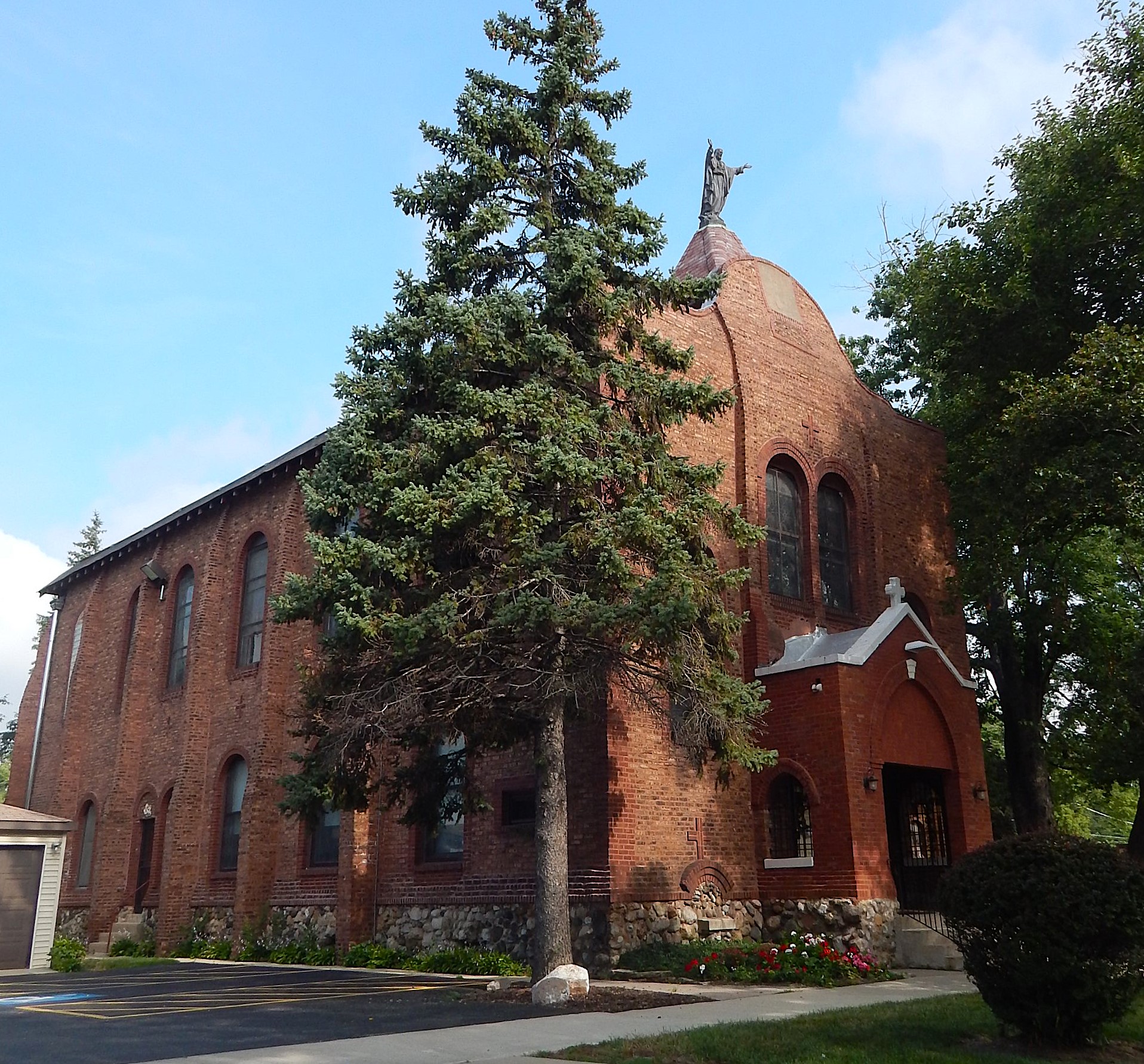
The Blue Island Ridge has its own “French connection.” There was an early group of settlers here, and their legacy to the community is the historic and charming Sacred Heart Church at 11652 S. Church Street.
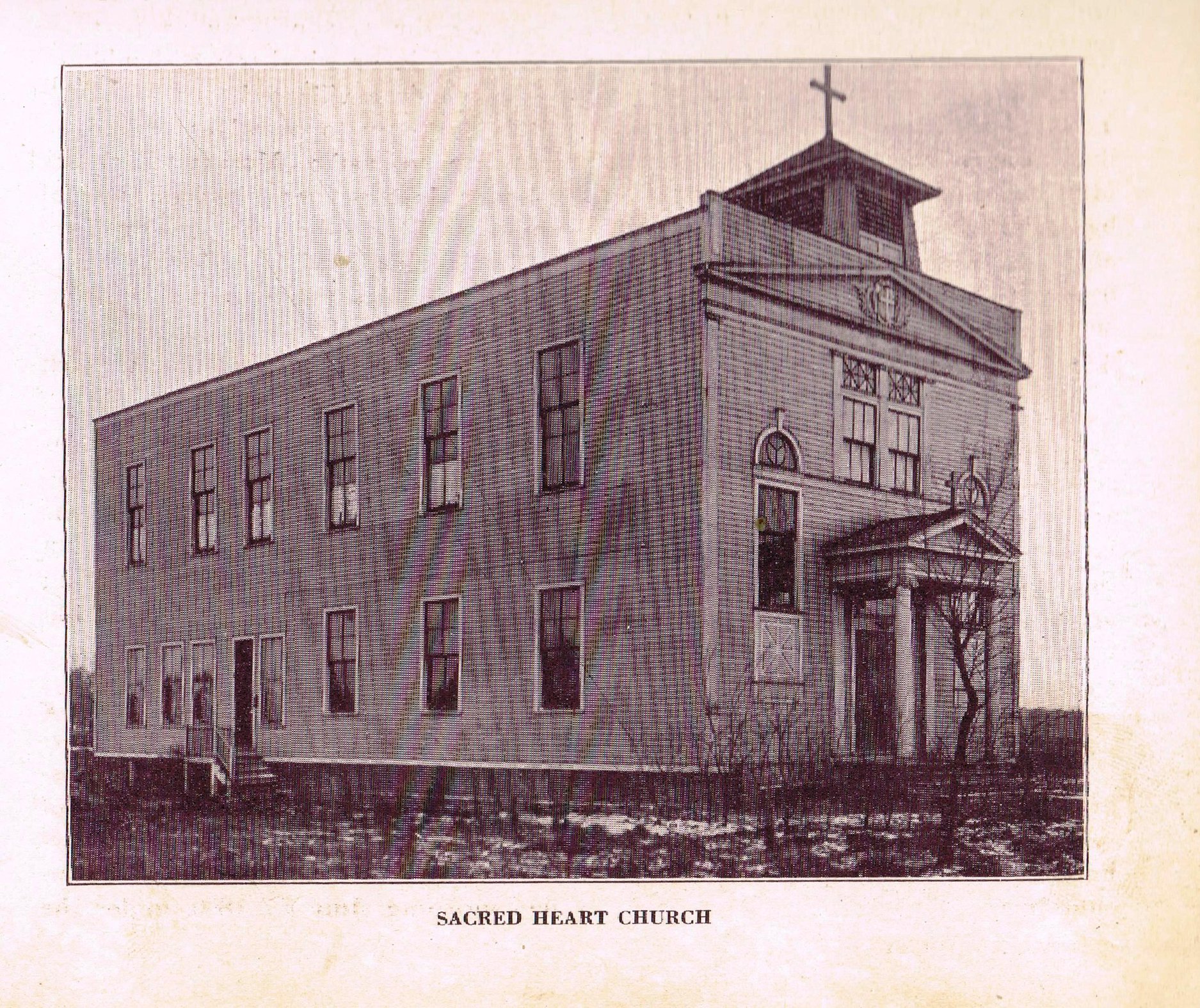
Rich clay deposits on and around the Blue Island Ridge led to brick-making becoming an important local industry in the early 1900s, and the workers established their homes in the area. Sacred Heart was originally founded in Alsip in 1892. After an unfortunate fire, the church moved to its current location to be closer to the Purington Brick Yards at 119th and Vincennes, where many of the French people worked.
The current church was built in 1904-5 originally as a wooden frame church, built on posts in a swamp. The church was established as a “national church” which meant it would serve a particular nationality, not a defined geographic area.
The story goes that the workers were allowed to take “seconds” of bricks from the brick yard, those bricks that were burnt in the ovens and therefore couldn’t be sold, over to the frame church one or two at a time. By 1922, when enough bricks had been saved, the present brick facade was added. The church as it stands now is actually the old frame church clad with this donated brick.
Father Raymond DeNorus, a missionary priest born in France, became pastor in 1912. From all accounts, he was a very charismatic man. He loved a good time, yet he was a man deeply devoted to his faith. He dispensed medicine, holy water and blessings from his side door.
Numerous miracle cures were reported to have taken place over the years. Crutches, canes and braces left abandoned at the church were hung on the side walls. Services at the church drew large crowds and it became a place for pilgrimages.
During this time the church became known as the Shrine of the Sacred Heart, a shrine being a special place of devotion that attracts travelers from afar.
Fr. DeNorus retired in 1935. With time, most of the French families moved on and were replaced by German and Irish workers.
In 1979, the Archdiocese of Chicago under John Cardinal Cody decided to close and demolish Sacred Heart, citing as its main reasons a shortage of priests and the expense of construction needed to correct building code violations.
Members of the congregation and the greater community rallied to restore and preserve the church. “Save Our Shrine” became the rallying cry.
The church was stripped of all its possessions. The congregation held Mass out in the parking lot. Sacred Heart Church was closed from 1979-1982. It likely would have been demolished, but then Cardinal Cody died.
The new Archbishop, Joseph Bernardin, agreed to review the matter. He reopened the church and celebrated Mass there in 1983. The church was reestablished as a "mission church" operating as part of the Holy Name of Mary Parish in Morgan Park.
The people of Sacred Heart have maintained their church for an additional 40 years. The church was visited by the late Francis Cardinal George, who was so taken with the church he said he could consider living there when he retired.
The devotion to the Sacred Heart of Jesus originated in France in the late 1600s when a nun, Saint Margaret Mary Alacoque, claimed that during a series of apparitions, Jesus promised certain blessings to those who practiced devotion to his Sacred Heart. The Vatican’s position is that the manifestation and promises are true. The name Sacred Heart was very fitting for a French mission church in Alsip/Morgan Park.
Open House Chicago takes place this coming week-end, October 19 and 20.
As one of the featured locations, the Ridge Historical Society (RHS) will be open both days from 10:00 a.m. to 5:00 p.m.
We are very excited about opening our new exhibit for this event: “Harry H. Waterman, Architect: Unique in Any Style.”
Waterman designed at least 40 buildings on the Ridge, including some well-known ones that go by popular names – the beloved “honeymoon cottage;” the “watchman’s residence” in Dan Ryan Woods; the “Walgreens’s mansion,” part of the Mercy Home for Girls; the “Beacon School;” and the “tombstone house.” All of these are covered in the exhibit.
This exhibit will focus on the contributions made by “the village architect,” as he was fondly known, as well as his personal life, and preservation of his work in the future. The exhibit will also look at some of his clients, like the Barker/Gregson and Pike families.
“Harry H. Waterman, Architect: Unique in Any Style” is curated by RHS Board member Tim Blackburn; with research and writing by Carol Flynn; architectural photography by Mati Maldre; research support by Linda Lamberty; and promotion by Grace Kuikman.
The exhibit will be up at least through the New Year. Admission is free.
RHS is located at 10621 S. Seeley Avenue. Regular open hours are Tuesday and Sunday from 1:00 p.m. to 4:00 p.m. or by appointment.
Look for the upcoming series about Waterman on the RHS Facebook page, written by Carol Flynn.
Friday, Oct. 11, 7:00 pm
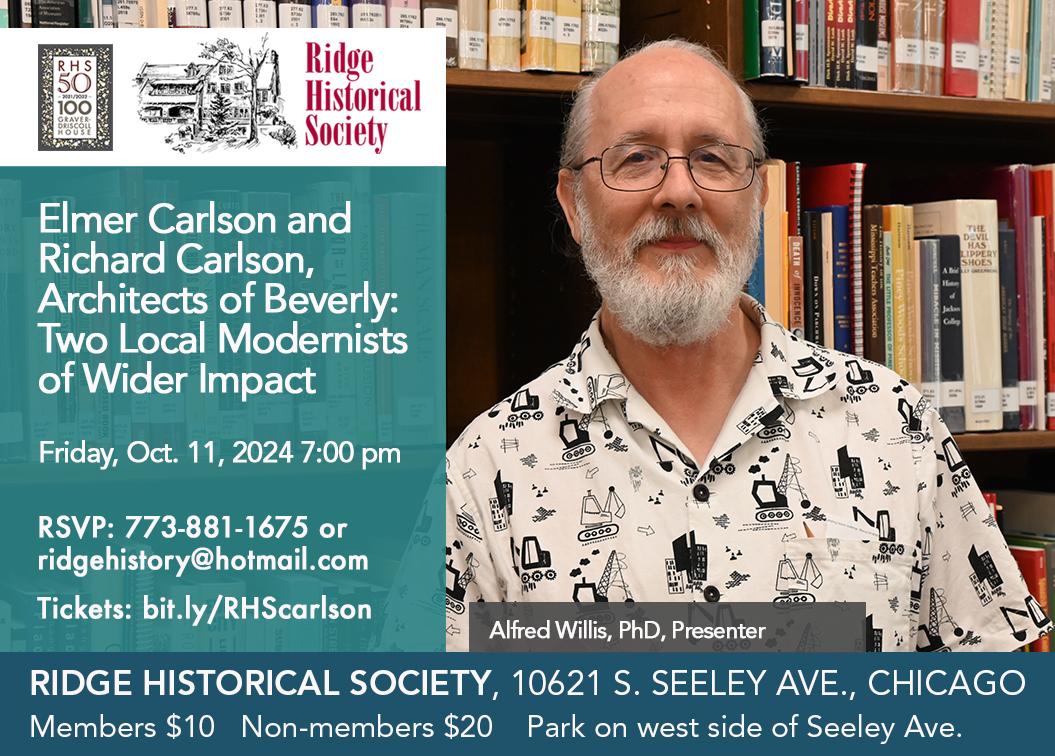
Elmer Carlson and Richard Carlson, Architects, of Beverly: Two Local Modernists of Wider Impact
– Alfred Willis, PhD, Presenter
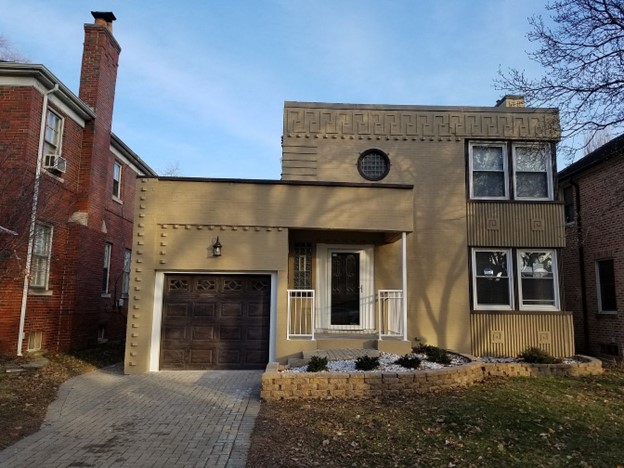
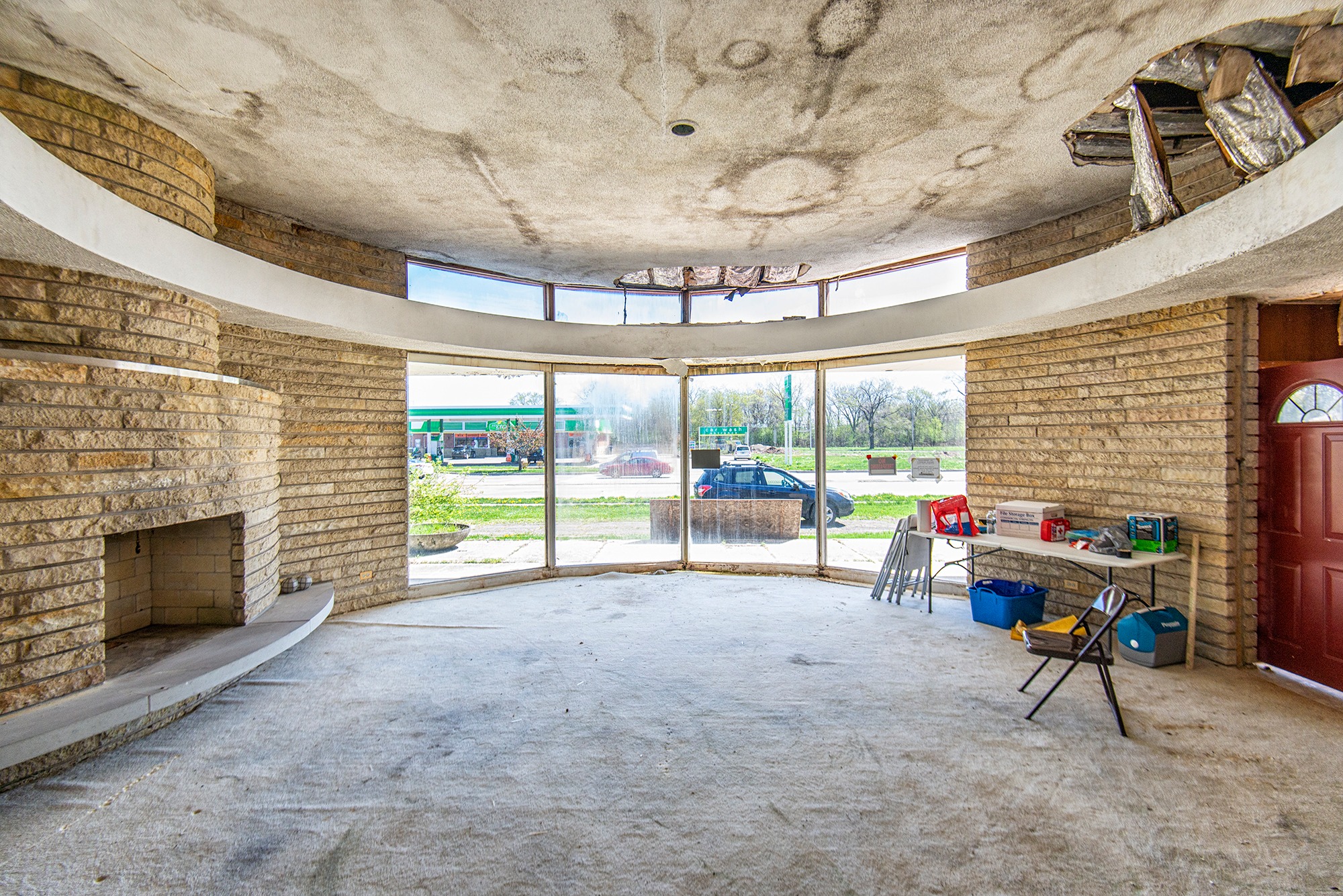
Elmer C. Carlson (1897-1956) was a Chicago architect of Swedish descent who settled in Beverly in the 1920s. Despite the depressed economic circumstances of the 1930s, he managed to prosper in that decade as a designer of residential, commercial, and institutional buildings in southern Chicago and several of its suburbs. While an accomplished creator of 'period' designs of striking charm, he simultaneously evinced a fine flair for Modernism.
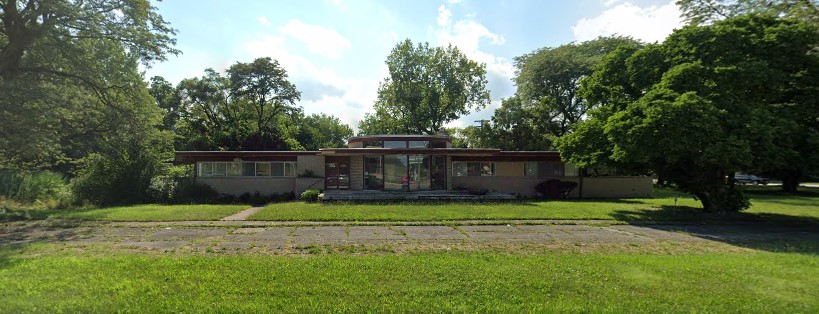
Working out of an ultramodern building on 95th Street, completed to his own design in 1946-47, he went on to even greater success after World War II as a prolific local architect of major projects sited both close to home and further afield. Elmer Carlson died in 1956 while developing a proposal for what should have been his greatest achievement in the residential sector, a villa in Robbins for the wealthy African-American entrepreneur S. B. Fuller.
Responsibility for refining the preliminary form of that interrupted project passed to his son, Richard E. Carlson (1930-2017) who had recently graduated in architecture form the University of Illinois and joined his father's Beverly practice. Thus making the most of a rare opportunity to begin his own career with what for his father (and mentor) had been the blank-check chance of a lifetime, Richard Carlson soon landed a wealthy clientele of his own that permitted a full display of his own unique taste and talent. His subsequent professional success unfolded first in Beverly but later in Colorado Springs.
About the Presenter: Alfred Willis, PhD is an architectural historian who grew up in Georgia. He was educated at Clemson University, Columbia University, and the University of Chicago. After retiring from a career in academic librarianship, he is now working as a consultant specializing in Modernism on nominations to the National Register. He is currently working as a contract librarian with the Historic Preservation Division of the Mississippi Department of Archives and History.
Ridge Historical Society
10621 S. Seeley Ave., Chicago, IL 60643
Limited Capacity. Get tickets here: https://bit.ly/RHScarlson