
Explore the RHS Facebook Archives, a rich repository of local history written by Carol Flynn. For two decades, Carol brought a deeply dedicated voice to public education at RHS. Her role as Facebook administrator through mid-2025 naturally extended her prolific research into meticulously detailed articles, most notably her multi-part historical series posts. Today, Carol continues her local history writing for The Beverly Review and other outlets.
Local Architecture
The Ridge History Society
Moving on from Barwick to Waterman
By Carol Flynn
Every fall, the Ridge Historical Society (RHS) looks forward to participating in the Beverly Art Walk and Open House Chicago. These events offer wonderful opportunities to present new exhibits showcasing the fascinating history of Beverly and Morgan Park to much wider audiences.
This post is a last call for viewing the current exhibit, “Louise Barwick’s Lost Ridge,” and the sub-exhibit, “Lost and Found.”
This current exhibit focuses on life on the Ridge from 1893 to 1905 as seen through the watercolor paintings of Louise Barwick, an artist and educator who lived on the Ridge. Another component of the exhibit includes aerial photography of Beverly taken by cameras attached to kites in 1899. A third component features historic images of buildings in Morgan Park taken in 1889, some of which remain and some of which are gone.
The exhibit may be viewed on Tuesdays and Sundays from 1:00 p.m. to 4:00 p.m. or by appointment. This exhibit will be phased out after Tuesday, September 24.
The first part of a new exhibit on architect Harry Hale Waterman, titled “Harry Hale Waterman, Architect: Unique in Any Style,” will then begin with the Beverly Area Art Walk on Saturday, September 28th, from 12 noon to 5:00 p.m.
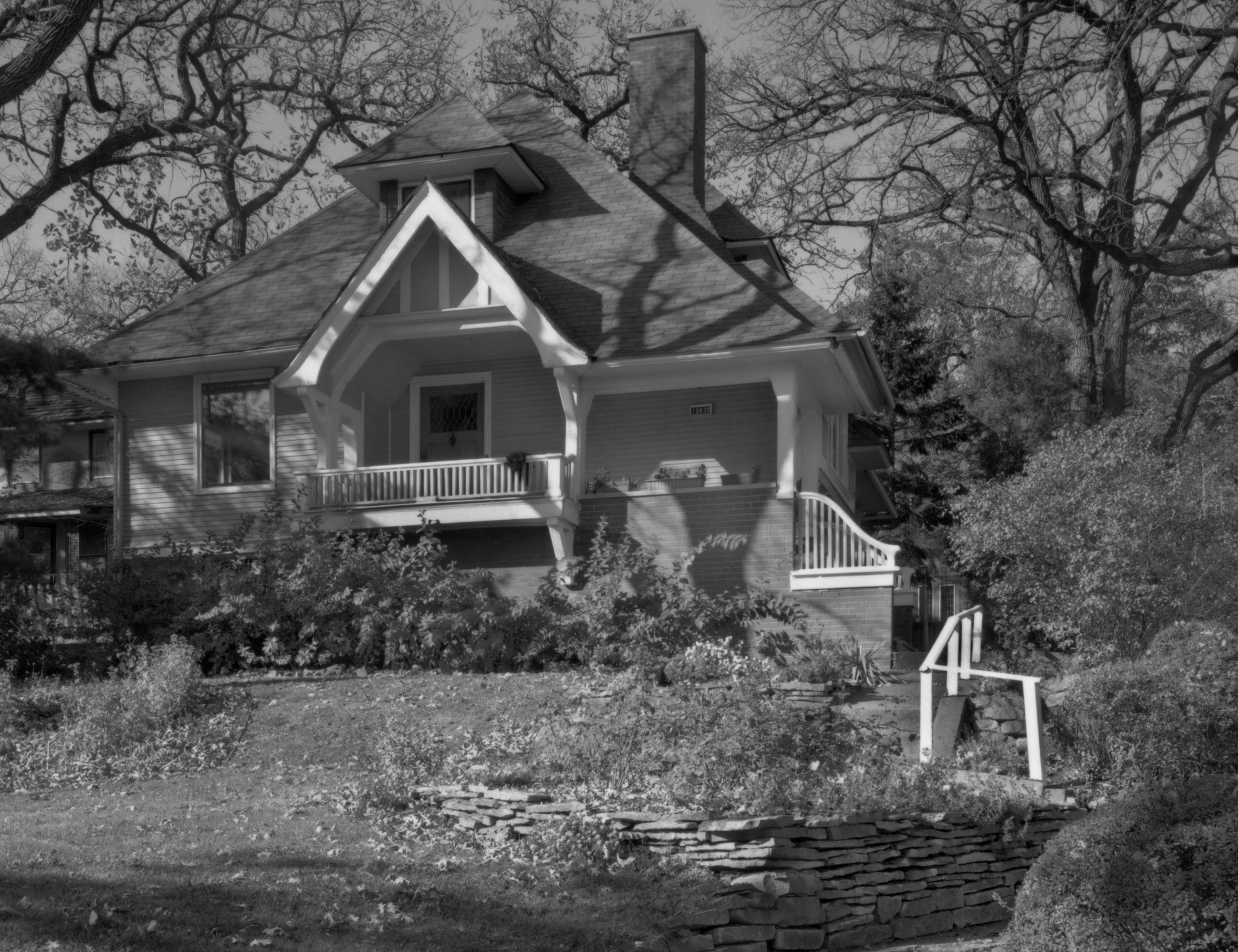
Photographer and RHS Board member Mati Maldre will exhibit more than 20 photos he has taken of Beverly/Morgan Park buildings designed by Waterman.
Waterman (1869-1948) was a contemporary, indeed a good acquaintance, of Frank Lloyd Wright. But while Wright concentrated his work on the one style he became so well known for, the Prairie Style, Waterman designed in many different styles, putting his unique “spin” or interpretation on each. He designed dozens of houses and other buildings in Beverly and Morgan Park around 1900.
Mati Maldre is a retired Professor of Art/Photography from Chicago State University (CSU). He initiated the photography program and taught at CSU, as well as the Beverly Art Center for 35 years.
During this year’s Beverly Art Walk, Maldre will discuss the process of taking professional architectural photographs using his wooden Deardorff camera and demonstrate how view cameras operate and why they create such detailed and sharp photographs.
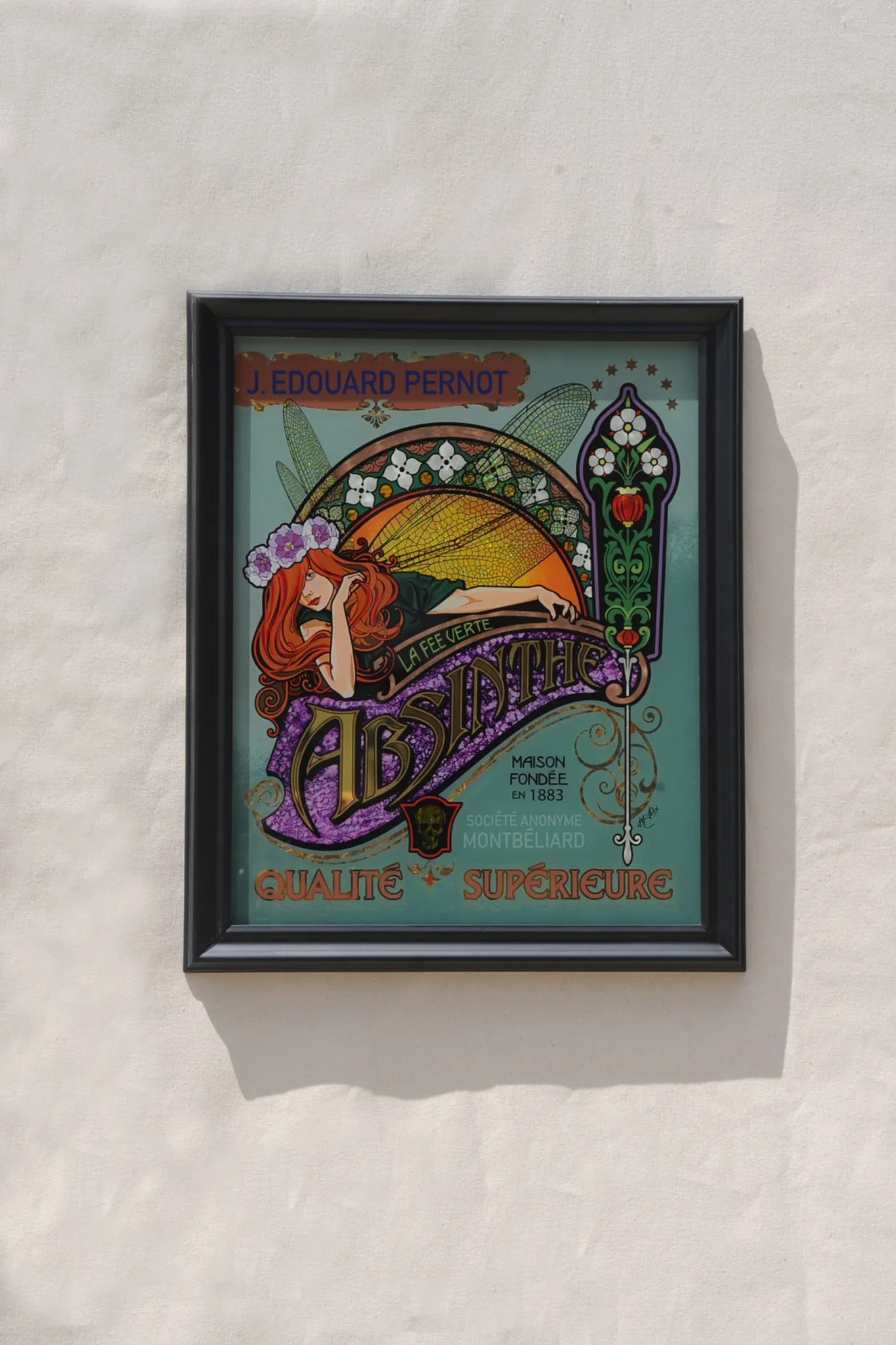
Also at RHS for the Beverly Art Walk on September 28 will be glass artist Sean Michael Felix, the owner of Illumination Art & Design in Humboldt Park.
Felix creates unique hand crafted architectural art glass, glass signs, and stained glass using 19th century techniques. For the Beverly Art Walk he will exhibit samples of his beautiful decorative work and demonstrate the nearly lost art of applying gold leaf to glass the way it was done by artisans in the Victorian Era.
RHS is located at 10621 S. Seeley Ave., in Chicago, and may be contacted at 773-881-1675 or ridgehistory@hotmail.com.
The complete Waterman exhibit will open in October in time for Open House Chicago on the weekend of October 19th and 20th.
Stay tuned to this page for an upcoming Facebook series on Waterman and his structures on the Ridge.
The Ridge Historical Society does not routinely get involved in real estate transactions or even listings, except to help with house history requests.
However, this unique listing is worth mentioning from a historical and aesthetic viewpoint.
One of the Homes of Tomorrow from the 1933 Chicago's World Fair Exhibition is now available.
The Florida Tropical House was moved to Beverly Shores, Indiana, by barge in 1935 with five other houses from the exhibit. Today, four of the houses, including this one, comprise the Century of Progress Historic Architectural District.
You don't actually get to own the house. For a very substantial sum, you get a long-term lease from the National Park Service, as well as the obligation to preserve and maintain the house, and make it open one day per year for public viewing. That event usually happens one day each Fall, and a chance to tour these houses is a must-see attraction.
The green art deco bathroom is the selling point for me!
https://gniarmls.rapmls.com/scripts/mgrqispi.dll?APPNAME=Gniarmls&PRGNAME=MLSLogin&ARGUMENT=t1IGbEhXaHixVQunrUGbAhAHafN3xUD9rfeK4xajgxw%3D&KeyRid=1&SID=d4552747-9d1a-4179-a4f0-ed9251e1fc50&fbclid=IwAR1htPfcd9ErD2fNgHd7EPfCDQrUpJvwEYjICVJlf-ZZWHIk3HuBMs4i6cw
The Ridge Historical Society (RHS) will be open today, Sunday, Dec. 17, and Tuesday, Dec. 19, from 1 pm to 4 pm, for viewing the exhibit, "Louise Barwick's Lost Ridge." RHS is located at 10621 S. Seeley Avenue, Chicago. Admission is free. Parking is available on Seeley Avenue. RHS is not handicapped accessible.
One section of the exhibit is on KITE PHOTOGRAPHY
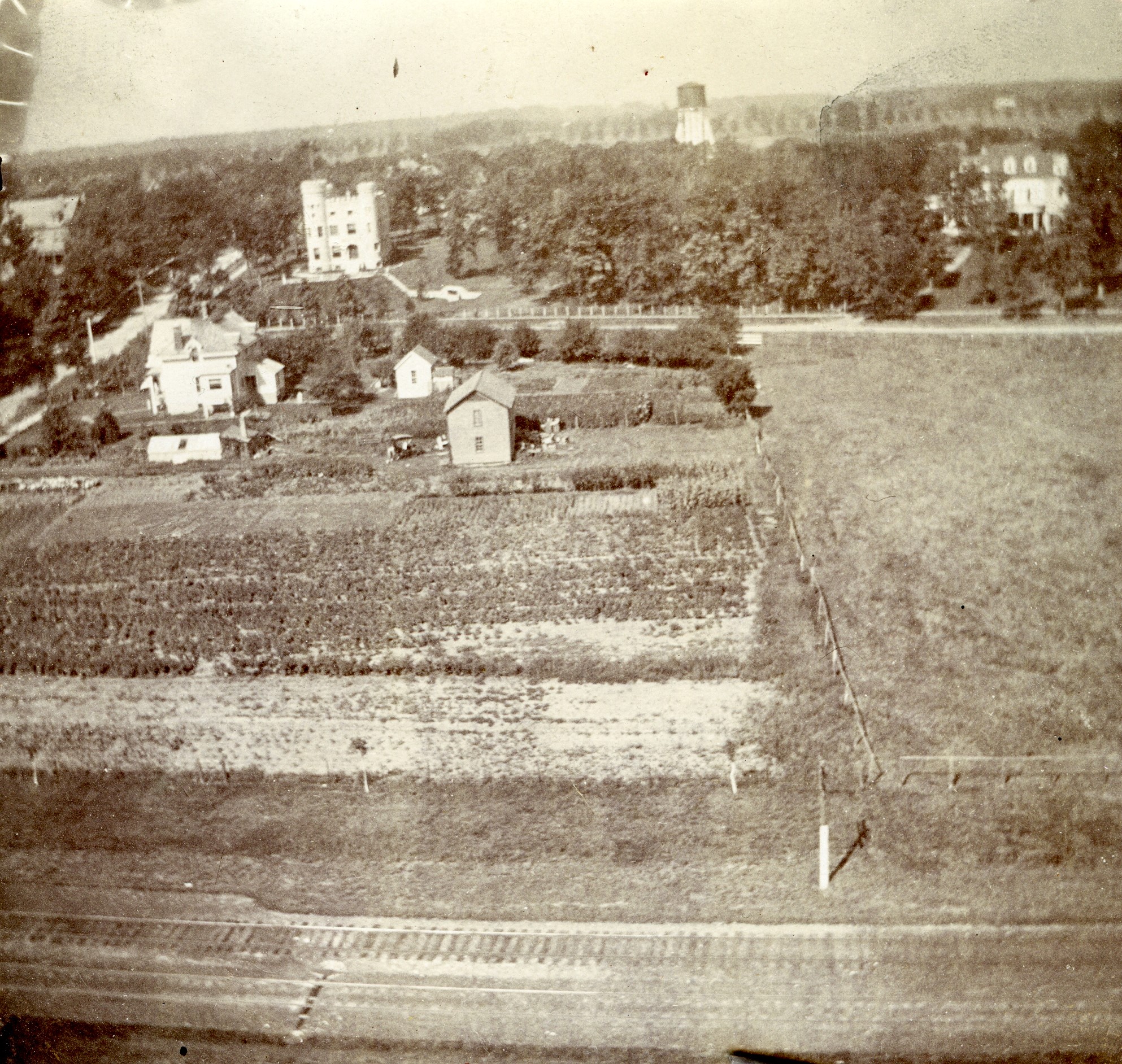
In 1899, two enterprising young men, Robert Heffron Murray and Frank Cox, attached a camera to a kite to take aerial photographs in the Beverly neighborhood. Murray, 17 years old at the time, and Cox, 21, both lived locally.
Fortunately, their experiments in aerial photography and their photos were reported in the local newspapers and therefore this historical record exists.
Several of the aerial photographs they published looked down on Longwood Drive at 103rd Street, giving us, literally, images frozen in time that document the corner as it existed almost 125 years ago.
This photo is one of them, and was posted a few days ago, inviting viewers to identify the location and buildings, which they readily did. Today is a follow up, with more information on the photo.
At the time, this area was known as “Tracy.” It was part of Washington Heights, which had annexed to the City of Chicago in 1890.
The name “Beverly Hills” was being used for a section in what is now North Beverly, around 91st Street, but it would not be until the 1910s that the name became commonly used for the entire section we know as Beverly today.
This photograph was taken from a field around today’s 102nd and Wood Streets. It is facing west, and shows in the foreground the train tracks of the Chicago, Rock Island, and Pacific line, which is today’s Metra Rock Island line.
Easily identified in the upper left is the Robert C. Givins House, also known as the Givins Castle, built in 1886-87, still prominent today as an area landmark. For orientation, this is the northwest corner of 103rd Street and Longwood Drive.
East of the Castle, where today there is a CVS Pharmacy on the northeast corner, is the Barnard seed farm. The Barnards were very early settlers in the area, and they grew primarily flowers on their farm which they harvested for their seeds and sold on the retail market.
To the north of the Castle (right side of photo), the large white house is the Horace E. Horton House, 10200 S. Longwood Drive, built in 1890 for the founder of the Chicago Bridge & Iron Company. The house is still there today. The rest of the block is still wooded territory. Incidentally, in 1905, Robert Heffron Murray married Sue Mary Horton, Horace’s daughter.
In the upper middle background is the Washington Heights water tower, which was located between Hoyne and Seeley Avenues. The water tower has an interesting history of its own. Before being annexed to the city, Washington Heights had its own water supply drawn from artesian wells. After annexation to the city, the water was drawn from Lake Michigan from a main at the Hyde Park pumping station at 68th Street. The water was pumped to storage reservoirs. The Blue Island Ridge, being of a higher elevation, had a separate water supply system and an additional pumping station at 104th and Charles Street, which brought the water up to this tank, which also had a small pumping station.
Eventually, technology advances did away with the need for this additional system, but the remains of the buildings were evident in the backyards of homes along Seeley and Hoyne for years.
For more information on this “kite photography experiment” visit the RHS exhibit. There were other photos taken with different views of the area that are explored in the exhibit.
The Ridge Historical Society
Fire at the Bretsnyder House
By Carol Flynn
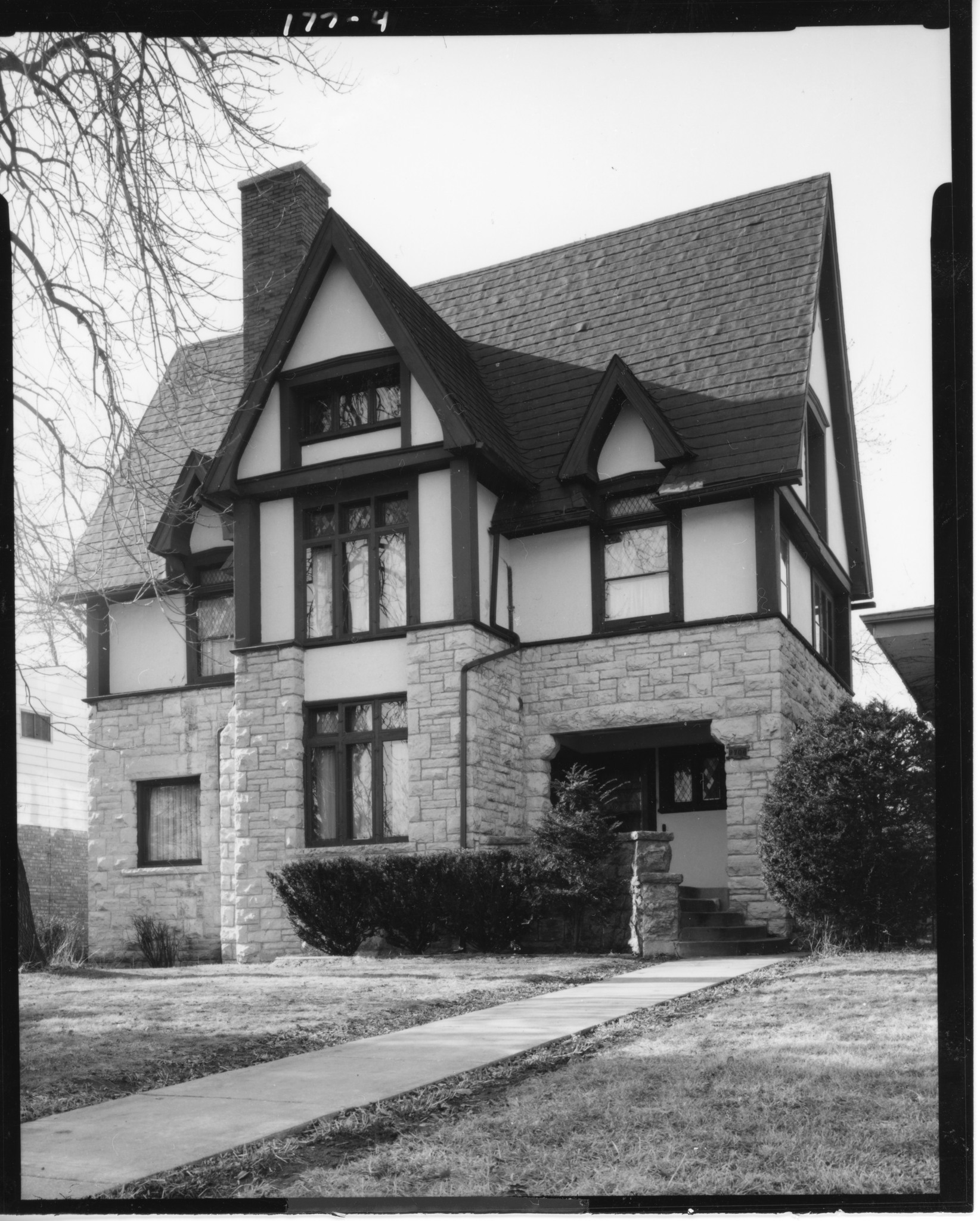
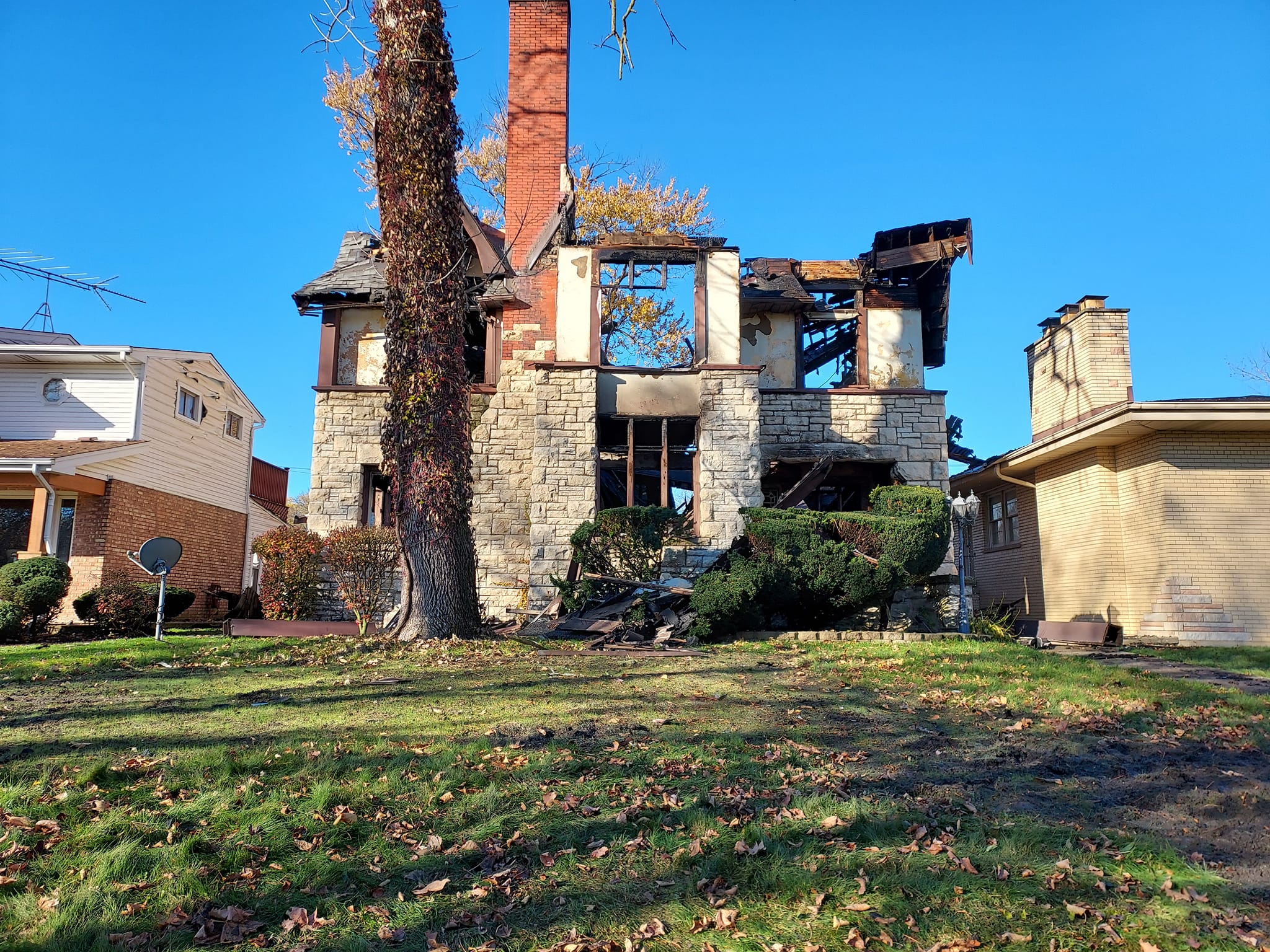
Last night the house at 9706 Longwood Drive was gutted by fire. Fortunately, no one was injured. It was reported that the house was currently unoccupied as it underwent renovation.
This house is the Minnie L. Bretsnyder House, built in 1895. The last name has several different spellings, including Bretshneider, but the family went by Bretsnyder in the years after the house was built, and when Minnie died in 1955, her obituary listed her as Minnie L. Bretsnyder.
The architect of the Norman- or Tudor-style house is not known with complete certainty, but according to Harold Wollf, architecture historian and past RHS registrar, the house is attributed to Harry Hale Waterman (1869 – 1948) based on the style. It was built during 1895-97, a period when Waterman was remiss in publicizing information on his projects.
Waterman was a contemporary of Frank Lloyd Wright and George Maher, but while they concentrated on developing distinctive styles, Waterman built in many different styles for a large group of clients. He designed many noteworthy buildings in the Beverly/Morgan Park community. He was affectionately known as "the village architect" in Morgan Park.
His work included the England J. Barker House at 107th Street and Longwood Drive; the Walter R. Barker House, also known as the “Walgreen mansion,” on 116th Street, part of the Mercy Home for Girls; the Morgan Park United Methodist Church at 110th Place and Longwood Drive; the Eugene S. Pike House at 91st Street and Longwood Drive; the Calumet Bank Building at 111th Street and Longwood Drive; and the Harry H. Waterman House at 108th Street and Longwood Drive.
The Bretsnyder family included Minnie, born in 1865 in Germany, and her husband William (1861 – 1942), born in Illinois to parents who came from Germany. William was an artist.
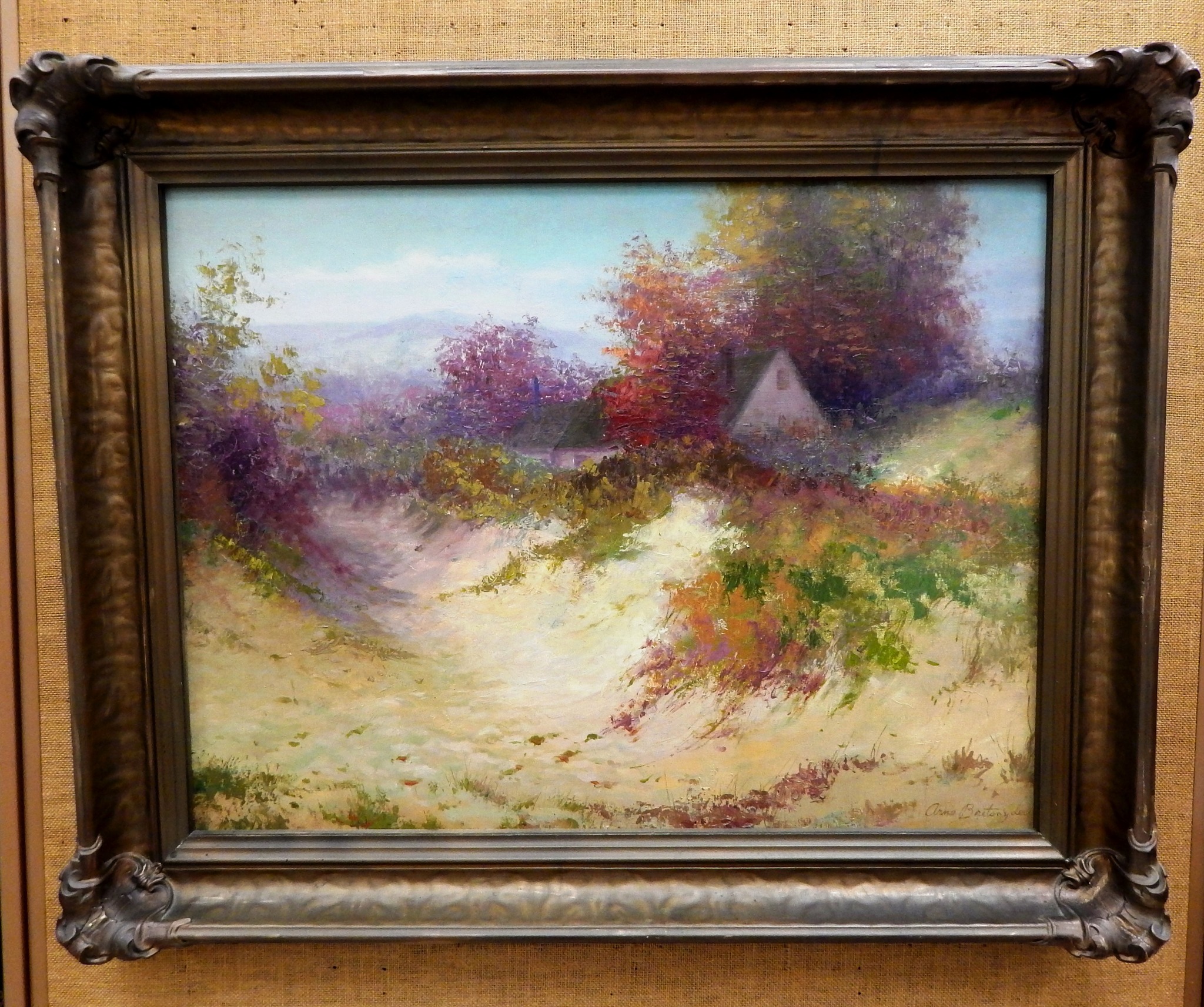
Their son, who lived at the house almost his entire life (he was about 10 when they built the house), was the artist Arno Bretsnyder (1885-1969). Arno studied under John Vanderpoel at the School of the Art Institute of Chicago (SAIC). He exhibited at the AIC in 1939.
The Vanderpoel Art Association has works by Arno in its collection at Ridge Park field house. His impressionistic oil paintings combined color, light, and texture in a dramatic way. He was known for landscapes and for Western paintings that depicted subjects like the Pony Express.
Arno joined the Society for Sanity in Art, a group opposed to modern art, including cubism, surrealism, and abstract expressionism.
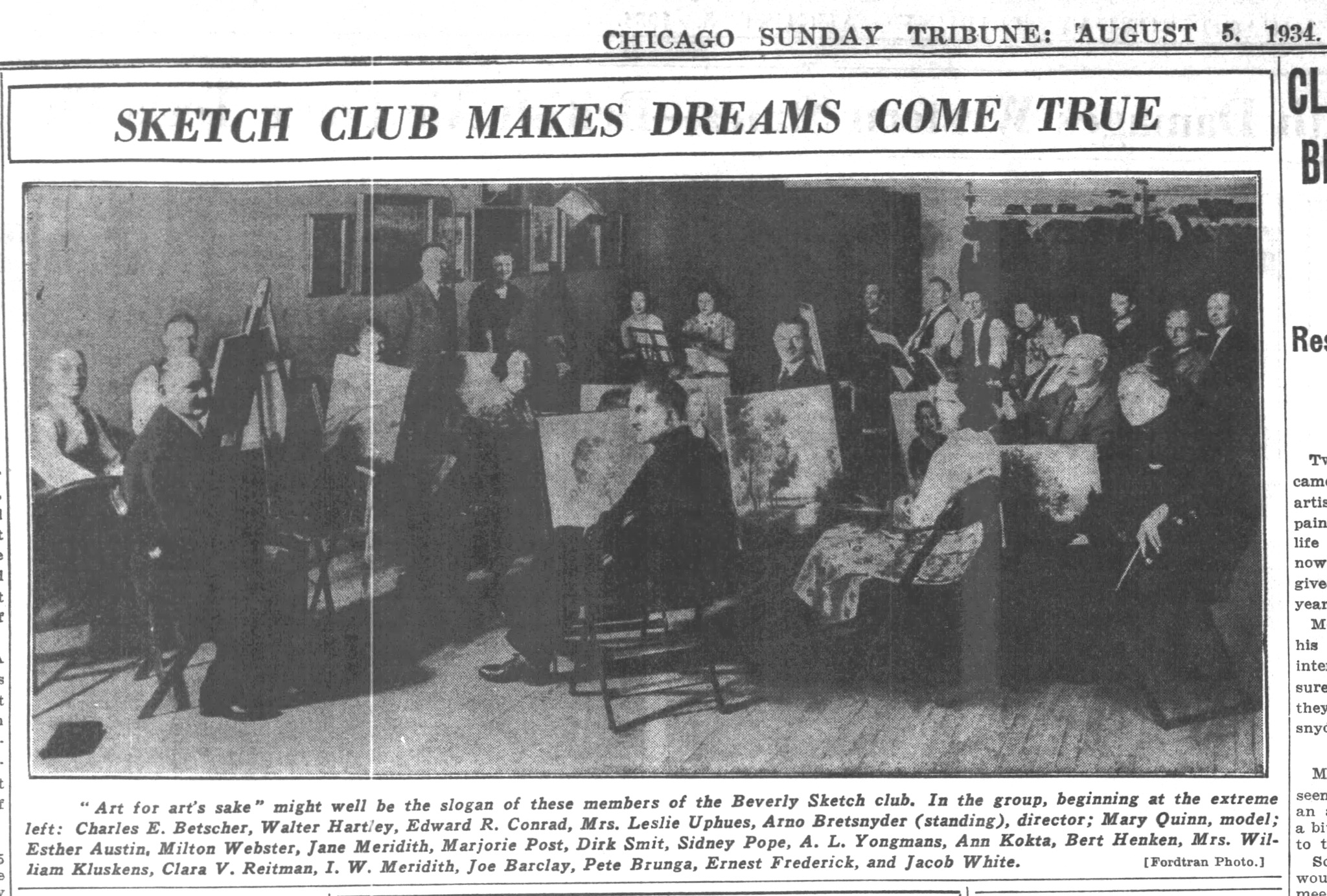
Arno was also very active in the Ridge community’s art scene. He formed the Beverly Sketch Club at Ridge Park and was an important member of the Ridge Art Association, where he staged and participated in many exhibits.
Updates on the Bretsnyder House will be posted as RHS does more research on the house’s history and additional details of the current status of the house are reported.
Research assistance by Tim Blackburn, RHS Board member.
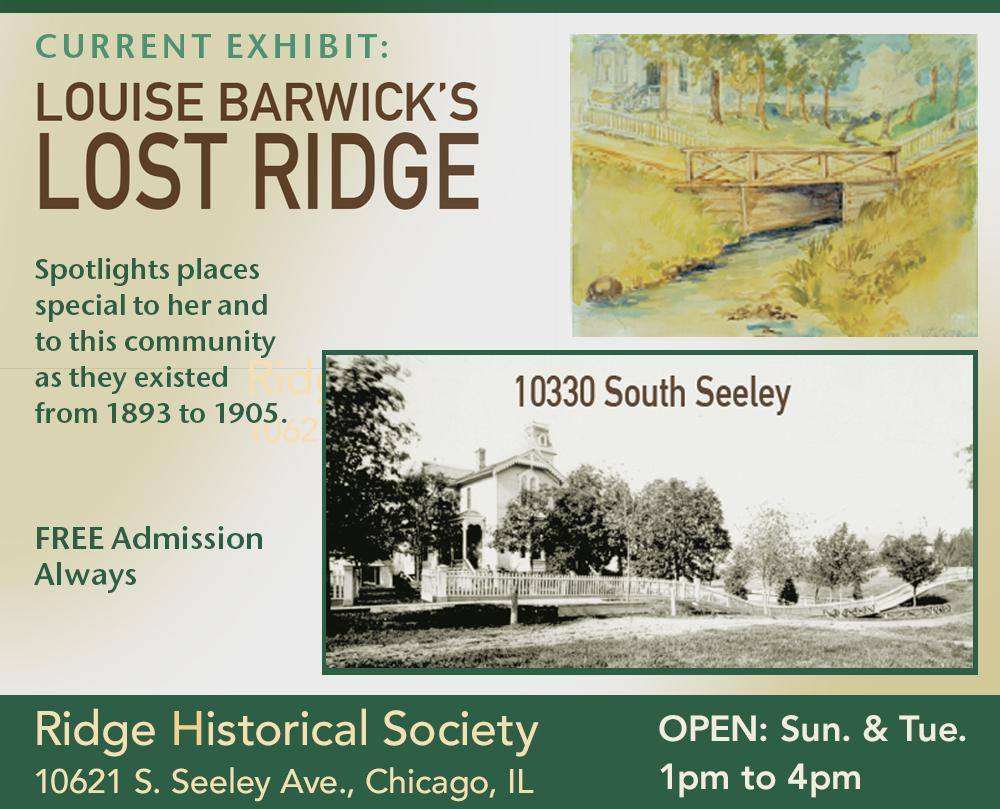
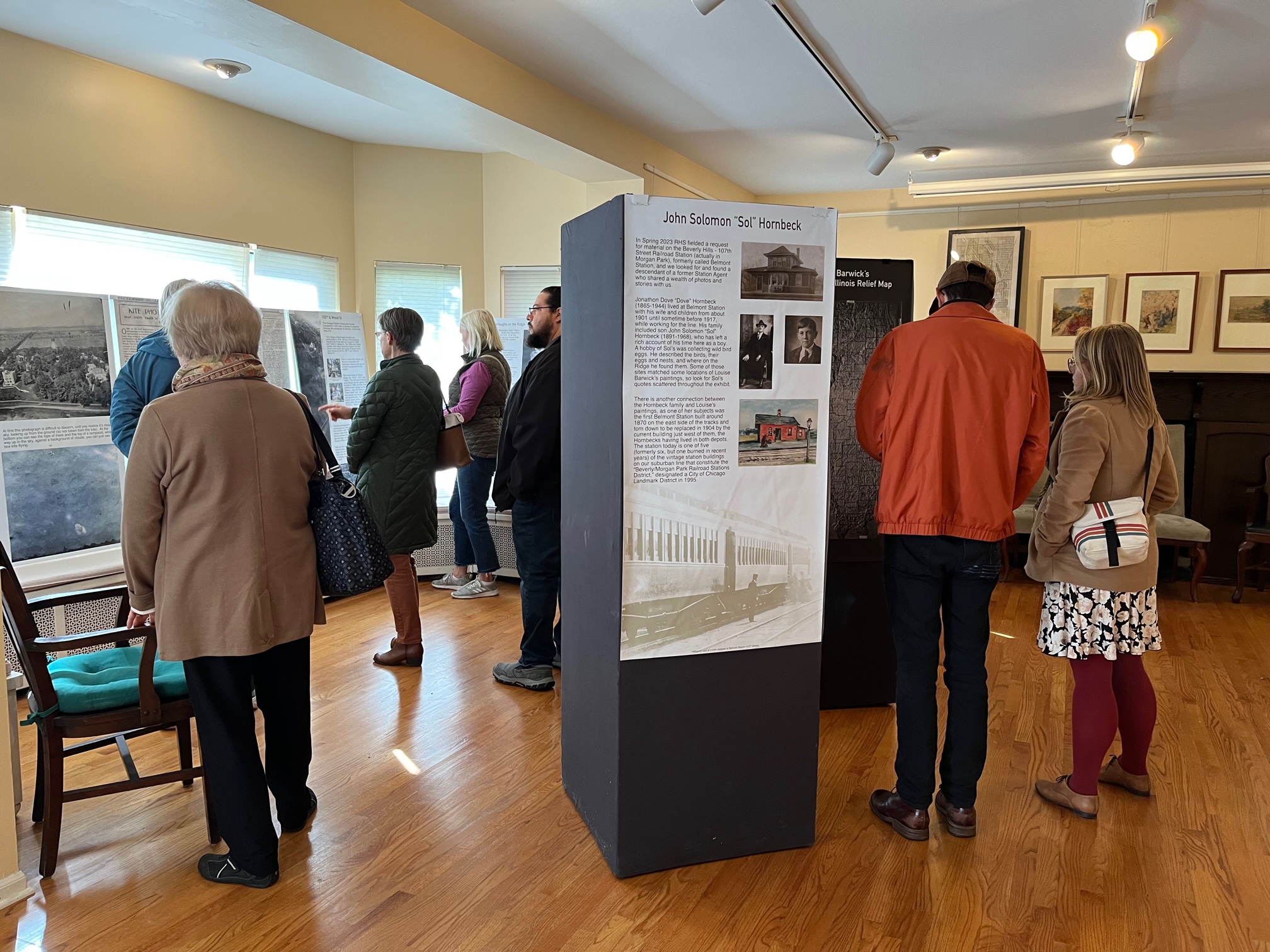
The Ridge Historical Society (RHS) has premiered a new exhibit that is now open for public viewing. There is something in this exhibit for everyone – art, rare photographs, architecture, and the stories of people who called the Ridge home. Curators of the exhibit are Linda Lamberty, RHS Historian, and Tim Blackburn, RHS Board member.
“Louise Barwick’s Lost Ridge” presents the area from 1893 to 1905 as experienced through the watercolor paintings and their descriptions by Louise Barwick, a local teacher and artist. Viewers will be taken back to the days when daisies stretched for acres, gaslights were lit by hand every night, and young women arrived for events in horse-drawn carriages.
A related story is that of Sol Hornbeck whose family lived and worked in one of the historic train stations. Sol shared stories about the wild bird life in the area.
Also on display are images of the area caught by kite photography, cutting edge technology of the 1890s, foreshadowing today’s drone photography.
Another part of the exhibit is an architecture feature on early buildings from Beverly and Morgan Park. Some are still standing but many others have fallen to the wrecking ball.
The fates of the Vanderpoel Block on 95th Street and the Charles Silva House on Esmond Avenue reveal that, unfortunately, progress and preservation are not always compatible. The Vanderpoel Block is preserved in a wonderful model on loan from Tim Blackburn. Artifacts salvaged from the Silva House are on display from the RHS collection.
Viewers will also enjoy rare early panoramic photos of the area, and can guess which of twenty-three original buildings are still standing. Hint: It’s more than half!
RHS is located at 10621 S. Seeley Avenue in Chicago. Exhibit hours are 1:00 p.m. to 4:00 p.m. on Sundays and Tuesdays, or by appointment. Admission is free. There is some parking on site, and more on Seeley Avenue. RHS is not wheelchair accessible. RHS may be contacted at 773/881-1675 or ridgehistory@hotmail.com.
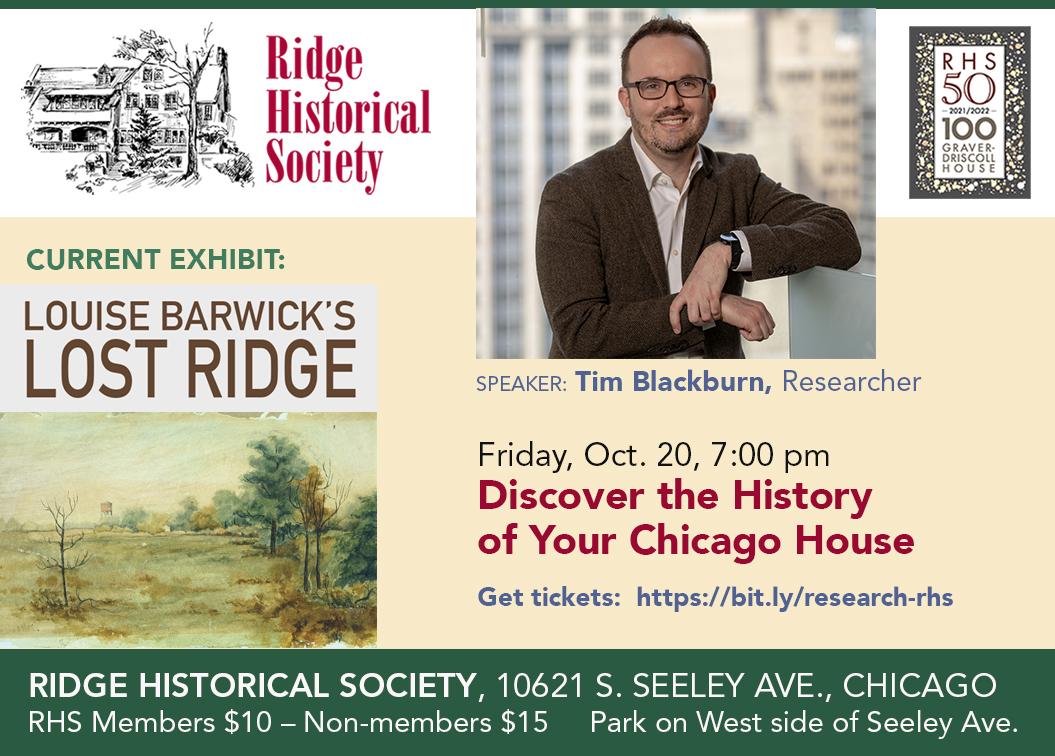
Friday, Oct. 20, 7:00 pm
“Discover the History of Your Chicago House” – Tim Blackburn, Researcher
You will learn how to research the history of your Chicago home, including the architecture, construction, inhabitants, and owners. You’ll develop research methods that will help you gain a new understanding and appreciation for your home’s history. The research methods covered will be useful for anyone researching a building older than 1955 in Chicago. You’ll learn about building permits, local history, Chicago street renumbering, Sanborn maps, and more.
Join us to find out more!
Tickets: Members: $10.00 Non-Members: $15.00 buy tickets online here:
https://bit.ly/research-rhs
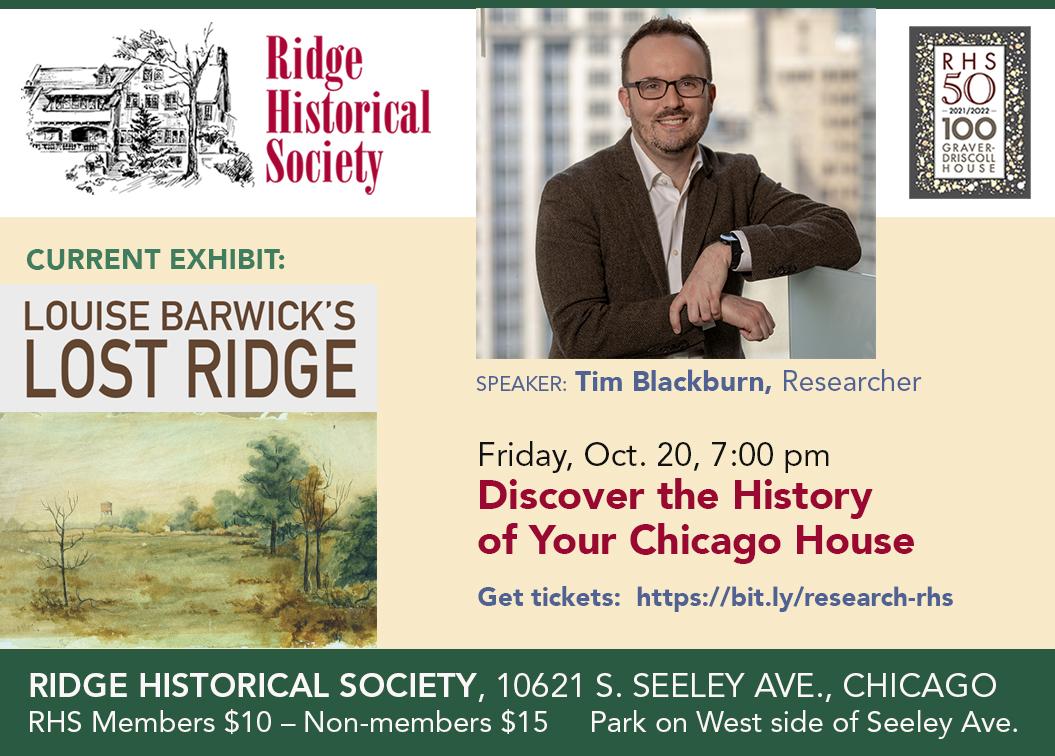
Friday, Oct. 20, 7:00 pm
“Discover the History of Your Chicago House” – Tim Blackburn, Researcher
You will learn how to research the history of your Chicago home, including the architecture, construction, inhabitants, and owners. You’ll develop research methods that will help you gain a new understanding and appreciation for your home’s history. The research methods covered will be useful for anyone researching a building older than 1955 in Chicago. You’ll learn about building permits, local history, Chicago street renumbering, Sanborn maps, and more.
Join us to find out more!
Tickets: Members: $10.00 Non-Members: $15.00 buy tickets online here:
https://bit.ly/research-rhs
Preserving historic buildings is very important for our heritage. Obviously, there are not enough resources to save every old house or building from the wrecking ball, but when there are people willing to raise the funds and do the work to repurpose a historic treasure for the good of a community, then those efforts should be supported.
In the Beverly community, the Ridge Historical Society is part of the effort to save the Eugene S. Pike House, located on the edge of the Dan Ryan Forest Preserve at 91st Street and Longwood Drive. We hope to have an update on the status of the Pike House soon.
In Joliet, efforts are underway to save the George Washington Casseday House. This article explores that. The house was built in 1851 by Casseday, who owned quite a bit of land in Joliet including the land the historic Joliet Correctional Center is built on.
It is now in the works to start an African American history museum in the building.
The Ridge Historical Society
The End of “Joliet Limestone”
By Carol Flynn
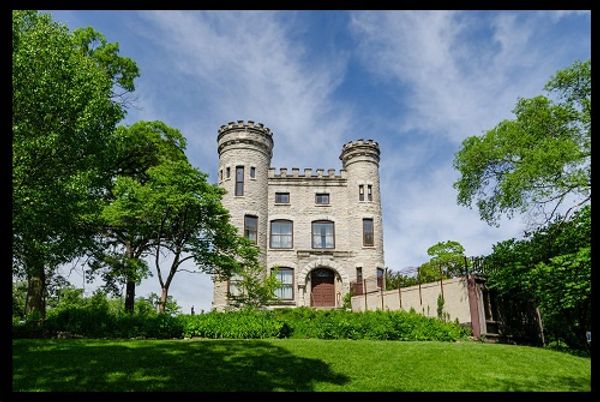
The Givins Beverly Castle, the Robert C. Givins House, located at the corner of 103rd Street and Longwood Drive, is Beverly’s best-known landmark. The Castle was built in 1887-88, which makes it over 130 years old.
But really, the Castle is millions of years old – it was constructed of “Joliet limestone.” The proper name for the stone is Joliet – Lemont dolomite, and its chemical composition gives it a yellowish or buff color not found in limestone which is usually more gray in color.
This material was quarried in the Joliet area and used for many buildings throughout the area, from the Water Tower and Holy Name Cathedral in downtown Chicago to the Joliet prison – and the Beverly Castle. The last documented building made of this stone was constructed in the 1940s – the All Saints Greek Orthodox Church of Joliet.
Last month, the last quarry in Joliet announced it was closing. This means it is more important than ever to preserve these buildings. The Beverly Unitarian Church, which owns and uses the Castle, completed restoration of its turrets in recent years.
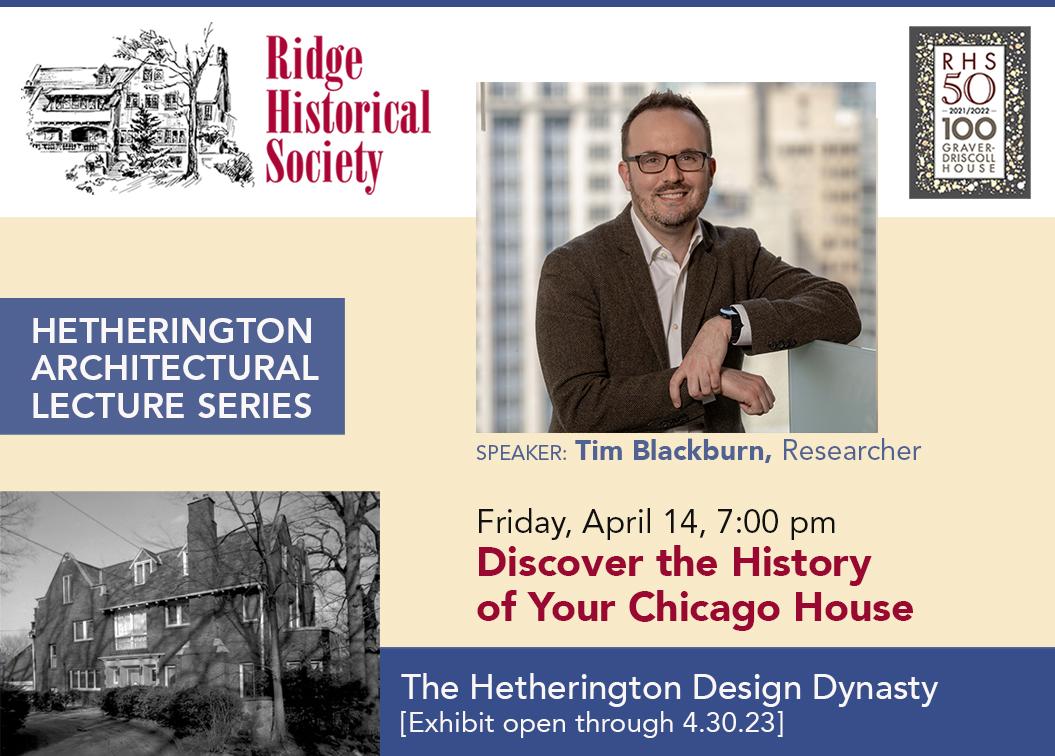
Researching Your Chicago Home
RHS researcher Tim Blackburn will show you how to discover the history of your home, including past inhabitants and construction.
Friday, April 14, 7:00 pm
“Discover the History of Your Chicago House” – Tim Blackburn, Researcher
You will learn how to research the history of your Chicago home, including the architecture, construction, inhabitants, and owners. You’ll develop research methods that will help you gain a new understanding and appreciation for your home’s history. The research methods covered will be useful for anyone researching a building older than 1955 in Chicago. You’ll learn about building permits, local history, Chicago street renumbering, Sanborn maps, and more.
The Ridge Communities of Beverly Hills, Morgan Park, Washington Heights and Mount Greenwood have an incredible collection of homes and housing styles — many with a rich history.
Join us to find out more!
RHS Members: $10
Non-Members: $15
The Ridge Historical Society is located at 10621 S. Seeley Avenue, Chicago. Parking is on the west side of Seeley Avenue. The building is not handicapped-accessible.
Buy tickets here: : https://bit.ly/rhs-research