
Explore the RHS Facebook Archives, a rich repository of local history written by Carol Flynn. For two decades, Carol brought a deeply dedicated voice to public education at RHS. Her role as Facebook administrator through mid-2025 naturally extended her prolific research into meticulously detailed articles, most notably her multi-part historical series posts. Today, Carol continues her local history writing for The Beverly Review and other outlets.
Local Architecture
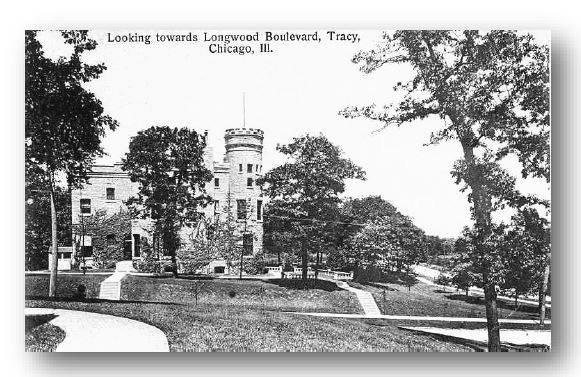
Tomorrow is Valentine’s Day, which brings to mind tales of love and devotion. Beverly/Morgan Park has its share of love stories (and a few scandals, but that is for another day). One of the most compelling surely has to be that a man built an actual castle for his new bride. We’re talking about the Givins Castle at 103rd Street and Longwood Drive, of course. This entire story has a lot of urban myth attached to it, and here are the real facts.
Robert Cartwright Givins was a very popular man in Chicago, very well-liked. The newspapers often referred to him as “Bob,” something unusual for the formal times of the late 1800s. He was a real estate developer, a lawyer, a writer of romance and science fiction novels, a world traveler, and the biggest booster of Chicago to be found. Bob Givins was even proposed for mayor. He had moved to Chicago from Canada, and his family came from Northern Ireland Protestant descendancy.
Givins lost his first wife and three of his four children at an early age. Only one son, Robert Saltern Givins, made it to adulthood – and he was involved in one of the scandals we will save until later.
On August 17, 1884, the Inter Ocean newspaper ran this little blurb: “Mr. Robert C. Givins has gone to St. Paul and Lake Minnetonka. Will he come back alone?”
Givins came back with a new wife, the former Emma Steen. Emma was a Chicago school teacher, 13 years younger than Givins, and of Norwegian descent. They built the Castle on the hill in Tracy, as the area was then known, in 1886-87. Tracy was the name of the street that would become 103rd Street.
Now we get to some of the myths. First, that Givins visited Ireland, saw this castle on the River Dee, and came home and built it for his new wife. Well, there is no documentation of this that we have found – yet. It seems the first time this was mentioned was about 50 years after the Castle was built. It actually could be highly likely that the Castle was built due to Masonic influence – the Givinses were very active in the Knights Templar of the Masons.
Second, there is a myth that the Givinses never lived in the Castle. They most certainly did. There are numerous newspaper articles about their activities there, and their involvement in the local community. They even brought a trendy new game to the Ridge: “pin-the-tail-on-the-donkey.” During the winters, they took up rooms in downtown hotels, which is something the rich living outside the city often did to avoid the commute downtown for business and social activities.
Givins was in favor of the annexation of Washington Heights, which included Beverly, to Chicago in 1890. He sat on the finance committee for the first Church of the Mediator at 110th St. and Hoyne Ave.
Emma Givins was a strong supporter of education for women and teachers’ rights. She was a founder of an early domestic science school through the Chicago Woman’s Club. This was a forerunner of today’s Family and Consumer Sciences programs.
The Castle was sold in 1909. The Givinses divided their time between the north suburbs and Sarasota, Florida. Emma died in 1914 at the age of 56. Bob died the following year, age 69. They are buried in Rosehill Cemetery on Chicago’s north side.
– Carol Flynn, RHS Communications @ridgehistoricalociety
A New Year brings new ideas and enthusiasm for celebrating the rich history of the Beverly Hills, Morgan Park, Washington Heights, and Mt. Greenwood neighborhoods on the far southwest side of Chicago. With this post, the Ridge Historical Society will be starting new features to reach out for stories, questions, and pictures. This is your community, this is your history, this is your society! We hope you will like and share this page and these posts so we can reach as many people as possible.
The area is known for its outstanding and diverse architecture. We have everything from Queen Anne to Prairie style, from Art Moderne to Chicago bungalows. To drive, walk or bike around the neighborhood is to constantly delight in the scenery. We even have our own castle!
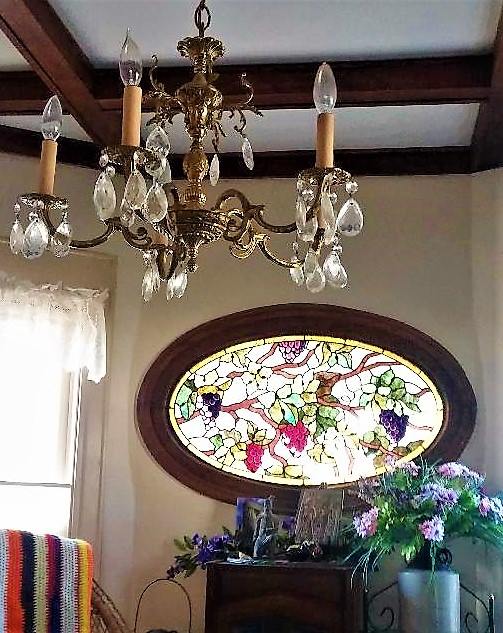
But the outsides of the houses are just one aspect. Inside the houses are delightful and charming features we rarely get to see. Last week, I was in a house that boasted a graceful, romantic original stained glass window as well as an original chandelier. Here is a picture. So often features like these have been removed with renovation and it is wonderful to find them preserved.
I invite you to share pictures of original features in your house or others you have seen. As most of these are private residences, we won't reveal addresses. I know we'll all enjoy these pictures.
Published by Carol Flynn – RHS Communications.