
Explore the RHS Facebook Archives, a rich repository of local history written by Carol Flynn. For two decades, Carol brought a deeply dedicated voice to public education at RHS. Her role as Facebook administrator through mid-2025 naturally extended her prolific research into meticulously detailed articles, most notably her multi-part historical series posts. Today, Carol continues her local history writing for The Beverly Review and other outlets.
Local History
The Ridge Historical Society
Memorial Day 2025
By Carol Flynn
This is Memorial Day weekend.
The purpose of Memorial Day is to remember the people who died while in military service to the United States of America.
Throughout its history, the Ridge communities have sacrificed many loved ones to U.S. military service.
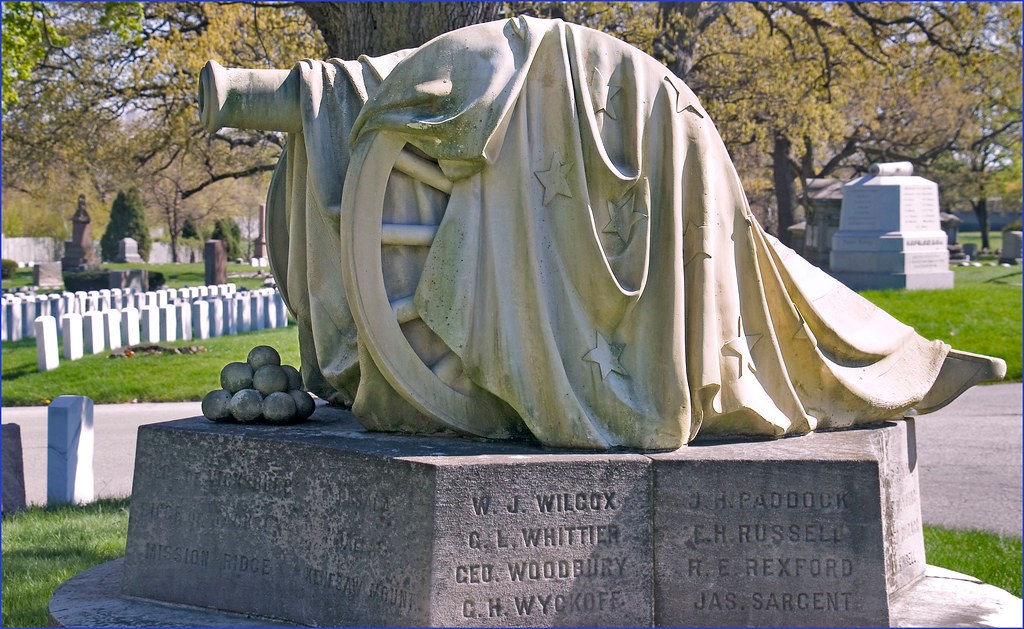
Among the earliest settlers on the Ridge were the Rexford, Wilcox, Morgan, and Barnard families. They all had sons who left the family farms to fight on the side of the Union in the U.S. Civil War. They were all friends, and they fought together in various units.
The Rexford family came to the Ridge first, in 1834. According to an 1889 history, the Rexford brothers, Roscoe and Everett, were “delighted” to join their friends at Camp Smith, Cairo, Illinois, in July of 1861. But soon, youthful visions of camaraderie and glory gave way to the grim reality of war.
Roscoe died at the age of 21 in 1862, after the Battle of Fort Donelson at the Tennessee–Kentucky border. He died from an unspecified illness – two/thirds of Civil War fatalities were due to illnesses such as malaria, typhoid, and pneumonia. He is buried in Mt. Greenwood Cemetery
The Wilcox family, which arrived on the Ridge in 1844, sent four of five Wilcox brothers off to fight in the war. The other son remained home to run the farm, a common practice of the day.
Two Wilcox brothers never came home. John was killed in 1863 and buried at Chattanooga, Tennessee. Wilbur was killed in Mississippi in 1863.
The Morgan and Barnard families fared better. Of the five sons who collectively fought in the war, all survived. The Morgans arrived in 1844, and the Barnards in 1846, when William Barnard was hired to be a tutor for the younger Morgan children.
Roscoe Rexford and Wilbur Wilcox were both members of the Company A, First Illinois Artillery Volunteers (“Battery A”), along with their brothers and the “Morgan boys.”
There is a monument to Battery A at Rosehill Cemetery on the north side. The names of those who died in service are inscribed in the base. R. E. Rexford and W. J. Wilcox are listed.
John Wilcox fought under his friend, Daniel Barnard, who formed his own company, Company K, 88th Infantry, Illinois volunteers.
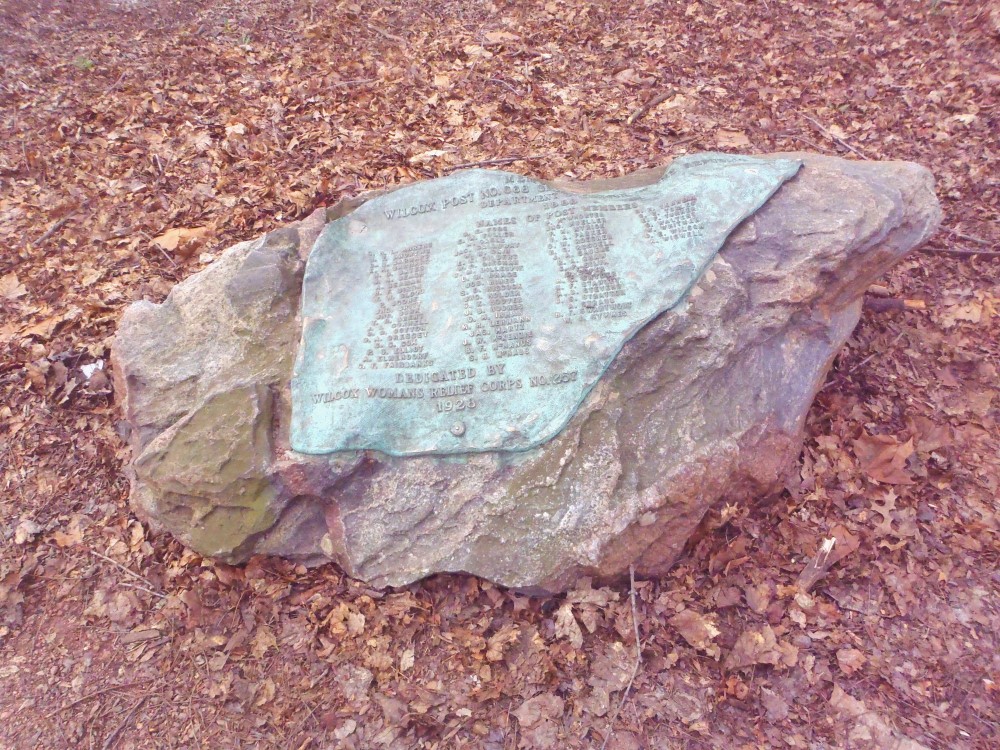
The Grand Army of the Republic (GAR) was founded in 1866 as a fraternal organization for veterans of the Union military. A local branch, Wilcox Post, No. 668, was founded in 1889, named in honor of the Wilcox brothers.
A stone and bronze marker listing the charter members, created in 1926, is installed at Ridge Park at 96th Street and Longwood Drive as part of a grouping of six memorial stones recognizing military service in various war periods. Daniel and Erastus Barnard, two of the Barnard brothers who were veterans and continued to live on the Ridge, are listed as charter members. The GAR dissolved in 1956 at the death of its last member.
This post cannot begin to list all of the U.S. military people from the Ridge who lost their lives in service to the country – World Wars I and II, Korea, Vietnam – there are hundreds of names on the list.
However, attention can be drawn to memorials that honor more recently fallen individuals.
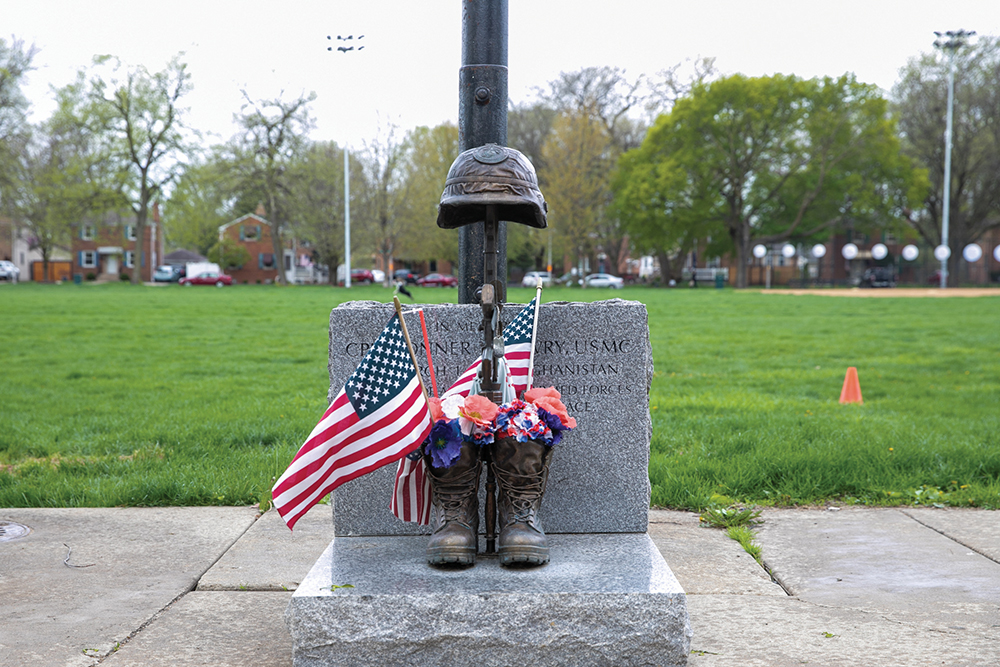
At Beverly Park, 2460 West 102nd Street, Cpl. Connor T. Lowry, USMC, is recognized. Born in 1988, this young man was raised in Beverly. He lost his life in 2012 in Afghanistan while conducting combat operations.
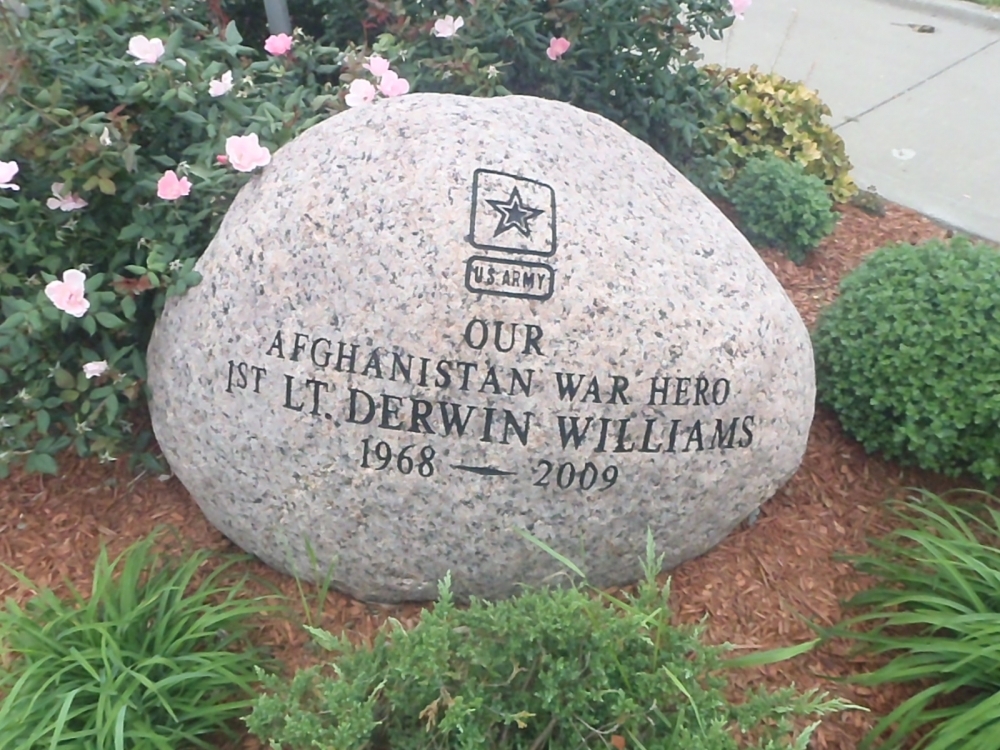
First Lt. Derwin Williams of the Illinois Army National Guard was killed in Afghanistan in 2009. There is a monument to him at 98th Place and Throop Street.
Here is a list of many of the monuments to service personnel in and near this community. How many times do we walk by these monuments and statues and give them little regard?
Ridge Park – Six memorial stones, including one of the oldest on the Ridge, installed in 1926.
Graver Park – World War I
Kennedy Park – Korean War
Beverly Park – Connor T. Lowry, Afghanistan
Dan Ryan Woods – Gold Star Mothers
Morgan Park High School flagpole and inside exhibit – graduates and staff
112th Street and Lothair Ave. – Memorial Triangle
98th Place and Throop Street – Derwin Williams, Afghanistan
111th Street and Kedzie Avenue – American Legion
Memorial Park in Blue Island – Gravestones, memorials, artillery
97th Street and Kedzie Avenue – American Legion Post artillery and eternal flame
Mount Greenwood Cemetery – Civil War veterans’ graves and cannon replica
Mount Hope Cemetery – Civil War veterans section
Beverly Cemetery – Veterans monument
Lincoln Cemetery – James Harvey, U.S. Colored Troops
Mount Olivet Cemetery – “Doughboy” grave statues
Morgan Park Academy – graduates and staff
Memorial Day is not really about having a three-day weekend to kick off summer with a neighborhood run, then “sticking around” for a parade, then going home for a barbecue.
It is about recognizing the people who died to give us – ALL of us – the freedom to enjoy those kinds of events.
The Ridge Historical Society
July 4, 1925 – Fireworks
By Carol Flynn
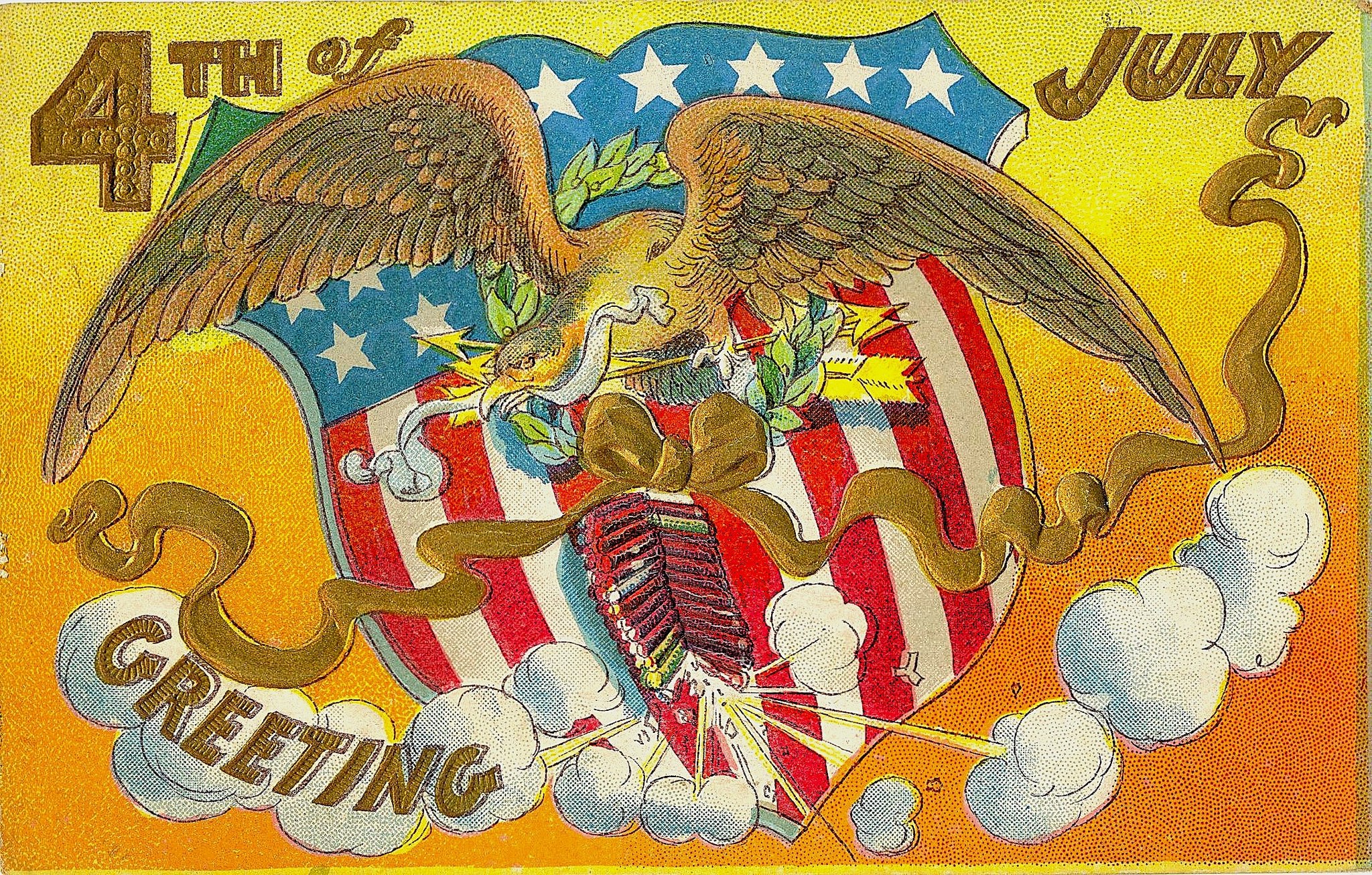
One hundred years ago on the Ridge, the community held a July 4th festival at Ridge Park at 96th Street and Longwood Drive.
Included were sporting competitions, awards for a house-decorating contest, a historical pageant, and family picnics.
The day started early with the “explosion” of a fireworks “bomb” calling people to the festivities. Fireworks also were displayed in the evening.
Fireworks are a significant part of the United States Fourth of July holiday – “the rockets’ red glare, the bombs bursting in air…,” and all that.
However, in Chicago and in Illinois, there are strict regulations on the possession and use of fireworks – which largely go unheeded.
Fireworks have created controversy since the earliest days in Chicago. The issues mainly relate to safety and fire prevention, of course.
As early as the 1860s, there were city ordinances banning the storage and use of fireworks without permits in the city. Following the Great Chicago Fire in 1871, the city increased its efforts to establish and enforce controls, but especially at the time of July 4, the ordinances were largely ignored.
And the members of the Chicago City Council themselves did not always support the ordinances.
In 1883, for example, the City Council lifted the ban on fireworks and shooting off firearms just for the 4th of July. They had given way to the demands of their “friends” who were sellers of fireworks.
The result was numerous deaths and injuries. The Chicago Tribune had taken a stance against lifting the ban for even the one day, and after the holiday, challenged Mayor Carter Harrison, Sr., on the decision, given the damage that occurred.
“I don’t think it would have made any difference. Five thousand policemen could not have prevented them from shooting,” said the mayor. “The Lord takes care of the boys. Some of them may get banged up a little, but they will come out all right. I do not believe in taking away the Fourth of July from them. It is a day that they should commemorate and hold sacred.”
The Tribune reported on the people who “got banged up a little.”
They included Thomas Kelly, a railroad man, who was shot in the abdomen by “a wild pistol shooter” and languished for several days before dying in the hospital.
There was also Charles Heradek, killed by a 13-year-old boy, whose mother told him to put the gun away and keep his mouth shut about what he had done.
Nine-year-old Katie Willard was killed by a bullet that lodged in her spine; young sisters Lizzie and Rosa Younk were “maimed” by a large firework; John Anderson was shot in his hand by his little boy; Thomas Garrity, 18, received a “large ragged wound in the face near the left eye” from a “toy pistol in the hands of a friend.”
A court ruling in 1903 caused cities across the U.S. to look at the fireworks situation with a new seriousness.
A fireworks explosion at an election night event in November 1902 in Madison Square Garden, New York City, resulted in a death and other serious injuries. The city’s aldermen had suspended the ordinance banning fireworks to allow the political parties to hold such events.
The court found that the city could be held liable for the deaths, injuries, and damage. New York City was successfully sued by several parties.
This caused cities to renew their commitments to enforcing bans and requiring permits for fireworks.
By 1925, selling and using fireworks and shooting guns within the Chicago city limits were banned by city ordinances. Fireworks could be used at events by experienced handlers with permits.
In late June 1925, the city vowed to “rigidly enforce” the laws on illegal fireworks. There had already been 14 deaths and two major fires from fireworks explosions leading up to the July 4th holiday.
An 8-year-old boy, Daniel Perry, had died from eating a firecracker. Another woman, Sophia Oxstein, walking down the street carrying her baby, had been hit by a charge from a “toy cannon” built by a 17-year-old neighbor.
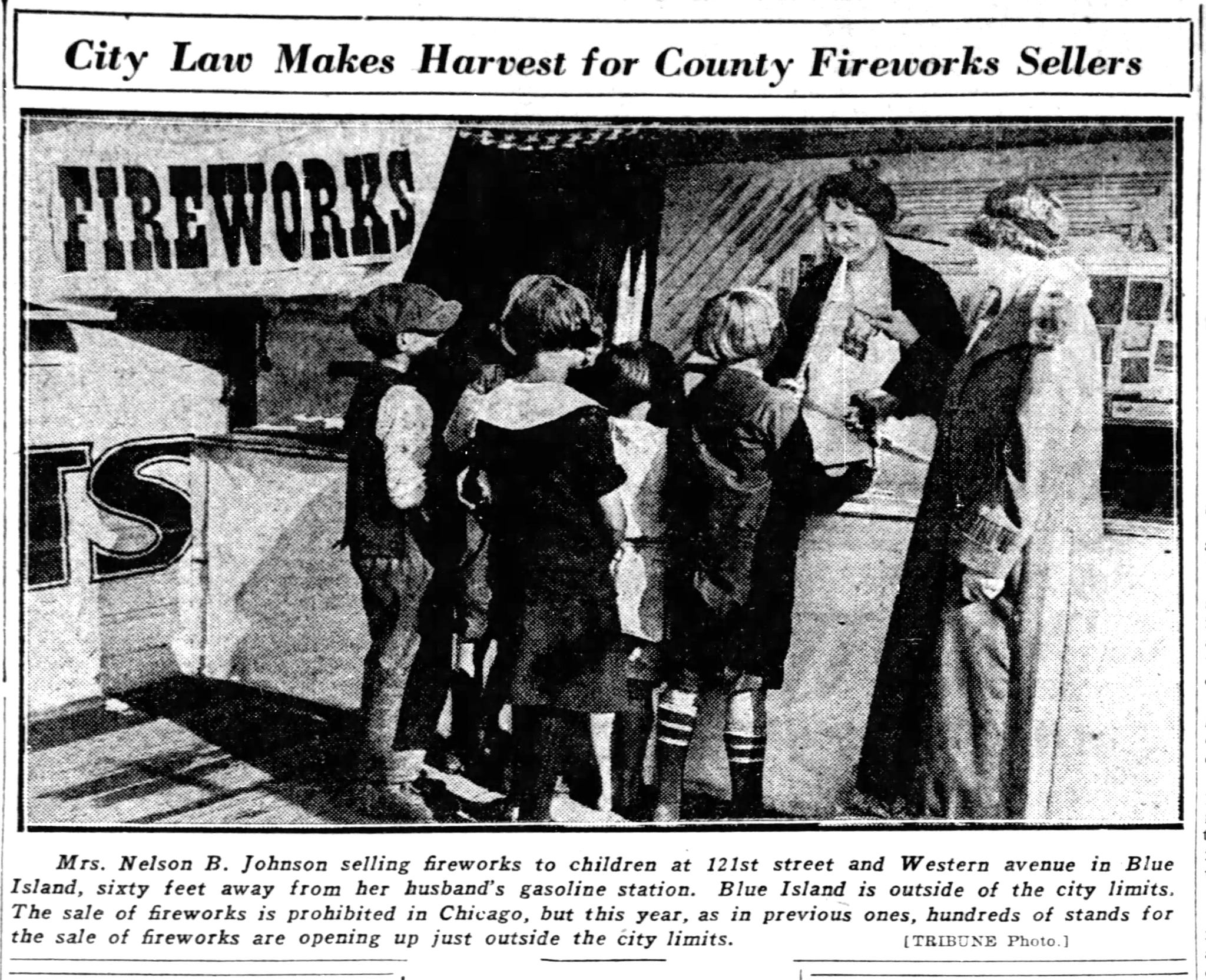
But fireworks could still be legally purchased in the rest of Illinois, and Chicago residents only had to walk across the street into a suburb to find roadside stands.
Ridge residents could cross 119th Street into Blue Island and find a fireworks stand just two blocks away. Chances are they could also find them in Evergreen Park across Western Avenue.
The Chicago Fire Commissioner had contacted 65 nearby municipalities to ask for their help in stopping illegal sales of fireworks, but not all had replied.
The purveyors of illegal fireworks caught in Chicago were given three options: “Put the fireworks in a water barrel, take them outside the city limits, or be arrested.”
On January 1, 1942, Illinois implemented a law to prohibit the sale and use of fireworks within the state. City and county officials would be allowed to grant permits for supervised displays, with a “competent individual” handling the display.
Today, Illinois has one of the most restrictive laws controlling the sale and use of fireworks, and even some of the items the state allows, like sparklers, are prohibited in the City of Chicago. Other states have various restrictions, and a few states have no restrictions at all.
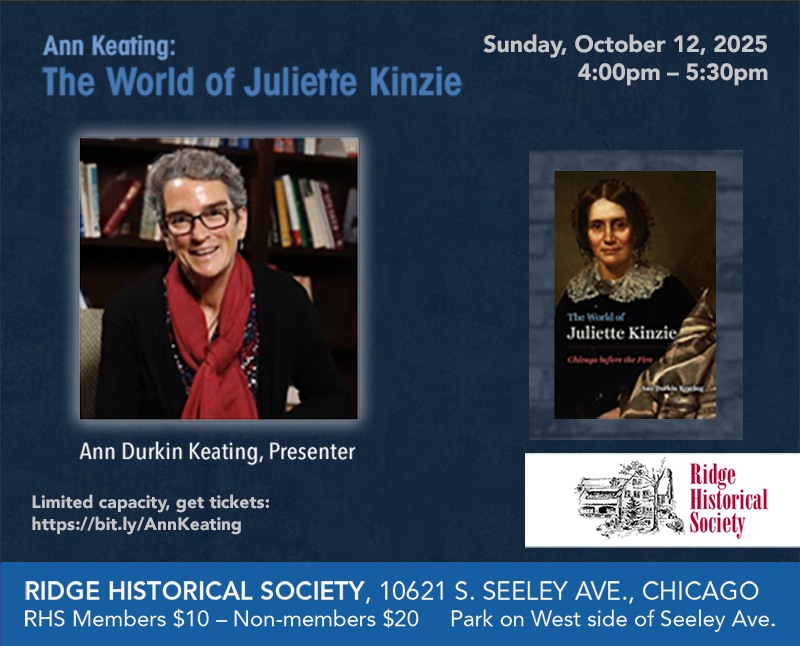
Ann Keating: The World of Juliette Kinzie
Date: October 12, 2025 4pm
Join us for author Ann Durkin Keating discussing her book,
The World of Juliette Kinzie: Chicago before the Fire.
Juliette Kinzie was also a writer and an important figure in documenting the history of early Chicago. Juliette, one of Chicago’s forgotten founders, and other women worked to create an urban and urbane world, often within their own parlors.
When Juliette Kinzie first visited Chicago in 1831, it was anything but a city. An outpost in the shadow of Fort Dearborn, it had no streets, no sidewalks, no schools, no river-spanning bridges. And with two hundred disconnected residents, it lacked any sense of community. In the decades that followed, not only did Juliette witness the city’s transition from Indian country to industrial center, but she was instrumental in its development.
About the Presenter: Ann Durkin Keating holds the C. Frederick Toenniges Professorship at North Central College in Naperville, Illinois. She is a history professor and chair of the History Department. She has taught at the college since 1991. She spearheaded publication of the book, ''Encyclopedia of Chicago'', and appears regularly as a public speaker and is often quoted as an expert source about Chicago-area history.
Keating was born in Evanston. She earned a bachelor of arts degree from the University of Illinois, and master of arts and doctorate degrees from the University of Chicago. She has written numerous books on the Chicagoland area including “Chicagoland: City and Suburbs in the Railroad Age” and “Chicago Neighborhoods and Suburbs: A Historical Guide”.
Members: $10 | Non-members: $20 | Students under 18: $5
Ridge Historical Society
10621 S. Seeley Ave., Chicago, IL 60643
Limited Capacity. Get tickets here: https://bit.ly/AnnKeating
RSVP: ridgehistory@hotmail.com 773.881.1675
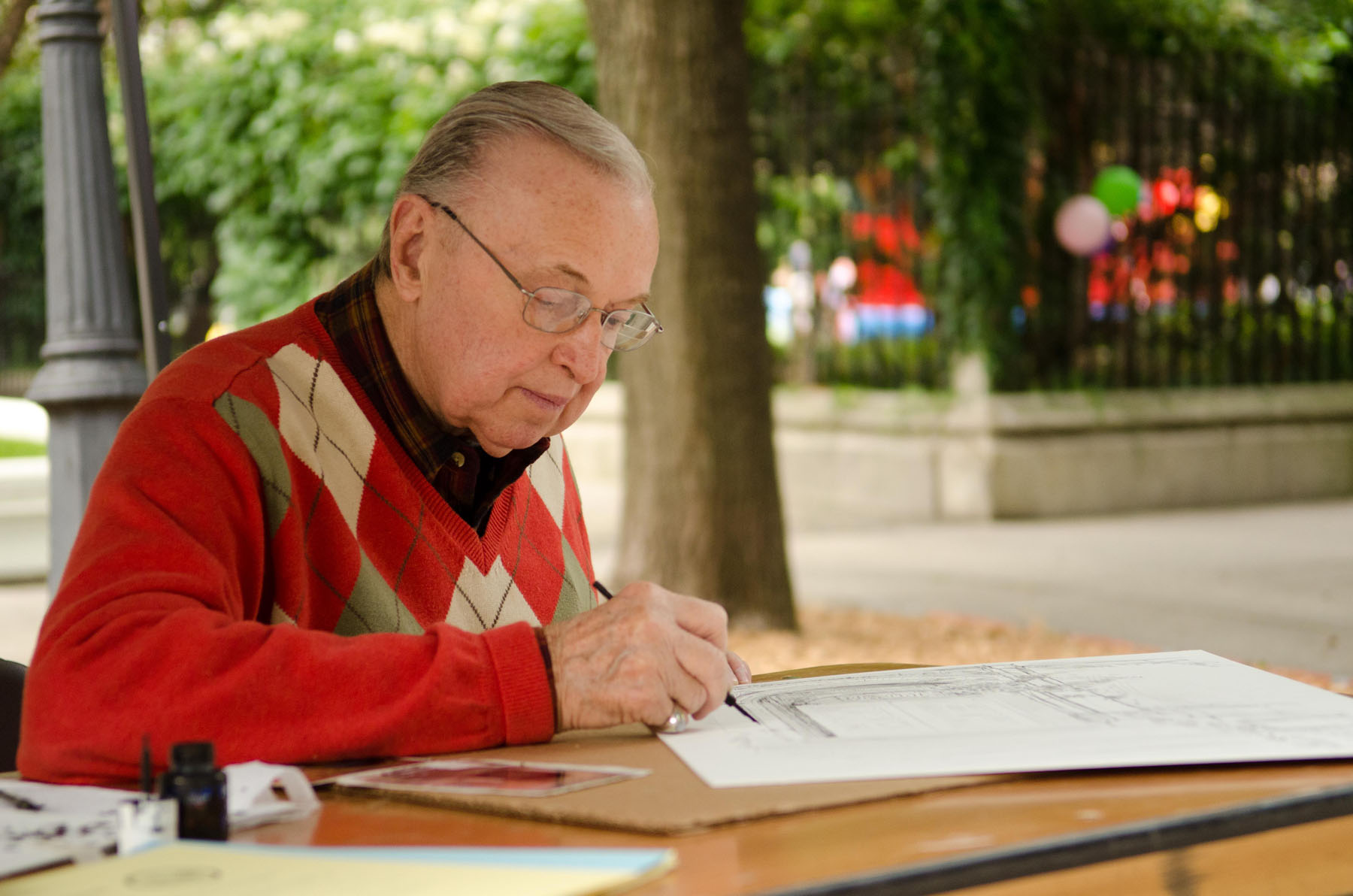
Today, we celebrate what would have been the 90th birthday of Jack Simmerling (1935–2013). A beloved artist, historian, and preservationist, Jack holds a special place in our history as a founding board member of the Ridge Historical Society in 1971.
From his start as a teenager preserving and documenting the vanishing grandeur of Victorian-era residences on Prairie Avenue to his long career capturing the architecture of Chicago through his art, Simmerling was nothing short of prolific. His paintings and drawings of his own neighborhood of Beverly Hills-Morgan Park continue to be a cherished visual identity of the community he loved.
Join us in celebrating Jack’s legacy. What is your favorite artwork or memory of Jack? Are you fortunate to have a Simmerling drawing or painting of your home? Did you take art classes from Jack? We’d love to hear some of your memories.
How well do you know Jack? Try these trivia questions:
1. In college at Notre Dame, Simmerling was known for his passion for Victorian-era design. As a result, a professor referred to him by what affectionate nickname?
Answer: "The last Victorian."
2. Which famous Chicago landmark did Simmerling document in a series of five paintings after his mother took him to see it being prepared for demolition in 1949, around the time of his 14th birthday?
Answer: The Potter Palmer Castle on the 1300 block of N. Lake Shore Drive. It was this visit that particularly piqued his interest in Chicago's vanishing Victorian-era architecture.
3. Jack once received criticism from a professor about his drawing of hands, which was likened to a bunch of what vegetable?
Answer: Carrots. After this, he focused on buildings and landscapes.
4. Where did Jack Simmerling first open The Heritage Gallery in January 1959?
Answer: 1973 W. 111th Street in Morgan Park. The gallery moved to 1913 W. 103rd Street in 1977 and 1907 W. 103rd Street in 2013. Today, Victoria Simmerling carries on the family legacy at the 1907 W. 103rd Street address.
5. What Morgan Park building did Simmerling restore in 1970 and rename "Heritage House," which was featured on the very first BAPA Home Tour in 1971?
Answer: His own home, the Ingersoll-Blackwelder house at 10910 S. Prospect Avenue. BAPA’s executive secretary at the time credited a large part of the success of the first home tour to the inclusion of the house, which had been rescued from demolition a year prior.
6. In 2001, Simmerling had two large sandstone bollards installed in front of the Ingersoll-Blackwelder house. From what Prairie Avenue mansion site did he recover them?
Answer: The site of the demolished Hanford House (2008 S. Calumet Avenue), which was destroyed by fire in 1953. The bollards were unearthed when the site was being redeveloped in 2001. Jack was fascinated by the "cursed" history of the Hanford House. You can view items he salvaged following the fire in the current exhibit at Ridge Historical Society.
7. Jack Simmerling was known for his love of music and owned a collection of nearly a dozen of what type of instrument?
Answer: Pianos. Inspired by his mother (a church organist at Sacred Heart Mission Church) and his grandmother (a silent movie pianist), he was passionate about music perhaps even more than art and architecture.
8. Jack was forced to switch his primary painting medium from oil to which other medium due to a skin allergy?
Answer: Watercolors. He increasingly worked in pen-and-ink as well.
9. Simmerling frequently included two specific details in his watercolors because the colors and light “beguiled” him. What were they?
Answer: Snow and puddles.
—-
If you haven't visited yet, now is the perfect time to experience "Jack Simmerling: Through His Eyes."
Produced in partnership with Glessner House, this exhibit traces Jack's artistic evolution and preservation efforts from his teenage years through his long career. The collection features rare artifacts, including the Hanford House items mentioned above, plus many artworks and artifacts from the Glessner House Jack Simmerling Collection.
Exhibit on view through February 2026 at Ridge Historical Society, 10621 S. Seeley Ave. Open Tuesdays and Sundays from 1 PM – 4 PM, or by appointment.