Explore the RHS Facebook Archives, a rich repository of local history written by Carol Flynn. For two decades, Carol brought a deeply dedicated voice to public education at RHS. Her role as Facebook administrator through mid-2025 naturally extended her prolific research into meticulously detailed articles, most notably her multi-part historical series posts. Today, Carol continues her local history writing for The Beverly Review and other outlets.
Local History
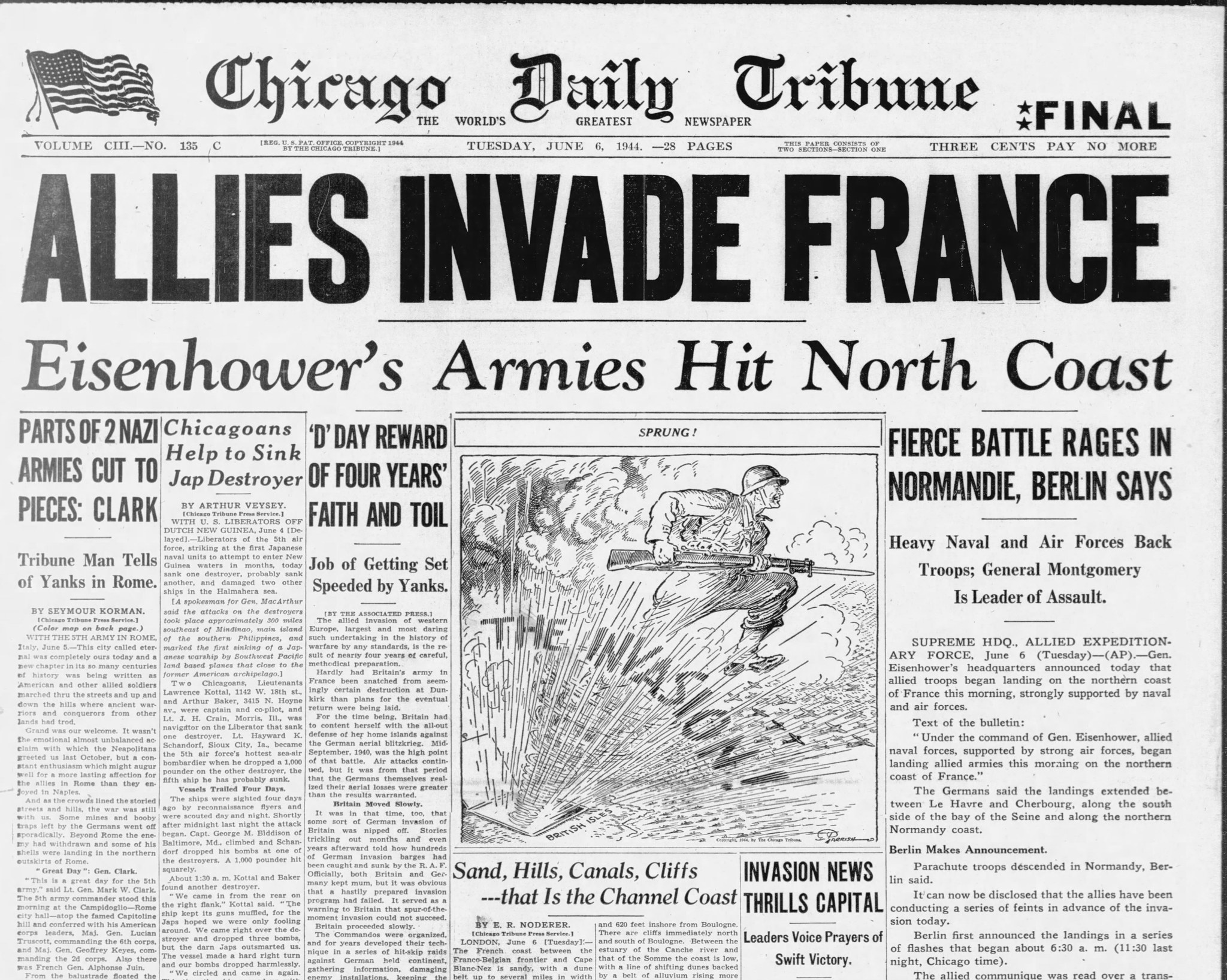
June 6, 1944, headlines in the Chicago Tribune. That summer, the news was dominated by the war in Europe. Many servicemen from Chicago and the Ridge fought bravely to stop the Nazis and fascist regimes from taking control. There are few World War II veterans still with us today.
The Ridge Historical Society
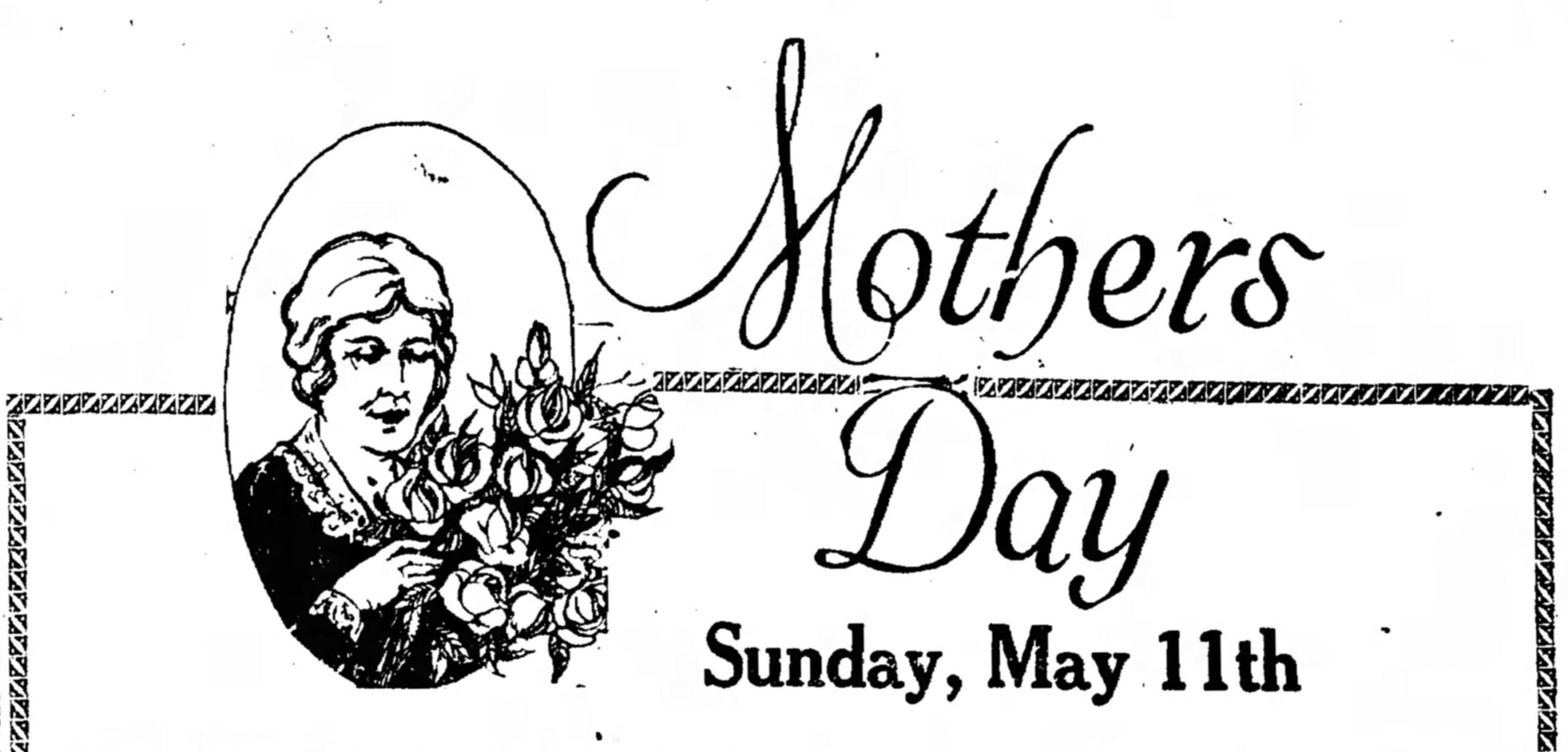
Mother’s Day One Hundred Years Ago
By Carol Flynn
The modern Mother’s Day in the U.S. grew out of the peace movement following the U.S. Civil War. Peace activists Ann Reeves Jarvis and Julia Ward Howe called for a “Mother’s Day for Peace” when mothers collectively would advocate that their children not be sacrificed as soldiers in wars.
When Ann Reeves Jarvis died in 1905, her daughter Anna Jarvis wanted to honor her and all mothers, and started a liturgical service in West Virginia. She proposed a national Mother’s Day, and President Woodrow Wilson declared the first officially recognized Mother’s Day in the U.S. in 1914.
Anna Jarvis always wanted the day to be one of prayer, thanks, honor, and personal reflection, and was opposed to the commercialism that crept into the holiday. She protested at a candy makers convention in 1923 and against the sale of carnations for Mother’s Day in 1925, where she was arrested for disturbing the peace.
At this time on the Ridge and nearby areas, the church influence was still very strong, but the commercialism that would come to own Mother’s Day was in evidence.
The Protestant community spent most of their Sundays in church back in those days, and in 1924, the local churches led the way in recognizing Mother’s Day. Everyone was encouraged to attend services “for mother’s sake.”
Church started with Sunday School and one topic that year was “What We Owe Our Mothers.”
The first service of the day offered sermons on topics like “Mother’s Unfeigned Faith” and “A Mother’s Heart.” Printed copies of the sermon “A Godly Mother” were distributed to the congregants at one church.
Choir programs included “Songs Mother Used to Sing.” Duets and solos included “My Mother’s Bible” and “Wear a Flower for Mother.”
Special christening services for children were held.
After Sunday dinner at home, people returned to church for evening services.
Evening services contained entertainment/educational programs as well as liturgical services. At one church, a large men’s chorus sang Mother’s Day songs, followed by a testimony meeting honoring mothers. Another church gave every mother who attended evening service a rose or a tribute booklet. A third church showed a stereopticon on “A Child and His Mother.”
Other social events also went on, usually on weekdays, not on Sunday, because Sunday was for church. Sororities and other groups gave annual Mother’s Day parties, luncheons, and teas that included music and drama programs. At one event. the local paper reported that “Miss Sadie Minrath danced the ‘frisco’ with Miss Anne Green at the piano.” The “frisco” was a popular contemporary dance, the first one set to jazz music.
At the same time, commercial gifts and services were beginning to take hold in the community, and advertisements were appearing in the newspapers.
Greenhouses and florist shops promoted blooming plants and flowers as good gifts for Mother’s Day. Novelty shops promoted commercially made cards, started by the Hallmark Company, and items like stationery. Candy stores promoted special boxes for the day.
Photography studios promoted their services for portraits. Dance studios promoted dancing lessons.
Frank’s Department Store at 63rd Street and Ashland, a popular shopping spot, used the day to advertise women’s shoes, handbags, gloves, and “dotted voile and tissue gingham dresses, trimmed with lace and organdies,” on sale for $2.98, down from $3.50.
As one advertiser put it, the question wasn’t whether or not to recognize your mother on this day, the question was how to do it.
Image from a flower ad, May, 1924.
The Ridge Historical Society
More on Aerial Photography
By Carol Flynn
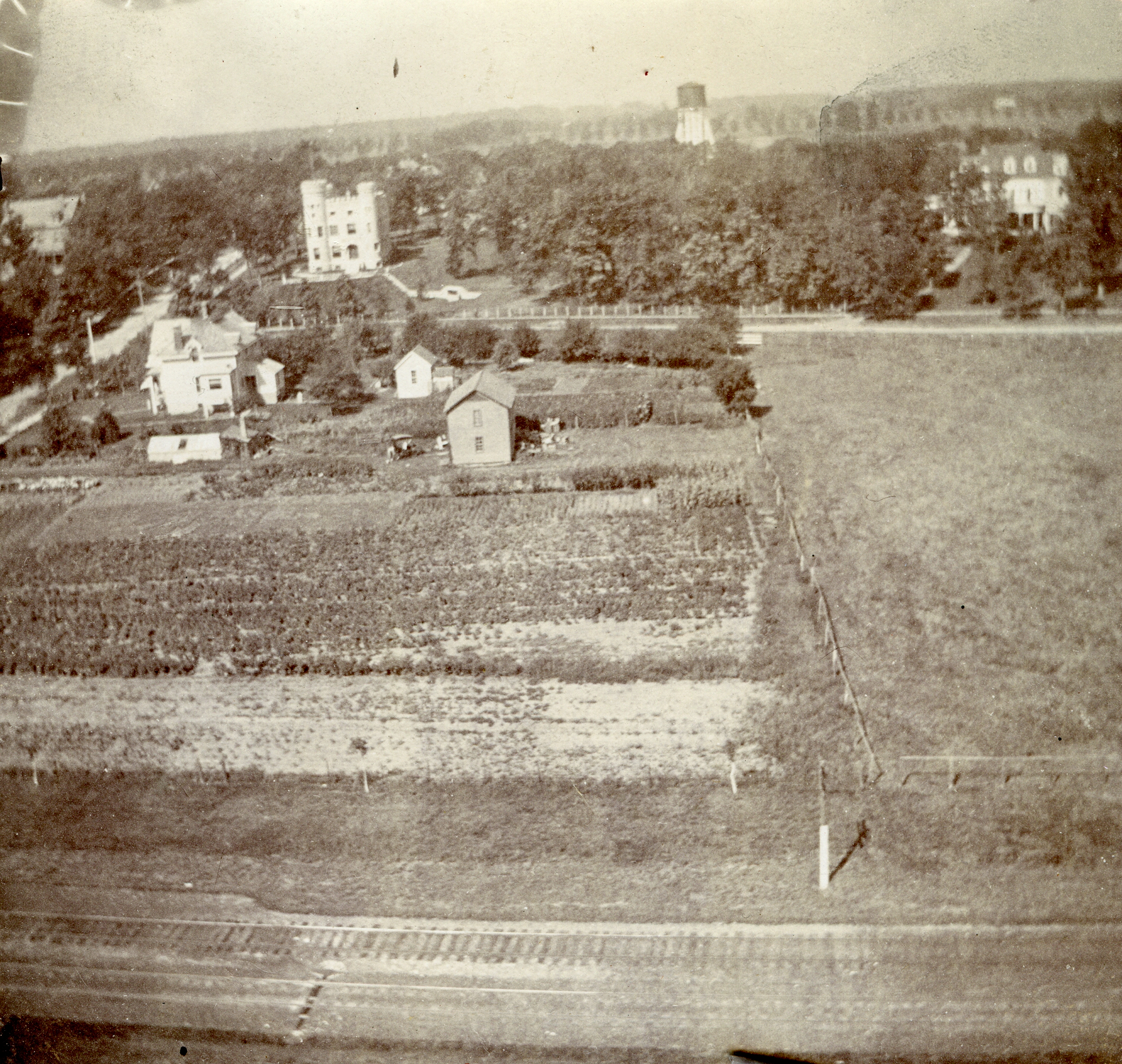
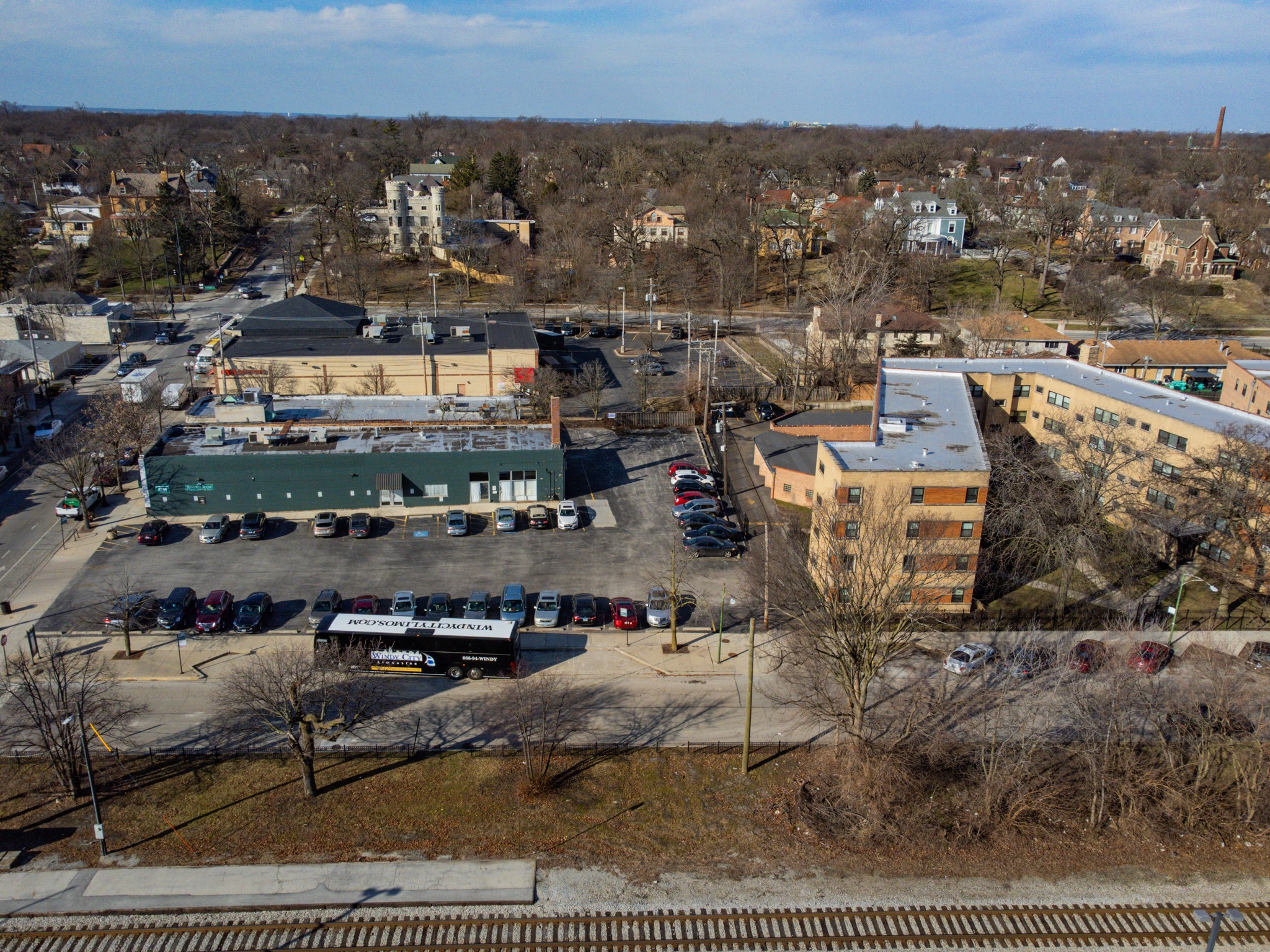
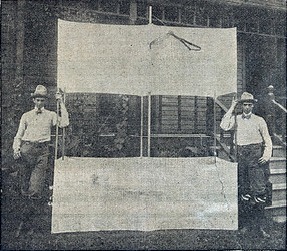
The current Ridge Historical Society (RHS) exhibit, “Louise Barwick’s Lost Ridge,” includes aerial photographs taken in 1899 by young men who attached a camera to a kite and sent it soaring over the community.
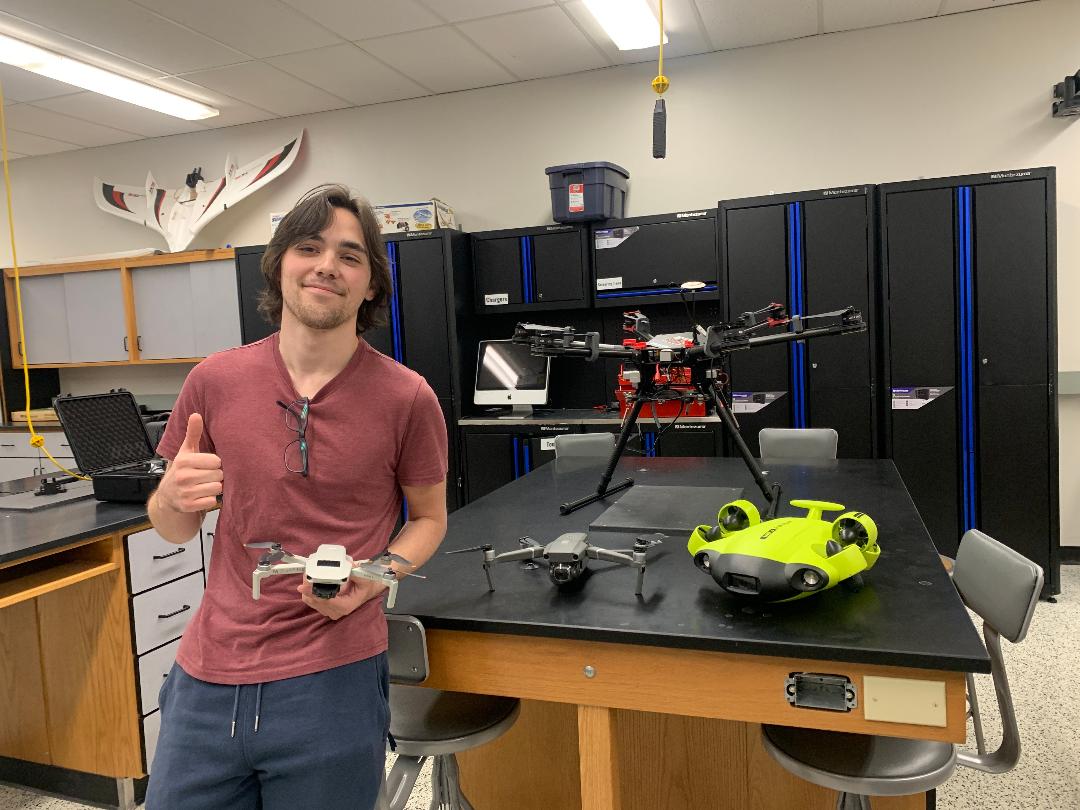
As covered in this article in the Beverly Review, in February, a college student from Morgan Park, Ben Johnson, took photos of those same views using drone technology:
https://www.beverlyreview.net/news/community_news/article_6454103a-0192-11ef-b6e6-53a4c44db920.html
Here we present the “then-and-now” photos of the area surrounding the corner of 103rd Street and Longwood Drive, as well as images of the photographers.
For more information on the topic, visit the RHS exhibit on Tuesday and Sunday afternoons from 1:00 to 4:00 p.m. RHS is located at 10621 S. Seeley Avenue.
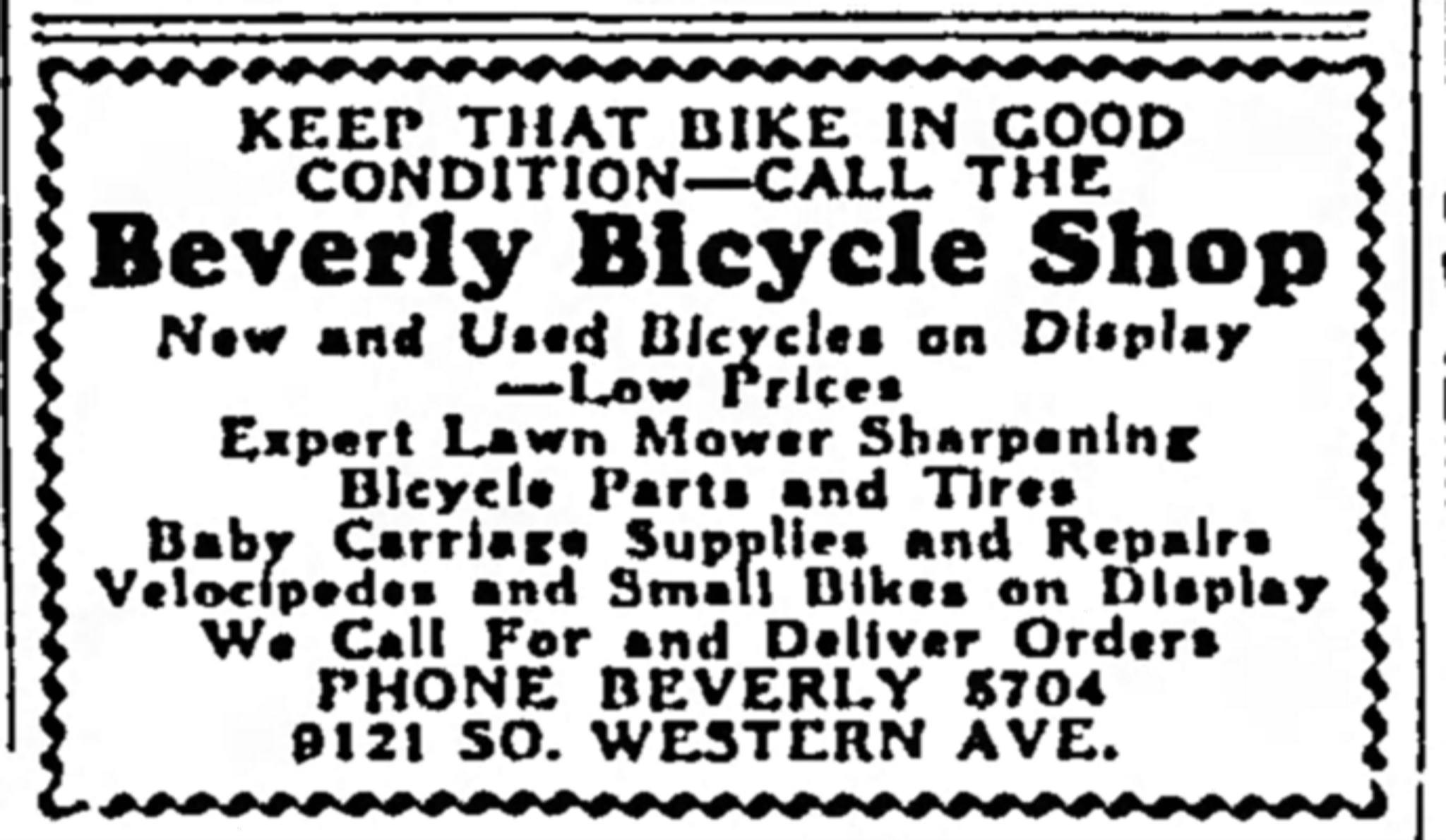
Beverly Bike and Ski Inc. at 9121 S. Western Avenue is a historic business in the community, with roots going back to the 1920s – actually, longer than the 100 years mentioned in this headline.
By 1920, James and Bessie Kosar and their family were already living at 9121 S. Western Ave. From directories and other sources from the time, it appears they ran a grocery there and started the bike shop, also, which was called the Beverly Bicycle Shop, but provided many services, as the attached ad shows.
At the time, Western Avenue was very rural, but it was a thoroughfare connecting the north side to the south side for many miles. There had been stopping places along the route for many years, as it was one of the routes used to reach the cemeteries (Mt. Greenwood, Mt. Hope, Mt. Olivet).
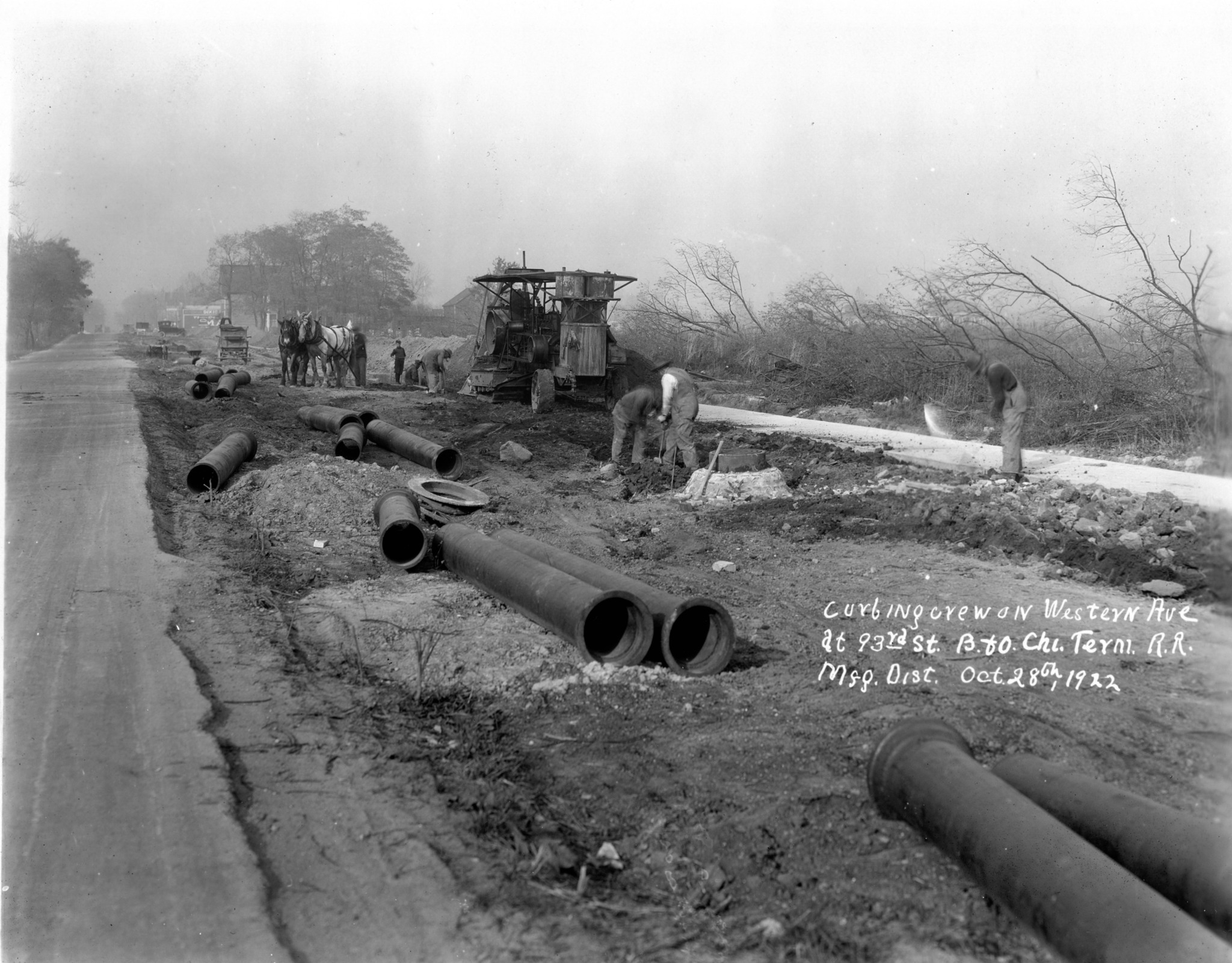
In 1922, Western Avenue through this area was graded, widened, and repaved, leading to the Western Avenue we know today.
The Ridge Historical Society has a photo of the paving work at 93rd Street and Western Avenue in 1922, showing the building that housed the Kosar family and their businesses in the background.
Eventually, the son James, born in 1914, ran the shop, likely starting in his teen-age years, around 1930. He was awarded a bronze star for his service in World War II. He ran the business for many years, and even stayed on for a while as a mechanic after he sold the shop to Bob Green in the 1970s.
The current owners, Paul and Kathleen Weise, bought the shop in 1996, and modernized it. They also involved the shop in community activities, from starting their own racing group to sponsoring the Beverly Cycling Classic.
Recently, the shop has been receiving a lot of media attention because Paul Weise has announced his retirement and has put the shop up for sale. Hopefully, he will find a buyer that will carry on the tradition of the store.
Read more about Beverly Bike and Ski in this month's BAPA Villager. https://bapa.org/beverly-bike-ski-nears-100-years-at-91st-and-western/
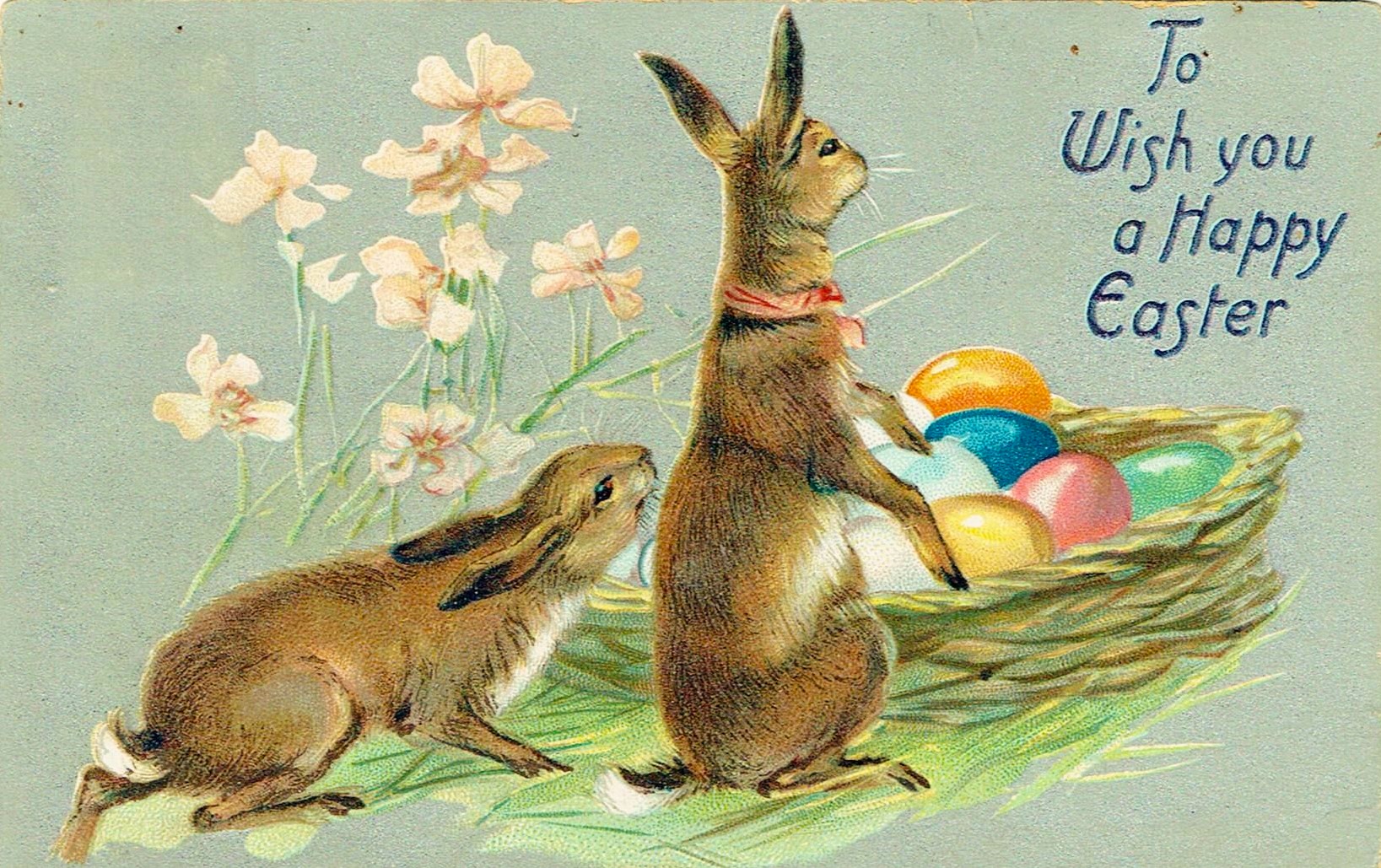
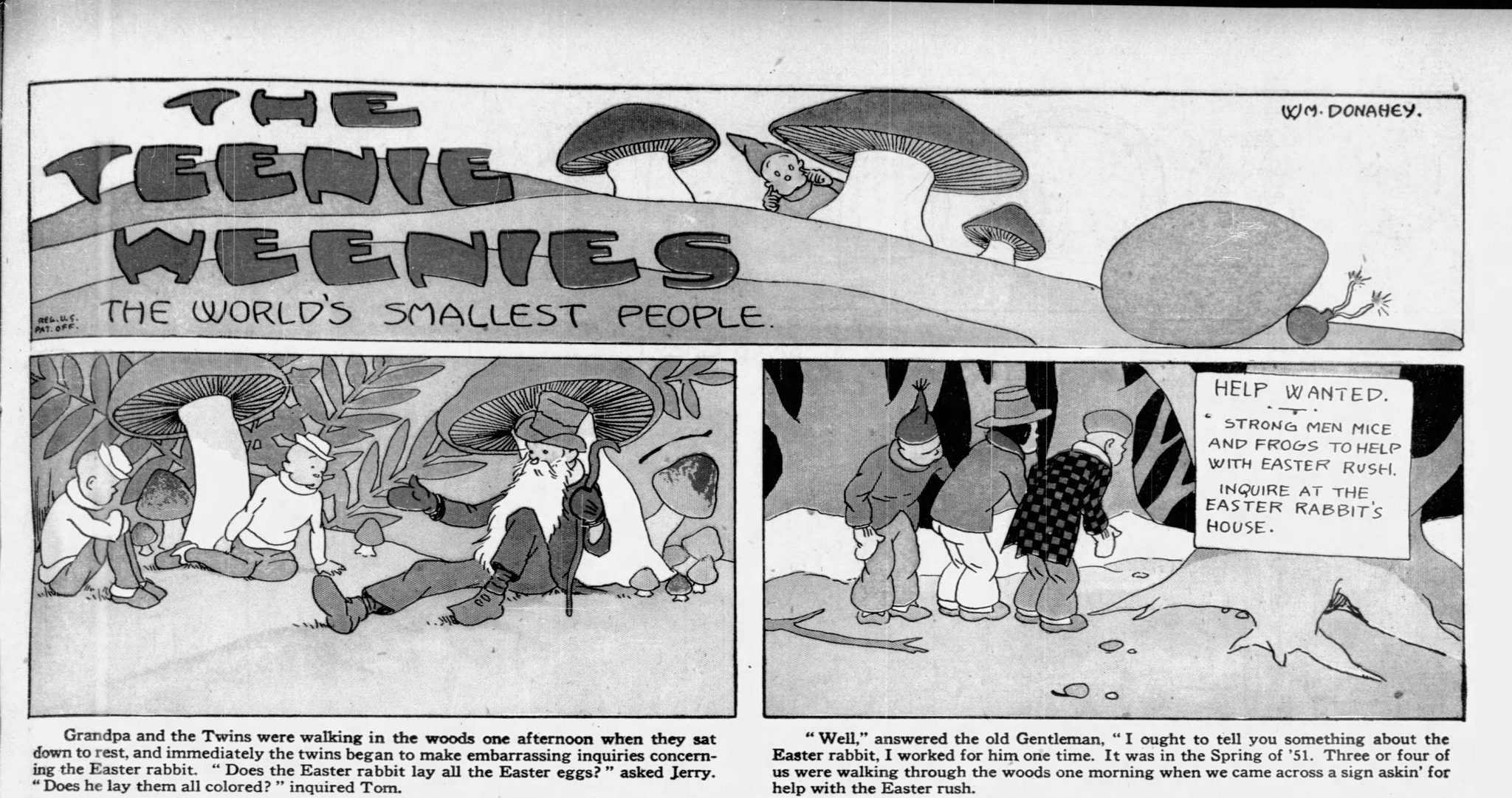
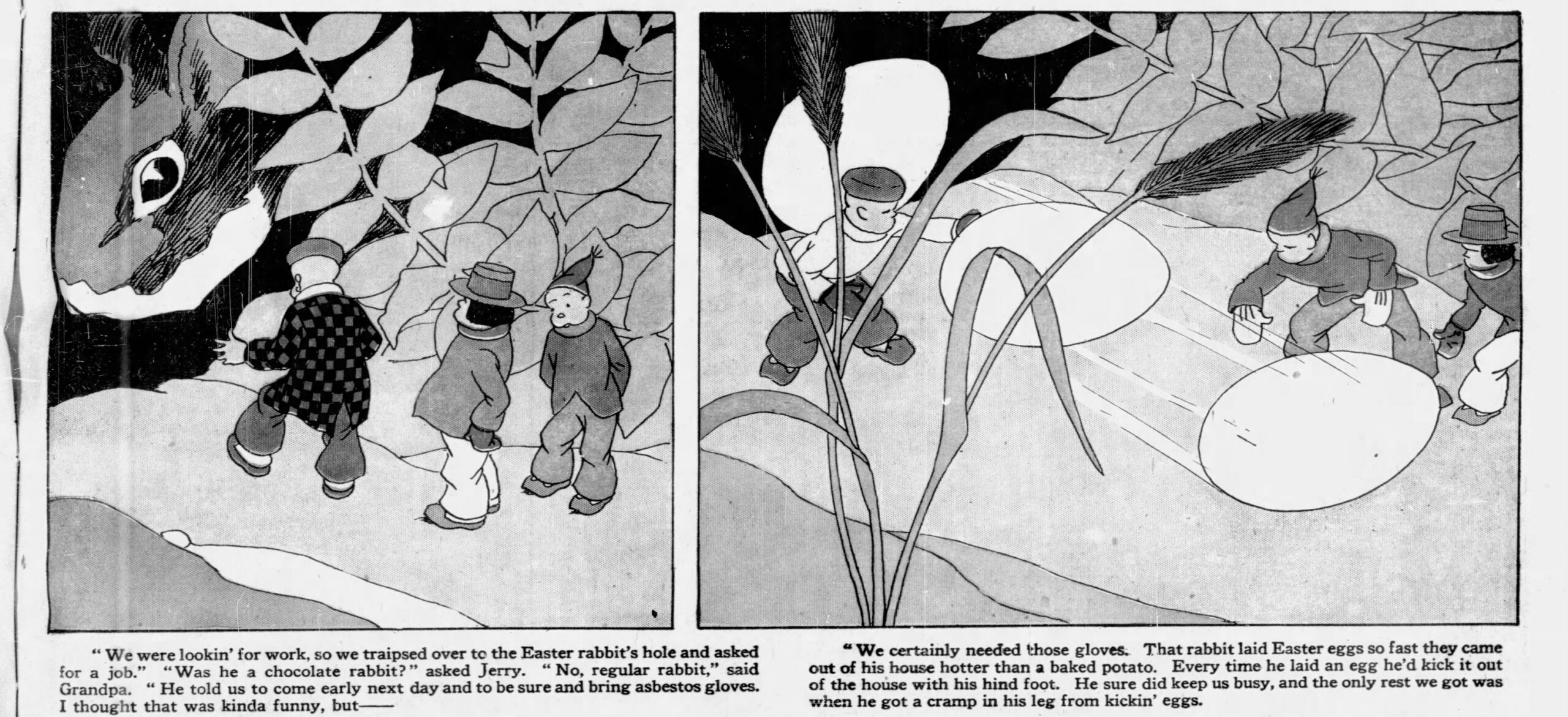
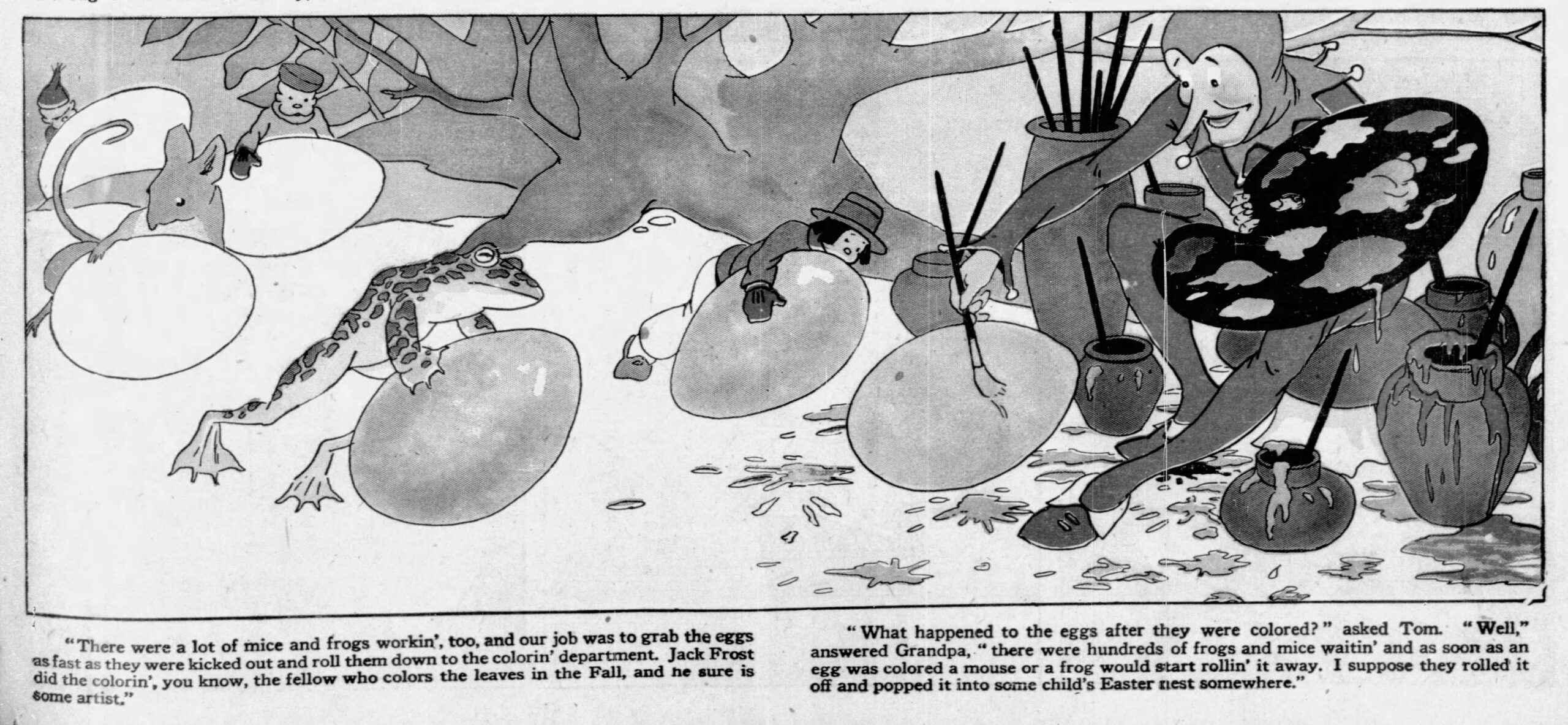
Happy Easter from the Ridge Historical Society!
Here's something a little different – a cartoon from Easter 1924 that appeared in the Chicago Tribune. This is how Easter eggs get painted.
And a vintage postcard greeting.
The Ridge Historical Society
The Parade and the Weather
By Carol Flynn
“Don't bring around a cloud to rain on my parade” is a memorable line from a song in the musical “Funny Girl.”
While in the song the line is a metaphor about not interfering in another person’s life, it is a reminder that the weather always plays a part in any outdoor event like a parade.
Springtime weather in Chicago is especially unpredictable and changeable, and St. Patrick’s Day parade plans always factor in the weather. Uncooperative weather doesn’t mean the parade will be canceled; in fact, that would be a very unlikely occurrence. It just means some adjustments may have to be made.
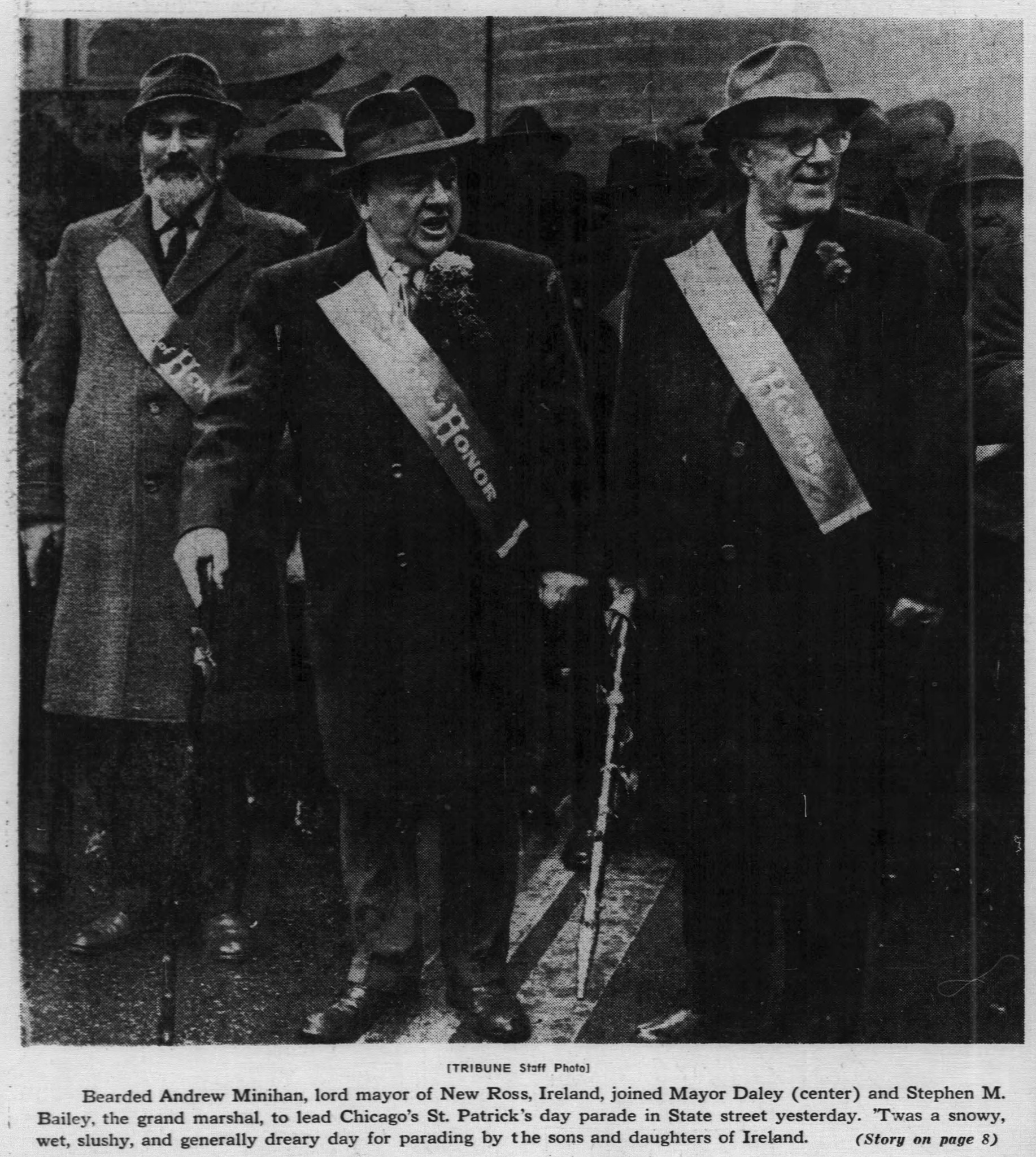
The most rain that ever fell on St. Patrick’s Day when a parade was held downtown was recorded as 1.42 inches in 1965. The Chicago Tribune described the precipitation that Wednesday as a mixture of snow, sleet, and freezing rain.
City crews worked from the early morning on to clear the parade route, and despite gusts of wind up to 52 miles per hour, the parade went on as scheduled.
Thousands of people lined State Street to watch. Entries in the parade included 60 floats and 41 marching bands.
The mayor of New Ross, Wexford, Ireland, a guest of Chicago’s Mayor Richard J. Daley, recorded the entire parade with his “motion picture camera.”
Other extreme weather days for parades when they were held right on March 17th include coldest and hottest.
The coldest St. Patrick’s Day on record in Chicago occurred on a Saturday in 1900, when the overnight temperature was one degree below zero. The newspapers reported the parade took place with a daytime temperature of sixteen degrees in blinding whirlwinds of snow and biting wind blasts. The streets were slippery frozen mud.
Despite the weather, or maybe partly due to it, enthusiasm was high on parade day. More than 3,000 people marched or rode in the parade, and many more lined the streets and cheered them on.
Irish and American flags and organization banners whipped wildly in the wind and musicians played with numb fingers. An Irish jaunting car, a special feature of the parade, “bounced and pitched and rolled and slid” through the frozen mud but made it to the parade’s end.
The parade lasted for two hours in that freezing cold.
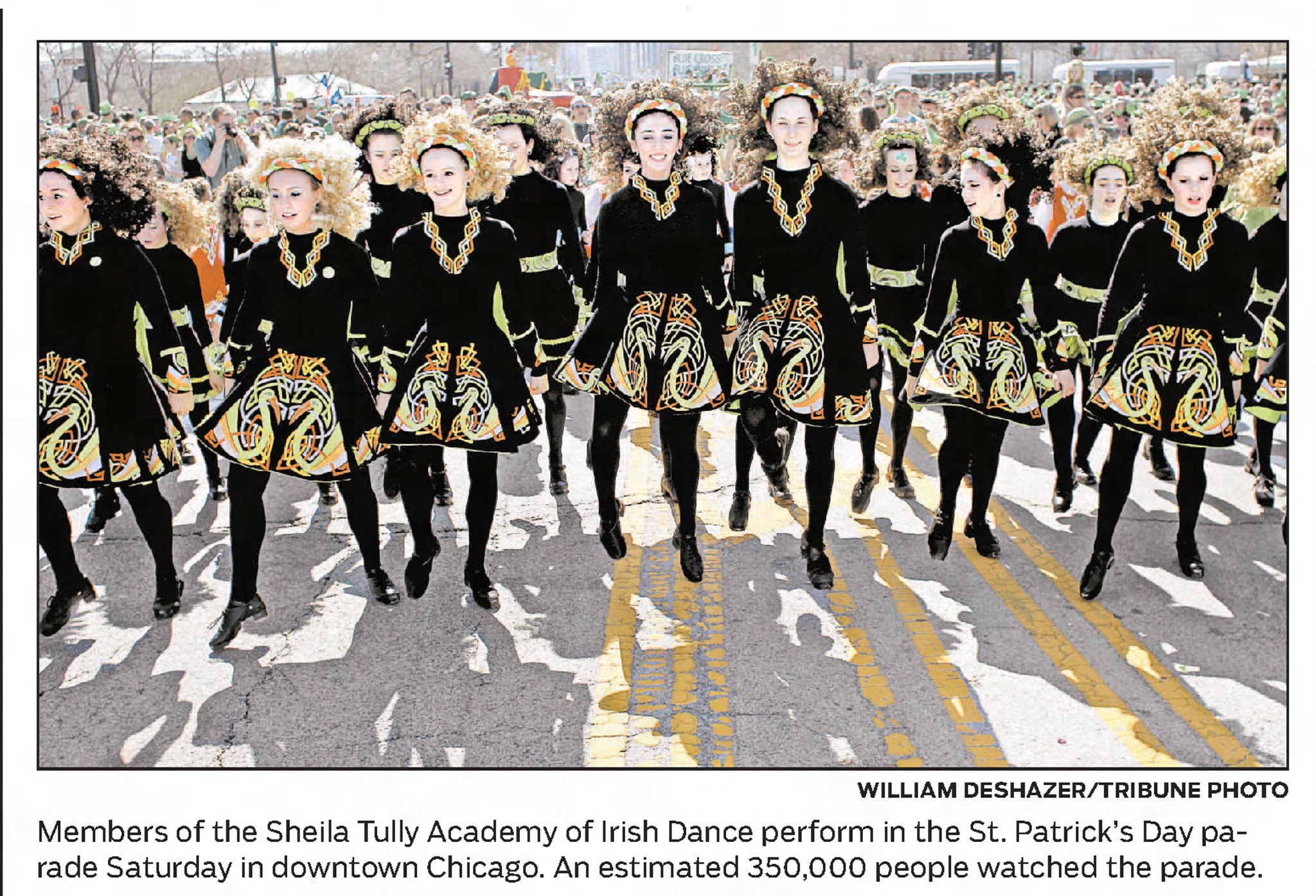
The record high temperature for St. Patrick’s Day was 82 degrees in 2012.
Over 350,000 parade goers that day enjoyed the warm weather so much, reported the Tribune, that two men jumped into the Chicago River, which was dyed green for the day per custom. After they were fished out, one ran away and the other was ticketed by the police.
A visitor from Georgia lamented there was no snow; she was hoping to experience some Chicago winter weather. Chicagoans were not sorry to disappoint her. If she had been here 112 years earlier, she could have experienced the worst there was to have.
This year, the weather for St. Patrick’s Day and the South Side Irish Parade is expected to be 40 degrees with no rain, which actually fits right into the norm for this time of year.
Happy St. Patrick's Day!
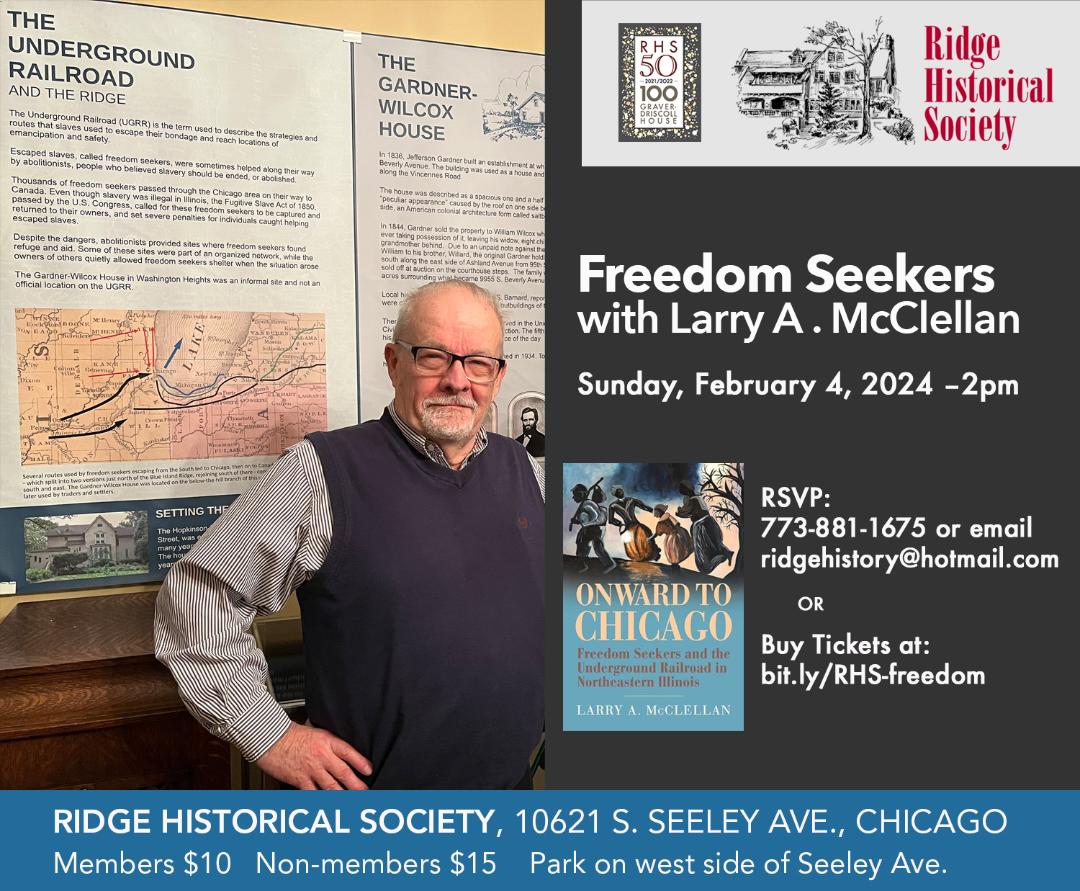
Freedom Seekers with Larry A. McClellan
Black History Month Program Focus is the Underground Railroad in Northeastern Illinois
Larry A. McClellan, emeritus professor of sociology and community studies at Governors State University, will present a program on his book, “Onward to Chicago,” which uncovers stories of the Underground Railroad freedom network in northeastern Illinois, Sun., Feb. 4, 2 p.m., Ridge Historical Society, 10621 S. Seeley Ave.
McClellan will share his work and personal experiences in developing a deeper, broader insight into the freedom seekers and their impact on local history.
“Onward to Chicago” was published by Southern Illinois University Press and released last summer. According to the press website, Illinois’s status as a free state beckoned enslaved people decades before the Civil War, and traditional histories of the Underground Railroad in Illinois start in 1839.
Larry A. McClellan reframes the story, not only introducing readers to earlier freedom seekers, but also illustrating that those who bravely aided them were Black and white, men and women. McClellan features dozens of individuals who made dangerous journeys to reach freedom as well as residents in Chicago and across northeastern Illinois who made a deliberate choice to break the law to help.
“Onward to Chicago” shows how Chicago emerged as a point of refuge for freedom seekers, and how the I & M Canal created opportunities for Black men, women, and children to escape slavery. “From eluding authorities to confronting kidnapping bands working out of St. Louis and southern Illinois, these stories of valor are inherently personal. Through deep research into local sources, McClellan presents the engrossing, entwined journeys of freedom seekers and the activists in Chicagoland who supported them,” the website says.
McClellan’s book won the 2023 Underground Railroad Free Press Hortense Simmons Memorial Prize for Advancement of Knowledge.
McClellan has been instrumental in adding listings to the National Park Service Network to Freedom register of the Underground Railroad, and is President of the Little Calumet Underground Railroad Project. He is the author of “The Underground Railroad South of Chicago” and “To the River: The Remarkable Journey of Caroline Quarlls, a Freedom Seeker on the Underground Railroad.”
McClellan will have his book, “Onward to Chicago” available for purchase at the event.
Admission to the presentation is $10 for members and $15 for non-members. Space is limited and tickets or reservations are required. Info and RSVP at: 773-881-1675 or ridgehistory@hotmail.com. Get tickets at bit.ly/RHS-freedom.
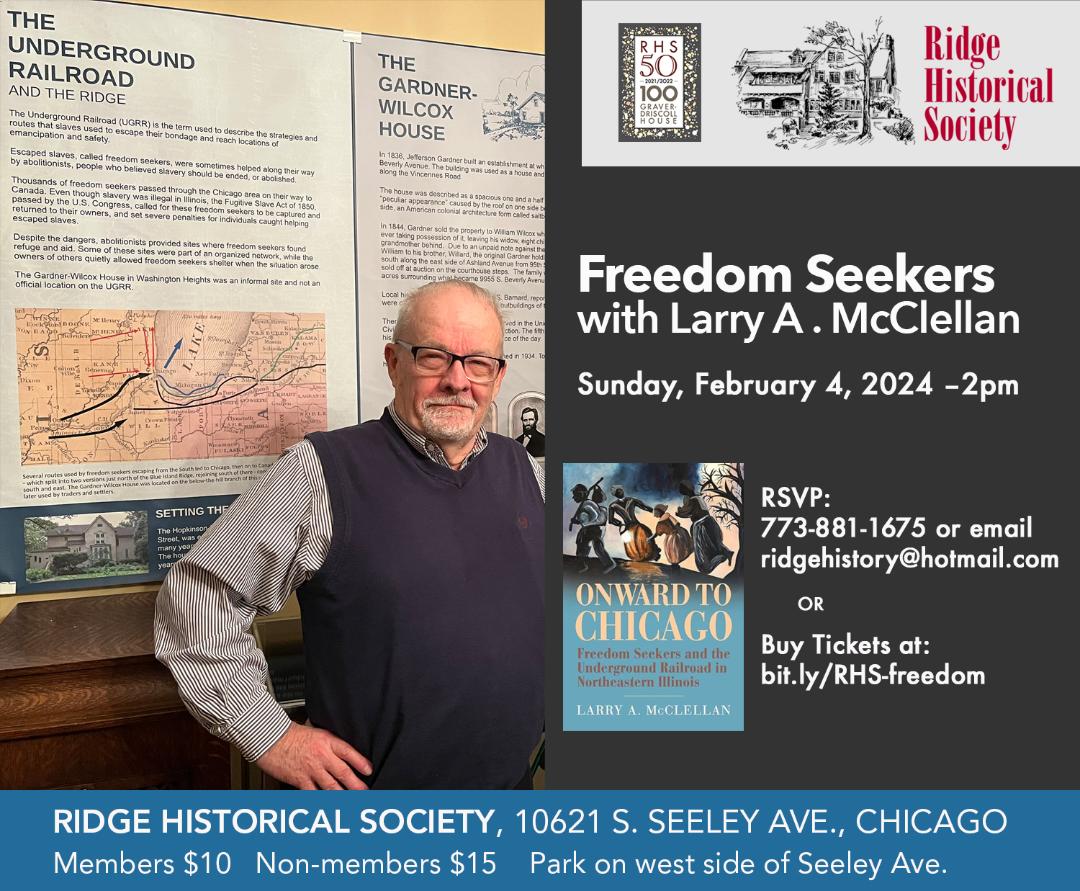
Freedom Seekers with Larry A. McClellan
Black History Month Program Focus is the Underground Railroad in Northeastern Illinois
Larry A. McClellan, emeritus professor of sociology and community studies at Governors State University, will present a program on his book, “Onward to Chicago,” which uncovers stories of the Underground Railroad freedom network in northeastern Illinois, Sun., Feb. 4, 2 p.m., Ridge Historical Society, 10621 S. Seeley Ave.
McClellan will share his work and personal experiences in developing a deeper, broader insight into the freedom seekers and their impact on local history.
“Onward to Chicago” was published by Southern Illinois University Press and released last summer. According to the press website, Illinois’s status as a free state beckoned enslaved people decades before the Civil War, and traditional histories of the Underground Railroad in Illinois start in 1839.
Larry A. McClellan reframes the story, not only introducing readers to earlier freedom seekers, but also illustrating that those who bravely aided them were Black and white, men and women. McClellan features dozens of individuals who made dangerous journeys to reach freedom as well as residents in Chicago and across northeastern Illinois who made a deliberate choice to break the law to help.
“Onward to Chicago” shows how Chicago emerged as a point of refuge for freedom seekers, and how the I & M Canal created opportunities for Black men, women, and children to escape slavery. “From eluding authorities to confronting kidnapping bands working out of St. Louis and southern Illinois, these stories of valor are inherently personal. Through deep research into local sources, McClellan presents the engrossing, entwined journeys of freedom seekers and the activists in Chicagoland who supported them,” the website says.
McClellan’s book won the 2023 Underground Railroad Free Press Hortense Simmons Memorial Prize for Advancement of Knowledge.
McClellan has been instrumental in adding listings to the National Park Service Network to Freedom register of the Underground Railroad, and is President of the Little Calumet Underground Railroad Project. He is the author of “The Underground Railroad South of Chicago” and “To the River: The Remarkable Journey of Caroline Quarlls, a Freedom Seeker on the Underground Railroad.”
McClellan will have his book, “Onward to Chicago” available for purchase at the event.
Admission to the presentation is $10 for members and $15 for non-members. Space is limited and tickets or reservations are required. Info and RSVP at: 773-881-1675 or ridgehistory@hotmail.com. Get tickets at bit.ly/RHS-freedom.
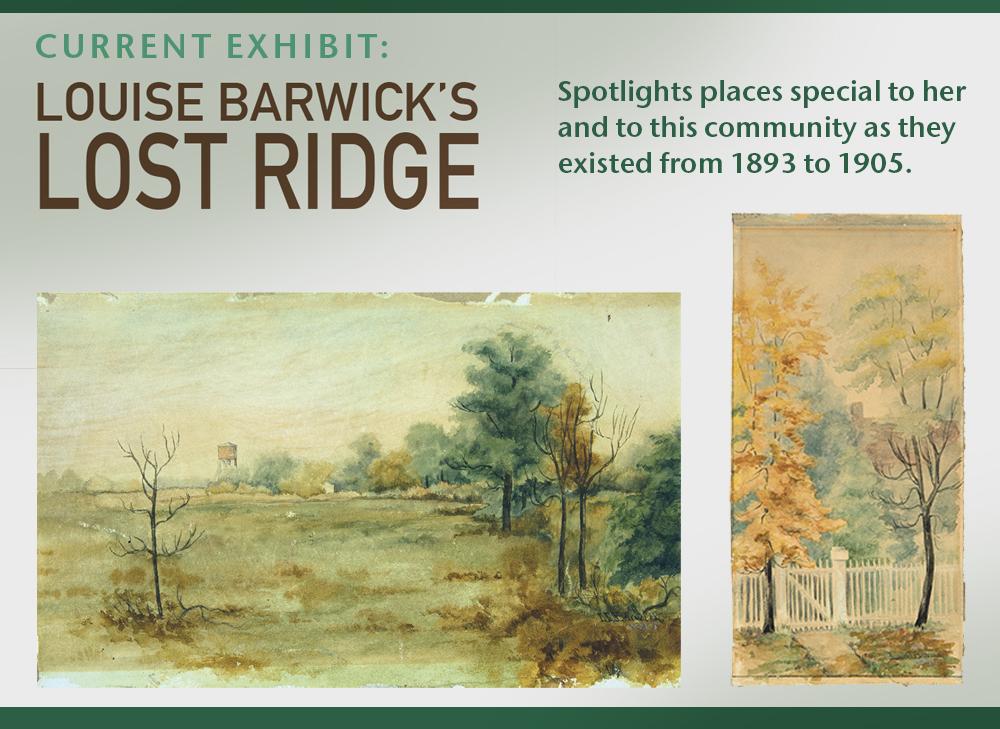
The Ridge Historical Society will be open today, Tuesday, January 2, 2024, for visitors to view the current exhibit, "Louise Barwick's Lost Ridge."
This exhibit emphasizes the visual and needs to be seen in person to be appreciated. Images of the Ridge from the late 1800s – early 1900s are captured through various media of the time, including watercolor paintings and aerial photography, creating a unique historical record of the actual appearance of the area around 103rd Street and Longwood Drive in days gone by.
RHS is located at 10621 S. Seeley Avenue, the hours are 1:00 p.m. to 4:00 p.m., and admission is free. There is some limited parking at the building, or on Seeley Avenue. The building is not handicapped accessible.
The Ridge Historical Society
The New Year Approaches One Hundred Years Ago
By Carol Flynn
Prohibition was in full swing in 1923, having begun with the Eighteenth Amendment to the U.S. Constitution in 1920, as New Year’s Eve approached one hundred years ago.
Federal law prohibited the production, importation, transportation, and sale of alcoholic beverages, but private ownership and consumption of alcohol were not illegal under federal law, and some uses, for example, religious use of wine, were permitted.
Within a week after Prohibition began, illegal production and bootlegging, the smuggling of alcoholic beverages, also began. In the larger cities, such as Chicago, rival crime syndicates fought for control of the illegal alcohol markets.
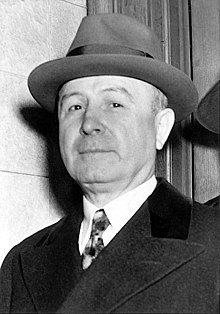
John Torrio rose to the top in Chicago organized crime. Historically, he is considered “unsurpassed in the annals of American crime; he was probably the nearest thing to a real mastermind that this country produced,” according to author and historian Hal Asbury.
In 1909, Torrio was invited to Chicago from New York by “Big Jim” Colosimo to help eliminate extortionists, which Torrio quite ably accomplished. He stayed in Chicago to help manage Colosimo’s 100+ brothels. In 1919, Torrio brought a young man named Al Capone from New York to Chicago to join their operation.
When Prohibition started, Torrio encouraged Colosimo to go into the bootlegging business, but Colosimo refused. Colosimo was gunned down at his restaurant in 1920 and Torrio, with Capone’s assistance, took over as Chicago’s organized crime boss. They soon became the leaders of the illegal alcohol operations in the city and suburbs.
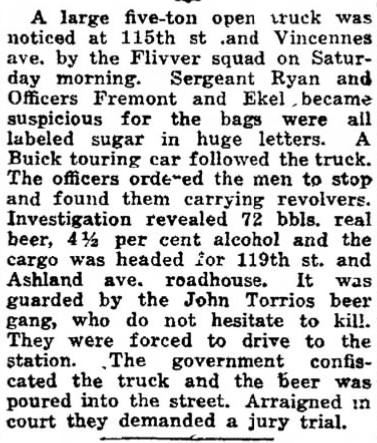
This story appeared in the Englewood Times on December 28, 1923.
A truck carrying a substantial amount of illegal beer was stopped at 115th Street and Vincennes Ave. It was reported to be under the protection of John Torrio’s “beer gang.” The members of the beer gang were not identified, but there was always the possibility that a young Al Capone was there that day.
The truck was on its’ way to a roadhouse at 119th Street and Ashland Ave., no doubt delivering supplies for New Year’s Eve celebrations.