
Explore the RHS Facebook Archives, a rich repository of local history written by Carol Flynn. For two decades, Carol brought a deeply dedicated voice to public education at RHS. Her role as Facebook administrator through mid-2025 naturally extended her prolific research into meticulously detailed articles, most notably her multi-part historical series posts. Today, Carol continues her local history writing for The Beverly Review and other outlets.
2020
The Ridge Historical Society
The Paranormal Ridge: Part 7 – The “real” ghost stories from the Givins Beverly Castle
By Carol Flynn
The last post covered the two ghost stories from the Castle that appear most often in print – the Irish fiancé and the influenza victim. The origins of these stories are not known, and neither is supported by historical facts. They fall into the realm of folklore or urban myth.
But while it may be disappointing that those two old stories are probably not true, there were – and continue to be – many other experiences at the Castle reported by “real” people that keep things interesting. The next few posts will cover some of those stories.
In an earlier post, it was mentioned that several factors come together on the Ridge that appear to encourage paranormal activity. Three of these factors – limestone, flowing water, and railroad tracks – are considered conductors of paranormal energy, and
they certainly come together at the Castle.
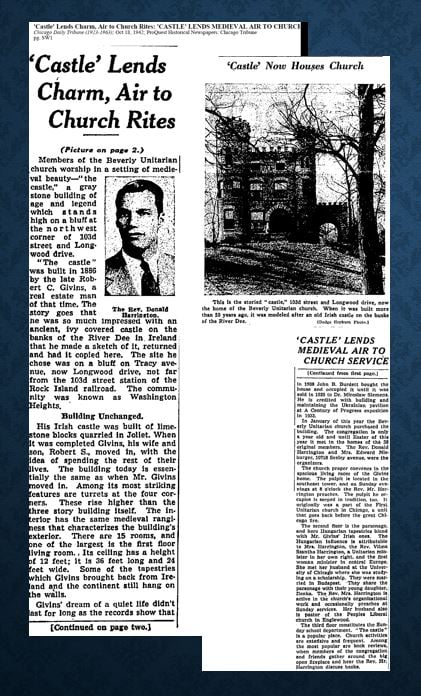
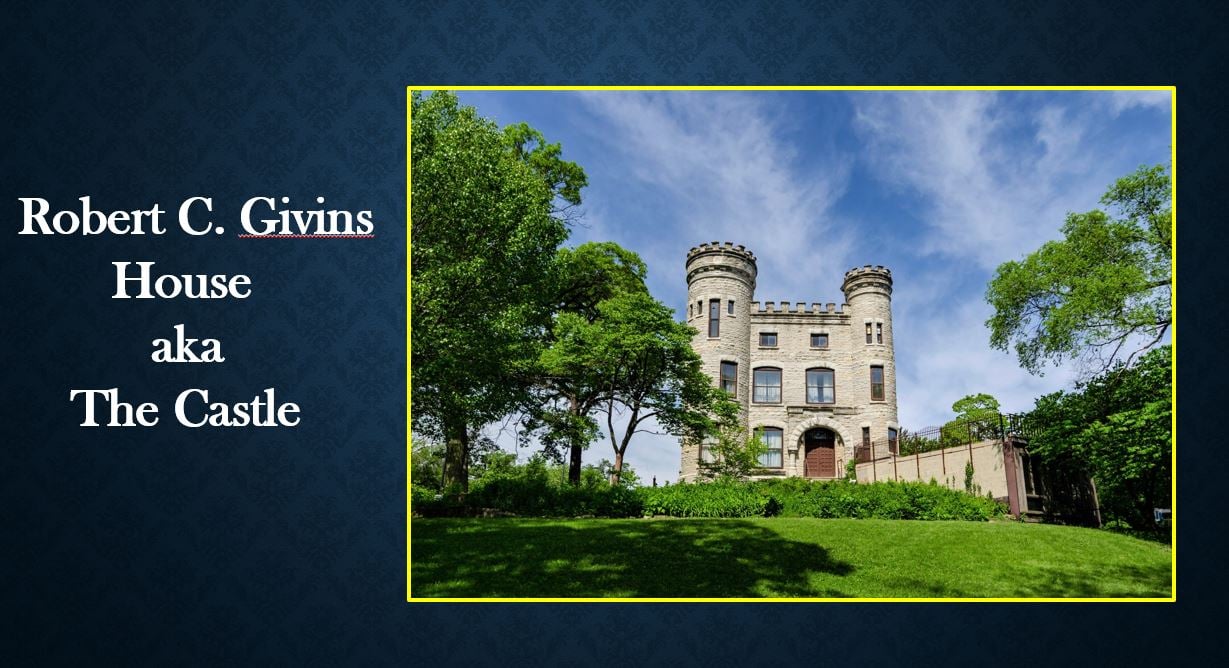
First, the building blocks of the Castle are limestone quarried from the banks of the DesPlaines River in Joliet, Illinois. This limestone formed in the reefs of shallow seas that covered the area 400 million years ago. Joliet limestone was used for many buildings in the 1800s, including the Castle built by Robert C. and Emma Steen Givins in 1886-7.
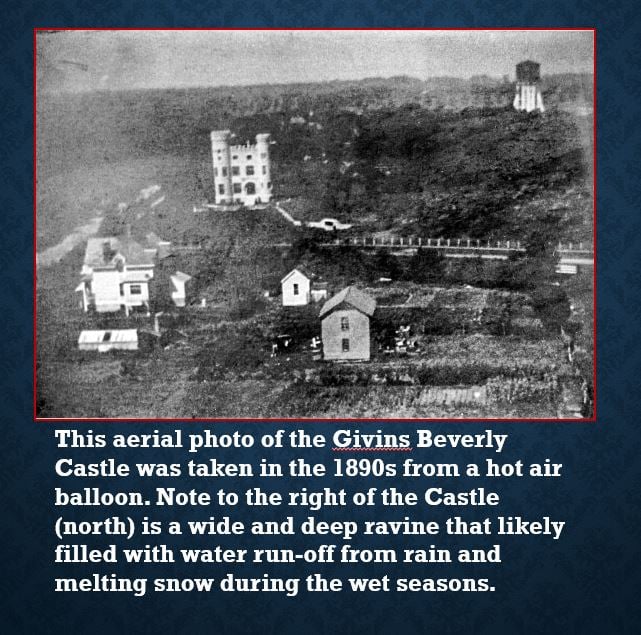
Second, just north of the Castle building was a large and deep ravine which likely included a stream at least during the “wet” season. This geological feature is evident on U.S. survey maps and in early pictures, and was mentioned in an article when Givins first built the Castle. The article stated that “stretching down the ravine from the house is a woodland park where the squirrels still bob up the big oaks and the rabbits have their warren.” The land was originally set up as a garden. The Beverly Unitarian Church (BUC), which has owned the Castle since the 1940s, built its school annexation in that section of the property.
Railroad tracks, the third factor, are just a few blocks to the east of the Castle. Bob Givins was often observed hurrying down the hill in the morning to catch the train on the Rock Island line at the Tracy stop (103rd Street) to go to his office downtown.
The first ghost stories on record for the Castle date to the 1920s. A man, who grew up on the Ridge 100 years ago, and was involved in the Ridge Historical Society but has now passed away, was asked in a newspaper interview about the Castle being haunted. He said he remembered stories, going back to his childhood in the 1920s, of people seeing ghostly lights floating in the windows. This is a common story for haunted houses. Such lights are usually dismissed today as reflections of streetlights or passing car lights, but 100 years ago, there were few streetlights, much less traffic, and no cars with high-beam headlights. The newspaper article is the only mention of these lights that has been found.
Some of the ghost guidebooks mention a story dated to the 1940s in which a caretaker at the Castle encountered a young woman with an Irish brogue dressed in old-fashioned clothes in the main room. She asked him what he was doing in her house. She then vanished. This would have been around the time that the Castle was purchased by the BUC and started being referred to as the “Irish Castle.” Unfortunately, no verification or further elaboration of this story for this time period has been found.
The earliest stories for which people can still be located for interviews start in the 1950s. The families hired by the BUC to be caretakers of the property lived on the second and third floors in the Castle. The ministers and other church personnel lived offsite.
One son from the family of caretakers who lived in the Castle from 1951 to 1962 is in his 80s now and lives in the southwest suburbs. He was 12 years old when the family moved into the Castle. In October 2019, he shared his memories for the “Phantoms and Folklore” program that was given at the Castle. The next post will relate his experiences.
The Ridge Historical Society
The Paranormal Ridge: Part 8 – Personal experiences reported at the Givins Beverly Castle in the 1950s
By Carol Flynn
This is the first of the in-person accounts of experiences at the Castle.
Rudy Visser was 12 years old when his family – father, mother, and three brothers – moved into the Castle in 1951 to be the caretakers. He attended Sutherland grammar school and Chicago Vocational high school. Now in his 80s and living in the southwest suburbs, in the fall of 2019 he shared his remembrances for a special event held at the Caste on “Folklore and Phantoms.”
As caretakers, the Vissers maintained the grounds and buildings, including everyday cleaning. It was a lot of work and they knew every inch of the Castle. The Vissers lived in rooms on the second and third floors. Back then, the Castle maintained its original floor plan, a lot of small rooms lined with dark wood. [Note: When originally built in 1886-87, the Castle was reported to have 15 rooms, paneled with red oak, including a spacious drawing room and ballroom, a library in the largest tower, and beautiful tapestries, chandeliers and gas lighting fixtures.]
Rudy said it was “very creepy” for a child living in the Castle. It was not comfortable and there was little privacy, being a church building open to the public. There were noises and creaking floors and the wind howling through the building. There were no screens in the windows and bats flew in at night, and they encountered rats when they first moved in.
One experience that Rudy found memorable involved a boarded-up opening in the basement. The family did not like going down to the basement, but it was necessary to tend the furnace and change blown fuses, as this pre-dated circuit breakers. The basement included a large room lined with benches that was used for parties and events.
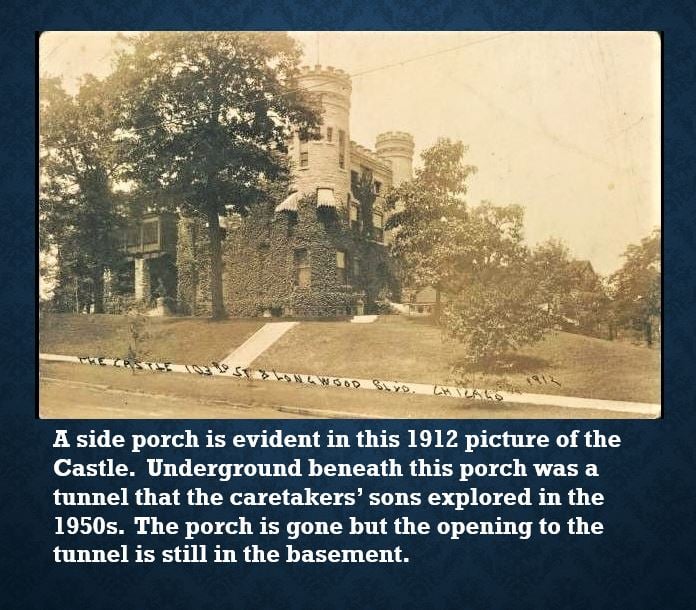
The boarded up “window” opened underground beneath a stone side porch on the south side of the Castle. The side porch is now gone but it is evident in old pictures. The opening entered a tunnel system that Rudy and his brothers crawled through that was full of mud and cobwebs and very constricted in places. Although they did not have a good perspective of distance underground, Rudy believes they crawled south at least as far as 103rd Street, but he does not know how much farther the tunnel extended past that. He said the tunnel was very old and he had no idea why it was built.
A lot of the renovations made to the Castle occurred while the Vissers lived there. In 1958, the school extension was built onto the building to the north. The school extension was supposed to be part one of a plan to tear down the Castle and build a new church, but that never happened. Before the school was built, that area was a garden.
One strange experience involved a lady in a flowing white dress that Rudy described as being like a nightgown. Rudy’s mother observed this woman several times walking around in the garden. Then one day, the woman was suddenly behind Mrs. Visser in the second-floor apartment. No one saw or heard her come in through the door. Back in the 1950s, the practice was to leave churches open during the daytime but locked at night, and the Castle followed this routine, so the woman would have been able to enter the building.
Mrs. Visser was startled and asked the woman what she wanted. The woman said she thought there was a service that day and she was looking for the minister. This was on a weekday, and Mrs. Visser explained that the services were on the weekends, and that is when the minister would be there. The woman said all right and left. Mrs. Visser immediately followed her to the door but when she looked out, the woman was gone. They never saw the woman again. They asked around and no one had any idea who the woman might have been. And for the record, the woman did not have an Irish brogue.
Another strange experience occurred one summer they lived there. The castle was closed and locked during the summers. There were no classes or services for three months. The family went away for a week, and before leaving, went through the entire building to make sure all the lights were off, the windows were closed, and the building secure. They locked the place up tight before they left.
When they returned, as they were driving down the street, they noticed a light was on in a third-floor turret window. They knew they had turned all the lights off, and there was no reason for anyone to be in the Castle while they were gone, especially up there in their family quarters – the room was the bedroom of one of the children. However, there certainly were other people with keys, including the minister, the piano teacher, and other church people.
The Castle was securely locked when they got to the building. Rudy’s father and the boys went up to the third floor, and as they were approaching the door of the room, it opened by itself with a loud squeaking noise. It scared all of them. There was no one in the room and the light was indeed on. No one ever admitted to going up there and turning on a light.
These were the experiences this family had at the Castle. They moved out in 1962. Rudy is a practical man and does not consider these to be “ghost stories.” He felt their walking on a certain floorboard or something of that nature might have made the door open on the third floor.
One story attributed to Rudy’s mother that appears in print did not happen. It is often reported that the caretaker in the 1950s reported that one time during a winter storm, there was a knock on the door, and when she answered, a girl with an Irish brogue was standing there in a light dress and no coat. Sometimes the story is that she is barefoot out there in the new snow. Supposedly, Mrs. Visser left the room to get the girl a wrap and when she returned, the girl was gone, and there were no footsteps left in the snow.
Rudy had never heard this story before and said this never happened to his mother.
Rudy said he receives calls, usually at Halloween time, about the ghost stories. He admitted that sometimes he embellishes the truth or makes something up just for his own amusement.
In the next post, stories from the 1960s will be shared.
The Ridge Historical Society
The Paranormal Ridge: Part 9 – Southtown Economist Interview
By Carol Flynn
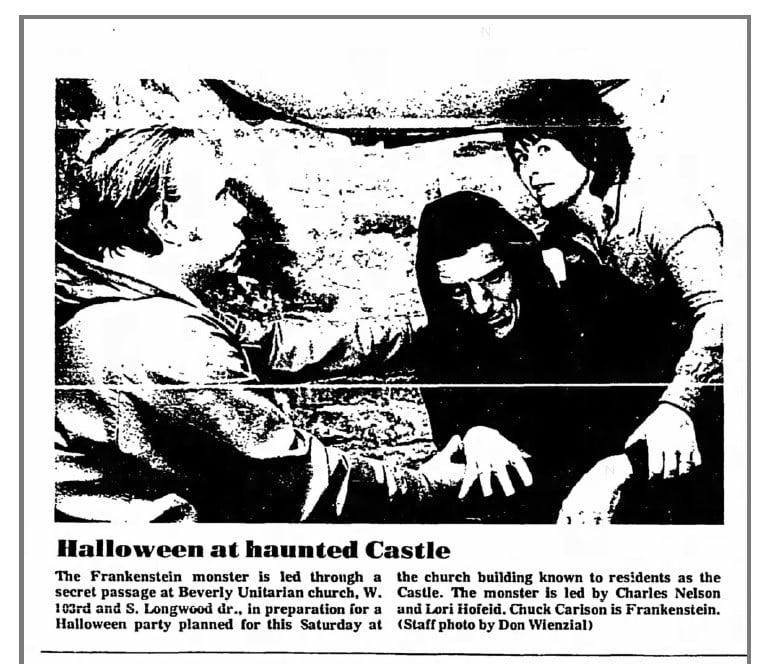
In 1972, the Beverly Unitarian Church (BUC), owner of the Castle since the 1940s, briefly embraced the Castle’s reputation as a “haunted house.” As part of the sesquicentennial anniversary celebrations of the area, BUC held an event at the Castle to “celebrate Halloween in Chicago’s Only Haunted Castle.”
The event included a walk through the appropriately decorated basement; ghost stories in one of the turret rooms; astrological, tarot card and crystal ball readings; dancing; a costume contest; and “spooky surprises.”
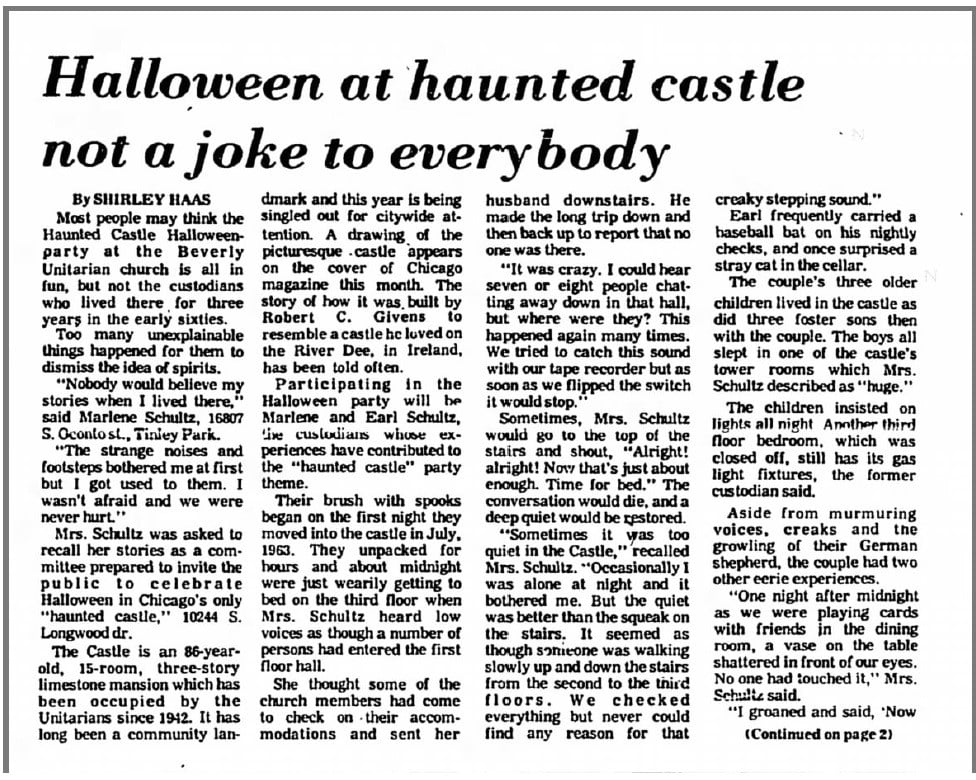
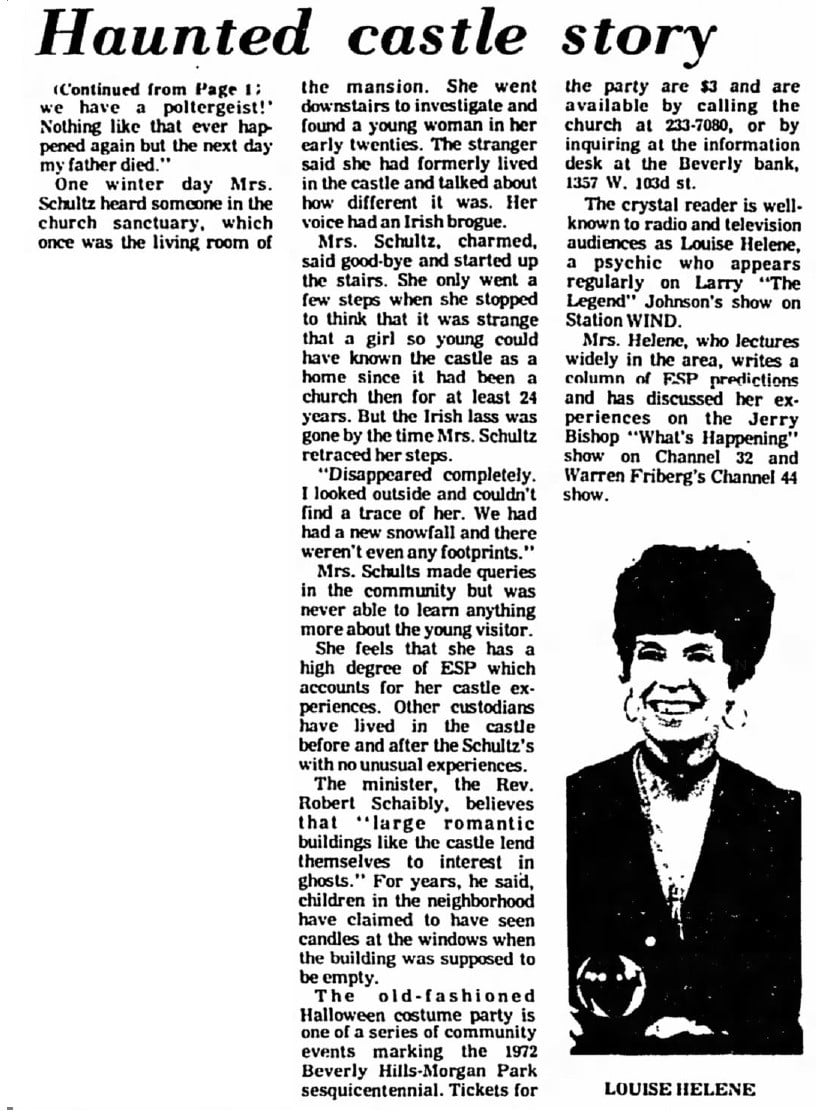
Leading up to the event, Shirley Haas, a newspaper reporter for the Southtown Economist, interviewed Marlene Schultz, a past caretaker of the Castle, about the strange experiences Marlene had while living there.
Shirley lived in Beverly and was a founding member of the Ridge Historical Society. She is 96 years old now, living on the north side in Lincoln Park. Just a few days ago in a phone conversation, Shirley explained that she reported what she was told, but she did caution that the interview was done in the context of promoting the Halloween event at the Castle.
Marlene participated in the 1972 event at the Castle. She is in her 80s now and RHS was not able to reach her to further discuss her experiences.
The entire article is included as an attachment to this post.
In the next post, other newspaper articles and personal accounts will be shared.
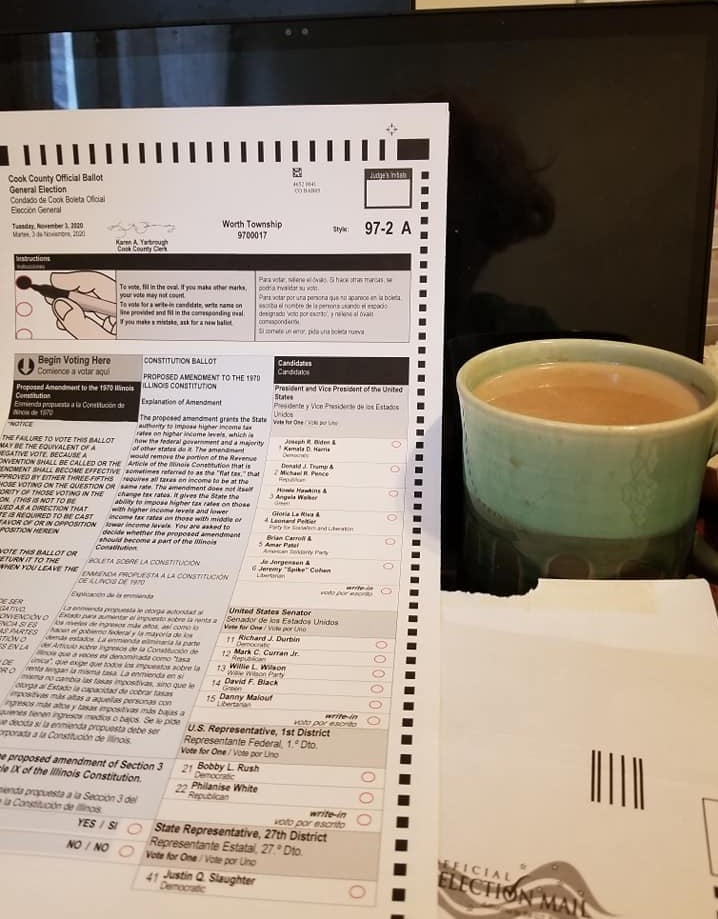
Message from the Ridge Historical Society: VOTE.
People made great sacrifices throughout history so that U.S. citizens have the right to VOTE for their leaders. Many gave their lives so future generations would have this right. VOTE.
The Ridge Historical Society
The Paranormal Ridge: Part 10 – Other Personal Experiences at the Castle
By Carol Flynn
The ghost stories from the Givins Beverly Castle show up in print often – in newspaper and magazine articles, websites, and books about Chicago ghost lore. Most of the stories that are printed are the usual ones that can be discounted as folklore, but one article led to new information in the quest to learn about the haunted happenings reported at the Castle.
In 1995, the Chicago Tribune ran an article on the Castle by staff writer Jerry Thomas. He repeated one of the usual stories that has the facts wrong on the history of the castle. He wrote that a girls’ boarding school was there in the 1930s and a girl died from influenza and haunts the Castle. This isn’t true – a physician owned the house in the 1930s and he and his family lived there. They did not run a boarding school, but the doctor did see patients at the house.
Although that story was not accurate, Thomas also wrote about two people who reported experiences there, a minister for the Beverly Unitarian Church (BUC) which has owned the Castle since the 1940s, and a psychic. Today’s post will cover the minister’s experiences and the next post will discuss the psychic.
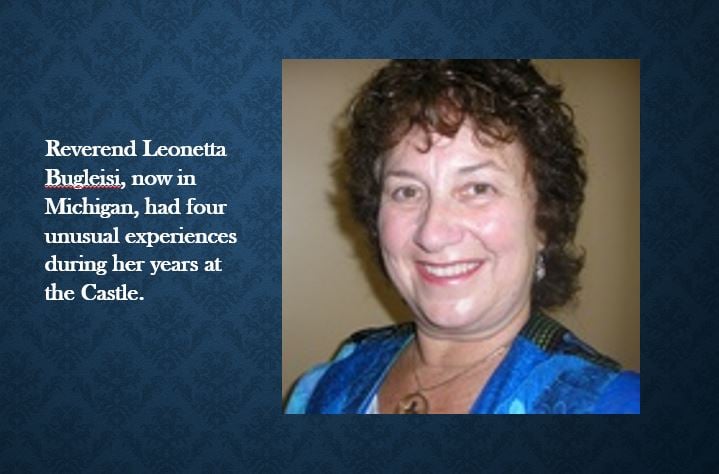
Reverend Leonetta Bugleisi was minister at the BUC from 1993 to 2003. Now living in Michigan, she was interviewed last year by RHS for the “Folklore and Phantoms” program. She recounted four unusual experiences she had during her time at the Castle.
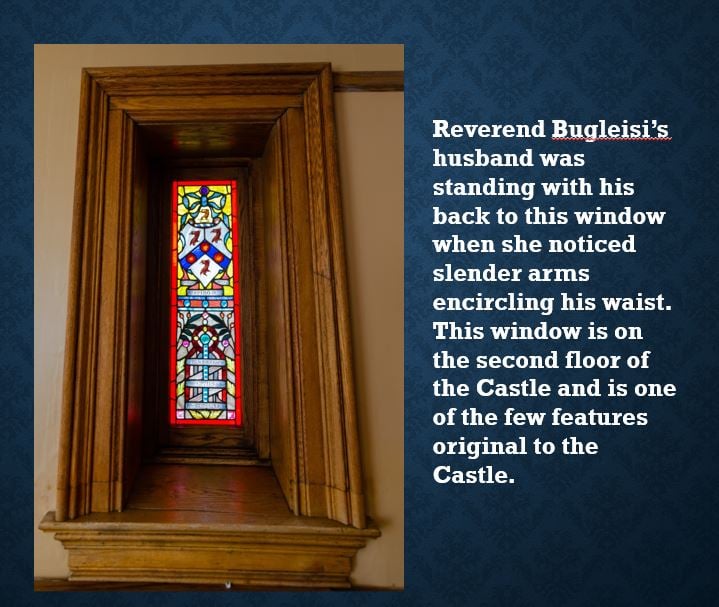
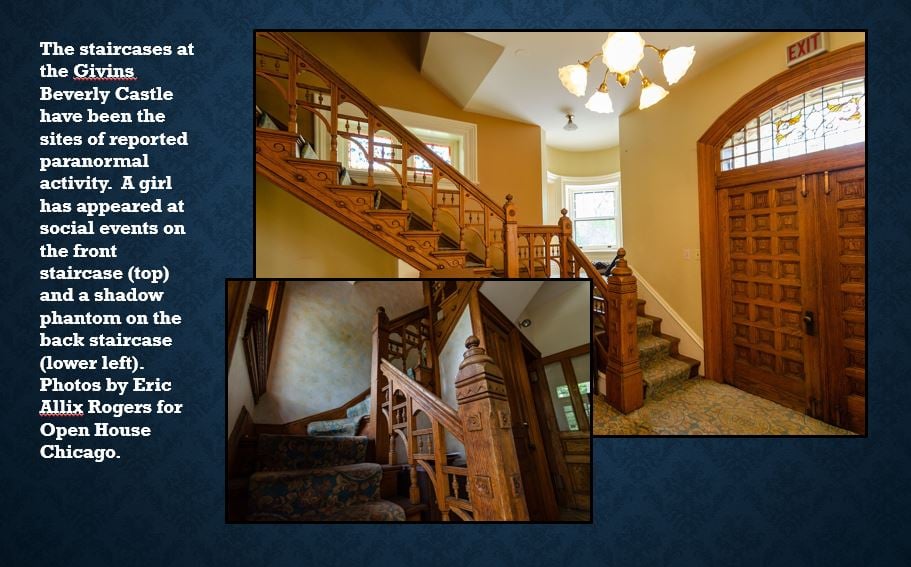
The first occurred in early 1994 at a welcoming event following the ceremony installing her as pastor. Her husband and she were on the second floor, in front of a stained glass window that is original to the house; she was facing her husband, talking to him, and he had his back to the window. Reverend Bugleisi saw a pair of very slender arms encircle her husband’s waist gently from the back. She assumed it was someone saying good-bye, but when she looked behind her husband, there was no one there. She asked him if he felt anything, and he said no. The arms vanished. She described the arms as looking like those of a young girl. Rev. Bugleisi has been consistent in relating this experience for 25 years. Last year, she humorously asked that it be reported that she had not been drinking at the event; she had not even had any sugar that day.
The second experience was an unnerving one. A custodian at the Castle was cleaning the floors in the school when he suddenly collapsed and died. He had had dental surgery and was on medication that apparently provoked this. Although not a paranormal event as such, it was unsettling to the BUC community.
About a month later, the third experience occurred. Reverend Bugleisi went to the library, a room on the second floor of the Castle, to get a book for a student. She noticed there was a copy of Elizabeth Kubler-Ross’s book “On Death and Dying” on one of the shelves. She took the other book to the student, then came back for the Kubler-Ross book and it was gone. No one else was found to have been in the library in that short amount of time. She looked all over for it but it was never found again. She felt there might be a connection between the custodian and the vanished book.
The back staircase to the third floor of the Castle was the setting for a fourth experience. After Reverend Bugleisi showed the apartment on the top floor to a woman, they left to descend the back staircase. Reverend Bugleisi saw movement out of the corner of her eye and looked back, and a shadow form was following her down the stairs. It was not the other woman, who was in front. The shadow faded away.
Reverned Bugleisi never heard other noises that people said they heard there, such as the piano playing by itself, voices, and the sounds of glassware tinkling. Other than the arms around her husband’s waist, she also never saw any girl, young woman or other ghosts.
In the early 1970s, a psychic visited the Castle, and that story will be in the next post.
The Ridge Historical Society
The Paranormal Ridge: Part 11 – A Psychic’s Visit to the Castle
By Carol Flynn
The Givins Beverly Castle has been owned and operated since the early 1940s by the Beverly Unitarian Church (BUC). In the early 1970s, the BUC brought attention to the stories of ghosts at the Castle through a series of events and newspaper articles.
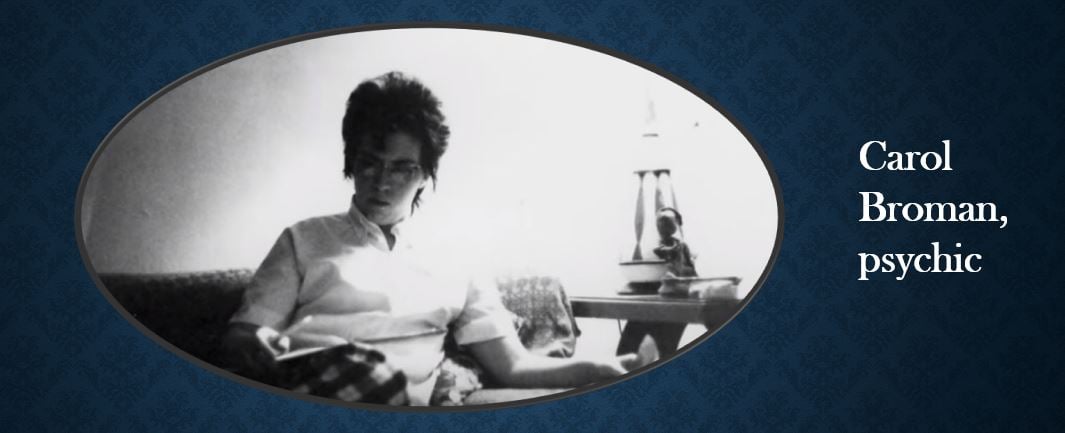
In 1995, the Chicago Tribune ran an article by Jerry Thomas calling attention to one of these events from the 1970s. The article stated that in 1973, a psychic named Carol Broman visited the Castle and reported that she experienced two spirits there – one a young girl – and there was bantering between them.
In preparation for last year’s “Folklore and Phantoms” program, this visit was researched – and proved to be most interesting.
This psychic, Carol Broman, was called in by the police in 1978 to help in the investigation of serial killer John Wayne Gacy. At that point, they were still treating the situation as a missing person case for one young man who had disappeared from his job at a drug store. He had told his mother he was going to talk to someone about a construction job. The police knew that Gacy and many others had been in the pharmacy that day, but no connections had been made yet. They still hoped to find the young man alive.
Broman told the police the boy was dead, he had been murdered, they would find multiple victims at the killer’s house, that it had to do with the construction business, and that the killer used trickery and torture on his victims. She also said the young man did not realize he was dead yet and his spirit was wandering.
Broman turned out to be correct in what she told the police they would find. The police never went public at the time that they used a psychic. The police inspector, Joseph Kozenczak, and his wife later wrote two books, and he was interviewed for an episode of Psychic Investigators, which can be found on YouTube. Kozenczak said he was chilled to the bone by Broman’s revelations. Although the use of psychics in policework is very controversial, Broman did a lot of work with the police as a psychic investigator. Broman and Kozenczak are deceased now. Gacy was executed in 1994 for 33 murders.
[As an aside, Gacy did construction work in the Beverly/Morgan Park area, and people here knew him. One RHS officer who worked for the city met Gacy through city contract work. She said everyone considered him a nice guy. It was an unimaginable horror when the bodies were found in the crawlspace under his house.]
Five years before she was involved in the Gacy investigation, Carol Broman, the psychic, accompanied by a Chicago Sun-Times reporter, was invited to visit the Castle to investigate paranormal activity. Their visit was covered in a Sun-Times article, and later covered in two books about ghosts, based on the Sun-Times article. The information in this post is based on the material in those books, so it is now third- or fourth-hand reporting. Of course, as this gets farther away from the original sources, the possibility of misinterpretation increases – this is often how folklore begins. Readers are cautioned that this incident at the Castle has not been verified – the original Sun-Times article has not been reviewed because the Sun-Times archives are not easily accessible to the public. In fact, there does not seem to be an archive for this time period – the 1970s.
According to the books, Broman started her tour in the basement, where she sensed fire in the Castle. She stated that there had been fires, and there would be another. The Castle does not have a history of any serious fires.
Broman said that In the living room/sanctuary of the Castle, she encountered two entities having a discussion. One was a young girl with the usual Irish brogue. The other was a tall man who was very angry, talking about infidelity, and wanting to burn the Castle down. He had been accused of murder but had never been tried for the crime, and he said although he had committed the murder, he was the one who had been treated very unfairly.
He was trying to plead his case to Broman, but she said she didn’t believe him. He had been a cruel and controlling husband. She felt the girl was the niece of the wife. The room was filled with white camellias which had been the wife’s favorite flower.
Unfortunately, there were no details given about who this man was or who he had killed, or where, when or how the murder had taken place, or what, if any, connection there was to the Castle. No known incidents like this have been associated with the Castle. Robert C. Givins, who built the Castle, had one son, Robert S. Givins, and there was a scandal when the son’s wife ran off with another man. But there was no known murder associated with this incident. The young girl continues the usual theme of the ghosts at the Castle. This story remains a complete mystery.
The next post will cover some experiences people have reported more recently.
The Ridge Historical Society
The Paranormal Ridge: Part 12 – More Recent Experiences at the Castle
By Carol Flynn
The early owners of the Givins Beverly Castle at 103rd Street and Longwood Drive were three private families in succession, and for a year and a half in the 1890s, the Castle was rented by a female college. Since the early 1940s, the Castle has been owned by the Beverly Unitarian Church (BUC). The building has been used for church services and functions and rented or loaned out for many other functions, from Jewish religious services to Christian weddings to Neo-Pagan drummings.
Beginning in the 1970s, the first-person stories relating strange experiences at the Givins Beverly Castle started to be recorded in newspaper interviews. Three people publicly shared their paranormal experiences – a caretaker from the 1960s, a psychic who visited in the 1970s, and a minister from the 1990s. There were, of course, many other hearsay stories repeated through the years.
More recently, other people have shared personal experiences. Another caretaker from the past confirmed that her daughter-in-law, the “sensitive” one in the family, was visited by an entity at the Castle in a room on the second floor that she used for sewing.
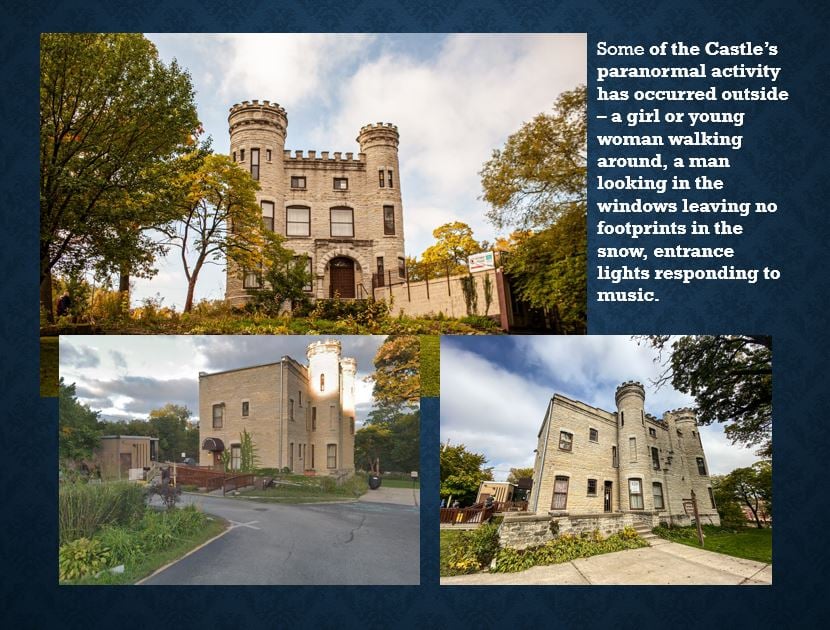
People from Blue Island involved in a ghost investigation a few years ago observed the phantom of a young woman dressed in an old-fashioned plaid dress gliding around the outside of the Castle.
A police officer said he was called to the Castle in the 1990s when a church member saw a man’s face looking in the windows from the outside, moving from window to window. The police officer said there were no footprints in the snow outside the windows.
A person who came to the Castle for Neo-Pagan events in the mid-1990s reported on an on-line site that she and a friend experienced intense feelings of being watched and driven away as they were climbing the stairs to the third floor. She attributed this to a haunted nursery that had been on the third floor. The third floor does not have a history of being used as a nursery, but BUC did conduct Sunday school classes up there.
About eight years ago, someone from the Castle who wished to remain anonymous was shown a photo a local woman took of the Castle that seemed to show the phantom of a young girl out in front on the Longwood Drive-side, walking toward the school annex to the north. The anonymous person said that teachers at the school reported feeling someone tug on their clothes at a child’s height but when they turned around there was no one there, or they heard a child’s voice in the school hallway but there were no students out there when they looked.
Musicians visiting the outside of the Castle at night heard disembodied footsteps and experienced lights flickering on and off in response to their guitar-playing. This brings up a point – the entity does seem to respond to social events and music. Several BUC members, as well as the caretaker whose story was reported in post 9, have said they have heard the piano playing when it is covered and no one is in the room, and the sounds of the voices and tinkling silverware and glasses. The minister reported the slender arms that went around her husband’s waist during an event (post 10). And there are stories of a girl being spotted at social events, often on the stairs, when no children were invited or reported as being there, but these stories are not verified.
One piece of information that is shared in the books is a reference to an actual woman who reportedly lived in the Castle during the Great Depression and tended the gardens. Some people have thought this woman could be the ghost. Who started this theory, and why, isn’t known. No historical information has been found on this woman, and it would not be appropriate to name her in this post.
In summary, the major stories that come up again and again for the Castle involve a young woman and/or a girl, from the past, usually with an Irish brogue. Who this person (or persons) could be is a guess – a student, a servant, a patient, a teacher or church member, a family member, are all possibilities. She most likely is not Givins’ Irish fiancé who died before she lived in the Castle because, first, there is no record to be found of Givins visiting Ireland in the immediate years before the Castle was built, and second, at the time the Castle was built his wife Emma, a school teacher of Norwegian descent, was very much alive, and she did live in the Castle for years. His first wife had died some years before.
The other stories that are reported by several people include sounds of the piano playing, and voices and clinking cutlery and glasses, like an event is going on.
There have been a few reports of male presences but these are much less common.
In the next post on the topic, some odds and ends related to the Castle ghost stories will be explored.
The Ridge Historical Society
The Paranormal Ridge: Part 13 – Odds and Ends on Castle Ghost Stories
By Carol Flynn
Here are two more pieces of interesting trivia about the Givins Beverly Castle that relate to the paranormal. The first is the Transylvania connection, and the second is Bob Givins’ own experience with a ghost.
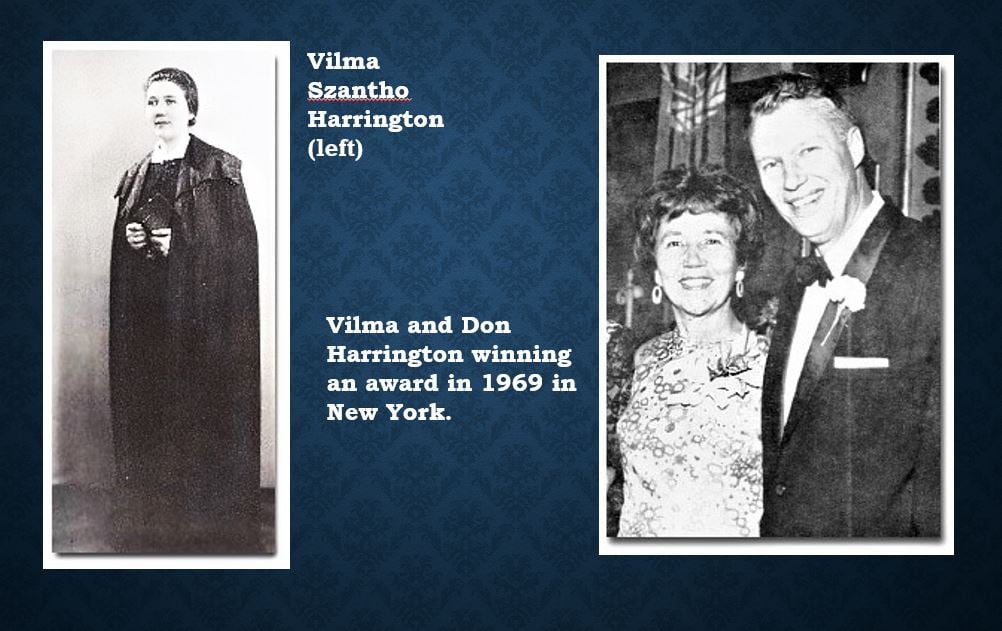
If the rumor that there was once a woman from Transylvania, Romania, the home of Dracula, in the neighborhood and she was connected to the Castle is ever heard, well, that is true. Her name was Vilma Szantho Harrington, and she was instrumental in starting the Beverly Unitarian Church. She was the first woman to be ordained a Unitarian minister.
Vilma was born and raised in Transylvania, which, along with Poland, was a starting place for the Unitarian Church. She came to Chicago to attend the University of Chicago. There she met Donald Harrington, a fellow seminary student, and they married in 1939. The Harringtons started the Unitarian Church in the Castle. They moved on to New York, where Donald became a leader in the Church there.
The history of the Unitarian Church is very interesting. By all of the many accounts about the Harringtons, they were wonderful people, devoted to social justice causes. Vilma died in 1982. Her husband wrote a tribute to her that can be found online at https://www.harvardsquarelibrary.org/biographies/vilma-szantho-harrington/. Donald died in 2005 in Transylvania.
The Unitarian Church connected with Harvard University has mentioned Dracula humorously in some of its web posts, but there is, of course, no connection at all between the Church and Dracula.
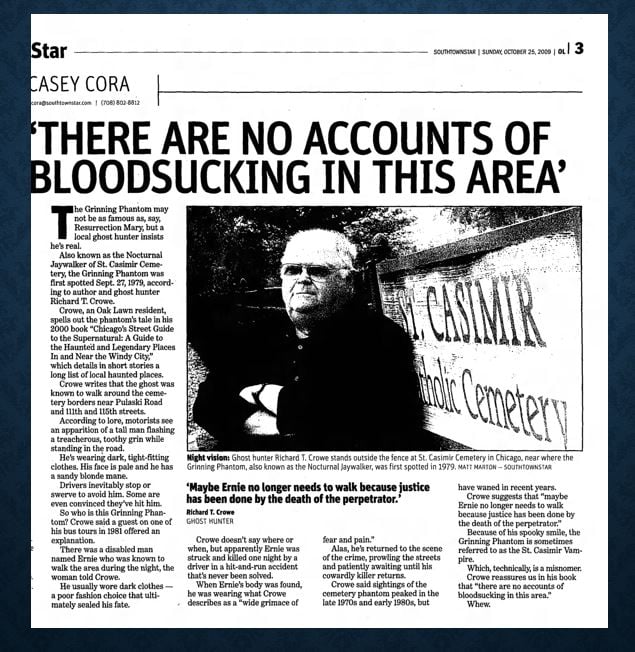
There has been an occasional vampire story on the South Side but these never came to anything. There were occasional sightings of a phantom by 111th and Pulaski Road at St. Casimir Cemetery, on the western edge of Mt. Greenwood. Richard Crowe, Chicago’s legendary ghost lore expert and tour director, assured the public this was not a vampire.
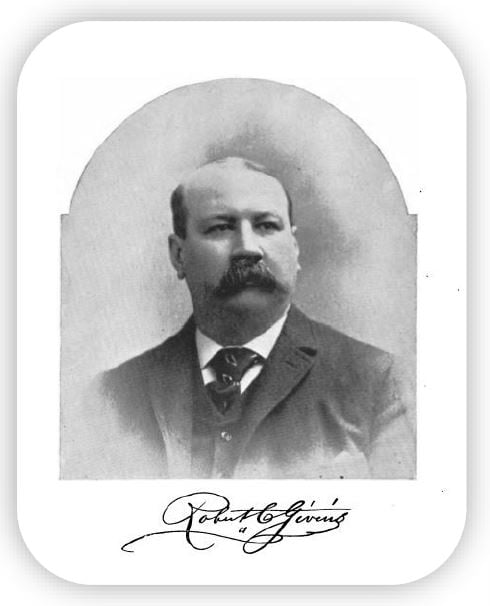
These posts have covered ghost stories at the Castle that Robert C. Givins built. As it turns out, Givins himself was no stranger to ghost experiences. One experience is covered in a book titled Robertson’s Landmarks of Toronto, published in 1894.
Givins’ ancestors came from Northern Ireland to Canada. Around 1800, Colonel James Givins, Robert’s grandfather, built a home in Toronto. At the time, Toronto was called York, and this was one of the first homes established, a landmark for many years until it was demolished in the late 1800s.
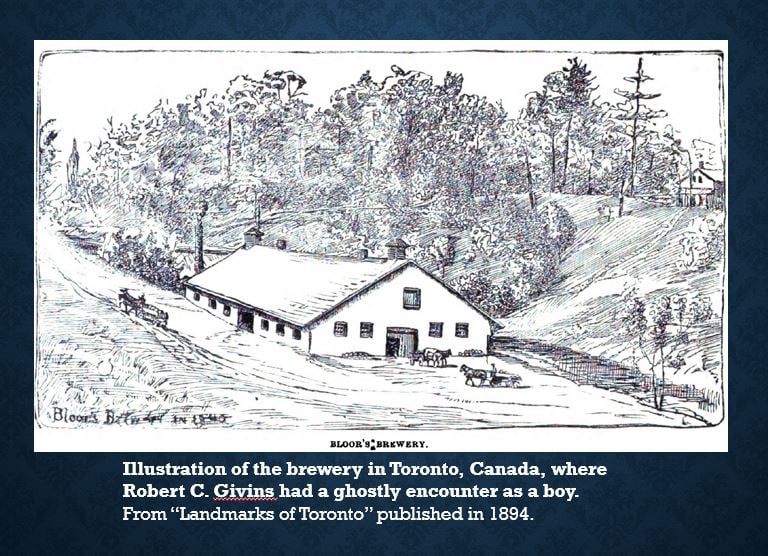
Robert C. Givins was born in Canada in 1846. In an adjacent village, Yorkville, which became part of Toronto in 1883, was an old brewery built at the bottom of a ravine. The building was described as “a low, red brick building one hundred feet long and fifty or sixty feet wide.” It was in a very picturesque setting, surrounded by thick woods with a pond from a stream that had been damned up to create water power for grinding. A water wheel was at one end of the building. A road ran down to the brewery from the street above.
By 1860, the brewery was no longer in operation. The building was used by local boys for a meeting place and shelter. In the wintertime, the road leading down into the ravine was used for sledding.
Givins shared the following story with a Canadian newspaper reporter:
“I remember one dark night one of the boys [dared] a party of us to go through the old [brewery]. A superstition existed among many in the village that this old building was haunted, and notwithstanding our frequent visits there in the day time, there was not a boy in the neighborhood who could be hired at any price to go through it at night, and I have no doubt many believed that it was actually haunted, because I remember a story in circulation at the time that one night an old watchman had occasion to go down there after an escaped burglar, claiming that as he entered the old building, he saw four ghosts playing whist on the top of one of the vats. He did not wait to catch the burglar, who either escaped or was annihilated by the ghostly occupants of the old building.
“We followed the nervy youth who originated this hazardous proposition. It was the blackest night he could have selected; thunder clouds hung over the pond, and an occasional flash indicated an approaching storm, and added no little terror to the occasion. To many of us this day seemed our last. Whew! – going through the old brewery at night. We groped our way down the hill, and after stumbling about over the rough ground and through shrubbery we finally got to the entrance to the old sluice. [This opening was where the water once ran to power the wheel for grinding.] It was 200 feet through into the big water wheel, which was located at one end of the brewery. The passage way was large enough for us to go two abreast, but was very low; we had to creep on our hands and knees. [No one] experienced a more breathless journey than we did.
“We got along, however, all right until we came to the big wheel, and after we all climbed through we stood inside the wheel to get a rest before we explored other portions of the brewery. In the corner of the room we thought we saw what first appeared to be a ray of light peeping through a crack in the wall. We all looked intently upon the corner where we saw two big bright eyes glaring at us like two coals of fire. We were paralyzed for a minute, not one of us mustering up courage enough to speak. At last the leader whispered, “Let’s get,” which we did and the way we scrambled out through that sluice to the entrance and got up the hill can never be properly expressed. Upon reaching the street, we walked hand in hand home.”
Tomorrow: Halloween and a final post on Castle ghosts
The Ridge Historical Society
The Paranormal Ridge: Part 14 – Save the Castle Ghosts
By Carol Flynn
Thank you to the members of the Beverly Unitarian Church (BUC) for being such good sports for the last few years while the Castle ghost folklore was researched and shared with the public. As much as folklore is an important part of history, it is recognized that the BUC has more important things to deal with than female phantoms with Irish brogues who don’t leave footprints in the snow.
Before we get to a final word about the Castle, there is one more category of ghost stories to look at – experiences that couldn’t and shouldn’t have happened.
There are several websites on which people post paranormal experiences and occasionally stories about the Castle show up. Here are two that fall into the “couldn’t and shouldn’t” category that were edited slightly to make them more readable:
“My friends and I would sometimes ditch school to go smoke some bud and we would often go to the abandoned castle. I’ve heard the voice of a woman talking, almost like shouting, as if in an argument with someone. She didn’t sound like an American; she sounded English or Celtic of some sort, with very proper speaking. I did not see anything but had a feeling of being watched.”
‘It is definitely haunted. I found a way inside and I did indeed hear a woman speaking aggressively in an English accent, or she sounded Irish.”
In response to these stories, first, the Castle has never been abandoned in its entire 130+ years of existence. BUC bought the Castle in 1942 and has used and maintained the building consistently for almost 80 years. Second, the building is kept secure and it is very doubtful anyone casually “found a way inside.” This is the “couldn’t” part of these stories – they just do not ring true.
More importantly, the Castle is private property. “Ghost exploration” does not justify trespassing, violating any laws, or invading someone's privacy. This is the “shouldn’t” part and applies to any location, not just the Castle.
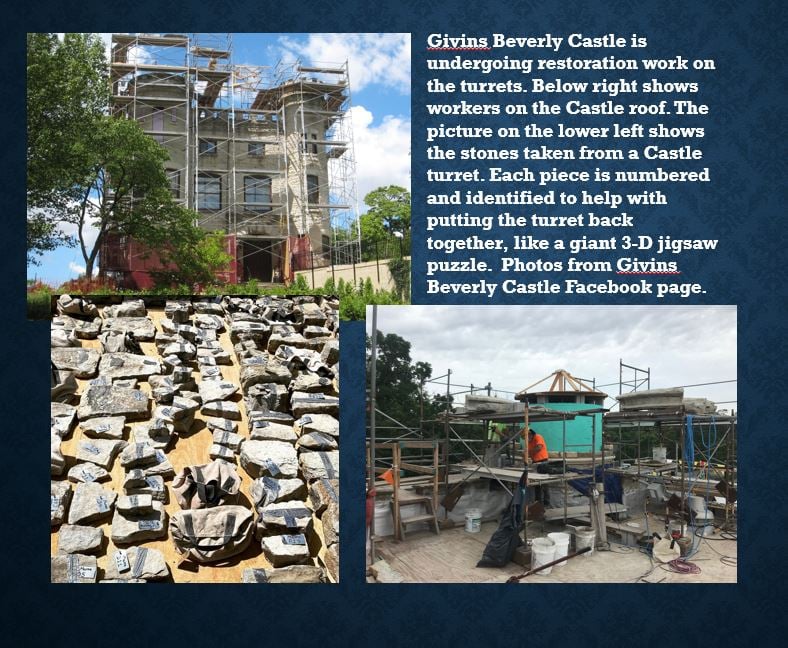
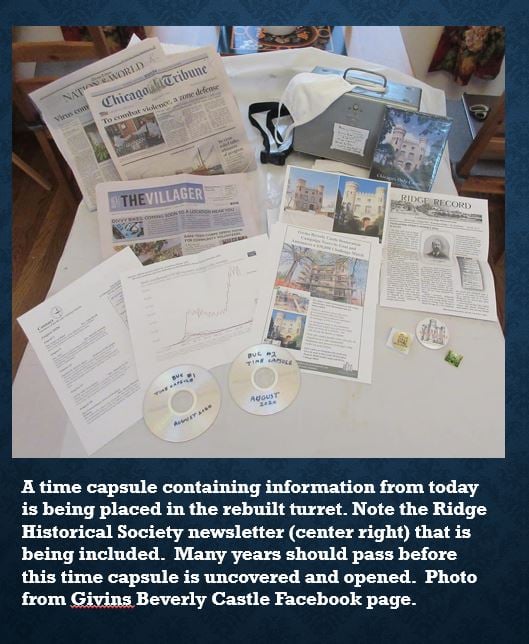
The final word about the Castle is that the BUC is currently undertaking a major restoration project. After more than 130 years, the turrets, or tops of the round towers at the Castle's corners, were found to be deteriorating. Work to repair them began this past summer.
The BUC continues to reach out to the community for financial support for the preservation work. Donations to the Castle Restoration Fund are used solely for that purpose and not for church operations. For more information on the restoration project, including information on funding and donating, visit the website at givinsbeverlycastle.org or see the Facebook page Givins Beverly Castle.
Castles stir the imagination, especially a medieval castle perched on a hill in a modern American city. The towers and turrets conjure up images of another time and place, of knights and fair maidens, thrones and dungeons. Ghost stories are part of the mystique of a castle, and the Givins Beverly Castle is no exception.
The Castle is the best known and loved landmark in Beverly. Even though the building is owned by BUC, the entire community gets to enjoy its presence. Saving the Castle means saving history and folklore – and the ghosts themselves. If the Castle deteriorates, where will the Irish lasses go?
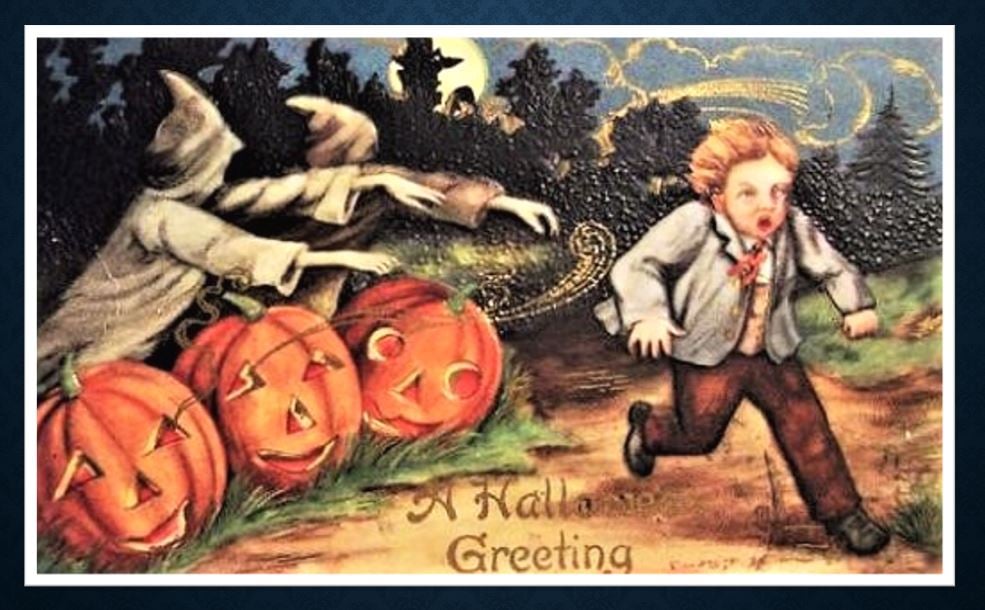
Happy Halloween.
The Ridge Historical Society
All Saints Day, November 1, 2020
By Carol Flynn
Today is All Saints Day or the Feast of All Saints. The date was set by Pope Gregory III during his pontificate in the years 731-741.
In some churches (Catholic, Lutheran, Anglican, Eastern Orthodox, Oriental Orthodox), anyone who has died and gone to Heaven is considered a saint. Some saints are considered worthy of greater honor because of their exceptional holiness or closeness to God. Some of these saints have individual feast days, but most do not. The Catholic Church has recognized more than 10,000 saints, but some names and stories have been lost to history. And some names were never recorded, such as people who died in groups as martyrs.
The intent of All Saints Day is to recognize all these people, known and unknown.
Some saints are designated as “patron saints” or advocates for places, occupations or crafts, causes, and situations. It is believed that patron saints can intercede on behalf of the needs of their charges.
The Ridge communities have several churches named for saints. One saint who is particularly relevant today as people struggle with the realities of the global coronavirus pandemic is St. Cajetan, the patron saint of the unemployed and job seekers.
Since the pandemic started, tens of millions of people have lost their jobs. In March and April of this year, 22 million nonfarm jobs were slashed. Although the situation started to improve in late summer, employment still remains about 11 million jobs below pre-pandemic days, and many temporary layoffs have become permanent. In a study in mid-October, nearly 78 million people reported difficulty in covering usual expenses.
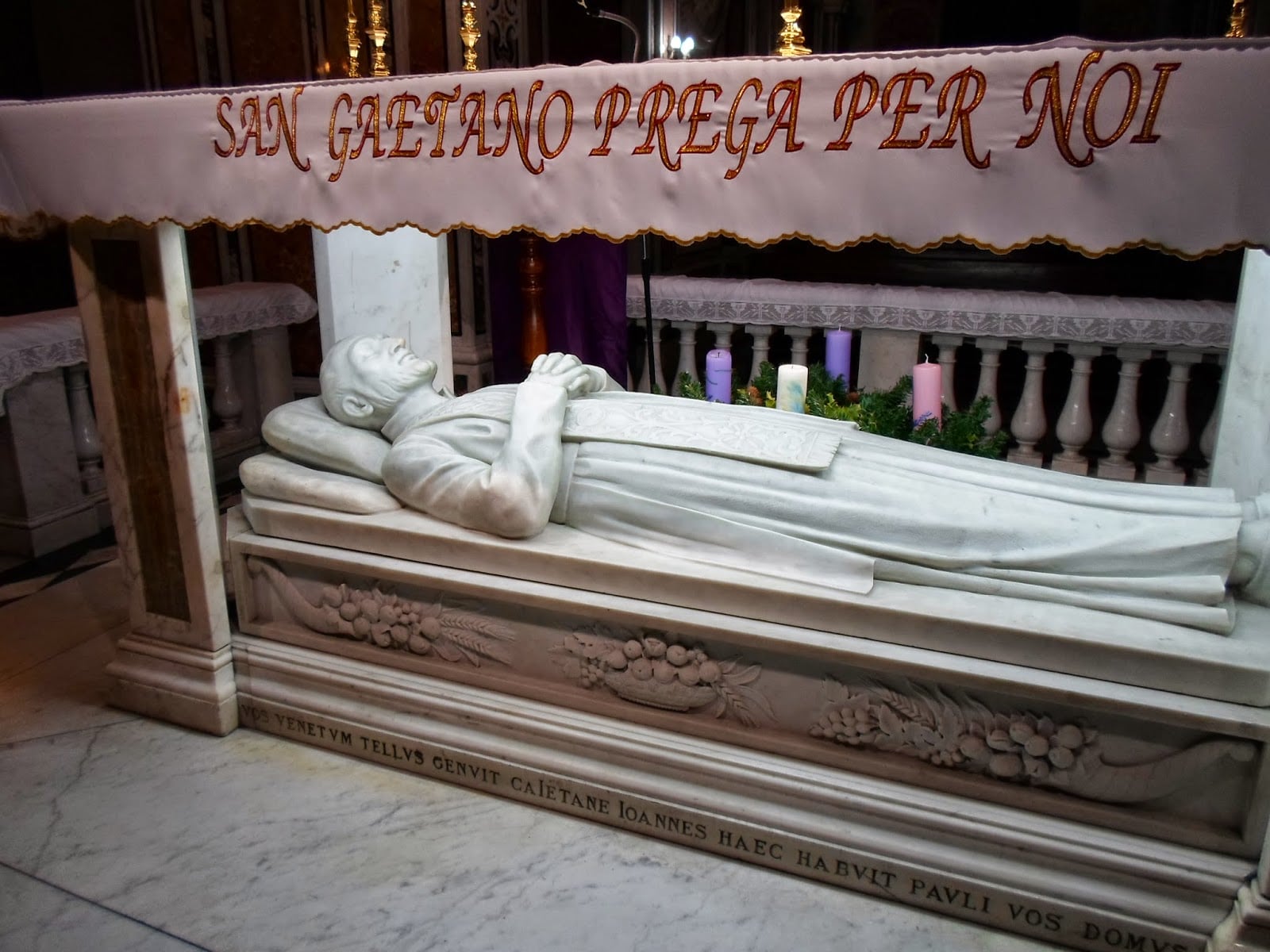
St. Cajetan, Gaetano dei Conti di Thiene (1480-1547), was born into a wealthy, noble family in Venice. He completed a law degree and worked as a diplomat for Pope Julius II. When Julius died, Cajetan resigned and entered the seminary, and was ordained a priest in 1516. He spent the rest of his life tending to the sick and poor, giving up his own worldly goods to help them. He established several hospitals for incurables during the years of the bubonic plague.
Cajetan recognized that people who had lost their livelihoods often became victims of desperation. He believed in the dignity of all people. He helped the unemployed through financial assistance and providing the basic necessities of life. In Naples, he founded a charitable non-profit bank/credit organization to protect the poor from usury, that is, exorbitant rates of interest. Wealthy benefactors donated to his cause and Cajetan took no money for his efforts. The bank provided loans without interest that people secured with personal objects. Job training and employment opportunities were also offered through the bank.
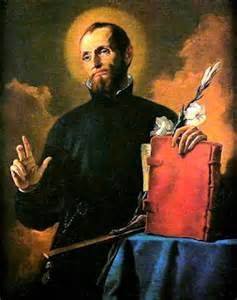
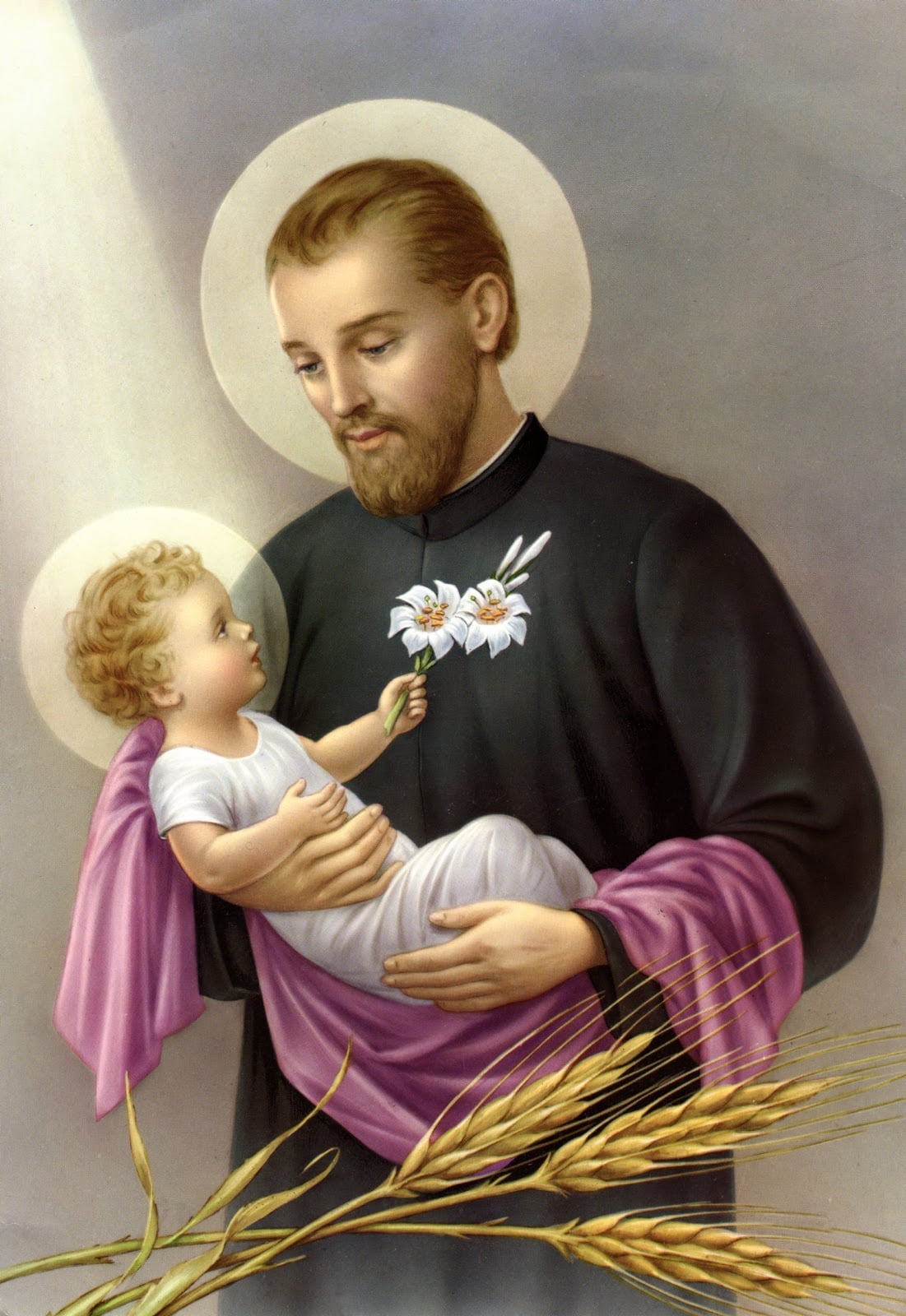
St. Cajetan is also the patron saint of Argentina. There they call him the patron of “Bread and Work.” He is presented two ways in art. One image depicts him with a book, to signify learning, and white lily, which represents Mary. The other presents him holding the infant Jesus. He had a vision in which Mary placed her infant in his arms, which he interpreted as her trust and approval of his work.
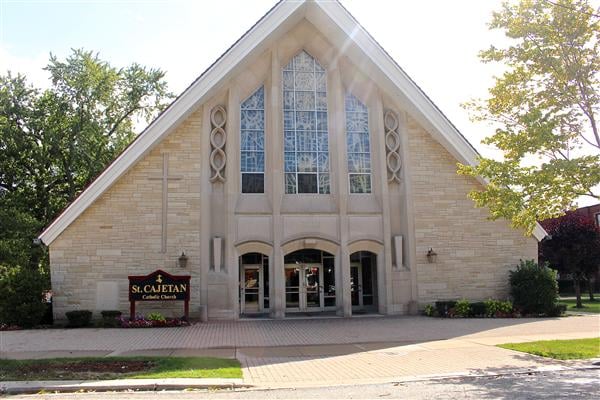
St. Cajetan Parish at 2445 West 112th Street was founded in 1927. It was the first Roman Catholic parish in Morgan Park, and the second Catholic church there, following Sacred Heart, which is a mission church and not a parish. It is the fifth Catholic church in RHS territory, and the fourth parish, following St. Margaret of Scotland (Washington Heights), St. Barnabas (Beverly), and St. Christina (Mount Greenwood). The current St. Cajetan Church was built in 1961-62.