Explore the RHS Facebook Archives, a rich repository of local history written by Carol Flynn. For two decades, Carol brought a deeply dedicated voice to public education at RHS. Her role as Facebook administrator through mid-2025 naturally extended her prolific research into meticulously detailed articles, most notably her multi-part historical series posts. Today, Carol continues her local history writing for The Beverly Review and other outlets.
2023
The Ridge Historical Society
The Early Days of Morgan Park – Part 5: More Founders of Morgan Park
By Carol Flynn
In previous posts, we looked at two of the prominent Chicago businessmen who developed Morgan Park, Frederick H. Winston and John F. Tracy. Both were executives with the Chicago, Rock Island, and Pacific Railroad (CRI&P) and both were founders of the Blue Island Land and Building Company (BILBCo).
Other men important to Chicago’s history were also part of the BILBCo.
CHARLES VOLNEY DYER (1808-1878) was a physician who came from Vermont to Chicago in 1835, where he served as Surgeon for the garrison at Fort Dearborn, and later went into private practice.
Dyer made the wise decision to invest in real estate, and he was able to retire in 1858. Presumably, his investment in the BILBCo paid off favorably.
He and his wife Louisa had three children and an adopted daughter who lived to adulthood.
Dyer is best known for being an ardent abolitionist. As early as 1837, he held a protest meeting in reaction to the murder of Elijah Lovejoy by a pro-slavery mob in Alton, Illinois. Lovejoy was the owner of a newspaper that advocated for ending slavery. The Lovejoys were good friends of Abraham Lincoln, and their nephew Austin Wiswall lived in Morgan Park and was a member of the Village Board of Trustees in the 1890s.
Dyer actively fought against slavery. He became a stationmaster on the Underground Railroad, hosting many escaped slaves, some brought to him by Owen Lovejoy, Elijah’s brother.
In a famous incident, a young escaped slave staying with Dyer was re-captured by slave traders and held at a hotel. Dyer burst into the room and cut the ropes to free the youngster and told him to flee through the window. One of the slave traders attacked Dyer with a knife and Dyer beat him unconscious with his walking stick.
A later connection between Dyer and Beverly/Morgan Park was the Loring School for Girls. Dyer’s daughter Stella Dyer Loring established this private school in 1876. From 1935 until the school’s closing in 1962, it was located in the England J. Barker House at 107th Street and Longwood Drive.
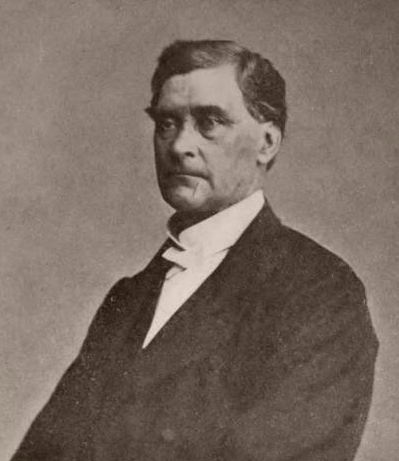
Dyer's photo is attached to this post.
CHARLES W. WESTON (1833-1880) was born in Massachusetts and had a career in manufacturing and merchandising. He came to Chicago in 1866 and made a new career in real estate investment. He also invested in elevated railways, or streetcars, and was named as Treasurer of the West Chicago Elevated Railway in 1879.
Weston died of consumption (tuberculosis) at the age of 48. He was living at the Palmer House at the time with his wife Mary and their ten-year old son. A special funeral train brought his coffin and mourners to Mount Greenwood Cemetery.
JOHN BACON LYON (1829-1904) was born in New York in 1829 and came to Chicago as a grain merchant in 1857. He joined the Board of Trade and became one of the longest-standing members. It was reported that he was involved in more deals than any other grain trader in the west.
Lyon was also involved in real estate, and had interests in the timber, turpentine, oyster, and sugar industries. He was known for his insightful investments, and keen judgment, making him one of the most successful businessmen in Chicago. He was also a founding member of the Chicago Historical Society.
He, his wife Emily, and their five children lived at 262 Michigan Avenue.
The next post will look at some of the BILBCo men who lived in and developed sections of Beverly.
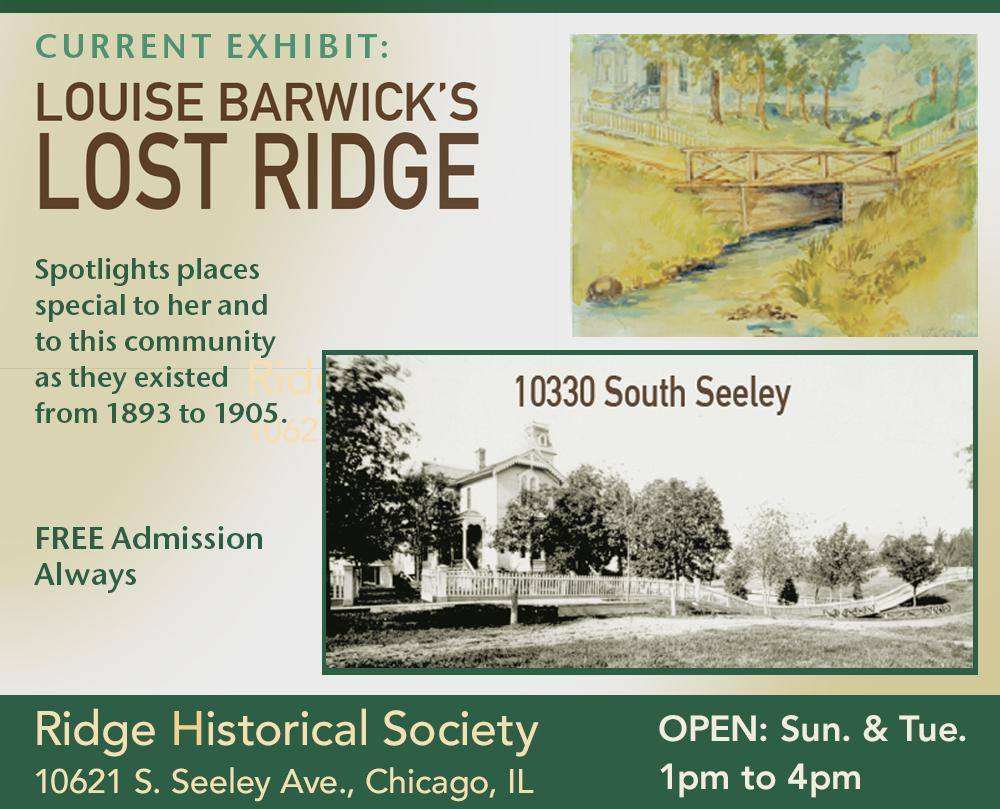
The Ridge Historical Society (RHS) has premiered a new exhibit that is now open for public viewing. There is something in this exhibit for everyone – art, rare photographs, architecture, and the stories of people who called the Ridge home. Curators of the exhibit are Linda Lamberty, RHS Historian, and Tim Blackburn, RHS Board member.
“Louise Barwick’s Lost Ridge” presents the area from 1893 to 1905 as experienced through the watercolor paintings and their descriptions by Louise Barwick, a local teacher and artist. Viewers will be taken back to the days when daisies stretched for acres, gaslights were lit by hand every night, and young women arrived for events in horse-drawn carriages.
A related story is that of Sol Hornbeck whose family lived and worked in one of the historic train stations. Sol shared stories about the wild bird life in the area.
Also on display are images of the area caught by kite photography, cutting edge technology of the 1890s, foreshadowing today’s drone photography.
Another part of the exhibit is an architecture feature on early buildings from Beverly and Morgan Park. Some are still standing but many others have fallen to the wrecking ball.
The fates of the Vanderpoel Block on 95th Street and the Charles Silva House on Esmond Avenue reveal that, unfortunately, progress and preservation are not always compatible. The Vanderpoel Block is preserved in a wonderful model on loan from Tim Blackburn. Artifacts salvaged from the Silva House are on display from the RHS collection.
Viewers will also enjoy rare early panoramic photos of the area, and can guess which of twenty-three original buildings are still standing. Hint: It’s more than half!
RHS is located at 10621 S. Seeley Avenue in Chicago. Exhibit hours are 1:00 p.m. to 4:00 p.m. on Sundays and Tuesdays, or by appointment. Admission is free. There is some parking on site, and more on Seeley Avenue. RHS is not wheelchair accessible. RHS may be contacted at 773/881-1675 or ridgehistory@hotmail.com.
The Ridge Historical Society
Wild Turkeys on the Ridge
By Carol Flynn
In the last few years, turkeys have been spotted roaming the streets of the Blue Island, from the city of Blue Island on the southern tip of the island to Beverly on the north.
Last year, a turkey was captured in Beverly and taken to an animal refuge in Indiana. There it was identified as an escaped domestic turkey.
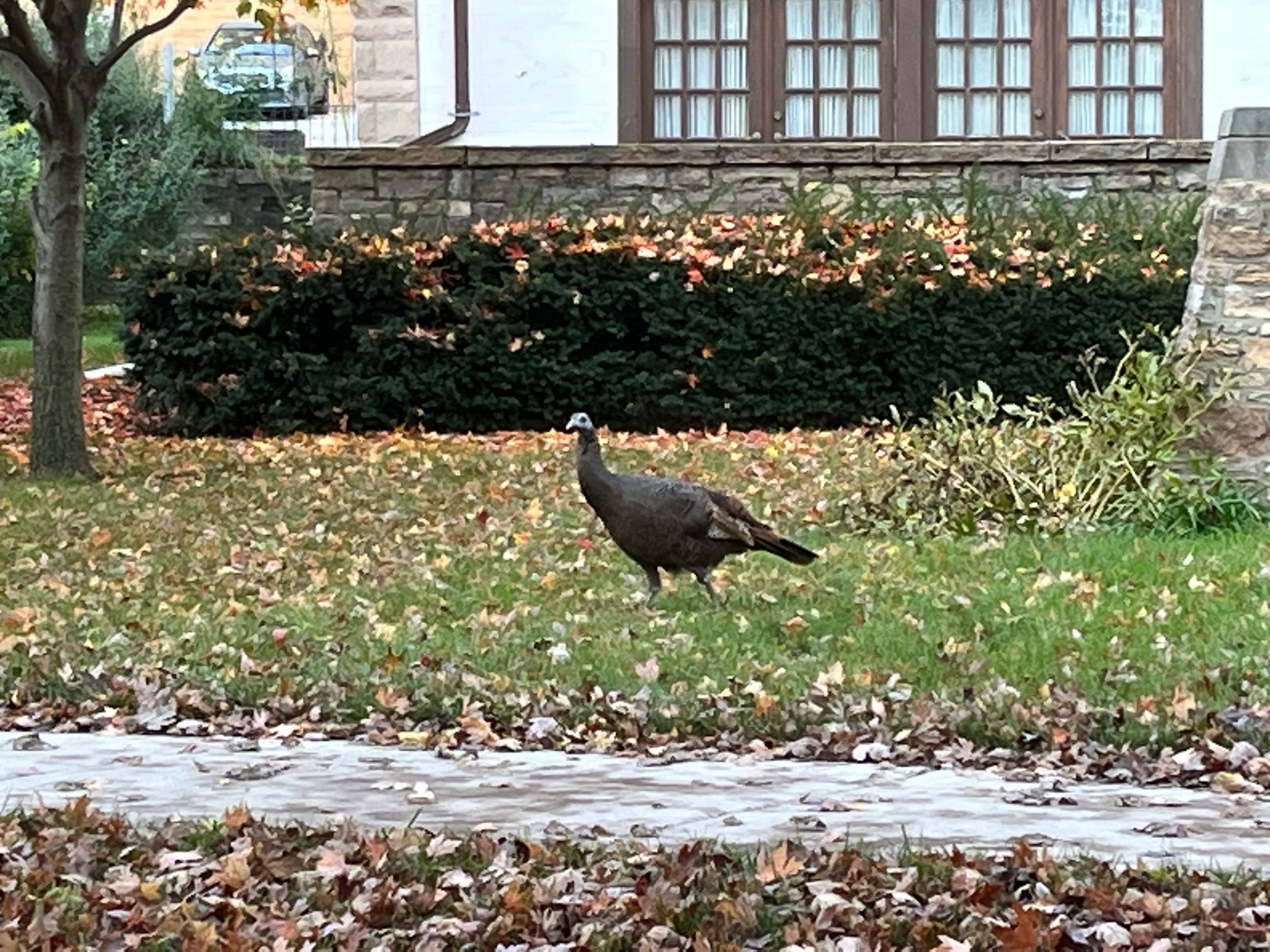
Right now, at least one turkey is walking around Beverly/Morgan Park. RHS President Debbie Nemeth caught this photo of it outside of the Morgan Park Presbyterian Church at 110th and Longwood Drive.
The history of wild turkeys in this country, and in Illinois, is very interesting.
In the mid-1800s, an English “sportsman and conservationist” named Parker Gillmore visited the northern Illinois/Indiana area and wrote up his stories in a book called “Prairie Farms and Prairie Folk,” which he published in London in 1872.
Gillmore shared this recollection:
“I had a sight which few have seen. I took the old hound with me…. Backward and forward the faithful old dog trailed his game … till at last a drove of over thirty full-grown turkeys took wing through the inundated portion of the forest. What splendid birds these were, and with what brilliancy the sun was reflected off their burnished plumage! The sight was before me for hours afterwards. Shall I ever forget it? My feelings answer no.”
Within three decades of Gillmore sharing that remembrance, wild turkeys had almost disappeared from the United States altogether.
The U.S. Department of Agriculture once stated that “the Wild Turkey is the largest and the gamiest game bird native to North America.”
Native Americans made use of turkeys long before white settlers came; they even domesticated them. They used the feathers for arrows, blankets, clothing, and ornamental headdresses. They ate the meat and used the bones for tools. Native Americans were environmentalists. They were always careful not to overhunt the wildlife so the supply was sustainable.
Starting in the 1600s, European settlers came along and became dependent upon the turkey as a mainstay of their pioneer lifestyle and diet.
Benjamin Franklin preferred the turkey to the bald eagle for use on the national seal. Franklin said the eagle was “a bird of bad moral character.” He said that “the Turkey is in Comparison a much more respectable Bird, and withal a true original Native of America… a Bird of Courage, and would not hesitate to attack a Grenadier of the British Guards who should presume to invade his Farm Yard with a red Coat on.”
Clearing the land for farms destroyed the bird’s habitat, and overhunting caused the turkey to disappear from Massachusetts by the 1820s.
A publication called “The Auk” reported in 1909 that in 1903, a man by the name of Mr. F. B. Smiley led a hunting party that killed five wild turkeys in Clinton County, Illinois. Smiley bragged that, “as far as he knew, these were the last Wild Turkeys ever seen in Illinois.”
By the early 1900s, only about 200,000 wild turkeys were left in the U.S. when once there were millions of these birds throughout the forests and prairies. The U.S. government began a program to bring them back from impending extinction.
Illinois was one of the first states to set up breeding farms for wild turkeys. One report said that a flock of thirty-five wild turkeys from an Arkansas breeder was brought to a wooded farm downstate.
Unfortunately, the early attempts were not too successful. A 1980 report shared that:
“The wild turkey was extirpated from Illinois during the early 1900s because of habitat destruction and excessive hunting. Attempts by the US Forest Service in 1935 and by the Illinois Department of Conservation in 1954 and 1955 to introduce pen-reared wild turkeys were not successful. The birds were too tame.”
Another article reported that it seemed the birds were quite able to fight off natural predators, like fox, but they did not recognize “their greatest enemy – the man with a gun.” The first releases hung out around the populated farms; it took a few generations of breeding in the woods before they “reverted back to their original shyness and cunning.”
The 1980 report went on to say that in 1958, wild turkeys live-trapped in West Virginia were released in Illinois, and this, and subsequent additional releases, began a successful increase in the wild turkey population in Illinois.
Apparently, it was best to leave the plan to Mother Nature.
Today, the eastern wild turkey is the only subspecies found in Illinois, according to the Illinois Department of Natural Resources (IDNR). They are large birds with dark, iridescent feathers in shades of bronze, red, purple, blue, and green.
The populations of wild turkeys reintroduced from 1958 to 1967 produced offspring that have now been reintroduced to all Illinois counties. They are found in woodlands and grasslands. They mainly eat plants but also insects, acorns, and berries.
In Illinois, wild turkeys are legally protected by the Illinois Wildlife Code. In urban areas, wild turkeys may not be removed except by a professional approved by the IDNR.
However, the turkeys spotted in urban areas are often escaped or released pen-raised turkeys from game-farm stock. According to IDNR, these birds often look like wild turkeys, but they lack a wariness of humans, are not adept at living in the wild, and often associate people with food. Besides leading to human–turkey conflicts, the escape of pen-raised turkeys has wildlife biologists concerned about the spread of disease to wild flocks and the loss of genetic purity caused by hybridization.
The IDNR is the organization that would oversee the identification of the turkey or turkeys roaming around the Ridge, and determine how to deal with the situation safely.
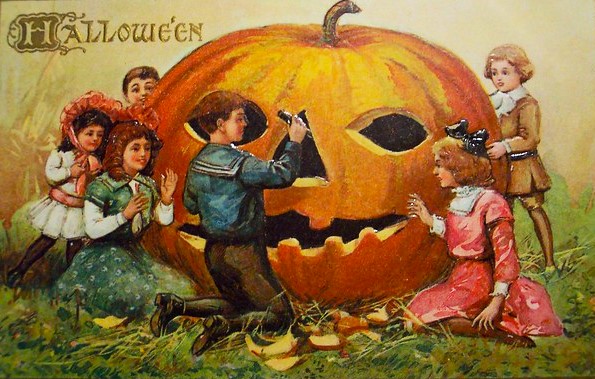
Happy Halloween from the Ridge Historical Society.
Halloween has become a truly American holiday but its origins are in Ireland. The traditions that the Irish brought over to the U.S. in the 1800s turned into today's Halloween customs.
About 2,000 years ago, the Celtic New Year of Samhain was born. The new year started with the end of the harvest. The people believed that at this time of year, the barrier between the physical and spiritual worlds was thinnest, and spirits could cross over into the physical world.
This included the spirits of deceased loved ones, who were welcomed. Places at the table were even set for these spirits.
It also included non-human spirits, like demons and fairies. To scare away these beings, people carved gruesome faces into turnips (rutabagas) and lit them from inside with candles, and placed them on their stoops or in their windows.
When they came to the States, rutabagas were less plentiful , and they discovered pumpkins were much easier to carve.
Thus, jack-o-lanterns began.
They also dressed in fearsome outfits to confuse the demons, leading to costumes. They left out treats for the fairies so the fairies wouldn't play tricks on them, leading to trick-or-treating.
The Ridge Historical Society
Myrtle’s Doll
By Carol Flynn
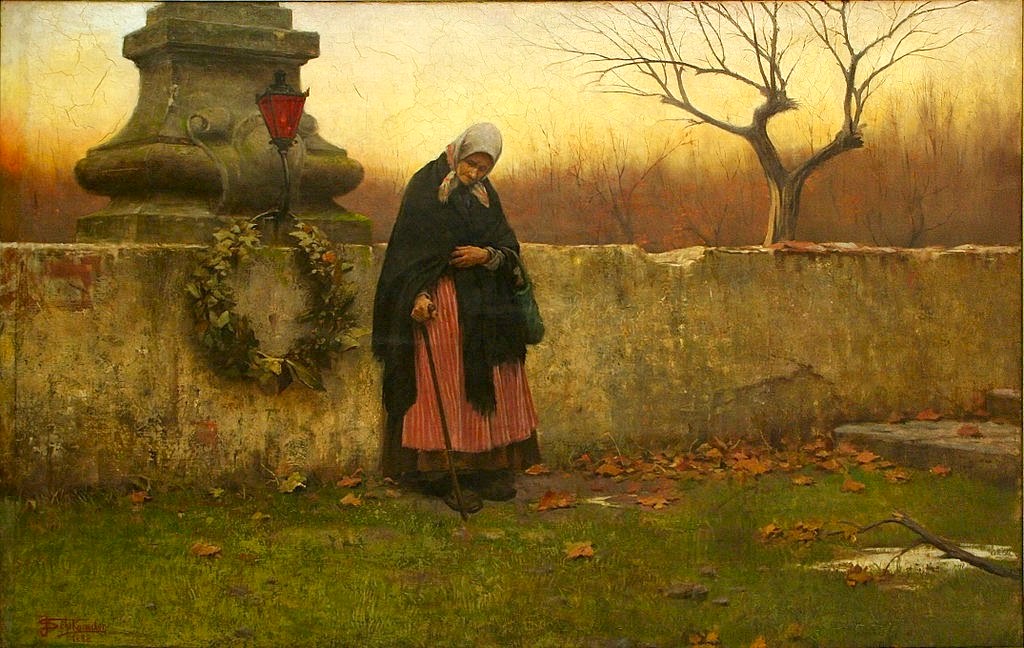
Today on All Souls Day when we remember and honor our departed loved ones, little Myrtle McCray’s story is especially touching. The researchers at the Ridge Historical Society brought this story to light.
Myrtle was not quite two years old when she died of influenza and pneumonia in 1918 during the historic influenza pandemic. Her family lived downstate near Coal City, where her father worked as a miner. The large family, ten people, slept in one room as was common at the time. Only Myrtle became ill and died from the flu.
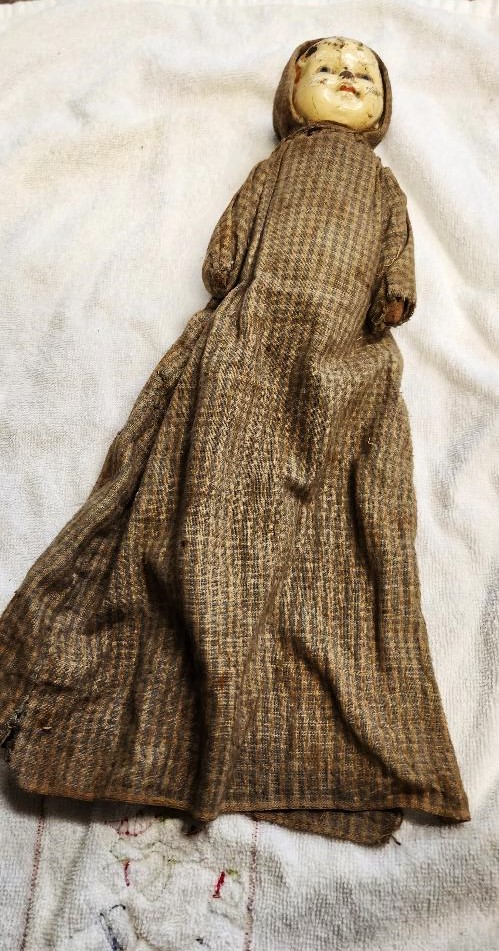
According to McCray family stories, Myrtle died holding her beloved doll, which had been passed down not only through her own generation but likely also through previous generations. The handmade doll was already well loved and well worn by the time it became Myrtle’s treasure.
Myrtle’s older sister, Hazel, who was about ten years old at the time, saved the doll as the only remembrance she had of her baby sister. There was no money then for photos of a little girl like Myrtle.
Hazel kept the doll in a cedar chest all her life. Hazel had two daughters, and she would show them the doll and tell them about Myrtle and her beautiful blond curls. The daughters came to cherish the doll and the story of their Aunt Myrtle. When their mother died, the doll was passed along to the oldest sister, and when that sister died in 2021, the doll became the property of the younger sister, Patricia Rose Wulf, of Beverly/Morgan Park.
Patricia and her husband, the late Col. Jerry C. Wulf, USMC (Ret.), moved to Beverly/Morgan Park in 1964. They raised their son and daughter here. Patricia was a member of the Beverly Juniors and has many friends and contacts in the area, including Elaine Spencer, past President of the Ridge Historical Society. Elaine’s husband, the late Carl Spencer, also a military veteran, and Jerry Wulf were good friends.
Now in her eighties, Patricia became concerned about what would happen to the doll when she was no longer able to care for it. With its peeling plaster face and its old worn fabric body and clothes, by the standards of many people, the doll was “creepy.” The next generation of Patricia’s family showed no interest in continuing to hold onto this doll, and she did not want to see it thrown away.
Patricia realized what she really wanted to do was to return the doll to Myrtle, at least in spirit.
She did not want to bury the doll in her backyard where it could be disturbed. She lived at 108th and Fairfield Avenue, right by Mount Greenwood Cemetery, so she decided to leave the doll at the cemetery with the hope that the cemetery would give it a permanent home.
Although Myrtle was not buried in Mount Greenwood Cemetery, but in a cemetery downstate in Girard, Illinois, Patricia believed that Myrtle’s spirit would know the doll had been returned.
Patricia lovingly wrapped the doll in towels and a little blanket, and placed it in a plastic box. She included a note that read: “Dear Little Myrtle: You have waited over a 100 years for your baby doll. Now she is returned to you from your loving family. Myrtle died in the 1918 Spanish flu.” She also included a tag with her contact information. This was in the summer of 2022.
The President of the Mount Greenwood Cemetery Association, Paula Everett, who is also a long-standing member of the RHS Board of Directors, found the plastic box behind an urn by a mausoleum in the cemetery. Taking the box back to the office, she was surprised and intrigued to discover the doll inside. She checked cemetery records, but there was no Myrtle buried in that mausoleum. Busy at the time, she put the doll in its box aside for further investigation in the future.
About three weeks ago, Paula mentioned the doll to the RHS Facebook page administrator. A search of the burial records from 1918 had not turned up any Myrtle buried at Mount Greenwood Cemetery. Paula wondered if the RHS researcher/writer would have any interest in this story, and of course the answer was a resounding yes.
Patricia Wulf was located, now living in Clarendon Hills. As she frequently comes to Beverly for appointments and to visit friends, she met the researcher at Beverly Bakery for brunch one Friday morning, and shared the story of Myrtle’s doll.
Despite its appearance, there’s really nothing “creepy” about the doll once the story is known. It is a story of family love and memory and preserving a family’s history.
The doll is now safely put away in a storeroom at the cemetery with other items that have been left at the cemetery through the years.
The Ridge Historical Society
Louise Barwick – Part 1
By Carol Flynn
The Ridge Historical Society (RHS) has opened a new exhibit – “Louise Barwick’s Lost Ridge.”
The exhibit may be viewed on Tuesdays and Sundays from 1:00 p.m. to 4:00 p.m. or by appointment. RHS is located at 10621 S. Seeley Avenue in Chicago. The exhibit is free.
This exhibit focuses on life on the Ridge from 1893 to 1905 as seen through the watercolor paintings of Louise Barwick, an artist and educator who lived on the Ridge.
Other components of the exhibit include a section on aerial photography taken by cameras attached to kites, and “lost and found” architecture – historic photos of buildings, some of which remain and some of which are gone from the Ridge.
This post will begin a look at Louise Barwick.
The watercolor paintings by the late Louise Barwick are among the gems of the RHS collection. Miss Barwick (1871 – 1957) was a long-time resident and art teacher in the Ridge community.
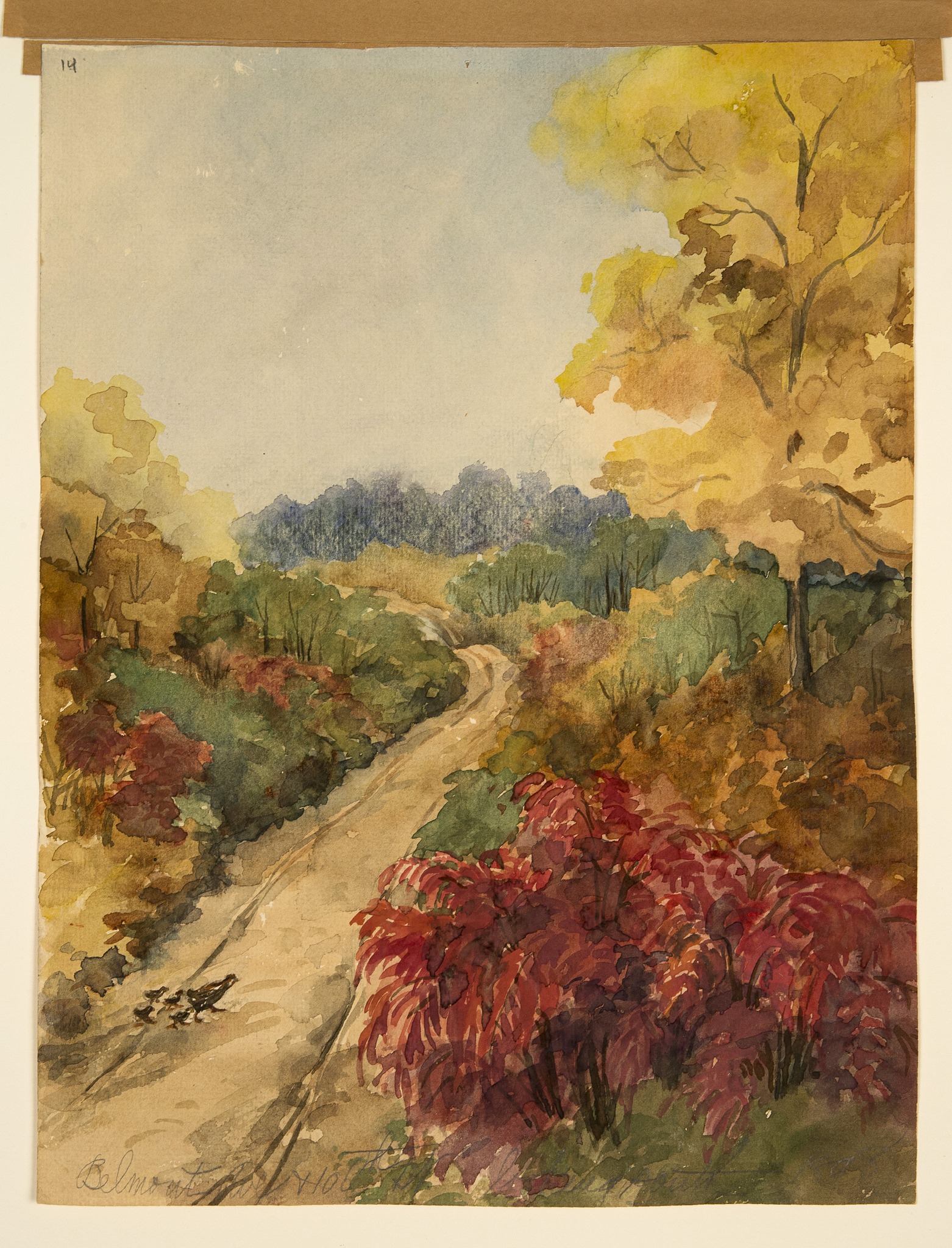
It is said that a picture is worth a thousand words. Miss Barwick’s paintings are not only interesting from an artistic perspective, but also because the subject matter depicts life on the Ridge circa 1895-1905.
Completed sometime in the 1940s or before, the paintings represent memories of everyday scenes as well as special events. They offer a unique visual interpretation of local history based on the experiences of a young woman of the time. Louise also included stories and descriptions that enrich viewers’ understanding of the images.
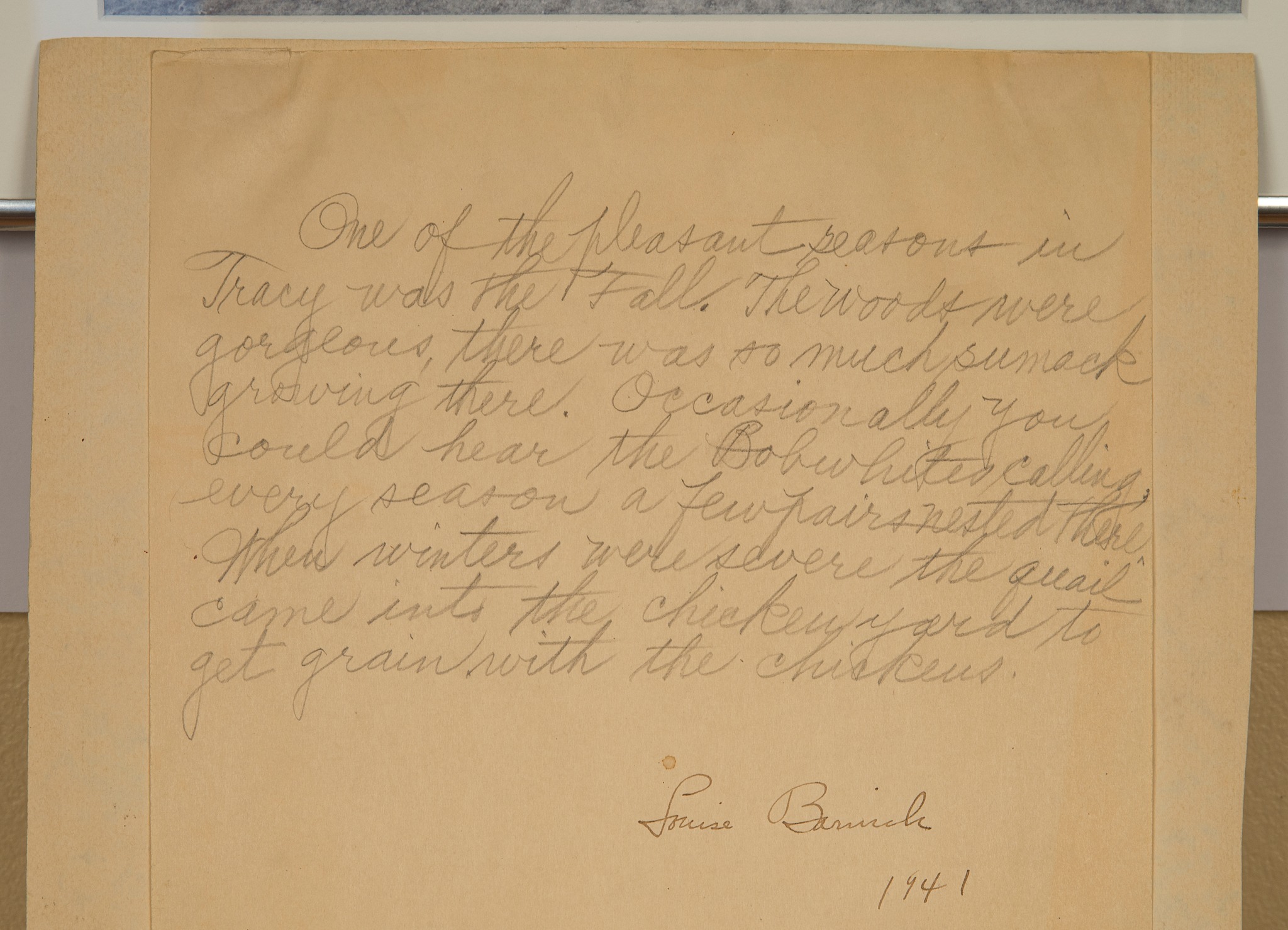
One example of her paintings and the notes with it are attached. To see more of her paintings, viewers are encouraged to visit RHS for the actual exhibit.
However, her watercolor paintings and teaching career are only part of Miss Barwick’s legacy. It was actually her geographical maps that won her fame.
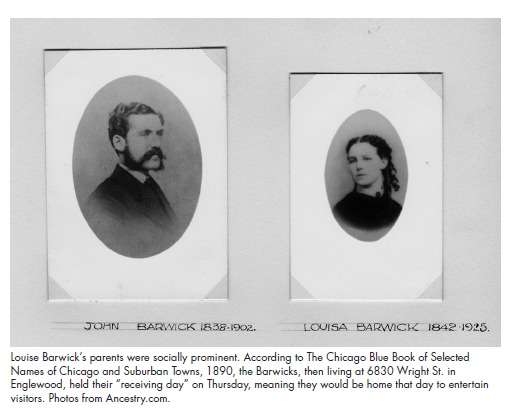
And Miss Barwick’s family history is also of note. She was a descendent of Chicago pioneers whose stories are part of the earliest days of the city.
Let's start with her genealogy.
The Barwick Family
Louise’s paternal grandfather, John Barwick (1806-1881) was a successful businessman and farmer in Canada.
He arrived in the Toronto area in 1832, having served in the British army, reaching the rank of lieutenant colonel. He established a saw mill, and was also a farmer and had a tavern license to sell beer and ale. From 1843-1847 he was partners with Benjamin Thorne, a leading merchant in Toronto and Montreal, who ran gristmill, sawmill, and tannery businesses. Barwick ran the Red Mills at Holland Landing as part of Thorne’s holdings.
Barwick was very active in local politics and improvements. In the 1860s, he served as president of the Provincial Agricultural Association of Upper Canada and on the Canada’s Board of Agriculture, and was involved in an exhibit that took place in London.
He was active in the formation and funding of the Canada Emigration Society, which encouraged people from the British Isles to immigrate to Canada. The businessmen considered this an investment – immigration brought more people to farm their vast land holdings, work in their industries, and buy their products.
John Barwick married Mary Ready Lee, the second daughter of Captain Simon Lee, who was wealthy from years with the East India Company. Mary’s hand had actually been asked for by another suitor, but Mrs. Lee insisted that by tradition the daughters had to marry in order. The first suitor was obliged to either marry the elder daughter or no Lee daughter at all.
John and Mary Barwick had a successful marriage, or at least a fruitful one. They had 18 children, including son John Lee Barwick, who came to Chicago at the age of 26, and took up with the Cleaver family.
The next post will look at the Cleaver family, and “Cleaverville,” a “company town” in Chicago that predated the Pullman area by three decades.
Here is a good introduction to the new RHS exhibit, "Louise Barwick's Lost Ridge."
https://www.beverlyreview.net/news/community_news/article_9cb7d924-7d90-11ee-88e6-2f9a24291df4.html
The Ridge Historical Society
Fire at the Bretsnyder House
By Carol Flynn
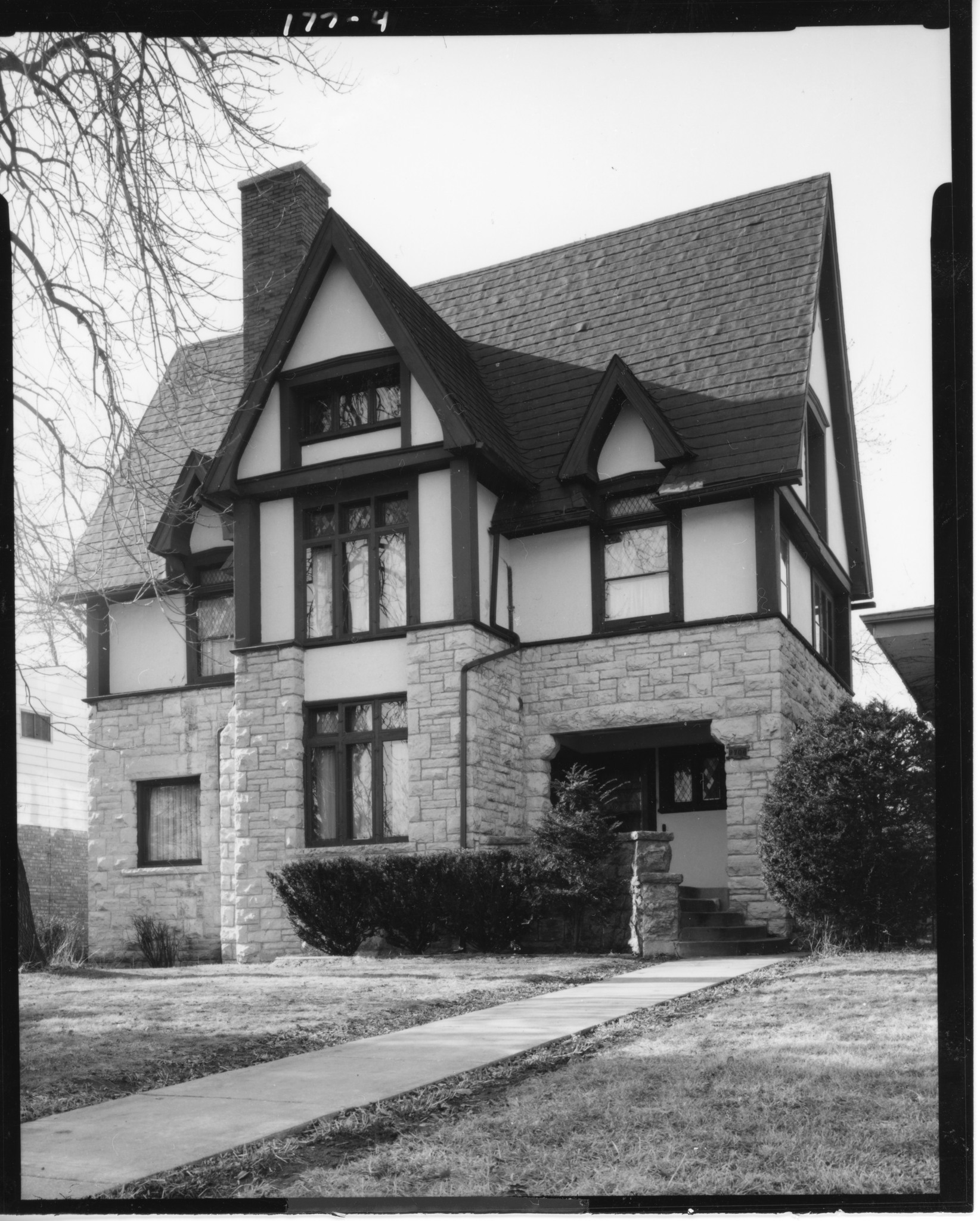
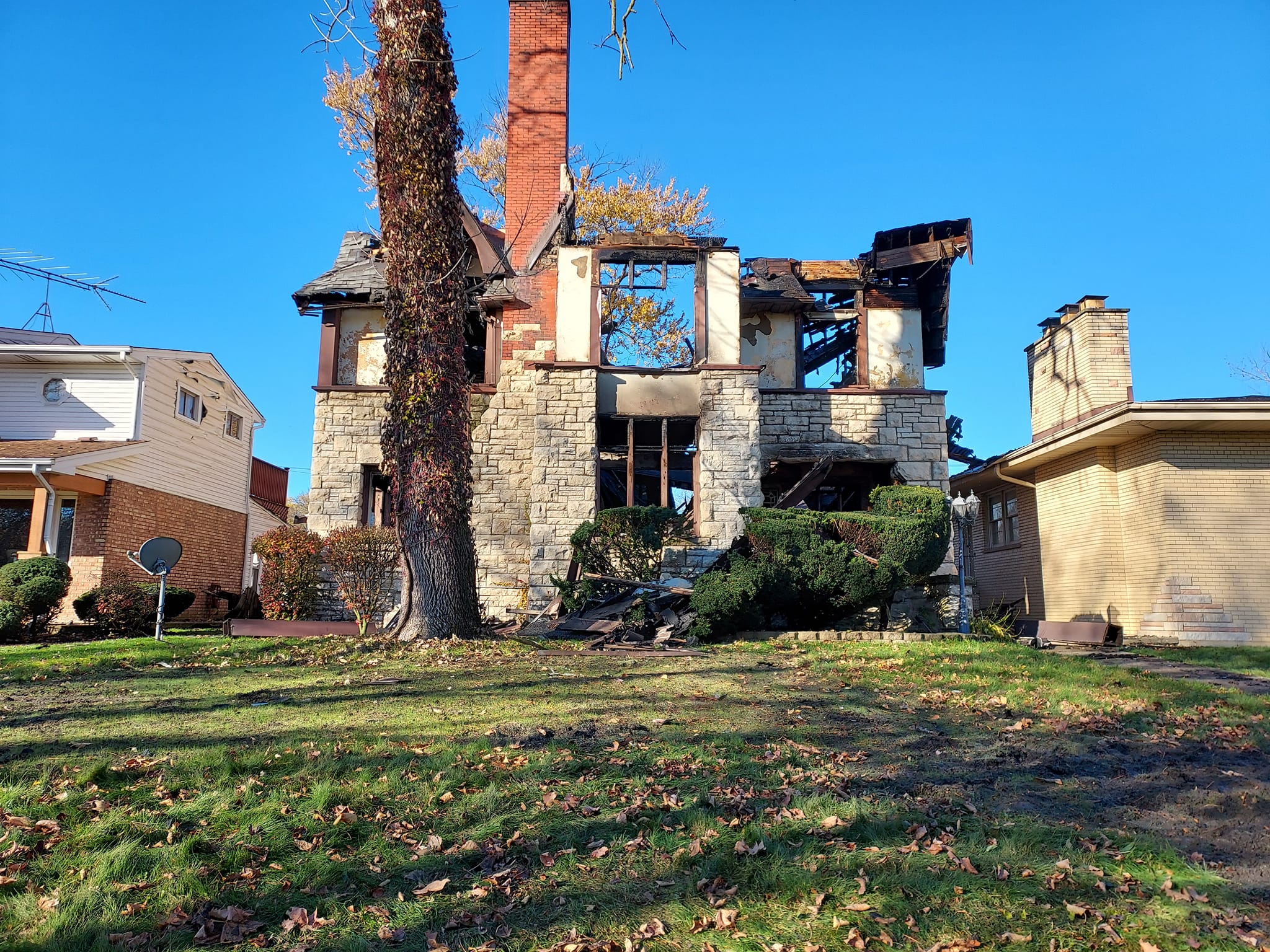
Last night the house at 9706 Longwood Drive was gutted by fire. Fortunately, no one was injured. It was reported that the house was currently unoccupied as it underwent renovation.
This house is the Minnie L. Bretsnyder House, built in 1895. The last name has several different spellings, including Bretshneider, but the family went by Bretsnyder in the years after the house was built, and when Minnie died in 1955, her obituary listed her as Minnie L. Bretsnyder.
The architect of the Norman- or Tudor-style house is not known with complete certainty, but according to Harold Wollf, architecture historian and past RHS registrar, the house is attributed to Harry Hale Waterman (1869 – 1948) based on the style. It was built during 1895-97, a period when Waterman was remiss in publicizing information on his projects.
Waterman was a contemporary of Frank Lloyd Wright and George Maher, but while they concentrated on developing distinctive styles, Waterman built in many different styles for a large group of clients. He designed many noteworthy buildings in the Beverly/Morgan Park community. He was affectionately known as "the village architect" in Morgan Park.
His work included the England J. Barker House at 107th Street and Longwood Drive; the Walter R. Barker House, also known as the “Walgreen mansion,” on 116th Street, part of the Mercy Home for Girls; the Morgan Park United Methodist Church at 110th Place and Longwood Drive; the Eugene S. Pike House at 91st Street and Longwood Drive; the Calumet Bank Building at 111th Street and Longwood Drive; and the Harry H. Waterman House at 108th Street and Longwood Drive.
The Bretsnyder family included Minnie, born in 1865 in Germany, and her husband William (1861 – 1942), born in Illinois to parents who came from Germany. William was an artist.
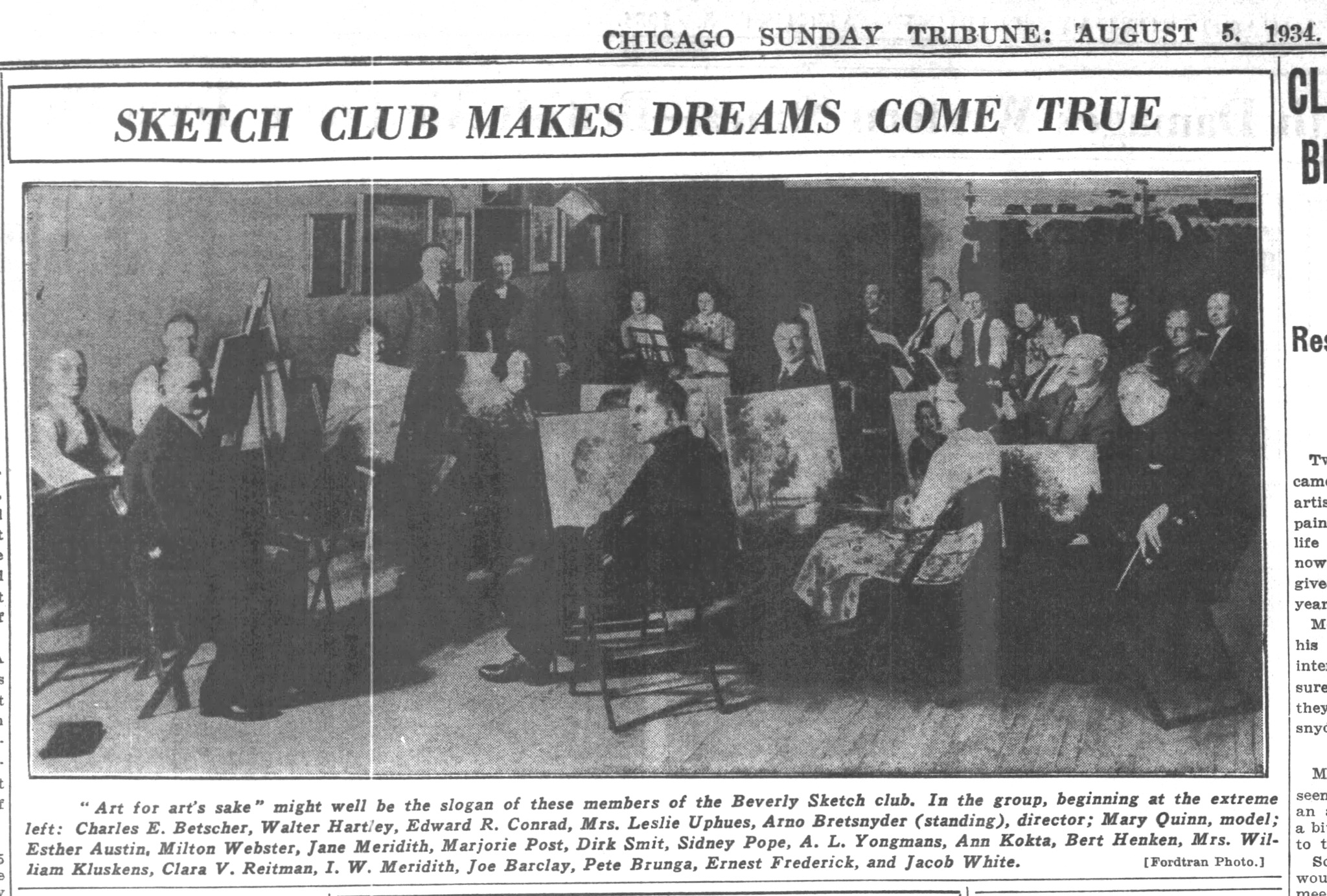
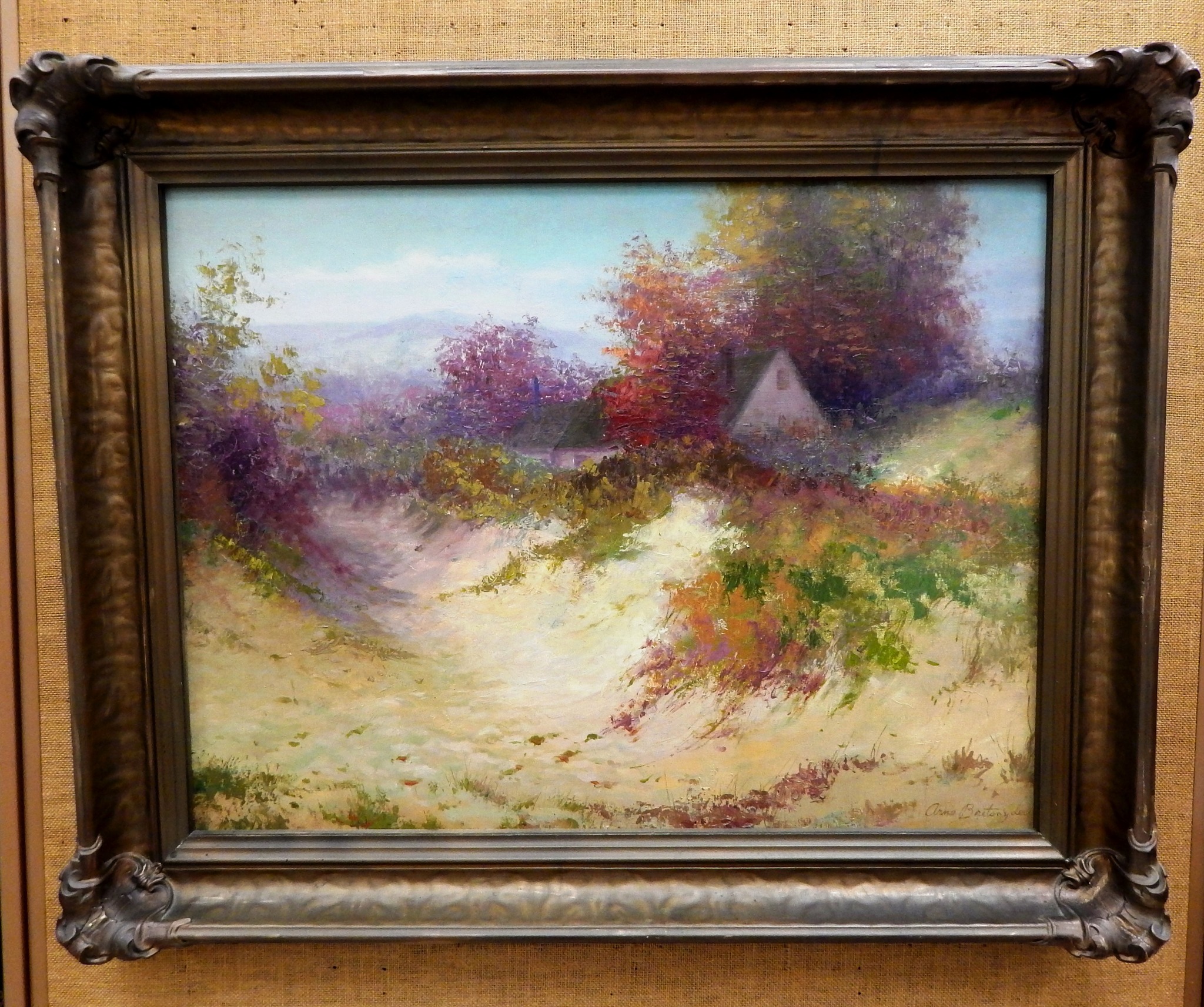
Their son, who lived at the house almost his entire life (he was about 10 when they built the house), was the artist Arno Bretsnyder (1885-1969). Arno studied under John Vanderpoel at the School of the Art Institute of Chicago (SAIC). He exhibited at the AIC in 1939.
The Vanderpoel Art Association has works by Arno in its collection at Ridge Park field house. His impressionistic oil paintings combined color, light, and texture in a dramatic way. He was known for landscapes and for Western paintings that depicted subjects like the Pony Express.
Arno joined the Society for Sanity in Art, a group opposed to modern art, including cubism, surrealism, and abstract expressionism.
Arno was also very active in the Ridge community’s art scene. He formed the Beverly Sketch Club at Ridge Park and was an important member of the Ridge Art Association, where he staged and participated in many exhibits.
Updates on the Bretsnyder House will be posted as RHS does more research on the house’s history and additional details of the current status of the house are reported.
Research assistance by Tim Blackburn, RHS Board member.
The Ridge Historical Society
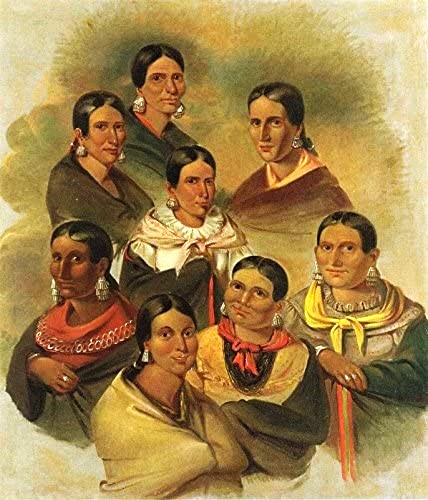
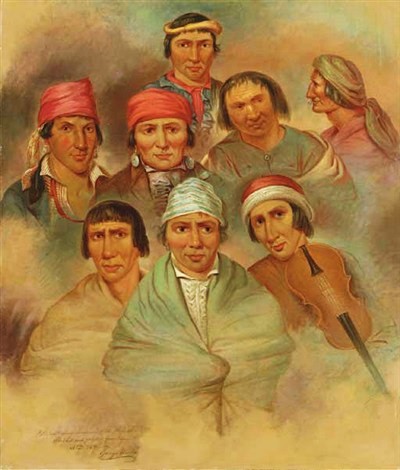
Native American Heritage Month: Land Acknowledgement Statement
By Carol Flynn
November is Native American Heritage Month. The theme for this year is “Celebrating Tribal Sovereignty and Identity.”
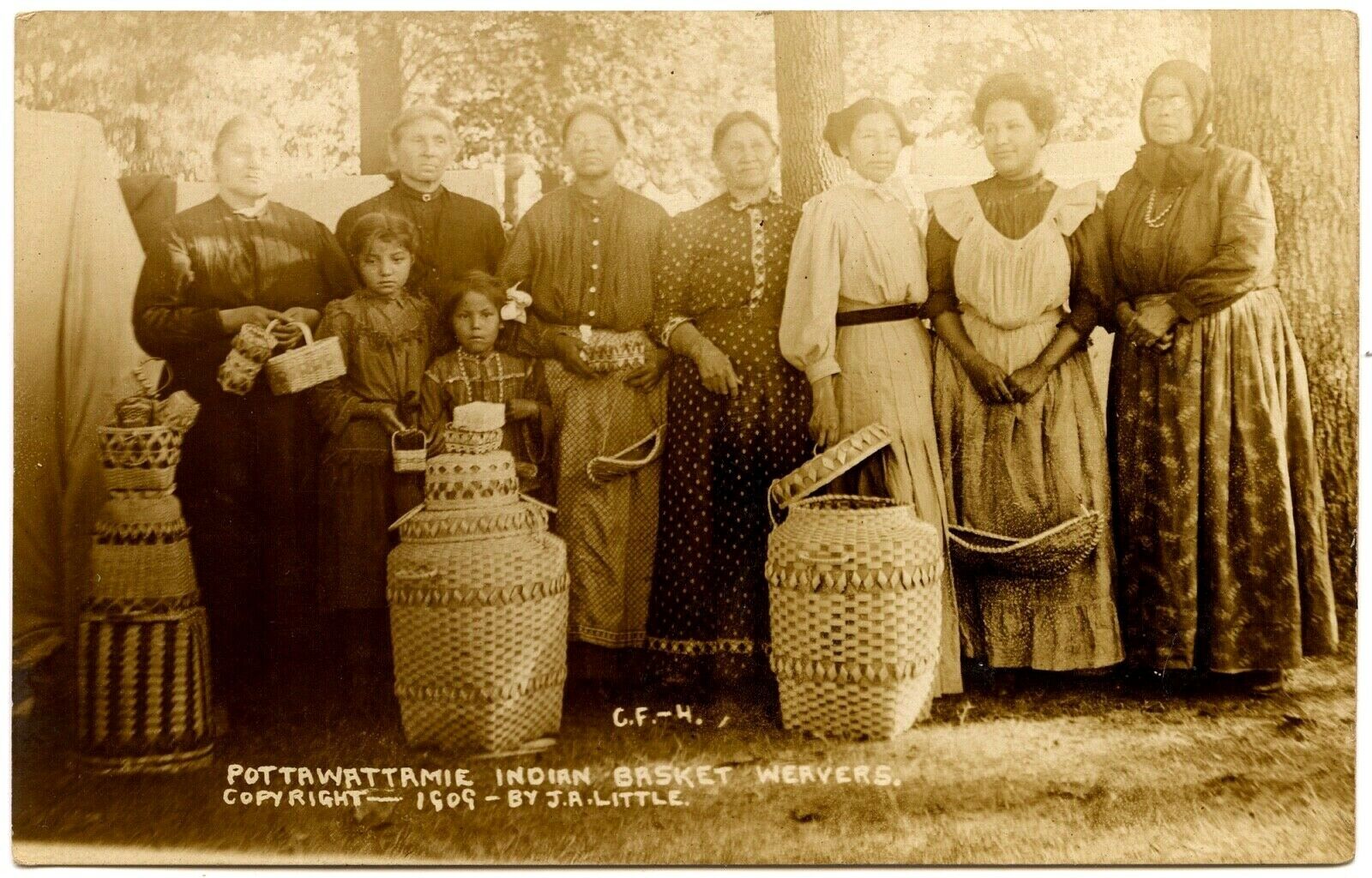
This continent was populated by Indigenous Peoples for 20,000 years before the European settlers came. There was, and still is, no single Native American culture, language, or lifestyle; there were many different groups here when the Europeans arrived. Ninety percent of those people died from diseases such as smallpox, measles, influenza, and cholera introduced by the Europeans, to which Native Americans had no natural immunities.
Native Americans should not just be considered as part of the past – they are very much part of the present and future of this country.
In recent years, governments, universities, cultural organizations, churches, and other institutions have begun recognizing the Native American heritage of the land through Land Acknowledgement Statements (LAS). These are formal declarations put out in writing that note the organization is located on land that was once the ancestral grounds of Native Americans.
These statements first started being used in Canada in 2015. They are often read aloud at the beginning of an event. In Canada, they are regularly included at events ranging from parliament sessions to ballet performances to National Hockey League games.
Chicago-area groups, including the Field Museum of Natural History and the Forest Preserves of Cook County, have issued Land Acknowledgement Statements.
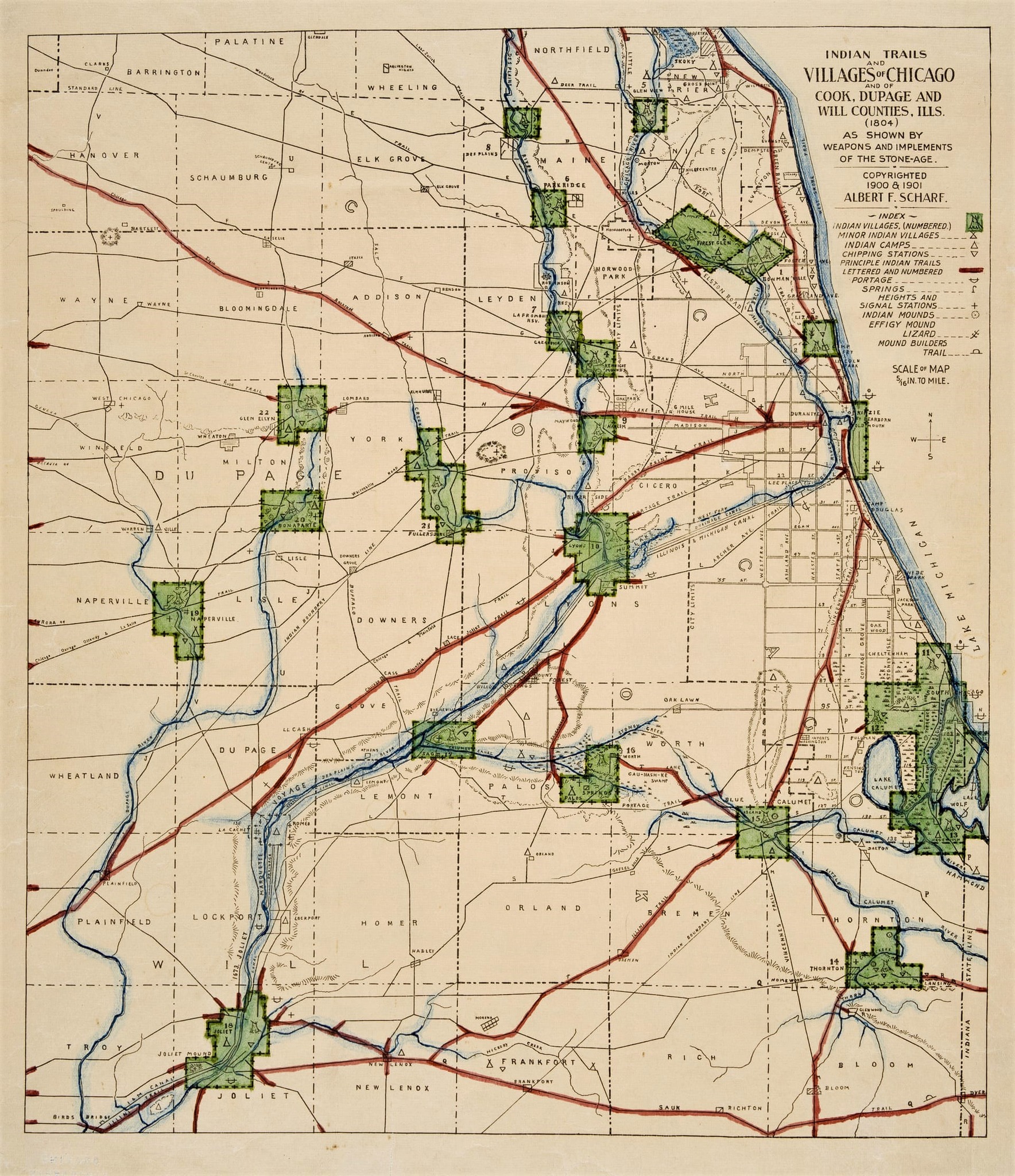
In 2021, the RHS Facebook page ran a series on the history of Native Americans on the Ridge as support for a suggested LAS for groups on the Blue Island Ridge. That LAS has been adopted by several organizations in the community.
The suggested LAS is:
“We acknowledge that we are located on the ancestral homelands of the Potawatomi tribe, a member of the Council of Three Fires with the Ojibwe and Odawa Peoples.
“Other tribes that lived in the Blue Island area include the Miami and the Illinois Confederation. Many additional tribes including the Fox, Sauk, Winnebago, Menominee, Meskwaki, and Kickapoo lived nearby and accessed the area for trading and portage routes.”
The rationale for this statement is that the Potawatomi were the dominant Native Americans living around the Blue Island area in 1833 at the time of the signing of the Treaty of Chicago. The Council of Three Fires, a confederation of the Ojibwe, Odawa, and Potawatomi tribes, ceded the land to the U.S. Government at that time, and most of the Native Americans left the area.
The Miami tribe also had a presence here, concurrent with the Potawatomi, and before that, until the late 1700s, tribes from the Illinois Confederation lived in the area until driven out by the Miami and Potawatomi.
Many other tribes lived nearby. This land is located on the Vincennes Trace and Calumet and Stony Creek waterways, and the land and water routes were used for trading, transportation, and seasonal migration. These tribes included the Fox, Sauk, Winnebago, Menominee, Meskwaki, and Kickapoo.
The Native American presence in the area included a major village and burial mounds in Blue Island, a signal station at the northern tip of the Ridge in today's Dan Ryan Woods, and two trails that ran across the Ridge. These were the Vincennes Trail that originally ran through North Beverly around 92nd Street, and a trail that ran along today's 103rd Street.
All of this has been lost now, but can be remembered by acknowledging its historical presence.
The Ridge Historical Society
Louise Barwick – Part 2
By Carol Flynn
The Ridge Historical Society’s new exhibit, “Louise Barwick’s Lost Ridge,” may be viewed on Tuesdays and Sundays from 1:00 p.m. to 4:00 p.m. or by appointment. RHS is located at 10621 S. Seeley Avenue in Chicago. The exhibit is free.
This exhibit focuses on life on the Ridge from 1893 to 1905 as seen through the watercolor paintings of Louise Barwick, an artist and educator who lived on the Ridge. Other components of the exhibit include a section on aerial photography taken by cameras attached to kites, and “lost and found” architecture – historic photos of buildings, some of which remain and some of which are gone from the Ridge.
This Facebook series on Louise Barwick complements the exhibit, but does not repeat it. More information on Louise herself, her family and her history, is being presented in this series. The exhibit concentrates more on visual images of the Ridge in the late 1800s.
This post will look at Louise’s maternal ancestors.
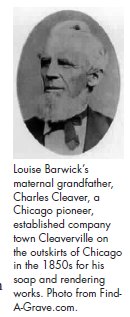
Charles Cleaver, Louise’s maternal grandfather, was born in London in 1814 into a family famous for soap-making. The Cleavers began the company that would change its name to Yardley of London after two Cleaver sons married Yardley daughters, and the Yardley family eventually took over the business.
In October 1833, Cleaver arrived in Chicago, when the city, in his own words, “… was just springing into existence … when the only sidewalk Chicago then had was an Indian trail along the river bank.”
Cleaver started the first soap and candle factory in what is now downtown Chicago. Cleaver also had a general store which he ran with his brother William.
Soap and candles were made from animal fat, usually beef tallow or pork lard. Therefore, essential to the operation were slaughterhouses and meat packing plants. Cleaver took all the lard and tallow from the meat packing houses of the city, and rendered it, that is, melted it down and clarified it (strained it to remove impurities) in the melting house adjoining the factory. He soon was the major supplier of rendered oils and other products made from the oils for the country west and north of Chicago.
In 1838, he married Mary Brookes, from another pioneer family, and they had eleven children.
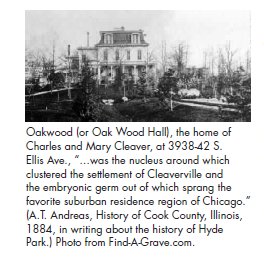
Around 1851, Cleaver bought land around what is now 35th Street and Cottage Grove. He built a meat packing facility and soap making and rendering works, and a general store. He created Cleaverville, a company town, to house his employees. He erected numerous homes and a meeting house, which was also the first church. Cleaver paid the Illinois Central Railroad to run trains to his settlement. Brother William served as postmaster and ran the store, among other duties.
Cleaverville ran from 35th Street and the lake west to Cottage Grove/Vincennes Road, and south to 43rd St., just north of Hyde Park. In fact, Cleaver coined the name Cottage Grove, because, yes, there was a cottage in a grove on the site.
Cleaverville was a smaller version and forerunner of the Pullman area, which would be built 30 years later by George Pullman as a company town for his railroad car business.
In 1853, the Cleavers built a grand house at 3938 Ellis Ave., which became the center of Cleaverville activities. The house was known as Oakwood Hall or Oak Wood Hall.
Up to 1856-57, Cleaver did all the melting for all the meat companies in the city. In 1857, Cleaver discontinued his soap factory, and turned his attention to real estate. He became one of the leading real estate men of the city.
The Cleavers, and later the Barwicks, were active in numerous organizations and listed in social registries. They were often covered in the society pages. One example occurred in 1864, when the Chicago Tribune described a holiday “Fair and Festival” planned to take place at the residence of Charles Cleaver, Esq., arranged by the ladies of the Salem Congregational Society, the church founded by Cleaver and his father-in-law Samuel Brookes. The event was a fund raiser for the church.
“There will be room for all, and the attractions will be of the very first order,” promised the Tribune. Plans called for an “excellent supper, and a choice collection of toys and fancy articles, most seasonable just at this time among the little folks.” Admission was 25 cents, “and the locality is just the pleasantest of all directions for an evening sleighing party. The ladies of Cleaverville deserve to be well-rewarded for their enterprise….”
Beginning in the late 1860s, Cleaver shared his experiences and memories of the very earliest days of Chicago in articles and talks. A collection of these materials was published as “Early Chicago Reminiscences” in 1882 by Fergus Printing Co. and is well worth a read by Chicago history buffs.
Charles Cleaver died in 1893 and is buried in Oak Woods Cemetery.
The next post will look at the Brookes family, Louise Barwick’s maternal grandmother’s side, another very early family in Chicago history.