
Explore the RHS Facebook Archives, a rich repository of local history written by Carol Flynn. For two decades, Carol brought a deeply dedicated voice to public education at RHS. Her role as Facebook administrator through mid-2025 naturally extended her prolific research into meticulously detailed articles, most notably her multi-part historical series posts. Today, Carol continues her local history writing for The Beverly Review and other outlets.
2020
Note to followers of the Ridge Historical Society Facebook posts: I pulled the series on the artist Henry Arthur Elkins. I have loads of information on him and I need to organize it better before I share it. I will get back to Mr. Elkins soon.
Next up: The real story of the pilgrims and the first Thanksgiving dinner.
– Carol Flynn
Contributed to RHS.
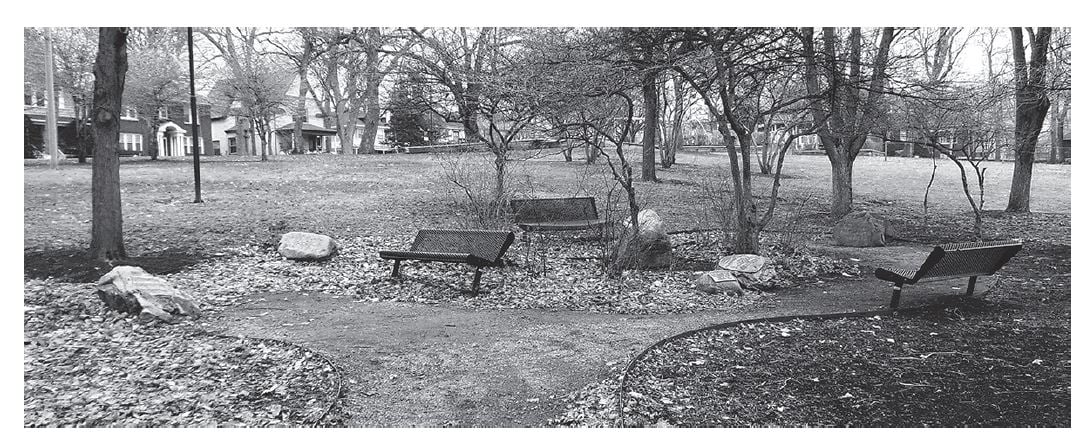
More for Veterans Day:
Ridge Park at 96th Street and Longwood Drive includes memorials to those who served in various wars. In the early 1990s, the park district grouped these together in a single area. The monuments recognize the Revolutionary War, the Civil War, the Spanish American War, World War II and Operation Desert Shield/Operation Desert Storm. Photo by C. Flynn, RHS newsletter.
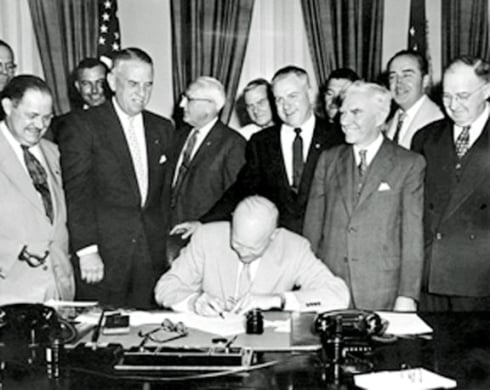
Today is Veterans Day, a federal holiday in the USA that honors all who have served in the US Armed Forces (and were not dishonorably discharged). In 1918, the Armistice with Germany went into effect on 11-11 at 11:00 a.m. This set Armistice Day on November 11, with the first one celebrated in 1919.
Originally, Armistice Day commemorated the end of World War I, and recognized the veterans of that war. After World War II, it was expanded to celebrate all veterans. In 1954, President Dwight D. Eisenhower signed the bill into law establishing the holiday, and that year, the name of the day was changed to Veterans Day.
Veterans Day is different from Memorial Day, which occurs in May. Memorial Day specifically honors those who died while in military service.
Veterans Day celebrates ALL veterans who served in war or in peacetime. On this day, it is especially appropriate to thank living veterans for their service. Veterans and their families should know about the services and benefits available to them, including health care, disability, education, career assistance, and housing. The website for the U.S. Department of Veteran Affairs is https://www.va.gov/.
Veterans Day also recognizes all veterans from previous days who are now deceased, no matter when they died. Veterans Affairs services include burial and memorial benefits such as headstones and grave markers. One way to honor a deceased veteran is to make sure that he or she does not lie forgotten in an unmarked grave. Family members or their representatives can apply for grave markers for a deceased veteran at no cost for the marker, although the cemetery may charge a “setting” fee.
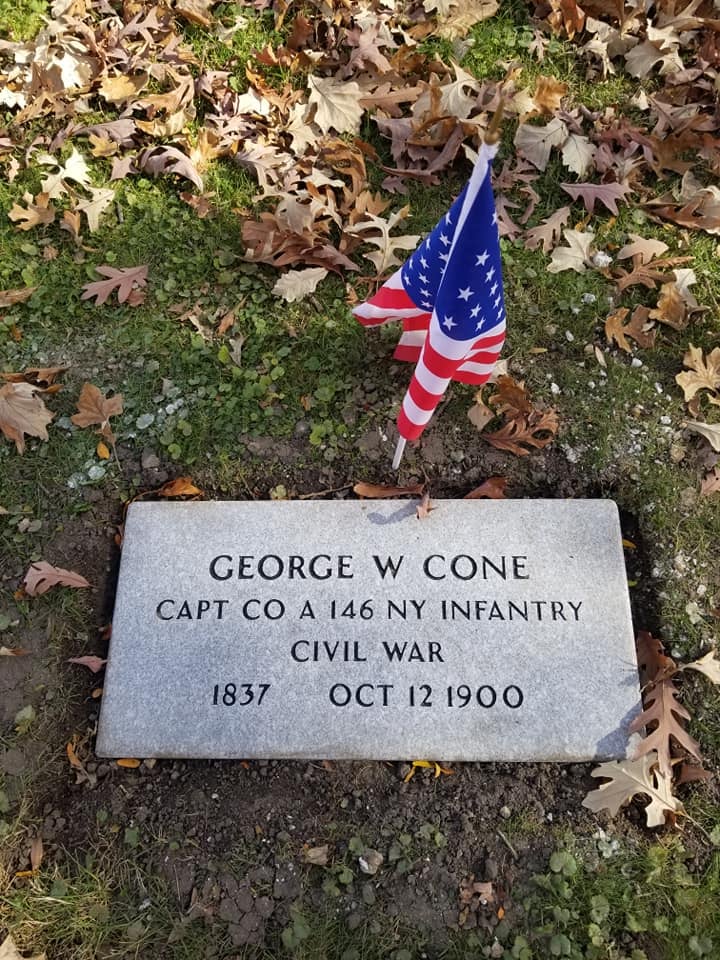
Examples of veteran grave markers on the Ridge can be viewed at Mount Greenwood Cemetery on 111th Street. The staff at this cemetery has worked for over a decade to identify veterans in unmarked graves and procure markers for the graves. Just recently, working with the organization Sons of Union Veterans of the Civil War, more markers were installed for Civil War veterans. An example of a marker is attached.
For more information on VA burials and memorial benefits, visit https://www.va.gov/burials-memorials/.
The Ridge Historical Society thanks and salutes all those who have served in the U.S. Armed Forces throughout the country’s history.
The Ridge Historical Society
The Nineteenth Amendment
By Carol Flynn
It will be a while yet before they can give final results for today’s election, so this seems like a good time to share a story about the Nineteenth Amendment to the U.S. Constitution, which was ratified 100 years ago.
The Nineteenth Amendment states: “The right of citizens of the United States to vote shall not be denied or abridged by the United States or by any State on account of sex.”
The U.S. Congress passed the legislation on June 4, 1919. It took Illinois less than a week to be the first state to ratify the amendment, on June 10, 1919. Thirty-six states were needed to ratify the amendment, and this was reached with Tennessee on August 18, 1920, allowing the country to certify the Nineteenth Amendment as adopted on August 26, 1920. [The last state to ratify the amendment was Mississippi, in 1984. Yes, 1984.]
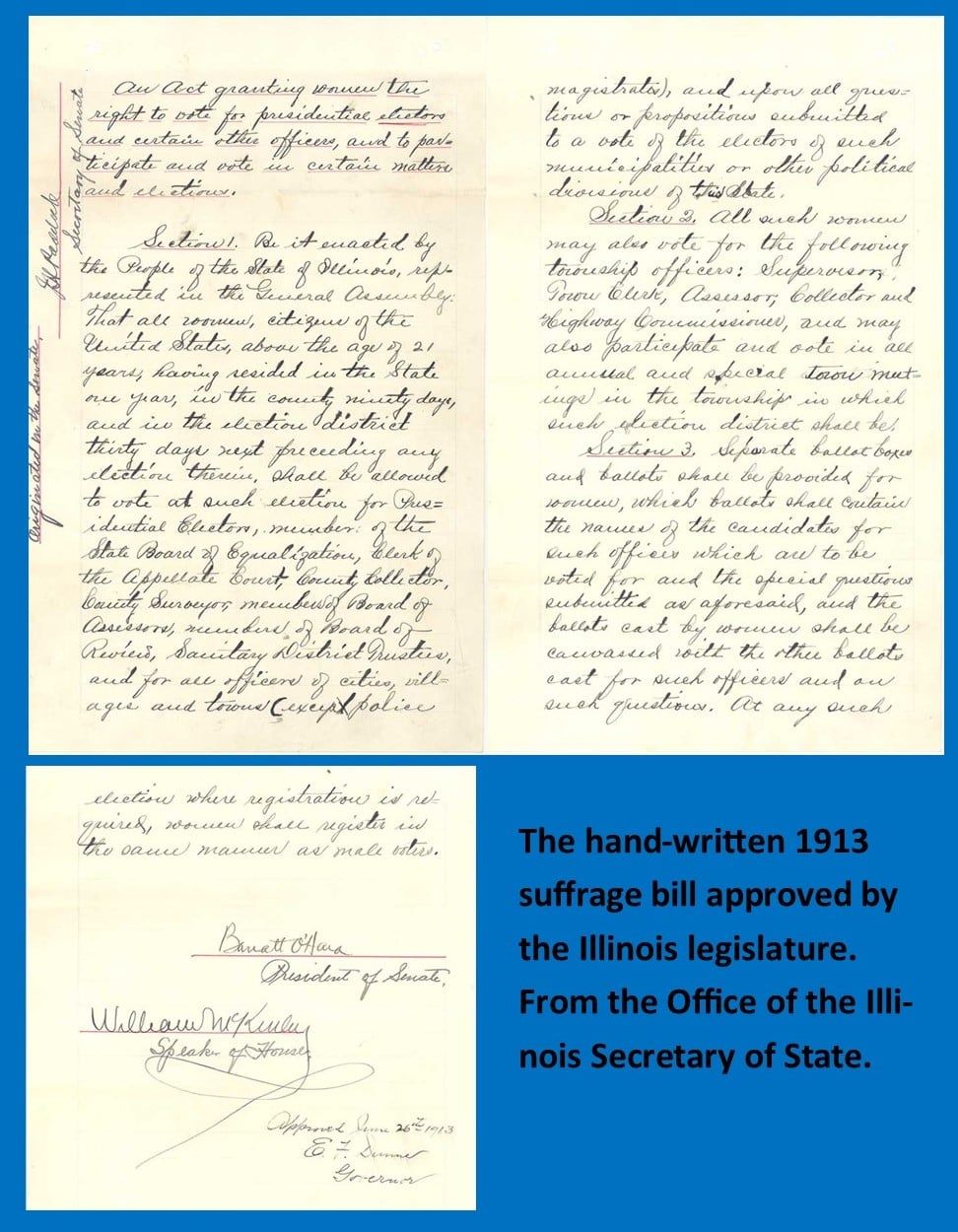
It was not surprising that Illinois was the first state to ratify the amendment, as it was legislation passed in Illinois in 1913 that was a major turning point in the women’s suffrage movement. In fact, the women of Illinois took the passage of the Nineteenth Amendment somewhat in stride because they had had the right to vote in the U.S. Presidential selection process for years.
Although the issue of women having the right to vote went back to the founding days of the country – the second First Lady Abigail Adams was all for it – the formal beginning of the women’s suffrage movement is considered to be an 1848 women’s rights convention held in Seneca Falls, New York. The group came up with a list of resolutions and the one concerning the right to vote was hotly debated.
It was one of the few men at the meeting, Frederick Douglass, former slave turned statesman, who convinced the women to leave suffrage in their platform.
Douglass wrote, “All that distinguishes man as an intelligent and accountable being, is equally true of woman; and if that government is only just which governs by the free consent of the governed, there can be no reason in the world for denying to woman the exercise of the elective franchise. Our doctrine is
that ‘Right is of no sex.’”
The resistance to women voting was widespread and strong, not just among men but for many women, also. The arguments against it generally related to the “proper” or “natural” role of women in society. The debate continued for seventy years.
But changes occurred in society. There was increased industrialization and urbanization. A fast growth in wealth led to the “Gilded Age,” a veneer which covered a wide range of corruption and social ills. Reform-minded groups called for change, and an atmosphere conducive to women’s suffrage finally emerged.
The period from 1890 to 1920 became known as the Progressive Era. Reforms in government, education, business, even churches and religion, took place. Leadership cut across party lines, and Theodore Roosevelt, Herbert Hoover, and Woodrow Wilson were all progressive.
By 1913 in Illinois, the Progressive Party held the balance of power in the state legislature. Women lawyers of the state’s suffrage association had figured out a way to get limited but significant voting rights for women.
The Electoral College is the process that the Founding Fathers established as a compromise between Congress or the public electing the President. Individuals known as “electors” are chosen by each state and it is the electors who actually choose the President. Each state has the authority to decide how its electors are chosen.
In Illinois, a bill allowing women to vote for the state’s electors was drawn up and introduced to the state legislature.
Every conceivable parliamentary maneuver was used by the opposition to keep the bill from coming up for a vote. Hundreds of men went to Springfield to entreat the Speaker to prevent entry of the bill. The Speaker asked the pro-suffrage lobby for a show of support, and he was immediately flooded with letters, telegrams, and telephone calls. Satisfied that there was public support for the bill, he let it go to vote.
When the time came for the vote, women “captains” went so far as to fetch needed male voters from their homes, and stayed on guard duty at the chamber doors to urge members in favor not to leave before the vote, and to prevent opposition lobbyists from being illegally allowed on the floor.
The bill passed. Illinois women became the first in the country with the right to vote in the process to select the U.S. President.
The opposition brought forth more than fifty legal challenges to have the new law declared unconstitutional, but none were successful. Pro-suffrage sentiment across the nation swelled. At the annual suffrage convention in 1916, a plan was developed state by state to procure voting rights in the presidential election process. Delegates went home and put their plans into motion and had successful results. By 1919, the country finally accepted that women were going to find a way to vote.
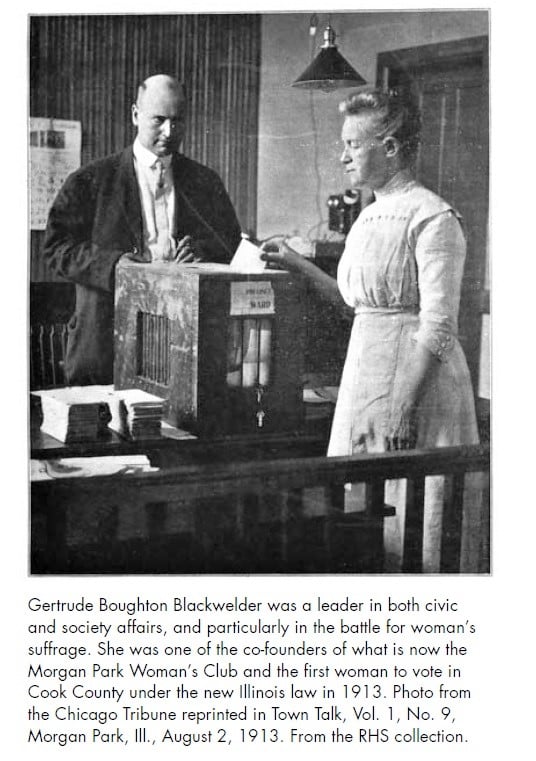
The women of the Ridge were not idle observers of these events, and many were ardent suffragists. They lost no time exercising their new, hard-won right. The other part of the 1913 Illinois bill covered certain aspects of municipal voting. The Illinois bill was passed on June 26, 1913, and on July 26, 1913, the women of Morgan Park voted for a bond issue to fund a high school. They were the first women in Cook County to vote, and the first woman to cast her ballot was Gertrude Blackwelder, former President of the Chicago Woman’s Club and the Chicago Political Equality League.
The InterOcean newspaper carried an article on the event. Many husbands and wives went to vote together for the first time ever. Even progressive David Herriott, the Morgan Park Postmaster and editor/publisher of the Morgan Park Post, was surprised when the women voted in their own names. His wife told him, “Mrs. David Herriott looks well on calling cards, but Janet Herriott has more political significance.” Janet Herriott cast the second female vote.
The event took on the aura of a garden party, according to the newspaper, with the summer frocks and parasols. It turned into a pleasant social afternoon with no problems. The policeman on duty said it was the most civil election he had ever witnessed. The women’s votes were kept separate from the men’s in case they were challenged legally. The only “bribe” in sight were packets of peanuts provided by the school superintendent, John H. Heil.
Just at closing time, a 65-year old woman rushed in still wearing her apron. She had biscuits in the oven at home and was in a hurry. The process was explained to her – she had to select a slip for or against the high school, fold it, and place it in the ballot box.
“For land’s sake,” she said, “it’s that easy and I’ve always respected a man because he knew enough to vote.”
World War I came in 1917, and women took on many non-traditional roles, both as volunteers and as paid employment. They showed they could keep their homes running and also participate in civic affairs. After years of opposing women’s suffrage, President Woodrow Wilson became an advocate. When the Nineteenth Amendment was finally ratified, the Illinois papers took little notice of it. They had been covering women voting for seven years.
The Ridge Historical Society
All Saints Day, November 1, 2020
By Carol Flynn
Today is All Saints Day or the Feast of All Saints. The date was set by Pope Gregory III during his pontificate in the years 731-741.
In some churches (Catholic, Lutheran, Anglican, Eastern Orthodox, Oriental Orthodox), anyone who has died and gone to Heaven is considered a saint. Some saints are considered worthy of greater honor because of their exceptional holiness or closeness to God. Some of these saints have individual feast days, but most do not. The Catholic Church has recognized more than 10,000 saints, but some names and stories have been lost to history. And some names were never recorded, such as people who died in groups as martyrs.
The intent of All Saints Day is to recognize all these people, known and unknown.
Some saints are designated as “patron saints” or advocates for places, occupations or crafts, causes, and situations. It is believed that patron saints can intercede on behalf of the needs of their charges.
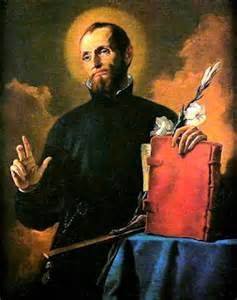
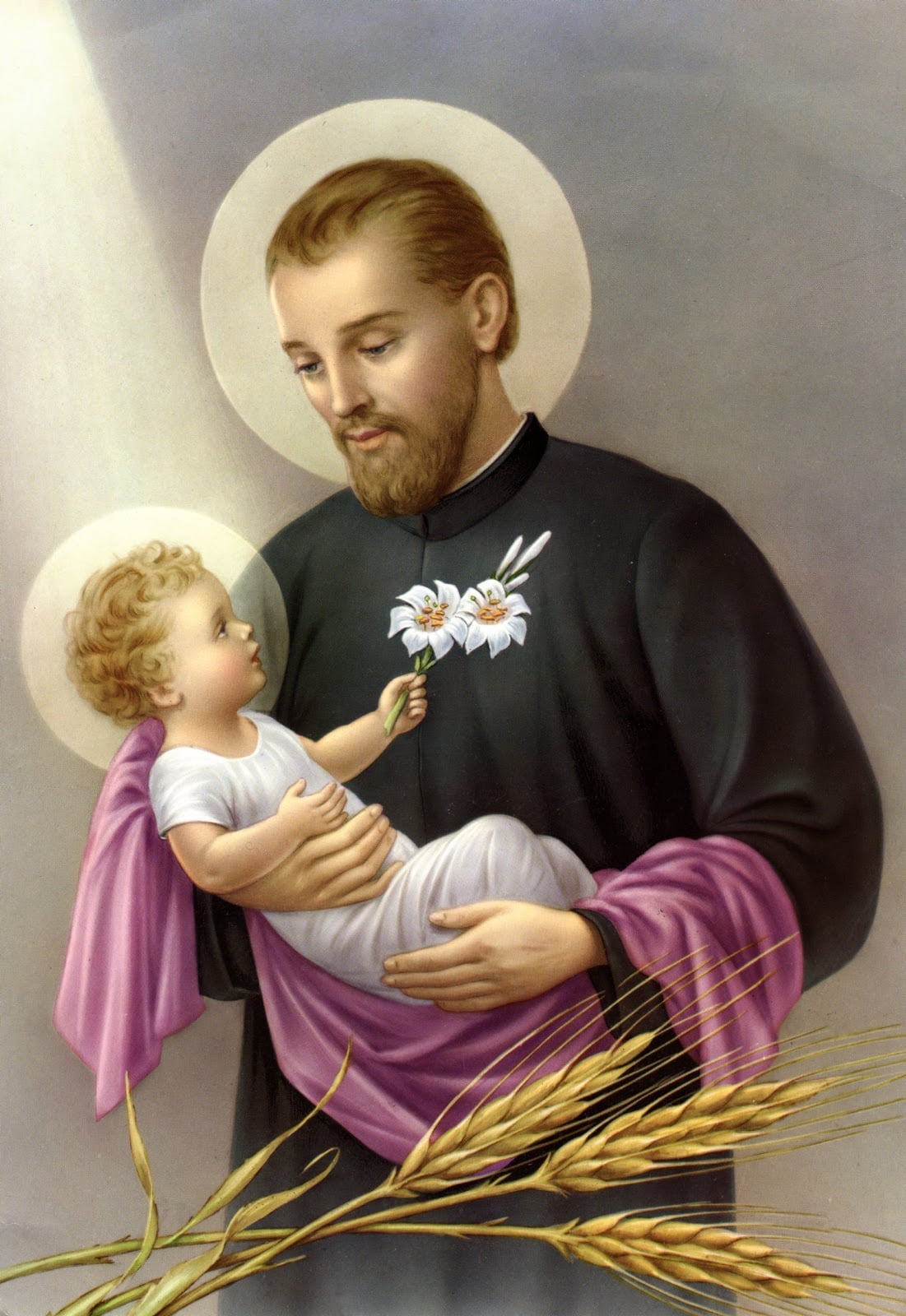
The Ridge communities have several churches named for saints. One saint who is particularly relevant today as people struggle with the realities of the global coronavirus pandemic is St. Cajetan, the patron saint of the unemployed and job seekers.
Since the pandemic started, tens of millions of people have lost their jobs. In March and April of this year, 22 million nonfarm jobs were slashed. Although the situation started to improve in late summer, employment still remains about 11 million jobs below pre-pandemic days, and many temporary layoffs have become permanent. In a study in mid-October, nearly 78 million people reported difficulty in covering usual expenses.
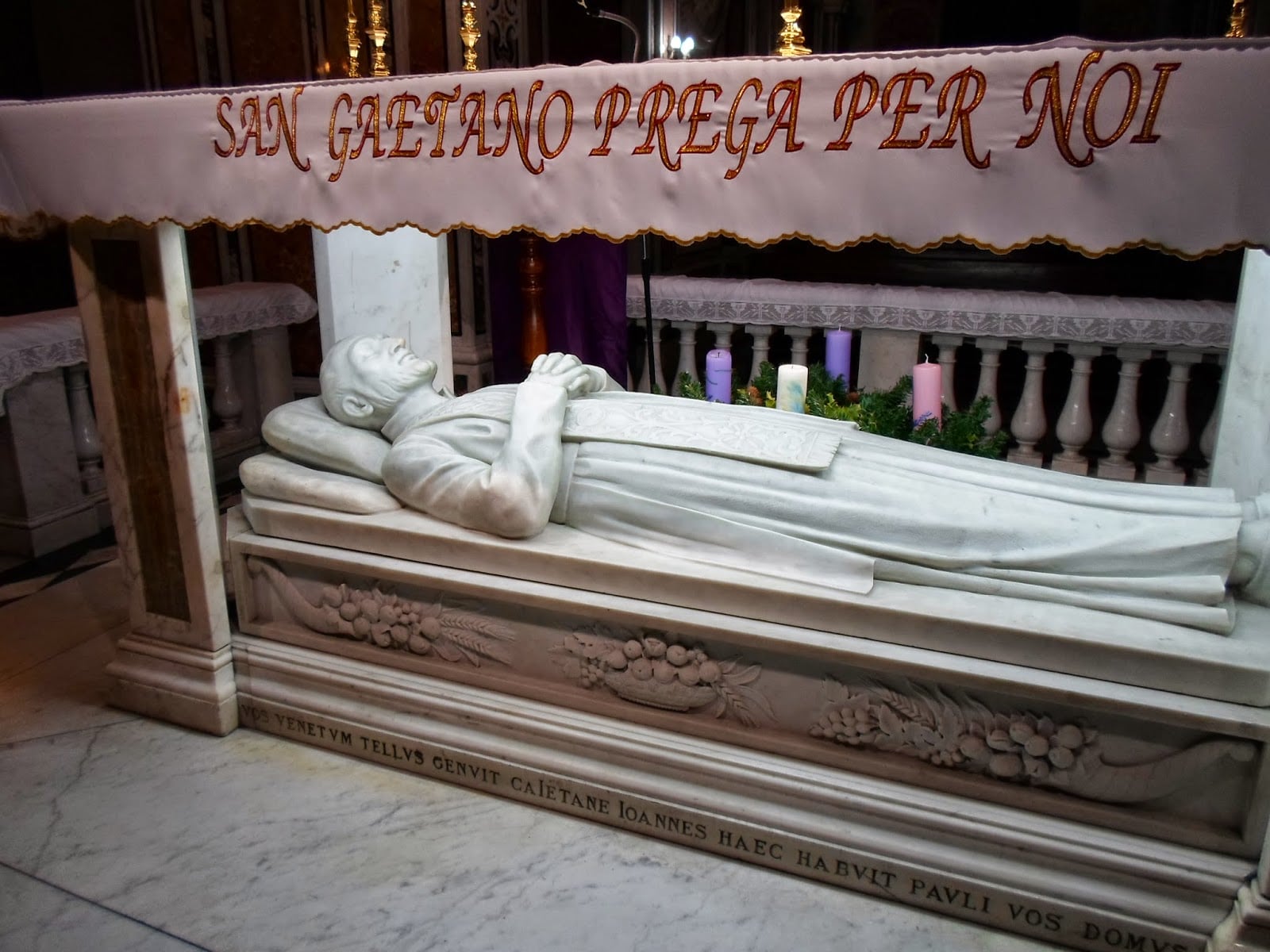
St. Cajetan, Gaetano dei Conti di Thiene (1480-1547), was born into a wealthy, noble family in Venice. He completed a law degree and worked as a diplomat for Pope Julius II. When Julius died, Cajetan resigned and entered the seminary, and was ordained a priest in 1516. He spent the rest of his life tending to the sick and poor, giving up his own worldly goods to help them. He established several hospitals for incurables during the years of the bubonic plague.
Cajetan recognized that people who had lost their livelihoods often became victims of desperation. He believed in the dignity of all people. He helped the unemployed through financial assistance and providing the basic necessities of life. In Naples, he founded a charitable non-profit bank/credit organization to protect the poor from usury, that is, exorbitant rates of interest. Wealthy benefactors donated to his cause and Cajetan took no money for his efforts. The bank provided loans without interest that people secured with personal objects. Job training and employment opportunities were also offered through the bank.
St. Cajetan is also the patron saint of Argentina. There they call him the patron of “Bread and Work.” He is presented two ways in art. One image depicts him with a book, to signify learning, and white lily, which represents Mary. The other presents him holding the infant Jesus. He had a vision in which Mary placed her infant in his arms, which he interpreted as her trust and approval of his work.
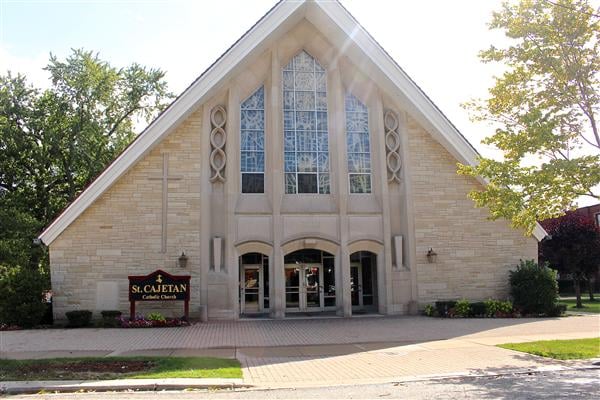
St. Cajetan Parish at 2445 West 112th Street was founded in 1927. It was the first Roman Catholic parish in Morgan Park, and the second Catholic church there, following Sacred Heart, which is a mission church and not a parish. It is the fifth Catholic church in RHS territory, and the fourth parish, following St. Margaret of Scotland (Washington Heights), St. Barnabas (Beverly), and St. Christina (Mount Greenwood). The current St. Cajetan Church was built in 1961-62.
The Ridge Historical Society
The Paranormal Ridge: Part 14 – Save the Castle Ghosts
By Carol Flynn
Thank you to the members of the Beverly Unitarian Church (BUC) for being such good sports for the last few years while the Castle ghost folklore was researched and shared with the public. As much as folklore is an important part of history, it is recognized that the BUC has more important things to deal with than female phantoms with Irish brogues who don’t leave footprints in the snow.
Before we get to a final word about the Castle, there is one more category of ghost stories to look at – experiences that couldn’t and shouldn’t have happened.
There are several websites on which people post paranormal experiences and occasionally stories about the Castle show up. Here are two that fall into the “couldn’t and shouldn’t” category that were edited slightly to make them more readable:
“My friends and I would sometimes ditch school to go smoke some bud and we would often go to the abandoned castle. I’ve heard the voice of a woman talking, almost like shouting, as if in an argument with someone. She didn’t sound like an American; she sounded English or Celtic of some sort, with very proper speaking. I did not see anything but had a feeling of being watched.”
‘It is definitely haunted. I found a way inside and I did indeed hear a woman speaking aggressively in an English accent, or she sounded Irish.”
In response to these stories, first, the Castle has never been abandoned in its entire 130+ years of existence. BUC bought the Castle in 1942 and has used and maintained the building consistently for almost 80 years. Second, the building is kept secure and it is very doubtful anyone casually “found a way inside.” This is the “couldn’t” part of these stories – they just do not ring true.
More importantly, the Castle is private property. “Ghost exploration” does not justify trespassing, violating any laws, or invading someone's privacy. This is the “shouldn’t” part and applies to any location, not just the Castle.
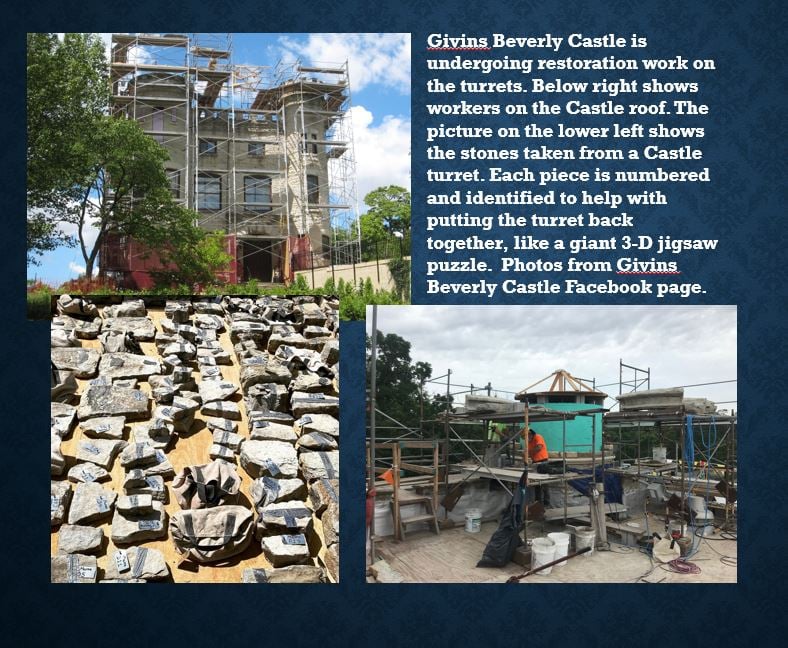
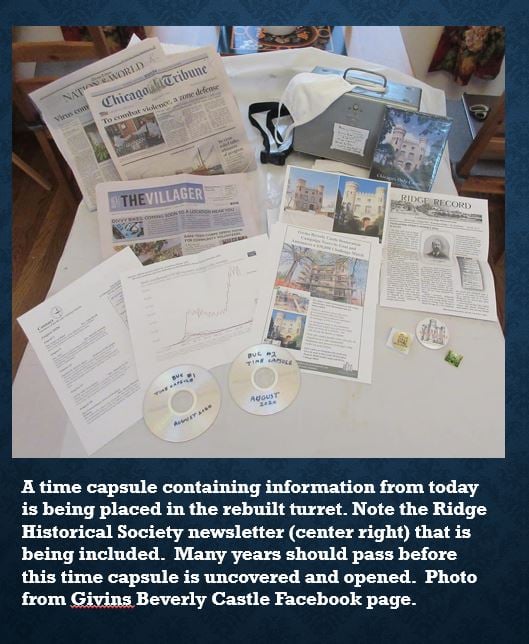
The final word about the Castle is that the BUC is currently undertaking a major restoration project. After more than 130 years, the turrets, or tops of the round towers at the Castle's corners, were found to be deteriorating. Work to repair them began this past summer.
The BUC continues to reach out to the community for financial support for the preservation work. Donations to the Castle Restoration Fund are used solely for that purpose and not for church operations. For more information on the restoration project, including information on funding and donating, visit the website at givinsbeverlycastle.org or see the Facebook page Givins Beverly Castle.
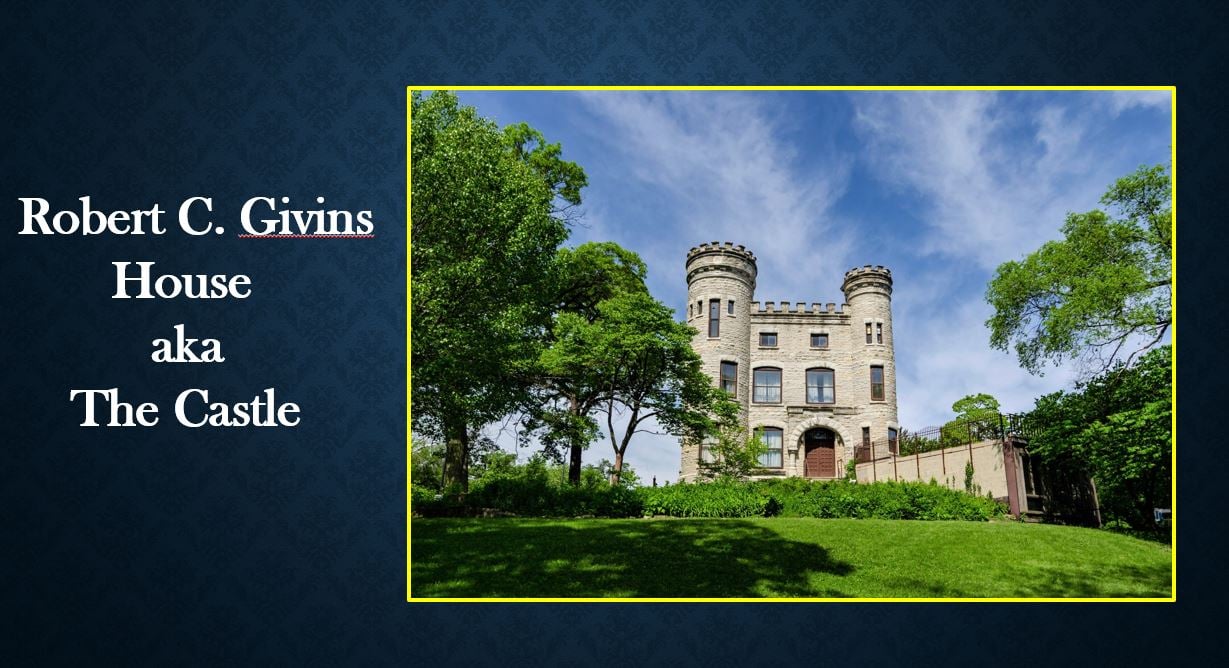
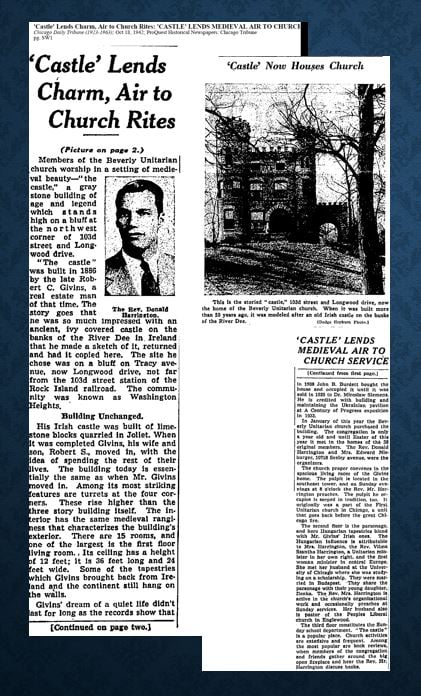
Castles stir the imagination, especially a medieval castle perched on a hill in a modern American city. The towers and turrets conjure up images of another time and place, of knights and fair maidens, thrones and dungeons. Ghost stories are part of the mystique of a castle, and the Givins Beverly Castle is no exception.
The Castle is the best known and loved landmark in Beverly. Even though the building is owned by BUC, the entire community gets to enjoy its presence. Saving the Castle means saving history and folklore – and the ghosts themselves. If the Castle deteriorates, where will the Irish lasses go?
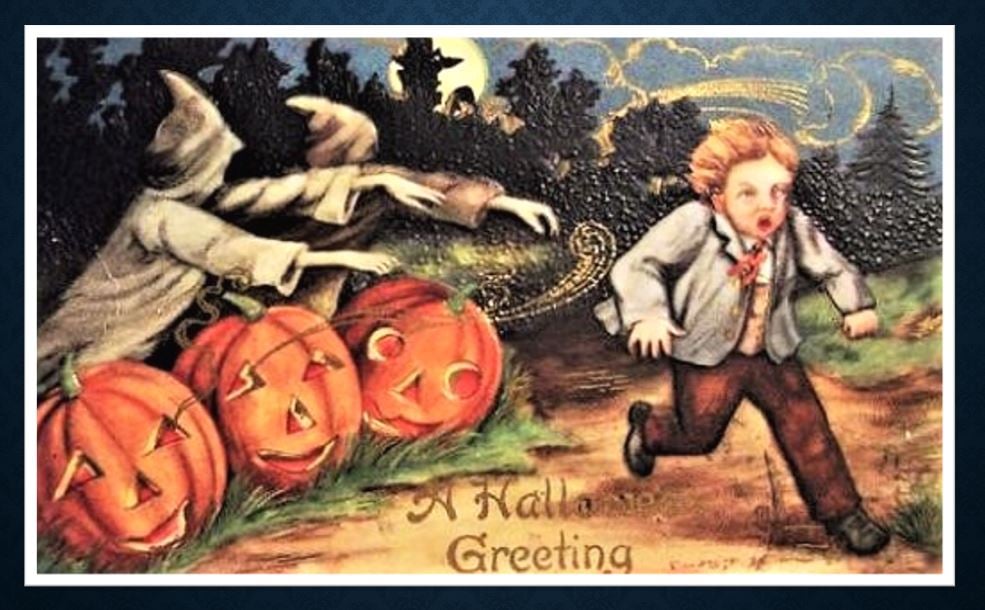
Happy Halloween.
The Ridge Historical Society
The Paranormal Ridge: Part 13 – Odds and Ends on Castle Ghost Stories
By Carol Flynn
Here are two more pieces of interesting trivia about the Givins Beverly Castle that relate to the paranormal. The first is the Transylvania connection, and the second is Bob Givins’ own experience with a ghost.
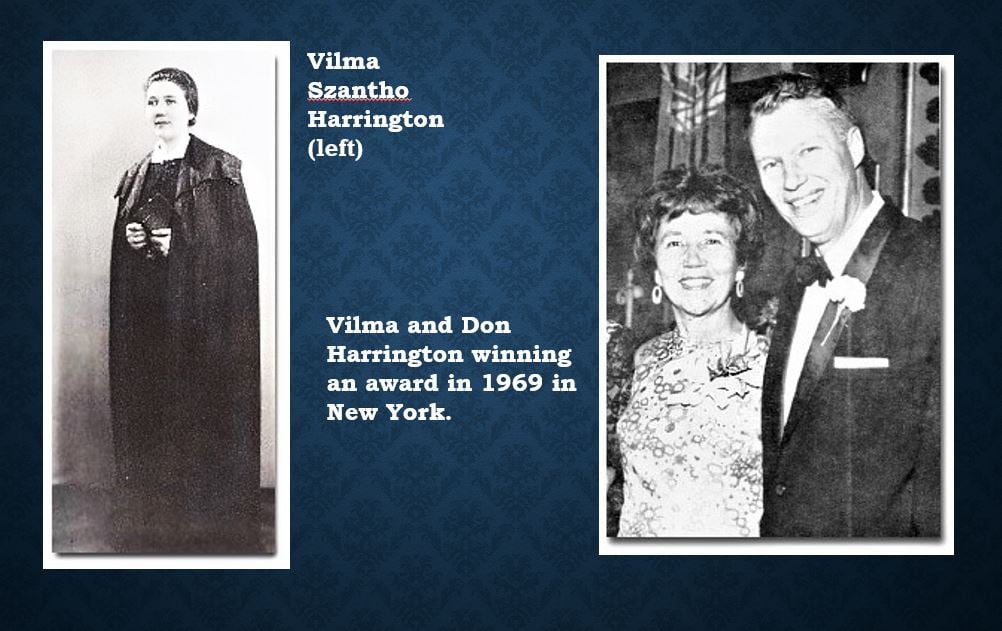
If the rumor that there was once a woman from Transylvania, Romania, the home of Dracula, in the neighborhood and she was connected to the Castle is ever heard, well, that is true. Her name was Vilma Szantho Harrington, and she was instrumental in starting the Beverly Unitarian Church. She was the first woman to be ordained a Unitarian minister.
Vilma was born and raised in Transylvania, which, along with Poland, was a starting place for the Unitarian Church. She came to Chicago to attend the University of Chicago. There she met Donald Harrington, a fellow seminary student, and they married in 1939. The Harringtons started the Unitarian Church in the Castle. They moved on to New York, where Donald became a leader in the Church there.
The history of the Unitarian Church is very interesting. By all of the many accounts about the Harringtons, they were wonderful people, devoted to social justice causes. Vilma died in 1982. Her husband wrote a tribute to her that can be found online at https://www.harvardsquarelibrary.org/biographies/vilma-szantho-harrington/. Donald died in 2005 in Transylvania.
The Unitarian Church connected with Harvard University has mentioned Dracula humorously in some of its web posts, but there is, of course, no connection at all between the Church and Dracula.
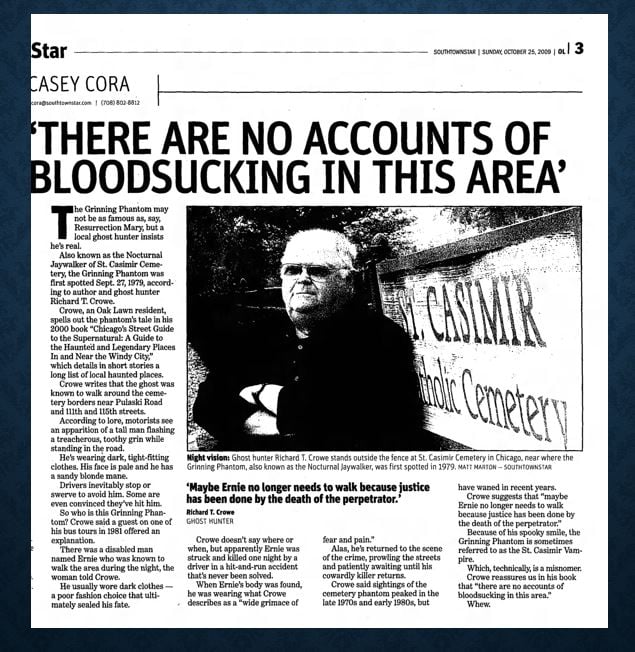
There has been an occasional vampire story on the South Side but these never came to anything. There were occasional sightings of a phantom by 111th and Pulaski Road at St. Casimir Cemetery, on the western edge of Mt. Greenwood. Richard Crowe, Chicago’s legendary ghost lore expert and tour director, assured the public this was not a vampire.
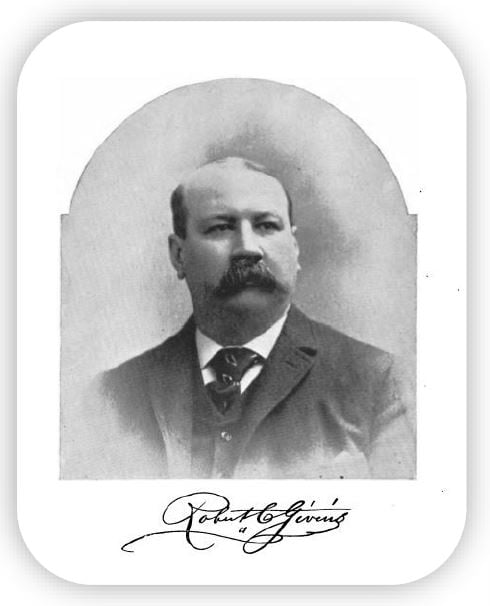
These posts have covered ghost stories at the Castle that Robert C. Givins built. As it turns out, Givins himself was no stranger to ghost experiences. One experience is covered in a book titled Robertson’s Landmarks of Toronto, published in 1894.
Givins’ ancestors came from Northern Ireland to Canada. Around 1800, Colonel James Givins, Robert’s grandfather, built a home in Toronto. At the time, Toronto was called York, and this was one of the first homes established, a landmark for many years until it was demolished in the late 1800s.
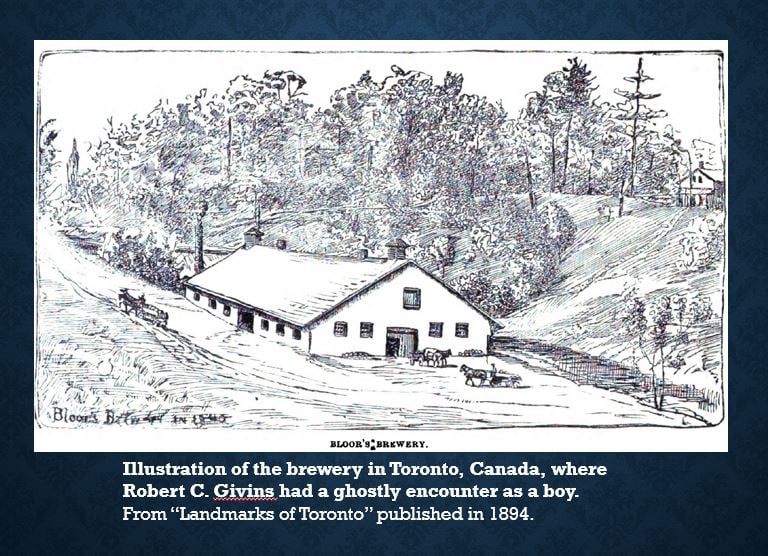
Robert C. Givins was born in Canada in 1846. In an adjacent village, Yorkville, which became part of Toronto in 1883, was an old brewery built at the bottom of a ravine. The building was described as “a low, red brick building one hundred feet long and fifty or sixty feet wide.” It was in a very picturesque setting, surrounded by thick woods with a pond from a stream that had been damned up to create water power for grinding. A water wheel was at one end of the building. A road ran down to the brewery from the street above.
By 1860, the brewery was no longer in operation. The building was used by local boys for a meeting place and shelter. In the wintertime, the road leading down into the ravine was used for sledding.
Givins shared the following story with a Canadian newspaper reporter:
“I remember one dark night one of the boys [dared] a party of us to go through the old [brewery]. A superstition existed among many in the village that this old building was haunted, and notwithstanding our frequent visits there in the day time, there was not a boy in the neighborhood who could be hired at any price to go through it at night, and I have no doubt many believed that it was actually haunted, because I remember a story in circulation at the time that one night an old watchman had occasion to go down there after an escaped burglar, claiming that as he entered the old building, he saw four ghosts playing whist on the top of one of the vats. He did not wait to catch the burglar, who either escaped or was annihilated by the ghostly occupants of the old building.
“We followed the nervy youth who originated this hazardous proposition. It was the blackest night he could have selected; thunder clouds hung over the pond, and an occasional flash indicated an approaching storm, and added no little terror to the occasion. To many of us this day seemed our last. Whew! – going through the old brewery at night. We groped our way down the hill, and after stumbling about over the rough ground and through shrubbery we finally got to the entrance to the old sluice. [This opening was where the water once ran to power the wheel for grinding.] It was 200 feet through into the big water wheel, which was located at one end of the brewery. The passage way was large enough for us to go two abreast, but was very low; we had to creep on our hands and knees. [No one] experienced a more breathless journey than we did.
“We got along, however, all right until we came to the big wheel, and after we all climbed through we stood inside the wheel to get a rest before we explored other portions of the brewery. In the corner of the room we thought we saw what first appeared to be a ray of light peeping through a crack in the wall. We all looked intently upon the corner where we saw two big bright eyes glaring at us like two coals of fire. We were paralyzed for a minute, not one of us mustering up courage enough to speak. At last the leader whispered, “Let’s get,” which we did and the way we scrambled out through that sluice to the entrance and got up the hill can never be properly expressed. Upon reaching the street, we walked hand in hand home.”
Tomorrow: Halloween and a final post on Castle ghosts
The Ridge Historical Society
The Paranormal Ridge: Part 12 – More Recent Experiences at the Castle
By Carol Flynn
The early owners of the Givins Beverly Castle at 103rd Street and Longwood Drive were three private families in succession, and for a year and a half in the 1890s, the Castle was rented by a female college. Since the early 1940s, the Castle has been owned by the Beverly Unitarian Church (BUC). The building has been used for church services and functions and rented or loaned out for many other functions, from Jewish religious services to Christian weddings to Neo-Pagan drummings.
Beginning in the 1970s, the first-person stories relating strange experiences at the Givins Beverly Castle started to be recorded in newspaper interviews. Three people publicly shared their paranormal experiences – a caretaker from the 1960s, a psychic who visited in the 1970s, and a minister from the 1990s. There were, of course, many other hearsay stories repeated through the years.
More recently, other people have shared personal experiences. Another caretaker from the past confirmed that her daughter-in-law, the “sensitive” one in the family, was visited by an entity at the Castle in a room on the second floor that she used for sewing.
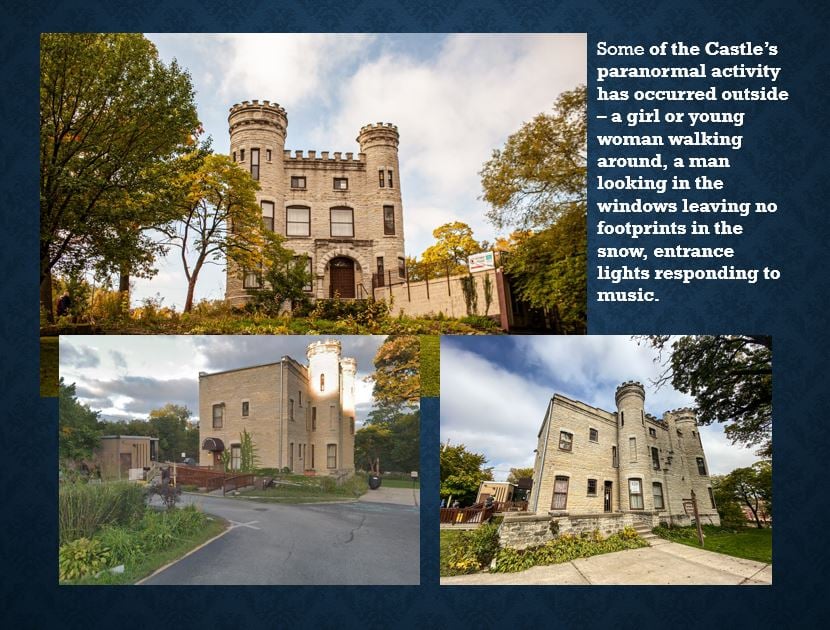
People from Blue Island involved in a ghost investigation a few years ago observed the phantom of a young woman dressed in an old-fashioned plaid dress gliding around the outside of the Castle.
A police officer said he was called to the Castle in the 1990s when a church member saw a man’s face looking in the windows from the outside, moving from window to window. The police officer said there were no footprints in the snow outside the windows.
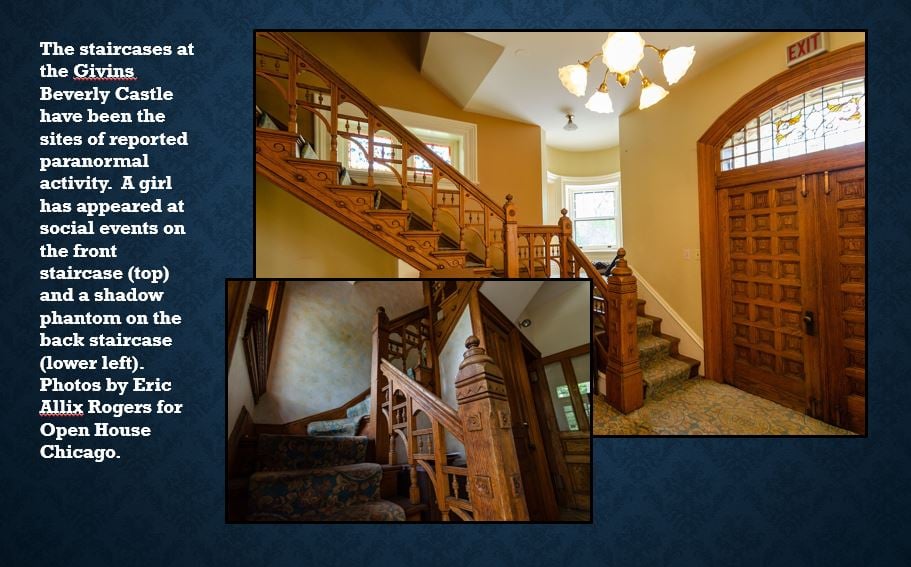
A person who came to the Castle for Neo-Pagan events in the mid-1990s reported on an on-line site that she and a friend experienced intense feelings of being watched and driven away as they were climbing the stairs to the third floor. She attributed this to a haunted nursery that had been on the third floor. The third floor does not have a history of being used as a nursery, but BUC did conduct Sunday school classes up there.
About eight years ago, someone from the Castle who wished to remain anonymous was shown a photo a local woman took of the Castle that seemed to show the phantom of a young girl out in front on the Longwood Drive-side, walking toward the school annex to the north. The anonymous person said that teachers at the school reported feeling someone tug on their clothes at a child’s height but when they turned around there was no one there, or they heard a child’s voice in the school hallway but there were no students out there when they looked.
Musicians visiting the outside of the Castle at night heard disembodied footsteps and experienced lights flickering on and off in response to their guitar-playing. This brings up a point – the entity does seem to respond to social events and music. Several BUC members, as well as the caretaker whose story was reported in post 9, have said they have heard the piano playing when it is covered and no one is in the room, and the sounds of the voices and tinkling silverware and glasses. The minister reported the slender arms that went around her husband’s waist during an event (post 10). And there are stories of a girl being spotted at social events, often on the stairs, when no children were invited or reported as being there, but these stories are not verified.
One piece of information that is shared in the books is a reference to an actual woman who reportedly lived in the Castle during the Great Depression and tended the gardens. Some people have thought this woman could be the ghost. Who started this theory, and why, isn’t known. No historical information has been found on this woman, and it would not be appropriate to name her in this post.
In summary, the major stories that come up again and again for the Castle involve a young woman and/or a girl, from the past, usually with an Irish brogue. Who this person (or persons) could be is a guess – a student, a servant, a patient, a teacher or church member, a family member, are all possibilities. She most likely is not Givins’ Irish fiancé who died before she lived in the Castle because, first, there is no record to be found of Givins visiting Ireland in the immediate years before the Castle was built, and second, at the time the Castle was built his wife Emma, a school teacher of Norwegian descent, was very much alive, and she did live in the Castle for years. His first wife had died some years before.
The other stories that are reported by several people include sounds of the piano playing, and voices and clinking cutlery and glasses, like an event is going on.
There have been a few reports of male presences but these are much less common.
In the next post on the topic, some odds and ends related to the Castle ghost stories will be explored.
The Ridge Historical Society
The Paranormal Ridge: Part 11 – A Psychic’s Visit to the Castle
By Carol Flynn
The Givins Beverly Castle has been owned and operated since the early 1940s by the Beverly Unitarian Church (BUC). In the early 1970s, the BUC brought attention to the stories of ghosts at the Castle through a series of events and newspaper articles.
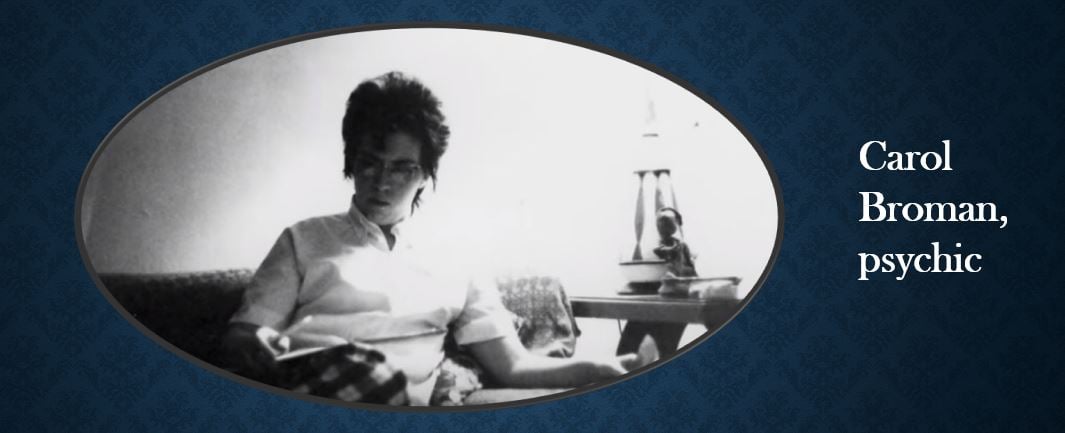
In 1995, the Chicago Tribune ran an article by Jerry Thomas calling attention to one of these events from the 1970s. The article stated that in 1973, a psychic named Carol Broman visited the Castle and reported that she experienced two spirits there – one a young girl – and there was bantering between them.
In preparation for last year’s “Folklore and Phantoms” program, this visit was researched – and proved to be most interesting.
This psychic, Carol Broman, was called in by the police in 1978 to help in the investigation of serial killer John Wayne Gacy. At that point, they were still treating the situation as a missing person case for one young man who had disappeared from his job at a drug store. He had told his mother he was going to talk to someone about a construction job. The police knew that Gacy and many others had been in the pharmacy that day, but no connections had been made yet. They still hoped to find the young man alive.
Broman told the police the boy was dead, he had been murdered, they would find multiple victims at the killer’s house, that it had to do with the construction business, and that the killer used trickery and torture on his victims. She also said the young man did not realize he was dead yet and his spirit was wandering.
Broman turned out to be correct in what she told the police they would find. The police never went public at the time that they used a psychic. The police inspector, Joseph Kozenczak, and his wife later wrote two books, and he was interviewed for an episode of Psychic Investigators, which can be found on YouTube. Kozenczak said he was chilled to the bone by Broman’s revelations. Although the use of psychics in policework is very controversial, Broman did a lot of work with the police as a psychic investigator. Broman and Kozenczak are deceased now. Gacy was executed in 1994 for 33 murders.
[As an aside, Gacy did construction work in the Beverly/Morgan Park area, and people here knew him. One RHS officer who worked for the city met Gacy through city contract work. She said everyone considered him a nice guy. It was an unimaginable horror when the bodies were found in the crawlspace under his house.]
Five years before she was involved in the Gacy investigation, Carol Broman, the psychic, accompanied by a Chicago Sun-Times reporter, was invited to visit the Castle to investigate paranormal activity. Their visit was covered in a Sun-Times article, and later covered in two books about ghosts, based on the Sun-Times article. The information in this post is based on the material in those books, so it is now third- or fourth-hand reporting. Of course, as this gets farther away from the original sources, the possibility of misinterpretation increases – this is often how folklore begins. Readers are cautioned that this incident at the Castle has not been verified – the original Sun-Times article has not been reviewed because the Sun-Times archives are not easily accessible to the public. In fact, there does not seem to be an archive for this time period – the 1970s.
According to the books, Broman started her tour in the basement, where she sensed fire in the Castle. She stated that there had been fires, and there would be another. The Castle does not have a history of any serious fires.
Broman said that In the living room/sanctuary of the Castle, she encountered two entities having a discussion. One was a young girl with the usual Irish brogue. The other was a tall man who was very angry, talking about infidelity, and wanting to burn the Castle down. He had been accused of murder but had never been tried for the crime, and he said although he had committed the murder, he was the one who had been treated very unfairly.
He was trying to plead his case to Broman, but she said she didn’t believe him. He had been a cruel and controlling husband. She felt the girl was the niece of the wife. The room was filled with white camellias which had been the wife’s favorite flower.
Unfortunately, there were no details given about who this man was or who he had killed, or where, when or how the murder had taken place, or what, if any, connection there was to the Castle. No known incidents like this have been associated with the Castle. Robert C. Givins, who built the Castle, had one son, Robert S. Givins, and there was a scandal when the son’s wife ran off with another man. But there was no known murder associated with this incident. The young girl continues the usual theme of the ghosts at the Castle. This story remains a complete mystery.
The next post will cover some experiences people have reported more recently.