Explore the RHS Facebook Archives, a rich repository of local history written by Carol Flynn. For two decades, Carol brought a deeply dedicated voice to public education at RHS. Her role as Facebook administrator through mid-2025 naturally extended her prolific research into meticulously detailed articles, most notably her multi-part historical series posts. Today, Carol continues her local history writing for The Beverly Review and other outlets.
2022
The Ridge Historical Society
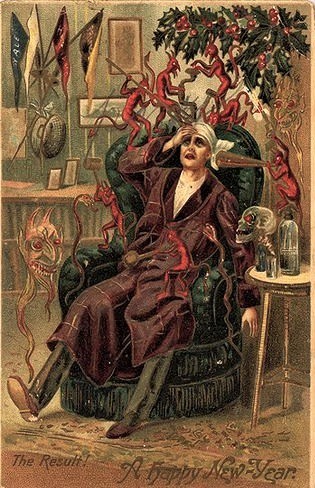
The New Year in Chicago and on the Ridge 100 Years Ago – Part 1
By Carol Flynn
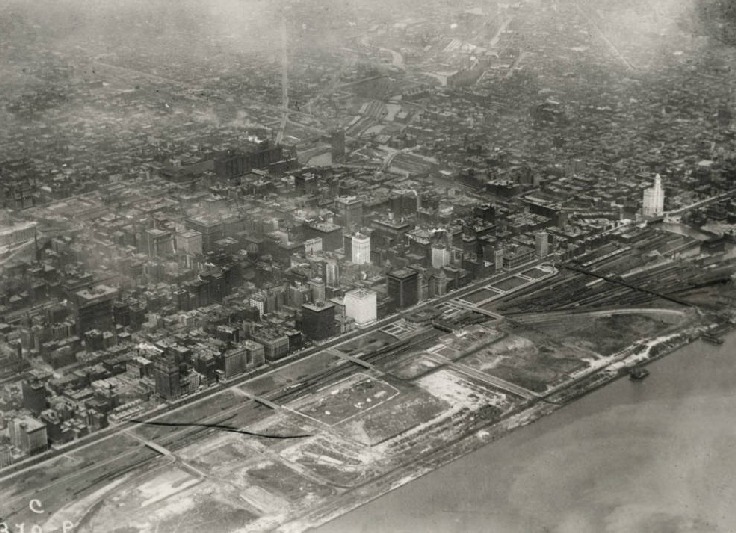
One hundred years ago, the annual welcoming in of the New Year promised to be one of the tamest ever. The United States was under the mandate of Prohibition. No alcohol could be produced, imported, transported, or sold.
In early December of 1922, Colonel Levi G. Nutt of the Federal Internal Revenue Department, charged with enforcing Prohibition in northern Illinois, was reported by the Chicago Daily Tribune to be organizing an undercover force of agents who would dress in evening clothes and “bear a general resemblance to ordinary human beings” to infiltrate New Year’s events to “harass, mangle, and destroy the merry making.”
The Tribune reported that “Col Nutt, who may be a nice man in a family circle, is a terror in the performance of duty, and he seems to enjoy saying that he expects to fill the jails and the hoosegows, the coolers and the police stations.”
However, the Chicago police didn’t intend to cooperate. According to the Tribune, Chief of Police Charles C. Fitzmorris said, “Let ‘em celebrate. The police will not interfere in any lawful celebrations. I expect to celebrate myself….[H]alf the men are to be off duty on Christmas and the other half on New Year’s.”
The Illinois Anti-Saloon League reportedly decided to ignore the New Year celebrations as a “temporary matter” that would not “take precedence over the fight” against illegal saloons.
The Tribune then reported that the raids were off, that Roscoe C. Andrews, Federal Prohibition Director for the State of Illinois, said that as long as people didn’t publicly flourish their hip flasks they would not be subject to search and seizure. This meant, wrote the Tribune, that “persons capable of pouring discreetly from under a tablecloth or a napkin, or from a flask in the pocket, will be immune from arrest.”
“Chicago’s holiday lid … [is] blasted clear off,” wrote the Tribune, leading Chicagoans to rush to make reservations for events.
Andrews, however, reacted to this Tribune article with an angry rebuttal, declaring, “Any statement that the lid is off in Chicago and that violations of the national prohibition act will be countenanced in any way, is absolutely without foundation….The mere fact that flasks are concealed under tablecloths or napkins is no defense.”
The battlelines were drawn.
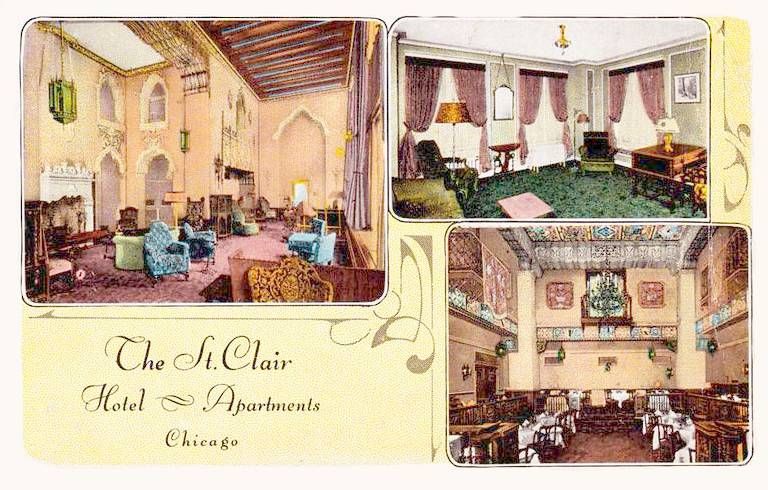
Numerous parties took place that holiday week-end, in hotels, cabarets, and private clubs and residences. The demand for space in the hotels was so great that some events had to take place on January 1 instead of December 31.
Many of the events were dinner dances, starting in the early evening. A formal dinner was followed by music and dancing. As many as three orchestras performed at some events. Additional entertainments, like vaudeville acts, were on some of the agendas. Events at country clubs included outside sports like ice skating and hockey. At midnight, noisemakers, horns, and pistol caps created a din that could go on for half an hour. Then a less formal supper was served at midnight, followed by dancing until the wee hours of the morning.
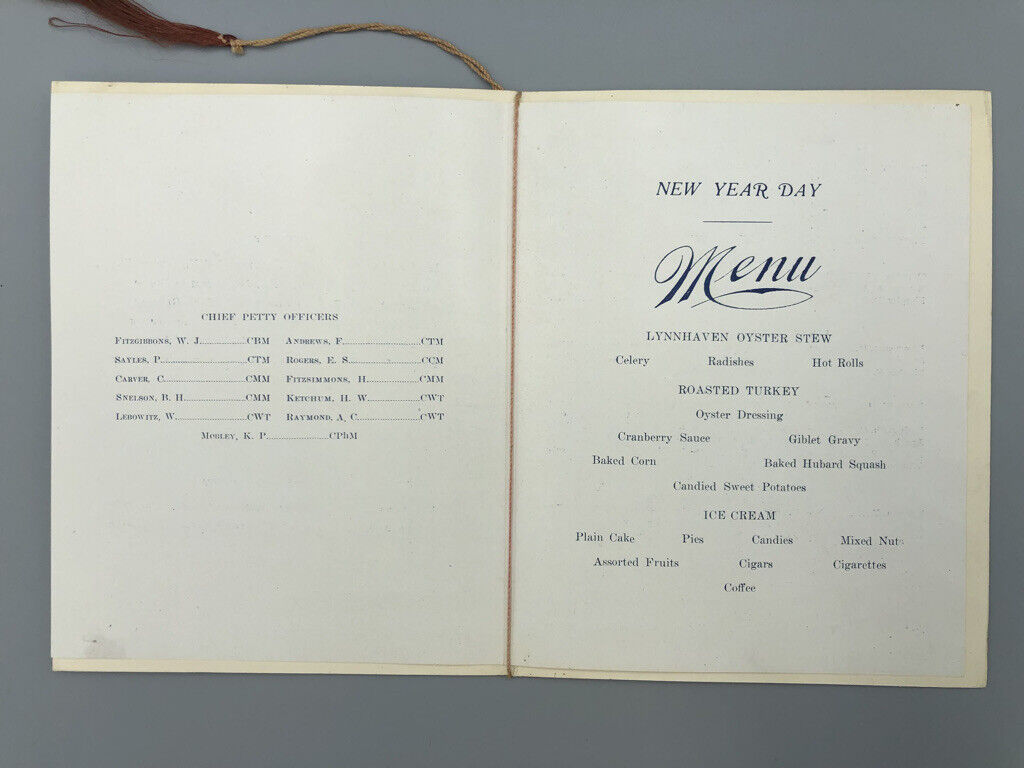
The menus for the formal dinners were always interesting and opulent. A typical New Year’s menu at a hotel included beginning courses of fruit cocktail, consommé, cream of tomato soup, and celery and almonds, followed by chicken and oysters dishes. The meat entrées included broiled pork tenderloin with pineapple fritters and fruit sauce, roasted turkey with cranberry jelly, and braised filet of beef with Bordelaise sauce. The side dishes were mashed potatoes, fried sweet potatoes, fresh spinach, and corn with green peppers. The entrees were followed by a lettuce and tomato salad. Desserts included pumpkin pie, peach pie, maplenut ice cream, steamed fruit pudding, assorted cakes, cheese, apples and raisins. Coffee, tea, and milk were availalble, and of course, people brought along their own flasks.
The cost for this meal was around $2.00 per person. A fifth of bootlegged Scotch was going for around $12.
The next day, St. Louis and San Francisco reported that riots ensued when federal agents raided events at hotels and resorts. The party-goers threw water glasses, flower vases, chairs, and even their plates bearing their entrees at the agents. People were injured – one agent was knocked unconscious by a flying bottle – and arrests were made.
Not so in Chicago. The promised raids of the “famous full dress army” never materialized, except for a few “minor cafes and saloons.”
The Tribune reported that Chicago “danced, sang, ate, went to theaters, churches and receptions.” Events at three to four hundred cafes, hotels, cabarets, and gardens, and too many private parties in residences and clubs to count, were celebrated with “little disorder” – for the most part, people were “good-natured and jolly.”
The weather was mild that year, very similar to what is forecasted for Chicago this year – the temperatures were in the mid-forties and cloudy, with a little light rain. Some 75,000 people descended upon the loop and the lakefront.
1922 turned out to be one of the biggest New Year’s Eve celebrations in Chicago’s history. Even Colosimo’s Café at 21st Street and Wabash Avenue, run by the “Chicago Outfit,” had to close its doors and cut off admittance, so great were the crowds trying to gain entry.
Many people held “watch parties” at home. Tomorrow, we’ll explore what was going on in Beverly and Morgan Park as 1922 became 1923.
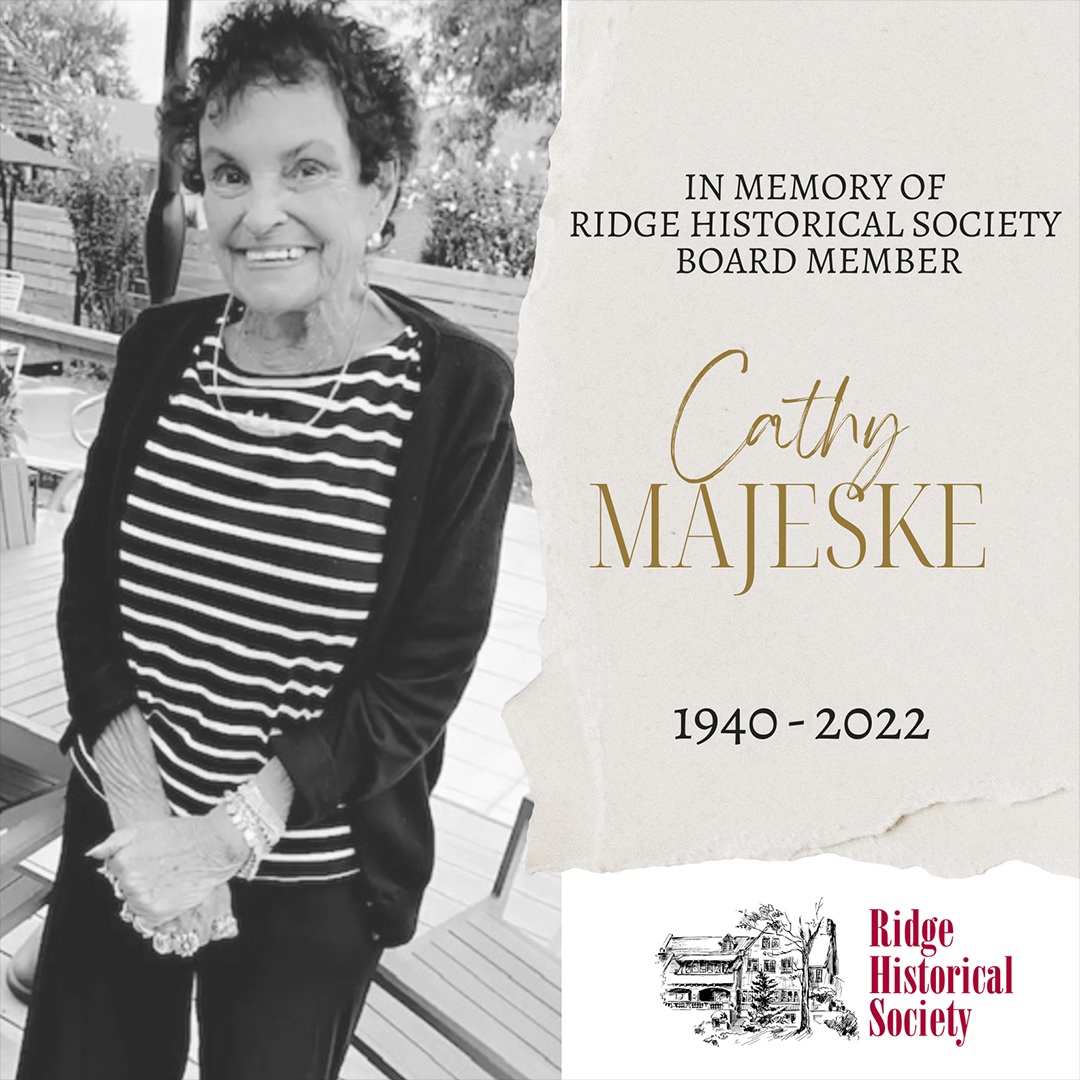
The Ridge Historical Society is saddened to announce that one of our Board Members, Cathy Majeske, passed away on December 28, 2022.
Cathy was a long-time member of the RHS Board and Chair of the Program Committee for many years, leading so many social and educational programs, garage sales, helping with holiday decorations and more. Her enthusiasm will be missed.
You can find details of the visitation and service at Colonial Chapel in Orland Park to be held on Sunday, Jan. 1, 2023 here:
https://www.colonialchapel.com/memorials/catherine-majeske/5103231/index.php#details
And now, back to work! The Ridge Historical Society will be open today, Tuesday, December 27, from 1:00 to 4:00 p.m., free admission. The address is 10621 S. Seeley Avenue.
The Hetherington Design Dynasty exhibit has been extended until late January. We'll be announcing upcoming programs soon, including another program on how to research your Chicago home, since the one held recently sold out. Stay tuned.
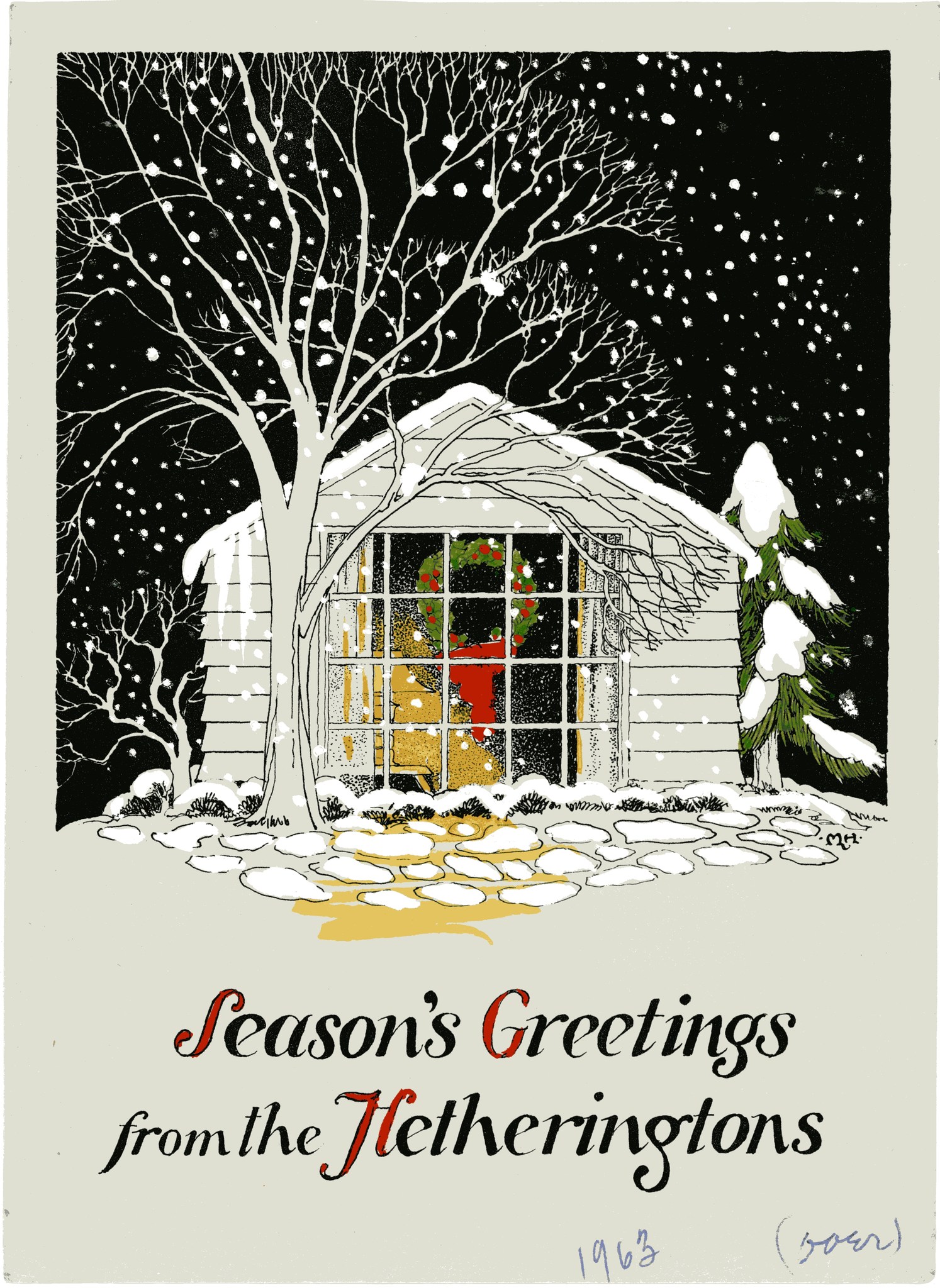
This is a Christmas card sent out in the past by Mildred Lyon Hetherington, local artist.
Season's Greetings from the Ridge Historical Society
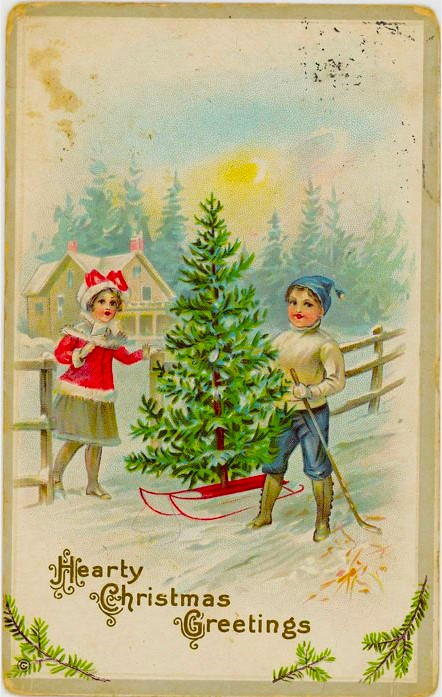
This vintage card from the early 1920s – one hundred years ago – shares a sentiment appropriate to today, one of the coldest Christmas Eves on record in Chicago! Hearty Christmas Greetings!

RHS Offers Membership Gift Certificates
A perfect gift for a local history buff or new neighbors, or someone who has moved away but remembers the community fondly, is a membership gift certificate from the Ridge Historical Society. Individual memberships are $25 and Family memberships are $50.
It’s not too late to pick one up this week. RHS, at 10621 S. Seeley Avenue, Chicago, is open on Tuesday afternoon from 1:00 to 4:00 p.m. Other arrangements may be made by contacting RHS at 773/881-1675 or ridgehistory@hotmail.com.
RHS could also send electronic verification of a gift with the print copy to follow.
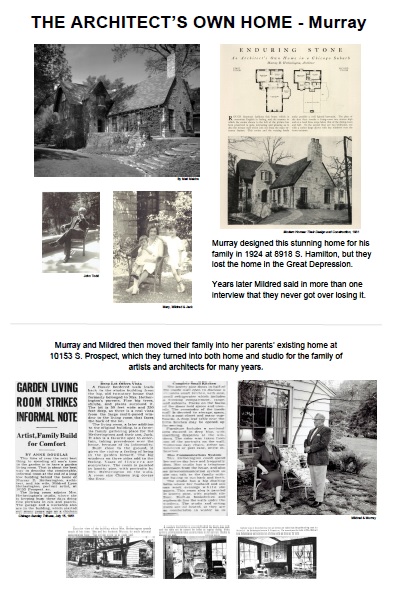
The Ridge Historical Society will be open on Sunday, December 18, from 1 to 4 p.m. The address is 10621 S. Seeley Ave., Chicago. Admission is free.
There are just a few weeks left to view the current exhibit, the Hetherington Design Dynasty. Three generations of the Hetherington family lived in Beverly, became architects, and designed close to 100 buildings in the area.
Murray D. Hetherington was the second generation. An example of his work is the house he designed for himself; his wife, the artist Mildred Lyon Hetherington; and thier son Jack, who became the third generation architect.
The First Beverly Art Center
By Carol Flynn
The Ridge Historical Society (RHS) will be open tomorrow, Sunday, December 11, from 1 p.m. to 4:00 p.m. The address is 10621 S. Seeley Avenue, and admission is free.
The current exhibit, Hetherington Design Dynasty, will only be on display for a few more weeks, through January 7. RHS is open on Sundays and Tuesdays from 1:00 to 4:00 p.m., or by appointment. Note, however, that Christmas and New Year’s Day fall on Sundays this year and RHS will be closed both days. This means there are only two Sundays left to view the exhibit – tomorrow and December 18.
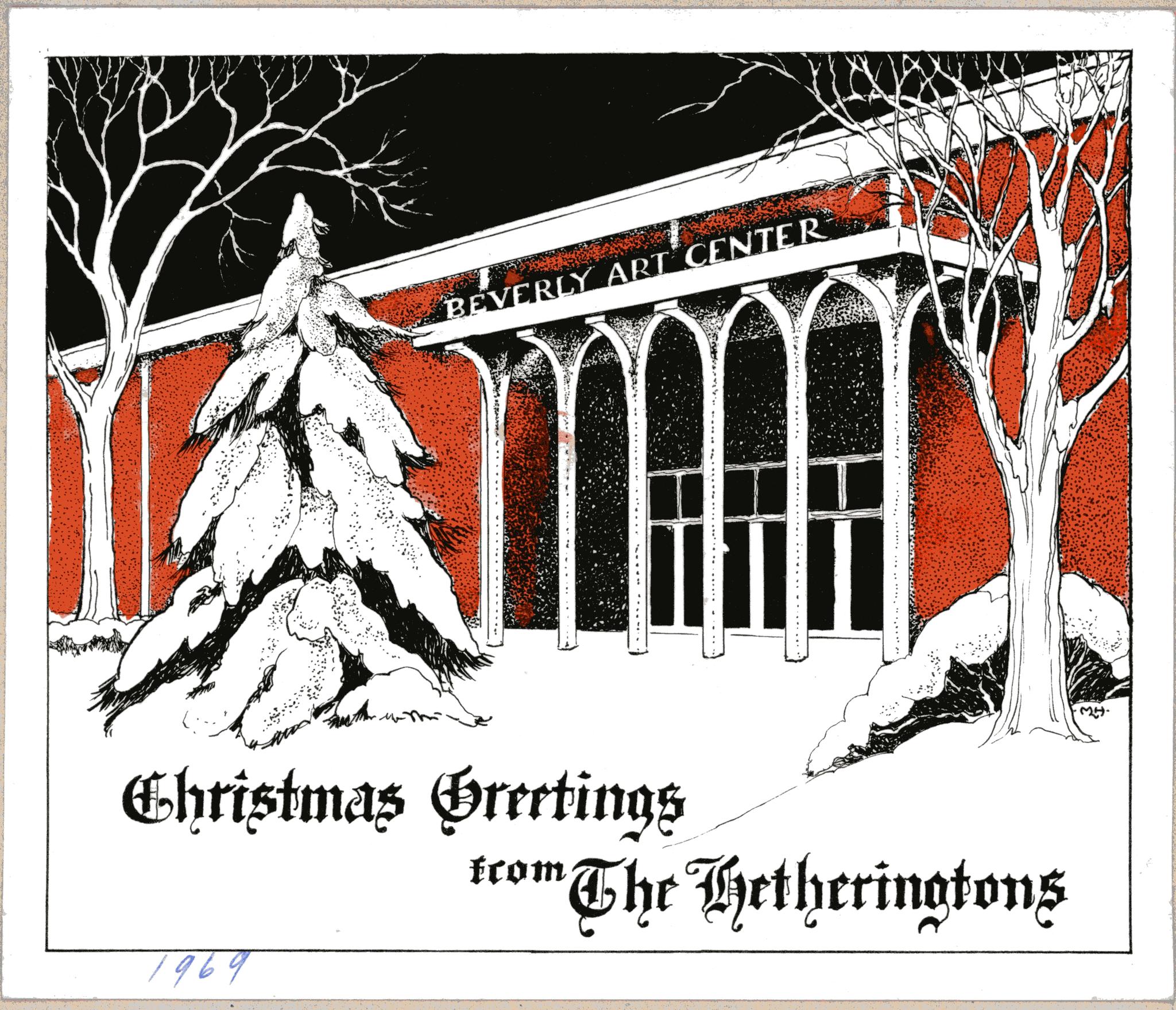
The exhibit has a new feature added for the holidays – the Christmas cards that Mildred Lyon Hetherington designed and sent to family and friends.
The Hetheringtons were a three-generation family of architects – John Todd, his son Murray, and Murray’s son Jack – who lived in Beverly and designed close to one hundred homes and buildings in the area, including the Graver-Driscoll House, RHS Headquarters.
Mildred Lyon was a local artist who met Murray Hetherington when they were both students at the Art Institute of Chicago. They married and had two children, son Jack the architect, and a daughter Mary who died young.
Mildred was known for her portraits and her illustrations of children’s publications. As many artists do, she created her own Christmas cards.
In 1969, Mildred’s card featured the new Beverly Art Center (BAC), which had just opened that September on the 2100 block of West 111th Street, on the campus of the Morgan Park Academy (MPA).
This was a significant event for the Hetherington family because the building was designed by Jack Hetherington, who had attended MPA. Although BAC moved from that building when the new BAC at 111th Street and Western Avenue was built, MPA continues to use the building
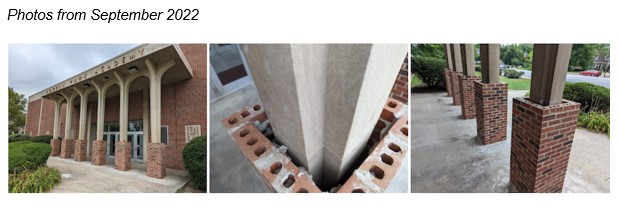
The original BAC building features a modern design with a portico that floats atop slender concrete columns, nicely depicted by Mildred in her Christmas card.
However, this past summer, architects and historians, as well as Hetherington family members, were dismayed to observe that MPA was encasing the lower sections of the concrete columns in brick, destroying the original façade.
While it is understood that this was done to preserve the columns from further deterioration, the alterations are incompatible with the original design. Not only is the building affected, but the visual cohesiveness of the Ridge Historic District is impacted by this type of alteration to a historic building. The Ridge Historic District is part of the National Register for Historic Places. The RHS Historic Buildings Committee has been in contact with MPA.
RHS can help owners of local historic buildings in need of preservation “facelifts” to understand landmark considerations, and to research the building’s history and design to assist with restoration efforts.
The Ridge Historical Society
The History of the Graver-Driscoll House – Part 7: The Fenn Family
By Carol Flynn
Every house has a history.
Today we return to the history of the Graver-Driscoll House, the headquarters for the Ridge Historical Society, which celebrates its centennial this year.
Designed by architect John Todd Hetherington, the house was built in 1921-2 for Herbert. S. Graver, Sr., his wife Anna, and their infant son Herbert, Jr. Graver was an executive with the family’s business, the Graver Tank Works, and a college football star whose University of Michigan team played in, and won, the first game in Pasadena in 1902 that became the Rose Bowl.
In 1940, the Gravers sold the house to John Grant and Grace Fenn. The Fenns had two children, Helen and Grant. The address used for the house at the time was 10616 South Longwood Drive, and the only entrance to the property on the top of the Ridge was via the steep driveway on Longwood Drive.
The Fenn family only owned the house from 1940 to 1946, yet it became a legendary location in their family history due to a special event that occurred there, the wedding of Helen to Lt. Alden J. “Buzz” Ritter in August of 1943.
The Fenn – Ritter family and RHS formed a bond over the years, and the family has shared numerous pictures and family stories with RHS. This past summer, the family donated Helen’s wedding dress to RHS.
John Grant Fenn was born in Chicago in December of 1890. His father was a traveling salesman at the time, then later worked at the steel mills in accounting.
Grace Harrison was born in September of 1891. Her father was the superintendent of schools in Union, Indiana.
John Grant and Grace married in 1916 in Cook County. Daughter Helen was born in 1918 and son Grant in 1924.
John Grant, usually referred to as J. Grant, earned a B.S. in mechanical engineering from the Armour Institute of Technology, which merged into the Illinois Institute of Technology. At the time he married, he was employed by the London Guarantee and Accident Co. as a factory inspector.
By 1920, the Fenns were living on 100th Place in Beverly. They were active in the local social scene; for example, one newspaper article reported that in December, 1929, they were part of the Entre Nous Dancing Club that held a dance the Ridge Park field house. J. Grant was on the committee for the dance.
In 1934, J. Grant Fenn and W. Proctor Roberts formed a corporation, Air Tempering Systems, Inc., to manufacture heating, refrigeration, and air-conditioning equipment and parts.
Air conditioning was an emerging industry. The concept of cooling went back to ancient times, using ice and snow. By 1900, ammonia–cycle artificial refrigeration systems were being used in the food industry, especially the Chicago meat packing houses. Air conditioning premiered at the 1904 World’s Fair in St. Louis. At the time, the machinery was too large, cumbersome, and expensive to be considered for home use.
Engineers, however, kept working on improvements, and in 1927, General Electric released the Monitor Top, the first refrigerator to run on electricity. By 1930, with the synthesis of artificial refrigerants like chlorofluorocarbons (which were eventually banned), the practicality of cooling systems for home use finally became realistic. The 1930s and 1940s saw the innovations that led to window air conditioners and by the 1960s, central air conditioning.
J. Grant apparently did well with the business through the years of the Great Depression. In 1934, the Fenns began purchasing property in Clearwater, Florida, and to divide their time between there and Chicago. The Florida newspapers reported they entertained aboard their cruiser, Goldreme.
In 1940, they purchased the Graver House. According to the family, sometime during the 1940s, they also purchased the strip of land between the house and Seeley Avenue to the west to build a second driveway entrance, at 10621 South Seeley Avenue, the address RHS uses today. The drive up the steep hill on Longwood Drive in the winter ice and snow was no longer a necessity.
On his World War II draft registration, J. Grant listed his occupation as a self-employed mechanical engineer.
The Fenns lived in the Graver House during the years of World War II. Grace was mentioned in the newspapers for helping to entertain servicemen. Son Grant attended Morgan Park Military Academy, and Grace was active with the Alumni Mothers group.
John Grant Fenn died in 1945 and was buried in Mount Greenwood Cemetery, where his parents had been buried many years before.
Grace sold the Graver House in 1946. She eventually moved to Clearwater, Florida, where she died in 1988 at the age of 96. Her remains were returned to Chicago for burial in Mount Greenwood Cemetery.
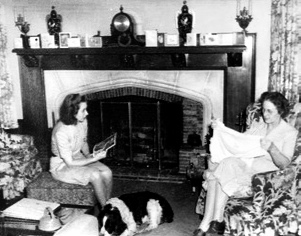
In this photo, Helen and Grace Fenn relax in their family home from 1940-1946, the Graver House.
Next installment: The Fenn children, Helen and Grant.
The Ridge Historical Society will be open tomorrow, Tuesday, December 6, from 1:00 to 4:00 p.m. The address is 10621 S. Seeley Avenue in Chicago. Admission is free.
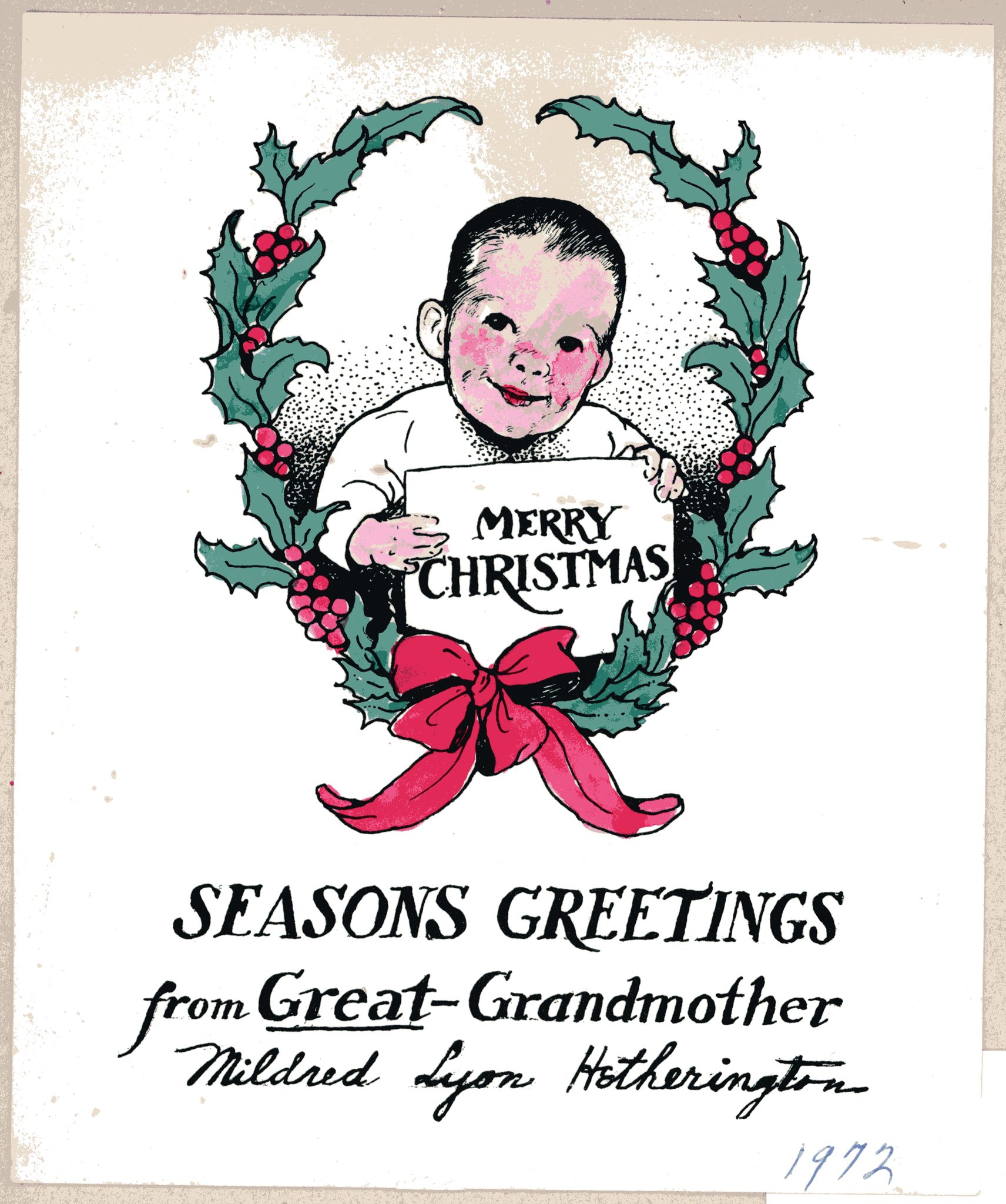
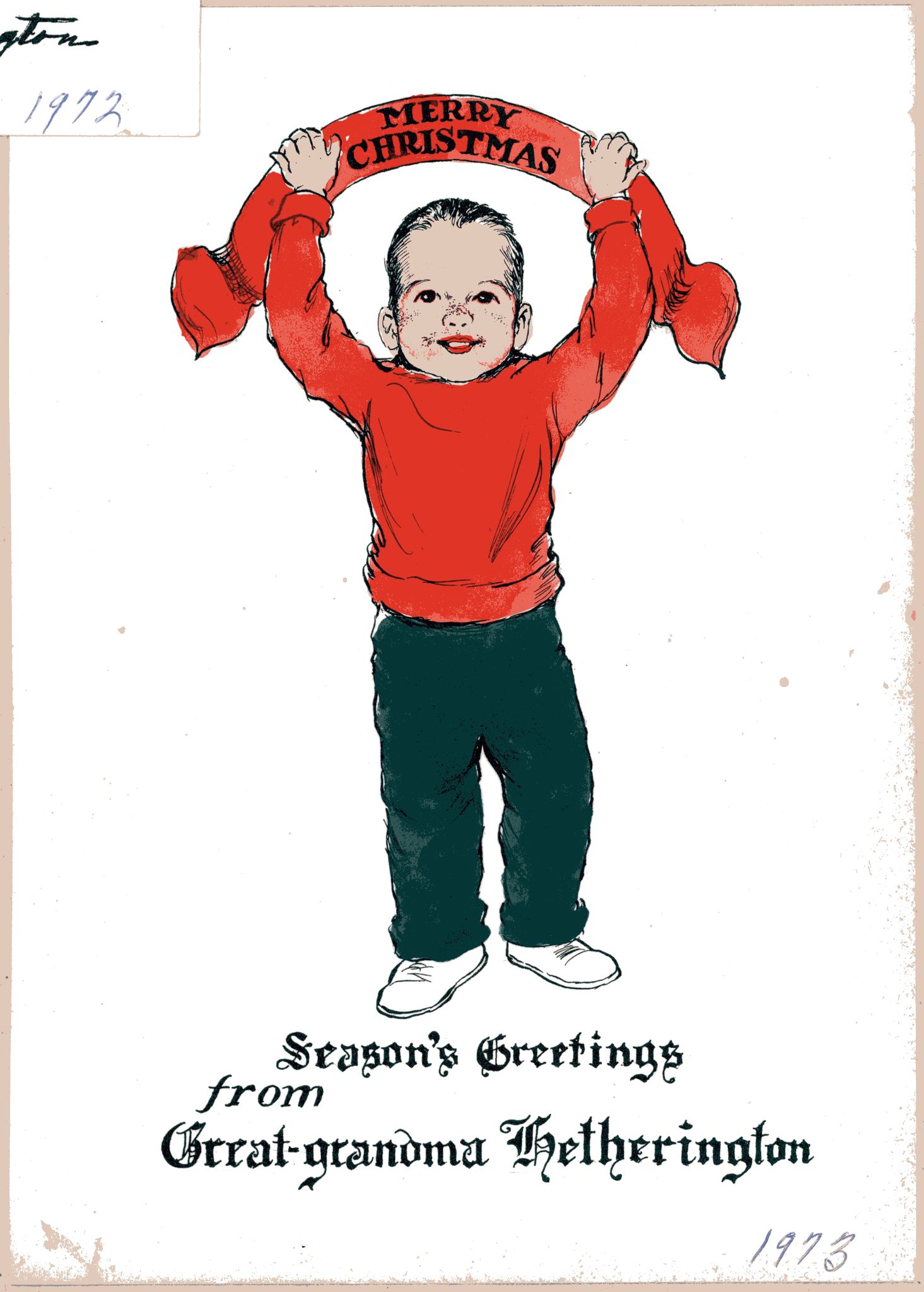
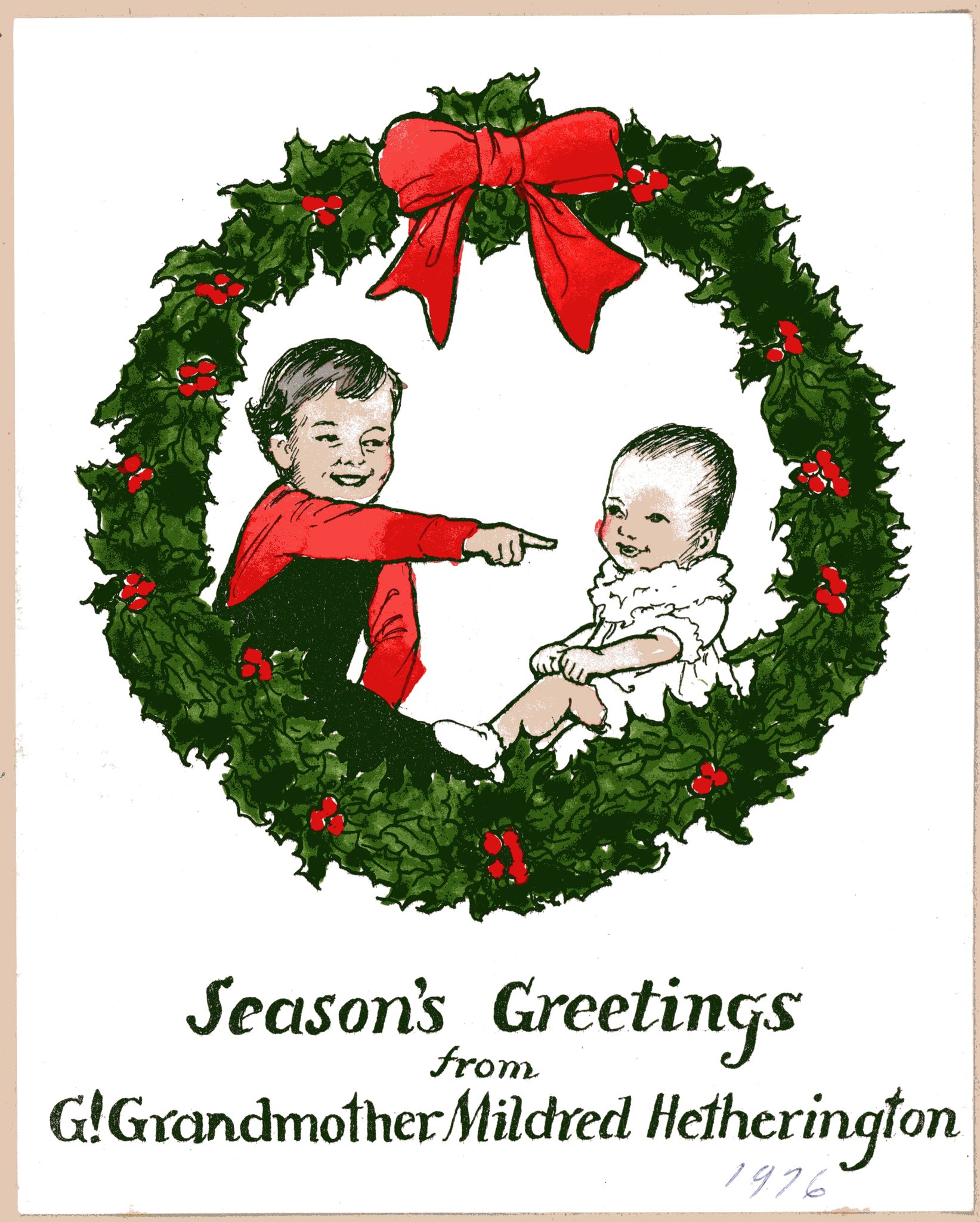
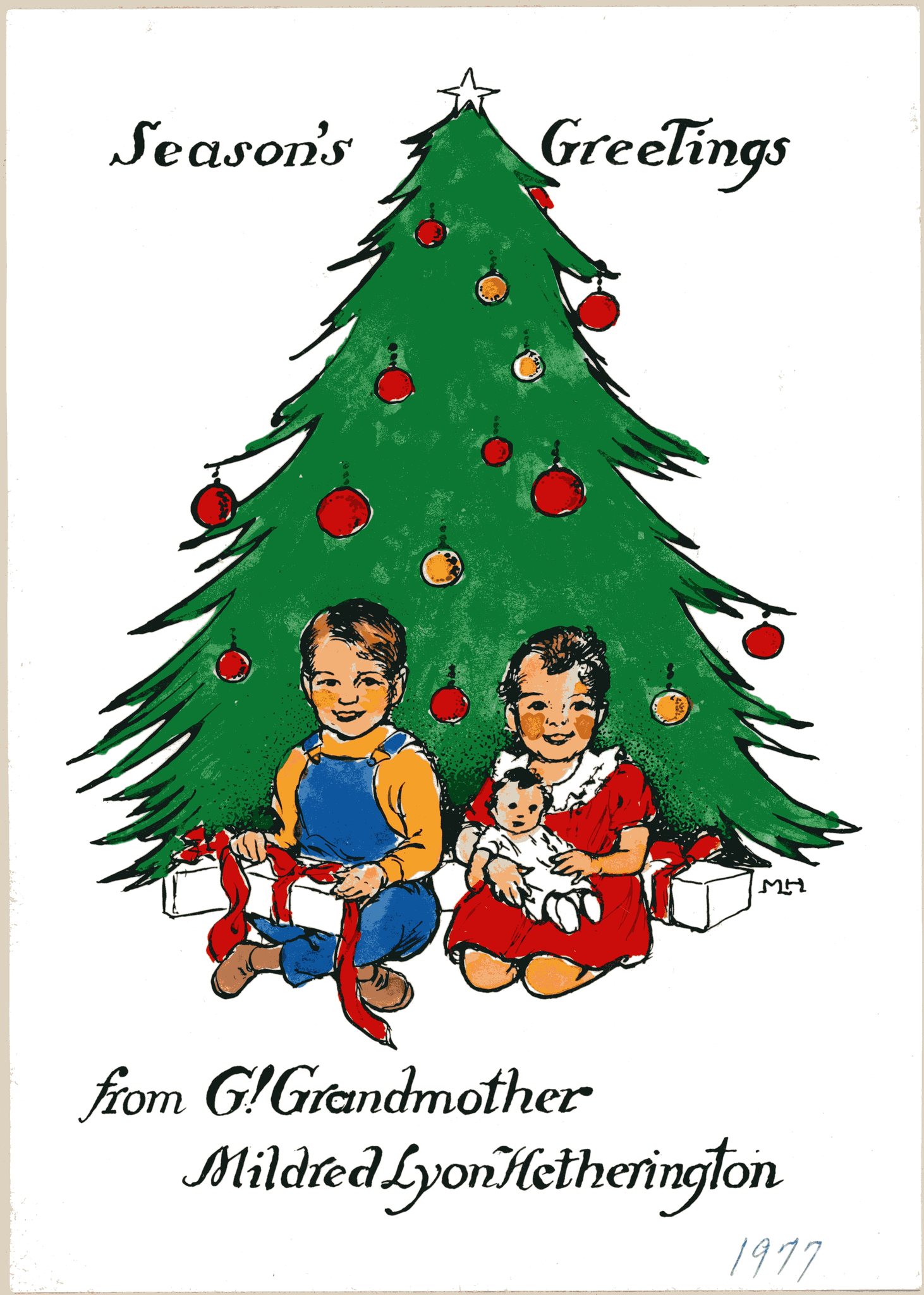
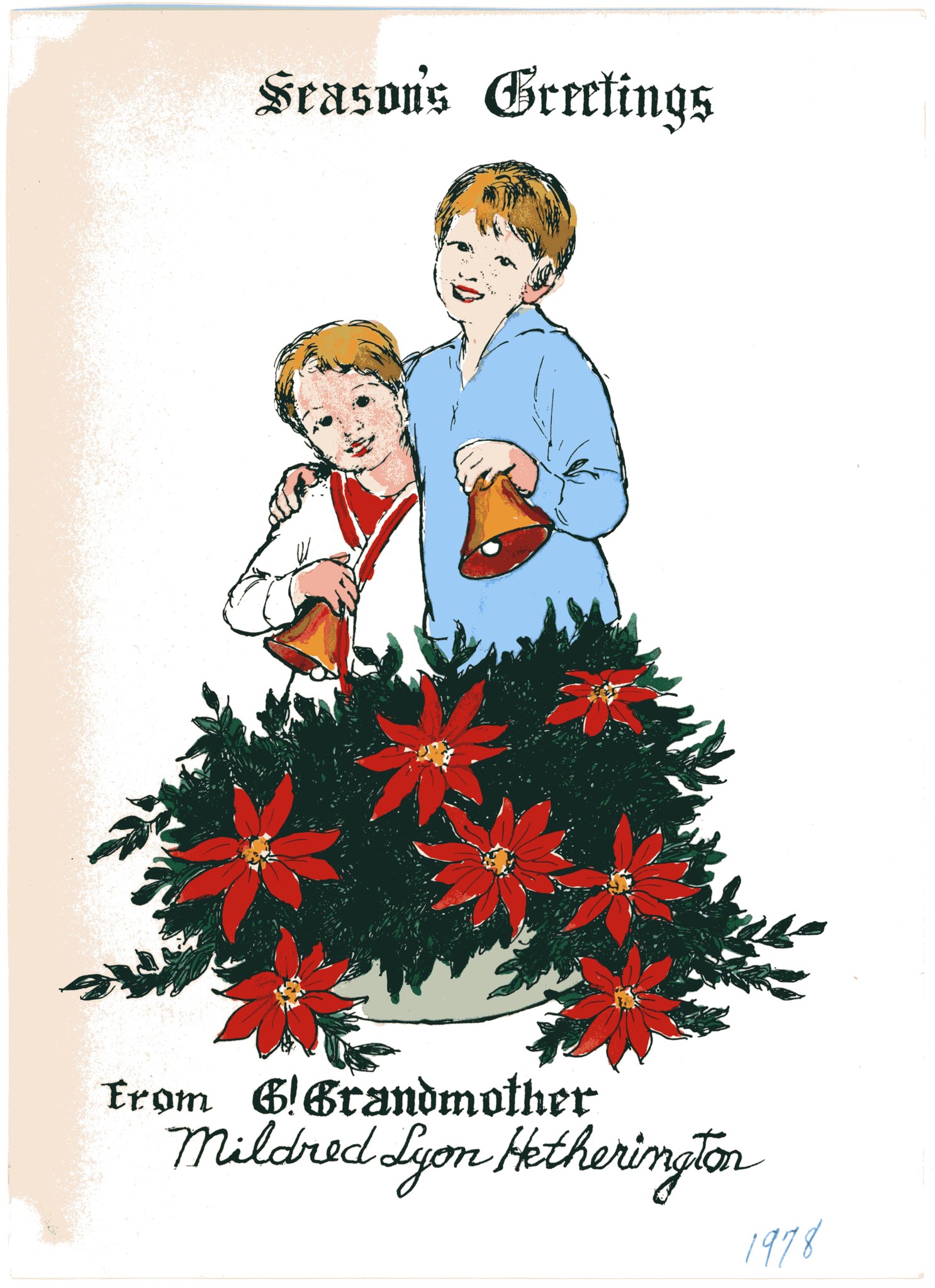
A new feature has been added to the current exhibit, Hetherington Design Dynasty. Christmas cards designed by local artist Mildred Lyon Hetherington are now on display. Mildred sent these cards to family members and friends.
The Smithsonian Institute began adding personal Christmas cards designed by famous artists to its Archives of American Art in 2015.
Christmas card art that artists design for their personal use is a unique art form. The holidays are a time for reflection and sharing, and this art often offers a glimpse of the artist's personal point of view of what is important in her life.
Mildred became a great-grandmother in 1972, and from that point on her cards chronicled the growth and development of her great-grandchildren.
Her skills as a portraitist and illustrator of children's publications are apparent in these cards, but more importantly from a personal perspective, her love for and devotion to these children couldn't be more evident.
The Hetherington Design Dynasty exhibit is entering its final month of display. The last day will be January 7, 2023. Visit now on Tuesday and Sunday afternoons from 1 to 4 p.m., or by special appointment. Contact RHS at 773/881-1675 or ridgehistory@hotmail.com.
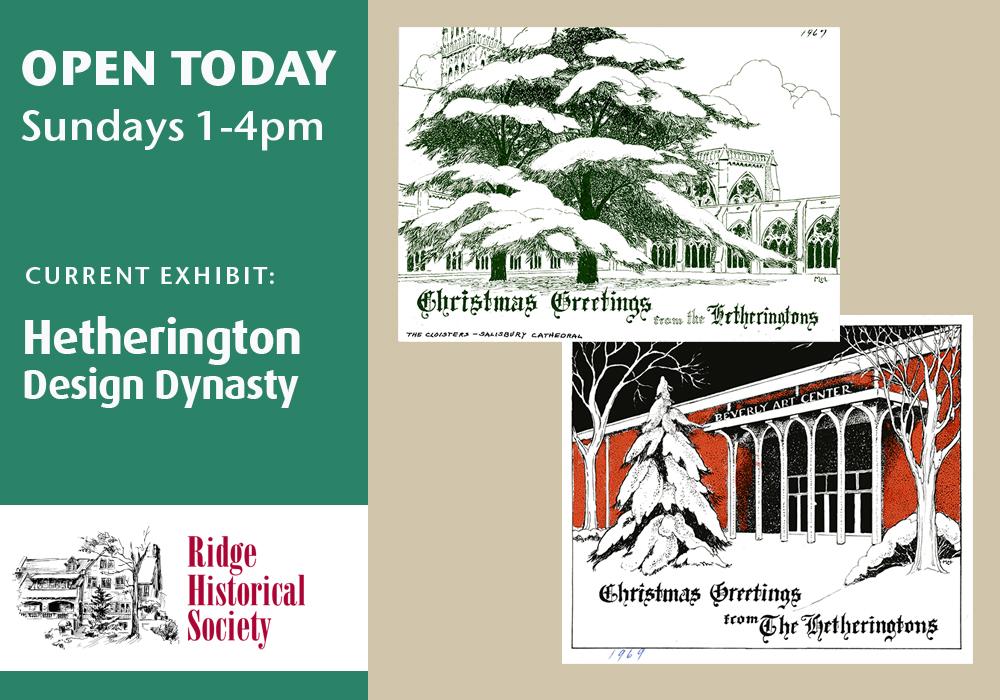
The Ridge Historical Society will be open tomorrow, Sunday, December 4, 2022, from 1:00 p.m. to 4:00 p.m. Admission is free. The address is 10621 S Seeley Avenue, Chicago.
The current exhibit is "Hetherington Design Dynasty" featuring the work of three generations of architects in the Hetherington family, John Todd, Murray, and Jack. They designed scores of houses and other buildings in the Blue Island Ridge communities.
The artwork of Mildred Lyon Hetherington is also part of the exhibit. Mildred was a local artist who married Murray, a fellow student she met at the Art Institute of Chicago. They were Jack's parents. Mildred was known for her portraits and illustrations of children's publications.
Added to the exhibit for the holiday season are the Christmas cards that Mildred designed and sent to family members and friends.
A closing date has been set for the Hetherington exhibit: January 7, 2023. If you have been planning to visit, now is the time to do so!