Explore the RHS Facebook Archives, a rich repository of local history written by Carol Flynn. For two decades, Carol brought a deeply dedicated voice to public education at RHS. Her role as Facebook administrator through mid-2025 naturally extended her prolific research into meticulously detailed articles, most notably her multi-part historical series posts. Today, Carol continues her local history writing for The Beverly Review and other outlets.
2023
The Ridge Historical Society
Memories of Past Winter Holidays on the Ridge
By Carol Flynn
Through the years, activities such as tobogganing in Dan Ryan Woods, shopping at the local stores, and holiday events at schools and churches left indelible impressions in the memories of people who called the Ridge “home.”
This year the RHS Facebook page will feature a new series for the winter holidays – memories and stories submitted by you, the readers.
The series starts off with a post from Mary Ellen Tatro-Mendoza, a teacher who lives in North Beverly. Mary Ellen is a fourth-generation resident of the Ridge. Her family's roots go back to the very early days when her ancestors worked in the Blue Island brick yards, and were members of the Sacred Heart Mission Church.
From Mary Ellen:
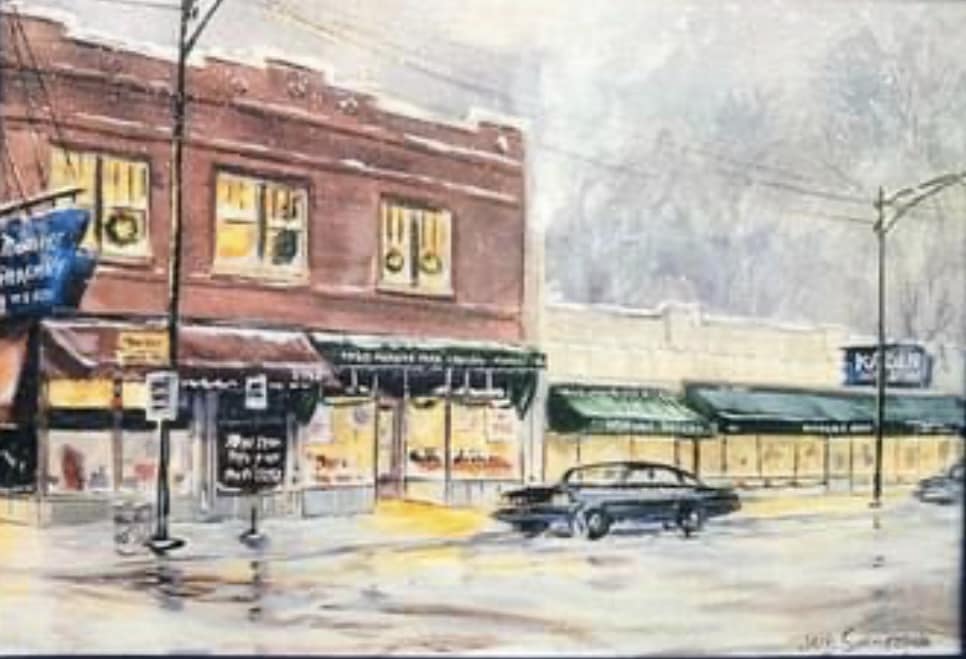
Christmas in Morgan Park by Jack Simmerling.
111th Street, looking east from Hale Avenue.
On the corner was Monterey Pharmacy, next was the Morgan Park Grocers, next was Holmdahl’s Bakery, and then Kaden’s Department Store.
You could get everything you needed at Kaden’s! Everyone did their Christmas shopping at Kaden’s. I can still see the sales clerk, taking out the boxes of nylon stockings and putting her hand underneath the stocking, so you could see the color of the hose. Would your mother like that color?
Everything was so lovely and quaint!
___________________________________________________________________
Thank you, Mary Ellen, for sharing your memories, and this image painted by the late artist Jack Simmerling. Jack operated the Heritage Gallery on 111th Street before moving to the current location on 103rd Street. This was likely painted in the 1960s.
Comments are welcome, and the only rules are that they must be positive and respectful. No disparagement of any kind, even implied, will be allowed.
Who would like to go next? You can send me a private message through Facebook if you would like to share a story, or email me at cflynn2013@yahoo.com. We look forward to hearing from you!
Tomorrow is clean-up day at the PIKE HOUSE!
Details are in the attached Patch article. Thank you, Patch and editor Lorraine Swanson for the coverage!
https://patch.com/illinois/beverly-mtgreenwood/volunteers-needed-fall-clean-saturday-eugene-s-pike-house?utm_term=article-slot-1&utm_source=newsletter-daily&utm_medium=email&utm_campaign=newsletter&user_email=746a8077f303b55eeca8959339fdbbedc6c3a0a6819429e815ae3ffc647bc238
The Ridge Historical Society – Giving Tuesday
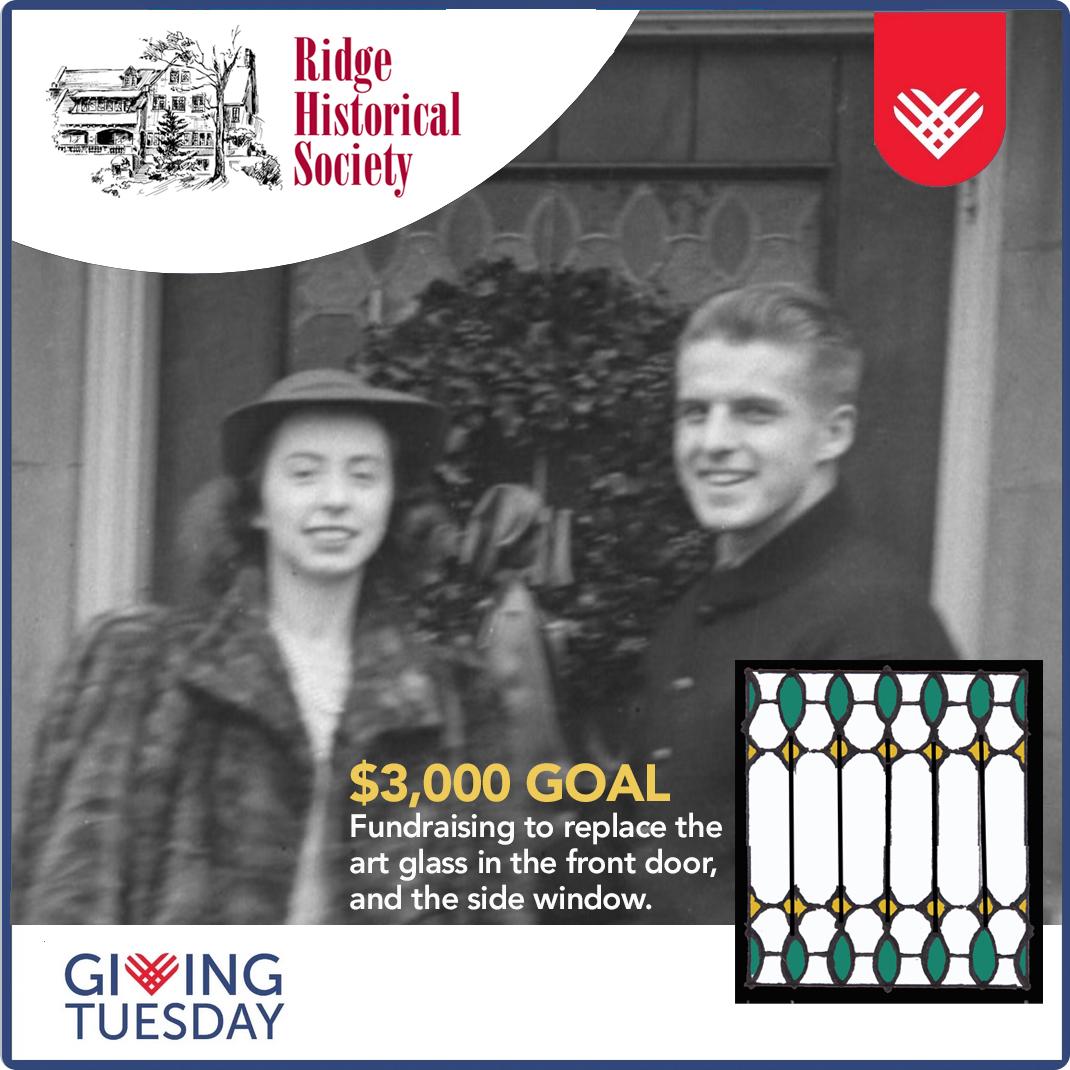
Restoration Campaign Part 1: Art Glass windows $3,000 goal
RHS has decided to start with a small but meaningful project to replicate the front door stained glass window and a small leaded glass window lost in the 1962 fire, started by the Family Christmas tree, that devastated the house. We are working with Colorsmith Stained Glass Studio of Riverside to reverse engineer the pattern based on historic photographs. This is the kick off the next phase of our exterior restoration work, the preservation of our 101-year-old windows.
Please consider donating to help us get to our goal of $3,000 to recreate these windows. Your support sustains our community’s history.
As part of our ongoing mission, we work to preserve, restore, and update the Graver-Driscoll House, home to RHS since 1971.
Ongoing work in recent years has included replacement of the slate roof, repair of brickwork, and rebuilding our one-of-a-kind veranda overlooking Longwood Drive. These projects have allowed RHS to host unique community events such as BAPA Porch Concerts, the Beverly Art Walk, and Open House Chicago.
To sustain these types of projects, we are launching our new Restoration Fund dedicated to ongoing restoration, preservation and modernization projects at the Graver-Driscoll House in order to better serve our communities.
The Ridge Historical Society is thankful for our patrons, members, volunteers, and donors. Without you, RHS could not preserve and interpret the history of the South Side communities along the Blue Island Ridge.
All money raised for this campaign will be used for the Window Restorations. Donations to RHS, a tax-exempt entity, are considered gifts to a charitable organization and will be acknowledged as such.
PayPal Donation Link: https://bit.ly/RHS-donation
The current exhibit at the Ridge Historical Society (RHS) offers glimpses into how the Beverly Hills and Morgan Park neighborhoods appeared over 100 years ago, through the watercolor paintings of artist Louise Barwick and other media.
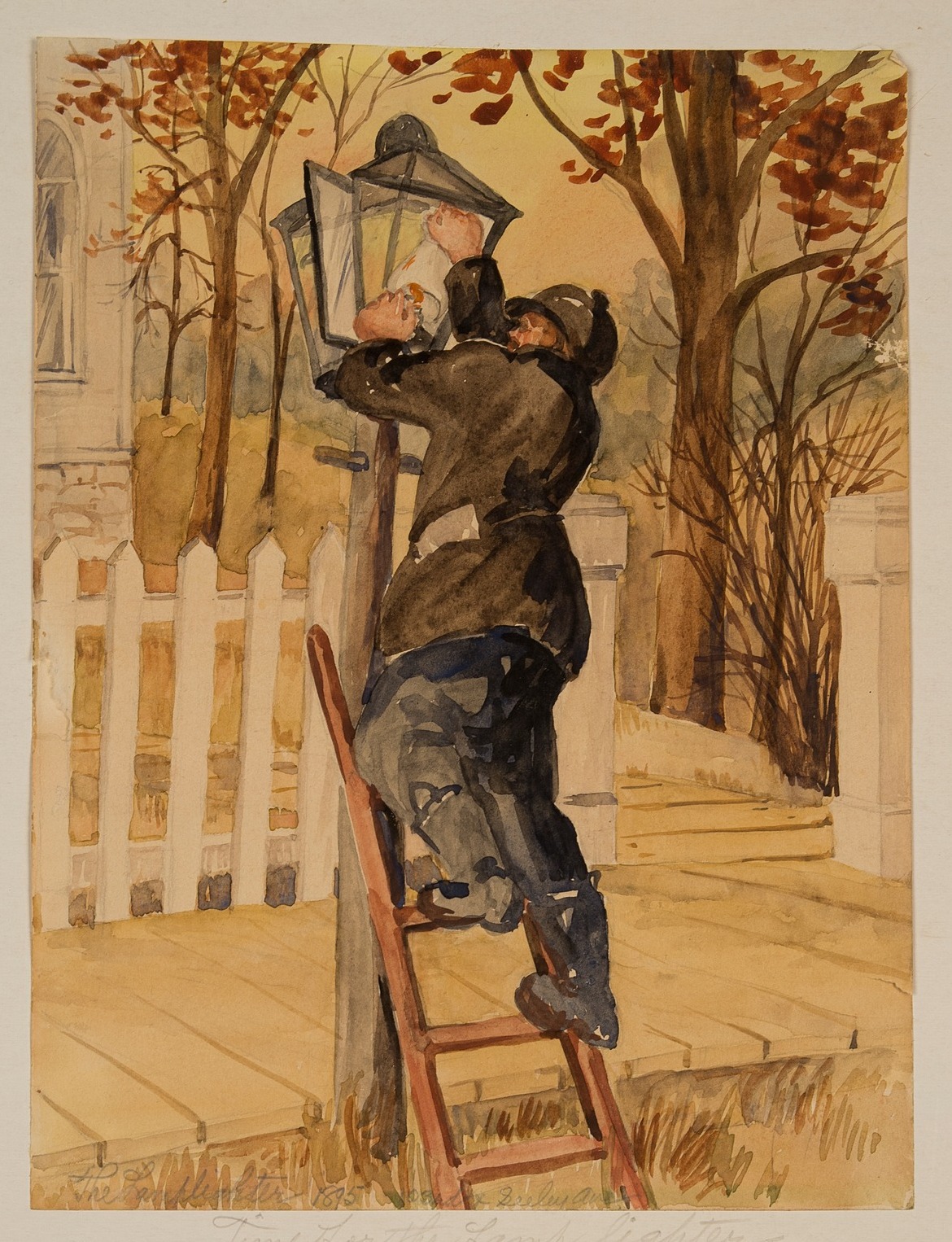
Today the street lights come on automatically thanks to electrical wiring, but just envision how once the lamplighter rode his bicycle around the neighborhood, lighting the gas lamps by hand.
This painting is “Lamplighter” painted in 1895.
The scene occurred on Belmont Avenue (now Seeley) south of 103rd Street. The partial view is of the house at 10330 Seeley, where the Barwick family lived.
The caption for the painting: The lamp lighter rode on his bicycle, carrying his short ladder and the gaslight taper.
Here are a few comments on the current Ridge Historical Society exhibit, “Louise Barwick’s Lost Ridge”:
Linda Lamberty, RHS Historian and Exhibit Co-Curator:
“It’s a visual experience …. I’m hoping people will sit with their coffee in the morning, looking out on their yards, and try to picture it the way it once was – and the way it was so loved by people in the community. We LOVE this neighborhood today, but 100+ years ago our predecessors loved a vastly different landscape just as much. This place is just uniquely special and has always been cherished.”
M.M., college educator, exhibit visitor:
“I have enjoyed lingering & lingering over the panels from the Louise Barwick exhibit; I can't stop gazing at them & rereading them, over & over.
“The relationship between the text and the images that the viewer's imagination feels enraptured by, is really an education unto itself. I love the experience of flowing back and forth, between the words and the visuals. It triggers the exhilaration of REAL learning."
“Louise Barwick’s Lost Ridge” is open to the public on Tuesday and Sunday afternoons from 1:00 to 4:00 p.m. or by appointment (call 773/881-1675 or email ridgehistory@hotmail.com). Admission is free. RHS is located at 10621 S. Seeley Avenue in Chicago.
HAPPY THANKSGIVING from the Ridge Historical Society
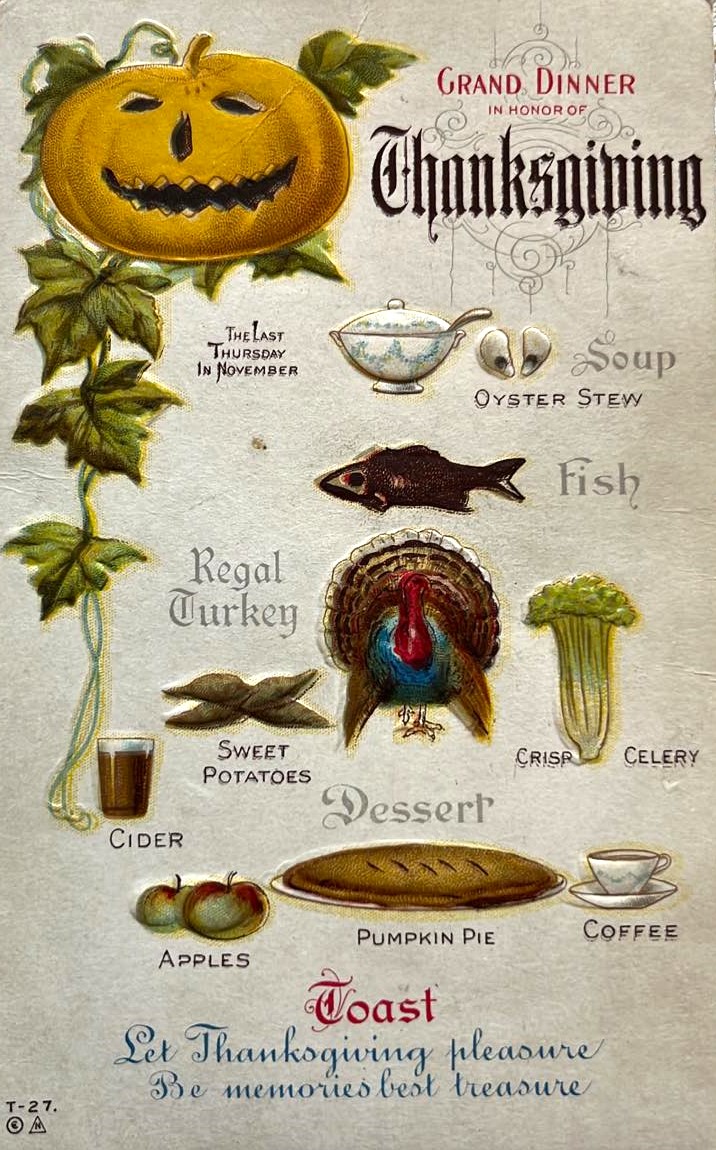
Thanksgiving, more than any other U.S. holiday, has a traditional menu associated with it.
This vintage postcard shares a typical dinner from 100+ years ago.
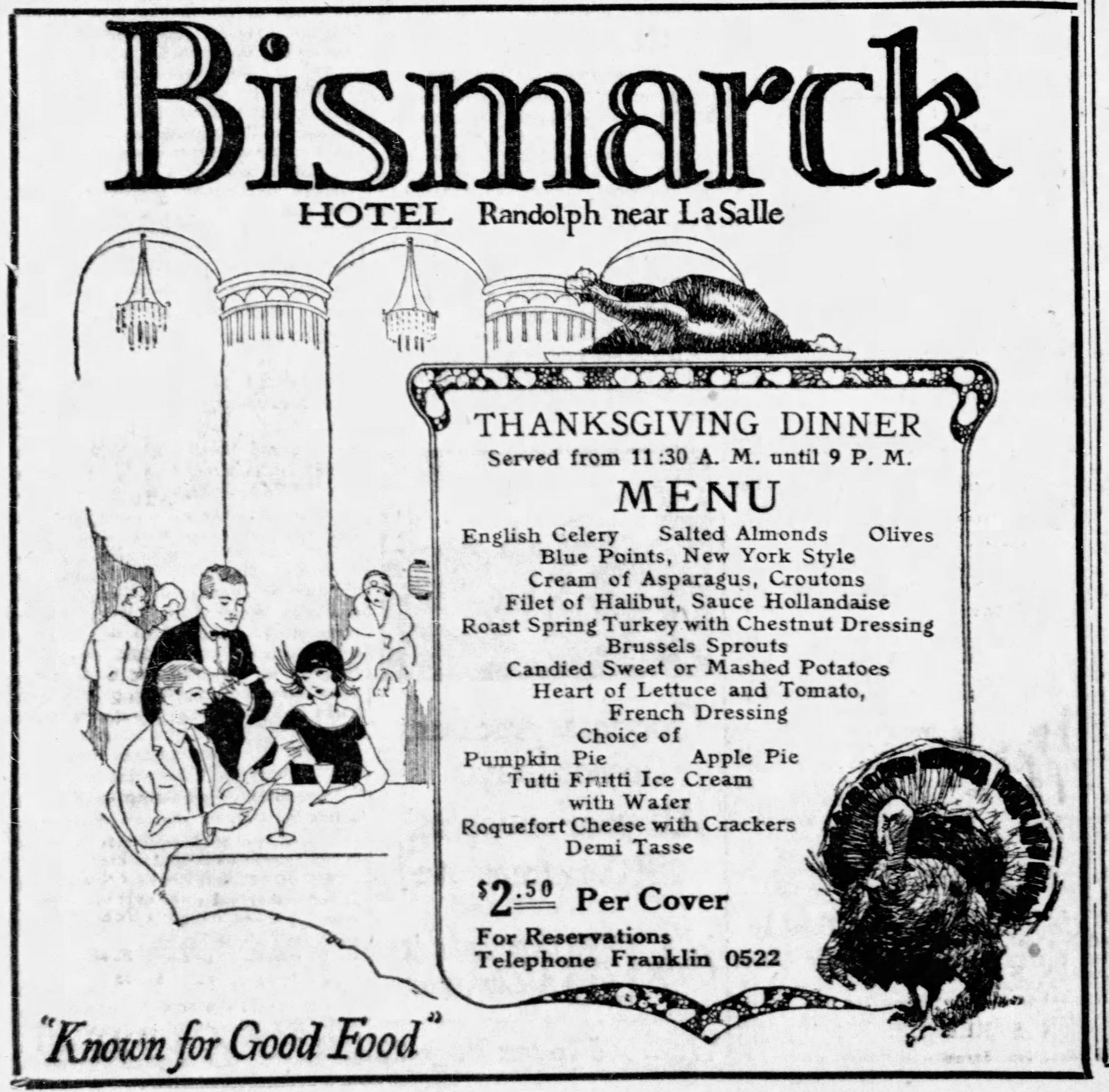
Diners could enjoy a multi-course meal at the downtown hotels. Here is an ad for Thanksgiving dinner at the Bismark Hotel that appeared in the Chicago Tribune in November 1923.
The Ridge Historical Society
Louise Barwick – Part 2
By Carol Flynn
The Ridge Historical Society’s new exhibit, “Louise Barwick’s Lost Ridge,” may be viewed on Tuesdays and Sundays from 1:00 p.m. to 4:00 p.m. or by appointment. RHS is located at 10621 S. Seeley Avenue in Chicago. The exhibit is free.
This exhibit focuses on life on the Ridge from 1893 to 1905 as seen through the watercolor paintings of Louise Barwick, an artist and educator who lived on the Ridge. Other components of the exhibit include a section on aerial photography taken by cameras attached to kites, and “lost and found” architecture – historic photos of buildings, some of which remain and some of which are gone from the Ridge.
This Facebook series on Louise Barwick complements the exhibit, but does not repeat it. More information on Louise herself, her family and her history, is being presented in this series. The exhibit concentrates more on visual images of the Ridge in the late 1800s.
This post will look at Louise’s maternal ancestors.
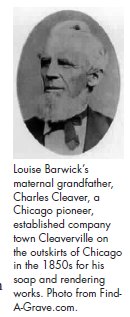
Charles Cleaver, Louise’s maternal grandfather, was born in London in 1814 into a family famous for soap-making. The Cleavers began the company that would change its name to Yardley of London after two Cleaver sons married Yardley daughters, and the Yardley family eventually took over the business.
In October 1833, Cleaver arrived in Chicago, when the city, in his own words, “… was just springing into existence … when the only sidewalk Chicago then had was an Indian trail along the river bank.”
Cleaver started the first soap and candle factory in what is now downtown Chicago. Cleaver also had a general store which he ran with his brother William.
Soap and candles were made from animal fat, usually beef tallow or pork lard. Therefore, essential to the operation were slaughterhouses and meat packing plants. Cleaver took all the lard and tallow from the meat packing houses of the city, and rendered it, that is, melted it down and clarified it (strained it to remove impurities) in the melting house adjoining the factory. He soon was the major supplier of rendered oils and other products made from the oils for the country west and north of Chicago.
In 1838, he married Mary Brookes, from another pioneer family, and they had eleven children.
Around 1851, Cleaver bought land around what is now 35th Street and Cottage Grove. He built a meat packing facility and soap making and rendering works, and a general store. He created Cleaverville, a company town, to house his employees. He erected numerous homes and a meeting house, which was also the first church. Cleaver paid the Illinois Central Railroad to run trains to his settlement. Brother William served as postmaster and ran the store, among other duties.
Cleaverville ran from 35th Street and the lake west to Cottage Grove/Vincennes Road, and south to 43rd St., just north of Hyde Park. In fact, Cleaver coined the name Cottage Grove, because, yes, there was a cottage in a grove on the site.
Cleaverville was a smaller version and forerunner of the Pullman area, which would be built 30 years later by George Pullman as a company town for his railroad car business.
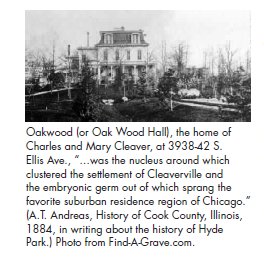
In 1853, the Cleavers built a grand house at 3938 Ellis Ave., which became the center of Cleaverville activities. The house was known as Oakwood Hall or Oak Wood Hall.
Up to 1856-57, Cleaver did all the melting for all the meat companies in the city. In 1857, Cleaver discontinued his soap factory, and turned his attention to real estate. He became one of the leading real estate men of the city.
The Cleavers, and later the Barwicks, were active in numerous organizations and listed in social registries. They were often covered in the society pages. One example occurred in 1864, when the Chicago Tribune described a holiday “Fair and Festival” planned to take place at the residence of Charles Cleaver, Esq., arranged by the ladies of the Salem Congregational Society, the church founded by Cleaver and his father-in-law Samuel Brookes. The event was a fund raiser for the church.
“There will be room for all, and the attractions will be of the very first order,” promised the Tribune. Plans called for an “excellent supper, and a choice collection of toys and fancy articles, most seasonable just at this time among the little folks.” Admission was 25 cents, “and the locality is just the pleasantest of all directions for an evening sleighing party. The ladies of Cleaverville deserve to be well-rewarded for their enterprise….”
Beginning in the late 1860s, Cleaver shared his experiences and memories of the very earliest days of Chicago in articles and talks. A collection of these materials was published as “Early Chicago Reminiscences” in 1882 by Fergus Printing Co. and is well worth a read by Chicago history buffs.
Charles Cleaver died in 1893 and is buried in Oak Woods Cemetery.
The next post will look at the Brookes family, Louise Barwick’s maternal grandmother’s side, another very early family in Chicago history.
The Ridge Historical Society
Native American Heritage Month: Land Acknowledgement Statement
By Carol Flynn
November is Native American Heritage Month. The theme for this year is “Celebrating Tribal Sovereignty and Identity.”
This continent was populated by Indigenous Peoples for 20,000 years before the European settlers came. There was, and still is, no single Native American culture, language, or lifestyle; there were many different groups here when the Europeans arrived. Ninety percent of those people died from diseases such as smallpox, measles, influenza, and cholera introduced by the Europeans, to which Native Americans had no natural immunities.
Native Americans should not just be considered as part of the past – they are very much part of the present and future of this country.
In recent years, governments, universities, cultural organizations, churches, and other institutions have begun recognizing the Native American heritage of the land through Land Acknowledgement Statements (LAS). These are formal declarations put out in writing that note the organization is located on land that was once the ancestral grounds of Native Americans.
These statements first started being used in Canada in 2015. They are often read aloud at the beginning of an event. In Canada, they are regularly included at events ranging from parliament sessions to ballet performances to National Hockey League games.
Chicago-area groups, including the Field Museum of Natural History and the Forest Preserves of Cook County, have issued Land Acknowledgement Statements.
In 2021, the RHS Facebook page ran a series on the history of Native Americans on the Ridge as support for a suggested LAS for groups on the Blue Island Ridge. That LAS has been adopted by several organizations in the community.
The suggested LAS is:
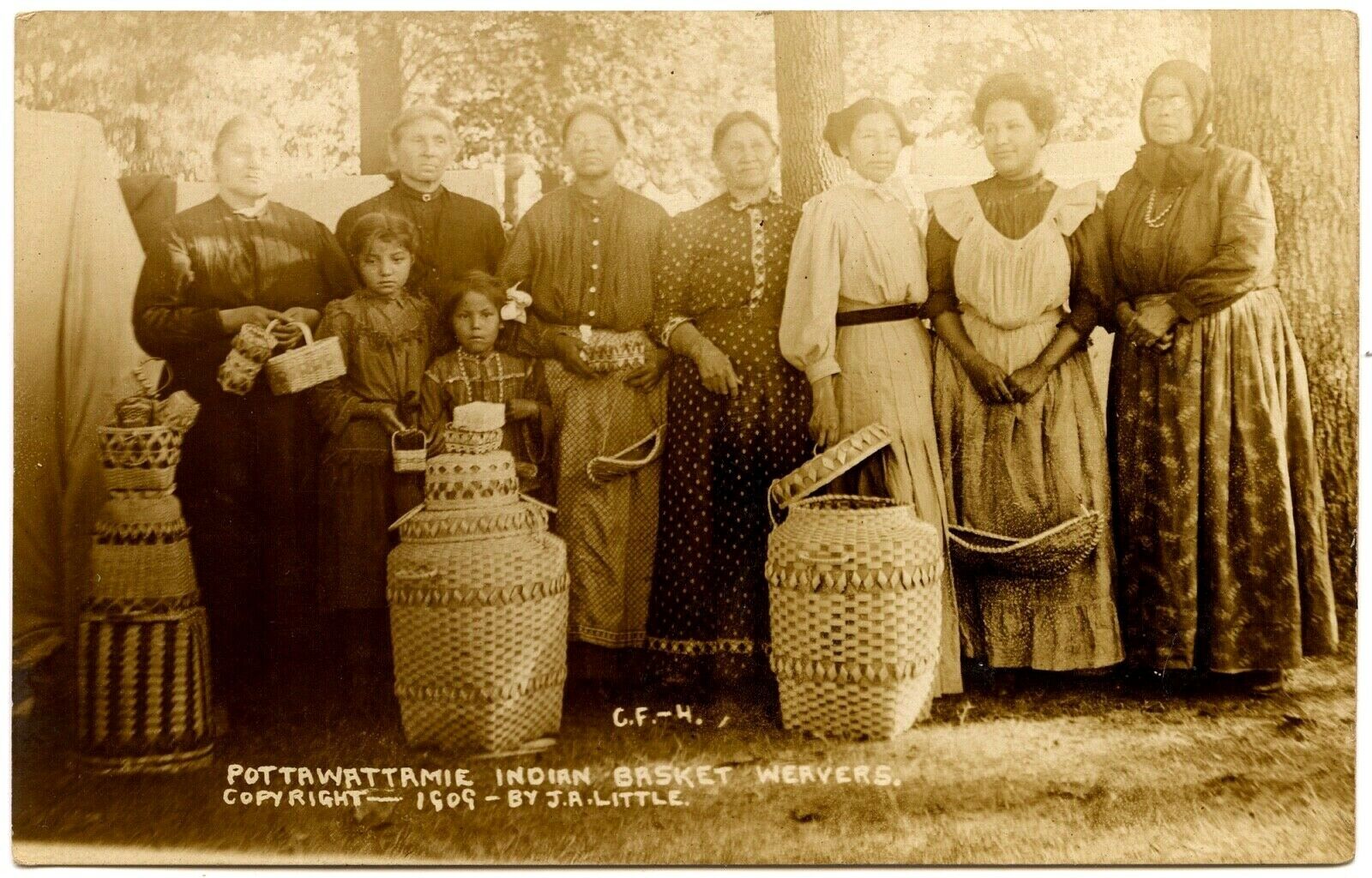
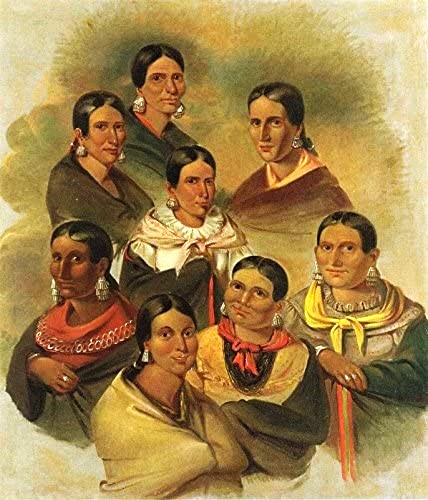
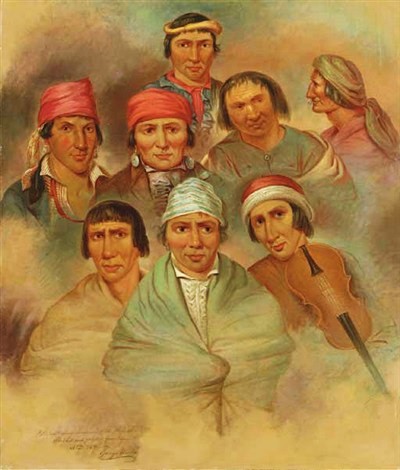
“We acknowledge that we are located on the ancestral homelands of the Potawatomi tribe, a member of the Council of Three Fires with the Ojibwe and Odawa Peoples.
“Other tribes that lived in the Blue Island area include the Miami and the Illinois Confederation. Many additional tribes including the Fox, Sauk, Winnebago, Menominee, Meskwaki, and Kickapoo lived nearby and accessed the area for trading and portage routes.”
The rationale for this statement is that the Potawatomi were the dominant Native Americans living around the Blue Island area in 1833 at the time of the signing of the Treaty of Chicago. The Council of Three Fires, a confederation of the Ojibwe, Odawa, and Potawatomi tribes, ceded the land to the U.S. Government at that time, and most of the Native Americans left the area.
The Miami tribe also had a presence here, concurrent with the Potawatomi, and before that, until the late 1700s, tribes from the Illinois Confederation lived in the area until driven out by the Miami and Potawatomi.
Many other tribes lived nearby. This land is located on the Vincennes Trace and Calumet and Stony Creek waterways, and the land and water routes were used for trading, transportation, and seasonal migration. These tribes included the Fox, Sauk, Winnebago, Menominee, Meskwaki, and Kickapoo.
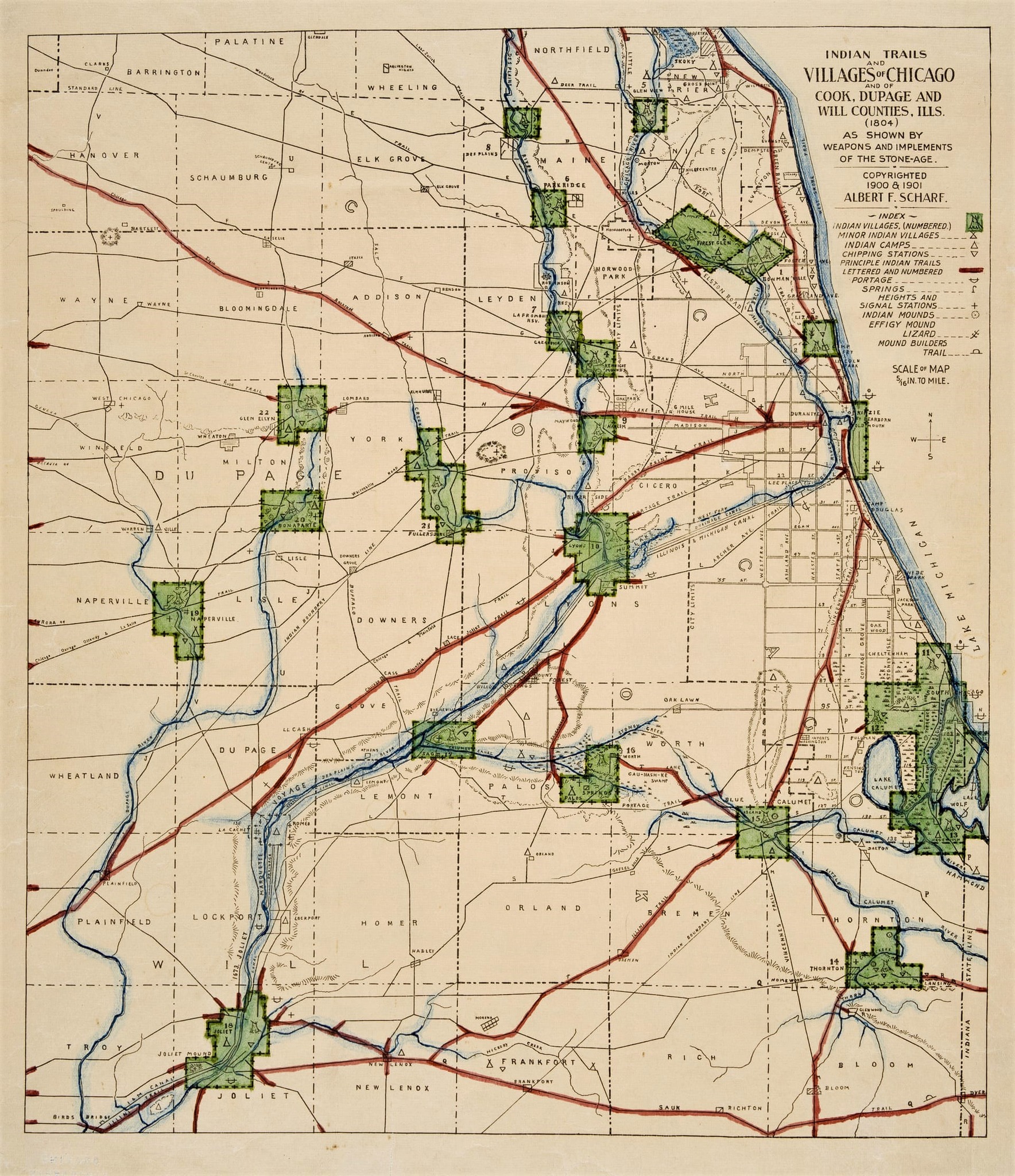
The Native American presence in the area included a major village and burial mounds in Blue Island, a signal station at the northern tip of the Ridge in today's Dan Ryan Woods, and two trails that ran across the Ridge. These were the Vincennes Trail that originally ran through North Beverly around 92nd Street, and a trail that ran along today's 103rd Street.
All of this has been lost now, but can be remembered by acknowledging its historical presence.
The Ridge Historical Society
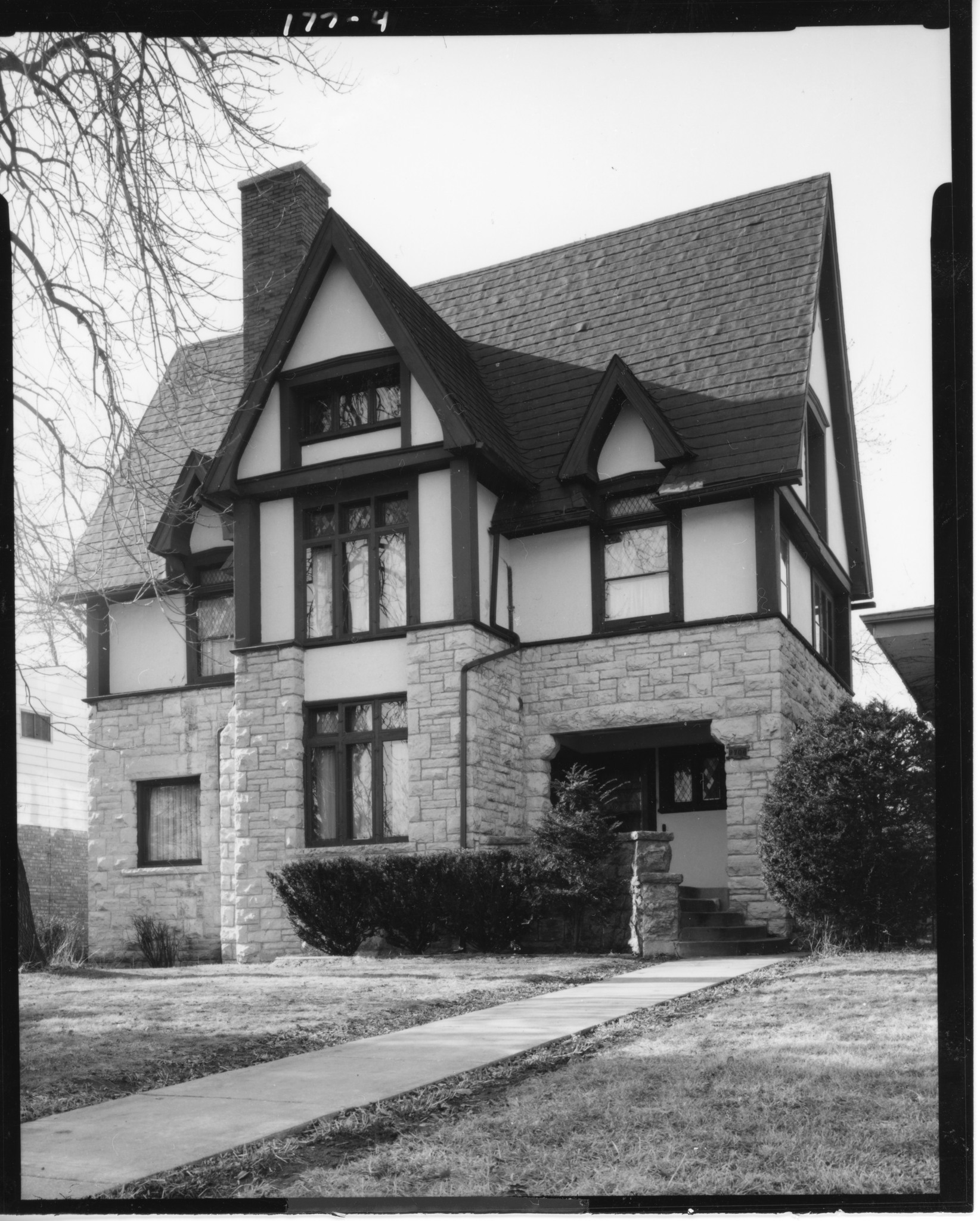
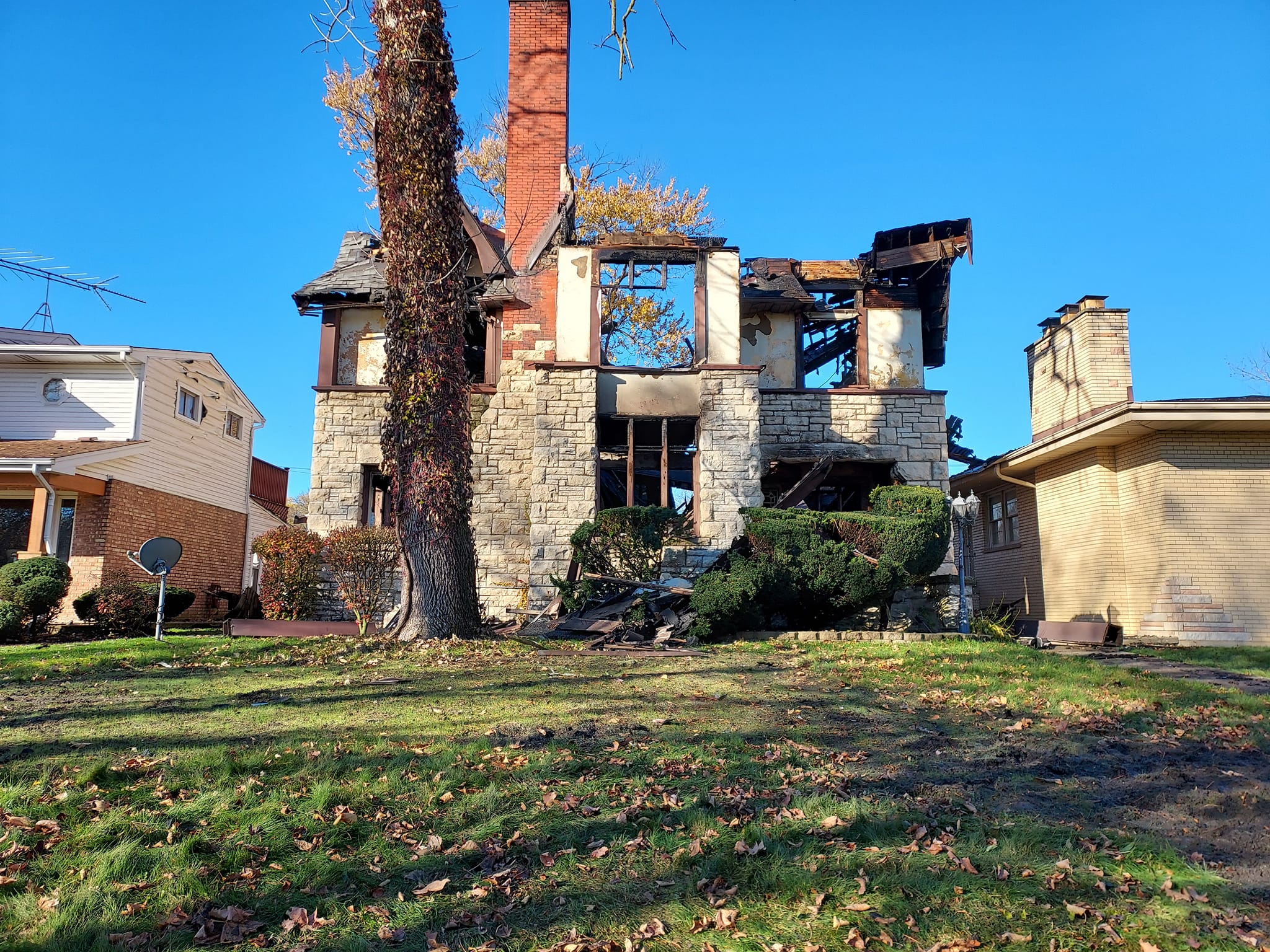
Fire at the Bretsnyder House
By Carol Flynn
Last night the house at 9706 Longwood Drive was gutted by fire. Fortunately, no one was injured. It was reported that the house was currently unoccupied as it underwent renovation.
This house is the Minnie L. Bretsnyder House, built in 1895. The last name has several different spellings, including Bretshneider, but the family went by Bretsnyder in the years after the house was built, and when Minnie died in 1955, her obituary listed her as Minnie L. Bretsnyder.
The architect of the Norman- or Tudor-style house is not known with complete certainty, but according to Harold Wollf, architecture historian and past RHS registrar, the house is attributed to Harry Hale Waterman (1869 – 1948) based on the style. It was built during 1895-97, a period when Waterman was remiss in publicizing information on his projects.
Waterman was a contemporary of Frank Lloyd Wright and George Maher, but while they concentrated on developing distinctive styles, Waterman built in many different styles for a large group of clients. He designed many noteworthy buildings in the Beverly/Morgan Park community. He was affectionately known as "the village architect" in Morgan Park.
His work included the England J. Barker House at 107th Street and Longwood Drive; the Walter R. Barker House, also known as the “Walgreen mansion,” on 116th Street, part of the Mercy Home for Girls; the Morgan Park United Methodist Church at 110th Place and Longwood Drive; the Eugene S. Pike House at 91st Street and Longwood Drive; the Calumet Bank Building at 111th Street and Longwood Drive; and the Harry H. Waterman House at 108th Street and Longwood Drive.
The Bretsnyder family included Minnie, born in 1865 in Germany, and her husband William (1861 – 1942), born in Illinois to parents who came from Germany. William was an artist.
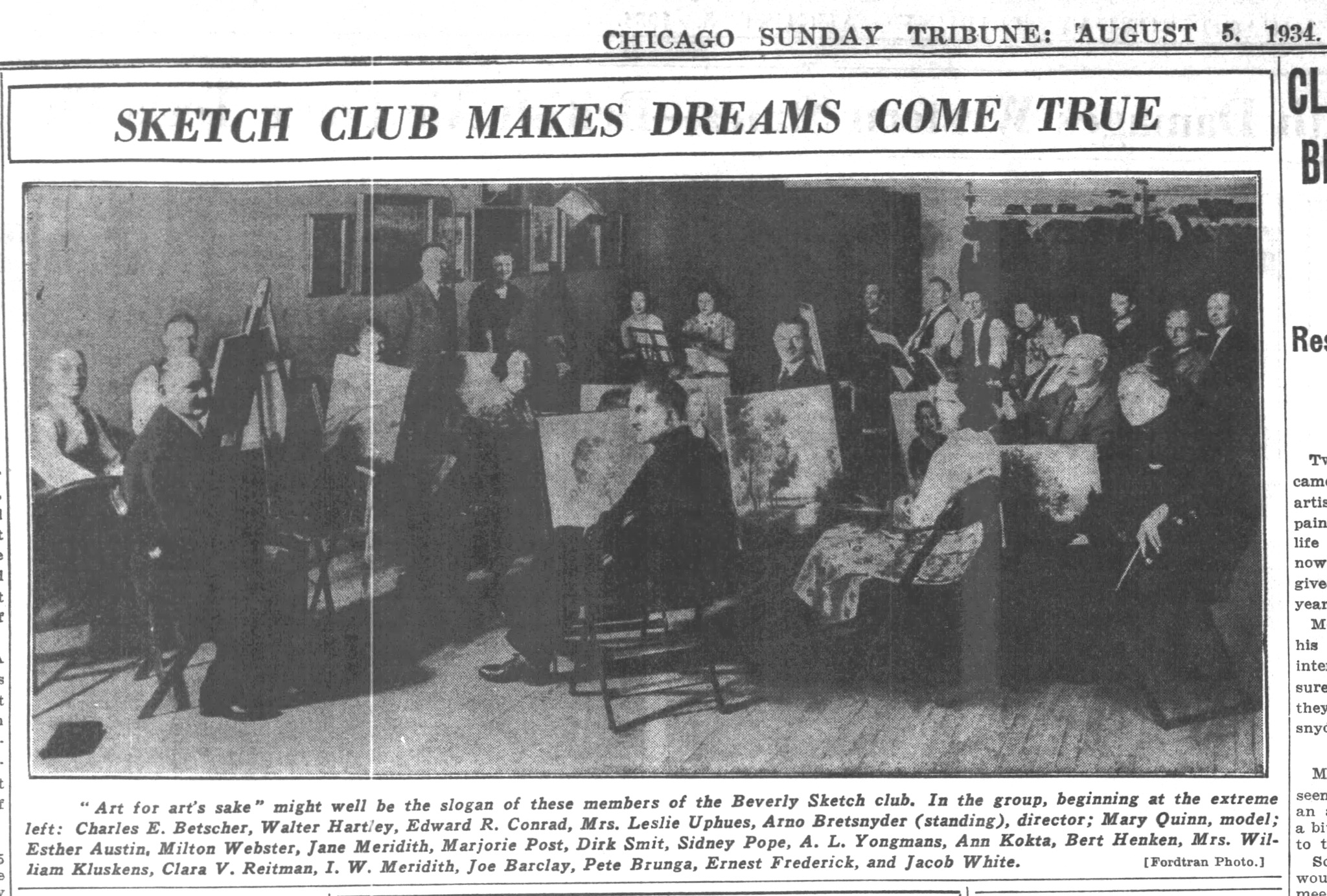
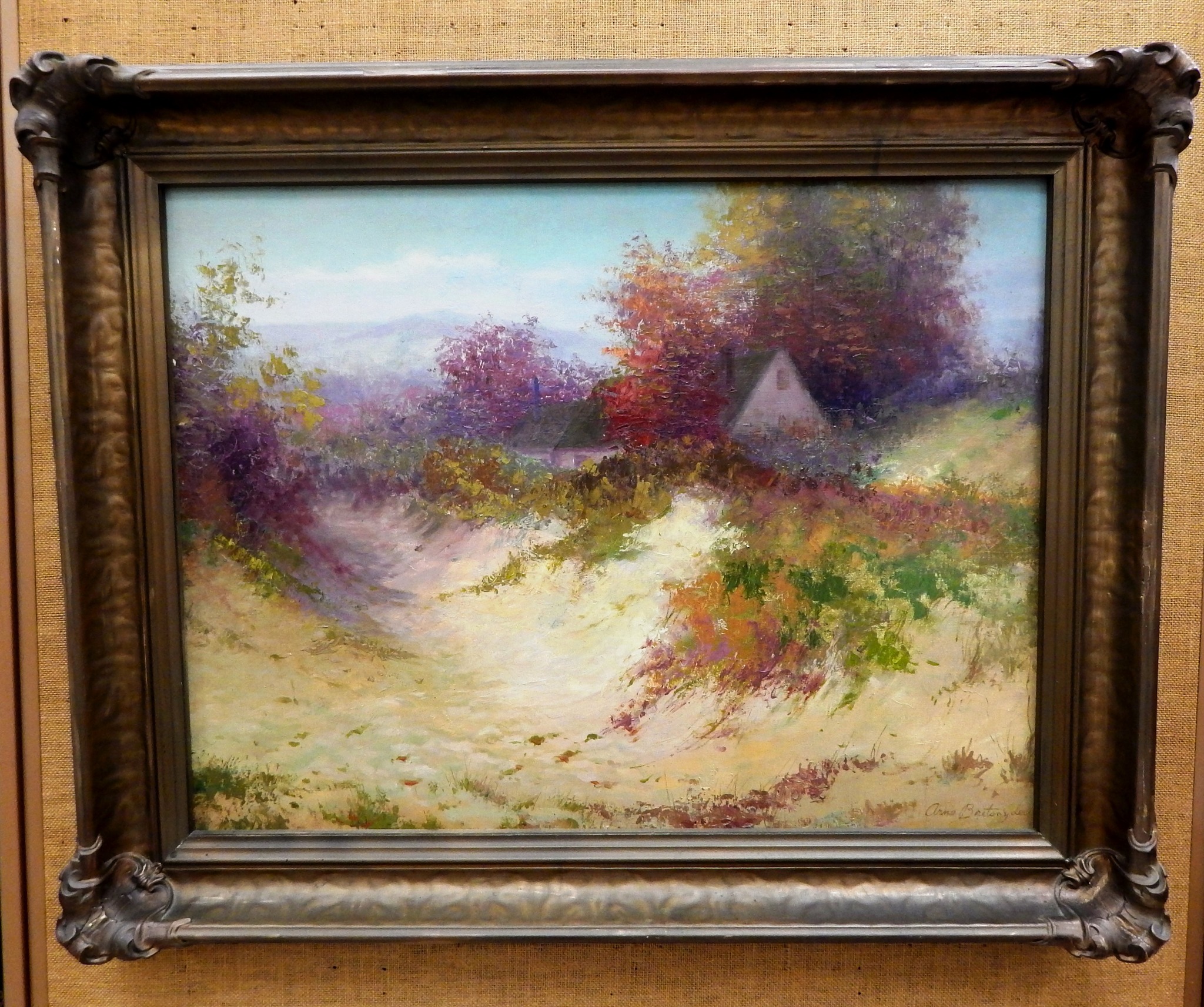
Their son, who lived at the house almost his entire life (he was about 10 when they built the house), was the artist Arno Bretsnyder (1885-1969). Arno studied under John Vanderpoel at the School of the Art Institute of Chicago (SAIC). He exhibited at the AIC in 1939.
The Vanderpoel Art Association has works by Arno in its collection at Ridge Park field house. His impressionistic oil paintings combined color, light, and texture in a dramatic way. He was known for landscapes and for Western paintings that depicted subjects like the Pony Express.
Arno joined the Society for Sanity in Art, a group opposed to modern art, including cubism, surrealism, and abstract expressionism.
Arno was also very active in the Ridge community’s art scene. He formed the Beverly Sketch Club at Ridge Park and was an important member of the Ridge Art Association, where he staged and participated in many exhibits.
Updates on the Bretsnyder House will be posted as RHS does more research on the house’s history and additional details of the current status of the house are reported.
Research assistance by Tim Blackburn, RHS Board member.
Here is a good introduction to the new RHS exhibit, "Louise Barwick's Lost Ridge."
https://www.beverlyreview.net/news/community_news/article_9cb7d924-7d90-11ee-88e6-2f9a24291df4.html
The Ridge Historical Society
Louise Barwick – Part 1
By Carol Flynn
The Ridge Historical Society (RHS) has opened a new exhibit – “Louise Barwick’s Lost Ridge.”
The exhibit may be viewed on Tuesdays and Sundays from 1:00 p.m. to 4:00 p.m. or by appointment. RHS is located at 10621 S. Seeley Avenue in Chicago. The exhibit is free.
This exhibit focuses on life on the Ridge from 1893 to 1905 as seen through the watercolor paintings of Louise Barwick, an artist and educator who lived on the Ridge.
Other components of the exhibit include a section on aerial photography taken by cameras attached to kites, and “lost and found” architecture – historic photos of buildings, some of which remain and some of which are gone from the Ridge.
This post will begin a look at Louise Barwick.
The watercolor paintings by the late Louise Barwick are among the gems of the RHS collection. Miss Barwick (1871 – 1957) was a long-time resident and art teacher in the Ridge community.
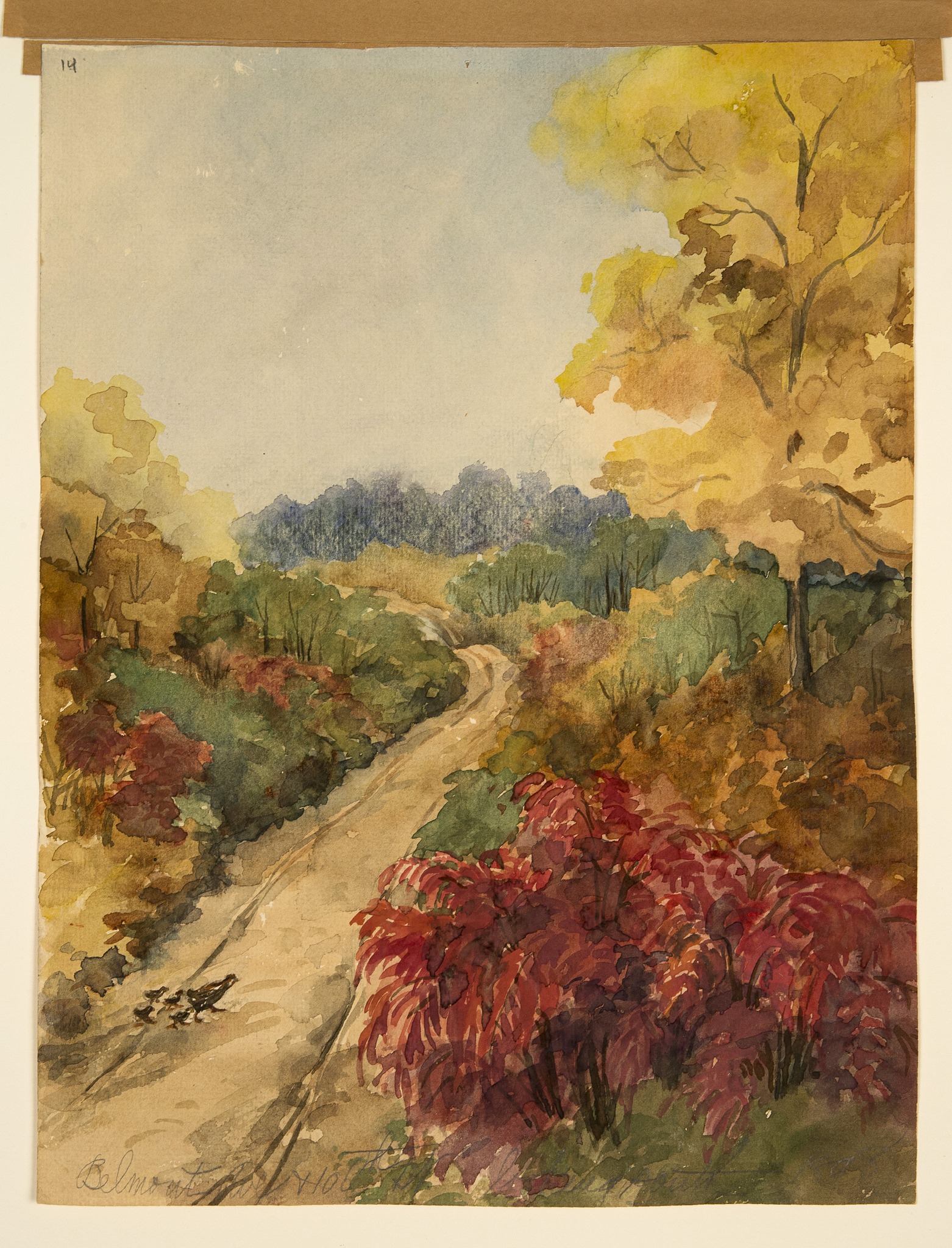
It is said that a picture is worth a thousand words. Miss Barwick’s paintings are not only interesting from an artistic perspective, but also because the subject matter depicts life on the Ridge circa 1895-1905.
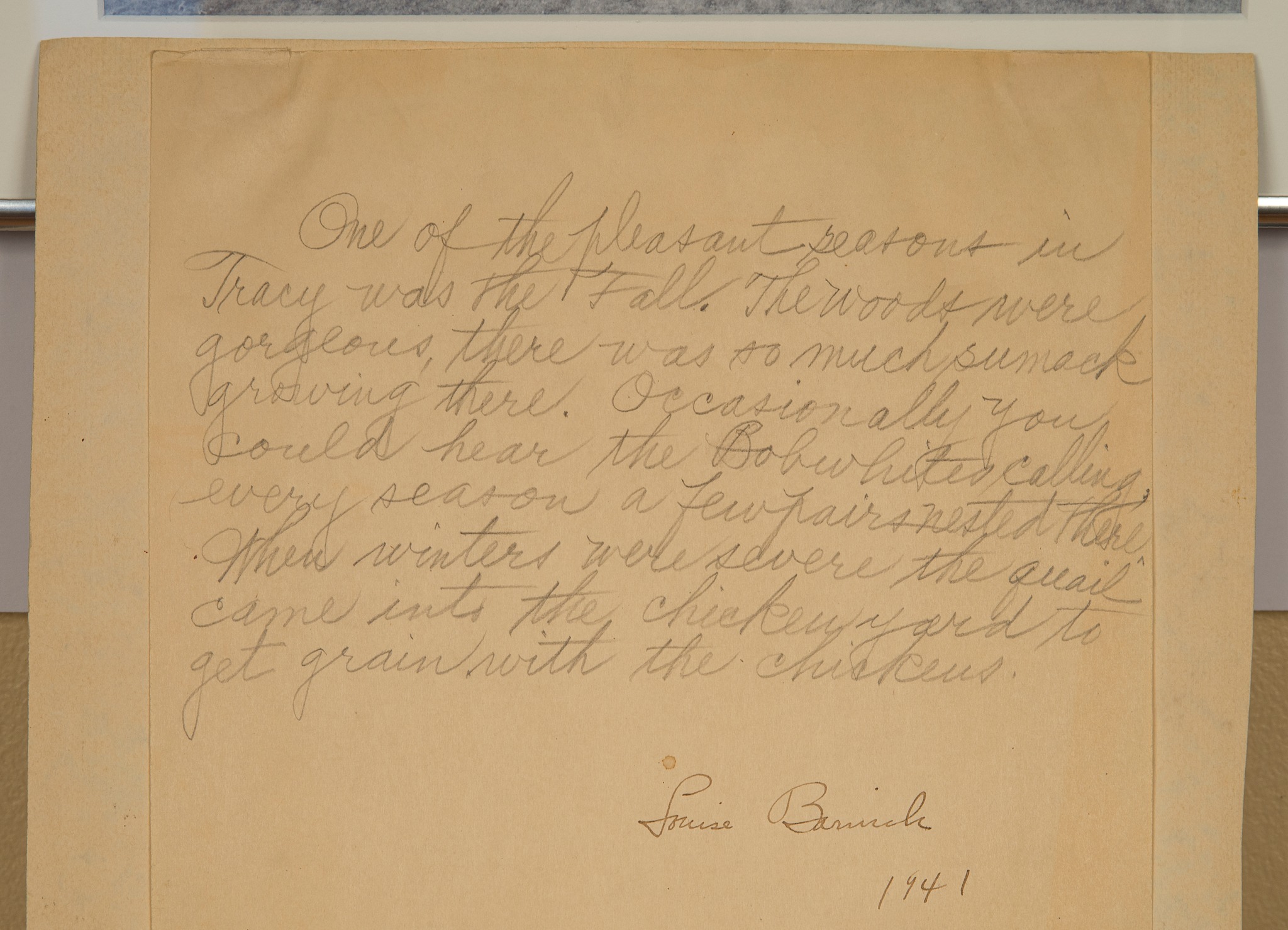
Completed sometime in the 1940s or before, the paintings represent memories of everyday scenes as well as special events. They offer a unique visual interpretation of local history based on the experiences of a young woman of the time. Louise also included stories and descriptions that enrich viewers’ understanding of the images.
One example of her paintings and the notes with it are attached. To see more of her paintings, viewers are encouraged to visit RHS for the actual exhibit.
However, her watercolor paintings and teaching career are only part of Miss Barwick’s legacy. It was actually her geographical maps that won her fame.
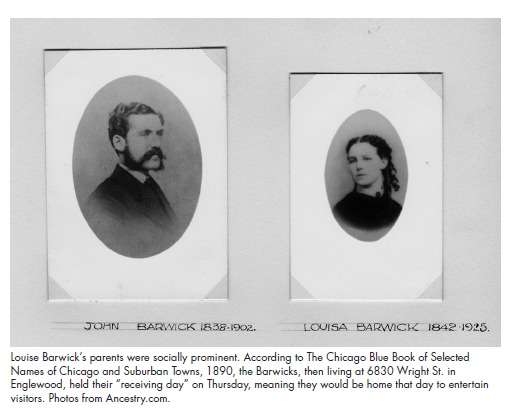
And Miss Barwick’s family history is also of note. She was a descendent of Chicago pioneers whose stories are part of the earliest days of the city.
Let's start with her genealogy.
The Barwick Family
Louise’s paternal grandfather, John Barwick (1806-1881) was a successful businessman and farmer in Canada.
He arrived in the Toronto area in 1832, having served in the British army, reaching the rank of lieutenant colonel. He established a saw mill, and was also a farmer and had a tavern license to sell beer and ale. From 1843-1847 he was partners with Benjamin Thorne, a leading merchant in Toronto and Montreal, who ran gristmill, sawmill, and tannery businesses. Barwick ran the Red Mills at Holland Landing as part of Thorne’s holdings.
Barwick was very active in local politics and improvements. In the 1860s, he served as president of the Provincial Agricultural Association of Upper Canada and on the Canada’s Board of Agriculture, and was involved in an exhibit that took place in London.
He was active in the formation and funding of the Canada Emigration Society, which encouraged people from the British Isles to immigrate to Canada. The businessmen considered this an investment – immigration brought more people to farm their vast land holdings, work in their industries, and buy their products.
John Barwick married Mary Ready Lee, the second daughter of Captain Simon Lee, who was wealthy from years with the East India Company. Mary’s hand had actually been asked for by another suitor, but Mrs. Lee insisted that by tradition the daughters had to marry in order. The first suitor was obliged to either marry the elder daughter or no Lee daughter at all.
John and Mary Barwick had a successful marriage, or at least a fruitful one. They had 18 children, including son John Lee Barwick, who came to Chicago at the age of 26, and took up with the Cleaver family.
The next post will look at the Cleaver family, and “Cleaverville,” a “company town” in Chicago that predated the Pullman area by three decades.